
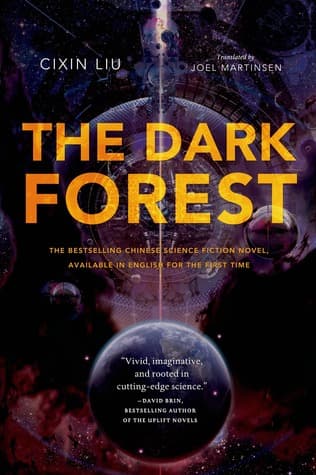
Synopsis
Covers the whole plot, including the ending.
- Difficulty
- Medium
- Pacing
- Variable
- Mood
- Philosophical, Suspenseful, Bleak, Grand, Strategic
- Read it if
- You enjoy hard science fiction, intricate strategic thinking, philosophical explorations of humanity's place in the cosmos, and a bleak but ultimately hopeful outlook on interstellar conflict.
- Skip it if
- You prefer character-driven narratives over plot and ideas, or find dense scientific concepts and a slow initial build-up tedious.
The Dark Forest Plot Summary
Covers the whole plot, including the ending.
The Wallfacer Project and Luo Ji's Unwilling Ascension
Four centuries before the Trisolaran fleet arrives, humanity is in despair. Sophons have infiltrated all technology, making any defense strategy visible to the enemy. To combat this, the Wallfacer Project starts, giving four individuals many resources and autonomy to devise secret, deceptive strategies known only to themselves. Three Wallfacers are prominent figures: Frederick Tyler, a former US Secretary of Defense; Manuel Rey Diaz, a Venezuelan former president; and Bill Hines, a British neuroscientist. The fourth, Luo Ji, an obscure Chinese astronomer and sociologist, is a baffling choice. He is initially confused by his role and unmotivated. However, the Trisolarans immediately identify him as their primary threat, sending a 'droplet' to assassinate him. Earth's defense systems narrowly stop the attack. This inexplicable targeting confirms his importance, despite his own confusion.
Luo Ji's Retreat and the Seeds of an Idea
Luo Ji uses his Wallfacer privileges for personal gain. He creates a secluded, idyllic life for himself and a woman he names Zhuang Yan, who matches the ideal woman he once described to his former colleague, Ye Wenjie. He builds a beautiful home and family, trying to escape the impending doom. During this period, he remembers a conversation with Ye Wenjie years prior. She introduced him to cosmic sociology – a field based on two axioms: 1) Survival is the primary need of civilization, and 2) Civilization continuously grows and expands, but the total matter in the universe remains constant. This abstract discussion, initially dismissed by Luo Ji, slowly begins to grow in his subconscious, hinting at a truth about interstellar relations.
The Wallfacers' Plans Unfold and Luo Ji's Slumber
Frederick Tyler begins building a massive, secret space fleet, seemingly for Earth's defense, but secretly intending to defect to Trisolaris to preserve human civilization. Manuel Rey Diaz starts a plan to develop advanced nuclear weapons, ostensibly for Earth, but with a hidden purpose of self-destruction to deny resources to the invaders. Bill Hines focuses on developing a brain-computer interface, claiming it's for enhanced combat, but secretly aiming to control soldiers' minds. Meanwhile, Luo Ji, frustrated by his lack of inspiration and the constant threat, decides to enter hibernation for two centuries. Before doing so, he leaves a single, cryptic instruction: to detonate a series of nuclear bombs at specific coordinates in space, seemingly without strategic value. This action confuses the United Nations and his escorts, further cementing his enigmatic reputation.
Two Centuries Later: A Changed World and Awakening
Luo Ji awakens two centuries later, during the 'Great Resurgence.' Humanity has achieved incredible technological feats, including space cities, fusion power, and advanced space fleets. However, sophons still make direct military confrontation impossible. He learns that the other Wallfacers have been exposed and their plans thwarted. Frederick Tyler was assassinated by his own forces after his defection plot was revealed. Manuel Rey Diaz was forced to activate his self-destruct mechanism, killing himself and his forces after his true intent was discovered. Bill Hines's plan to control soldiers' minds was also exposed, leading to his disgrace and mental collapse. Luo Ji is now the last Wallfacer, still without a clear strategy, and humanity's hope decreases as the Trisolaran fleet draws nearer.
The Dark Forest Theory Emerges
After seeing the failures of the other Wallfacers and thinking about his conversation with Ye Wenjie, Luo Ji begins to understand the implications of cosmic sociology. He realizes that the two axioms, combined with the presence of sophons and the Trisolarans' immediate targeting of him, point to a conclusion: the 'Dark Forest' theory. In this theory, every civilization in the universe is like a hunter in a dark forest, armed with a gun. They must hide their presence to survive, because any detected civilization is a potential threat that must be eliminated immediately to prevent it from becoming a more powerful threat later. This explains the Trisolarans' ruthlessness and their desire to silence him before he could articulate this concept.
The Curse of the Universe and Luo Ji's Revelation
Luo Ji understands that his cryptic instruction to detonate bombs at specific coordinates two centuries prior was an unconscious attempt to test the Dark Forest theory. He realizes that if he could broadcast the existence and location of a star to the universe, other civilizations would destroy it, even if he didn't know how. He uses his Wallfacer authority to broadcast the coordinates of a specific star, 187J3X1, into deep space. He then publicly announces his 'curse,' declaring that this star will be destroyed. This act, while seeming nonsensical to humanity, is a direct challenge to the Trisolarans, showing humanity's new understanding of interstellar survival and the potential to weaponize this knowledge against them.
The Trisolaran Response and the Deterrence Strategy
The Trisolarans, recognizing the danger of Luo Ji's discovery, confirm his theory by destroying star 187J3X1 with a 'photoid,' a relativistic weapon. This act, witnessed by humanity, validates Luo Ji's 'Dark Forest' theory and his 'curse.' Humanity is terrified but also empowered by this new understanding. Luo Ji proposes a new defense strategy: 'Dark Forest Deterrence.' Humanity will threaten to broadcast the coordinates of the Trisolaran homeworld to the entire universe if the Trisolaran fleet attacks Earth. This would guarantee the destruction of both civilizations by other, unknown forces, creating a fragile but effective mutual assured destruction. The Trisolarans, valuing their own survival, are forced to accept this deterrence.
The Swordholder and the Brink of Annihilation
With the Dark Forest Deterrence in place, Luo Ji becomes the 'Swordholder,' the sole individual with the authority and means to activate the broadcast to destroy Trisolaris. His life becomes a constant vigil, a burden of responsibility. He lives in isolation, maintaining the broadcast system, knowing that any failure or act of aggression from Trisolaris could force him to trigger the end of both civilizations. This period of fragile peace has extreme tension, as humanity relies entirely on Luo Ji's resolve and the Trisolarans' fear of universal destruction. Humanity's technological progress continues, but under the ever-present shadow of the Dark Forest.
The Crisis and the Fall of the Swordholder
After decades, humanity grows complacent and tired of Luo Ji's sole authority. They decide to replace him with a more technologically advanced, automated deterrence system, believing it to be more reliable. A new 'Swordholder,' Cheng Xin, is chosen. However, the Trisolarans, who have been observing humanity's psychological shifts through the sophons, seize this moment of transition. They launch a surprise attack with a single 'droplet,' aiming to destroy the broadcast system during the handover. Cheng Xin, unable to activate the terrifying broadcast due to her compassionate nature, hesitates. This brief moment of weakness is enough for the droplet to destroy the system, leaving humanity defenseless.
The End of Deterrence and the New Era
With the deterrence system destroyed, the Trisolaran fleet resumes its course towards Earth, and humanity is plunged into despair. The Trisolarans declare their intent to force humanity into Australia, reducing their population to a mere fraction. However, in his final act as the true Swordholder, Luo Ji, having anticipated this betrayal and secretly maintaining a backup system, uses his own broadcast to declare his intention to reveal the Trisolaran homeworld. This act of defiance, even without the full system, causes the Trisolarans to pause. Luo Ji then explains that the universe is a dark forest, and that the only true escape is to hide completely. The book ends with humanity facing an uncertain future, but with a new understanding of the universe's brutal realities, and the lingering hope that some may still find a way to survive the coming invasion.
Principal Figures
Luo Ji
Protagonist
An unambitious astronomer who becomes humanity's unlikely savior and the 'Swordholder'.
Initially presented as a lazy, pleasure-seeking astronomer and sociologist, Luo Ji is thrust into the Wallfacer Project as the fourth, most mysterious, and most targeted member. He struggles with his immense responsibility, retreating into an idyllic life with Zhuang Yan. His unique insight, sparked by a conversation with Ye Wenjie, leads him to formulate the 'Dark Forest' theory, a terrifying but ultimately effective deterrence strategy against the Trisolarans. He carries the immense burden of humanity's survival, becoming the 'Swordholder' and facing constant psychological pressure. Despite his initial reluctance, his profound understanding of cosmic sociology proves to be humanity's only hope.
Relationships: Ye Wenjie (former colleague and philosophical mentor); Zhuang Yan (wife, idealized companion); Shi Qiang (Da Shi) (bodyguard and loyal friend)
Shi Qiang (Da Shi)
Supporting
A pragmatic and loyal security officer assigned to protect Luo Ji.
Da Shi is a seasoned police detective and security expert, initially assigned to protect Luo Ji as part of the Wallfacer Project. He is pragmatic, resourceful, and possesses a cynical, down-to-earth worldview that contrasts sharply with the intellectual and philosophical struggles of Luo Ji. Despite their differences, Da Shi develops a deep loyalty and friendship with Luo Ji, often providing practical advice and unwavering support. He frequently reminds Luo Ji of the immediate dangers and the need for survival, grounding Luo Ji's abstract thoughts in reality. His presence offers a constant anchor for Luo Ji throughout his journey.
Relationships: Luo Ji (bodyguard, loyal friend, and confidant)
Frederick Tyler
Supporting
A Wallfacer and former US Secretary of Defense with a hidden agenda of defection.
Frederick Tyler is one of the four Wallfacers, a former US Secretary of Defense known for his strategic acumen. His public plan involves building a vast, advanced space fleet to defend Earth. However, his secret intent, revealed through the 'Wallbreaker' investigation, is to defect to Trisolaris with a portion of humanity, ensuring their survival by sacrificing the rest. He believes this is the only realistic way to preserve human civilization against the overwhelming Trisolaran threat. His plan is exposed, leading to his assassination by his own forces before he can fully execute his treachery.
Relationships: Trisolarans (secretly seeking to collaborate with them); Bill Hines (fellow Wallfacer (no direct close relationship))
Manuel Rey Diaz
Supporting
A Wallfacer and former Venezuelan president who plans for self-destruction.
Manuel Rey Diaz is another Wallfacer, a charismatic former Venezuelan president. His public strategy involves developing powerful nuclear weapons and a formidable space arsenal. His hidden plan, however, is a radical form of deterrence: to develop a self-destruct mechanism for humanity's space fleet, ensuring that if Earth falls, Trisolaris gains nothing but a devastated planet. He intends to use this threat to force Trisolaris into a peaceful coexistence. His true intentions are uncovered by a 'Wallbreaker,' forcing him to activate his self-destruct sequence, killing himself and his loyal forces.
Relationships: Bill Hines (fellow Wallfacer (no direct close relationship))
Bill Hines
Supporting
A Wallfacer and neuroscientist who attempts to control human minds.
Bill Hines is the third Wallfacer, a brilliant British neuroscientist. His public plan focuses on developing advanced brain-computer interfaces to enhance the combat effectiveness of soldiers. His secret strategy, however, involves using these interfaces to control the minds of his soldiers, transforming them into emotionless, perfectly obedient fighting machines. He believes this is the only way to overcome human weakness in the face of the Trisolaran threat. His plan is exposed by a 'Wallbreaker,' leading to his public disgrace and eventual mental breakdown, highlighting the ethical and practical failures of his approach.
Relationships: Keiko Kirino (wife and 'Wallbreaker')
Keiko Kirino
Supporting
Bill Hines's wife and a 'Wallbreaker' who exposes his plan.
Keiko Kirino is Bill Hines's wife and a neuroscientist in her own right. She becomes a 'Wallbreaker,' one of the individuals dedicated to deciphering and exposing the secret plans of the Wallfacers. Driven by a deep concern for humanity and a belief that the Wallfacers' unchecked power is dangerous, she meticulously investigates her own husband's work. Her relentless efforts lead to the unraveling of Bill Hines's true intentions to control human minds, ultimately exposing his plan and contributing to his downfall. She represents the human desire for transparency and accountability even in times of crisis.
Relationships: Bill Hines (husband, whose plan she exposes)
Ye Wenjie
Supporting
The astrophysicist who first contacted Trisolaris and shared the concept of cosmic sociology with Luo Ji.
Though deceased at the start of 'The Dark Forest,' Ye Wenjie's influence is profound. As the astrophysicist who first contacted Trisolaris in the previous book, her actions set the stage for the invasion. Crucially, she is the one who introduces Luo Ji to the foundational axioms of 'cosmic sociology' during a seemingly innocuous conversation. Her insights, though abstract at the time, become the intellectual bedrock for Luo Ji's eventual formulation of the 'Dark Forest' theory. She serves as a posthumous mentor, her ideas guiding Luo Ji towards humanity's only viable defense.
Relationships: Luo Ji (former colleague and intellectual inspiration)
Zhuang Yan
Supporting
Luo Ji's idealized wife, created from his own desires.
Zhuang Yan is the woman Luo Ji takes as his wife during his initial retreat from his Wallfacer duties. She embodies the ideal woman he described to Ye Wenjie years prior: beautiful, gentle, and providing a sense of peace and domestic bliss. Luo Ji uses his Wallfacer resources to find and cultivate this relationship, attempting to create a perfect, insulated life for himself. She represents Luo Ji's initial desire to escape responsibility and find personal happiness amidst the impending apocalypse. Her existence highlights his struggle between personal desire and his ultimate duty to humanity.
Relationships: Luo Ji (wife, idealized companion)
Cheng Xin
Supporting
A compassionate aerospace engineer who briefly becomes the 'Swordholder' but fails.
Cheng Xin is an aerospace engineer who is chosen to replace Luo Ji as the 'Swordholder' centuries after his initial success. She represents humanity's desire for a more humane and less terrifying form of deterrence. Known for her compassion and idealism, she is seen as a symbol of a more advanced, empathetic humanity. However, her inability to bring herself to trigger the devastating Dark Forest broadcast when directly challenged by the Trisolarans leads to the failure of the deterrence system and humanity's subsequent vulnerability. Her character highlights the psychological toll and moral dilemma inherent in wielding the ultimate weapon.
Relationships: Luo Ji (successor as 'Swordholder')
Themes & Insights
Survival and the Nature of Civilization
The core theme of 'The Dark Forest' is the fundamental drive for survival, for individuals and for entire civilizations. The two axioms of cosmic sociology (survival as primary, continuous expansion) directly inform this. The Trisolarans' ruthless pursuit of Earth, the Wallfacers' desperate and often morally ambiguous plans, and Luo Ji's eventual formulation of the Dark Forest theory all come from this primal urge. The book explores how civilizations, when faced with existential threats in a hostile universe, prioritize their own existence above all else, leading to brutal logic and extreme measures. It questions the definition of morality in an interstellar context.
“Survival is the primary need of civilization. Civilization continuously grows and expands, but the total matter in the universe remains constant.”
Deception and Misdirection
Given the sophons' ability to observe all human communication and technology, deception is humanity's only viable strategy. The entire Wallfacer Project is built on this theme, with each Wallfacer designing a public, misleading plan to hide their true intentions. Luo Ji's success relies entirely on the Trisolarans' inability to read his mind and his ability to project an image of incompetence and hedonism. The 'Dark Forest' theory itself is a form of universal deception, where civilizations hide their presence to avoid detection and destruction. The book explores the psychological and strategic complexities of operating under constant, undetectable surveillance.
“A Wallfacer's true strategy must be known only to himself, and it must be hidden behind layers of deception and misdirection, even from humanity itself.”
The Burden of Knowledge and Power
Luo Ji's journey shows the burden that comes with terrifying knowledge and the power to act upon it. His discovery of the Dark Forest theory initially plunges him into despair, and his role as the 'Swordholder' forces him into a life of isolation and constant vigilance. The weight of holding humanity's fate in his hands, knowing that a single decision could lead to annihilation, is a central psychological struggle. The book also touches on the ethical dilemmas of such power, as seen in Bill Hines's attempt to control minds and Cheng Xin's ultimate failure to wield such destructive authority due to her compassion.
“I am the Swordholder. I hold the sword of deterrence. I am the brink of humanity's destruction, and its salvation.”
Humanity's Evolving Nature and Resilience
Despite the existential threat, humanity changes and develops throughout the book. The 'Great Resurgence' shows humanity's technological advancement and ability to adapt, building space cities and developing advanced science. However, the book also highlights humanity's persistent flaws: complacency, political infighting, and the psychological inability to sustain extreme measures of deterrence over long periods. The contrast between Luo Ji's pragmatic ruthlessness and Cheng Xin's compassionate idealism reflects humanity's internal struggle between its capacity for survival and its desire for a more humane existence, showing its complex and evolving nature.
“The universe is a dark forest, and every civilization is a hunter with a gun. The only thing they can do is to hide themselves as much as possible.”
The Fermi Paradox and Cosmic Horror
The book offers a solution to the Fermi Paradox ('Where is everybody?'). The 'Dark Forest' theory explains the apparent silence of the universe not as an absence of life, but as an active, terrifying silence born of fear. Civilizations remain hidden to avoid detection and subsequent destruction by others. This concept creates a sense of cosmic horror, transforming the vast, empty universe from a place of wonder to a dangerous, predatory environment where humanity is vulnerable prey. The realization that every detected civilization is a target fundamentally shifts humanity's perception of its place in the cosmos.
“In the Dark Forest, other lives are eternal threats. Any life that exposes itself will soon be eliminated.”
Plot Devices & Literary Techniques
The Wallfacer Project
A covert, deceptive defense strategy against the Trisolaran invasion.
The Wallfacer Project is a unique and central plot device. It grants four individuals immense power and resources to devise secret strategies against the Trisolarans, whose sophons make all conventional defense plans transparent. The Wallfacers must maintain a public facade (the 'wall') to conceal their true intentions, even from their own species. This device drives the narrative, creating mystery, suspense, and allowing for deep exploration of deception, strategic thinking, and the psychological toll of such a burden. It's humanity's desperate gamble against an omniscient enemy.
The Sophons
Subatomic particles that enable Trisolaran omniscience and sabotage.
Sophons are a critical plot device inherited from the first book. These proton-sized supercomputers travel at light speed, allowing the Trisolarans instant, omnipresent surveillance of all human technology and communication. They also have the ability to subtly interfere with particle accelerators, preventing humanity from advancing fundamental physics. The sophons are the primary reason for the Wallfacer Project's existence, forcing humanity to rely on the one thing sophons cannot penetrate: the human mind. They are the ultimate surveillance tool and a constant reminder of humanity's vulnerability.
The Dark Forest Theory
Luo Ji's horrifying solution to the Fermi Paradox and humanity's ultimate weapon.
The Dark Forest Theory is the pivotal conceptual plot device that redefines the entire universe. Formulated by Luo Ji, it posits that the universe is a 'dark forest' where every civilization is a hidden hunter. Any detected civilization is immediately destroyed by others to eliminate potential threats, explaining the Fermi Paradox. This theory becomes humanity's 'deterrence' weapon: the threat to broadcast Trisolaris's location to the universe. It shifts the entire power dynamic, offering a fragile peace based on mutual assured destruction and profoundly changes humanity's understanding of its cosmic place.
Hibernation
A means for characters to bridge vast periods of time, facilitating narrative jumps.
Hibernation is a practical plot device that allows characters like Luo Ji and Da Shi to skip centuries, directly experiencing different eras of human development and the progression of the Trisolaran threat. This enables the narrative to cover a vast timeline (four centuries) without losing key characters, providing a personal perspective on humanity's evolution. It highlights the drastic technological and societal changes, as well as the enduring nature of the core conflict, making the passage of time a tangible element of the story.
The 'Droplet'
A Trisolaran probe, a symbol of their advanced technology and ruthlessness.
The 'droplet' is a seemingly innocuous, perfectly reflective, teardrop-shaped probe sent by the Trisolarans. It functions as a powerful plot device, showcasing the overwhelming technological superiority of the invaders and their cold, efficient ruthlessness. Its near-invulnerability and ability to cut through Earth's most advanced defenses with ease serve as stark reminders of humanity's inferiority. The droplet is used as an assassination tool, a weapon of mass destruction, and ultimately, the instrument that breaks the Dark Forest Deterrence, driving key plot points and demonstrating the dire stakes.
The Dark Forest Quotes
“The universe is a dark forest. Every civilization is an armed hunter stalking through the trees like a ghost, gently pushing aside branches that block the path and trying to tread without sound.”
“In the face of the universe’s dark forest state, the only way for Earth to survive is to remain silent and hidden.”
“The Trisolarans do not understand deception or subterfuge. Their thoughts are transparent, making them both terrifying and vulnerable.”
“To defeat an enemy, you must first understand them. But to understand them, you must first become them.”
“Humanity’s greatest weapon is not technology, but the unpredictability of the individual mind.”
“The Wallfacer Project is a gamble that a single mind can outthink an entire civilization.”
“In the dark forest, there are no friends, only hunters and prey.”
“The Trisolaran threat has united humanity, but it has also stripped away our illusions about peace.”
“A civilization’s survival may depend on its ability to keep secrets, even from itself.”
“The stars are not meant for dreaming; they are graves waiting to be filled.”
“Hope is a dangerous thing in a dark forest. It makes you visible.”
“To save humanity, we must first be willing to sacrifice it.”
“The universe does not care about morality, only survival.”
“In the end, every civilization faces the same choice: hide or perish.”
Quiz
10 questions on the plot and the characters. Each answer comes with a short explanation.
Question 1
What is the primary reason Earth's defense plans are vulnerable to Trisolaris in 'The Dark Forest'?
- Human spies working for the aliens
- Sophons, subatomic particles that monitor all human information
- Advanced alien hacking of Earth's computer networks
- Radio transmissions that accidentally reveal strategic data
Show answer
B. Sophons, subatomic particles that monitor all human information Sophons are subatomic particles sent by Trisolaris that can monitor all human communications and information in real-time, making traditional military planning impossible. This technological advantage forces humanity to develop the Wallfacer Project.
Question 2
What is the Wallfacer Project designed to accomplish?
- Build massive space fleets to confront the Trisolaran invasion
- Allow four individuals to develop secret defense strategies hidden from both Earth and Trisolaris
- Create a peace treaty with Trisolaris through diplomatic negotiations
- Evacuate humanity to other star systems before the invasion
Show answer
B. Allow four individuals to develop secret defense strategies hidden from both Earth and Trisolaris Because sophons can monitor all human information, the Wallfacer Project grants four individuals (Wallfacers) enormous resources to devise defense plans entirely in their minds, using deception to keep strategies secret from both human factions and Trisolaris.
Question 3
Why is Luo Ji selected as a Wallfacer despite being an unambitious astronomer and sociologist?
- He has proven military experience from previous conflicts
- He is the only human who can communicate directly with Trisolaris
- Trisolaris specifically wants him dead, suggesting he poses a unique threat
- He invented the technology that created the sophons
Show answer
C. Trisolaris specifically wants him dead, suggesting he poses a unique threat Luo Ji's selection is mysterious even to him, but it becomes clear that Trisolaris views him as particularly dangerous—they attempt to assassinate him repeatedly. This suggests he has latent potential or knowledge that could threaten the aliens.
Question 4
What concept from sociology does Luo Ji develop that becomes central to the novel's themes?
- The 'Dark Forest' theory of cosmic sociology
- The 'Golden Rule' of interstellar diplomacy
- The 'Great Filter' hypothesis for alien civilizations
- The 'Prime Directive' for non-interference with primitive species
Show answer
A. The 'Dark Forest' theory of cosmic sociology Luo Ji develops the 'Dark Forest' theory, which posits that the universe is like a dark forest where civilizations hide and preemptively destroy others to ensure their own survival. This becomes a key philosophical and strategic element in humanity's defense.
Question 5
How do the other three Wallfacers differ from Luo Ji in terms of their backgrounds?
- They are all scientists with no political experience
- They are influential statesmen and scientists, while Luo Ji is an unknown
- They are military leaders who have fought against Trisolaris before
- They are all from Western countries, while Luo Ji is Chinese
Show answer
B. They are influential statesmen and scientists, while Luo Ji is an unknown The other Wallfacers—Frederick Tyler, Manuel Rey Díaz, and Bill Hines—are prominent figures (a former U.S. Secretary of Defense, a Venezuelan politician, and a Nobel laureate scientist). In contrast, Luo Ji is an obscure academic, making his selection puzzling.
Question 6
What is the primary method Wallfacers use to keep their strategies secret from sophons?
- Encrypting all communications with unbreakable codes
- Working in isolated underground bunkers shielded from sophons
- Deceit and misdirection, hiding true intentions in their minds
- Using telepathy to communicate without electronic signals
Show answer
C. Deceit and misdirection, hiding true intentions in their minds Since sophons can monitor all information, Wallfacers rely on psychological deception—they devise plans internally and execute actions that mislead both humans and Trisolaris about their true objectives.
Question 7
What event from Luo Ji's past involving Ye Wenjie becomes crucial to his Wallfacer strategy?
- She taught him advanced physics that he uses to build weapons
- She revealed the existence of Trisolaris to him in a private conversation
- She suggested two axioms of cosmic sociology to him
- She gave him a secret code to communicate with alien civilizations
Show answer
C. She suggested two axioms of cosmic sociology to him Before her death, Ye Wenjie (a key character from the first book) shared with Luo Ji two axioms: survival is the primary need of civilization, and civilizations continuously grow but the universe's resources are finite. These form the basis of his Dark Forest theory.
Question 8
How does Luo Ji ultimately use the Dark Forest theory to threaten Trisolaris?
- By broadcasting the location of Trisolaris to the universe, risking destruction by other civilizations
- By building a fleet to directly attack the Trisolaran homeworld
- By creating a false peace treaty to lure Trisolaris into a trap
- By developing a weapon that can destroy sophons throughout the solar system
Show answer
A. By broadcasting the location of Trisolaris to the universe, risking destruction by other civilizations Luo Ji establishes a 'dead man's switch' system that will broadcast Trisolaris's coordinates to the universe if he dies. This leverages the Dark Forest theory—exposing their location makes them vulnerable to preemptive attacks by other civilizations, forcing Trisolaris to stand down.
Question 9
What is the significance of the 'Wallbreakers' in the novel?
- They are Trisolaran agents tasked with assassinating the Wallfacers
- They are human collaborators who try to sabotage Earth's defenses from within
- They are individuals assigned to deduce and counter the Wallfacers' secret plans
- They are scientists working to break the sophons' monitoring capabilities
Show answer
C. They are individuals assigned to deduce and counter the Wallfacers' secret plans Wallbreakers are humans (sometimes working with Trisolaris) whose sole purpose is to analyze and expose the Wallfacers' strategies. They represent a counter-initiative that adds tension, as Wallfacers must outthink both aliens and these dedicated opponents.
Question 10
Why does Luo Ji initially resist his role as a Wallfacer and what does he demand instead?
- He demands to be given command of Earth's space fleet
- He asks for a secluded estate with his dream partner, seeking a peaceful life
- He insists on being allowed to communicate directly with Trisolaris
- He refuses until all other Wallfacers are removed from the project
Show answer
B. He asks for a secluded estate with his dream partner, seeking a peaceful life Luo Ji is uninterested in saving humanity and initially sees the Wallfacer role as a burden. He uses his authority to demand an idyllic life with a fictional perfect partner (created through resources), reflecting his unambitious and escapist nature before he embraces his destiny.
The Dark Forest FAQ
What is 'The Dark Forest' about?
The novel follows Earth's desperate preparations for an alien invasion by Trisolaris, scheduled to arrive in 400 years. With human technology and plans exposed by sophons (subatomic spies), humanity initiates the Wallfacer Project, granting four individuals unlimited resources to develop secret defense strategies through psychological deception. The story centers on Luo Ji, an unremarkable astronomer who becomes the most targeted Wallfacer by the aliens.
Why should I read 'The Dark Forest'?
This novel offers a brilliant exploration of cosmic sociology and game theory applied to interstellar conflict, featuring the revolutionary 'Dark Forest' theory that explains why the universe appears silent. It combines hard science fiction concepts with psychological warfare, presenting one of science fiction's most chilling solutions to the Fermi Paradox through Luo Ji's philosophical journey.
What is the background/setting of 'The Dark Forest'?
Set in the 21st and 22nd centuries following the events of 'The Three-Body Problem,' Earth exists under constant surveillance by Trisolaran sophons that monitor all human communications and technology development. Humanity enjoys technological advancement but lives with the psychological burden of knowing an alien invasion fleet is en route, creating a society obsessed with long-term survival strategies.
What are the most memorable quotes?
Key quotes include Luo Ji's formulation of cosmic sociology axioms: 'First: Survival is the primary need of civilization. Second: Civilization continuously grows and expands, but the total matter in the universe remains constant.' The novel's title concept is captured in: 'The universe is a dark forest. Every civilization is an armed hunter stalking through the trees like a ghost.'
What writing style does the author use?
Liu Cixin employs a methodical, idea-driven narrative that prioritizes scientific concepts and philosophical implications over character development. The prose is direct and explanatory, with extensive technical descriptions of astrophysics and sociology concepts, creating a cerebral tone that matches the novel's themes of cosmic-scale strategy and existential threat.
What minor details add significant meaning?
Luo Ji's imaginary girlfriend created during his Wallfacer isolation becomes crucial when he later meets a real woman matching her description - suggesting either profound coincidence or that his Wallfacer powers extend to reality manipulation. The repeated motif of ants crawling on gravestones symbolizes humanity's insignificance in the cosmic scale while hinting at persistence against overwhelming odds.
What are some subtle foreshadowing moments?
Early scenes showing Luo Ji's disinterest in academic astronomy foreshadow his unconventional approach to the cosmic threat. The Wallbreakers' systematic dismantling of other Wallfacer plans subtly prepares readers for the revelation that Luo Ji's apparent inactivity is itself a sophisticated strategy. Trisolaris's specific fear of Luo Ji, despite his unimpressive credentials, hints at his unique understanding of cosmic sociology.
What unexpected character connections exist?
Luo Ji's Wallbreaker turns out to be his own wife, Zhuang Yan, manipulated by Trisolaris through sophon influence. The astronomer who first discovers the Trisolaran crisis in the previous novel connects to Luo Ji through shared academic circles, creating continuity in humanity's scientific response. Bill Hines, another Wallfacer, secretly collaborates with his wife to develop mental seal technology that becomes crucial later.
What are unspoken character motivations?
Luo Ji initially seeks only personal comfort and escape from responsibility, but gradually develops a paternal protectiveness toward all humanity that drives his final strategy. Trisolarans fear not just human technology but specifically human capacity for deception and unpredictable creativity. The other Wallfacers are motivated by ego and conventional military thinking, blinding them to the psychological nature of the conflict.
What psychological complexities do characters exhibit?
Luo Ji displays paradoxical traits: profound laziness combined with intense focus when pursuing his imaginary perfect life, and selfishness that transforms into the ultimate self-sacrifice. The Wallbreakers exhibit fanatical devotion to Trisolaris born from philosophical despair about humanity's future. Humanity collectively suffers from 'Trisolaris phobia' - simultaneous denial of and obsession with the distant threat.
What are the major emotional turning points?
Luo Ji's realization that his imaginary girlfriend has a real counterpart marks his transition from passive recipient to active Wallfacer. The moment he understands the Dark Forest theory represents an emotional nadir where he comprehends the universe's true terrifying nature. His final confrontation with the Trisolaran probe, where he threatens mutual destruction, shows his complete transformation into humanity's determined protector.
How do relationship dynamics evolve?
Luo Ji and Zhuang Yan's relationship begins as his Wallfacer-created fantasy, becomes a genuine marriage, then fractures when she's revealed as his Wallbreaker, and finally reconciles through shared parental love for their child. The dynamic between humanity and Trisolaris evolves from pure hostility to a strange mutual dependence, where each civilization's survival becomes paradoxically linked to the other's restraint.
Which parts remain ambiguous or open-ended?
Whether Luo Ji's imaginary girlfriend coincidentally matching a real person represents supernatural intervention, sophisticated Wallfacer reality manipulation, or mere narrative convenience is never fully explained. The exact mechanism by which he establishes the dark forest deterrence system remains technically vague, emphasizing the psychological over the technological. The ultimate fate of the Trisolaran civilization after the deterrence is established is left uncertain.
What are controversial scenes or decisions?
Luo Ji's use of a stellar hydrogen bomb array to create a 'spell' targeting a distant star raises ethical questions about endangering innocent civilizations. His final threat to broadcast both Earth and Trisolaris's coordinates represents ultimate mutually assured destruction that some readers view as morally questionable. The Wallfacer Project itself, granting individuals absolute power without accountability, presents troubling authoritarian implications.
'The Dark Forest' ending explained: how it ends & what it means
Luo Ji successfully establishes 'dark forest deterrence' by threatening to broadcast both Earth and Trisolaris's cosmic coordinates, which would attract destruction from other civilizations following the dark forest theory. This creates a stalemate where both civilizations must coexist peacefully. The ending means that mutual vulnerability, not technological superiority, becomes the foundation for interstellar peace, with Luo Ji as the 'Swordholder' maintaining balance through the threat of mutual annihilation.
What is the significance of the Wallfacer Project's psychological warfare?
The project represents humanity's recognition that conventional military strategy is useless against an enemy monitoring all communications. By relying on individual human psychology and deception - the one domain sophons cannot penetrate - it turns human consciousness itself into a weapon. The Wallfacers' plans fail not from technical flaws but from psychological vulnerabilities, highlighting that in cosmic conflict, understanding motivation matters more than understanding physics.
How does the Dark Forest theory solve the Fermi Paradox?
The theory proposes that all advanced civilizations remain silent and hidden because broadcasting one's location invites destruction from others who follow the same logic. This creates a universe where civilizations are like hunters in a dark forest - staying quiet, attacking any who reveal themselves, and never cooperating. This explains why we detect no alien signals despite the universe's age and size, presenting a profoundly pessimistic view of cosmic civilization dynamics.
What role do the sophons play beyond surveillance?
Beyond monitoring human communications, sophons actively sabotage scientific progress by creating false experimental results in particle accelerators, locking human physics at a pre-invasion level. They also manipulate human psychology through subtle influences, as seen with Zhuang Yan becoming Luo Ji's Wallbreaker. Their omnipresence creates a psychological prison where humanity knows it cannot develop technology beyond what Trisolaris already understands.
How does Luo Ji's character differ from other Wallfacers?
Unlike the other Wallfacers who are accomplished leaders using conventional strategic thinking, Luo Ji is an unremarkable academic with no military or political experience. His strategy emerges from philosophical contemplation rather than technical planning, focusing on cosmic sociology rather than weapons development. His apparent inactivity and personal obsessions mask his deeper understanding of the fundamental rules governing interstellar relations.
About the author

Cixin Liu is a Chinese science fiction author best known for his award-winning novel, 'The Three-Body Problem.' This novel, the first in the 'Remembrance of Earth's Past' trilogy, gained international acclaim and won the Hugo Award for Best Novel, making Liu the first Asian author to receive the honor. His work often explores grand scientific concepts and humanity's place in the universe.
Similar books
- Dune
Frank Herbert
4.2 (766k) average on GoodreadsFantasyExplores complex political and strategic maneuvering on a grand scale, with deep philosophical underpinnings.
- Hyperion
Dan Simmons
4.2 (188k) average on GoodreadsFantasyFeatures a vast, mysterious universe and a blend of hard science fiction with philosophical themes.
- Blindsight
Peter Watts
4.0 (27k) average on GoodreadsFantasyDeals with challenging scientific concepts, alien intelligence, and the nature of consciousness in a dark, thought-provoking way.
- Permutation City
Greg Egan
4.1 (8k) average on GoodreadsFantasyWhile both are hard science fiction, Egan's work focuses on consciousness, simulation, and the nature of reality, offering intricate scientific puzzles. Liu's 'The Dark Forest' tackles a grander, species-level existential threat with a unique philosophical core rooted in universal logic.
- Revelation Space
Alastair Reynolds
4.0 (44k) average on GoodreadsScience FictionReynolds' series shares a vast scope and cosmic horrors, but its 'inhibitors' are an ancient, mysterious alien intelligence. Liu's 'Dark Forest' hypothesis provides a more logically derived and universally applicable motivation for interstellar conflict, making the threat feel more chillingly rational.
- Harry Potter and the Sorcerer's Stone
J.K. Rowling
4.5 (7M) average on GoodreadsFantasyRescued from a miserable life under the stairs, an orphaned boy discovers he's a wizard destined for a magical school, where he uncovers a dangerous secret tied to the dark wizard who murdered his parents.



Enjoyed the summary?
A summary gives you the shape of the book. The book itself has the detail, the examples and the voice.
Find The Dark Forest on AmazonAs an Amazon Associate, BookBrief earns from qualifying purchases. How we're funded