
Core Idea
- Difficulty
- Easy
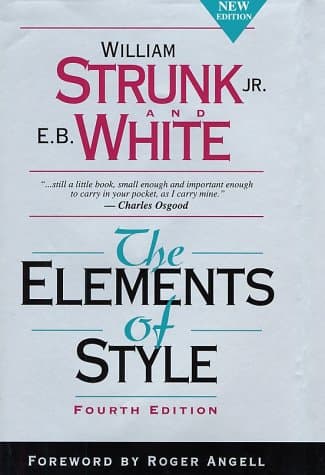
Key Takeaways from The Elements of Style
Omit Needless Words
Conciseness is the bedrock of forceful writing, achieved by ruthlessly eliminating superfluous language.
This is the book's core idea and its most lasting contribution. Strunk and White suggest a direct approach to writing, where every word must earn its place. They don't mean simplistic writing, but writing that is rich with meaning, free from extra words that hide clarity. The goal is to make reading easier by presenting information directly and efficiently. This ensures that an idea's strength isn't weakened by unnecessary language. Writers must edit their own work carefully, always asking if each phrase and clause is needed.
“Vigorous writing is concise. A sentence should contain no unnecessary words, a paragraph no unnecessary sentences, for the same reason that a drawing should have no unnecessary lines and a machine no unnecessary parts. This requires not that the writer make all his sentences short, or that he avoid all detail and treat his subjects only in outline, but that every word tell.”
In the book: The entire chapter 'Elementary Principles of Composition' repeatedly emphasizes brevity, with specific examples of wordy phrases (e.g., 'the fact that' becoming 'that' or simply omitted).
Try this: After drafting, conduct a 'word audit' on each sentence. Can a phrase be replaced by a single word? Can a clause be removed without losing essential meaning? Prioritize strong verbs and nouns over adverbs and adjectives where possible.
Use the Active Voice
Active voice invigorates sentences, making them clearer, more direct, and more engaging than passive constructions.
While not an absolute rule to never use passive voice, Strunk and White strongly prefer active voice as the default. Active voice immediately shows who is doing the action, making sentences more dynamic and easier to understand. Compare 'The ball was hit by the boy' to 'The boy hit the ball.' The second example is shorter and more powerful. Using too much passive voice often leads to weaker, less precise sentences and can hide who is responsible. This idea is especially important in business and technical writing, where clarity and accountability are key. The book admits exceptions, like when the actor is unknown or not important, but these are seen as departures from the preferred style.
“The active voice is usually more direct and vigorous than the passive.”
In the book: Chapter 2, 'Elementary Principles of Composition,' provides direct comparisons: 'My attendance at the lecture was irregular' vs. 'I was irregular in my attendance at the lecture' (preferring the latter for directness).
Try this: During revision, identify sentences using 'to be' verbs followed by past participles (e.g., 'was written,' 'has been done'). Rephrase them to put the actor first, making the sentence active and more forceful.
Place the Emphatic Words at the End
Strategic placement of key words at a sentence's conclusion maximizes their impact and memorability.
This idea, often missed in other style guides, is one of the book's best. Strunk and White know that the end of a sentence naturally carries emphasis. By saving the most important idea, word, or phrase for this spot, a writer can increase its effect, leaving a stronger impression. Conversely, ending a sentence weakly can lessen its power. This is about more than grammar; it's about making writing effective and creating a rhythm that guides the reader's attention. Mastering this technique allows for more refined sentence structure, balancing clarity and impact. It is a subtle but strong tool for persuasive and memorable writing.
“The proper place for the word, or group of words, which the writer desires to make most prominent is usually the end of the sentence.”
In the book: Strunk's example: 'This law is a useful one, but it is not an easy one to administer' is weaker than 'This law is a useful one, but not an easy one to administer.' The latter places the difficulty at the emphatic end.
Try this: When crafting sentences, identify the core message or most impactful word. Rearrange clauses or phrases to ensure this key element lands at the sentence's conclusion, maximizing its punch. Read sentences aloud to feel their natural rhythm.
Cultivate a Plain Style
Prioritize direct, unpretentious language over flowery prose to ensure clarity and authenticity.
Strunk and White support a clear, natural, and plain style that avoids pretense. They suggest that good writing often resembles good conversation – direct, honest, and free from unnecessary jargon or overly academic structures. This doesn't mean simplifying content, but presenting complex ideas with an easy-to-understand clarity. The focus is on conveying meaning effectively, not on showing off vocabulary or stylistic flourishes that might obscure the message. This idea encourages writers to find their true voice and to trust that clarity itself has an inherent elegance and persuasive power. It is a practical approach to communication, valuing function over showiness.
“Write in a way that comes naturally. It is an old observation that the best writers are the ones who write as if they were talking. This is, of course, a generalization, and like all generalizations is untrue to some extent, but its kernel of truth is important.”
In the book: The recurring advice against 'fancy words' or 'rhetorical tricks' throughout the book, and the explicit instruction to 'Write in a way that comes naturally.'
Try this: Before writing, imagine explaining your topic to an intelligent, curious friend. Draft your thoughts in that conversational tone. Then, refine for conciseness and precision, but always retaining the natural flow and directness.
Know Your Audience and Purpose
Effective writing is always tailored to its intended readers and the specific goal it aims to achieve.
While not stated as a 'rule,' the philosophy of 'The Elements of Style' implies a need to understand the audience and purpose. The book's focus on clarity, conciseness, and directness only makes sense when writing to communicate effectively with a reader. A writer who removes needless words, uses active voice, and places emphatic words strategically does so to better serve their reader and achieve their communication goal. This approach has limits in highly specialized or creative writing where stylistic experimentation or a deliberately complex approach might be part of the artistic goal. However, for practical, everyday communication, knowing who you are writing for and what you want them to understand or do is essential.
“No set of rules can be so constructed as to afford a ready solution to every problem of expression. The writer will find that the best way to make his sentences clear and strong is to think them clear and strong before he writes them.”
In the book: Though not a direct rule, the entire book's focus on reader comprehension and clarity implies this principle. The advice to 'make every word tell' is for the benefit of the reader.
Try this: Before beginning any writing project, explicitly define your target audience (who are they, what do they know?) and your primary purpose (what do you want them to think, feel, or do?). Refer back to these definitions throughout the writing and editing process.
Master Basic Grammar and Punctuation
Adherence to fundamental grammatical rules is essential for maintaining clarity and credibility.
A large part of 'The Elements of Style' covers the mechanics of writing: rules for commas, apostrophes, hyphens, and common grammar mistakes. This shows the book's belief that unclear writing and weak impact come from sloppy mechanics. Grammar and punctuation errors create problems for the reader, distracting them from the message and weakening the writer's credibility. While some rules have changed or become more flexible over time, the book stresses a core set of conventions that are still widely accepted as signs of professional and careful writing. This focus shows that strong writing involves not just big ideas, but also careful attention to detail.
“The first principle of composition is to be clear. The second is to be concise. The third is to be correct.”
In the book: Chapters 1 and 3 are dedicated to 'Elementary Rules of Usage' and 'A Few Matters of Form,' covering everything from forming the possessive to using commas and hyphens correctly.
Try this: Regularly review and refresh your understanding of fundamental grammar rules. Utilize style guides and grammar checkers not as replacements for knowledge, but as aids to catch common errors and reinforce correct usage.
Vary Sentence Structure
While conciseness is key, a monotonous rhythm can be avoided through judicious variation in sentence length and type.
This point recognizes a subtle but important detail: while the book constantly pushes for brevity, it does not advocate for a relentless series of short, choppy sentences. Strunk and White understand that rhythm and flow are important for engaging prose. A paragraph made only of simple sentences can feel as dull as one filled with overly complex ones. The strongest idea here is that variation, used on purpose, can improve readability and keep readers interested without losing clarity. This requires a writer to develop an 'ear' for prose, knowing when to combine ideas, when to separate them, and how to create a natural rhythm that supports the message.
“Although there is no substitute for a good ear, the writer who trains himself to be aware of the architecture of sentences will be a better writer than one who is not.”
In the book: While emphasizing short sentences, the book also includes examples of well-constructed longer sentences that effectively convey complex ideas without being wordy, implying that variety is part of good composition.
Try this: After drafting, read your work aloud to identify monotonous rhythms. Consciously combine short sentences using conjunctions or subordinate clauses, and break apart overly long ones for better flow. Aim for a mix of simple, compound, and complex sentences.
Do Not Overstate
Avoid hyperbole and sensationalism; let the facts and clear expression carry the weight of your argument.
This idea goes beyond just word choice to the overall tone and presentation of ideas. Strunk and White implicitly warn against the dangers of exaggeration and emotional manipulation in writing. When a writer exaggerates, it often signals a lack of confidence in the message or an attempt to make up for weak arguments. Instead, the book suggests a grounded, rational approach where the strength of the ideas themselves, presented clearly and concisely, is enough. This builds trust with the reader and ensures the message is received with credibility, not skepticism. This argument has limits in highly emotional or persuasive writing where rhetorical flair is part of the genre, but for most informational or analytical writing, restraint is key.
“Do not be tempted by a fine word, if a common word will do. Do not be tempted by a long word, if a short word will do.”
In the book: The constant push for simple, direct language and the avoidance of 'fancy' or 'pompous' words implicitly discourages overstatement, as these often go hand-in-hand.
Try this: Review your drafts for instances of hyperbole, unnecessary intensifiers (e.g., 'very,' 'really,' 'extremely'), or emotional language that doesn't serve a specific, objective purpose. Trim these to let the core message shine through.
Revere Revision
Good writing is not spontaneous; it is the product of diligent and often ruthless revision.
While not a separate chapter, the entire philosophy of 'The Elements of Style' is based on the idea that writing is a process of refinement. The advice to 'omit needless words,' 'use active voice,' and 'place emphatic words at the end' are all actions taken during revision. The book implicitly teaches that the first draft is only a start, and that true clarity and vigor come from careful, critical self-editing. This is the book's most practical idea: good writers are not just good composers, but excellent revisers. They look at their own work critically, willing to cut, rephrase, and restructure until every sentence is as effective as possible. This dedication to revision is what separates acceptable writing from truly exceptional prose.
“The best writing is rewriting. The writer must be willing to make concessions to the reader's needs and tastes.”
In the book: The book is filled with examples of wordy or awkward sentences being revised into concise and clear ones, demonstrating the transformative power of editing.
Try this: Integrate dedicated revision stages into your writing process. After a draft, take a break, then return with the specific goal of applying Strunk and White's principles: checking for conciseness, active voice, emphasis, and clarity. Don't be afraid to cut extensively.
Quiz
10 questions on the main ideas. Each answer comes with a short explanation.
Question 1
Who are the primary authors of 'The Elements of Style'?
- William Strunk Jr. and E.B. White
- William Strunk Jr. and George Orwell
- E.B. White and Jane Austen
- Strunk and White
Show answer
A. William Strunk Jr. and E.B. White While E.B. White is credited with revising and expanding the book, William Strunk Jr. is the original author.
Question 2
What is the main goal of 'The Elements of Style'?
- To introduce complex literary devices
- To promote a plain English style and effective communication
- To provide a comprehensive history of the English language
- To teach advanced grammar rules for academic writing
Show answer
B. To promote a plain English style and effective communication The book emphasizes clarity, conciseness, and the use of plain English to enhance communication.
Question 3
According to the provided description, what is a key benefit of using 'The Elements of Style'?
- It helps writers to use more complex vocabulary.
- It teaches how to write lengthy, descriptive passages.
- It helps writers to enliven their sentences.
- It focuses on the historical evolution of words.
Show answer
C. It helps writers to enliven their sentences. The description explicitly states that the book can help you 'enliven your sentences'.
Question 4
The book's emphasis on 'plain English' suggests a preference for:
- Ornate and elaborate prose
- Clear, direct, and accessible language
- Technical jargon and specialized terminology
- Poetic and metaphorical expressions
Show answer
B. Clear, direct, and accessible language Plain English means using simple, direct language that is easy for most people to understand.
Question 5
The description mentions that the book offers 'practical advice'. What does this imply about its content?
- The advice is theoretical and abstract.
- The advice is actionable and intended for immediate application.
- The advice is primarily for creative writers.
- The advice is outdated and no longer relevant.
Show answer
B. The advice is actionable and intended for immediate application. Practical advice suggests that the content is useful and can be directly applied to improve writing.
Question 6
Which of the following is NOT a category associated with 'The Elements of Style' as mentioned in the prompt?
- Business
- Reference
- Creativity
- Fiction
Show answer
D. Fiction The prompt lists Business, Reference, and Creativity as categories, but not Fiction.
Question 7
The phrase 'improve writing skills' suggests that the book aims to:
- Discourage people from writing
- Provide advanced techniques for literary analysis
- Enhance the user's ability to write effectively
- Teach the history of different writing styles
Show answer
C. Enhance the user's ability to write effectively Improving writing skills means making one's writing better and more effective.
Question 8
Considering the emphasis on 'plain English' and 'enlivening sentences', what kind of writing would 'The Elements of Style' likely discourage?
- Concise and clear reports
- Verbose and convoluted prose
- Direct and engaging marketing copy
- Simple and informative instructions
Show answer
B. Verbose and convoluted prose Plain English and enlivening sentences are the opposite of verbose and convoluted prose, which often obscures meaning.
Question 9
The description states the book can help you 'communicate more effectively'. This implies that the book's principles are applicable to:
- Only academic research papers
- A wide range of communication scenarios
- Primarily informal personal letters
- Creative fiction writing only
Show answer
B. A wide range of communication scenarios Effective communication is a universal skill, suggesting the book's advice is broadly applicable beyond specific genres.
Question 10
If a writer consistently uses overly complex sentence structures and obscure vocabulary, what advice from 'The Elements of Style' would be most relevant?
- To embrace the complexity and use more jargon.
- To focus on the historical origins of their words.
- To simplify their language and make it more direct.
- To write longer sentences for greater impact.
Show answer
C. To simplify their language and make it more direct. The book advocates for plain English and clarity, which means simplifying complex structures and vocabulary.
The Elements of Style FAQ
What is The Elements of Style about?
The Elements of Style is a concise style manual that provides practical advice on improving writing skills. It emphasizes the use of plain English and offers guidance on how to make sentences more engaging and effective.
Who wrote The Elements of Style?
The Elements of Style was written by William Strunk Jr., with later editions updated by E.B. White.
What are the main principles taught in The Elements of Style?
The book's core principles revolve around conciseness, clarity, and the avoidance of unnecessary words and complex sentence structures. It promotes a direct and accessible writing style.
Is The Elements of Style suitable for business writing?
Yes, its emphasis on clarity, conciseness, and directness makes it highly beneficial for professional and business communication, helping to ensure messages are understood quickly and accurately.
How can The Elements of Style help improve creativity in writing?
By stripping away clutter and promoting strong, active verbs, the book helps writers focus on conveying their core ideas more powerfully. This clarity can, in turn, allow creative thoughts to shine through more effectively.
What does 'plain English style' mean in the context of this book?
Plain English style, as advocated by the book, means using clear, straightforward language that is easy for the reader to understand. It avoids jargon, overly complex vocabulary, and convoluted sentence constructions.
What are some common writing mistakes The Elements of Style addresses?
The book addresses common errors such as misuse of prepositions, incorrect use of conjunctions, wordiness, and the overuse of passive voice. It provides specific rules and examples to correct these issues.
How does The Elements of Style compare to other writing guides?
Compared to more extensive guides, The Elements of Style is exceptionally brief and focused, offering distilled wisdom. Its strength lies in its directness and the timeless nature of its core advice.
Is this book only for academics or can anyone use it?
This book is for anyone who writes. Whether you are a student, a professional, or simply someone who wants to communicate more effectively, its principles are universally applicable.
What is the 'rule of thumb' emphasized in The Elements of Style?
A key 'rule of thumb' is to use fewer words. The book strongly advocates for conciseness, suggesting writers omit needless words to make their writing stronger and clearer.
Similar books
- Steve Jobs
Walter Isaacson
4.1 (957k) average on GoodreadsBusinessSteve Jobs was a visionary who fused creativity and technology to revolutionize six industries and shape our digital world.
- Freakonomics: A Rogue Economist Explores the Hidden Side of Everything
Steven D. Levitt
4.0 (709k) average on GoodreadsBusinessThis book uses economic principles to reveal the surprising incentives behind everything from drug dealing and real estate to cheating teachers and the decline of crime.
- The Tipping Point: How Little Things Can Make a Big Difference
Malcolm Gladwell
4.0 (690k) average on GoodreadsBusinessMalcolm Gladwell explains how small, targeted actions can start widespread changes in trends, behaviors, and ideas.
- Outliers: The Story of Success
Malcolm Gladwell
4.2 (556k) average on GoodreadsBusinessMalcolm Gladwell argues that true success is not just about individual talent, but about the hidden advantages of culture, opportunity, and unique experiences that shape extraordinary lives.
- The Subtle Art of Not Giving a F*ck: A Counterintuitive Approach to Living a Good Life
Mark Manson
3.9 (530k) average on GoodreadsBusinessEmbrace your flaws and stomach life's lemons, because true happiness isn't about relentless positivity, but about choosing what truly matters to give a f*ck about.
- The 7 Habits of Highly Effective People: Powerful Lessons in Personal Change
Stephen R. Covey
4.1 (524k) average on GoodreadsBusinessThis book presents seven habits that help people live more effective, purposeful lives.






Enjoyed the summary?
A summary gives you the shape of the book. The book itself has the detail, the examples and the voice.
Find The Elements of Style on AmazonAs an Amazon Associate, BookBrief earns from qualifying purchases. How we're funded