
Core Idea
- Difficulty
- Medium
- Read it if
- You are interested in game theory, evolutionary biology, political science, or understanding how cooperation can emerge and persist in competitive environments, from international relations to business negotiations.
- Skip it if
- You are looking for a light read with no analytical depth, or you are solely interested in prescriptive 'how-to' guides without the underlying theoretical framework and evidence.
Key Takeaways from The Evolution of Cooperation
The Power of Tit-for-Tat
Simplicity and reciprocity triumph in repeated interactions.
Axelrod's computer tournaments showed that the simple 'Tit-for-Tat' strategy consistently did better than more complex approaches. This strategy has two rules: cooperate first, then copy your opponent's last action. It works because it is nice (never defects first), retaliatory (punishes defection right away), forgiving (cooperates again quickly after an opponent does), and clear (easy to understand and predict). This mix makes it strong against exploitation while helping mutual cooperation grow, proving that a direct, reciprocal approach can be very effective in fostering cooperation among self-interested agents.
“The most effective strategy in a world of egoists, without central authority, is often the simplest: cooperate on the first move, and thereafter do whatever your opponent did on the previous move.”
In the book: The two computer tournaments, where programs submitted by various academics competed in an iterated Prisoner's Dilemma. Tit-for-Tat, submitted by Anatol Rapoport, won both tournaments against highly sophisticated strategies.
Try this: In business negotiations, start with a cooperative stance but be prepared to match any uncooperative moves. If a competitor cuts prices, you might too, but be ready to return to stable pricing if they do. This builds trust while protecting against exploitation.
Related ideas: iterated-prisoner's-dilemma, reciprocity, niceness, retaliation
The Shadow of the Future
The expectation of future interactions is key to fostering present cooperation.
Axelrod points out that cooperation is much more likely to happen and last when people believe they will interact again. This 'shadow of the future' changes immediate, self-interested choices into long-term strategic decisions. If interactions happen only once, defection is often the smart choice. But if there is a good chance of future encounters, the cost of harming a relationship by defecting is more than the short-term gain. This idea is key to understanding why cooperation thrives in stable communities, long-term business partnerships, or ongoing international relations, unlike in brief interactions.
“The future can cast a shadow back upon the present, and thereby promote cooperation. The importance of the future is that it provides a motive for cooperation.”
In the book: The mathematical analysis of the discount parameter (w) in the iterated Prisoner's Dilemma, which represents the probability of future interaction. Cooperation becomes rational only when 'w' is sufficiently high.
Try this: When building a professional network, prioritize sustained engagement over one-off transactions. Focus on nurturing long-term relationships through consistent reliability and helpfulness, knowing that future opportunities depend on current goodwill.
Related ideas: discount-factor, long-term-relationships, game-theory, future-orientation
Evolution of Cooperation in Nature
Cooperative strategies can emerge and persist through natural selection.
Axelrod extends his findings beyond human interactions to biology, showing how cooperative strategies, like Tit-for-Tat, can develop through natural selection. In environments where organisms interact repeatedly, cooperative behaviors that lead to mutual benefits can win out over purely selfish ones. This challenges the old idea that evolution only favors ruthless competition. Examples from biology, such as symbiotic relationships or reciprocal altruism, show how repeated interaction and the 'shadow of the future' lead to cooperation, demonstrating that these mechanisms are universal across different levels of life.
“Cooperation can evolve even in a world of egoists without central authority. The mechanism is natural selection.”
In the book: The example of vampire bats sharing blood meals, where a bat that has successfully fed will regurgitate blood for a less fortunate bat, with the expectation of reciprocity in the future. This is a real-world example of reciprocal altruism in action.
Try this: Observe and learn from natural systems where cooperation thrives. For instance, in team dynamics, encourage a culture of mutual support and resource sharing, understanding that a thriving collective benefits all individuals within it, similar to an ecosystem.
Related ideas: reciprocal-altruism, natural-selection, evolutionary-biology, symbiosis
The Importance of Initial Cooperation
Starting with a cooperative gesture sets the stage for mutual benefit.
One important lesson from Tit-for-Tat's success is the importance of being 'nice' — specifically, always cooperating on the very first move. This initial cooperative gesture shows a willingness to work together and starts a positive interaction cycle. Without it, even a strategy willing to cooperate later might cause immediate defection, breaking trust before it can even begin. This shows the power of a proactive, trusting approach in starting relationships, whether personal, professional, or international, proving that an olive branch can be the most strategic first step.
“The first move is crucial. A strategy that begins by cooperating greatly enhances the chances of establishing a cooperative relationship.”
In the book: Tit-for-Tat's rule set explicitly states to cooperate on the first move. Other 'meaner' strategies that started with defection often trapped themselves in cycles of mutual defection.
Try this: When joining a new team or starting a new project, proactively offer help or share resources without immediate expectation of return. This establishes goodwill and encourages others to reciprocate, fostering a cooperative environment.
Related ideas: first-move, trust-building, niceness, proactive-cooperation
Avoiding Unnecessary Defection Cycles
Forgiveness and clarity prevent endless spirals of retaliation.
Beyond being nice and retaliatory, Tit-for-Tat's cleverness is in its forgiveness. After punishing a defection, it immediately returns to cooperation if the opponent does. This stops the 'echo effect,' where one mistake leads to an endless cycle of mutual defection and resentment. Strategies that are too unforgiving, even if they succeed at first, eventually do poorly because they cannot escape these destructive cycles. This highlights the need for clear, fair responses and the willingness to let go of past problems to restart cooperation, which is important for lasting relationships.
“A strategy must be able to retaliate, but also to forgive. Without forgiveness, a single defection can trigger an endless echo of mutual punishment.”
In the book: The comparison between Tit-for-Tat and 'Grim Trigger' strategies. Grim Trigger, which defects forever after a single defection by the opponent, often leads to worse outcomes than Tit-for-Tat because it cannot recover from errors.
Try this: In team conflicts, address issues directly but once a resolution is reached, move on without holding grudges. If a colleague makes a mistake, acknowledge it but don't let it permanently damage the working relationship; give them a chance to re-cooperate.
Related ideas: forgiveness, echo-effect, retaliation, conflict-resolution
The Role of Group Identity and Evolution
Cooperation can be fostered by promoting group identity and shared future.
Axelrod looks at how cooperation can be improved through things that increase the likelihood and importance of future interactions, such as group identity. When individuals see themselves as part of a group with a shared future, the 'shadow of the future' grows for everyone. This is seen in tribal societies, national identities, or company cultures. By building a strong sense of belonging and mutual reliance, groups can strengthen the conditions under which Tit-for-Tat-like strategies naturally appear and grow, leading to stronger and more widespread cooperation within the group, even if competition remains outside.
“The evolution of cooperation is facilitated when individuals can recognize each other and recall past interactions, or when they are part of a larger, identifiable group.”
In the book: Discussion of how stable communities and kinship groups naturally foster the conditions for iterated interactions, making cooperation a more viable strategy over time compared to transient populations.
Try this: In organizational leadership, cultivate a strong team identity through shared goals, regular team-building activities, and transparent communication. This reinforces the perception of a shared future and encourages internal cooperation.
Related ideas: group-selection, collective-action, social-identity, shared-destiny
Teaching Cooperation
Cooperative principles can be taught and spread through example.
Axelrod argues that understanding the rules of cooperation — niceness, retaliation, forgiveness, and clarity — allows us to actively encourage and teach these behaviors. By showing these traits in our own interactions, we create an environment where others are encouraged to do the same. This is not about morals but about strategically showing the benefits of cooperation. When a new player meets a consistent Tit-for-Tat player, they quickly learn that defection is costly and cooperation is rewarding, leading to the spread of cooperative norms. This offers a hopeful view of our ability to create more cooperative societies.
“Once cooperation has started, it can be spread by the actions of those who are already cooperating. The process of teaching cooperation can be self-reinforcing.”
In the book: The concept of 'ecology' of strategies, where successful strategies (like Tit-for-Tat) can spread and dominate a population over time, teaching others through their superior performance.
Try this: As a mentor, consistently model cooperative behaviors: be fair, address issues promptly, and forgive mistakes. This provides a clear example for mentees on how to build effective, cooperative professional relationships.
Related ideas: social-learning, norm-diffusion, modeling-behavior, strategic-teaching
The Dangers of Too Much Cleverness
Overly complex or exploitative strategies often backfire in the long run.
One surprising result of the tournaments was the failure of many complex strategies designed to 'outsmart' opponents by predicting their moves or finding weaknesses. These strategies, often seen as smart, often ended in mutual defection because they were either too unclear (making it hard for others to cooperate with them) or too aggressive (causing endless retaliation). Tit-for-Tat's strength was its simplicity and predictability, which allowed for stable, long-term cooperation. This suggests that in many real-world situations, seeking small, mutual gains through clear and strong strategies is more effective than trying to win a big, short-term victory through complicated plans.
“The very cleverness of some of the more complex strategies proved to be their undoing. Simplicity and robustness were key.”
In the book: Many sophisticated programs submitted to the tournaments, which attempted to detect patterns or exploit weaknesses, ultimately performed worse than the simple Tit-for-Tat.
Try this: In product development, resist the urge for overly complex features that might confuse users or introduce bugs. Often, a simpler, reliable product that consistently delivers core value will build more trust and loyalty than an over-engineered one.
Related ideas: complexity-trap, robustness, simplicity, exploitation-failure
The Preconditions for Cooperation
Certain conditions are necessary for cooperation to emerge and thrive.
Axelrod identifies several key conditions for cooperation to start and last. These include a high chance of future interactions (the 'shadow of the future'), the ability for players to recognize each other and remember past behaviors, and a relatively low cost of initial defection that does not immediately end the game. Without these conditions, even the best cooperative strategies struggle. This framework helps explain why cooperation might fail in some situations (e.g., anonymous, one-time interactions) and provides guidance on how to set up environments to encourage more cooperative results.
“Cooperation can thrive when interactions are repeated, when players are identifiable, and when the stakes are not so high as to preclude the possibility of recovery from a single defection.”
In the book: The mathematical conditions for Tit-for-Tat to be stable and invade a population, which depend on the discount parameter (w) and the payoffs of the Prisoner's Dilemma matrix.
Try this: When designing a new collaborative platform or system, ensure there are persistent user profiles and reputations (identifiability) and that projects involve ongoing engagement rather than isolated tasks (repeated interactions).
Related ideas: preconditions-for-cooperation, identifiability, iterated-interactions, payoff-matrix
No Central Authority Needed
Cooperation can arise organically without external enforcement.
Perhaps the most important takeaway is that cooperation does not need a kind leader or a strong central authority to enforce rules. Instead, it can appear naturally from the self-interested interactions of individuals, if the right conditions are met. This decentralized cooperation is a strong idea, useful in international relations, market dynamics, and even the evolution of life itself. It suggests that complex social order and mutual benefit can come from simple, reciprocal strategies, offering a hopeful view on the potential for cooperation in seemingly chaotic or competitive environments.
“The most important single conclusion is that cooperation can get started in a world of egoists without central authority, and that it can thrive in a wide range of circumstances.”
In the book: The entire premise and outcome of the computer tournaments, which explicitly modeled interactions without any 'judge' or external enforcer.
Try this: In a startup environment, empower teams to self-organize and establish their own working agreements. Trust that with repeated interactions and clear communication, cooperative norms will naturally emerge without needing constant top-down management.
Related ideas: decentralized-cooperation, spontaneous-order, anarchy, self-organization
The Evolution of Cooperation Quotes
“The foundation of cooperation is not really trust, but the durability of the relationship.”
“What makes it possible for cooperation to emerge is the fact that the players might meet again.”
“The most important property of Tit For Tat is that it is nice, meaning that it is never the first to defect.”
“The second most important property of Tit For Tat is that it is retaliatory.”
“The third important property of Tit For Tat is that it is forgiving.”
“The success of Tit For Tat is due to its combination of niceness, provocability, and forgiveness.”
“Even without a central authority, cooperation based on reciprocity can be stable.”
“The shadow of the future is the key to cooperation.”
“Cooperation can evolve in a world of egoists without the need for love or altruism.”
“The conditions that foster cooperation are not necessarily rare.”
“The analysis of cooperation can be applied to a wide variety of substantive areas.”
“The problem of cooperation is central to all social life.”
“Learning is critical for the evolution of cooperation.”
“The interaction of individuals, rather than their internal states, is what matters most.”
Quiz
10 questions on the main ideas. Each answer comes with a short explanation.
Question 1
Which simple strategy emerged as the most robust winner in Axelrod's initial computer tournaments for the Iterated Prisoner's Dilemma?
- Always Defect
- Random Choice
- Tit for Tat
- Generous Tit for Tat
Show answer
C. Tit for Tat Tit for Tat, which cooperates on the first move and then mimics the opponent's previous move, consistently outperformed more complex strategies in the initial tournaments due to its simplicity, niceness, provocability, and forgiveness.
Question 2
According to Axelrod, what are the four key properties that make Tit for Tat so effective in the Iterated Prisoner's Dilemma?
- Aggressive, Complex, Unforgiving, Manipulative
- Nice, Provocable, Forgiving, Simple
- Nice, Exploitative, Forgiving, Complex
- Random, Unpredictable, Patient, Opportunistic
Show answer
B. Nice, Provocable, Forgiving, Simple Axelrod identifies these four properties (niceness, provocability, forgiveness, and simplicity) as crucial for Tit for Tat's success, allowing it to initiate cooperation, punish defection, restore cooperation, and be easily understood.
Question 3
Axelrod argues that for cooperation to emerge and be stable, the 'shadow of the future' must be sufficiently large. What does this concept primarily refer to?
- The memory of past interactions between players.
- The probability that two players will interact again in the future.
- The potential for new players to enter the game.
- The uncertainty of an opponent's strategy.
Show answer
B. The probability that two players will interact again in the future. The 'shadow of the future' refers to the importance of future interactions. If there's a high probability of future encounters, the long-term benefits of cooperation outweigh the short-term gains of defection.
Question 4
Beyond the computer tournaments, Axelrod applied the principles of the Iterated Prisoner's Dilemma to explain cooperation in which real-world historical context?
- The rise of feudalism in medieval Europe.
- The trench warfare of World War I, specifically the 'live-and-let-live' system.
- The Cold War arms race between the USA and USSR.
- The development of international trade agreements.
Show answer
B. The trench warfare of World War I, specifically the 'live-and-let-live' system. Axelrod famously analyzes the 'live-and-let-live' system that emerged spontaneously among opposing soldiers in the trenches of WWI, demonstrating how cooperation can arise even in hostile environments when future interactions are expected.
Question 5
What is one of the key conditions Axelrod identifies as necessary for the evolution of cooperation by natural selection?
- A central authority capable of enforcing rules.
- The ability of individuals to recognize and remember previous interactions with others.
- A fixed and unchanging population size.
- Complete transparency of all players' strategies.
Show answer
B. The ability of individuals to recognize and remember previous interactions with others. For strategies like Tit for Tat to succeed and for cooperation to evolve, players must be able to remember past interactions to apply conditional cooperation and retaliation.
Question 6
Axelrod discusses the concept of 'ecological stability' in the context of the tournament. What does this refer to?
- The ability of a strategy to thrive in a static, unchanging environment.
- The stability of the physical environment in which the game is played.
- The robustness of a strategy when its competitors are allowed to evolve and adapt.
- The consistency of a strategy's performance across different game parameters.
Show answer
C. The robustness of a strategy when its competitors are allowed to evolve and adapt. Ecological stability refers to how well a strategy performs when the 'population' of strategies itself is allowed to evolve, with successful strategies reproducing and unsuccessful ones dying out. Tit for Tat proved ecologically stable.
Question 7
Which of the following is NOT one of Axelrod's recommendations for promoting cooperation in real-world situations?
- Enlarge the shadow of the future.
- Make your actions unpredictable to keep opponents guessing.
- Teach people to care about each other's welfare.
- Improve the ability to recognize and remember individual players.
Show answer
B. Make your actions unpredictable to keep opponents guessing. Axelrod emphasizes clarity and predictability (like Tit for Tat) to foster cooperation, not unpredictability. His recommendations include making interactions more frequent, improving recognition, and teaching reciprocity.
Question 8
What fundamental game theory concept is the Iterated Prisoner's Dilemma designed to model?
- Situations where individual rationality leads to collective optimality.
- Situations where cooperation is always the dominant strategy for all players.
- Situations where individual rationality leads to suboptimal collective outcomes.
- Situations with perfect information and no uncertainty.
Show answer
C. Situations where individual rationality leads to suboptimal collective outcomes. The Prisoner's Dilemma precisely illustrates how, in a single interaction, rational self-interest leads both players to defect, resulting in a worse outcome for both than if they had cooperated.
Question 9
Axelrod suggests that even in a world of self-seeking egoists, cooperation can emerge without a central authority. What is the primary mechanism he identifies for this emergence?
- Altruistic impulses inherent in human nature.
- The enforcement of rules by a powerful external entity.
- Reciprocity based on the expectation of future interactions.
- A universal moral code shared by all participants.
Show answer
C. Reciprocity based on the expectation of future interactions. The core argument of the book is that reciprocity, driven by the prospect of repeated interactions ('shadow of the future'), allows cooperation to emerge and thrive even among purely self-interested agents without any external enforcement.
Question 10
When discussing the robustness of strategies, Axelrod introduces the concept of an 'Evolutionary Stable Strategy' (ESS). What distinguishes an ESS in the context of the Prisoner's Dilemma?
- A strategy that always achieves the highest payoff regardless of the opponent's strategy.
- A strategy that, once adopted by a population, cannot be invaded by a small number of mutant strategies.
- A strategy that relies on complex calculations to predict opponent moves.
- A strategy that promotes immediate defection to maximize short-term gains.
Show answer
B. A strategy that, once adopted by a population, cannot be invaded by a small number of mutant strategies. An ESS is a strategy that, if adopted by a population, cannot be outcompeted by any other strategy. Axelrod explores how Tit for Tat, under certain conditions, can approach or become an ESS, meaning cooperation can be maintained against invasion by selfish strategies.
The Evolution of Cooperation FAQ
What is the main idea of 'The Evolution of Cooperation'?
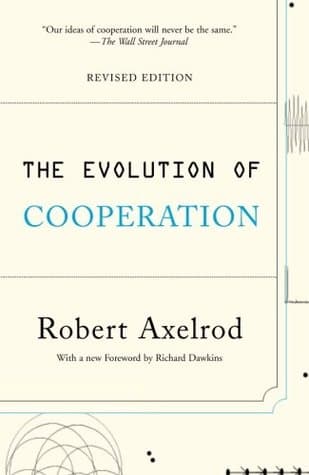
Robert Axelrod's book explores how cooperation can emerge and persist even among self-interested individuals or entities, without the need for a central authority. It demonstrates that cooperation is possible and often beneficial in repeated interactions.
What is 'Tit for Tat' and why is it significant in the book?
Tit for Tat is a simple strategy in game theory where an individual cooperates on the first move and then mirrors the opponent's previous move. It proved to be surprisingly successful in Axelrod's computer tournaments, highlighting its effectiveness in fostering cooperation.
Does cooperation always work in real-world scenarios, as suggested by the book?
While the book provides strong theoretical and empirical evidence for the emergence of cooperation, it acknowledges that real-world scenarios are complex. The effectiveness of cooperative strategies often depends on factors like the duration of interactions, transparency, and the potential for future encounters.
How is Axelrod's theory different from traditional economic models of self-interest?
Traditional economic models often assume purely rational, self-maximizing agents who may not cooperate without external incentives. Axelrod's work demonstrates that cooperation can spontaneously arise and be a rational strategy even for self-interested agents, especially in repeated interactions, by considering long-term gains.
What is the Prisoner's Dilemma, and how does it relate to the book?
The Prisoner's Dilemma is a classic game theory scenario illustrating why two rational individuals might not cooperate, even if it appears to be in their best interest to do so. Axelrod uses this game repeatedly to model and demonstrate how cooperation, particularly through strategies like Tit for Tat, can overcome the dilemma in iterated interactions.
Can the principles of cooperation from the book be applied in business negotiations?
Yes, the book's principles, particularly those derived from Tit for Tat, are highly applicable to business negotiations. They suggest that a strategy of initial cooperation, followed by reciprocity, can build trust and lead to mutually beneficial long-term relationships, avoiding destructive competitive cycles.
What role does reputation play in the evolution of cooperation?
Reputation is crucial because it allows individuals or entities to anticipate future behavior based on past interactions. A good reputation for cooperation encourages others to cooperate, while a reputation for defection can lead to ostracism, reinforcing the incentive for cooperative behavior.
How does 'The Evolution of Cooperation' apply to international relations and politics?
The book offers valuable insights into international relations by explaining how cooperation can emerge between sovereign states, even without a global authority. It suggests that repeated interactions and the shadow of the future can incentivize nations to cooperate on issues like arms control or trade, rather than constantly defecting.
Similar books
- The Selfish Gene
Richard Dawkins
4.1 (140k) average on GoodreadsPsychologyDiscusses how seemingly altruistic behaviors can arise from individual self-interest at a genetic level.
- Steve Jobs
Walter Isaacson
4.1 (957k) average on GoodreadsBusinessSteve Jobs was a visionary who fused creativity and technology to revolutionize six industries and shape our digital world.
- Freakonomics: A Rogue Economist Explores the Hidden Side of Everything
Steven D. Levitt
4.0 (709k) average on GoodreadsBusinessThis book uses economic principles to reveal the surprising incentives behind everything from drug dealing and real estate to cheating teachers and the decline of crime.
- The Tipping Point: How Little Things Can Make a Big Difference
Malcolm Gladwell
4.0 (690k) average on GoodreadsBusinessMalcolm Gladwell explains how small, targeted actions can start widespread changes in trends, behaviors, and ideas.
- Outliers: The Story of Success
Malcolm Gladwell
4.2 (556k) average on GoodreadsBusinessMalcolm Gladwell argues that true success is not just about individual talent, but about the hidden advantages of culture, opportunity, and unique experiences that shape extraordinary lives.
- The Subtle Art of Not Giving a F*ck: A Counterintuitive Approach to Living a Good Life
Mark Manson
3.9 (530k) average on GoodreadsBusinessEmbrace your flaws and stomach life's lemons, because true happiness isn't about relentless positivity, but about choosing what truly matters to give a f*ck about.






Enjoyed the summary?
A summary gives you the shape of the book. The book itself has the detail, the examples and the voice.
Find The Evolution of Cooperation on AmazonAs an Amazon Associate, BookBrief earns from qualifying purchases. How we're funded