
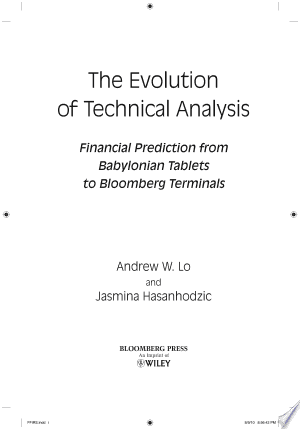
Core Idea
- Difficulty
- Hard
- Read it if
- You are a finance professional, academic, or serious investor interested in a rigorous, historical, and interdisciplinary examination of technical analysis, moving beyond anecdotal evidence to explore its scientific and psychological foundations.
- Skip it if
- You are looking for a practical 'how-to' guide for applying technical analysis or a quick read on basic chart patterns. This book is academic and theoretical, not a trading manual.
Key Takeaways from The Evolution of Technical Analysis
Ancient Roots, Modern Relevance
Technical analysis isn't a modern invention; its principles echo through millennia.
Technical analysis, often seen as a modern pseudoscience, has a surprisingly long history. Lo carefully tracks its origins to ancient civilizations, showing that the human desire to find patterns and predict outcomes from past data is not new. From Babylonian clay tablets recording prices to early Japanese rice traders, the basic ideas of watching supply and demand, finding trends, and using visuals to make decisions have been consistently applied. This history gives the practice important credibility, showing that while tools and markets change, the underlying psychological and economic forces behind price movements, which technical analysis tries to capture, stay very similar. Understanding this long history changes how technical analysis is viewed, from a fringe practice to a deeply rooted human way of predicting markets.
“The charting of past stock prices for the purpose of identifying trends, patterns, strength, and cycles within market data has allowed traders to make informed investment decisions based in logic, rather than on luck.”
In the book: Babylonian cuneiform tablets recording commodity prices, early Japanese rice trading records, and Dutch tulip mania charts.
Try this: Approach market analysis with a historical perspective, recognizing that current market behaviors often mirror patterns observed in ancient markets. Don't dismiss 'old' methods outright; they often contain fundamental truths.
Related ideas: historical-market-analysis, pattern-recognition, market-psychology
East Meets West: Divergent Paths, Convergent Goals
Distinct cultural approaches to market analysis ultimately sought the same predictive edge.
Lo points out the interesting differences and eventual similarities between Eastern and Western technical analysis. In the East, especially Japan, people like Munehisa Homma developed complex systems, such as candlestick charting for rice futures as early as the 18th century. These systems focused on patterns and market psychology and were often intuitive and visual. At the same time, in the West, pioneers like Charles Dow developed theories based on market averages and trends, focusing on the economic reasons and 'smart money' movements. While their methods, tools, and cultures were very different, both traditions shared the same goal: to gain a predictive edge by interpreting market data. This comparison shows that the human desire to forecast markets is universal and that there are many ways to do it, suggesting that effective technical analysis is not limited to one culture.
“The book compares and contrasts the Eastern practices of China and Japan to Western methods.”
In the book: Munehisa Homma's development of candlestick charting for Japanese rice markets vs. Charles Dow's work on the Dow Theory and market averages in the late 19th/early 20th century.
Try this: Explore diverse technical analysis techniques from different cultures (e.g., Japanese candlesticks alongside Western chart patterns) to broaden your analytical toolkit and gain a more holistic market perspective.
Related ideas: candlestick-charts, dow-theory, cultural-market-approaches
Pioneers and Their Enduring Legacies
Key figures laid the groundwork for modern technical analysis, shaping its core tenets.
The book highlights the influential thinkers who created the core ideas of technical analysis. Munehisa Homma’s systematic approach to rice trading, which led to candlestick patterns, gave a visual language for market sentiment. Charles Dow, through his observations of market averages, established the idea of trends and market phases, which became the foundation of Dow Theory. Humphrey B. Neill explored the psychological aspects of crowd behavior, linking market action to human emotion. William D. Gann, with his mix of geometry, astronomy, and mathematics, aimed to find hidden orders in price movements. These early figures, despite their varied methods, shared a commitment to observing and recognizing patterns. Their ideas, though often refined, are still central to modern technical analysis and continue to shape how traders understand market dynamics.
“The book details the contributions of pioneers such as Charles Dow, Munehisa Homma, Humphrey B. Neill, and William D. Gann.”
In the book: Specific contributions of Munehisa Homma (candlesticks), Charles Dow (Dow Theory, market averages), Humphrey B. Neill (mass psychology), and William D. Gann (geometric and time cycles).
Try this: Study the original works of these pioneers to understand the fundamental principles behind common indicators and patterns. Don't just apply techniques; understand their historical and theoretical underpinnings.
Related ideas: munehisa-homma, charles-dow, william-gann, humphrey-neill
The Psychological Undercurrent
Market movements are deeply intertwined with collective human emotions and biases.
Lo suggests that much of technical analysis's lasting appeal and effectiveness comes from its ability to show and use market psychology. Price patterns are not just random; they often show collective fear, greed, hope, and despair among market participants. The book suggests that technical analysis, by finding repeated patterns, is essentially finding repeated behavioral biases and emotional responses in the market crowd. This view connects 'charting' and 'behavioral finance,' suggesting that technical analysts were, in a way, doing applied behavioral economics long before it was formally recognized. Understanding this psychological side is important for any trader, as it explains why certain patterns continue even in seemingly efficient markets.
“Whether driven by mass psychology, fear or greed of investors, the forces of supply and demand, or a combination, technical analysis has flourished for thousands of years.”
In the book: Examples of market bubbles and crashes throughout history (e.g., Dutch tulip mania, 1929 crash), where collective irrationality drove prices beyond fundamental value, creating observable patterns.
Try this: When analyzing charts, consider the underlying psychological state of the market. Is fear driving a sharp sell-off? Is greed fueling an unsustainable rally? Use this insight to anticipate potential turning points or accelerations.
Related ideas: behavioral-finance, market-sentiment, crowd-psychology, fear-greed
The Perpetual Debate: Science vs. Art
Technical analysis navigates a complex space between rigorous methodology and intuitive interpretation.
Lo's historical review indirectly highlights the ongoing question in technical analysis: is it a science with measurable rules, or an art form that needs intuition and experience? Early practitioners often combined observation with some subjective interpretation. While modern technical analysis increasingly uses quantitative methods and algorithms, the 'art' of reading charts—finding subtle patterns, understanding context, and weighing conflicting signals—remains important. The book shows cases where strict application failed and where detailed interpretation succeeded. This dual nature means that while technical analysis can be systematized, its most effective use often combines careful analysis with an intuitive grasp of market flow. It's not just about drawing lines; it's about understanding what those lines mean for market dynamics.
“The Evolution of Technical Analysis explores the fascinating history of technical analysis, tracing where technical analysts failed, how they succeeded, and what it all means for today's traders and investors.”
In the book: The contrast between William D. Gann's highly geometric and mathematical (yet often mystical) approaches and the more observational, pattern-based methods of early chartists.
Try this: Develop a systematic approach to technical analysis, but also cultivate the 'art' of chart reading through extensive practice and observation. Don't become a slave to indicators; learn to read the underlying price action.
Related ideas: quantitative-analysis, chart-interpretation, market-intuition
Adaptation to New Technologies
Technical analysis has constantly evolved, leveraging new tools from paper charts to Bloomberg terminals.
A key lesson from Lo's work is how well technical analysis adapts to different technologies. From drawing charts by hand on graph paper to the rise of computers and advanced software, the core ideas have remained, simply finding new, more efficient, and powerful ways to be expressed. The shift from physical charts to digital screens, and the ability to process large amounts of data with algorithms, has made technical analysis more accessible and allowed for more complex pattern recognition and testing. This development shows that technical analysis is not static but a dynamic field that uses new tools to improve its predictive abilities. The continuous adoption of technology keeps it relevant, proving that the basic search for a market advantage is not tied to a specific tool.
“Financial Prediction from Babylonian Tablets to Bloomberg Terminals.”
In the book: The progression from hand-drawn charts in the early 20th century to the use of computers for calculating indicators (e.g., moving averages) in the late 20th century, and finally to real-time data feeds and algorithmic trading platforms.
Try this: Stay updated with new technological advancements in charting software and analytical tools. Understand how these tools can enhance your ability to apply technical analysis, but always remember the underlying principles.
Related ideas: algorithmic-trading, data-visualization, fintech, historical-data
The Efficient Market Hypothesis Challenge
Technical analysis implicitly, and often explicitly, challenges the notion of perfectly efficient markets.
Lo's exploration of technical analysis naturally challenges the Efficient Market Hypothesis (EMH), which states that all available information is already in asset prices, making consistent outperformance through technical means impossible. The very existence and long history of technical analysis suggest that markets are not always perfectly efficient, or at least not efficient in a way that prevents using behavioral biases and patterns. If markets were truly random, technical analysis would have no basis. The fact that it has 'flourished for thousands of years' implies there are systematic, predictable parts of price action that can be used. This ongoing tension makes the field so dynamic and debated, pushing researchers to understand the limits and conditions under which technical analysis might offer an advantage.
“traders to make informed investment decisions based in logic, rather than on luck.”
In the book: The book's focus on identifying trends and patterns directly contradicts the 'random walk' theory central to the EMH. The success stories of technical analysts, even if anecdotal, provide counter-evidence.
Try this: Acknowledge the EMH but don't let it paralyze your analytical efforts. Understand that market inefficiencies, often driven by human psychology, can create opportunities that technical analysis aims to capture.
Related ideas: efficient-market-hypothesis, market-inefficiencies, random-walk-theory, alpha-generation
The Quest for Logic, Not Luck
Technical analysis offers a structured framework to make decisions, reducing reliance on chance.
Ultimately, the lasting appeal of technical analysis, as Lo shows, comes from the human desire to create order from chaos and make decisions based on 'logic, rather than on luck.' In the unpredictable world of financial markets, technical analysis provides a framework, a set of rules and observations, that allows traders to build a consistent decision-making process. Even if not always perfectly predictive, it offers a systematic way to manage risk, find possible entry/exit points, and understand market context. This structured approach, however imperfect, is much more appealing and psychologically comforting than pure guessing. It empowers participants by giving them a method to interpret market signals, turning random price changes into potentially useful insights. This disciplined approach is arguably its greatest contribution.
“traders to make informed investment decisions based in logic, rather than on luck.”
In the book: The development of specific trading systems and rules by pioneers, designed to be repeatable and objective, rather than purely discretionary or emotional.
Try this: Develop a clear, rules-based trading plan using technical analysis. Define your entry, exit, and risk management criteria before entering a trade. This systematic approach reduces emotional bias and promotes consistency.
Related ideas: risk-management, trading-strategy, decision-making-framework, systematic-trading
Beyond Prediction: Understanding Market Dynamics
Technical analysis offers a lens to comprehend market forces, not just forecast prices.
While often seen as a prediction tool, Lo's historical account suggests that technical analysis's deeper value is in helping traders understand the underlying forces of supply and demand, the changes in market sentiment, and the strength (or weakness) of trends. It's not just about guessing where the price will go, but understanding why it might go there, or why it's currently acting in a certain way. By finding trends, patterns, and cycles, technical analysis provides a framework for understanding a market's 'health,' its momentum, and possible areas of support or resistance. This deeper understanding allows for better decision-making, even when exact predictions are hard to make, making it a valuable addition to fundamental analysis.
“identifying trends, patterns, strength, and cycles within market data.”
In the book: The use of indicators like volume to gauge the 'strength' of a trend, or support/resistance levels to identify areas where supply and demand are likely to clash.
Try this: Use technical analysis not just for entry/exit signals, but also to gain a broader understanding of the market's current state, momentum, and potential inflection points. Combine it with fundamental analysis for a holistic view.
Related ideas: supply-demand-analysis, market-momentum, support-resistance, market-structure
The Evolution of Technical Analysis Quotes
“The efficient markets hypothesis is the most important idea in the history of finance.”
“Technical analysis, at its core, is the study of collective human behavior.”
“Markets are not always efficient, nor are they always irrational; they are adaptive.”
“The profits of technical analysis are not guaranteed, but its insights into human nature are undeniable.”
“Pattern recognition is a fundamental aspect of human intelligence, and it is natural to apply it to financial markets.”
“The history of technical analysis is a history of trial and error, of successes and failures, but always of learning.”
“Risk is not just about volatility; it's about the probability of losing money, and how much.”
“The market is a complex adaptive system, constantly evolving and adapting to new information and new participants.”
“Technical analysis should not be dismissed out of hand; rather, it should be subjected to rigorous scientific scrutiny.”
“The real challenge is not just identifying patterns, but understanding why they occur and whether they are likely to persist.”
“Evolutionary forces shape not only biological systems but also financial markets and the strategies employed within them.”
“Behavioral biases are not necessarily irrational, but rather heuristics that have been adaptive in certain environments.”
“The future of finance lies in integrating insights from diverse disciplines, from psychology to computer science to evolutionary biology.”
“Technical analysis, properly understood, is not a magic bullet, but a tool for understanding market dynamics and human behavior.”
Quiz
10 questions on the main ideas. Each answer comes with a short explanation.
Question 1
According to Andrew W. Lo, what is the fundamental purpose of charting past stock prices in technical analysis?
- To manipulate market prices for personal gain.
- To identify trends, patterns, strength, and cycles within market data.
- To predict geopolitical events affecting financial markets.
- To determine the intrinsic value of a company's assets.
Show answer
B. To identify trends, patterns, strength, and cycles within market data. The book states that charting past stock prices allows traders to identify trends, patterns, strength, and cycles within market data, enabling informed investment decisions based in logic.
Question 2
The book traces the history of technical analysis from what ancient period?
- Ancient Greece
- Roman Empire
- Babylonian Tablets
- Egyptian Dynasties
Show answer
C. Babylonian Tablets The subtitle of the book, 'Financial Prediction from Babylonian Tablets to Bloomberg Terminals,' explicitly mentions Babylonian Tablets as the starting point for tracing the history.
Question 3
Which of the following is NOT listed as a pioneer whose contributions are detailed in 'The Evolution of Technical Analysis'?
- Charles Dow
- Munehisa Homma
- Benjamin Graham
- William D. Gann
Show answer
C. Benjamin Graham The book specifically mentions detailing the contributions of Charles Dow, Munehisa Homma, Humphrey B. Neill, and William D. Gann. Benjamin Graham is known for value investing, not technical analysis, and is not listed in the book's description.
Question 4
Andrew W. Lo suggests that technical analysis has flourished for thousands of years despite being on the 'outskirts of the financial establishment' due to what underlying drivers?
- Government regulations and institutional endorsements.
- Mass psychology, fear or greed of investors, or the forces of supply and demand.
- Exclusive access to insider information and proprietary algorithms.
- Its consistent ability to outperform all other investment strategies.
Show answer
B. Mass psychology, fear or greed of investors, or the forces of supply and demand. The book states that technical analysis flourished, 'Whether driven by mass psychology, fear or greed of investors, the forces of supply and demand, or a combination.'
Question 5
What key distinction does the book make regarding the geographical origins and evolution of technical analysis?
- It focuses exclusively on European contributions to technical analysis.
- It argues that technical analysis originated solely in the Western world.
- It compares and contrasts Eastern practices (China and Japan) to Western methods.
- It claims that Eastern technical analysis is entirely derived from Western principles.
Show answer
C. It compares and contrasts Eastern practices (China and Japan) to Western methods. The description explicitly states that the book 'Compares and contrasts the Eastern practices of China and Japan to Western methods,' highlighting a global perspective.
Question 6
When the book discusses traders making 'informed investment decisions based in logic, rather than on luck,' what is it implying about the nature of technical analysis?
- That technical analysis provides a guaranteed outcome for every trade.
- That technical analysis offers a systematic, data-driven approach to market prediction.
- That technical analysis relies solely on intuition and gut feelings.
- That technical analysis is a form of gambling with better odds.
Show answer
B. That technical analysis offers a systematic, data-driven approach to market prediction. The phrase 'based in logic, rather than on luck' suggests that technical analysis provides a structured, analytical framework for decision-making, distinguishing it from purely speculative or random approaches.
Question 7
What is Andrew W. Lo's institutional affiliation mentioned in the book's description?
- Harvard University
- Stanford University
- University of Chicago
- MIT
Show answer
D. MIT The book's description clearly states, 'MIT's Andrew W. Lo details how the charting of past stock prices...'
Question 8
The book's exploration of 'where technical analysts failed, how they succeeded, and what it all means for today's traders and investors' implies what about its overall perspective on technical analysis?
- It is a purely dismissive critique of technical analysis.
- It offers an unbiased, comprehensive, and practical assessment of its historical efficacy and modern relevance.
- It advocates for the exclusive use of technical analysis over all other methods.
- It focuses only on the successes of technical analysis without acknowledging failures.
Show answer
B. It offers an unbiased, comprehensive, and practical assessment of its historical efficacy and modern relevance. By examining both failures and successes, and discussing its meaning for today, the book suggests a balanced, comprehensive, and practical evaluation rather than a biased one.
Question 9
Given the book's title and description, what is the most likely reason Andrew W. Lo chose to include 'Bloomberg Terminals' in the subtitle alongside 'Babylonian Tablets'?
- To highlight the author's personal preference for modern financial technology.
- To emphasize the continuous evolution and adaptation of technical analysis from ancient origins to contemporary high-tech applications.
- To suggest that modern technical analysis is fundamentally different and unrelated to its historical roots.
- To imply that technical analysis is now exclusively performed by sophisticated algorithms.
Show answer
B. To emphasize the continuous evolution and adaptation of technical analysis from ancient origins to contemporary high-tech applications. The juxtaposition of 'Babylonian Tablets' (ancient) and 'Bloomberg Terminals' (modern, high-tech) effectively illustrates the vast historical scope and continuous evolution of technical analysis, adapting to new tools and contexts over millennia.
Question 10
The statement that technical analysis has 'flourished for thousands of years on the outskirts of the financial establishment' implies what about its acceptance within mainstream finance?
- It has always been fully integrated and widely accepted by all financial institutions.
- It has historically been viewed with skepticism or as a fringe practice by mainstream financial theory.
- It is a recent invention that has yet to gain widespread recognition.
- Its principles are fundamentally incompatible with any form of financial analysis.
Show answer
B. It has historically been viewed with skepticism or as a fringe practice by mainstream financial theory. Being on the 'outskirts of the financial establishment' suggests that while it has persisted and grown, it has often been regarded as outside the conventional or academically accepted practices within mainstream finance.
The Evolution of Technical Analysis FAQ
What is technical analysis, and how has it evolved over time?
Technical analysis involves charting past stock prices to identify trends, patterns, and cycles within market data for investment decisions. This book traces its evolution from ancient practices, such as those found on Babylonian tablets, to modern Bloomberg terminals, highlighting its consistent presence despite varying degrees of acceptance by the financial establishment.
Does technical analysis work, or is it just based on luck?
The book explores instances where technical analysis has both succeeded and failed throughout history. It details how traders have used it to make informed decisions based on logic derived from market data, rather than relying solely on chance, suggesting that its efficacy is a complex and nuanced topic.
What is the 'Efficient Market Hypothesis' and how does it relate to technical analysis?
While not explicitly detailed in the book description, the Efficient Market Hypothesis (EMH) is a core concept in finance that often challenges technical analysis, suggesting that all available information is already reflected in stock prices, making it impossible to consistently 'beat' the market. Technical analysis, by contrast, posits that past price movements can predict future ones, often placing it in opposition to strong forms of EMH.
How does Eastern technical analysis differ from Western methods?
The book provides a detailed comparison and contrast between the technical analysis practices developed in Eastern cultures, such as China and Japan, and those originating in Western traditions. It explores unique methodologies and philosophies that emerged in different parts of the world.
Who were some of the key pioneers in the field of technical analysis?
The book highlights significant contributions from influential figures such as Charles Dow, known for the Dow Theory; Munehisa Homma, a legendary Japanese rice trader credited with candlestick charting; Humphrey B. Neill; and William D. Gann, famous for his geometric trading methods.
What role do mass psychology, fear, and greed play in technical analysis?
The book suggests that technical analysis has flourished for thousands of years, driven by various factors including mass psychology and the emotional forces of fear and greed among investors. These human elements often influence supply and demand, creating patterns that technical analysts aim to identify and exploit.
How is 'The Evolution of Technical Analysis' different from other books on technical trading strategies?
Unlike many books that focus solely on specific trading strategies, this book offers a comprehensive historical account of technical analysis. It traces its origins, evolution, successes, and failures from ancient times to the modern era, providing a broader, more academic perspective rather than a 'how-to' guide.
Can modern traders and investors still benefit from understanding the history of technical analysis?
Yes, by understanding where technical analysts succeeded and failed in the past, today's traders and investors can gain valuable insights into the underlying principles and limitations of these methods. This historical perspective can inform more robust and logical investment decisions in contemporary markets.
About the author

Andrew W. Lo is the Charles E. and Susan T. Harris Professor of Finance at the MIT Sloan School of Management. A leading figure in quantitative finance, his research spans asset pricing, risk management, and behavioral finance. Lo is the author of "The Evolution of Technical Analysis: Financial Forecasting Technologies Since the Renaissance," which explores the historical development of technical analysis tools and methodologies.
Similar books
- Technical Analysis of the Financial Markets
John J. Murphy
Murphy's book is widely considered a foundational textbook for technical analysis practitioners, focusing heavily on chart patterns, indicators, and practical application. While comprehensive in its coverage of techniques, it largely assumes the efficacy of these methods. Lo's book, in contrast, is less a 'how-to' guide and more a 'why-do' exploration, questioning and theorizing the underlying reasons for technical analysis's existence and potential validity within a broader economic framework. Murphy provides the toolkit; Lo provides the theoretical justification (or critique) for using it.
- Freakonomics: A Rogue Economist Explores the Hidden Side of Everything
Steven D. Levitt
4.0 (709k) average on GoodreadsBusinessThis book uses economic principles to reveal the surprising incentives behind everything from drug dealing and real estate to cheating teachers and the decline of crime.
- Rich Dad, Poor Dad
Robert T. Kiyosaki
4.1 (369k) average on GoodreadsBusinessRobert Kiyosaki explains that financial literacy, owning assets instead of liabilities, and making money work for you are the real ways to build wealth, lessons he learned from his biological 'poor dad' and his best friend's entrepreneurial 'rich dad.'
- Think and Grow Rich
Napoleon Hill
4.2 (218k) average on GoodreadsBusinessLearn the thirteen principles of success from early 20th-century business leaders to achieve financial independence and personal fulfillment.
- Zero to One: Notes on Startups, or How to Build the Future
Peter Thiel
4.2 (189k) average on GoodreadsBusinessTo build the future, Peter Thiel argues, you must embrace the idea that true innovation lies not in small improvements, but in creating something entirely new that avoids competition.
- The 4-Hour Workweek
Timothy Ferriss
3.9 (181k) average on GoodreadsBusinessLearn how to leave the traditional work-life by creating automated income, outsourcing tasks, and taking 'mini-retirements' to live a life of freedom and adventure, all while working only four hours a week.





Enjoyed the summary?
A summary gives you the shape of the book. The book itself has the detail, the examples and the voice.
Find The Evolution of Technical Analysis on AmazonAs an Amazon Associate, BookBrief earns from qualifying purchases. How we're funded