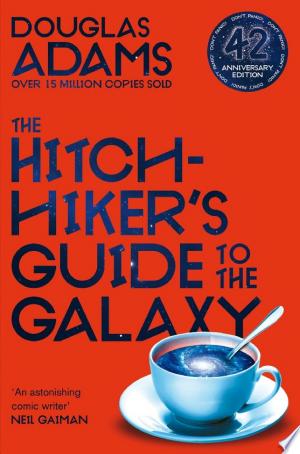

Estimated read time: 9 min read
One Sentence Summary
After Earth is unexpectedly destroyed, hapless human Arthur Dent embarks on a hilarious and absurd intergalactic adventure with his eccentric alien friend Ford Prefect.
Table of Contents
Introduction
Imagine waking up one morning to discover that not only is your house about to be bulldozed, but so is the entire Earth. Welcome to the wild, witty world of The Hitchhiker's Guide to the Galaxy by Douglas Adams—a cult classic that’s equal parts science fiction, absurd comedy, and philosophical musing. Since its publication in 1979, this book has delighted readers with its madcap adventures, sharp satire, and unforgettable advice: “Don’t Panic.” It’s a must-read for anyone who loves humor, pop culture, or pondering the meaning of life, the universe, and—of course—everything.
Historical Context
The End of the Seventies: Science Fiction Gets a Sense of Humor
Douglas Adams wrote The Hitchhiker’s Guide to the Galaxy during a time when science fiction was dominated by the likes of Star Wars and Star Trek. But Adams had something different in mind—he wanted to poke fun at the genre, British bureaucracy, and the human condition itself. The book actually started as a BBC radio series in 1978, gaining a cult following before it was ever published as a novel. Adams’s irreverent take on science fiction reflected the post-1960s skepticism and the growing appetite for satire in the late twentieth century.
Inspirations and Real-Life Parallels
Adams drew inspiration from British comedy traditions (think Monty Python) and his own experiences as a struggling writer. The character of Arthur Dent is a classic everyman, reminiscent of the ordinary Brit caught up in extraordinary events. The book’s interstellar bureaucracy and bumbling aliens lampoon the inefficiencies of real-world governments and institutions.
Brief Synopsis
Plot Overview
The Hitchhiker’s Guide to the Galaxy follows Arthur Dent, an average Englishman, as his mundane life is abruptly upended. On what seems like an ordinary Thursday, Arthur discovers his friend Ford Prefect is actually an alien researcher for an electronic guidebook. Moments later, Arthur’s house is demolished and, even worse, Earth is destroyed to make way for an intergalactic bypass. Luckily, Arthur is whisked away into space by Ford. What follows is a hilarious, mind-bending adventure across the cosmos involving a stolen spaceship, a depressed robot, and a quest for the ultimate answer to life.
Setting
The story zooms from a sleepy English village to the farthest corners of the galaxy. The book’s universe is a bizarre, bureaucratic, and utterly unpredictable place—populated by eccentric aliens, talking doors, and a guidebook that’s more helpful for its comic relief than its accuracy. Despite the cosmic scale, the atmosphere is delightfully British, dripping with irony and dry wit.
Main Characters
| Name | Role | Key Traits | Importance to the Plot |
|---|---|---|---|
| Arthur Dent | Protagonist, Earthman | Ordinary, bewildered, polite | The everyman whose perspective grounds the story |
| Ford Prefect | Alien researcher, Arthur’s friend | Witty, knowledgeable, resourceful | Arthur’s guide to the galaxy |
| Zaphod Beeblebrox | President of the Galaxy, space rogue | Charismatic, reckless, two-headed | Drives much of the action, comic chaos |
| Trillian (Tricia McMillan) | Human woman, space traveler | Intelligent, adventurous, adaptable | The only other human survivor |
| Marvin the Paranoid Android | Robot, ship’s crew | Depressed, cynical, super-intelligent | Provides comic relief and philosophical depth |
| Slartibartfast | Planet designer | Eccentric, creative | Aids the protagonists, builds worlds |
Plot Summary
Section 1: Earth’s Last Day
Arthur Dent wakes up to find bulldozers ready to demolish his house. He lies in the mud in protest—classic British passive resistance. Ford Prefect arrives, bearing a pint and some very bad news: the world is about to end. Ford drags Arthur to the pub, where he reveals his alien identity and the imminent destruction of Earth.
Section 2: Hitchhiking into Space
As the Vogons (bureaucratic alien demolishers) obliterate Earth, Ford and Arthur hitch a ride on the Vogon spaceship using a device called the “electronic thumb.” Unfortunately, Vogons are notorious for their love of bureaucratic procedure and terrible poetry. After enduring a painful poetry recital, Ford and Arthur are ejected into space.
Section 3: The Heart of Gold
Miraculously, the pair are picked up by the starship Heart of Gold, piloted by Zaphod Beeblebrox (Ford’s semi-cousin and the two-headed, egomaniacal President of the Galaxy), Trillian (the only other human survivor), and the perpetually gloomy robot Marvin. The ship is powered by the Infinite Improbability Drive, which makes the impossible possible—with unpredictable consequences.
Section 4: Deep Thought and the Ultimate Question
The crew embarks on a quest to discover the meaning of life. They visit the planet Magrathea, famed for manufacturing luxury planets. There, they meet Slartibartfast, who reveals that Earth was actually a supercomputer designed by pan-dimensional beings to find the Ultimate Question of Life, the Universe, and Everything. The answer, as it turns out, is “42”—but the real question remains unknown.
Section 5: Escaping Magrathea and Beyond
As the characters flee various dangers (including bureaucratic mice and explosive devices), they reflect on the absurdity of existence. The book ends with the promise of more misadventures, leaving readers both amused and curiously thoughtful about their own place in the universe.
Themes and Motifs
The Absurdity of Life
At its core, The Hitchhiker’s Guide to the Galaxy is a comedic meditation on the randomness and unpredictability of existence. The destruction of Earth for an “intergalactic bypass” is a perfect metaphor for the universe’s indifference to human concerns.
Bureaucracy and Satire
Adams skewers bureaucracy at every turn, from the Vogons’ pointless paperwork to the convoluted systems of galactic government. It’s a biting, hilarious critique of red tape, both alien and earthly.
The Search for Meaning
The book famously reduces the answer to life, the universe, and everything to a simple number: 42. This running joke underscores the futility—and the humor—of seeking simple answers to complex questions.
Technology and Alienation
The Guide itself is a symbol of the modern struggle to make sense of overwhelming information. Technology, from Marvin to the Infinite Improbability Drive, is both wondrous and alienating.
Britishness and Irony
Adams’s dry British humor pervades the novel, making the end of the world seem almost cozy. The characters respond to cosmic calamities with resignation, wit, and the occasional cup of tea.
Literary Techniques and Style
Narrative Structure
Adams employs a non-linear, episodic structure. The plot frequently digresses into absurd tangents, much like the Guide itself, mirroring the unpredictability of both the universe and human thought.
Satire and Parody
The novel is a masterclass in satire, lampooning everything from politics to philosophy. Adams uses exaggeration and irony to expose the silliness of bureaucracy and the limitations of science fiction tropes.
Symbolism
- The Guide: Represents humanity’s thirst for knowledge and the often futile search for clarity in a chaotic universe.
- Marvin: Embodies the darkly comic side of intelligence and the existential angst of modernity.
- The Towel: A recurring motif, the towel is both a practical tool and a symbol of preparedness—and the absurdity of what we choose to value.
Dialogue and Wit
Adams’s dialogue sparkles with wordplay, puns, and deadpan humor. His style is approachable and light, even when exploring deep philosophical questions.
Author's Background
Douglas Adams: From Struggling Writer to Icon
Douglas Adams was a British writer and humorist, born in 1952. Before Hitchhiker’s, he worked odd jobs and wrote for Monty Python’s Flying Circus. Adams’s unique blend of science fiction and comedy revolutionized the genre, inspiring countless authors and comedians.
Influences and Legacy
Adams was influenced by British comedy, science fiction, and his own quirky worldview. His other works include Dirk Gently’s Holistic Detective Agency and several Hitchhiker’s sequels. Adams’s legacy endures in pop culture, from radio to TV adaptations, and his impact is felt in everything from Doctor Who to The Simpsons.
Key Takeaways
- Life is absurd, and that’s okay: Embrace the randomness.
- Don’t Panic: Sometimes, the best response to chaos is a sense of humor.
- Bureaucracy is universal: Even aliens can’t escape paperwork.
- Simple answers don’t solve complex questions: “42” is both a joke and a profound observation.
- Always know where your towel is: Be prepared, even if you don’t know what for.
Reader's Takeaway
Reading The Hitchhiker’s Guide to the Galaxy is like having your mind stretched and tickled at the same time. You’ll laugh out loud, ponder existence, and maybe even feel a little less anxious about not having all the answers. It’s perfect for anyone who’s ever felt lost in the universe—or needed a good laugh to get through the day.
Conclusion
The Hitchhiker’s Guide to the Galaxy is a rare gem: a book that entertains, enlightens, and endures. Douglas Adams’s witty prose, unforgettable characters, and philosophical undercurrents make it a classic for the ages. Whether you’re a college student grappling with life’s big questions or just someone in need of a laugh, this book will remind you: the universe is a strange place, and sometimes the best thing you can do is grab your towel and enjoy the ride. Don’t panic—and don’t forget to read the book for yourself!
The Hitchhiker's Guide to the Galaxy FAQ
What is 'The Hitchhiker's Guide to the Galaxy' about?
The book follows Arthur Dent, an ordinary human who is swept off Earth just before its destruction to make way for a hyperspace bypass. Guided by his alien friend Ford Prefect, Arthur embarks on a whimsical journey across the galaxy, encountering bizarre aliens, improbable events, and the ever-helpful (and occasionally inaccurate) electronic guidebook known as The Hitchhiker's Guide to the Galaxy.
Who are the main characters in the book?
The main characters include Arthur Dent (the bewildered human protagonist), Ford Prefect (Arthur's friend and a researcher for the Guide), Zaphod Beeblebrox (the eccentric, two-headed President of the Galaxy), Trillian (the only other surviving human), and Marvin (the perpetually depressed robot).
Is 'The Hitchhiker's Guide to the Galaxy' part of a series?
Yes, it is the first book in a five-part trilogy (yes, really!) written by Douglas Adams. The series continues with 'The Restaurant at the End of the Universe,' 'Life, the Universe and Everything,' 'So Long, and Thanks for All the Fish,' and 'Mostly Harmless.'
What is the significance of the number 42 in the book?
In the book, 42 is revealed to be the 'Answer to the Ultimate Question of Life, the Universe, and Everything,' as calculated by an enormous supercomputer named Deep Thought. The joke is that while the answer is known, the actual Ultimate Question itself is unknown.
What genre does the book belong to?
'The Hitchhiker's Guide to the Galaxy' is primarily a science fiction comedy, known for its wit, satire, and absurd humor. It also parodies and plays with classic science fiction tropes.
How did Douglas Adams come up with the idea for the book?
Douglas Adams reportedly conceived the idea while lying drunk in a field in Innsbruck, Austria, staring at the stars with a copy of a hitchhiker's guidebook. The concept evolved into a BBC radio comedy series before being adapted into the novel.
Do I need to be a science fiction fan to enjoy this book?
Not at all! While the book is set in space and features science fiction elements, its humor, clever writing, and satirical observations about life appeal to a broad audience.
Is there a movie or TV adaptation of 'The Hitchhiker's Guide to the Galaxy'?
Yes, the story has been adapted into a BBC radio series, a 1981 television series, and a 2005 feature film. There have also been stage productions, comic books, and video games inspired by the book.
What is the 'Guide' in the title?
The 'Guide' refers to a fictional electronic book that provides humorous and often dubious advice to intergalactic travelers. It is famous for its cover, which bears the words 'DON'T PANIC' in large, friendly letters.
Why is 'The Hitchhiker's Guide to the Galaxy' considered a classic?
The book is celebrated for its unique blend of wit, philosophical insight, and creative storytelling. Douglas Adams' satirical take on science fiction and his ability to find humor in life's absurdities have made the book a beloved classic for readers of all ages.