
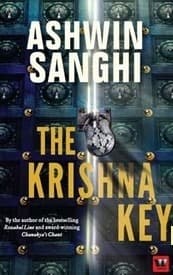
Synopsis
Covers the whole plot, including the ending.
- Difficulty
- Medium
- Pacing
- Fast
- Mood
- Mysterious, Suspenseful, Intriguing, Epic
- Read it if
- You enjoy thrillers that blend ancient Indian history, mythology, and modern-day conspiracies with a fast-paced plot.
- Skip it if
- You dislike books with extensive historical exposition or are not interested in reinterpretations of mythological figures.
The Krishna Key Plot Summary
Covers the whole plot, including the ending.
The First Sacrifice and the Scholar's Plea
The novel opens with the murder of a young woman, Geeta, in Dwarka, her body arranged ritually. At the same time, Professor Ravi Mohan Saini, a disgraced historian at the University of Delhi, meets his former mentor, Professor Homi Sorabjee. Sorabjee, fearing for his life, gives Ravi a coded message and a replica of a unique conch shell, hinting at a dangerous secret connected to Krishna. Sorabjee believes a killer is targeting people based on an ancient prophecy and warns Ravi about a 'final avatar' who will begin the Kali Yug. Before Ravi understands, Sorabjee is found dead, seemingly by suicide, but Ravi suspects murder.
The Oracle's Prophecy and the Hunt for the Killer
Ravi begins to decode Sorabjee's clues, which point to an ancient prophecy about Krishna's final avatar and the start of Kali Yug. He realizes the conch shell is a replica of the Panchajanya, Krishna's divine conch. His investigation leads him to Priya, a child prodigy and student of Sanskrit and ancient texts, who offers more insights into the prophecies. Meanwhile, the killer, a charismatic man named Taarak, continues his murders. Each victim embodies a flaw Taarak believes must be removed for humanity's salvation. Taarak believes he is the final avatar and is carrying out divine justice.
A Web of Ancient Texts and Modern Betrayal
Ravi, with Priya's knowledge and Inspector Dawood Ibrahim's help, examines ancient texts and symbols. He discovers a secret society, the 'Krishna-Dharma,' dedicated to preserving Krishna's legacy. He learns about a lost manuscript, the 'Krishna Key,' which is said to contain Krishna's wisdom and a powerful secret. Taarak also seeks this key, believing it will give him power and validate his divine mission. Ravi realizes that Taarak is not just a murderer but is removing anyone who could stop him or reveal the truth about Krishna's legacy.
The Dwarka Connection and the Submerged City
Following clues from Sorabjee's notes and ancient scriptures, Ravi travels to the submerged city of Dwarka, Krishna's fabled kingdom. He believes a piece of the puzzle lies underwater. With marine archaeologists, he explores the ruins, finding an ancient inscription that clarifies the prophecy and the 'Krishna Key.' During his dangerous exploration, he encounters Taarak's operatives, who are also searching for the same clues, showing the killer's ruthless determination and network. Ravi realizes the danger he is in as he nears the truth.
Somnath's Secrets and the Lingam's Power
Ravi's journey takes him to the historic Somnath Temple, also linked to Krishna and ancient legends. He learns about the Jyotirlingam, a sacred Shiva lingam, and its hidden meaning in Krishna's legacy. Through his research and talks with local scholars, he uncovers that the lingam is not just a religious artifact but has a symbolic or actual connection to the 'Krishna Key.' Taarak's presence is evident, as Ravi finds proof that the killer has also been to Somnath, tracking the same ancient knowledge and leaving a trail of fear. The stakes rise as Ravi understands the killer's careful planning.
The Kalibangan Massacre and a Cryptic Message
The plot continues with another murder at the ancient archaeological site of Kalibangan, linked to the Indus Valley Civilization. The victim is an archaeologist close to uncovering information. Taarak leaves a cryptic message, crafted to mimic ancient scripts, which Ravi and Priya must decipher. This message hints at the 'Krishna Key' being a concept rather than a physical object, or perhaps both. The killer's intelligence and his deep understanding of history and mythology become clear, making him a formidable enemy.
Mount Kailash and the Ultimate Revelation
The trail leads Ravi to Mount Kailash, believed to be Shiva's home and a place of spiritual power. Here, Krishna's legacy is said to be hidden. Ravi faces dangers from nature and Taarak's followers. He discovers that the 'Krishna Key' is not a single artifact but a collection of ancient knowledge, a scientific principle disguised as mythology, related to advanced technology or understanding of the universe. This challenges Ravi's understanding of history and science.
Confrontation and the True Nature of the Key
Ravi finally confronts Taarak, who reveals his identity and his twisted reasons for the murders. Taarak believes he is fulfilling a divine command to cleanse humanity and begin a new age using the 'Krishna Key.' The 'Krishna Key' is a genetic blueprint or ancient bio-weaponry, a devastating power Krishna hid to prevent its misuse. Taarak intends to unleash this power, believing it will purify the world. Ravi, with Inspector Dawood's help, races to stop Taarak from activating the key and causing global destruction.
The Final Battle and the Legacy's Preservation
A climax unfolds as Ravi and Inspector Dawood try to stop Taarak's plans. The battle is intellectual and physical, as Ravi uses his historical and scientific knowledge to counter Taarak's interpretation of ancient texts and his access to the 'Krishna Key.' They prevent Taarak from fully activating the key, though with struggle and sacrifice. Taarak is defeated, and the immediate threat is neutralized. However, the revelation of the 'Krishna Key's' true nature impacts Ravi and the world, showing the balance between ancient wisdom and modern responsibility.
Aftermath and the Burden of Knowledge
Afterward, the world deals with the discovery of the 'Krishna Key' and its implications. The existence of such powerful, ancient technology challenges established history and science. Ravi Mohan Saini, now a hero, must ensure this ancient knowledge is guarded and never misused. He understands the responsibility that comes with such a discovery and dedicates his life to understanding and protecting Krishna's legacy, ensuring it is used for good, not destruction. The experience changes him, a scholar with an extraordinary secret.
The Krishna Key Characters
Ravi Mohan Saini
Protagonist
A disgraced historian who must unravel an ancient mystery to save the world.
Ravi Mohan Saini is a brilliant but controversial historian, ostracized from academia due to past scandals and his unconventional theories. He possesses an encyclopedic knowledge of ancient Indian history, mythology, and languages. Initially cynical and reclusive, he is thrust into a dangerous quest after his mentor's death. He is driven by a deep sense of justice and a thirst for truth, even when it challenges his own beliefs. His intellect and ability to connect disparate historical clues are his greatest assets.
Relationships: Professor Homi Sorabjee (Mentor and friend, whose death propels Ravi into the mystery.); Priya (Young prodigy and intellectual collaborator, helping Ravi decipher clues.); Inspector Dawood Ibrahim (Police officer and ally, providing investigative support and protection.); Taarak (Arch-nemesis, a twisted reflection of intellectual brilliance.)
Taarak
Antagonist
A charismatic serial killer who believes he is Krishna's final avatar, seeking to purify humanity.
Taarak is a highly intelligent, manipulative, and charismatic individual who genuinely believes he is the Kalki avatar, the final incarnation of Vishnu, destined to cleanse the world. He is a master of ancient texts, prophecies, and psychological manipulation. His methods are brutal and ritualistic, each murder carefully orchestrated to reflect a perceived flaw in humanity. He sees himself as a divine executor, not a killer, and his conviction makes him incredibly dangerous. He is driven by a warped sense of duty and a desire for ultimate control.
Relationships: Ravi Mohan Saini (Intellectual and ideological adversary, both seeking the 'Krishna Key'.)
Priya
Supporting
A child prodigy with extraordinary knowledge of Sanskrit and ancient scriptures.
Priya is an exceptionally intelligent young girl, possessing an almost supernatural grasp of Sanskrit, ancient languages, and Vedic scriptures. Her precocious intellect and photographic memory make her an invaluable asset to Ravi's investigation. Despite her age, she displays remarkable maturity and an unwavering dedication to understanding the ancient mysteries. She often provides crucial translations and interpretations that Ravi, with all his academic training, might overlook. She represents innocence and the future, contrasting with the dark themes of the killer.
Relationships: Ravi Mohan Saini (Collaborator and mentor figure, with Priya often guiding Ravi with her insights.)
Inspector Dawood Ibrahim
Supporting
A pragmatic and dedicated police officer investigating the serial killings.
Inspector Dawood Ibrahim is a shrewd and determined police officer, initially skeptical of Ravi's unconventional theories but eventually becoming his trusted ally. He represents law and order, providing a grounded perspective amidst the historical and mythological complexities. He is dedicated to solving the murders and protecting the innocent, bringing a practical, investigative approach to the fantastical elements of the plot. His loyalty and courage are instrumental in the final confrontation with Taarak.
Relationships: Ravi Mohan Saini (Initially a suspicious investigator, later a steadfast ally and friend.)
Professor Homi Sorabjee
Supporting
Ravi's former mentor, whose murder sets the entire plot in motion.
Professor Homi Sorabjee is a respected historian and Ravi's former mentor. He is a key figure in the initial stages of the mystery, possessing crucial knowledge about the 'Krishna Key' and the impending threat. His sudden and suspicious death, after entrusting Ravi with vital clues, serves as the catalyst for the entire narrative. Though his physical presence is brief, his legacy and the information he imparts guide Ravi throughout his perilous journey. He represents the academic world's initial engagement with the ancient secret.
Relationships: Ravi Mohan Saini (Mentor and close academic colleague.)
Geeta
Mentioned
The first victim of the serial killer, whose death begins the investigation.
Geeta is the first victim of Taarak, found brutally murdered in Dwarka. Her death is significant as it establishes the ritualistic nature of the killings and immediately draws Ravi into the unfolding mystery. While her character is not deeply developed, her fate underscores the ruthless determination of the killer and the high stakes involved in the hunt. Her murder serves as a chilling opening to the narrative, signaling the dark path ahead.
The Krishna Key Themes
The Interpretation of Myth and History
The novel explores how ancient myths and historical accounts can be reinterpreted, often with dangerous results. Taarak, the antagonist, twists Vedic scriptures and Krishna's prophecies to justify his acts, believing he is the 'final avatar.' Ravi, on the other hand, seeks historical and scientific truths within these narratives, often finding rational explanations for seemingly supernatural events. This theme is central to Ravi's intellectual journey as he deciphers clues from Dwarka and Somnath, distinguishing between literal belief and symbolic meaning.
“History is not what happened. It is what is remembered. And what is remembered depends on who is doing the remembering.”
The Nature of Divine Justice and Retribution
A theme concerns divine justice and whether humanity has the right to enact it. Taarak acts as a divine agent, punishing those he deems 'unworthy' to purify the world, echoing ancient concepts of Kali Yug and divine retribution. The novel questions the morality of such actions and the dangers of self-appointed saviors. Ravi and Dawood, representing reason and law, challenge this twisted ideology, emphasizing that justice, even if inspired by higher principles, must be administered ethically and humanely, not through murder. Victims are chosen based on Taarak's warped view of 'sins' against a pure society.
“When man plays God, he creates a devil.”
The Power and Peril of Ancient Knowledge
The 'Krishna Key' itself shows this theme. It is not a magical artifact but advanced ancient knowledge, potentially a genetic blueprint or bio-weaponry, hidden in mythological narratives. The novel shows how such discoveries, if misinterpreted or misused, can lead to disaster. Ravi's quest is not just to find the key but to understand its true nature and prevent its destructive use, highlighting the responsibility that comes with uncovering powerful secrets. The journey to Kailash emphasizes the sacred and perilous nature of this knowledge.
“The greatest secrets are often hidden in plain sight, veiled by the very stories we tell ourselves.”
Faith vs. Reason
The book contrasts blind faith with rational inquiry. Taarak's actions are driven by an unshakeable, twisted faith in his divine mandate and a literal reading of prophecies. Ravi, a historian, uses evidence, logic, and analysis to solve the mystery, seeking scientific or historical explanations for events. The narrative explores the tension between these two approaches, showing how an imbalance can lead to fanaticism or dismissal. Priya, with her blend of scriptural knowledge and logical deduction, often bridges this divide, showing that faith and reason can inform each other.
“To believe without questioning is to invite deception.”
Plot Devices & Literary Techniques
The MacGuffin: The Krishna Key
The central object of desire and mystery that drives the plot.
The 'Krishna Key' serves as the primary MacGuffin. Initially, it is shrouded in mystery, believed to be a powerful artifact or secret left by Krishna. Both Ravi and Taarak are intensely focused on acquiring or understanding it, albeit for vastly different purposes. Its true nature is gradually revealed to be not a physical key but a profound, ancient scientific or genetic knowledge, capable of immense creation or destruction. Its ambiguity and eventual revelation propel the narrative forward, forcing characters to constantly reassess their understanding of Krishna and his legacy.
The Prophecy of Kalki Avatar
An ancient prophecy that fuels the antagonist's delusion and guides the protagonist's investigation.
The ancient prophecy of the Kalki Avatar, the final incarnation of Vishnu destined to appear at the end of Kali Yug to cleanse the world, is a critical plot device. Taarak interprets this prophecy literally and believes he is this avatar, using it to justify his serial killings. Ravi, conversely, must delve into the origins and various interpretations of this prophecy to understand Taarak's motives and anticipate his next moves. The prophecy provides a mythological framework for the thriller, blurring the lines between ancient belief and modern crime, and creating a sense of impending doom.
Historical Locations as Clues
Real-world historical and mythological sites that serve as integral puzzle pieces.
The novel extensively uses real historical and mythological locations like Dwarka, Somnath, Kalibangan, and Mount Kailash as crucial plot devices. Each location holds a piece of the puzzle, containing inscriptions, artifacts, or legends that guide Ravi's investigation. These sites are not merely backdrops; they are active participants in the unfolding mystery. Ravi must physically travel to these places, deciphering clues embedded in their history and architecture. This device grounds the fantastical elements in tangible, recognizable settings, enhancing the sense of historical authenticity and adventure.
Coded Messages and Ancient Scripts
Cryptic texts and symbols that Ravi must decipher to advance the plot.
From Professor Sorabjee's initial coded message to the ancient inscriptions found in Dwarka and the symbolic messages left by Taarak at crime scenes, coded messages and ancient scripts are central to the plot. Ravi, often with Priya's help, must painstakingly translate and interpret these texts. This device highlights Ravi's academic expertise and provides intellectual challenges for the characters. Each deciphered message reveals a new layer of the mystery, pushing the narrative forward and gradually unveiling the true nature of the 'Krishna Key' and Taarak's grand plan.
The Krishna Key Quotes
“When you have to choose between two evils, choose the one that you have not yet tried.”
“The past is never dead. It's not even past.”
“Every lie contains an element of truth. That's what makes it believable.”
“Sometimes, the greatest truths are hidden in plain sight, disguised as myth or legend.”
“Faith is not about believing in something. It's about believing in yourself.”
“The line between genius and madness is often blurred, especially when one is driven by a singular purpose.”
“Destiny is not a road you find, but a road you create.”
“Power corrupts, and absolute power corrupts absolutely. But sometimes, it also reveals absolute truth.”
“The greatest battles are not fought on fields of war, but within the human heart.”
“History is written by the victors, but sometimes, the vanquished leave behind clues that rewrite it.”
“The universe doesn't give you what you want, it gives you what you need.”
“There are no coincidences, only patterns waiting to be discovered.”
“Knowledge without wisdom is a dangerous weapon.”
“Sometimes, the only way to find your path is to get lost.”
Quiz
10 questions on the plot and the characters. Each answer comes with a short explanation.
Question 1
Who is the primary antagonist and serial killer in 'The Krishna Key', believing himself to be the final avatar of Krishna?
- Ravi Mohan Saini
- Anil Soni
- Taarak Vakil
- Radhika Singh
Show answer
C. Taarak Vakil Taarak Vakil is the 'poor little rich boy' who grows up believing he is the final avatar of Krishna and becomes a serial killer.
Question 2
Which historical figure is mentioned as having destroyed a Vrindavan temple, a detail Ravi Mohan Saini delves into?
- Akbar
- Aurangzeb
- Ashoka
- Babur
Show answer
B. Aurangzeb The synopsis explicitly states that Saini delves into antiquity concerning a Vrindavan temple destroyed by Aurangzeb.
Question 3
What is Krishna's 'priceless legacy to mankind' that a sinister conspiracy seeks to expose?
- A hidden treasure of gold and jewels
- A powerful weapon of mass destruction
- An ancient secret or possession
- The blueprint for an advanced civilization
Show answer
C. An ancient secret or possession The synopsis mentions a 'sinister conspiracy to expose an ancient secret—Krishna’s priceless legacy to mankind' and 'Krishna’s most prized possession'.
Question 4
Which of the following locations is NOT mentioned as a place Ravi Mohan Saini must visit in his quest?
- The submerged remains of Dwarka
- The mysterious lingam of Somnath
- The Golden Temple of Amritsar
- The icy heights of Mount Kailash
Show answer
C. The Golden Temple of Amritsar The synopsis lists Dwarka, Somnath, and Mount Kailash as key locations for Saini's quest, but not the Golden Temple of Amritsar.
Question 5
What is the 'Dark Age' or epoch mentioned in the prophecy when Krishna is expected to return in a new avatar?
- Satyug
- Treta Yuga
- Dvapara Yuga
- Kaliyug
Show answer
D. Kaliyug The prophecy states Krishna would return in a fresh avatar 'when needed in the eventual Dark Age—the Kaliyug'.
Question 6
What is the primary motivation behind the serial killer's gruesome acts?
- Revenge against his family
- Belief in himself as a divine avatar
- Desire for wealth and power
- To hide a personal secret
Show answer
B. Belief in himself as a divine avatar The killer executes his schemes 'in the name of God' because he 'grows up believing that he is that final avatar' of Krishna.
Question 7
What is the academic profession of the protagonist, Ravi Mohan Saini?
- Archaeologist
- Historian
- Linguist
- Mythologist
Show answer
B. Historian Ravi Mohan Saini is explicitly identified as a 'Historian' in the synopsis.
Question 8
The book offers an 'incredible alternative interpretation' of which historical period?
- The Mughal Empire
- The Mauryan Dynasty
- The Vedic Age
- The Gupta Period
Show answer
C. The Vedic Age Ashwin Sanghi provides 'an incredible alternative interpretation of the Vedic Age'.
Question 9
What kind of justice does Ravi Mohan Saini aim to prevent by delving into antiquity?
- A gross miscarriage of justice
- An unjust war
- The destruction of historical sites
- The loss of ancient texts
Show answer
A. A gross miscarriage of justice Saini 'must also delve into antiquity to prevent a gross miscarriage of justice'.
Question 10
The 'first clue to a sinister conspiracy' is identified as what event?
- The discovery of ancient artifacts
- The arrival of a murderer executing schemes in God's name
- A prophecy about Krishna's return
- The disappearance of a historical document
Show answer
B. The arrival of a murderer executing schemes in God's name The synopsis states, 'the arrival of a murderer who executes his gruesome and brilliantly thought-out schemes in the name of God is the first clue to a sinister conspiracy'.
The Krishna Key FAQ
What is the central premise of 'The Krishna Key'?
The novel revolves around a modern-day serial killer, Taarak Vakil, who believes himself to be the tenth avatar of Vishnu, Kalki, and executes victims according to ancient prophecies. Historian Ravi Mohan Saini must race against time to uncover the true meaning of Krishna's legacy and prevent Taarak from unleashing a catastrophic plan, while also being framed for the murders.
Who is Ravi Mohan Saini and what is his role in the story?
Ravi Mohan Saini is a brilliant historian and academic who becomes the prime suspect in Taarak Vakil's serial killings. He is forced to go on the run and use his extensive knowledge of Indian history, mythology, and archaeology to decipher clues left by Taarak and ultimately stop his destructive agenda, all while trying to clear his name.
Who is Taarak Vakil and what drives his actions?
Taarak Vakil is the antagonist, a wealthy but deeply disturbed individual who genuinely believes he is the Kalki avatar destined to cleanse the world. His actions are driven by this messianic delusion, fueled by a childhood trauma and manipulation, leading him to commit gruesome murders based on interpretations of ancient texts and prophecies.
What is 'Krishna's priceless legacy' that the book refers to?
Krishna's priceless legacy is revealed to be a sophisticated ancient technology and knowledge system, not a physical object, related to energy and consciousness. This 'legacy' is a secret passed down through generations, intended to be used for humanity's advancement but also possessing immense destructive potential if misused.
How does the novel blend historical events and mythological narratives?
The novel intricately weaves historical sites like Dwarka, Somnath, and Kalibangan with mythological tales of Krishna, the Mahabharata, and the Kaliyug prophecies. It reinterprets these ancient narratives through a scientific and conspiratorial lens, suggesting that many 'miracles' were advanced technologies and that historical figures had hidden agendas.
What is the significance of the 'Sudarshan Chakra' in the context of the book?
The Sudarshan Chakra, traditionally Krishna's divine discus, is reinterpreted in the book as an ancient weapon of mass destruction, possibly an advanced energy device. Taarak Vakil seeks to reactivate or recreate this 'weapon' to fulfill his destructive vision of cleansing the world, making it a key element in his plan.
Are the symbols and clues used by Taarak Vakil based on real historical or mythological elements?
Yes, many of the symbols, prophecies, and locations Taarak Vakil uses are drawn from real Hindu mythology, Vedic texts, and archaeological sites. The book then provides an alternative, often scientific or technological, interpretation of these elements, suggesting hidden meanings beyond their traditional spiritual understanding.
How does the concept of 'Dharma' play into the antagonist's motivations?
Taarak Vakil misinterprets 'Dharma' as a rigid set of rules requiring extreme purification and the elimination of 'adharma' (unrighteousness) through violent means. He sees himself as an agent of divine justice, bringing about a new age by purging the world of what he perceives as moral decay, justifying his horrific acts.
What is the role of the 'Nagas' or serpent people in the book's alternative history?
The 'Nagas' are presented not as mythical serpents, but as an ancient, advanced civilization or bloodline possessing secret knowledge and technology. They are depicted as guardians of Krishna's legacy, tasked with preserving and hiding it from those who would misuse its power, linking them to a deeper conspiracy.
How does Taarak Vakil's childhood trauma contribute to his psychological state?
Taarak's childhood trauma, including the death of his mother and the influence of a manipulative guru, profoundly shapes his fractured psyche. These experiences are exploited to instill in him the delusion of being Kalki, providing a psychological foundation for his violent interpretations of divine purpose and his detachment from reality.
What psychological elements make Ravi Mohan Saini a compelling protagonist?
Ravi's psychological depth comes from his struggle with being framed, forcing him to confront his own vulnerabilities and resilience. His academic rigor is contrasted with his desperate fight for survival, showcasing his mental fortitude and ability to think under extreme pressure, while grappling with the moral implications of his discoveries.
How does the book explore the psychology of religious extremism and delusion?
The book delves into religious extremism through Taarak Vakil, illustrating how deeply held beliefs, when combined with mental instability and external manipulation, can lead to extreme violence. It shows how prophecies can be twisted to justify horrific acts, highlighting the dangers of unchecked faith and a messianic complex.
What is the psychological impact of the 'Kaliyug' prophecy on the characters?
The 'Kaliyug' prophecy, foretelling a dark age of moral decay, deeply affects characters by instilling a sense of urgency and dread. For Taarak, it justifies his 'purification' efforts, while for Ravi, it acts as a catalyst to understand and prevent the prophecy's destructive potential, highlighting the psychological burden of impending doom.
Does the book present a definitive 'truth' about Krishna or leave it open to interpretation?
The book presents an alternative, often scientific and technological, interpretation of Krishna's life and 'miracles,' suggesting they were advanced knowledge rather than divine intervention. While it offers a coherent narrative, it also implicitly encourages readers to question established beliefs and consider different perspectives on history and mythology.
What is the core debate or philosophical question the book raises regarding science versus faith?
The book constantly pits scientific understanding and archaeological evidence against traditional faith and mythological beliefs. It raises the question of whether ancient 'miracles' can be explained by advanced, lost technologies, challenging readers to consider if science can demystify faith without diminishing its cultural or spiritual significance.
How does the book's ending contribute to its overall message?
The ending, by revealing Krishna's legacy as knowledge rather than a divine object, reinforces the message that true power lies in understanding and wisdom, and that humanity's choices determine its future. It concludes with a sense of hope, emphasizing responsibility in wielding knowledge, and leaves room for continued debate on the nature of divinity and technology.
Is 'The Krishna Key' critical of religion, or does it offer a new perspective?
The book is not overtly critical of religion itself, but rather of its fundamentalist interpretations and the misuse of faith for destructive purposes. It offers a fresh perspective by recontextualizing religious narratives through a scientific and historical lens, inviting readers to explore the deeper, often hidden, meanings within mythology.
What is the significance of the 'Blue God' title for Krishna in the context of the story?
The 'Blue God' title for Krishna hints at his unique and often enigmatic nature, which the book reinterprets. While traditionally symbolic of infinity or the cosmos, in the book's speculative narrative, it could subtly allude to advanced origins, technology, or even a different physiological makeup, adding to the mystery surrounding his true legacy.
About the author

Ashwin Sanghi is a critically acclaimed Indian author known for his bestselling thriller novels. His works, including "The Krishna Key," "The Rozabal Line," and "The Sialkot Saga," blend mythology, history, and suspense. Sanghi's ability to weave intricate plots with ancient Indian lore has earned him a significant readership in the Indian fiction scene and beyond.
Similar books
- The Da Vinci Code
Dan Brown
3.9 (1.9M) average on GoodreadsThrillerFeatures a symbologist racing to uncover ancient secrets tied to religious history, pursued by a killer.
- The Rozabal Line
Ashwin Sanghi
3.3 (8k) average on GoodreadsThrillerAnother historical-religious thriller by the same author, known for intricate plots and ancient conspiracies.
- The Immortals of Meluha
Amish Tripathi
4.1 (101k) average on GoodreadsFantasyBoth authors draw heavily from Indian mythology. Tripathi's work is a more overt fantasy retelling and reinterpretation of myths, creating an alternate history. Sanghi, conversely, attempts to ground his narrative in a more 'historical' (though speculative) framework, positioning Krishna as a historical figure and focusing on archaeological and textual evidence, aiming for a plausible 'what if' scenario rather than pure fantasy.
- Angels & Demons
Dan Brown
3.9 (2.7M) average on GoodreadsThrillerA Harvard symbologist races through Rome's ancient sites, deciphering cryptic clues to unmask the Illuminati and stop a vengeful plot to destroy the Vatican with a stolen antimatter weapon.
- Gone Girl
Gillian Flynn
4.1 (2.3M) average on GoodreadsThrillerA wife's sudden disappearance on her fifth anniversary reveals a web of lies and psychological warfare, exposing the secrets within a seemingly perfect marriage.
- The Girl on the Train
Paula Hawkins
3.9 (2.1M) average on GoodreadsThrillerA woman’s fascination with a seemingly perfect couple she watches from her daily train commute leads her into a dark investigation when she witnesses something that shatters their idyllic image.




Enjoyed the summary?
A summary gives you the shape of the book. The book itself has the detail, the examples and the voice.
Find The Krishna Key on AmazonAs an Amazon Associate, BookBrief earns from qualifying purchases. How we're funded