
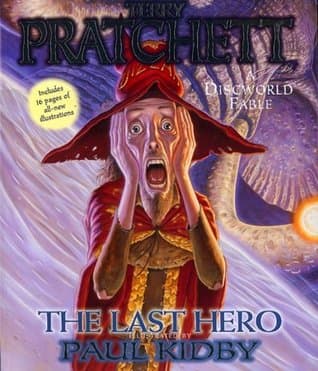
Synopsis
Covers the whole plot, including the ending.
- Difficulty
- Easy
- Pacing
- Fast
- Mood
- Humorous, Adventurous, Reflective, Satirical
- Read it if
- You enjoy satirical fantasy, epic quests with a comedic twist, and meditations on aging heroes.
- Skip it if
- You prefer serious, high-stakes fantasy without humor, or find slapstick comedy distracting.
The Last Hero Plot Summary
Covers the whole plot, including the ending.
The Last Quest of Cohen the Barbarian
The story begins with news spreading across Discworld: Cohen the Barbarian, now an old man, has gathered his equally old friends, the Silver Horde, for one final, bold quest. Their goal is to return fire to the gods on Cori Celesti, the highest mountain and home of the gods. This act, meant to repay the gods for the theft of fire by the first hero, Prometheus, is said to destroy Discworld. The news causes panic among the wizards of Unseen University and Lord Vetinari, who realize the terrible results of Cohen's plan. They immediately try to find a way to stop him before it is too late, despite the great difficulty of reaching the gods' home.
The Patrician's Dilemma and the Wizards' Intervention
Lord Vetinari, always practical, meets with Archchancellor Mustrum Ridcully and the senior faculty of Unseen University. He asks them to stop Cohen's world-ending mission. Realizing it is impossible to physically stop Cohen and his Horde, and seeing the magical risks of directly fighting the gods, they decide on a more subtle approach. Vetinari asks the inventor and artist, Leonard of Quirm, to build a flying machine that can reach Cori Celesti. The mission to fly this craft and convince Cohen to give up his quest goes to the always scared and clumsy wizard, Rincewind, along with the Librarian and the inventor himself.
The Flying Machine Takes Flight
Leonard of Quirm reveals his flying machine, a device powered by a mix of magic and science, designed to work in the thin air near the gods' home. Rincewind, despite his great fear and constant wish to run, is forced to join the crew, as his magical clumsiness ironically makes him less open to certain divine influences. The Librarian, an orangutan whose great strength and practical skills are very useful, also joins them. As they climb, the journey is full of danger, including strong winds, freezing temperatures, and the increasing strangeness of the upper atmosphere, testing both the machine and its crew.
Encountering the Gods' Domain
As the flying machine nears Cori Celesti, the environment becomes more surreal and dangerous. They pass through clouds that are actually solid thoughts and feelings, and meet strange, partly thinking beings. The air itself seems to shimmer with divine power, and reality becomes fluid. Rincewind, especially, struggles with the mental effect of being so close to the gods, feeling their indifference and great power. Leonard, however, stays focused on the technical problems, while the Librarian uses his strength and agility to keep the craft steady amid the chaos, pushing them closer to their goal.
Cohen's Ascent and the Gods' Indifference
Meanwhile, Cohen and the Silver Horde – Caleb, Truckle the Uncivil, and the surprisingly quick Evil Harry Dread – are making their own hard climb up Cori Celesti. They face mythical creatures, dangerous land, and the physical challenge of their age, but their legendary toughness keeps them going. The gods, watching from their high spot, seem mostly uncaring about the coming disaster. They are more concerned with their small arguments, games, and the endless cycle of creation and destruction, seeing mortals as mere toys or background noise. Their lack of concern shows their great power and distance from Discworld's fate.
The Meeting on the Summit
Rincewind, Leonard, and the Librarian finally reach the top of Cori Celesti, finding Cohen and the Silver Horde ready for their final act. Cohen, carrying a barrel of very flammable oil, plans to set fire to the gods' home, returning the spark of life they stole. Rincewind, terrified but driven by the coming doom, tries to reason with Cohen, explaining the terrible results for Discworld. However, Cohen, full of ancient heroic traditions, is firm in his mission, believing it is the only proper end for a hero. The tension is clear as Discworld's fate hangs in the balance, with only Rincewind's desperate pleas stopping global destruction.
The Revelation of the Fire
In a key moment, Cohen explains his true intention. He is not planning to light a literal fire that would burn Discworld. Instead, he plans to destroy the *fire* of inspiration and creativity that the gods 'stole' from humanity and then only sometimes give. He believes that true heroism comes from inside, not from divine help or pre-set destiny. This revelation changes the understanding of his quest completely, turning it from an act of angry destruction into a philosophical statement about free will and the nature of heroism. The gods, now paying closer attention, are momentarily confused by this unexpected challenge to their power.
A Hero's Choice and the Gods' Response
Cohen faces the gods directly, not with violence, but with the strength of his belief. He argues that humanity should make its own destiny, make its own mistakes, and find its own heroes without the gods' interference. He questions their right to dictate history and inspire (or fail to inspire) mortals. The gods, at first amused, then annoyed, start to feel a real challenge to their old power. They are used to being worshipped or ignored, but not directly confronted by a mortal who questions their very purpose. This philosophical stand is far more dangerous to them than any physical threat.
The Librarian's Intervention and the Cosmic Scale
As the situation grows, the Librarian, watching the subtle magical energies and divine reactions, plays an important role. His unique view as an orangutan, free from human ideas about gods, lets him see certain truths. He helps understand the true nature of the 'fire' Cohen seeks to destroy. The cosmic scale of Cohen's actions begins to show, as the very fabric of belief and story that supports Discworld is threatened. The gods, realizing the depth of Cohen's challenge, are forced to rethink their relationship with humanity and the possibility of a world without their direct influence.
The Last Hero's Departure
After his statement and a brief, almost quiet interaction with the gods, Cohen and the Silver Horde, having won a philosophical victory rather than one of brute force, decide their work is done. They do not return to Discworld. Instead, they ride off into the 'sunset' of the universe, choosing to continue their adventures in the vast, unknown cosmos. They leave the gods to think about their new reality and Discworld to make its own path. Their departure means the end of an era of obvious heroic involvement and the start of a more self-reliant age for humanity. Discworld is saved, but forever changed by their final act.
The Gods' Aftermath and Humanity's Future
Afterward, the gods are in a state of change. Cohen's challenge has forced them to face their own outdatedness and the growing independence of mortals. While they still exist, their direct influence on Discworld is much less. They begin to try new ways of interacting with humanity, often with funny and slightly sad results. On Discworld, life continues, but with a subtle change. The age of grand, divinely ordered heroes is over, replaced by a world where individuals must find their own courage and make their own choices. The future, while unclear, is now truly in humanity's hands.
The Last Hero Characters
Cohen the Barbarian
Protagonist
The last legendary hero, seeking to challenge the gods in his final quest.
Cohen is an ancient barbarian hero, well past his physical prime but still possessing immense courage, cunning, and an unwavering sense of justice, albeit one rooted in ancient, brutal traditions. He believes in the 'good old days' of clear-cut good and evil, and views modern civilization with suspicion. Despite his age, he is still a formidable warrior, capable of inspiring fear and loyalty. His driving force is to ensure that heroism, and humanity, are truly self-made, not dictated by divine whims.
Relationships: The Silver Horde (Leader of his loyal, equally ancient companions.); Rincewind (Target of Rincewind's rescue mission; an ideological foil.)
Rincewind
Supporting
The cowardly, incompetent wizard tasked with saving the world from Cohen.
Rincewind is a perpetually terrified and magically inept wizard from Unseen University. He possesses an uncanny ability to survive impossible situations, primarily by running away very fast. Despite his lack of magical prowess, he often finds himself at the center of world-saving events, usually against his will. His main drive is self-preservation, but beneath his cowardice lies a surprising resilience and a deep-seated, if often unacknowledged, sense of duty. He represents the common man's fear and reluctance in the face of grand, world-altering events.
Relationships: Lord Vetinari (Subordinate, often reluctantly sent on dangerous missions.); Mustrum Ridcully (Subordinate, often the target of Ridcully's exasperation.); The Librarian (Reluctant but effective companion on the mission.); Leonard of Quirm (Fellow crew member on the flying machine.)
Lord Vetinari
Supporting
The Patrician of Ankh-Morpork, pragmatic and calculating.
Lord Vetinari is the Machiavellian ruler of Ankh-Morpork, known for his cold, calculating intellect and his ability to maintain order through subtle manipulation and a deep understanding of human nature. He is intensely practical, valuing stability and efficiency above all else. He rarely acts directly, preferring to orchestrate events from behind the scenes. His driving force is the continued, peaceful (or at least orderly) functioning of Ankh-Morpork and, by extension, the Discworld.
Relationships: Mustrum Ridcully (Collaborator in world-saving efforts, often issuing directives.); Leonard of Quirm (Patron of Leonard's inventions.)
Mustrum Ridcully
Supporting
The Archchancellor of Unseen University, boisterous and practical.
Mustrum Ridcully is the Archchancellor of Unseen University, a gruff, no-nonsense wizard who prefers hunting and practical solutions over theoretical magic. He is surprisingly effective at managing the chaotic university and often cuts through magical and bureaucratic red tape with blunt force. Despite his lack of 'traditional' wizardly demeanor, he is fiercely protective of the Discworld and its institutions. His driving force is to ensure the continued existence and stability of the university and the Discworld.
Relationships: Lord Vetinari (Collaborator and often exasperated recipient of Vetinari's tasks.); Rincewind (His 'go-to' wizard for dangerous missions, despite Rincewind's incompetence.)
The Librarian
Supporting
An orangutan wizard with immense strength and unexpected wisdom.
The Librarian is an orangutan who was transformed by a magical accident and chose to remain in his simian form. He is fiercely protective of the books in the Unseen University library and possesses surprising strength, agility, and a deep, intuitive understanding of magic. He communicates primarily through 'Ook's but is highly intelligent and capable of complex thought. His driving force is the preservation of knowledge and, by extension, the Discworld.
Relationships: Rincewind (Reluctant but effective companion on the mission.); Unseen University faculty (Colleague, often providing practical solutions.)
Leonard of Quirm
Supporting
The Discworld's greatest inventor, artist, and genius.
Leonard of Quirm is a polymath, an inventor, artist, and scientist of unparalleled genius. He is loosely based on Leonardo da Vinci. Leonard is perpetually curious and obsessed with creation, often oblivious to the practical or moral implications of his inventions. He is calm, focused, and sees the world as a series of fascinating problems to be solved. His driving force is the pursuit of knowledge and the joy of invention, often leading him to create marvels that are either incredibly useful or incredibly dangerous.
Relationships: Lord Vetinari (His patron, who often commissions his inventions.); Rincewind (Fellow crew member, often relying on Rincewind's (accidental) input.)
The Silver Horde (Caleb, Truckle, Evil Harry Dread)
Supporting
Cohen's equally ancient and legendary barbarian companions.
The Silver Horde are Cohen's loyal, ancient, and battle-hardened companions. Caleb is a more thoughtful, philosophical barbarian; Truckle the Uncivil is crude and direct; and Evil Harry Dread, despite his name, is surprisingly cheerful and enjoys the simple pleasures of villainy. They are all legendary heroes in their own right, sharing Cohen's worldview and his desire for one last, glorious adventure. They are driven by loyalty to Cohen and a desire to go out in a blaze of glory, embodying the old heroic ideals.
Relationships: Cohen the Barbarian (Loyal companions and fellow adventurers.)
The Gods of the Discworld
Antagonists/Supporting
Petty, powerful, and largely indifferent beings dwelling on Cori Celesti.
The Gods of the Discworld are a pantheon of powerful but often petty and squabbling beings. They live atop Cori Celesti, observing and occasionally meddling with mortals, primarily for their own amusement or to settle divine disputes. They are largely indifferent to the suffering or fate of mortals, viewing them as playthings or sources of belief. Their driving force is their own internal politics, games, and the maintenance of their own power and existence, which is linked to mortal belief.
Relationships: Cohen the Barbarian (The object of Cohen's final challenge and philosophical confrontation.)
The Last Hero Themes
The Nature of Heroism
The book explores what it means to be a hero. It contrasts Cohen's 'old school' barbarian heroism with newer, more complex forms. Cohen believes heroism means facing the biggest challenges, even if it leads to destruction. The rescue team shows a more intellectual and cooperative kind of heroism. Finally, Cohen's revelation that he wants to destroy the 'fire' of divine inspiration, not literal fire, redefines heroism as self-determination and making one's own destiny, rather than following a path set by gods or fate. This is clear when Cohen, instead of destroying the world, challenges the gods for humanity's right to self-determination.
“What they gave us was the gift of being told what to do. What we need is the gift of not being told what to do. The gift of being able to choose.”
The End of an Era and Progress
The story marks the end of an era – the time of mythic, larger-than-life heroes like Cohen. His quest is clearly 'the last' heroic act of its kind. The conflict between Cohen's old ideals and the modern, more civilized Discworld (shown by Ankh-Morpork and its groups) highlights the steady progress of time. While there is a longing for the 'good old days,' the story suggests that progress, even with its difficulties, is needed for humanity to grow. Cohen and the Silver Horde leaving for the cosmos means that Discworld no longer needs such obvious, interfering heroism.
“Civilisation. I mean, it's not like the old days, is it? You can't just go and kick a king in the teeth any more. There's lawyers.”
Free Will vs. Destiny/Divine Influence
A main conflict is whether humanity's fate is set by the gods or if mortals have true free will. Cohen's quest directly challenges the gods' influence, arguing that their 'gift' of fire (inspiration/destiny) is actually a form of control. By trying to 'return' this fire, he aims to break humanity's reliance on divine help, letting them make their own choices, mistakes, and successes. The gods' initial indifference and later surprise at Cohen's philosophical challenge show their perceived power and the radical nature of his claim for human freedom.
“The gods gave us the fire. And then they stood back and watched us burn. It's time to give it back.”
The Power of Belief and Narrative
In Discworld, belief has real power, and the gods exist because mortals believe in them. Cohen's actions, by challenging the very idea of heroism and divine oversight, threaten to unravel the gods' power. The story suggests that the stories people tell themselves and the beliefs they hold shape their reality more than direct divine intervention. The gods' eventual retreat and the change in their influence show that even divine power changes with the evolving stories and beliefs of mortals.
“Gods, after all, are only as powerful as the faith they inspire.”
The Absurdity of the Divine
The gods of Discworld are shown as mostly petty, argumentative, and uncaring beings, more concerned with their own games and rivalries than with their worshippers' fate. Their home on Cori Celesti is a place of strange, illogical events. This portrayal adds humor and satire to the story, showing how absurd it is to expect deep wisdom or care from such beings. Their reaction to Cohen's challenge – first dismissive, then confused, then mildly annoyed – highlights their detachment and makes Cohen's philosophical stand even more powerful by contrast.
“The gods were having a good time. They had created the world, and now they were watching it.”
Plot Devices & Literary Techniques
The Flying Machine of Leonard of Quirm
A magical-mechanical contraption enabling travel to the gods' domain.
This invention is the primary means by which Rincewind, Leonard, and the Librarian are able to pursue Cohen and the Silver Horde to Cori Celesti. It functions as a blend of advanced science and subtle magic, necessary to navigate the unique atmospheric conditions near the gods' abode. The machine not only provides the literal vehicle for the plot's progression but also symbolizes the Discworld's shift towards more technological and scientific solutions, away from purely magical or divine intervention.
The Barrel of Octogen
Cohen's intended fuel for destroying the gods' 'fire'.
This highly flammable substance, derived from the concentrated essence of octogen (the magical energy of the Discworld), is what Cohen intends to use to 'burn' the gods' domain. It acts as a MacGuffin, driving the initial fear and urgency of the rescue mission, as its literal ignition would destroy the Discworld. However, its true significance is revealed to be symbolic, representing the 'fire' of divine inspiration that Cohen seeks to return, thereby shifting the nature of his quest from physical destruction to philosophical defiance.
Cori Celesti
The highest mountain and dwelling place of the Discworld gods.
Cori Celesti is not just a geographical location but a realm of immense magical power and shifting reality. It serves as the ultimate destination for Cohen's quest and the setting for the climax. Its bizarre and dangerous environment, where clouds are thoughts and reality is fluid, heightens the stakes and showcases the immense power and indifference of the gods. It is a symbolic representation of the divine, a place beyond mortal comprehension and control, which Cohen ultimately challenges.
The Silver Horde
Cohen's band of elderly, legendary barbarian companions.
The Silver Horde serves as a collective plot device representing the 'end of an era' of traditional heroism. Their collective age and legendary status amplify the significance of Cohen's final quest. They are not merely sidekicks but active participants, each contributing their unique, albeit aging, skills and perspectives. Their unwavering loyalty to Cohen and their shared desire for a glorious end reinforce Cohen's motivations and provide both comic relief and moments of genuine pathos as they face their mortality and the unknown.
The Last Hero Quotes
“The Librarian, a creature of many moods and even more limbs, was an orang-utan. He had been an orang-utan for many years, ever since a magical accident had turned him into one. He had, in fact, been an orang-utan for so long that he had forgotten what it was like to be human, and didn't care.”
“Rincewind looked around. He was standing on a flat, white, featureless plain that stretched to the horizon in all directions. Above him, the sky was a featureless, flat white. He had a feeling about this. It was probably going to be a long day.”
“The gods play games with the lives of men. And sometimes, if they're feeling particularly cruel, they play games with the lives of heroes.”
“Cohen the Barbarian was old. So old that his beard was white, his skin was like ancient parchment, and his eyes, though still sharp, had seen more sunrises than most people had seen days.”
“There was a certain amount of argument about whether a hero could be a coward. Cohen had always maintained that a truly brave man was one who was terrified and did it anyway.”
“The Discworld, for all its magic and monsters, was a place where things generally made a certain amount of sense, even if it was a very strange sense.”
“He'd always believed that the most important thing a man could have was a good sharp sword, a strong arm, and a healthy disrespect for authority. And a clean pair of trousers, just in case.”
“The Silver Horde were not so much a group of adventurers as a force of nature, albeit a very old, very grumpy, and very well-armed force of nature.”
“It was a well-known fact that the universe was a lot more complicated than most people gave it credit for, especially when it came to things like time, space, and the occasional rogue god.”
“The important thing about gods, Rincewind had learned, was that they were just as petty and short-sighted as humans, only with more power.”
“There was a time when heroes were young, strong, and full of hope. Now, they were old, creaky, and full of painkillers.”
“The gods created the world, but men created the stories. And sometimes, the stories were more powerful than the gods themselves.”
“He was a hero. And that meant he had to do something stupid, dangerous, and probably fatal, because that's what heroes did.”
“Even the gods had to admit that sometimes, just sometimes, a good explosion was exactly what was needed to clear the air.”
“The sky was full of stars, as always. But tonight, they seemed to shine a little brighter, as if in approval of a job well done, or perhaps just in relief.”
Quiz
10 questions on the plot and the characters. Each answer comes with a short explanation.
Question 1
What is the primary objective of Cohen the Barbarian's final quest in 'The Last Hero'?
- To conquer the last unconquered kingdom on the Discworld.
- To retrieve a powerful artifact stolen by the gods.
- To return fire to the gods, which the first hero stole.
- To challenge Death to a duel for eternal life.
Show answer
C. To return fire to the gods, which the first hero stole. Cohen believes that the first hero stole fire from the gods, and his final quest is to return it, which will, unfortunately, destroy the world.
Question 2
Who is the main character leading the quest to prevent Cohen from ending the world?
- Rincewind, the wizard.
- Captain Vimes of the City Watch.
- Archchancellor Ridcully of Unseen University.
- Carrot Ironfoundersson.
Show answer
A. Rincewind, the wizard. Rincewind is reluctantly recruited by the Patrician and the wizards of Unseen University to join the mission to stop Cohen.
Question 3
What item does Cohen still carry with him, despite his age, as a symbol of his heroic past?
- A magical amulet.
- His ancient, trusty sword.
- A shield made from dragon scales.
- A legendary helmet of invincibility.
Show answer
B. His ancient, trusty sword. Even in his old age, Cohen still wields his 'ancient (yet still trusty) sword,' though he also uses a new walking stick.
Question 4
What is the name of the 'airship' specifically designed by Leonard of Quirm for the mission to stop Cohen?
- The Grand Experiment.
- The Kite.
- The Sky-Sailor.
- The Cloud-Runner.
Show answer
B. The Kite. Leonard of Quirm constructs a fantastic flying machine called 'The Kite' to transport the Discworld's greatest minds to prevent the apocalypse.
Question 5
Which Discworld deity is notably absent or difficult to contact, leading to the gods' panic about Cohen's plan?
- Blind Io.
- Offler.
- The Lady.
- Om.
Show answer
D. Om. The gods struggle to find Om, who is often depicted as having little actual power or influence, further complicating their response to the crisis.
Question 6
What is the primary philosophical theme explored through Cohen's actions and the efforts to stop him?
- The futility of ambition.
- The conflict between chaos and order.
- The nature of heroism and the transition from myth to modern civilization.
- The importance of magic in a changing world.
Show answer
C. The nature of heroism and the transition from myth to modern civilization. The book deeply examines what it means to be a hero in different eras, contrasting Cohen's old-school barbarianism with the complexities of a more civilized Discworld.
Question 7
Who is the member of the Silver Horde who suggests using a 'fire-proof' box for the gold they carry, showing a surprisingly practical side?
- Hrun the Barbarian.
- Mr. Saveloy, the teacher.
- Caleb the Ripper.
- Hamish, the dwarf.
Show answer
B. Mr. Saveloy, the teacher. Mr. Saveloy, the former teacher and newest member of the Silver Horde, brings a touch of unexpected practicality to the group.
Question 8
What is the ultimate fate of Cohen and the Silver Horde after they meet the gods?
- They are defeated and imprisoned by the gods.
- They are granted immortality and become new gods.
- They ride off into the sunset, continuing their adventures in the afterlife.
- They are transformed into statues on Cori Celesti.
Show answer
C. They ride off into the sunset, continuing their adventures in the afterlife. After their confrontation with the gods, Cohen and the Silver Horde, including Death, ride off into the sunset, choosing an eternal adventure rather than a peaceful rest.
Question 9
What specific item is Cohen's 'new walking stick' revealed to be, adding to the irony of his aging hero status?
- A discarded wizard's staff.
- A leg from a particularly tough dwarf.
- A magically enhanced branch from a sentient tree.
- A memento from his first great adventure.
Show answer
B. A leg from a particularly tough dwarf. It is revealed that Cohen's walking stick is, in fact, the preserved leg of a dwarf, a grimly practical and very Cohen-esque choice.
Question 10
The concept of 'narrativium' plays a role in the book. What does 'narrativium' fundamentally represent in the context of Cohen's quest?
- The raw magical energy that powers spells.
- The underlying force of storytelling that shapes reality on the Discworld.
- A rare element found at the center of the Discworld.
- The collective belief of mortals that empowers the gods.
Show answer
B. The underlying force of storytelling that shapes reality on the Discworld. Narrativium is the fundamental 'substance' of the Discworld that ensures stories play out as they should, making Cohen's 'last hero' narrative particularly potent and dangerous.
The Last Hero FAQ
What is the central premise of 'The Last Hero'?
'The Last Hero' follows Cohen the Barbarian, an elderly legendary hero, as he embarks on one final, audacious quest. He intends to return fire to the gods by blowing up their home on Cori Celesti, believing it's a fitting end for the last true hero and a re-enactment of the first hero's theft.
Who are the Silver Horde, and what role do they play?
The Silver Horde is Cohen's band of equally ancient, yet still formidable, barbarian companions: Caleb, Truckle the Uncivil, Hamish, and Mr. 'Tiny' Ahamad. They are fiercely loyal to Cohen and join him without hesitation on his perilous journey to Cori Celesti, ready to face gods and destiny itself.
Why does Cohen decide to 'return fire' to the gods?
Cohen believes that the first hero stole fire from the gods, initiating civilization. As the last hero, he feels it's his duty to 'return' it in a spectacular fashion by destroying their domain, bringing an end to the age of heroes and perhaps the world itself, in a final, grand gesture.
Who are the main characters trying to stop Cohen?
The main characters attempting to thwart Cohen's plan are a diverse group assembled by the Patrician: Rincewind the wizard, Leonard of Quirm the inventor, Carrot Ironfoundersson the watchman, and Librarian the orangutan. They are tasked with reaching Cori Celesti and preventing the world's destruction.
What is the significance of the 'ice giants' in Cohen's journey?
The 'ice giants' are not literal giants but the harsh, frozen peaks of the Ramtops that Cohen and the Silver Horde must traverse to reach Cori Celesti. Their journey through this treacherous landscape emphasizes their age, resilience, and the sheer physical challenge of their final quest.
How does Leonard of Quirm's flying machine contribute to the plot?
Leonard of Quirm's magnificent flying machine, powered by rockets and ingenuity, is the primary means by which the rescue party travels to Cori Celesti. It represents the pinnacle of Discworld technology and provides the only hope of reaching the gods' domain in time to stop Cohen.
What is the role of the gods on Cori Celesti in this story?
The gods on Cori Celesti are portrayed as a bickering, somewhat indifferent pantheon, largely observing mortals but rarely intervening directly. Cohen's plan forces them into action, revealing their own fears and the precariousness of their existence, which is tied to mortal belief.
Are there any subtle allusions to real-world myths or legends in Cohen's quest?
Cohen's quest to 'return fire' and challenge the gods strongly echoes the myth of Prometheus, who stole fire for humanity. His journey to the gods' home also parallels various tales of heroes ascending to Olympus or Valhalla for a final confrontation or reward.
How does the book explore the theme of aging in heroes?
The book poignantly explores the realities of aging through Cohen and the Silver Horde, who grapple with aching backs, lost teeth, and the changing world. Despite their physical decline, their spirit, courage, and desire for one last glorious adventure remain undimmed, challenging societal perceptions of old age.
What psychological motivations drive Cohen's final, destructive act?
Cohen is driven by a profound sense of anachronism and a desire for a 'proper' ending to his life and the age of heroes he represents. He seeks a death worthy of his legend, a final grand spectacle that will ensure he is remembered, rather than fading away forgotten in a world he no longer understands.
How do the gods react psychologically to Cohen's threat?
The gods initially dismiss Cohen's threat but quickly descend into panic and infighting when they realize the seriousness of his intent. Their psychological state reveals their vulnerability and dependence on mortal belief, highlighting their own existential fears when faced with true destruction.
What does the ending suggest about the nature of heroism and legend?
The ending suggests that heroism, while grand, is also tied to its era. Cohen's decision to ride off into the sunset, rather than face a mundane end, reinforces the idea that true legends are about the story, not necessarily the survival. It questions whether a hero can ever truly 'retire'.
Is Cohen's plan ultimately a selfish act or a noble one?
This is debatable. While his plan would destroy the world, Cohen genuinely believes it's the right, heroic thing to do, a grand finale for an era. It's selfish in its potential outcome but noble in his personal conviction and desire to fulfill what he perceives as a heroic destiny.
What is the ultimate message about civilization versus the 'barbarian' way of life?
The book contrasts the complexities and comfort of civilization with the simple, brutal honesty of the barbarian life. While civilization brings progress, it also brings lawyers and boredom, which Cohen despises. The message suggests a tension between these two ideals, with neither being entirely superior.
Does the book offer a definitive answer to what constitutes a 'hero'?
No, the book offers a nuanced perspective. Cohen is undoubtedly a hero of his time, but his actions are destructive in a modern context. Characters like Carrot and Rincewind, who are less overtly 'heroic', demonstrate different forms of heroism through duty and unexpected courage, suggesting heroism evolves.
What is the significance of the 'Great A'Tuin' in the context of this story's ending?
The Great A'Tuin, the giant turtle carrying the Discworld, is a constant, almost indifferent presence. Its existence highlights the cosmic scale of Cohen's plan, as his actions threaten not just humanity but the entire Discworld. The ending subtly reminds us of the larger universe beyond mortal concerns.
How does the character of Rincewind develop or show new facets in this adventure?
Rincewind, typically a coward, demonstrates an unusual level of reluctant bravery and competence in 'The Last Hero'. He pilots the flying machine, confronts gods, and even manages a moment of genuine heroism, showcasing a growth beyond his usual self-preservation instincts, albeit still with much complaining.
What is the symbolic meaning of the 'fire' that Cohen intends to return?
The 'fire' symbolizes not just literal fire, but the spark of civilization, technology, and perhaps even consciousness that humanity 'stole' from the gods. By returning it, Cohen aims to reverse this theft, ending the era of human dominance and the complications it brought, returning to a simpler, more 'heroic' age.
About the author
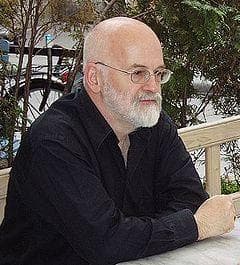
Sir Terence David John Pratchett was an English humorist, satirist, and author of fantasy novels, especially comical works. He is best known for his Discworld series of 41 novels.
Similar books
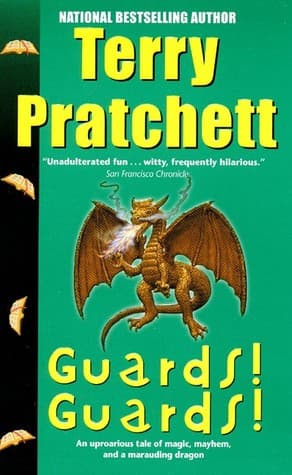
- Guards! Guards!
Terry Pratchett
4.3 (165k) average on GoodreadsFantasyShares Pratchett's signature wit, world-building, and character-driven humor.
- The Colour of Magic
Terry Pratchett
4.0 (425k) average on GoodreadsFictionEarly Discworld novel featuring Rincewind and a quest-based plot, though less refined.
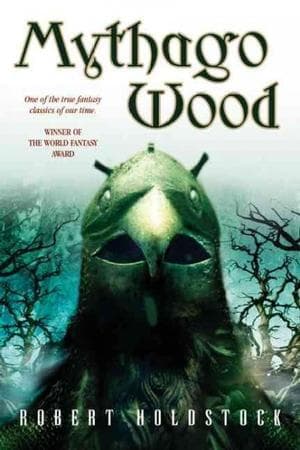
- Mythago Wood
Robert Holdstock
3.8 (8k) average on GoodreadsFantasyExplores ancient myths and their impact on the present, with a sense of epic wonder.
- Harry Potter and the Sorcerer's Stone
J.K. Rowling
4.5 (7M) average on GoodreadsFantasyRescued from a miserable life under the stairs, an orphaned boy discovers he's a wizard destined for a magical school, where he uncovers a dangerous secret tied to the dark wizard who murdered his parents.
- The Hunger Games
Suzanne Collins
4.3 (6.4M) average on GoodreadsFantasyIn a future where children fight to the death on live television, Katniss Everdeen volunteers for the arena, turning a death sentence into a fight for survival and a spark of rebellion.
- 1984
George Orwell
4.2 (3.1M) average on GoodreadsPoliticsIn a future where surveillance and thought control are absolute, a man's search for truth clashes with the Party, showing that hope can be a form of rebellion.




Enjoyed the summary?
A summary gives you the shape of the book. The book itself has the detail, the examples and the voice.
Find The Last Hero on AmazonAs an Amazon Associate, BookBrief earns from qualifying purchases. How we're funded