“The world is full of obvious things which nobody by any chance ever observes.”
— Holmes reflects on the nature of observation in a mystery.

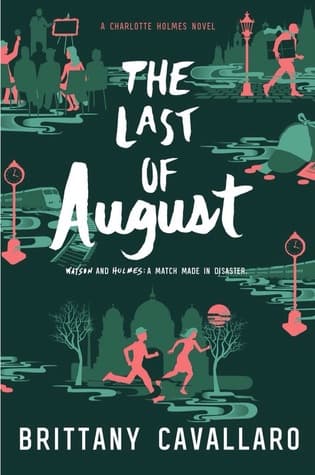
Brittany Cavallaro (2017)
Goodreads Rating
3.60/ 5(14,773 reviews)
Genre
Summary Read
11 min
Book Length
360 min
Sign in to track this book
Charlotte Holmes and Jamie Watson face a German art forgery ring, a presumed-dead Moriarty, their families' dark histories, and their complicated feelings for each other.
Ask anything about The Last of August and get instant answers grounded in the summary.
Jamie Watson travels to Sussex, England, to spend Christmas break with Charlotte Holmes at her family's estate. The atmosphere is tense. Charlotte's parents, Olivia and Mycroft, seem distant, and her uncle Leander acts secretive about his work. Leander, an art historian, is reportedly involved in a German art forgery investigation. Charlotte and Jamie's growing romantic feelings are complicated by Charlotte's emotional guardedness and a past mystery involving August Moriarty. The fragile peace ends when Leander disappears from the estate, leaving a cryptic note. Charlotte immediately suspects foul play and prepares to follow his trail.
Using the few clues Leander left, Charlotte and Jamie go to Berlin. Their investigation quickly leads them into the city's underground art forgery scene. They are surprised to find August Moriarty, whom Charlotte thought was dead and had been obsessed with, alive and working in this world. August, a member of the powerful Moriarty family known for art forgery, becomes their contact. He is a source of both information and suspicion. Charlotte's complicated history with August, along with Jamie's growing jealousy, adds more tension to their dangerous search for Leander and the truth.
As Charlotte, Jamie, and August look deeper into the Berlin art world, they uncover a sophisticated art forgery ring, much larger than they first thought. The Moriarty family, especially August's uncle, Julian Moriarty, runs this operation. They have perfected making perfect copies of famous artworks for generations. Leander, they discover, was not just investigating; he had gotten too close to the Moriarty's secrets. The situation gets more serious as they realize Leander might be held captive or in danger because of what he found out about the Moriarty business.
The trail of the forgery ring leads Charlotte, Jamie, and August to the art houses and auctions of Prague. Here, they try to get into a high-stakes event where forged masterpieces are being traded. Their plan fails, and they find themselves in danger, barely escaping capture by Julian Moriarty's guards. During this intense event, Charlotte makes a quick decision that puts her and Jamie in more danger. This shows her recklessness and focus on the case. The close call also makes Jamie face Charlotte's past connection to August and the risks she takes.
Charlotte, Jamie, and August find Leander, held captive by Julian Moriarty. Leander tells them the full extent of Julian's operation and the danger he is in. However, a shocking truth comes out: Leander was not just investigating; he had been forced or tricked into helping the Moriartys in some way. This betrayal deeply affects Charlotte, who admired her uncle. The discovery complicates their rescue, as they now must free Leander and deal with the moral issues of his actions and the Moriarty family's power.
August Moriarty gives Charlotte and Jamie important information about his family's history and why they have forged art for generations. He explains that the Moriartys see themselves as artists, perfecting the skill of copying. Their operation is less about simple greed and more about a twisted sense of artistic legacy and control over the art market. August's mixed feelings about his family's history and his own part in it are clear, adding to his character and to understanding the antagonist's reasons. This information helps Charlotte understand the scope of what she is facing.
The investigation's peak brings Charlotte and Jamie face-to-face with Julian Moriarty, the leader of the forgery ring. The confrontation is tense and dangerous. Julian shows his ruthlessness and his deep hatred for those who threaten his family's operations. He tries to manipulate Charlotte, using her past and her desire for answers. During this standoff, the full extent of Leander's involvement and the pressure he was under are revealed. Charlotte and Jamie must use their intelligence and bravery to outsmart Julian and keep Leander safe, while dealing with the physical threats from Julian's network.
After the intense confrontation, Julian Moriarty's operations are stopped, and he is arrested or significantly weakened, though the full extent of his defeat may not be clear. Leander is rescued, but his reputation and Charlotte's trust in him are badly damaged by his compromised actions. The Moriarty family's power lessens, but their history of forgery does not disappear completely. Charlotte and Jamie deal with the emotional aftermath of the case, the danger they faced, and their changing relationship. The events leave them with more questions than answers about truth, loyalty, and their own families.
Afterwards, Charlotte faces the emotional impact of August Moriarty and the results of her single-minded pursuit of the truth, which often puts her and Jamie in danger. August's reappearance and the truths about her uncle Leander make her rethink her past and her idea of family loyalty. Jamie, always a loyal companion, supports Charlotte, helping her process the trauma and disappointment. Their bond grows, but Charlotte's guarded nature and her past continue to challenge their growing romantic relationship, leaving their future uncertain but hopeful.
Charlotte and Jamie return to school, changed by their experiences in Berlin and Prague. The case tested their detective skills, their personal limits, and their partnership. While the immediate threat from the Moriarty family may be gone, the knowledge they gained about art forgery and the hidden parts of powerful families stays with them. Their bond, formed in danger and mutual respect, strengthens, setting the stage for future adventures and continued growth in their complex, intellectual relationship. They now understand each other's weaknesses better.
The Protagonist
Charlotte learns to confront her past traumas and begins to open up emotionally, especially to Jamie, while grappling with the disillusionment caused by her uncle's actions.
The Protagonist
Jamie grows in confidence and assertiveness, learning to stand up for himself and articulate his feelings to Charlotte, while solidifying his role as her indispensable partner.
The Supporting
August is revealed to be alive and conflicted about his family's legacy, acting as both a hindrance and an aid to Charlotte and Jamie, while reigniting old flames with Charlotte.
The Supporting
Leander's initial portrayal as an innocent victim gives way to the revelation of his compromised involvement, leading to his rescue but a fractured relationship with Charlotte.
The Antagonist
Julian serves as the main antagonist, whose elaborate forgery ring is exposed and disrupted by Charlotte and Jamie.
The Supporting
Her character remains largely static, representing the intellectual yet emotionally distant Holmes family dynamic.
The Supporting
His character remains largely static, reinforcing the intellectual yet emotionally distant Holmes family dynamic.
The Mentioned
Not applicable as she is a mentioned character.
The novel explores how characters deal with their family histories. Charlotte and Jamie are descendants of literary figures, and their identities are shaped by the expectations and burdens of their names. Charlotte tries to define herself beyond being 'Holmes,' especially because of her past with August Moriarty. The Moriarty family, in contrast, embraces their history of criminal brilliance through art forgery, seeing it as a twisted artistic tradition. Leander's actions also make Charlotte face the imperfect truth of her family's 'good' name. This theme questions whether identity is set by heritage or by personal choices.
“What they learn might change everything they know about their families, themselves, and each other.”
This theme is central to a mystery novel. The plot is about finding the truth behind Leander's disappearance and the Moriarty art forgery ring, which itself is based on lies. Forgery blurs the lines between original and copy, truth and lie. Characters like August Moriarty act in morally gray areas, making their true intentions hard to know. Charlotte's past with August is full of deceit and misunderstanding. The novel constantly asks characters and readers to look past appearances and question what is real. It shows how easily truth can be twisted or hidden, even by those closest to you.
“But Charlotte isn't the only Holmes with secrets, and the mood at her family's Sussex estate is palpably tense.”
The growing romance between Charlotte and Jamie is a main emotional thread. Jamie's deep love and loyalty for Charlotte are tested by her emotional guardedness and her complicated past with August Moriarty. Jamie feels jealous and insecure when August reappears, challenging his place in Charlotte's life. Charlotte, while having feelings for Jamie, struggles to express them, often focusing on logic or the case. The novel explores the vulnerability and pain of loving someone who is emotionally closed off. It shows how past relationships can affect present ones, forcing characters to face their deepest insecurities.
“Holmes and Watson could be becoming more than friends—but still, the darkness in Charlotte's past is a wall between them.”
Charlotte's character is defined by her intense intellectual focus, first on August Moriarty and then on solving her uncle's disappearance. This single-mindedness, while leading to her brilliant deductions, often makes her ignore personal safety and emotional well-being. Her past with August is a big obstacle in her relationship with Jamie, as it is a part of her history she keeps hidden. The Moriarty family's long-standing commitment to art forgery can also be seen as a collective obsession, a dedication to their 'craft' that goes beyond law and morality. The theme examines the destructive and constructive power of intense focus.
“August Moriarty (formerly Charlotte's obsession, currently believed by most to be dead)...”
The novel looks at the complexities of family connections, especially the expectations and possibility of betrayal within them. Charlotte's initial loyalty and admiration for her uncle Leander are shattered when she learns of his compromised involvement with the Moriarty family. This forces her to face the difficult truth that even those she trusts most can act against her expectations. Similarly, August Moriarty is conflicted by his loyalty to his family's criminal business versus his own morals and his complicated feelings for Charlotte. The theme highlights the often-strained nature of family duty and the strong impact of perceived betrayals.
“What they learn might change everything they know about their families...”
Provides an intimate, yet somewhat filtered, perspective on Charlotte Holmes.
Jamie Watson serves as the first-person narrator, offering the reader an intimate and often emotionally charged perspective on Charlotte Holmes and their adventures. His role as the 'Watson' allows for Charlotte's brilliance to be highlighted through his observations, while also providing a grounded, empathetic counterpoint to her more detached nature. The narrative is filtered through his love and concern for Charlotte, meaning the reader experiences her through his eyes, including his frustrations, jealousy, and admiration. This perspective also allows for internal monologues about his feelings for Charlotte and his struggles with their complicated dynamic, giving emotional depth to the high-stakes plot.
A sophisticated criminal enterprise serving as the central mystery.
The Moriarty family's art forgery ring is the primary plot device driving the mystery. It provides the reason for Leander Holmes's disappearance and draws Charlotte and Jamie into a dangerous international investigation. The intricate details of the forgery process, the network of dealers, and the historical legacy of the Moriarty family's involvement add depth and complexity to the criminal underworld they navigate. This device allows for exploration of themes like truth vs. deception, the nature of art, and the power of legacy, while providing a constant source of suspense, danger, and intellectual challenge for the protagonists to unravel.
The traditional Holmesian method of advancing the plot through intellectual puzzles.
True to its Sherlockian roots, the plot progresses through a series of cryptic clues, subtle observations, and Charlotte's brilliant deductions. Leander's initial disappearance leaves behind minimal, ambiguous hints that Charlotte meticulously pieces together. From analyzing the details of art pieces to deciphering coded messages or understanding criminal psychology, Charlotte's deductive process is a central mechanism for uncovering information and moving the narrative forward. This device not only showcases Charlotte's intellectual prowess but also engages the reader in the mystery, inviting them to follow her thought process as she solves the puzzles.
An inherited rivalry that adds historical context and personal stakes.
The historical rivalry between the Holmes and Moriarty families serves as a powerful backdrop and personalizes the conflict for Charlotte and August. It's not just a battle between good and evil, but a clash of inherited legacies and opposing ideologies. This feud adds a layer of destiny and heightened stakes to the narrative, as Charlotte and August are almost fated to confront each other. It also allows for the exploration of how family history shapes individual identity and the choices characters make, often forcing them to either uphold or defy their ancestral roles. The re-emergence of August Moriarty directly triggers the rekindling of this ancient conflict.
Provides a glamorous and dangerous backdrop for the international investigation.
The shift from the familiar, somewhat staid English setting to the vibrant and gritty European cities of Berlin and Prague is a key plot device. These international locations provide a sense of adventure and danger, immersing Charlotte and Jamie in a world far removed from their typical school environment. Berlin's underground art scene and Prague's glamorous art houses offer diverse backdrops for the forgery operation, creating a visually rich and atmospherically distinct environment for the mystery to unfold. The foreign setting also enhances the feeling of isolation and vulnerability for the protagonists, increasing the stakes of their investigation.
“The world is full of obvious things which nobody by any chance ever observes.”
— Holmes reflects on the nature of observation in a mystery.
“Love is a dangerous disadvantage.”
— Watson contemplates the risks of romantic entanglements.
“We are all mysteries, even to ourselves.”
— A character muses on self-discovery and hidden depths.
“Sometimes the smallest clues lead to the biggest truths.”
— Holmes emphasizes the importance of details in solving a case.
“Trust is a fragile thing, easily broken and hard to mend.”
— Watson reflects on relationships and betrayal.
“The past is a ghost that haunts us all.”
— A character discusses the lingering effects of history.
“In the end, we are all just stories waiting to be told.”
— A philosophical moment about life and legacy.
“Fear is a poison that clouds the mind.”
— Holmes advises on overcoming emotional obstacles.
“The heart wants what it wants, even when it knows better.”
— Watson struggles with romantic feelings.
“Every lie has a truth hidden within it.”
— A insight into deception and uncovering secrets.
“Courage is not the absence of fear, but the will to act despite it.”
— A character encourages bravery in a tense situation.
“The line between love and obsession is thin and easily crossed.”
— A warning about the dangers of intense emotions.
“Secrets are like shadows; they follow you everywhere.”
— Reflection on the burden of hidden truths.
“Sometimes the hardest person to save is yourself.”
— A moment of self-reflection and personal struggle.
“In a world of chaos, love is the only constant.”
— A hopeful note on the enduring power of love.
Ready to see how well you understood this book? Take our interactive quiz with 10 questions.
Support the author — grab the full book.
As an Amazon Associate, BookBrief earns from qualifying purchases, at no extra cost to you. How we're funded.