
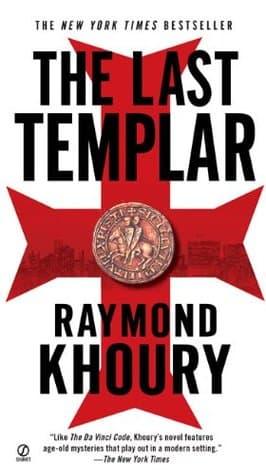
Synopsis
Covers the whole plot, including the ending.
- Difficulty
- Medium
- Pacing
- Fast
- Mood
- Suspenseful, Mysterious, Thrilling, Conspiratorial, Historical
- Read it if
- You enjoy fast-paced thrillers blending historical mystery with modern-day action and conspiracy theories involving powerful ancient orders and the Church.
- Skip it if
- You dislike historical conspiracies that challenge religious dogma or find extensive travelogues and detailed historical explanations tedious.
The Last Templar Plot Summary
Covers the whole plot, including the ending.
The Fall of Acre and the Templar's Escape
In 1291, as the last Crusader stronghold of Acre falls to the Mamluks, a young Templar knight named Martin and his mentor, Aimard, receive a mysterious chest from the dying Grand Master, Guillaume de Beaujeu. They, along with a few other knights, escape to the sea, boarding a ship meant to carry them and their cargo to safety. The city burns behind them, and the Templar Order's fate hangs in the balance. The ship, carrying the Order's most guarded secret, vanishes into the Mediterranean, its destination and the chest's contents becoming a legend lost to time.
Metropolitan Museum Heist
In present-day New York City, a black-tie gala opening the 'Treasures of the Vatican' exhibit at the Metropolitan Museum of Art is violently interrupted. Four masked horsemen, dressed as Templar Knights, charge into the museum, causing panic. Archaeologist Tess Chaykin, attending the event, sees the scene. The horsemen's leader, after a brutal attack on security, takes a specific artifact: a strange, geared device. He speaks cryptic Latin words before seizing the device and leading his group away, vanishing as quickly as they appeared, leaving behind devastation and unanswered questions.
FBI Investigation Begins
FBI Agent Sean Reilly, an experienced anti-terrorist specialist, investigates the museum heist. The attack's theatrical nature, with the Templar costumes and specific target, puzzles authorities. Reilly, at first suspecting a sophisticated terrorist group, starts to piece together the clues. He finds himself drawn into the crime's historical and religious implications, realizing this is no ordinary robbery but something far more complex and rooted in history, with potentially devastating modern consequences.
Tess and Sean's Unlikely Alliance
Tess Chaykin, a brilliant but somewhat quiet archaeologist and expert in ancient languages and artifacts, is asked by the FBI to help identify the stolen device and decipher the Latin spoken by the horsemen's leader. Her unique knowledge proves helpful. Initially hesitant to get deeply involved, Tess is drawn into the mystery by the Templar connection's historical weight. She forms an alliance with Agent Reilly, their contrasting personalities and professional approaches often clashing but ultimately complementing each other as they look deeper into the enigma.
The First Clue and a Deadly Pursuit
Working together, Tess and Reilly find that the stolen geared device is more than just an artifact; it is a key to a larger puzzle. Through careful research and Tess's linguistic skills, they decipher a hidden message or clue embedded within the device or the Latin phrase, pointing towards a specific historical location or text. This discovery immediately puts them in danger, as the mysterious group responsible for the heist learns of their progress. They find themselves targeted by killers, leading to close calls and a desperate race to stay ahead.
Journey to Europe
The clues lead Tess and Reilly out of New York and across the Atlantic to Europe, specifically to sites with important Templar history. Their journey takes them through ancient churches, forgotten archives, and hidden crypts in places like France and Italy. Each location reveals another piece of the puzzle, often coded messages, obscure symbols, or historical documents. They learn more about the Templar Order's true secrets and the immense power it holds, realizing the stakes are far higher than they first imagined.
The Brotherhood of the Templar
As Tess and Reilly search further, they uncover evidence of a powerful, secret organization – a modern continuation or revival of the original Templar Order, or at least a group claiming its legacy. This 'Brotherhood' has kept its secrets for centuries, operating in the shadows and holding significant influence. They realize that the museum heist was not an isolated incident but part of a larger, planned operation to recover something of immense value to this group, something that could reshape global power dynamics or religious understanding.
The Vatican's Involvement
The investigation reveals a darker side to the Vatican's historical relationship with the Templars. Tess and Reilly discover that the Church has tried to suppress the Templar secret for centuries, fearing its potential to undermine its authority and basic doctrines. They meet people within the Vatican who are either involved in the cover-up or actively trying to prevent the secret from being exposed, showing the deep power struggles and ideological conflicts that have lasted for generations, all centered around the truth the Templars guarded.
Deciphering the Grand Master's Final Message
Through Tess's archaeological insights, her fluency in ancient languages, and Reilly's investigative skills, they finally decipher the Grand Master's final, most cryptic message, the one given to Martin in Acre. This message points directly to the location of the true Templar treasure – not gold or jewels, but a document or artifact that contains a truth so profound and potentially destabilizing that it could shatter religious faith and global order. The race quickens as they close in on the ultimate prize.
The Confrontation in the Holy Land
The pursuit ends in the Middle East, specifically in the Holy Land, the Templar Order's birthplace. Tess and Reilly confront the leaders of the modern Templar group, as well as those within the Vatican who have tried to control or suppress the secret. The climax is a tense and violent confrontation, where the true nature of the Templar secret is finally revealed. It is a revelation that challenges centuries of accepted history and religious dogma, forcing all involved to deal with the profound implications of what has been found.
The Revelation of Christ's 'Myth'
The Templar secret is finally revealed: a document, believed to be the true gospel written by a close contemporary of Jesus, which shows him not as divine, but as a mortal man, a prophet, whose teachings were later embellished and deified by his followers. This 'gospel' contains no miracles, no resurrection, only a human story. The document, if revealed, would dismantle the foundations of Christianity, proving Pope Leo X's quote that the 'myth of Christ' served well. This revelation explains the centuries of fierce protection and suppression.
The Choice and Its Aftermath
With the Templar secret in their hands – the document that could shatter the Christian world – Tess and Reilly face a difficult choice. Do they reveal the truth to the world, potentially causing global chaos and a crisis of faith on an unprecedented scale, or do they keep it hidden, allowing the 'myth' to persist? The decision weighs heavily on them, understanding the immense power they now hold. The ending leaves the implications of their choice, and the future of religious belief, uncertain, hinting at the profound ripple effects of their discovery.
The Last Templar Characters
Tess Chaykin
Protagonist
A brilliant archaeologist specializing in ancient languages and artifacts.
Tess Chaykin is a highly intelligent and independent archaeologist with an exceptional talent for deciphering ancient texts and understanding historical contexts. She is initially reluctant to involve herself in the FBI investigation, preferring the quiet solitude of academic research. However, her inherent curiosity and a strong sense of historical integrity compel her to join forces with Reilly. She is driven by a desire for truth and a deep respect for history, which often puts her at odds with those who seek to manipulate or suppress it. Her analytical mind is key to unlocking the Templar mystery.
Relationships: Sean Reilly (Initially a professional alliance, evolving into a close partnership and mutual respect, with underlying romantic tension.)
Sean Reilly
Protagonist
A seasoned FBI anti-terrorist agent with a pragmatic and disciplined approach.
Sean Reilly is a dedicated and resourceful FBI agent, accustomed to dealing with tangible threats and conventional crime. He is initially skeptical of the historical and religious dimensions of the museum heist, preferring concrete evidence and direct action. His pragmatism often clashes with Tess's academic approach, but he quickly learns to value her expertise. Reilly is driven by a strong sense of duty and justice, and his determination to uncover the truth propels the investigation forward. He is courageous and protective, especially of Tess, as they navigate increasingly dangerous situations.
Relationships: Tess Chaykin (A professional partnership that deepens into a bond of trust and mutual admiration, with hints of romance.)
Martin
Historical Protagonist/Catalyst
A young Templar knight who escapes Acre with the Order's greatest secret.
Martin is a fictional young Templar knight from 1291, present during the fall of Acre. He is entrusted by the dying Grand Master with the sacred chest containing the Templar's ultimate secret. His escape and the subsequent disappearance of his ship form the historical foundation of the modern-day mystery. Martin represents the last link to the original secret, his actions centuries ago directly influencing the present-day events. He is portrayed as loyal and dedicated to his Order, undertaking a perilous mission to safeguard its most profound truth.
Relationships: Aimard (His mentor within the Templar Order, who helps him escape Acre.); Guillaume de Beaujeu (The Grand Master who entrusts him with the secret.)
Aimard
Supporting (Historical)
Martin's mentor, a wise and experienced Templar knight.
Aimard is an older, more experienced Templar knight who serves as a mentor to young Martin during the harrowing escape from Acre in 1291. He is instrumental in ensuring Martin understands the gravity of the mission and the importance of protecting the chest. Aimard represents the wisdom and dedication of the older generation of Templars, ensuring the continuity of their sacred trust even in the face of their Order's destruction. His guidance is crucial in setting Martin on his path to safeguard the secret.
Relationships: Martin (Mentor and protector.)
Brotherhood of the Templar (Modern)
Antagonists
A shadowy, modern-day organization seeking to reclaim the Templar secret.
This clandestine group, comprised of wealthy and influential individuals, believes itself to be the true inheritors and protectors of the original Templar Order's legacy. They are the masked horsemen who raid the Met Museum. Their ultimate goal is to recover the lost secret and use its power or influence for their own ends, whether it be to reshape religious belief, gain political power, or simply maintain the truth's hidden status. They are ruthless and highly organized, employing assassins and sophisticated resources to achieve their objectives, and are willing to kill anyone who stands in their way.
Relationships: Tess Chaykin (Adversaries, constantly pursuing and attempting to eliminate her.); Sean Reilly (Adversaries, constantly pursuing and attempting to eliminate him.)
Cardinal Valenti
Supporting/Antagonist
A high-ranking Vatican official involved in the Templar secret's suppression.
Cardinal Valenti is a powerful and influential figure within the Vatican, deeply entrenched in the Church's long-standing efforts to suppress the Templar secret. He represents the institutional fear and desire to protect the established dogma, even if it means concealing historical truth. Valenti is a complex character, not necessarily evil, but driven by what he perceives as the greater good for the Church and its followers. He is willing to go to great lengths to prevent the secret from being revealed, often conflicting with Tess and Reilly.
Relationships: Tess Chaykin (Opponent in the race for the secret, representing the Church's desire for secrecy.); Sean Reilly (Opponent in the race for the secret, representing the Church's desire for secrecy.)
Pope Leo X
Mentioned (Historical)
16th Century Pope, whose quote prefaces the book.
Pope Leo X is a historical figure, a 16th-century Pope whose famous quote, 'It has served us well, this myth of Christ,' serves as an epigraph to the novel. This quote encapsulates the central theme of the book, suggesting that the Church knowingly propagated a 'myth' for its own benefit. While not a character in the direct narrative, his statement acts as a powerful thematic anchor, foreshadowing the profound revelation at the story's core and the Vatican's historical involvement in maintaining certain doctrines.
The Last Templar Themes
The Nature of Faith and Truth
The novel explores the tension between historical truth and religious faith. It questions if faith can last if its foundational 'truths' are revealed to be historical fictions or deliberate creations. The Templar secret, a document suggesting Christ was only mortal, directly challenges centuries of Christian dogma. This theme appears in the characters' struggles, particularly Cardinal Valenti's actions to preserve the 'myth' for society's stability, and Tess Chaykin's pursuit of historical accuracy, regardless of its disruptive potential. The ending forces the protagonists to decide if the world is better off with or without the 'truth.'
“It has served us well, this myth of Christ.”
Historical Conspiracy and Secrecy
The entire plot relies on a centuries-old conspiracy to hide a truth that could shatter established religious and historical narratives. The existence of a modern-day 'Brotherhood of the Templar' and the Vatican's historical efforts to suppress the secret show how powerful institutions can control information and manipulate history. The story carefully uncovers layers of secrecy, from coded messages in ancient artifacts to hidden archives, showing how far groups will go to protect or exploit a deep secret. This theme suggests that history is not always what it seems, and powerful truths can lie hidden for generations.
“History is written by the victors. And sometimes, it's rewritten by those who guard its most dangerous secrets.”
The Price of Knowledge
Seeking the Templar secret comes at a high cost, both personally for Tess and Reilly, and potentially globally. The characters face constant danger, violence, and moral dilemmas as they uncover increasingly disruptive truths. The novel suggests that some knowledge is so powerful that its revelation could cause widespread chaos and suffering, forcing a difficult ethical choice. Tess's academic drive for truth clashes with the practical concerns about its consequences, while Reilly must weigh the pursuit of justice against the potential for global instability. The final decision about the secret's fate shows this theme.
“Some truths are best left buried, Agent. For the good of mankind.”
The Enduring Power of Institutions
The novel examines the lasting power of institutions, especially the Catholic Church and the secret 'Brotherhood of the Templar.' It shows how these organizations, with their resources, influence, and centuries of history, can shape events and control narratives. The Church's consistent efforts to maintain its dogma, even through suppression, and the Templars' ability to remain a secret society for over 700 years, illustrate their resilience. The conflict between these groups and the protagonists highlights the challenge of confronting such deeply embedded powers.
“The Church has survived for two millennia, Dr. Chaykin. It knows how to protect itself.”
Plot Devices & Literary Techniques
The Antikythera Mechanism-like Device
An ancient, geared artifact that serves as the initial key to the mystery.
This strange, geared device, stolen from the Metropolitan Museum, is the inciting incident of the modern plot. It functions as a complex puzzle box, containing coded messages or acting as a key to decipher further clues. Its intricate design and anachronistic appearance immediately signal its importance and historical depth, linking the present-day heist to an ancient secret. Its theft by the Templar horsemen highlights its critical role as the first piece of the larger puzzle, propelling Tess and Reilly into the dangerous world of Templar lore and conspiracy.
Coded Messages and Ancient Texts
Hidden information embedded in historical artifacts and documents.
Throughout the novel, Tess and Reilly encounter various forms of coded messages, ancient texts, and obscure symbols that serve as breadcrumbs leading them to the ultimate Templar secret. These devices require Tess's expertise in linguistics and archaeology to decipher, allowing the plot to unfold through intellectual discovery. They are crucial for revealing historical context, identifying locations, and explaining the motivations of the Templars. This device emphasizes the intellectual challenge of the mystery and Tess's unique contribution to the investigation.
The MacGuffin (The Templar Secret)
The ultimate, highly sought-after object that drives the entire plot.
The 'Templar secret' itself acts as the primary MacGuffin of the story. While its true nature (a document proving Christ's mortality) is eventually revealed, its initial identity is shrouded in mystery, generating suspense and driving all character motivations. Both the modern Templar Brotherhood and elements within the Vatican are desperate to acquire or suppress it, making it the central object of desire and conflict. Its immense power to reshape history and faith is what makes it so valuable and dangerous, fueling the race across continents.
The Chase/Race Against Time
A relentless pursuit and desperate search for the secret before antagonists.
The narrative is structured as a continuous chase and race against time. Tess and Reilly are not only pursuing the Templar secret but are also constantly being pursued by the ruthless modern-day Templars and shadowed by Vatican operatives. This device creates constant tension, danger, and urgency, as the protagonists must decipher clues and travel to new locations before their adversaries can either seize the secret themselves or eliminate Tess and Reilly. The ticking clock aspect heightens the stakes and propels the plot forward at a brisk pace.
The Last Templar Quotes
“The greatest truths are often hidden in the simplest of places, under the weight of history and the dust of ages.”
“Faith, like fear, can make men do terrible things, but it can also inspire them to unimaginable greatness.”
“Some secrets are meant to stay buried. Not because they are dangerous, but because the world isn't ready for them.”
“The past is never truly dead. It's not even past. It's a living, breathing thing that influences every moment of our present.”
“Power is not about what you possess, but about what you can control, and more importantly, what you can make others believe.”
“There are no accidents in history, only events whose true causes are yet to be revealed.”
“Sometimes, the most dangerous weapon is not a sword or a gun, but an idea that challenges everything we hold dear.”
“The search for truth is a lonely path, often fraught with peril, but it is the only path worth taking.”
“History is written by the victors, but the truth often lies with the vanquished.”
“Even in the darkest of times, a flicker of hope can ignite a revolution.”
“The greatest deceptions are often built on a foundation of partial truths.”
“We are all products of our history, bound by its chains, yet also freed by its lessons.”
“To truly understand the present, one must first understand the echoes of the past.”
Quiz
10 questions on the plot and the characters. Each answer comes with a short explanation.
Question 1
In what year does the historical prologue of 'The Last Templar' take place, depicting the fall of Acre?
- 1099
- 1187
- 1291
- 1307
Show answer
C. 1291 The book opens in 1291 with the fall of Acre, where a young Templar knight escapes with a mysterious chest.
Question 2
Which famous New York City landmark is the setting for the present-day attack by the masked horsemen?
- The Empire State Building
- The Metropolitan Museum of Art
- Grand Central Terminal
- The New York Public Library
Show answer
B. The Metropolitan Museum of Art The masked horsemen attack the Metropolitan Museum of Art during a 'Treasures of the Vatican' exhibit opening.
Question 3
What is the profession of Tess Chaykin, who witnesses the attack at the museum?
- Historian
- Art Conservator
- FBI Agent
- Archaeologist
Show answer
D. Archaeologist Tess Chaykin is identified as an archaeologist attending the gala.
Question 4
What specific item do the masked horsemen target and steal from the Vatican exhibit?
- A jeweled cross
- An ancient manuscript
- A strange geared device
- A relic believed to be from the True Cross
Show answer
C. A strange geared device The leader of the horsemen 'hones in on one piece in particular, a strange geared device,' taking it with reverence.
Question 5
What is the role of Sean Reilly in the investigation following the museum attack?
- Head of Museum Security
- FBI anti-terrorist specialist
- Lead Detective, NYPD
- Vatican Liaison
Show answer
B. FBI anti-terrorist specialist Sean Reilly is introduced as an FBI anti-terrorist specialist leading the investigation.
Question 6
What is the historical significance of the 'myth of Christ' quote attributed to Pope Leo X at the beginning of the book?
- It highlights the Pope's personal devotion to Christ.
- It suggests the political and strategic utility of religious belief.
- It refers to the historical debate about Christ's existence.
- It's a commentary on the Pope's efforts to spread Christianity.
Show answer
B. It suggests the political and strategic utility of religious belief. The quote, 'It has served us well, this myth of Christ,' implies a cynical view of religion's instrumental value, setting a theme of hidden truths and political manipulation.
Question 7
What specific instructions did the dying Grand Master of the Templars give regarding the mysterious chest in 1291?
- To deliver it to the King of France.
- To bury it beneath the walls of Acre.
- He entrusted it to a young Templar knight and his mentor to escape with.
- To destroy its contents before it fell into enemy hands.
Show answer
C. He entrusted it to a young Templar knight and his mentor to escape with. The Grand Master 'entrusted' the mysterious chest to the young Templar knight and his mentor, who then escaped with it.
Question 8
What is the ultimate goal of Sean Reilly and Tess Chaykin's 'deadly game of cat and mouse' as they race across continents?
- To capture the masked horsemen and bring them to justice.
- To recover the lost secret of the Templars.
- To prevent a global terrorist attack.
- To expose corruption within the Vatican.
Show answer
B. To recover the lost secret of the Templars. The synopsis states their goal is to 'race across three continents to recover the lost secret of the Templars.'
Question 9
What is the significance of the masked horsemen dressing as Templar Knights during their attack?
- It's a random costume choice for anonymity.
- It's a direct challenge to the historical narrative of the Templars.
- It implies a connection to the historical Templar Order and its hidden secrets.
- It's a symbolic protest against the Vatican exhibit.
Show answer
C. It implies a connection to the historical Templar Order and its hidden secrets. Their attire directly links them to the Knights Templar, suggesting a deep, historical motivation tied to the Order's 'dark, hidden history' and lost secrets.
Question 10
The synopsis mentions the escaping Templar ship 'vanishes without a trace.' What does this imply for the overall mystery?
- The Templars successfully reached their destination and settled.
- The secret was lost forever at sea, making the present-day search futile.
- It creates a historical gap and an unsolved mystery that the present-day plot aims to resolve.
- The ship was sunk by naval forces shortly after leaving Acre.
Show answer
C. It creates a historical gap and an unsolved mystery that the present-day plot aims to resolve. The ship vanishing 'without a trace' establishes the central historical mystery—what happened to the Templars and their secret, linking the past to the present-day quest.
The Last Templar FAQ
What is the central mystery that propels the plot of 'The Last Templar'?
The central mystery revolves around the disappearance of the Templar Knights' greatest secret and treasure after the fall of Acre in 1291. In the present day, the theft of a strange geared device from the Metropolitan Museum of Art by masked horsemen reignites the hunt for this ancient secret, which is believed to be a document that could challenge the very foundations of Christianity.
Who are the main protagonists driving the investigation in the present day?
The main protagonists are Tess Chaykin, an archaeologist who witnesses the museum heist and recognizes the significance of the stolen artifact, and Sean Reilly, an FBI anti-terrorist specialist assigned to the case. Their combined expertise, one in history and the other in modern investigation, proves crucial as they delve into the Templar mystery.
What is the significance of the opening scene in Acre in 1291?
The opening scene establishes the historical foundation for the entire novel, depicting a young Templar knight and his mentor escaping the burning city of Acre with a mysterious chest. This chest, containing the Order's most valuable secret, vanishes, setting up the historical enigma that Tess and Sean must unravel centuries later.
Who are the masked horsemen, and what is their immediate objective at the Metropolitan Museum of Art?
The masked horsemen are a modern-day group, later revealed to be linked to a secret Vatican society, who stage a dramatic raid on the Metropolitan Museum. Their immediate objective is to steal a specific geared device from the 'Treasures of the Vatican' exhibit, which they believe is a key to unlocking the location of the lost Templar secret.
What is the 'myth of Christ' mentioned in the Pope Leo X quote, and how does it relate to the Templars' secret?
The 'myth of Christ' refers to the established narrative of Jesus's life and divinity as propagated by the Church. The Templars' lost secret is revealed to be a document, 'The Gospel of Jesus,' which purports to be an eyewitness account challenging this traditional narrative, specifically by suggesting Jesus survived the crucifixion and had a family.
How does the geared device stolen from the museum connect to the Templars' ancient secret?
The geared device, initially thought to be a simple artifact, is actually a sophisticated mechanical puzzle or 'key' designed by the Templars. It contains coded information and requires specific knowledge to operate, ultimately revealing the location of the hidden vault where 'The Gospel of Jesus' is stored.
What role does the Vatican play in the modern-day hunt for the Templar secret?
The Vatican, specifically a shadowy secret society within it known as the 'Fraternitas Crucis' (Brotherhood of the Cross), is actively involved in the hunt. They seek to recover and suppress 'The Gospel of Jesus' at all costs, fearing its contents could shatter the faith of millions and undermine the Church's authority.
What is the ultimate 'treasure' that the Templars protected, and why was it so dangerous?
The ultimate 'treasure' is 'The Gospel of Jesus,' a document written by Mary Magdalene that claims Jesus survived the crucifixion, married her, and had children. This account is dangerous because it directly contradicts fundamental tenets of Christian theology regarding Jesus's death, resurrection, and divinity, threatening to destabilize millennia of religious doctrine.
How does Tess Chaykin's archaeological background influence her approach to the mystery?
Tess's archaeological background provides her with a deep understanding of ancient languages, artifacts, and historical contexts, which are crucial for deciphering the Templars' clues. Her academic training allows her to identify the significance of the geared device and interpret the cryptic messages left behind, often seeing connections that Reilly, a modern investigator, might miss.
Describe Sean Reilly's character arc throughout the novel. How does his initial skepticism change?
Sean Reilly begins as a pragmatic FBI agent, initially viewing the case as a complex terrorism investigation, skeptical of historical conspiracies. As he witnesses inexplicable events and encounters undeniable evidence, his skepticism slowly erodes, forcing him to confront the possibility that ancient secrets profoundly impact the present. He evolves from a grounded investigator to someone willing to believe in extraordinary truths.
What psychological motivations drive the antagonists, particularly the leader of the 'Fraternitas Crucis'?
The antagonists, particularly the leader of the Fraternitas Crucis, are driven by a profound conviction that protecting the 'myth of Christ' is paramount to preserving global faith and order. Their motivation stems from a deep-seated fear that revealing 'The Gospel of Jesus' would lead to widespread chaos, spiritual collapse, and potentially wars, justifying their ruthless methods as a necessary evil.
How does the novel explore the psychological impact of discovering a truth that fundamentally challenges one's worldview?
The novel explores this through both Tess and Sean, who are forced to re-evaluate their understanding of history, religion, and reality. Tess, as an academic, is more open to new historical interpretations, but Sean, initially rooted in concrete facts, struggles with the implications. The revelation of 'The Gospel of Jesus' forces them, and the reader, to confront how deeply ingrained beliefs can be challenged by compelling evidence.
Is 'The Gospel of Jesus' presented as definitively authentic within the narrative, or is its authenticity left ambiguous?
Within the narrative, 'The Gospel of Jesus' is presented as definitively authentic, written by Mary Magdalene and containing an eyewitness account. The plot's tension derives from the profound belief in its authenticity by both those seeking to reveal it and those desperate to suppress it, rather than from ambiguity about its origin.
How does the book blend historical fact with fictional elements to create its narrative?
The book skillfully blends historical facts like the fall of Acre, the existence of the Knights Templar, and the political power of the Vatican with fictional elements such as the specific contents of 'The Gospel of Jesus' and the modern-day conspiracy. It uses real historical events as a backdrop to ground its speculative narrative about a profound secret.
What philosophical questions does 'The Last Templar' raise about faith, history, and truth?
The novel raises profound questions about the nature of faith versus historical truth, asking whether a 'truth' that undermines faith is inherently good or destructive. It explores whether humanity is better off believing in a comforting myth or confronting a potentially destabilizing reality, prompting readers to consider the societal implications of such a revelation.
Does the ending provide a clear resolution to the fate of 'The Gospel of Jesus,' or does it leave room for continued debate?
The ending provides a clear resolution within the narrative regarding the immediate fate of 'The Gospel of Jesus,' but it leaves room for continued debate about its broader societal impact. While the document's contents are revealed to the protagonists and some antagonists, its public dissemination and the world's reaction are left open, hinting at the potential for future conflict or profound shifts in understanding.
How does the novel's fast-paced, thriller style influence the reader's engagement with its historical and theological themes?
The fast-paced, thriller style, with its globe-trotting chases and life-or-death stakes, keeps the reader engaged and invested in the plot. This high-octane delivery makes the complex historical and theological themes more accessible and exciting, as they are revealed through urgent discoveries and perilous encounters rather than lengthy exposition, effectively couching deep ideas within an entertaining narrative.
Similar books
- The Da Vinci Code
Dan Brown
3.9 (1.9M) average on GoodreadsThrillerFeatures a symbologist and a secret society, a race against time, and a religious conspiracy.
- Foucault's Pendulum
Umberto Eco
3.9 (60k) average on GoodreadsThrillerExplores complex historical conspiracies and secret societies with deep academic research.
- Angels & Demons
Dan Brown
3.9 (2.7M) average on GoodreadsThrillerA Harvard symbologist races through Rome's ancient sites, deciphering cryptic clues to unmask the Illuminati and stop a vengeful plot to destroy the Vatican with a stolen antimatter weapon.
- Gone Girl
Gillian Flynn
4.1 (2.3M) average on GoodreadsThrillerA wife's sudden disappearance on her fifth anniversary reveals a web of lies and psychological warfare, exposing the secrets within a seemingly perfect marriage.
- The Girl on the Train
Paula Hawkins
3.9 (2.1M) average on GoodreadsThrillerA woman’s fascination with a seemingly perfect couple she watches from her daily train commute leads her into a dark investigation when she witnesses something that shatters their idyllic image.
- The Guest List
Lucy Foley
3.8 (1.3M) average on GoodreadsThrillerOn a remote Irish island, a glamorous wedding descends into a deadly whodunnit when a guest is found murdered, trapping everyone with their secrets as a storm rages.





Enjoyed the summary?
A summary gives you the shape of the book. The book itself has the detail, the examples and the voice.
Find The Last Templar on AmazonAs an Amazon Associate, BookBrief earns from qualifying purchases. How we're funded