
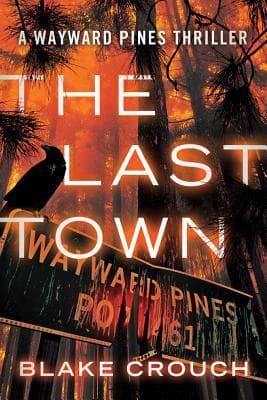
Synopsis
Covers the whole plot, including the ending.
- Difficulty
- Medium
- Pacing
- Fast
- Mood
- Suspenseful, Desperate, Intense, Claustrophobic
- Read it if
- You enjoy fast-paced, high-concept thrillers with a strong sense of mystery and a dystopian twist. Fans of 'The Matrix' or 'Lost' will appreciate the blend of sci-fi, suspense, and a compelling central mystery.
- Skip it if
- You prefer character-driven dramas over plot-heavy thrillers, or if you dislike stories with significant plot twists and a bleak, post-apocalyptic setting.
The Last Town Plot Summary
Covers the whole plot, including the ending.
Ethan's Escape and the Truth Revealed
Secret Service agent Ethan Burke, after weeks of manipulation in Wayward Pines, Idaho, escapes the town's perimeter with his son, Ben. They go through the wilderness beyond the electrified fence, pursued by Wayward Pines security. During their escape, Ethan and Ben encounter terrifying creatures called 'abbies' (aberrations), confirming warnings about the outside world. They also find abandoned, ruined cities, suggesting a global catastrophe. Ethan eventually learns the truth from a hidden bunker: Wayward Pines is the last human settlement, built by David Pilcher, and it is 2,000 years in the future. The abbies are mutated descendants of humanity.
Pilcher's Revelation and the Town's Founding
Ethan and Ben are captured and brought to David Pilcher's underground facility, where Ethan learns the full truth. Pilcher explains he foresaw humanity's self-destruction from environmental collapse and war. He started 'Project Archangel,' cryogenically freezing a select group of people, including himself, and awakening them 2,000 years later. Wayward Pines was built as a controlled environment to preserve the human race, with the fence protecting them from the abbies. Pilcher says his extreme methods, including strict rules and executions, are necessary for humanity's survival. He emphasizes that knowing the past or the world's true nature would cause panic and destroy the fragile society.
The First Generation's Indoctrination
While Ethan deals with the truth, Ben goes to the 'First Generation' school. This program teaches children born in Wayward Pines Pilcher's ideas. They learn that Pilcher is their savior, the creator of their safe world, and that the outside is a dangerous wasteland. The First Generation, led by Jason Higgins, is loyal to Wayward Pines and its rules, acting as Pilcher's enforcers and future leaders. Ben, having seen the outside world with Ethan, struggles with this information but is pressured to conform, especially by Jason, who watches him closely.
Theresa's Investigation and Unsettling Discoveries
Meanwhile, Theresa Burke, Ethan's wife, investigates Wayward Pines, unaware of the full truth her husband has found. She works with Adam Hassler, a former colleague of Ethan's, who also seems trapped in Wayward Pines. Theresa discovers more about the town's surveillance, resident disappearances, and the control by Sheriff Pope and Nurse Pam. She sees the townspeople's fear and compliance, and suspects something more sinister than a simple cult, though she does not yet understand Pilcher's deception. Her efforts bring her closer to the truth, putting her in more danger.
Ethan's Dilemma and Pilcher's Control
Pilcher offers Ethan a choice: be Sheriff and help maintain order, or face consequences. He makes it clear that his family's safety depends on his cooperation. Ethan, now knowing Wayward Pines' existence and the abbies, struggles with this moral problem. He sees the need for Pilcher's mission but dislikes the control and lies. He realizes that keeping the illusion is important for the town's survival, yet his conscience fights against hiding the truth and freedom. He accepts the role, but secretly plans to protect his family and change things from within.
The Breach and the Abbies' Attack
During a time of tension, a breach occurs in the electrified fence protecting Wayward Pines. A horde of abbies enters the town, causing terror and chaos. The town's defenses, made to keep residents in, are overwhelmed by the number of creatures. Residents are attacked, and the illusion of safety is broken. This event makes Ethan act, using his Secret Service training to organize a defense and protect the townspeople, while Pilcher's security forces try to stop the attack.
Ethan's Leadership and Sacrifice
Amidst the abbie invasion, Ethan Burke becomes the leader. He takes charge, coordinating the remaining security forces and able-bodied townspeople to fight the abbies. He ensures Theresa and Ben's safety, guiding them to a secure place. Knowing the fence is broken and the abbies are too many, Ethan realizes a desperate act is needed to save the remaining population. He sacrifices himself, setting explosives to destroy the facility and the attacking abbies, creating a final barrier to protect the survivors. His act allows a small group to escape to an inner sanctuary.
The Aftermath and a New Beginning
After Ethan's sacrifice, a small group of survivors, including Theresa and Ben, emerge from the damaged Wayward Pines. The town is in ruins, but the abbie threat is temporarily contained. However, the lack of leadership and the trauma of the invasion leave the adults disoriented. The First Generation, led by Jason Higgins, takes control. Having been taught Pilcher's ideas, they assert their authority, ready to rebuild Wayward Pines according to Pilcher's original vision, but with a more ruthless approach. Humanity's future rests with these young leaders, leaving Theresa and Ben in a difficult situation.
The Last Town Characters
Ethan Burke
Protagonist
Secret Service agent, unwillingly thrust into Wayward Pines' twisted reality
Ethan Burke is a highly skilled Secret Service agent who wakes up in Wayward Pines with amnesia and soon discovers the town's sinister secrets. Initially driven to escape and find his family, he is tenacious, observant, and morally grounded. His journey forces him to confront unimaginable truths about humanity's future and the sacrifices required for survival. He struggles with the moral compromises necessary to protect his family and the townspeople, ultimately choosing a path of self-sacrifice. His past as an agent makes him uniquely suited to navigate the dangers of Wayward Pines and the abbies.
Relationships: Theresa Burke (Wife); Ben Burke (Son); David Pilcher (Adversary/Manipulator); Beverly (Brief romantic interest/confidante); Kate Hewson (Former partner/Love interest)
Theresa Burke
Supporting
Ethan's determined wife, investigating his disappearance and Wayward Pines' secrets
Theresa Burke is Ethan's wife and a former Secret Service agent herself. She travels to Wayward Pines to find Ethan, displaying immense resilience and investigative skills. She is fiercely protective of her family and refuses to accept the town's superficial explanations. Her skepticism and determination lead her to uncover many of Wayward Pines' unsettling truths from within the town, even before learning the full scope of Pilcher's plan. She adapts quickly to the strange environment and remains a strong presence, fighting for her family's survival.
Relationships: Ethan Burke (Husband); Ben Burke (Son); Adam Hassler (Former colleague/Confidante)
Ben Burke
Supporting
Ethan and Theresa's teenage son, caught between his parents and the First Generation
Ben Burke is Ethan and Theresa's teenage son, initially confused and resentful about being brought to Wayward Pines. He experiences the shocking truth of the outside world alongside his father, then struggles with the indoctrination efforts of the First Generation. Ben is intelligent and observant, but also vulnerable to the influence of his peers, particularly Jason Higgins. His journey highlights the conflict between individual freedom and societal control, and he represents the younger generation's struggle to find their place in Pilcher's vision for humanity's future.
Relationships: Ethan Burke (Father); Theresa Burke (Mother); Jason Higgins (Peer/Antagonist)
David Pilcher
Antagonist
The brilliant and ruthless visionary behind Wayward Pines
David Pilcher is the enigmatic and brilliant scientist who founded Wayward Pines. Convinced that humanity was doomed, he initiated Project Archangel, cryogenically freezing individuals to awaken 2,000 years in the future and restart civilization. He is a charismatic but deeply authoritarian figure, believing his extreme methods, including total surveillance, executions, and the suppression of truth, are necessary for humanity's survival. He views himself as a savior, but his messianic complex and willingness to control every aspect of his subjects' lives make him a complex antagonist. He genuinely believes in his cause, even if his methods are horrific.
Relationships: Ethan Burke (Adversary/Chosen Sheriff); Nurse Pam (Loyal confidante/Enforcer); Jason Higgins (Disciple/Leader of First Generation)
Nurse Pam
Supporting
Pilcher's fiercely loyal enforcer and the seemingly benevolent but sinister nurse
Nurse Pam is David Pilcher's most loyal and ruthless enforcer. Initially appearing as a kind but stern nurse in the Wayward Pines hospital, she quickly reveals her true nature as a cold, calculating, and utterly devoted servant of Pilcher's vision. She is responsible for many of the town's most brutal acts, including executions and psychological manipulation, all justified as necessary for the survival of Wayward Pines. Her unwavering belief in Pilcher's mission makes her a formidable and terrifying presence, capable of extreme cruelty under a veneer of medical authority.
Relationships: David Pilcher (Superior/Object of loyalty); Ethan Burke (Adversary)
Sheriff Pope
Supporting
The original, menacing sheriff of Wayward Pines
Sheriff Pope is the first sheriff Ethan encounters in Wayward Pines. He is a menacing, authoritarian figure who embodies the town's oppressive rules and swift punishments. Pope serves as an initial antagonist for Ethan, enforcing Pilcher's strict regime with a chilling smile and a penchant for public executions. His role is to maintain the illusion of a normal town while secretly controlling its inhabitants and eliminating anyone who questions the status quo. He is ultimately revealed to be a loyal 'sleeper' from the past, awakened by Pilcher.
Relationships: Ethan Burke (Adversary); David Pilcher (Superior)
Jason Higgins
Supporting
Leader of the First Generation and Pilcher's zealous disciple
Jason Higgins is a member of the 'First Generation,' children born and raised in Wayward Pines and indoctrinated into Pilcher's ideology. He becomes the charismatic and fanatical leader of this group, fiercely loyal to Pilcher and the town's rules. Jason views outsiders and questioners with deep suspicion and ruthlessness, believing that any deviation from Pilcher's plan jeopardizes humanity's future. He is a product of Pilcher's controlled environment, embodying both the hope and the terrifying potential of a society built on absolute obedience and a distorted sense of purpose.
Relationships: David Pilcher (Mentor/Idol); Ben Burke (Peer/Rival)
Adam Hassler
Supporting
Ethan's former boss and a resident of Wayward Pines
Adam Hassler is Ethan's former Secret Service boss, who also finds himself trapped in Wayward Pines. He initially appears as another victim of the town's manipulation, but later reveals a deeper understanding of the situation. Hassler provides Theresa with crucial information and support in her investigation, acting as a reluctant ally. He is a pragmatic character, having come to terms with the reality of Wayward Pines to some extent, but still striving for survival and a degree of truth.
Relationships: Ethan Burke (Former subordinate/Colleague); Theresa Burke (Ally)
Kate Hewson
Supporting
Ethan's former partner and love interest, now a Wayward Pines resident
Kate Hewson is Ethan's former Secret Service partner and the reason he originally came to Wayward Pines. She has been in the town longer than Ethan and has seemingly adjusted to its rules, even marrying another resident. Kate represents the town's ability to normalize its inhabitants, but she secretly harbors a desire for freedom and truth. She is a complex character who has made compromises for survival but still retains a moral compass, trying to aid Ethan in subtle ways.
Relationships: Ethan Burke (Former partner/Love interest); Harold Ballinger (Husband (in Wayward Pines))
The Last Town Themes
Truth vs. Illusion
The novel's main theme is the difference between Wayward Pines' illusion of a normal town and the truth of its post-apocalyptic existence. Pilcher believes the illusion is necessary for humanity's survival, arguing that the truth would cause society to collapse. Ethan, however, fights for the truth, even as he understands the lie's necessity. This theme appears in the town's strict rules, the hidden information, and what happens when the truth about the abbies and the year 4014 is revealed. The novel asks if ignorance is bliss or a dangerous base for society.
“They needed to believe the lie. They had to. Otherwise, they wouldn’t survive.”
Survival at Any Cost
This theme explores the moral limits people will cross for humanity's survival. David Pilcher's project is based on the idea that any cost, including control, manipulation, and murder, is justified if humanity continues to exist. Ethan, though horrified by Pilcher's methods, eventually sees the harsh necessity of some measures against the abbies. The novel makes readers consider individual freedom versus group survival, and if a future built on such sacrifices is worth it.
“There are no choices here, Ethan. Only survival.”
Control and Free Will
Wayward Pines is an example of a society built on absolute control, where an unseen authority dictates every part of life. The town's rules, surveillance, and quick punishments remove residents' free will, supposedly for their own good. Ethan's struggle is a fight for independence and the right to make choices, even dangerous ones. The First Generation's indoctrination shows how easily free will can be suppressed for obedience to a perceived greater good. The abbie invasion eventually breaks this control, but the First Generation tries to re-establish it.
“You don’t make choices here, Ethan. We make them for you.”
The Nature of Humanity
The novel looks at what it means to be human in extreme situations. It explores humanity's capacity for both cleverness and cruelty, seen in Pilcher's vision and methods. The 'abbies'—mutated descendants of humanity—make people rethink what humanity is and how fragile its existence can be. The townspeople, without their past and manipulated, show how human society works under pressure. The First Generation, raised in this controlled environment, represents a new, potentially frightening, evolution of human nature shaped by Pilcher's ideas.
“We are the last of them, Ethan. The last tiny ember of humanity.”
Plot Devices & Literary Techniques
Memory Loss/Amnesia
Used to disorient the protagonist and the reader, slowly revealing the truth.
Ethan Burke wakes up in Wayward Pines with partial amnesia, unable to fully recall the events leading to his arrival. This device is crucial for building suspense and mystery, as both Ethan and the reader are forced to piece together the bizarre reality of Wayward Pines from a disoriented perspective. It allows the town's true nature to be unveiled gradually, enhancing the shock and confusion as more details emerge about its purpose and the outside world. The memory loss also serves to highlight the psychological manipulation employed by Pilcher's regime.
The Electrified Fence
A physical and symbolic barrier separating Wayward Pines from the terrifying unknown.
The electrified fence serves as a literal barrier protecting Wayward Pines from the abbies, but also a potent symbol of the town's isolation and the truth being kept from its inhabitants. For the townspeople, it's a boundary they are forbidden to cross, enforced by deadly means. For Ethan, it represents the ultimate obstacle to freedom and the key to understanding the town's secrets. Its eventual breach marks a pivotal moment, shattering the illusion of safety and forcing a direct confrontation with the post-apocalyptic reality.
The 'First Generation'
A group of indoctrinated youth representing the future of Pilcher's society.
The First Generation is a plot device used to explore the themes of control, indoctrination, and the shaping of future society. These children, born and raised within Wayward Pines, are taught Pilcher's ideology as absolute truth, becoming fiercely loyal and ruthless enforcers of his vision. They represent the success of Pilcher's social engineering and the potential for a new, fanatical form of humanity. Their emergence as the new leaders at the end of the book signifies the continuation of Pilcher's legacy, albeit with a more extreme interpretation, and a chilling vision for the future.
The Abbies (Aberrations)
The monstrous, mutated creatures representing the devolved future of humanity.
The Abbies are the terrifying, mutated descendants of humanity that inhabit the world outside Wayward Pines. They serve as the primary external threat, justifying Pilcher's extreme measures and the existence of the town. As a plot device, they are the ultimate reveal of the novel's science fiction premise – that Wayward Pines exists 2,000 years in the future after humanity's self-destruction. Their appearance transforms the narrative from a psychological thriller into a post-apocalyptic survival story, forcing characters and readers to confront the horrific consequences of humanity's past actions and the fragility of its future.
The Last Town Quotes
“The past is a ghost, the future a dream, and all we ever have is now.”
“Sometimes the only way to stay sane is to go a little crazy.”
“Fear is a prison, but so is hope when it's misplaced.”
“In a world of lies, the truth becomes the most dangerous weapon.”
“We're all just trying to find our way back to something we lost.”
“The end of the world isn't an event; it's a process.”
“Memory is a fragile thing, easily reshaped by those in power.”
“Survival isn't about strength; it's about adaptation.”
“The greatest mysteries are the ones we carry inside ourselves.”
“In the silence, you can hear the echoes of what might have been.”
“Freedom is an illusion when every choice is predetermined.”
“The line between monster and savior is thinner than we think.”
“We build walls to keep the world out, but they end up caging us in.”
Quiz
10 questions on the plot and the characters. Each answer comes with a short explanation.
Question 1
What is the primary role of Ethan Burke before arriving in Wayward Pines?
- Police officer
- Secret Service agent
- Journalist
- Military officer
Show answer
B. Secret Service agent Ethan Burke is explicitly described as a Secret Service agent who arrived in Wayward Pines three weeks ago, which establishes his background and investigative skills.
Question 2
What surrounds Wayward Pines to protect it from the outside world?
- A concrete wall
- An electrified fence
- A moat with alligators
- Armed guards in watchtowers
Show answer
B. An electrified fence The book describes an electrified fence that surrounds Wayward Pines, which is central to the town's isolation and the mystery Ethan uncovers.
Question 3
Who is presented as a god-like figure to the children in Wayward Pines?
- Ethan Burke
- David Pilcher
- The town mayor
- A historical leader
Show answer
B. David Pilcher David Pilcher, the town's creator, is taught to children as a god, highlighting the cult-like control and indoctrination in Wayward Pines.
Question 4
What is the main consequence for residents who ask questions or try to leave Wayward Pines?
- They are fined heavily
- They are publicly shamed
- They can be killed
- They are imprisoned indefinitely
Show answer
C. They can be killed The book states that no one is allowed to leave, and even asking questions can get you killed, emphasizing the extreme measures of control in the town.
Question 5
What does Ethan Burke discover about the world beyond Wayward Pines?
- It is a utopian society
- It is a normal, modern world
- It is a terrifying world with a secret
- It is completely deserted
Show answer
C. It is a terrifying world with a secret Ethan discovers the astonishing secret of what lies beyond the fence: a terrifying world that threatens the town, which is key to the plot's suspense and mystery.
Question 6
How does the book describe the control over the population of Wayward Pines?
- Through democratic elections
- By a madman and his army of followers
- Via advanced technology only
- Through economic incentives
Show answer
B. By a madman and his army of followers The population is under the control of a madman (implied to be David Pilcher) and his army, which adds to the thriller and sci-fi elements of the story.
Question 7
What is Wayward Pines referred to as in the context of humanity's survival?
- The first colony
- The last town
- The safe haven
- The experimental zone
Show answer
B. The last town Wayward Pines is described as 'the last town' and 'the last, fragile remnant of humanity,' highlighting its role as a final refuge in a dystopian world.
Question 8
What imminent threat does the secret beyond the fence pose to Wayward Pines?
- It will cause an economic collapse
- It is about to storm through the fence to wipe out humanity
- It will lead to a rebellion inside the town
- It will reveal the town's location to outsiders
Show answer
B. It is about to storm through the fence to wipe out humanity The secret is described as 'about to come storming through the fence to wipe out this last, fragile remnant of humanity,' creating a sense of impending doom and driving the plot.
Question 9
In what way are residents' lives controlled in Wayward Pines, according to the book?
- They are told who to marry, where to live, and where to work
- They have complete freedom but are monitored
- They vote on all major decisions
- They are assigned roles based on skills tests
Show answer
A. They are told who to marry, where to live, and where to work Residents are told who to marry, where to live, and where to work, illustrating the totalitarian control and loss of personal freedom in the town.
Question 10
What genre elements are most prominent in 'The Last Town' based on the provided description?
- Romance and comedy
- Historical fiction and biography
- Thriller, mystery, and science fiction
- Fantasy and adventure
Show answer
C. Thriller, mystery, and science fiction The book is explicitly categorized as thriller, mystery, and science fiction, with elements like suspense, secret discoveries, and futuristic or dystopian themes.
The Last Town FAQ
What is 'The Last Town' about?
'The Last Town' follows Secret Service agent Ethan Burke as he uncovers the horrifying truth about Wayward Pines, a seemingly idyllic town where residents are controlled through strict rules and surveillance. He discovers the town is actually a last refuge for humanity, protected by an electrified fence from monstrous creatures called 'abbies' (aberrations) that now dominate the outside world. The book climaxes with these creatures breaching the fence, threatening to wipe out the town's population.
Why should I read 'The Last Town'?
This book delivers intense thriller and sci-fi elements with a gripping premise about a controlled society facing existential horror. It explores themes of survival, free will, and the ethics of preservation, culminating in a high-stakes battle against terrifying creatures. The fast-paced plot and shocking revelations make it a compelling read for fans of dystopian fiction and mystery.
What is the background/setting of 'The Last Town'?
The story is set in Wayward Pines, Idaho, a secluded town created by David Pilcher as a sanctuary for humanity after a global catastrophe. The town is surrounded by an electrified fence to keep out 'abbies'—evolved, predatory humans. Internally, it operates under authoritarian control where residents are assigned roles, forbidden from leaving, and indoctrinated to worship Pilcher as a god-like figure.
What are the most memorable quotes?
Key quotes include David Pilcher's chilling declaration, 'I am not a monster. I am a savior,' highlighting his delusional self-justification. Ethan's realization, 'The fence wasn't built to keep us in. It was built to keep them out,' underscores the town's true purpose. Another impactful line is, 'In Wayward Pines, the truth is the most dangerous thing of all,' reflecting the oppressive control over information.
What writing style does the author use?
Blake Crouch employs a fast-paced, suspenseful writing style with short chapters and cliffhangers that drive the thriller narrative. He uses vivid, visceral descriptions to depict the horror of the 'abbies' and the claustrophobic atmosphere of Wayward Pines. The prose is direct and action-oriented, emphasizing tension and mystery through Ethan's investigative perspective.
What minor details add significant meaning?
Minor details like the town's perfectly manicured lawns and enforced curfews subtly reinforce the illusion of normalcy masking control. The absence of modern technology (e.g., no internet or phones) hints at the town's isolation. Small acts of rebellion, such as residents whispering questions, underscore the pervasive fear and surveillance under Pilcher's regime.
What are some subtle foreshadowing moments?
Early mentions of the electrified fence as 'for protection' foreshadow its true role against external threats. Pilcher's god-like status in children's education hints at his manipulative control. Ethan's initial disorientation and memory gaps subtly foreshadow the revelation that he and other residents have been cryogenically preserved and revived in a future overrun by 'abbies'.
What unexpected character connections exist?
Ethan discovers that his wife, Theresa, and son, Ben, are also in Wayward Pines, manipulated by Pilcher to control him. Pilcher's followers, including Sheriff Pope, are revealed to be former associates or test subjects from his pre-catastrophe experiments. These connections deepen the personal stakes and illustrate Pilcher's intricate web of manipulation over the town's population.
What are unspoken character motivations?
David Pilcher is driven by a messiah complex and guilt over his role in the catastrophe, leading him to control Wayward Pines as a 'perfect' society. Ethan's primary motivation is protecting his family, which fuels his defiance against Pilcher. Many residents secretly desire freedom but suppress it out of fear, revealing a collective struggle between survival and autonomy.
What psychological complexities do characters exhibit?
Ethan grapples with trauma from his past and the cognitive dissonance of uncovering the town's truth. Pilcher displays narcissistic and paranoid traits, justifying his tyranny as necessary for humanity's survival. Residents like Theresa show conflicted loyalty, torn between trusting Ethan and fearing Pilcher's retribution, highlighting the psychological toll of living under constant threat.
What are the major emotional turning points?
Key emotional moments include Ethan's reunion with his family, which strengthens his resolve to fight Pilcher. The revelation that the outside world is overrun by 'abbies' causes despair and shifts the conflict from internal rebellion to external survival. The climax, as the fence is breached, evokes terror and solidarity among the townspeople facing annihilation together.
How do relationship dynamics evolve?
Ethan and Theresa's relationship strains under Pilcher's manipulations but rekindles through shared resistance. Ethan's interactions with Pilcher shift from suspicion to outright hostility as he uncovers more secrets. The townspeople's dynamic changes from passive compliance to fragmented unity when the 'abbies' attack, forcing them to choose between Pilcher's control or collective defense.
Which parts remain ambiguous or open-ended?
The fate of Wayward Pines after the fence breach is left uncertain, with no clear resolution on whether humanity survives. Pilcher's ultimate motives—whether purely altruistic or selfish—are debated, as his methods blur the line between savior and tyrant. The long-term impact of the 'abbies' on the world outside is not fully explained, leaving the broader apocalyptic context open to interpretation.
What are controversial scenes or decisions?
Pilcher's decision to manipulate and control residents, including separating families, sparks debate on the ethics of survival at any cost. Ethan's choice to prioritize his family over the town's collective safety raises moral questions. The violent suppression of dissent by Pilcher's followers, such as public executions, highlights the brutality of authoritarian rule in the name of preservation.
'The Last Town' ending explained: how it ends & what it means
The ending sees the electrified fence breached by 'abbies,' leading to a chaotic battle as the townspeople fight for survival. Ethan and his family attempt to escape, but the outcome is left ambiguous, symbolizing the fragility of humanity's last stand. This conclusion emphasizes themes of inevitable collapse and the question of whether control or freedom is more vital in the face of extinction.
About the author

Blake Crouch is a celebrated author known for his mind-bending thrillers that blend speculative fiction with high-stakes action. His notable works include the 'Wayward Pines' trilogy, 'Recursion,' and 'Dark Matter,' all praised for their intricate plots and compelling characters. Crouch's writing often explores complex scientific concepts and their profound impact on humanity.
Similar books
- Recursion
Blake Crouch
4.2 (109k) average on GoodreadsThrillerFeatures high-stakes sci-fi concepts, fast pacing, and a focus on time and memory manipulation.
- The Road
Cormac McCarthy
4.0 (716k) average on GoodreadsScience FictionExplores a bleak, post-apocalyptic world with a strong emphasis on survival and the nature of humanity, albeit with a different tone.
- Gone Girl
Gillian Flynn
4.1 (2.3M) average on GoodreadsThrillerWhile both are thrillers, Gone Girl focuses on interpersonal psychological manipulation and a single, intricate mystery within a domestic setting. The Last Town has a much broader scope, dealing with societal secrets, speculative biology, and the future of humanity, offering a grander, more existential form of suspense. Crouch's narrative is less about individual deceit and more about collective survival and ethical dilemmas.
- The Martian
Andy Weir
4.4 (817k) average on GoodreadsThrillerThe Martian is a sci-fi survival thriller grounded in scientific accuracy, focusing on problem-solving and an individual's ingenuity against nature. The Last Town, while also sci-fi, delves into speculative biology, societal control, and psychological horror. Crouch's tension comes from uncovering profound secrets and facing an evolutionary threat, rather than engineering solutions to physical obstacles, making it a more philosophical and less 'hard science' oriented thriller.
- Angels & Demons
Dan Brown
3.9 (2.7M) average on GoodreadsThrillerA Harvard symbologist races through Rome's ancient sites, deciphering cryptic clues to unmask the Illuminati and stop a vengeful plot to destroy the Vatican with a stolen antimatter weapon.
- The Girl on the Train
Paula Hawkins
3.9 (2.1M) average on GoodreadsThrillerA woman’s fascination with a seemingly perfect couple she watches from her daily train commute leads her into a dark investigation when she witnesses something that shatters their idyllic image.





Enjoyed the summary?
A summary gives you the shape of the book. The book itself has the detail, the examples and the voice.
Find The Last Town on AmazonAs an Amazon Associate, BookBrief earns from qualifying purchases. How we're funded