
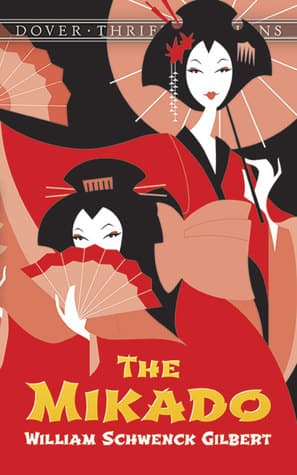
Synopsis
Covers the whole plot, including the ending.
- Difficulty
- Easy
- Pacing
- Fast
- Mood
- Humorous, Witty, Lighthearted, Satirical
- Read it if
- You enjoy classic comic operas, satirical humor, and witty wordplay, or are a fan of Gilbert and Sullivan.
- Skip it if
- You prefer serious drama, contemporary language, or are not interested in Victorian-era satire.
The Mikado Plot Summary
Covers the whole plot, including the ending.
Nanki-Poo's Return and Unrequited Love
The story begins in Titipu, where noblemen await Nanki-Poo, a minstrel. Nanki-Poo tells Pish-Tush he is the Mikado's son, disguised to avoid marrying Katisha, an older lady from his father's court. He came back to Titipu to find Yum-Yum, Ko-Ko's ward, whom he fell in love with a year ago. He learns Yum-Yum is engaged to Ko-Ko. Ko-Ko, condemned to death for flirting, was pardoned and given his job by town officials who feared he would execute them if they didn't. This makes Nanki-Poo sad, and he thinks about suicide.
Ko-Ko's Dilemma and the Mikado's Decree
Pooh-Bah, the Lord High Everything Else, tells Ko-Ko that the Mikado has ordered an execution in Titipu within a month, or the town's executioner office will be removed, and the town will become a village. This puts Ko-Ko in a difficult spot, as he does not want to execute anyone, especially himself. Nanki-Poo, still sad about losing Yum-Yum, offers to be executed in a month if he can marry and spend that month with Yum-Yum. Ko-Ko agrees, seeing a way out. Yum-Yum and her sisters, Pitti-Sing and Peep-Bo, are happy she will not marry Ko-Ko.
Katisha's Arrival and Nanki-Poo's Exposure
As Nanki-Poo and Yum-Yum's wedding preparations begin, Katisha arrives in Titipu, having found Nanki-Poo. She recognizes him despite his disguise and tries to reveal he is the Mikado's son. The townspeople, however, like Nanki-Poo and Yum-Yum and ignore Katisha. They make fun of her looks and age, making her leave in anger. Despite this, Katisha vows revenge and promises to expose Nanki-Poo to his father, ensuring the execution will happen with harsh punishment for Nanki-Poo's defiance.
The Mikado's Unexpected Visit
The wedding of Nanki-Poo and Yum-Yum is stopped by the Mikado himself, with Katisha. The Mikado is not there for an execution but to find his missing son, Nanki-Poo, whom he believes has run away. Ko-Ko, Pooh-Bah, and Pitti-Sing are scared, realizing their plan to execute Nanki-Poo will now be seen as treason. They try to hide Nanki-Poo's identity and the execution deal, fearing the Mikado's anger. The Mikado, however, cares most about his son's location, unaware of the complicated plan.
The False Execution Certificate
To calm the Mikado and avoid punishment for not executing anyone, Ko-Ko, Pooh-Bah, and Pitti-Sing make up a story. They present a fake certificate of Nanki-Poo's execution, claiming he was beheaded. This document describes the execution in such vivid and funny detail that it makes the Mikado suspicious. Katisha, still there, looks at the certificate and points out mistakes, increasing the Mikado's doubt. The Mikado, initially satisfied an execution happened, now thinks his son was murdered and threatens Ko-Ko and his friends: they will be 'boiled in oil, or melted in lead, or chopped into mince-meat' if Nanki-Poo is not found alive.
Nanki-Poo's Reappearance and Ko-Ko's Desperate Plea
Facing death, Ko-Ko, Pooh-Bah, and Pitti-Sing panic. Their only hope is for Nanki-Poo to reappear. They find Nanki-Poo and Yum-Yum, now married, and try to convince Nanki-Poo to show himself to his father. Nanki-Poo refuses, saying if he reveals himself, Katisha will claim him as her husband. He insists he will only reappear if Katisha is married to someone else, freeing him from his engagement. This puts Ko-Ko in a difficult spot; he must marry off Katisha to save his own life and the lives of his friends.
Ko-Ko Wooes Katisha
In a desperate move, Ko-Ko decides he must marry Katisha. He approaches Katisha, who is still sad about Nanki-Poo's supposed death. Ko-Ko tries to win her over with a song about love and companionship, despite his age and looks. Katisha, at first unwilling and grieving, slowly softens under Ko-Ko's persistent and somewhat silly efforts. She finds herself unexpectedly drawn to his sincerity, or perhaps his desperation, and starts to consider his proposal, seeing it as a chance for happiness, even with Ko-Ko.
Katisha's Acceptance and Nanki-Poo's Revelation
After Ko-Ko's plea, Katisha agrees to marry him. With Katisha now engaged to Ko-Ko, Nanki-Poo is free from his previous engagement to her. He then shows himself to his father, the Mikado, surprising everyone. The Mikado is happy to find his son alive and well, forgiving him for his disappearance and the deception. Ko-Ko's quick thinking and willingness to sacrifice himself (by marrying Katisha) saved his own life and the lives of Pooh-Bah and Pitti-Sing, and brought order back to Titipu.
Resolution and Happy Endings
With Nanki-Poo reunited with his father and married to Yum-Yum, and Ko-Ko having married Katisha, all problems are solved. The Mikado, happy his son is safe, cancels the execution order. Ko-Ko, through his clever (and slightly dishonest) actions, satisfied everyone and avoided a bad fate. The play ends with a celebratory song, where everyone expresses happiness and relief. The couples — Nanki-Poo and Yum-Yum, and Ko-Ko and Katisha — look forward to their futures, ending the chaos in Titipu.
The Mikado Characters
Nanki-Poo
Protagonist
The Mikado's son, disguised as a minstrel, in love with Yum-Yum.
Nanki-Poo is the son of the Mikado, who has fled his father's court to avoid marrying Katisha, an elderly and unattractive woman. He disguises himself as a wandering minstrel and comes to Titipu to find Yum-Yum, with whom he fell in love a year prior. He is romantic, somewhat naive, and deeply committed to Yum-Yum, even willing to sacrifice his life for a month of marriage to her. His primary motivation is to escape Katisha and marry his beloved, which drives much of the plot's central conflict. He is the catalyst for Ko-Ko's predicament.
Relationships: Yum-Yum (beloved and eventual wife); The Mikado (father); Katisha (unwanted betrothed)
Yum-Yum
Protagonist
Ko-Ko's ward, a beautiful and somewhat vain young woman in love with Nanki-Poo.
Yum-Yum is one of Ko-Ko's three wards, known for her beauty and charm. She is in love with Nanki-Poo and is initially distressed by her betrothal to Ko-Ko. She is depicted as somewhat vain, enjoying the admiration she receives, but her affection for Nanki-Poo is genuine. Her desire to marry Nanki-Poo is a key driver of the plot, as it fuels Nanki-Poo's initial despair and Ko-Ko's subsequent desperate plan. She is often accompanied by her sisters, Pitti-Sing and Peep-Bo, who share her youthful outlook.
Relationships: Nanki-Poo (beloved and eventual husband); Ko-Ko (guardian and unwanted suitor); Pitti-Sing (sister/ward); Peep-Bo (sister/ward)
Ko-Ko
Antagonist/Supporting
The Lord High Executioner of Titipu, a tailor pardoned from death, and the main comedic foil.
Ko-Ko is a former tailor who was condemned to death for flirting but was pardoned and appointed Lord High Executioner by the other officials of Titipu. He is a central comedic figure, characterized by his bumbling nature, self-preservation instincts, and a knack for convoluted solutions to impossible problems. His reluctance to execute anyone and his desperate attempts to satisfy the Mikado's decree drive much of the farcical plot. His transformation from unwanted suitor to Katisha's husband is a key plot twist, demonstrating his resourcefulness.
Relationships: Yum-Yum (ward and betrothed (initially)); Nanki-Poo (intended victim/savior); Pooh-Bah (subordinate/confidante); Pitti-Sing (ward); Peep-Bo (ward); Katisha (unwanted betrothed (initially), then wife)
The Mikado
Supporting
The Emperor of Japan, Nanki-Poo's father, and the source of the execution decree.
The Mikado is the Emperor of Japan and Nanki-Poo's father. He is a formidable figure, known for his strict laws and unconventional ideas of punishment, which are often described with a darkly humorous tone. His arrival in Titipu is initially for the purpose of finding his missing son, not to enforce the execution decree, creating dramatic irony. He is ultimately a benevolent, if somewhat eccentric, ruler who prioritizes his son's happiness once Nanki-Poo's identity is revealed. His decrees set the initial conflict in motion.
Relationships: Nanki-Poo (son); Katisha (intended daughter-in-law)
Katisha
Antagonist/Supporting
An elderly, formidable lady of the Mikado's court, betrothed to Nanki-Poo.
Katisha is an elderly and unattractive lady of the Mikado's court, to whom Nanki-Poo is betrothed. She is a determined and vengeful character, pursuing Nanki-Poo across Japan. She is initially portrayed as a formidable antagonist, threatening to expose Nanki-Poo and ensure his execution. Despite her stern exterior, she is vulnerable and longs for love and acceptance. Her eventual marriage to Ko-Ko is a crucial turning point, resolving the central conflict and allowing Nanki-Poo to marry Yum-Yum. She represents the obstacle to Nanki-Poo's happiness.
Relationships: Nanki-Poo (unwanted betrothed); The Mikado (ruler, intended father-in-law); Ko-Ko (eventual husband)
Pooh-Bah
Supporting
The Lord High Everything Else of Titipu, holding all major offices.
Pooh-Bah is a highly pompous and self-important official in Titipu, holding virtually all the major offices (e.g., First Lord of the Treasury, Commander-in-Chief, Archbishop of Titipu, Lord Mayor). He frequently reminds others of his noble ancestry and accepts bribes with a show of reluctance, claiming to only do so to avoid hurting people's feelings. He is a significant source of comedic relief through his inflated sense of self and his willingness to compromise his principles for personal gain or convenience, particularly in assisting Ko-Ko's schemes.
Relationships: Ko-Ko (superior (nominally), co-conspirator); Pish-Tush (fellow official)
Pitti-Sing
Supporting
One of Ko-Ko's wards, Yum-Yum's sister, and a co-conspirator.
Pitti-Sing is one of Ko-Ko's wards and Yum-Yum's sister. She is a lively and outspoken young woman, often joining in the general merriment and sometimes offering pointed commentary. She plays a significant role in the deception of the Mikado, participating in the creation of the false execution certificate. Her character adds to the youthful energy and provides additional comedic support, particularly in scenes involving the three wards. She is loyal to Yum-Yum and Nanki-Poo.
Relationships: Yum-Yum (sister/fellow ward); Peep-Bo (sister/fellow ward); Ko-Ko (guardian, co-conspirator)
Pish-Tush
Supporting
A nobleman of Titipu, often a voice of reason or exposition.
Pish-Tush is a nobleman of Titipu, often serving as a foil to the more eccentric characters. He is generally more grounded and provides exposition or challenges the logic of the others, particularly Ko-Ko and Pooh-Bah. While not a central figure, he helps to move the plot forward by questioning actions and providing necessary information to the audience, such as explaining the situation with Ko-Ko's appointment. He represents a more conventional, albeit still humorous, perspective within the absurd world of Titipu.
Relationships: Nanki-Poo (confidante (initially)); Pooh-Bah (fellow official)
The Mikado Themes
Absurdity of Law and Authority
The Mikado makes fun of how arbitrary law is and the people who enforce it. The Mikado's order for an execution, no matter who is executed, shows how senseless bureaucracy can be. Ko-Ko's appointment as Lord High Executioner, despite being a condemned man, shows illogical power structures. Pooh-Bah's many self-serving titles further mock power concentrated in incompetent hands. The plot involves characters trying to get around or manipulate ridiculous laws, like the 'death for flirting' offense, instead of upholding justice.
“My object all sublime / I shall achieve in time – / To let the punishment fit the crime – / The punishment fit the crime.”
Love and Marriage (and its Obstacles)
A main theme is love struggling against social and legal problems. Nanki-Poo and Yum-Yum's love is blocked by Ko-Ko's claim, the Mikado's order, and Katisha's prior engagement. The play looks at different kinds of love: romantic love (Nanki-Poo and Yum-Yum), desperate, practical love (Ko-Ko for Katisha to save his life), and unwanted, possessive love (Katisha for Nanki-Poo). In the end, love wins, but only through a series of funny tricks and compromises, suggesting that even in an absurd world, love finds a way.
“Is it not lovely to be a bride, / With a man by your side?”
Appearance vs. Reality
The play often contrasts how things seem with how they are. Nanki-Poo is disguised as a minstrel but is the Mikado's son. Ko-Ko, the Lord High Executioner, is a clumsy tailor who fears executing anyone. Nanki-Poo's 'execution' is a lie. This theme also appears in characters' self-perception, like Pooh-Bah's exaggerated sense of importance. The humor often comes from the audience knowing the truth while the characters on stage are caught in their deceptions or misunderstandings, creating dramatic irony.
“A more humane Mikado never did in Japan exist.”
Satire of Victorian Society
Though set in a fantasy Japan, The Mikado criticizes Victorian English society. The strict class system, inefficient bureaucracy, and odd social rules of Victorian England are reflected in Titipu. The 'death for flirting' law can be seen as a jab at Victorian moral hypocrisy and overly dramatic legal statements. The characters' names (Ko-Ko, Pooh-Bah, Pish-Tush) sound English, further emphasizing the satirical goal. The play uses the foreign setting to safely critique English issues without being overtly political.
“I am, in point of fact, a particularly clean old man.”
Plot Devices & Literary Techniques
Mistaken Identity / Disguise
Nanki-Poo's disguise as a minstrel drives the initial conflict and subsequent complications.
Nanki-Poo's disguise as a wandering minstrel is the foundational plot device. It allows him to escape his unwanted betrothal to Katisha and pursue Yum-Yum, but it also creates the central conflict when he is unable to reveal his true identity. This mistaken identity is crucial for the Mikado's initial search for his son and for the elaborate deception concerning Nanki-Poo's 'execution.' The humor and dramatic tension are largely derived from the characters' attempts to maintain or reveal Nanki-Poo's true status at various opportune (or inopportune) moments.
The MacGuffin (The Execution Decree)
The Mikado's decree that an execution must take place serves as the central driver of the plot.
The Mikado's decree, stating that an execution must occur in Titipu within a month or the town will be reduced in rank, functions as a classic MacGuffin. It is the primary catalyst for Ko-Ko's desperate actions and the convoluted plot. While the decree itself is important for driving the action, its specific details or ultimate enforcement are less significant than the way it forces the characters to act and react, leading to comedic situations and plot twists. It provides the urgent stakes needed for the farce to unfold.
Farcical Coincidence and Timing
Unlikely arrivals and opportune revelations propel the plot's comedic momentum.
The play relies heavily on farcical coincidence and impeccable comedic timing. For instance, Katisha's arrival just as Nanki-Poo is about to marry Yum-Yum, and then the Mikado's arrival (not for the execution, but to find his son) at a critical moment, are perfectly timed to escalate the chaos. The repeated near-exposure of Nanki-Poo, and his eventual revelation only after Katisha is otherwise engaged, are all products of this device. These coincidences, while improbable, are essential for maintaining the play's lighthearted and absurd tone, preventing the characters from resolving conflicts too easily.
Dramatic Irony
The audience's knowledge of Nanki-Poo's true identity creates humor and tension.
Dramatic irony is a pervasive element throughout The Mikado. The audience is aware from early on that Nanki-Poo is the Mikado's son, while most of the characters in Titipu are not (or only discover it later). This creates humor as characters discuss Nanki-Poo's 'execution' or the Mikado's search, unaware of the full implications. For example, when Ko-Ko presents the false execution certificate to the Mikado, the audience knows Nanki-Poo is alive, adding to the comedic tension of the scene. This device heightens the absurdity of the characters' predicaments.
The Mikado Quotes
“My object all sublime I shall achieve in time—To let the punishment fit the crime—The punishment fit the crime.”
“And I've got a little list—I've got a little list Of society offenders who might well be underground, And who never would be missed—who never would be missed!”
“I am, in point of fact, a particularly clean-minded and high-souled young man, of a most refined nature.”
“The idiot who marries a wife and doesn't know what to do with her is a bad bargain.”
“It is a great mistake to marry for beauty only.”
“When your Majesty says 'Let a thing be done,' it's as good as done—practically, it is done—because, when your Majesty says 'Let a thing be done,' it's not for us to reason why.”
“On a tree by a river a little tom-tit Sang 'Willow, titwillow, titwillow!'”
“My brain it teems with original fancies.”
“Here's a how-de-do! If I marry Yum-Yum, Tra-la-la, To Ko-Ko, tra-la-la, I must die!”
“I am, in point of fact, a particularly clean-minded and high-souled young man, of a most refined nature.”
“The threatened blow is still suspended. If you don't marry Ko-Ko, you die. If you do, he dies.”
“I am Pooh-Bah. I am, in point of fact, a particularly haughty and exclusive person, of a most aristocratic nature.”
“To say 'black' when I mean 'white'—that is the practice of a courtier.”
“The Mikado's will is law.”
Quiz
10 questions on the plot and the characters. Each answer comes with a short explanation.
Question 1
Who is the Lord High Executioner of Titipu?
- Nanki-Poo
- The Mikado
- Ko-Ko
- Pish-Tush
Show answer
C. Ko-Ko Ko-Ko is the Lord High Executioner of Titipu, who was originally condemned to death himself but pardoned on condition that he marry his ward, Yum-Yum.
Question 2
What is Nanki-Poo's true identity?
- A wandering samurai
- The son of the Mikado
- A disgraced nobleman
- A foreign ambassador
Show answer
B. The son of the Mikado Nanki-Poo is actually the son of the Mikado, who fled his father's court to avoid marrying Katisha.
Question 3
Why does Ko-Ko need to find someone to execute?
- To impress the Mikado with his efficiency
- To fulfill the Mikado's decree that an execution must occur in Titipu
- To punish a local criminal for a serious offense
- To test the loyalty of his subordinates
Show answer
B. To fulfill the Mikado's decree that an execution must occur in Titipu The Mikado has decreed that unless an execution takes place in Titipu within a month, the city's dignity will be reduced to the level of a village, a fate Ko-Ko desperately tries to avoid.
Question 4
Who is Yum-Yum?
- The daughter of the Mikado
- Ko-Ko's ward, loved by Nanki-Poo
- A member of the Mikado's court
- Nanki-Poo's former fiancée
Show answer
B. Ko-Ko's ward, loved by Nanki-Poo Yum-Yum is Ko-Ko's beautiful ward and the object of Nanki-Poo's affection. Their love drives much of the plot.
Question 5
What is the primary theme satirized by W.S. Gilbert in 'The Mikado'?
- The dangers of foreign influence
- The rigidity of social class systems
- Victorian English culture and the absurdities of bureaucracy and law
- The pursuit of artistic freedom
Show answer
C. Victorian English culture and the absurdities of bureaucracy and law The book description highlights 'a lighthearted burlesque of Victorian English culture and the vagaries of love,' with the 'fanciful version of Japanese society' serving as a thinly veiled critique of British society, law, and bureaucracy.
Question 6
What is the 'Little List' song about?
- A list of potential wives for Nanki-Poo
- A catalogue of Ko-Ko's past offenses
- A satirical list of people 'who would not be missed' if executed, reflecting Victorian societal annoyances
- A menu of traditional Japanese dishes
Show answer
C. A satirical list of people 'who would not be missed' if executed, reflecting Victorian societal annoyances In 'I've Got a Little List,' Ko-Ko enumerates various types of people he believes would not be missed if they were executed, a classic example of Gilbert's satirical wit directed at contemporary society.
Question 7
Who is Katisha?
- The Mikado's chief advisor
- An elderly, unattractive lady who claims Nanki-Poo as her intended husband
- Yum-Yum's jealous sister
- A local magistrate in Titipu
Show answer
B. An elderly, unattractive lady who claims Nanki-Poo as her intended husband Katisha is an 'elderly, unattractive lady' of the Mikado's court who claims Nanki-Poo as her betrothed, pursuing him relentlessly, which adds to the comedic complications.
Question 8
What is the solution proposed to satisfy the Mikado's demand for an execution while allowing Nanki-Poo and Yum-Yum to marry?
- Ko-Ko agrees to execute himself
- Nanki-Poo and Yum-Yum agree to a temporary marriage, after which Nanki-Poo will be executed, but they fake the execution.
- They convince the Mikado that a banishment counts as an execution.
- A random citizen is chosen for execution by lot.
Show answer
B. Nanki-Poo and Yum-Yum agree to a temporary marriage, after which Nanki-Poo will be executed, but they fake the execution. Nanki-Poo agrees to be executed after a month of marriage to Yum-Yum, but the plan is to fake his execution and have Ko-Ko provide a false affidavit. This convoluted plan highlights the absurdity of the legal system being satirized.
Question 9
What is the ultimate fate of Ko-Ko regarding Katisha?
- He successfully avoids her and marries Yum-Yum.
- He is forced to marry Katisha to save himself and the others from execution.
- Katisha leaves Titipu to pursue Nanki-Poo elsewhere.
- The Mikado pardons Ko-Ko and Katisha, allowing them to remain unmarried.
Show answer
B. He is forced to marry Katisha to save himself and the others from execution. To save everyone from the Mikado's wrath after Nanki-Poo's supposed execution (which is revealed to be fake), Ko-Ko must marry Katisha, as Nanki-Poo cannot marry her and return to life. This is a classic example of Gilbert's 'topsy-turvy' endings.
Question 10
How does the 'fanciful version of Japanese society' in the play primarily serve Gilbert's satirical intent?
- It accurately portrays historical Japanese customs for educational purposes.
- It provides an exotic backdrop for a universal love story without specific cultural critique.
- It allows Gilbert to critique Victorian English laws, bureaucracy, and social norms without directly offending the British audience.
- It emphasizes the superiority of Western legal systems over Eastern ones.
Show answer
C. It allows Gilbert to critique Victorian English laws, bureaucracy, and social norms without directly offending the British audience. As noted in the book description, the Japanese setting is a 'fanciful version' used as a vehicle for 'a lighthearted burlesque of Victorian English culture,' allowing Gilbert to satirize contemporary British society through a distant, exotic lens.
The Mikado FAQ
What is 'The Mikado' about?
'The Mikado' is a lighthearted comic opera by Gilbert and Sullivan set in a fanciful version of Japan. It tells the story of Nanki-Poo, a wandering minstrel who is in love with Yum-Yum, the ward of Ko-Ko, the Lord High Executioner of Titipu. Complications arise because Yum-Yum is betrothed to Ko-Ko, and Ko-Ko himself is under orders from the Mikado to execute someone, or face execution himself.
Why should I read 'The Mikado'?
You should read 'The Mikado' for its brilliant wit, sparkling lyrics, and clever satire of Victorian English society and its absurdities, all presented within a charming, melodious framework. Gilbert's elegant comedic gifts shine through in the witty dialogue and ingenious plot, making it a delightful and intellectually stimulating experience even without the musical accompaniment.
What is the background/setting of 'The Mikado'?
The story is set in a fictionalized, whimsical version of Japan, specifically in the town of Titipu, and later features the arrival of the Emperor, The Mikado. This 'Japanese' setting serves as a thinly veiled burlesque of Victorian English customs, laws, and social hierarchies, allowing Gilbert to satirize contemporary society without direct confrontation.
What are the most memorable quotes?
Some memorable quotes include 'My object all sublime / I shall achieve in time / To let the punishment fit the crime' sung by Ko-Ko, which perfectly encapsulates the opera's satirical take on justice. Another is 'A more humane Mikado never / Did in Japan exist' describing the seemingly benevolent but ultimately strict emperor.
What writing style does the author use?
W.S. Gilbert employs a highly witty, satirical, and articulate writing style, characterized by clever wordplay, intricate rhymes, and a precise command of language. His dialogue is sharp and often ironic, while his lyrics are renowned for their rhythmic precision and ability to convey complex ideas and humorous situations with elegance.
What minor details add significant meaning?
The detailed lists of 'people who would not be missed' that Ko-Ko compiles are not just funny; they subtly reveal the societal grievances and petty annoyances of Victorian England, from the 'idiot who praises, with enthusiastic tone, all centuries but this and every country but his own' to the 'object all sublime' of making the punishment fit the crime.
What are some subtle foreshadowing moments?
The initial mention of Nanki-Poo being a wandering minstrel and Ko-Ko's past as a cheap tailor subtly foreshadows their true identities and social standing, which are later revealed to be far more significant than they initially appear. Nanki-Poo's insistence on his musical talent also hints at his royal lineage.
What unexpected character connections exist?
The most significant unexpected connection is that Nanki-Poo, the humble minstrel, is actually the son of The Mikado, and Ko-Ko, the Lord High Executioner, was previously a common tailor. This revelation completely upends the social hierarchy and resolves many of the plot's initial conflicts regarding Nanki-Poo's suitability for Yum-Yum.
What are unspoken character motivations?
While Ko-Ko outwardly expresses a desire to marry Yum-Yum, his deeper, unspoken motivation is to maintain his position and avoid execution by pleasing The Mikado. His willingness to sacrifice his 'life' (or rather, Nanki-Poo's life) for this purpose, and his later desperate attempts to find a substitute, reveal a strong drive for self-preservation.
What psychological complexities do characters exhibit?
Ko-Ko exhibits a complex mix of self-preservation, cunning, and surprising sentimentality. Despite his grim profession, he is deeply afraid of death and constantly seeks loopholes. His transformation from a condemned man to the Lord High Executioner also highlights the arbitrary nature of power and social climbing.
What are the major emotional turning points?
A major emotional turning point occurs when Nanki-Poo reveals his true identity as the Mikado's son, shifting the power dynamic entirely. Another is when Katisha arrives, demanding Nanki-Poo, leading to Ko-Ko's desperate plan to marry her himself to save Nanki-Poo and himself, showcasing a surprising act of self-sacrifice (albeit for self-preservation).
How do relationship dynamics evolve?
The relationship between Nanki-Poo and Yum-Yum evolves from a forbidden love to a sanctioned union once Nanki-Poo's true identity is revealed. Ko-Ko's relationship with Yum-Yum transforms from an enforced engagement to a familial guardianship, while his relationship with Katisha shifts from one of dread to a surprisingly advantageous (for him) marriage.
Which parts remain ambiguous or open-ended?
While the main romantic and life-or-death plots are resolved, the long-term implications of Ko-Ko's marriage to Katisha, and the true extent of The Mikado's 'humanity' in his 'fitting the punishment to the crime' philosophy, remain somewhat open-ended. The satire of societal absurdity continues, suggesting ongoing human folly.
What are controversial scenes or decisions?
The entire premise of Ko-Ko needing to execute someone to avoid his own execution, and his subsequent attempts to find a volunteer (Nanki-Poo), could be seen as controversial for its dark humor regarding capital punishment. However, it's presented with such absurdity that it serves more as satire than genuine endorsement.
'The Mikado' ending explained: how it ends & what it means
'The Mikado' ends with Nanki-Poo marrying Yum-Yum after his true identity as the Mikado's son is revealed, making their union permissible. Ko-Ko cleverly saves himself and Nanki-Poo from execution by marrying the formidable Katisha, thus satisfying the Mikado's demand for a 'victim' and ensuring 'justice' is served. The ending signifies the triumph of love and cleverness over absurd laws and social strictures, all wrapped in a neat, happy, and satirical bow.
About the author

W.S. Gilbert was an English playwright and librettist active in the late 19th century, best known for his collaboration with composer Arthur Sullivan on comic operas. One of his notable works is "The Mikado," which satirizes British society through a fictional Japanese setting. Gilbert's contributions to musical theatre have had a lasting impact on the genre.
Similar books
- The Importance of Being Earnest
Oscar Wilde
4.2 (302k) average on GoodreadsHistoryWhile The Mikado uses an exotic setting to critique British society, Oscar Wilde's The Importance of Being Earnest directly lampoons Victorian social conventions, particularly marriage, class, and morality, within a purely British context. Both employ brilliant wit and linguistic flourish, but Wilde's play focuses more on the absurdity of social performance and identity within the drawing-room, whereas Gilbert casts a wider net of institutional critique through a fantastical lens. Wilde's characters, though stylized, often possess a more defined sense of individual (if performative) agency compared to Gilbert's more archetypal figures.
- Nineteen Eighty-Four
George Orwell
4.2 (5.5M) average on GoodreadsFictionWinston Smith dreams of truth and rebellion in a world where Big Brother watches all, but he confronts the terrifying power of a regime that controls not just actions, but thoughts.
- The Frozen River
Ariel Lawhon
4.4 (600k) average on GoodreadsFictionIn 1789 Maine, a heroic midwife's diary helps her expose a murder and get justice in a town that wants to silence her.
- A Man Called Ove
Fredrik Backman
4.4 (569k) average on GoodreadsFictionA stubborn widower, who lives by strict rules, finds his quiet world changed by a lively new family next door, making him face his past and find happiness in human connection.
- The Art of Racing in the Rain
Garth Stein
4.2 (452k) average on GoodreadsFictionThrough the eyes of Enzo, a wise and observant dog, a race car driver's family navigates a journey of love, loss, and resilience, learning that life's most important lessons often come in the curves, not just on the straightaways.
- The Colour of Magic
Terry Pratchett
4.0 (425k) average on GoodreadsFictionOn a discworld hurtling through space on the back of a giant turtle, an inept wizard and his naive, walking-luggage-toting tourist embark on a chaotic, belief-fueled journey to the very edge of their flat planet, encountering dragons that only exist if you believe in them.





Enjoyed the summary?
A summary gives you the shape of the book. The book itself has the detail, the examples and the voice.
Find The Mikado on AmazonAs an Amazon Associate, BookBrief earns from qualifying purchases. How we're funded