
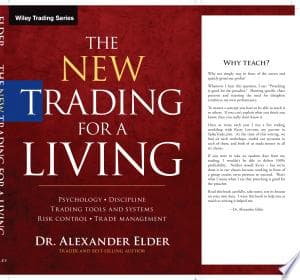
Core Idea
- Difficulty
- Medium
- Read it if
- You are a beginner or intermediate trader seeking a comprehensive, systematic approach to market analysis, trade execution, and risk management, with a strong emphasis on psychological discipline.
- Skip it if
- You are an advanced quantitative trader looking for highly complex algorithmic strategies, or you prefer purely fundamental analysis over technical and psychological aspects.
Key Takeaways from The New Trading for a Living
The Three Pillars of Trading
Success in trading hinges on Mind, Method, and Money Management, each demanding equal attention.
Elder says that trading success is not just about finding a perfect indicator or system. Instead, it relies on three parts: a disciplined mind (psychology), a good method (trading system), and strict money management (risk control). Ignoring any part will cause problems. Many new traders focus too much on methods, missing the psychological traps and the important role of saving capital. Real skill comes from combining all three, creating a personal trading style that fits one's psychology while managing risk and following a clear system.
“Successful trading is based on knowledge, focus, and discipline.”
In the book: Elder's framework is a foundational concept throughout the book, with dedicated sections for each pillar, emphasizing their interconnectedness. He often refers to the 'three Ms' (Mind, Method, Money) as the essential components.
Try this: Before even considering a trade, evaluate your mental state, confirm your trading system's signals, and calculate your exact risk per trade. Regularly review your performance across all three pillars to identify weaknesses.
Related ideas: trading-psychology, risk-management, trading-system
Master Your Trading Psychology
Conquer fear and greed, and develop self-discipline to avoid common trading pitfalls.
Trading is a mental challenge where emotions like fear, greed, hope, and regret try to stop good decisions. Elder emphasizes that self-control is most important. Traders must be disciplined to follow their rules, cut losses quickly, and let profits grow. He warns against quick decisions made by emotion, like chasing stocks or trading for revenge after a loss. Understanding your own emotional biases and having a consistent, calm approach is more important than any technical indicator.
“Overcome barriers to success and develop stronger discipline.”
In the book: Elder frequently discusses the 'mass psychology' of the market and how individual traders often fall prey to herd mentality or personal emotional swings. He provides examples of how fear causes traders to exit too early and greed makes them hold onto losing positions.
Try this: Maintain a trading journal that includes your emotional state before, during, and after each trade. This self-awareness helps identify patterns in your emotional responses and develop strategies to counteract them, such as stepping away from the screen after a significant loss.
Related ideas: emotional-control, discipline, self-management
The Impulse System for Trend Following
Combine two indicators to identify strong trends and avoid choppy markets.
Elder introduces his 'Impulse System' as a simple yet effective tool for finding good trades. It uses two indicators: a 13-period Exponential Moving Average (EMA) and a MACD-Histogram. When both move in the same direction (e.g., EMA rising and MACD-Histogram rising), it shows a strong trend, a good time to enter. When they conflict or are flat, it suggests a weak or choppy market, which is best avoided. This system helps filter out noise and focus on clear, trending chances, reducing bad trades.
“The Impulse System… helps you avoid trades against the trend and trades in choppy markets.”
In the book: The Impulse System is a core technical analysis tool presented in the book, with numerous chart examples illustrating its application across different timeframes and assets. Elder details its construction and interpretation.
Try this: Only take long trades when both the 13-period EMA is rising and the MACD-Histogram is rising (green bars). Only take short trades when both are falling (red bars). Stay out of the market when the indicators diverge or are flat (blue bars).
Related ideas: technical-analysis, macd-histogram, exponential-moving-average
Money Management: The Ultimate Survival Tool
Protect your capital above all else by strictly limiting risk per trade.
Money management is not just about setting stops; it is about survival. Elder strongly argues that a trader's main goal is to protect their capital, not to get rich fast. He supports a strict risk-per-trade rule, usually risking no more than 2% of total trading capital on any single trade. This ensures that a series of losses will not empty your account, allowing you to stay in the game long enough for your system to make profits. It is a basic rule for long-term success.
“Master money management as you set entries, targets and stops.”
In the book: Elder provides calculations and examples demonstrating how even a high win rate can be undone by poor money management, while a moderate win rate with strict risk control can lead to consistent profits. He emphasizes the mathematical certainty of ruin when risk is uncontrolled.
Try this: Before every trade, define your entry, your stop-loss, and your target. Calculate the difference between your entry and stop-loss. Then, determine your position size so that the monetary value of that difference (your potential loss) does not exceed 2% of your total trading capital.
Related ideas: risk-per-trade, position-sizing, capital-preservation
The Importance of a Trading Journal
Learn from your past trades to become your own best teacher.
Elder says a detailed trading journal is necessary for improving. It is not enough to just record entries and exits; a good journal includes the reasons for the trade, the setup, your emotional state, and an analysis after the trade. By reviewing your journal regularly, you can find repeating mistakes, improve your system, and understand your psychological patterns. This practice turns every trade, win or loss, into a valuable learning experience, helping with growth and discipline.
“Use a record-keeping system that will make you into your own teacher.”
In the book: Elder dedicates a section to the components of an effective trading journal, explaining what to record and why. He frames it as the primary tool for 'self-supervision' and developing an objective perspective on one's trading.
Try this: After each trading day, document every trade: entry/exit prices, volume, reasons for entry/exit, the market context, your emotional state, and any lessons learned. Review your journal weekly to spot trends in your performance and psychology.
Related ideas: trade-analysis, self-reflection, performance-tracking
Trading as a Business
Approach trading with the seriousness, planning, and professionalism of an entrepreneur.
Elder challenges the idea of trading as a quick way to get rich, instead seeing it as a serious business. Like any successful business, trading needs a strong business plan (trading plan), careful record-keeping, continuous learning, and strict rule-following. It requires a professional mindset, treating losses as business costs and profits as income, rather than personal wins or failures. This view helps with objectivity and removes the emotional stress that often affects amateur traders.
“Successful trading is based on knowledge, focus, and discipline.”
In the book: Elder provides templates for creating a comprehensive trade plan and emphasizes the need for a 'business-like' approach to market analysis, risk management, and self-assessment.
Try this: Develop a detailed trading plan outlining your strategy, risk parameters, and daily routine. Treat your trading capital as business capital, and regularly review your 'business performance' rather than just focusing on individual trade outcomes.
Related ideas: trading-plan, professionalism, business-mindset
The Power of Multiple Timeframes
Gain a clearer market perspective by analyzing trends across different chart durations.
A common mistake is focusing on one timeframe, which can give a wrong view of the market. Elder suggests using 'triple screen' analysis, looking at an asset across three different timeframes (e.g., weekly, daily, and hourly). The longest timeframe shows the main trend, the middle timeframe confirms it and shows pullbacks, and the shortest timeframe is for exact entry and exit points. This helps avoid trading against the main trend and improves the chance of successful trades.
“You need to look at the market through three timeframes to get a full picture.”
In the book: Elder illustrates the triple screen system with multiple chart examples, showing how a stock might appear bearish on an hourly chart but bullish on a weekly chart, guiding the trader to only take long trades during pullbacks.
Try this: First, identify the trend on a longer timeframe (e.g., weekly). Then, use an intermediate timeframe (e.g., daily) to spot corrections or entry signals within that trend. Finally, use a shorter timeframe (e.g., hourly) for precise execution.
Related ideas: multi-timeframe-analysis, trend-identification, charting
Asymmetrical Market Zones
Identify setups where potential rewards significantly outweigh potential risks.
Not all trading chances are equal. Elder teaches traders to look for 'asymmetrical market zones,' where the potential profit is much greater than the potential loss. This idea is important for long-term profit, as even a system with a win rate below 50% can be profitable if the winning trades are much larger than the losing trades. It is about getting the best reward-to-risk ratio, making sure every dollar risked can return multiple dollars.
“Identify asymmetrical market zones, where rewards are higher and risks lower.”
In the book: Elder discusses how to calculate reward-to-risk ratios for potential trades and illustrates setups that offer favorable asymmetries, often tied to support/resistance levels or breakout points.
Try this: Before entering any trade, calculate your potential profit (target minus entry) and potential loss (entry minus stop-loss). Only take trades where the reward-to-risk ratio is at least 2:1 or preferably 3:1.
Related ideas: reward-risk-ratio, trade-selection, risk-reward
The Trader's Checklist and Rating System
Systematize your decision-making and evaluate your readiness to trade.
To fight impulsive trading and ensure consistency, Elder suggests creating personal checklists and rating systems. This means making a set of rules for judging possible trades (e.g., trend strength, support/resistance, indicator signals) and giving scores. He also suggests rating your own mental and physical readiness to trade each day, stopping you from trading when you are emotional or tired. This systematic approach removes personal bias and strengthens disciplined action.
“The New Trading for a Living includes templates for rating stock picks, creating trade plans, and rating your own readiness to trade.”
In the book: The book provides explicit templates for 'rating stock picks' and 'rating your own readiness to trade,' demonstrating practical implementation of these checklists.
Try this: Before placing a trade, go through your personalized checklist, assigning points to each criterion. Only execute trades that meet a minimum score. Additionally, use a daily checklist to assess your mental and physical state, deciding if you are fit to trade that day.
Related ideas: decision-making, trade-planning, systematic-trading
Continuous Learning and Adaptation
The markets constantly evolve; so must the successful trader.
The fact that this updated edition exists shows an important lesson: markets change, and trading strategies must change too. What worked yesterday might not work tomorrow. Elder shows the importance of continuous learning, adapting to new market conditions, technologies, and psychological insights. Successful traders are always learning, improving their methods, understanding new tools, and constantly improving their self-awareness. Not changing is a major problem in the financial world.
“The New Trading for a Living updates a modern classic, popular worldwide among both private and institutional traders. This revised and expanded edition brings time-tested concepts in gear with today's fast-moving markets, adding new studies and techniques for the modern trader.”
In the book: The fact that Elder updated his own classic work to include 'new studies and techniques for the modern trader' is direct evidence of this principle. The book itself is a testament to the need for adaptation.
Try this: Dedicate time each week to reviewing market news, studying new indicators or strategies, and analyzing your past performance to identify areas for improvement. Be open to modifying your trading plan based on new insights or changing market conditions.
Related ideas: market-adaptation, lifelong-learning, trading-evolution
The New Trading for a Living Quotes
“The market is like the ocean, constantly moving, with tides and currents. You need to learn to sail, not to stop the ocean.”
“Your most important task is to protect your capital. If you lose money, you cannot trade.”
“The goal of a successful trader is to make the best trades. Money is secondary.”
“Amateurs think about how much money they can make. Professionals think about how much money they can lose.”
“Discipline is the bridge between goals and accomplishment.”
“The three M's of trading are Mind, Method, and Money Management.”
“Emotional trading is losing trading.”
“Every trade has to have an exit point before you enter it.”
“The market discounts everything. It’s a voting machine in the short run and a weighing machine in the long run.”
“Indicators are like rearview mirrors. They show you where you've been, not where you're going.”
“The biggest enemy of a trader is himself.”
“Trade with a plan, not with hope.”
“The market doesn't care about your opinions, only your positions.”
“Successful trading is based on anticipation, not reaction.”
Quiz
10 questions on the main ideas. Each answer comes with a short explanation.
Question 1
According to Alexander Elder in 'The New Trading for a Living', what is one of the three foundational pillars for successful trading?
- Access to exclusive news feeds
- High-speed internet connection
- Knowledge, focus, and discipline
- A large starting capital
Show answer
C. Knowledge, focus, and discipline The book explicitly states that successful trading is based on knowledge, focus, and discipline, emphasizing these as core tenets for traders.
Question 2
What kind of approach to the markets does 'The New Trading for a Living' primarily advocate?
- Aggressive and high-frequency
- Calm and disciplined
- Intuitive and spontaneous
- Following popular market sentiment
Show answer
B. Calm and disciplined The book's description clearly states it 'teaches a calm and disciplined approach to the markets,' which is a central theme.
Question 3
What specific tools does 'The New Trading for a Living' provide templates for?
- Cryptocurrency mining algorithms
- Advanced macroeconomic forecasting models
- Rating stock picks, creating trade plans, and rating personal readiness to trade
- Automated trading bot configurations
Show answer
C. Rating stock picks, creating trade plans, and rating personal readiness to trade The summary explicitly mentions that the book 'includes templates for rating stock picks, creating trade plans, and rating your own readiness to trade.'
Question 4
What key aspect does Elder emphasize alongside self-management for successful trading?
- Market timing through astrological charts
- Risk management
- Reliance on expert advisors
- Frequent account balance checks
Show answer
B. Risk management The book description highlights that it 'emphasizes risk management along with self-management,' indicating their intertwined importance.
Question 5
What kind of market zones does the book aim to help traders identify?
- Zones with high volatility and unpredictable swings
- Asymmetrical market zones, where rewards are higher and risks lower
- Zones dominated by institutional trading algorithms
- Zones requiring immediate, reactive trading decisions
Show answer
B. Asymmetrical market zones, where rewards are higher and risks lower The book aims to help traders 'Identify asymmetrical market zones, where rewards are higher and risks lower,' a key strategic element.
Question 6
How does 'The New Trading for a Living' suggest a record-keeping system can benefit a trader?
- By providing data for tax audits only
- By automatically executing trades based on past performance
- By making you into your own teacher
- By comparing your performance against market benchmarks
Show answer
C. By making you into your own teacher The text states the book helps 'Use a record-keeping system that will make you into your own teacher,' highlighting its role in self-improvement.
Question 7
What is unique about the charts presented in 'The New Trading for a Living' compared to its previous editions?
- They are exclusively in black and white for clarity.
- They are interactive and linked to live market data.
- All charts are new, in full color, with clear comments on rules and techniques.
- They feature predictive AI overlays for future price movements.
Show answer
C. All charts are new, in full color, with clear comments on rules and techniques. The description specifies that 'All charts in this book are new and in full color, with clear comments on rules and techniques,' indicating a significant update.
Question 8
The book mentions 'modern market tools' alongside 'classic wisdom'. What does this combination primarily aim to achieve for traders?
- To encourage speculative, short-term gambling strategies
- To lift trading to a higher level by offering a comprehensive, updated approach
- To simplify trading to the point where no personal effort is required
- To replace human decision-making entirely with automated systems
Show answer
B. To lift trading to a higher level by offering a comprehensive, updated approach The summary states, 'The New Trading for a Living will lift your trading to a higher level by sharing classic wisdom along with modern market tools,' indicating the goal of improving overall trading effectiveness.
Question 9
How does 'The New Trading for a Living' position itself in relation to the author's previous works and other industry guides?
- It completely contradicts the advice given in previous editions.
- It serves as a less valuable resource than the author's previous books.
- It is an even more valuable resource than the author's previous books and a model for the industry, often imitated but never duplicated.
- It is a simplified version intended only for novice traders.
Show answer
C. It is an even more valuable resource than the author's previous books and a model for the industry, often imitated but never duplicated. The text states, 'The New Trading for a Living will become an even more valuable resource than the author's previous books,' and 'a model for the industry—often imitated but never duplicated,' highlighting its enhanced value and influence.
Question 10
What is the primary objective of mastering money management, as taught in the book?
- To minimize the number of trades taken per day.
- To set entries, targets, and stops effectively.
- To avoid paying commissions on trades.
- To predict exact market reversals with certainty.
Show answer
B. To set entries, targets, and stops effectively. The book teaches to 'Master money management as you set entries, targets and stops,' indicating these are core components of effective money management.
The New Trading for a Living FAQ
What is the core philosophy of "The New Trading for a Living"?
The book emphasizes a calm and disciplined approach to the markets, focusing on the critical interplay of risk management, self-management, and developing a systematic trading strategy. It teaches traders to overcome emotional barriers and make informed decisions.
Does the trading system outlined in "The New Trading for a Living" still work in today's fast-moving markets?
Yes, this updated edition specifically brings time-tested concepts in line with modern, fast-moving markets. It includes new studies and techniques to ensure its relevance and effectiveness for contemporary traders.
What is 'asymmetrical market zone' as described in the book?
An asymmetrical market zone refers to specific market conditions where the potential rewards for a trade are significantly higher than the potential risks. The book teaches traders how to identify these advantageous zones to maximize their profit potential while minimizing downside exposure.
How does "The New Trading for a Living" differ from other popular trading books?
This book stands out by providing clear rules for risk and self-management, along with practical templates for trade planning and self-assessment. Its emphasis on psychological discipline combined with robust technical analysis and money management sets it apart as a comprehensive guide.
What practical tools or templates does the book provide?
The book includes practical templates for rating stock picks, creating detailed trade plans, and even rating your own readiness to trade. These tools help traders structure their decision-making process and maintain discipline.
Is "The New Trading for a Living" suitable for both new and experienced traders?
Absolutely. The book's clear language and systematic approach make it accessible for beginners, while experienced traders will find valuable new insights, updated techniques, and a refreshed perspective on classic wisdom to elevate their trading.
What is the importance of record-keeping according to Alexander Elder?
Alexander Elder highlights record-keeping as a crucial element for self-improvement, stating that a robust system will turn you into your own teacher. By meticulously tracking trades, traders can analyze their performance, identify patterns, and learn from their successes and failures.
Does the book cover money management strategies?
Yes, a significant portion of the book is dedicated to mastering money management. It provides clear guidance on how to set appropriate entries, profit targets, and stop-loss orders to protect capital and manage risk effectively.
Similar books
- Trading in the Zone
Mark Douglas
4.3 (10k) average on GoodreadsFinanceFocuses heavily on trading psychology and mindset, a key pillar in Elder's work.
- Technical Analysis of the Financial Markets
John J. Murphy
Murphy's 'Technical Analysis of the Financial Markets' is a far more exhaustive and academic textbook on technical analysis, covering a vast array of charting patterns, indicators, and theories in meticulous detail. While Murphy provides an encyclopedic reference for market analysis, it largely omits the critical components of trading psychology and money management that Elder integrates so effectively. Elder's book is more prescriptive and system-oriented, offering a complete trading philosophy, whereas Murphy's work serves as a comprehensive reference manual for the 'market analysis' pillar, requiring the reader to integrate psychological and risk management principles from other sources.
- Freakonomics: A Rogue Economist Explores the Hidden Side of Everything
Steven D. Levitt
4.0 (709k) average on GoodreadsBusinessThis book uses economic principles to reveal the surprising incentives behind everything from drug dealing and real estate to cheating teachers and the decline of crime.
- Rich Dad, Poor Dad
Robert T. Kiyosaki
4.1 (369k) average on GoodreadsBusinessRobert Kiyosaki explains that financial literacy, owning assets instead of liabilities, and making money work for you are the real ways to build wealth, lessons he learned from his biological 'poor dad' and his best friend's entrepreneurial 'rich dad.'
- Think and Grow Rich
Napoleon Hill
4.2 (218k) average on GoodreadsBusinessLearn the thirteen principles of success from early 20th-century business leaders to achieve financial independence and personal fulfillment.
- Zero to One: Notes on Startups, or How to Build the Future
Peter Thiel
4.2 (189k) average on GoodreadsBusinessTo build the future, Peter Thiel argues, you must embrace the idea that true innovation lies not in small improvements, but in creating something entirely new that avoids competition.




Enjoyed the summary?
A summary gives you the shape of the book. The book itself has the detail, the examples and the voice.
Find The New Trading for a Living on AmazonAs an Amazon Associate, BookBrief earns from qualifying purchases. How we're funded