
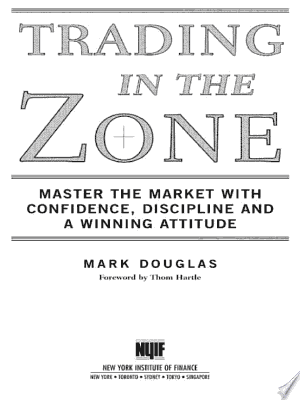
Core Idea
- Difficulty
- Medium
- Read it if
- You are a trader struggling with consistency, emotional decision-making, or self-sabotage, and believe that psychology is a key missing piece in your trading success.
- Skip it if
- You are looking for specific trading strategies, technical analysis methods, or a 'get rich quick' guide, as this book focuses exclusively on the psychological aspects of trading.
Key Takeaways from Trading in the Zone
Think in Probabilities
Embrace the probabilistic nature of trading outcomes, rather than seeking certainty.
Most traders want certainty, believing they can predict the next market move. Douglas says this is a basic misunderstanding. The market is about probabilities. Every trade is just one event in a series of chances, each with a random outcome when seen alone. Professional traders know their advantage comes from consistently using a strategy with a positive expected return over many trades, not from predicting individual trades. This change in mindset, from 'knowing' to 'playing the odds,' is vital for emotional stability and consistent profits. It removes the pressure of being right on every single trade.
“The market generates patterns that repeat themselves with statistical reliability, but there is no certainty that any particular pattern will produce the same outcome each time.”
In the book: Douglas frequently uses analogies of casino gambling, specifically how casinos operate on probabilities and large sample sizes to ensure profitability, despite individual bets being random. He contrasts this with the typical trader's desire for certainty on single events.
Try this: Develop a trading system with a positive expectancy and rigorously follow its rules. Focus on trade execution and risk management for each instance, understanding that the 'win' or 'loss' of a single trade is irrelevant to the system's overall profitability. Track your trades to build a statistically significant sample size.
Related ideas: probabilistic-thinking, expectancy, sample-size
Master Your Mental Environment
Your beliefs about trading and the market dictate your experience and results.
Douglas stresses that the 'zone' in trading is mainly a state of mind, marked by objectivity and freedom from fear or excitement. Our inner mental state, our beliefs, attitudes, and expectations, affects our trading results much more than external market conditions. Limiting beliefs, like needing to be right, fearing to miss out, or fearing loss, cause errors in execution, hesitation, or overtrading. By finding and replacing these harmful beliefs with helpful ones (e.g., 'anything can happen,' 'I am a consistent winner'), traders can develop the mental discipline needed for consistent profits. This inner work is the basis for outer success.
“The market's behavior is neutral. It doesn't care about your beliefs, hopes, or fears. Only your interpretation of its behavior matters.”
In the book: Douglas recounts numerous anecdotes of traders who sabotage themselves due to internal conflicts, despite having sound strategies. He highlights how the same market setup can yield vastly different results for two traders due to their differing mental states.
Try this: Engage in self-reflection to uncover limiting beliefs about trading, money, and yourself. Practice affirmations and mental rehearsal to internalize empowering beliefs. Treat trading as a skill that requires mental training as much as technical analysis. Journaling your thoughts and feelings before, during, and after trades can be a powerful tool for self-awareness.
Related ideas: mental-discipline, limiting-beliefs, self-sabotage
Accept the Risk of the Unknown
Confront and accept that every trade carries an inherent, unpredictable risk.
One of the biggest psychological challenges for traders is the fear of losing. This fear often comes from not wanting to accept the uncertainty and risk in every trade. Douglas argues that professional traders fully accept that any single trade can lose, no matter how good the setup looks. This acceptance frees them from emotional paralysis and impulsive decisions driven by fear. By deciding and accepting the maximum risk on each trade before entering, traders can operate without emotion. This lets them manage the trade objectively rather than reacting to 'what if' situations. Accepting risk is a cornerstone of consistent performance.
“The moment you put on a trade, you are immediately exposed to the unknown. There is no way around it.”
In the book: Douglas describes how the fear of loss causes traders to move stop losses, cut winners short, or refuse to take valid setups, all because they cannot tolerate the discomfort of uncertainty. He contrasts this with professional gamblers who understand and accept the fixed risk of each bet.
Try this: Before entering any trade, define your maximum acceptable loss (stop loss) and mentally commit to it. Understand that this capital is 'at risk' and you might lose it. Practice visualizing losses as a normal part of the trading process, akin to a business expense. Never risk more than you are comfortable losing on a single trade.
Related ideas: risk-acceptance, fear-of-loss, uncertainty-management
Eliminate Emotional Biases
Objectivity is paramount; emotional interference distorts perception and leads to errors.
Emotions like fear, greed, hope, and regret are the main reasons for inconsistent trading. Douglas explains how these emotions create biases that warp a trader's view of market information. For example, hope can make a trader hold a losing trade, while greed can lead to over-leveraging or taking profits too soon. To be consistent, traders must learn to watch market action from a detached, objective view, free from these powerful emotions. This does not mean being emotionless, but learning to recognize emotions without letting them control trading decisions. Having a systematic approach and sticking to it helps bypass emotional impulses.
“The market is an endless stream of opportunities, but only if you can perceive them without bias.”
In the book: Douglas frequently cites examples of traders moving stop losses in hopes of a turnaround, or exiting winning trades prematurely out of fear of losing paper profits, all driven by emotional interference rather than objective analysis.
Try this: Develop a detailed trading plan with clear entry, exit, and risk management rules. Commit to following this plan without deviation, regardless of how you feel. Use a checklist before each trade to ensure all criteria are met. Practice mindfulness to observe your emotional state without judgment, and avoid trading when in an emotionally compromised state.
Related ideas: emotional-control, cognitive-bias, objectivity
Understand Market Structure as a Flow of Energy
Perceive market movements as a continuous, dynamic interaction of forces, not isolated events.
Douglas tells traders to change their view from seeing the market as separate trades or patterns to seeing it as a continuous flow of energy. This 'flow' is driven by the combined beliefs and actions of all participants. Every tick shows a shift in the balance of buying and selling pressure. Understanding this helps traders avoid focusing on specific outcomes or feeling personally hurt by market moves. When you see the market as a neutral, uncaring flow, you can learn to move with it, finding opportunities within its natural rhythms instead of fighting it with rigid expectations. This view promotes adaptability and reduces personal attachment to outcomes.
“The market is always in a state of becoming. It's a constant flow of energy, not a series of discrete events.”
In the book: Douglas uses the analogy of a river, where individual drops of water (trades) contribute to the overall current (trend). He argues that getting caught up in individual 'drops' distracts from the larger, more powerful flow.
Try this: Practice observing price action without immediate judgment. Focus on the overall trend and momentum rather than getting bogged down by every minor fluctuation. Think in terms of supply and demand dynamics, and how they contribute to the market's 'energy.' Develop the ability to 'read' the market's current state and adapt your strategy accordingly, rather than imposing your will on it.
Related ideas: market-dynamics, price-action, adaptability
Develop a 'No-Fault' Trading Attitude
Eliminate self-blame and judgment to foster a learning-oriented mindset.
A common trap for traders is self-blame and judgment after a losing trade. This 'fault-finding' attitude is bad because it causes negative emotions, reduces objectivity, and slows learning. Douglas suggests a 'no-fault' approach, where a losing trade is simply information, an outcome of a probabilistic event. By removing the emotional charge of 'right' or 'wrong,' traders can objectively analyze what happened, learn from it, and improve their system or execution without hurting their self-esteem or confidence. This mindset is vital for building resilience and staying consistent over time, as losses are a normal part of trading.
“There is no such thing as a 'bad' trade, only a trade that didn't work out as expected. Blaming yourself only makes it harder to learn.”
In the book: Douglas illustrates how self-blame leads to a cycle of fear, hesitation, and further mistakes, as traders become afraid to make another 'bad' trade. He contrasts this with a scientific approach where failed experiments are simply data points for learning.
Try this: After every trade, especially losing ones, review your process objectively. Ask: 'Did I follow my plan?' and 'What can I learn from this outcome?' instead of 'Why am I so stupid?' or 'I knew I shouldn't have done that.' Treat losses as tuition fees for your trading education. Focus on process improvement, not self-criticism.
Related ideas: self-compassion, learning-mindset, resilience
Focus on the Process, Not the Outcome
Consistent application of your edge leads to consistent results; individual outcomes are distractions.
Many traders focus too much on the money from each trade, which causes emotional swings and bad decisions. Douglas argues that consistent profits come from a disciplined focus on the trading process: finding good setups, managing risk, and executing trades according to a plan. If the process is good and used consistently, positive financial results will naturally follow over a series of trades. Shifting focus from 'making money' on one trade to 'executing my strategy perfectly' across many trades frees the trader from the pressure of individual outcomes and promotes a more professional, detached approach. This is the mark of a truly consistent trader.
“The consistent winners are those who have learned to focus on the execution of their edge, knowing that the money will take care of itself.”
In the book: Douglas frequently points out that traders often deviate from their plan when a trade is 'winning' (taking profits too early) or 'losing' (holding on too long), precisely because they are fixated on the P&L of that single trade, rather than adhering to their process.
Try this: Create a detailed trading plan and evaluate your performance based on how well you followed the plan, rather than solely on the P&L of individual trades. Reward yourself for disciplined execution, even on losing trades. Review your trade journal to identify deviations from your process and work to correct them. Trust that your edge, when consistently applied, will yield results.
Related ideas: process-orientation, discipline, execution
Understand the Five Fundamental Truths
Internalize core market realities to build a resilient trading psychology.
Douglas condenses the essence of a winning mindset into five basic truths: 1) Anything can happen. 2) You do not need to know what will happen next to make money. 3) There is a random distribution between wins and losses for any set of variables that define an advantage. 4) An advantage is simply a higher chance of one thing happening over another. 5) Every market moment is unique. Understanding these truths helps get rid of unrealistic expectations and fears. They provide a way to accept uncertainty, focus on probabilities, and understand that consistency comes from managing a series of random outcomes, not from predicting them. This mental framework is vital for emotional resilience.
“You don't need to know what is going to happen next to make money. You only need to know what you will do next.”
In the book: Douglas dedicates an entire chapter to explaining and reinforcing these five truths, demonstrating how a true understanding of each one can resolve common psychological trading problems like fear, greed, and the need to be right.
Try this: Regularly review and meditate on these five truths. Print them out and keep them visible. When faced with uncertainty or emotional distress during trading, refer back to these principles to regain perspective and ground your decision-making in market reality. Use them as a mental checklist to ensure your mindset is aligned with successful trading.
Related ideas: fundamental-truths, market-reality, psychological-framework
Cultivate Self-Trust and Self-Acceptance
Believe in your ability to follow your rules and recover from mistakes.
Many traders struggle with self-trust, often due to past mistakes or a lack of self-discipline. Douglas argues that building strong self-trust is essential. This means believing in your ability to define your edge, follow your rules, manage your risk, and recover from losses without falling into bad patterns. Lack of self-trust shows up as hesitation, second-guessing, or impulsive actions. Self-acceptance, on the other hand, means recognizing your current abilities and limits without judgment, and committing to constant improvement. Together, self-trust and self-acceptance create a strong psychological base that allows a trader to operate with confidence and consistency, even in tough market conditions.
“The best traders have complete trust in themselves to do what they're supposed to do, without hesitation or internal conflict.”
In the book: Douglas describes how traders often create 'rules' but then break them, leading to a cycle of self-condemnation and diminished self-worth. He emphasizes that breaking your own rules is a betrayal of self-trust.
Try this: Start with small, manageable rules and consistently follow them to build a track record of self-discipline. Forgive yourself for past mistakes, learn from them, and commit to doing better. Practice positive self-talk and visualization to reinforce your belief in your abilities. View trading as a journey of personal growth where self-mastery is as important as market mastery.
Related ideas: self-trust, self-acceptance, confidence
Establish a Framework for Freedom
Structure your trading with rules to achieve true mental and financial freedom.
Many new traders wrongly think freedom means no rules, believing they can do anything they want in the market. Douglas shows the paradox: real freedom in trading comes from a very structured and disciplined approach. By setting clear, objective rules for entry, exit, position size, and risk management, traders remove subjective decisions and emotional interference. This framework offers mental freedom because it removes the burden of constantly trying to predict or react to the market. With a solid system, traders can operate without fear, knowing their risk is defined and their strategy is being consistently used. This structured freedom allows for the consistent execution needed for long-term success.
“Paradoxically, the more structure you put around your trading, the more freedom you will experience.”
In the book: Douglas contrasts the 'freedom' of an undisciplined trader, which leads to chaos and losses, with the 'freedom' of a disciplined trader, who operates calmly within well-defined parameters, leading to consistent profitability.
Try this: Develop a comprehensive trading plan that covers every aspect of your trading decisions. Automate as much of your decision-making as possible through clear rules. Review your plan regularly and update it based on market conditions or personal learning, but never deviate from it during live trading. Embrace the structure as your path to consistent profitability and mental peace.
Related ideas: trading-plan, structure, discipline, freedom
Trading in the Zone Quotes
“The market doesn't 'owe' you anything.”
“Any single trade is just a random outcome.”
“The market is always right.”
“There are five fundamental truths about trading: 1. Anything can happen. 2. You don't need to know what is going to happen next to make money. 3. There is a random distribution between wins and losses for any given set of variables that define an edge. 4. An edge is nothing more than an indication of a higher probability of one thing happening over another. 5. Every moment in the market is unique.”
“Your ultimate goal is to learn to think like a professional trader.”
“The best traders think in probabilities.”
“Cut your losses short and let your winners run.”
“You don't have to be right to make money.”
“The market is a never-ending flow of opportunities.”
“The market will provide you with whatever you need to demonstrate your level of skill.”
“The only way to avoid pain in the markets is to develop a strong sense of self-discipline and an absolute belief in your edge.”
“You are trading your beliefs about the market, not the market itself.”
“The market doesn't care about your opinion, your analysis, or your good intentions. It will do what it will do.”
“The consistent winners are the ones who have eliminated the fear of being wrong or losing money.”
Quiz
10 questions on the main ideas. Each answer comes with a short explanation.
Question 1
According to Mark Douglas, what is the single most important psychological edge a successful trader possesses?
- An innate ability to predict market turns with high accuracy.
- The capacity to think in probabilities and manage risk.
- Superior access to insider information.
- A perfect trading system that never loses.
Show answer
B. The capacity to think in probabilities and manage risk. Douglas emphasizes that successful traders understand that any single trade is random in its outcome, but over a series of trades, their edge will manifest. This requires thinking in probabilities and managing risk effectively, rather than seeking certainty.
Question 2
What does Mark Douglas identify as the primary reason most traders fail to achieve consistent profitability?
- Lack of sophisticated trading software.
- Insufficient capital.
- Ingrained mental habits and a misunderstanding of market probabilities.
- Poor internet connection.
Show answer
C. Ingrained mental habits and a misunderstanding of market probabilities. Douglas's core argument is that mental habits, such as fear of losing, desire to be right, and impulsivity, prevent traders from executing their edge consistently, even with a good system. They misinterpret random outcomes as personal failures or successes.
Question 3
Douglas states that the market generates 'random outcomes.' What does he mean by this in the context of individual trades?
- The market is completely unpredictable and there's no edge.
- While an edge exists over many trades, the outcome of any single trade cannot be known with certainty.
- Only highly experienced traders can predict individual trade outcomes.
- Market movements are purely based on chance, like a coin flip.
Show answer
B. While an edge exists over many trades, the outcome of any single trade cannot be known with certainty. This is a fundamental concept in the book. Douglas explains that while a trading system might have a positive expectancy over a series of trades, the next trade's outcome is always random relative to the system's edge. This understanding is crucial for accepting risk and avoiding emotional reactions to individual losses.
Question 4
Which of the following is NOT one of the 'five fundamental truths' about the market that Douglas advocates for traders to internalize?
- Anything can happen.
- You don't need to know what is going to happen next to make money.
- Every moment in the market is unique.
- The market always moves in predictable cycles.
Show answer
D. The market always moves in predictable cycles. Douglas emphasizes the unpredictability and uniqueness of market moments, stating that traders do not need to predict the future to profit. The statement about predictable cycles contradicts his teaching on random outcomes and the uniqueness of each moment.
Question 5
Douglas argues that a trader must establish 'absolute self-trust.' What does he mean by this in a practical trading context?
- Believing that you will never make a mistake.
- Trusting your ability to objectively follow your rules without hesitation or internal conflict.
- Being confident that every trade you take will be profitable.
- Ignoring all market data and relying solely on intuition.
Show answer
B. Trusting your ability to objectively follow your rules without hesitation or internal conflict. Self-trust, according to Douglas, means having complete confidence in your ability to act in your own best interest by adhering to your trading plan and managing risk, without being swayed by fear, greed, or other self-sabotaging emotions. It's about execution, not prediction.
Question 6
What is the primary psychological barrier Douglas identifies that prevents traders from truly accepting risk?
- Lack of adequate capital.
- The inherent human need to avoid pain and be right.
- Poor market analysis skills.
- Over-reliance on complex indicators.
Show answer
B. The inherent human need to avoid pain and be right. Douglas extensively discusses how the desire to be right and the aversion to pain (losing money) lead traders to violate their rules, cut winners short, let losers run, and generally interfere with their trading plan, thus preventing them from truly accepting the inherent risk of each trade.
Question 7
Douglas suggests that traders should cultivate a 'perpetual state of objectivity.' How is this best achieved?
- By constantly changing trading strategies to adapt to market conditions.
- By developing a clear set of rules and executing them without emotional attachment to outcomes.
- By only trading when you feel exceptionally confident.
- By avoiding all news and external market commentary.
Show answer
B. By developing a clear set of rules and executing them without emotional attachment to outcomes. Objectivity, for Douglas, means perceiving the market as it is, without projecting hopes, fears, or past experiences onto it. This is facilitated by having a well-defined edge (rules) and executing it mechanically, understanding that each outcome is merely a probability unfolding, not a personal judgment.
Question 8
Mark Douglas advises traders to 'create a mental environment of consistency.' Which of the following is a key practice for achieving this?
- Engaging in daily positive affirmations about winning trades.
- Deliberately placing yourself in a 'no-fear' state by predefining risk and accepting the outcome.
- Constantly reviewing past winning trades to boost confidence.
- Only trading with a large amount of capital to reduce perceived risk.
Show answer
B. Deliberately placing yourself in a 'no-fear' state by predefining risk and accepting the outcome. A central theme is the importance of pre-committing to risk and mentally accepting any outcome before a trade is placed. This eliminates the fear of loss and allows the trader to execute their plan without emotional interference, fostering consistent behavior.
Question 9
Douglas discusses the concept of 'market structure from a psychological perspective.' What is the main implication of this view for a trader?
- Market structure is solely determined by the fundamental economic data.
- The market is a collective reflection of individual traders' beliefs, expectations, and fears.
- Market structure is an illusion and has no real bearing on price movement.
- Only institutional traders influence market structure significantly.
Show answer
B. The market is a collective reflection of individual traders' beliefs, expectations, and fears. Douglas views the market as a psychological environment where prices move based on the collective behavior of individuals. Understanding this helps traders realize that their own beliefs and mental state are part of this collective, and thus, controlling their own psychology is paramount to navigating this environment.
Question 10
How does Douglas suggest a trader should deal with a series of losing trades (a drawdown)?
- Immediately stop trading and revise the entire strategy.
- Increase position size to quickly recover losses.
- Acknowledge it as a probable outcome of an edge and continue executing the system, potentially reducing risk per trade.
- Blame external market conditions and wait for a 'better' market.
Show answer
C. Acknowledge it as a probable outcome of an edge and continue executing the system, potentially reducing risk per trade. Douglas teaches that drawdowns are an inherent part of trading, even with a positive expectancy system. The key is to accept them as part of the probabilities, maintain self-trust, and continue executing the plan without emotional interference. A prudent adjustment might be to reduce risk per trade, not abandon the system or chase losses.
Trading in the Zone FAQ
What is 'Trading in the Zone' about?
Trading in the Zone by Mark Douglas explores the psychological aspects of trading, aiming to help traders achieve consistent profitability. It focuses on overcoming mental habits and ingrained beliefs that lead to poor decision-making and financial losses.
Does 'Trading in the Zone' provide specific trading strategies?
No, 'Trading in the Zone' does not offer specific trading strategies or systems. Instead, its primary focus is on developing the correct mindset, discipline, and understanding of market probabilities essential for successful execution of any strategy.
What is the 'zone' that Mark Douglas refers to?
The 'zone' in 'Trading in the Zone' refers to a state of mind where a trader can execute their strategy without hesitation, fear, or overconfidence. It's a mental state characterized by objectivity, discipline, and comfort with uncertainty and risk.
How does 'Trading in the Zone' differ from other trading psychology books?
'Trading in the Zone' distinguishes itself by deeply dissecting the underlying mental frameworks that govern trading behavior, rather than just offering tips. Douglas emphasizes understanding probabilistic thinking and the true nature of risk, moving beyond superficial psychological advice.
Does 'Trading in the Zone' work for all types of traders?
The principles taught in 'Trading in the Zone' are universally applicable to all traders, regardless of their market, timeframe, or trading style. Its insights into human psychology and market probabilities are fundamental to consistent success in any speculative endeavor.
What is 'probabilistic thinking' in the context of trading?
Probabilistic thinking in trading means understanding that every single trade outcome is random and independent, but over a series of trades, your edge will play out. It involves accepting that losses are part of the game and not letting individual outcomes affect your overall strategy or emotional state.
How can 'Trading in the Zone' help with trading consistency?
'Trading in the Zone' helps with consistency by teaching traders to adopt a mindset that aligns with the true nature of the markets. By overcoming fear, overthinking, and the need to be right, traders can execute their edge consistently, leading to more reliable results over time.
Is 'Trading in the Zone' suitable for beginner traders?
While 'Trading in the Zone' can be challenging for absolute beginners due to its depth, it offers invaluable foundational psychological insights. Beginners who grasp its concepts early can avoid common mental pitfalls that often plague new traders and develop a robust mindset from the start.
Similar books
- Freakonomics: A Rogue Economist Explores the Hidden Side of Everything
Steven D. Levitt
4.0 (709k) average on GoodreadsBusinessThis book uses economic principles to reveal the surprising incentives behind everything from drug dealing and real estate to cheating teachers and the decline of crime.
- Rich Dad, Poor Dad
Robert T. Kiyosaki
4.1 (369k) average on GoodreadsBusinessRobert Kiyosaki explains that financial literacy, owning assets instead of liabilities, and making money work for you are the real ways to build wealth, lessons he learned from his biological 'poor dad' and his best friend's entrepreneurial 'rich dad.'
- Think and Grow Rich
Napoleon Hill
4.2 (218k) average on GoodreadsBusinessLearn the thirteen principles of success from early 20th-century business leaders to achieve financial independence and personal fulfillment.
- Zero to One: Notes on Startups, or How to Build the Future
Peter Thiel
4.2 (189k) average on GoodreadsBusinessTo build the future, Peter Thiel argues, you must embrace the idea that true innovation lies not in small improvements, but in creating something entirely new that avoids competition.
- The 4-Hour Workweek
Timothy Ferriss
3.9 (181k) average on GoodreadsBusinessLearn how to leave the traditional work-life by creating automated income, outsourcing tasks, and taking 'mini-retirements' to live a life of freedom and adventure, all while working only four hours a week.
- intelligent investor
Benjamin Graham
4.2 (153k) average on GoodreadsFinanceBenjamin Graham's 'value investing' guide, updated for modern markets, helps investors navigate financial changes with classic strategies and disciplined long-term thinking.




Enjoyed the summary?
A summary gives you the shape of the book. The book itself has the detail, the examples and the voice.
Find Trading in the Zone on AmazonAs an Amazon Associate, BookBrief earns from qualifying purchases. How we're funded