
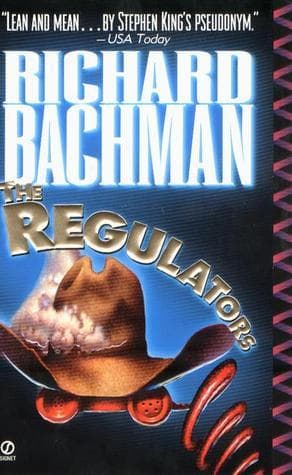
Synopsis
Covers the whole plot, including the ending.
- Difficulty
- Medium
- Pacing
- Fast
- Mood
- Surreal, Violent, Intense, Desperate, Nightmarish
- Read it if
- You enjoy extreme horror with a unique, reality-bending premise and don't mind a high body count and disturbing imagery.
- Skip it if
- You prefer traditional horror without supernatural or surreal elements, or are sensitive to graphic violence involving children.
The Regulators Plot Summary
Covers the whole plot, including the ending.
The Arrival of the Regulators
A peaceful afternoon on Poplar Street in Wentworth, Ohio, ends when a red van, seemingly an ice cream truck, drives onto the street. From it emerge bizarre, cartoonish figures resembling cowboys, armed with anachronistic and deadly weapons. These 'Regulators' immediately begin a brutal assault on residents and their homes, turning the familiar street into a nightmarish battlefield. The attack is sudden, unprovoked, and violent, leaving inhabitants bewildered as their reality begins to unravel. The first victims are innocent bystanders, caught off guard by the absurdity and lethality of the invasion.
The Massacre and the Children's Role
The Regulators' initial assault kills many adult residents of Poplar Street. The violence is graphic and relentless, with no apparent logic. Amidst the chaos, it becomes clear that the strange phenomena—the cartoonish villains, the transforming landscape, the bizarre weaponry—connect to the minds of the children on the street, particularly Seth Garin. Seth, a young autistic boy, and his recently deceased cousin, Collie Entragian, shared an intense imaginative world, fueled by old Westerns and children's cartoons. This shared fantasy, now twisted by a malevolent entity, manifests physically, turning their innocent games into a deadly reality.
Mary Jackson's Stand
Mary Jackson, a writer living with her sister Ellen and nephew Seth, quickly realizes the supernatural nature of the attack. She is one of the few adults who does not immediately panic, instead trying to protect Seth and understand the unfolding horror. She observes Seth's unusual reactions and how his attention seems to influence the manifestations. Mary's maternal instincts take over, but she also needs to understand the 'story' behind the madness. Her efforts to shield Seth become central, as she suspects his unique mind is both the source and the potential key to stopping the onslaught.
The Entragian Connection
As the situation worsens, the true nature of the threat emerges. The Regulators and the increasingly surreal environment are controlled by the malevolent spirit of Collie Entragian, a serial killer who recently died in a shootout with police. Collie's spirit, possessing Seth Garin, uses Seth's powerful imagination and autistic mind to project his twisted fantasies and dark desires onto Poplar Street. Collie's personality, a mix of childish cruelty and adult depravity, shapes the Regulators and their actions, turning the street into a living nightmare of his own design. He feeds off the fear and chaos he creates.
Audrey Wyler's Revelation
Audrey Wyler, an elderly resident of Poplar Street, has some psychic sensitivity. She experiences vivid visions and premonitions, which give her a terrifying, fragmented understanding of the forces at play. She sees the ghost of Collie Entragian and understands his connection to Seth. Her insights, though often cryptic and disbelieved by others, provide crucial pieces of the puzzle for Mary and other survivors. Audrey's struggle to communicate her visions and her eventual confrontation with the source of the evil highlight the supernatural elements of the narrative and her role as an unwitting oracle.
The Shifting Reality of Poplar Street
Under Collie Entragian's influence, Poplar Street undergoes grotesque and impossible transformations. Houses become animated, roads turn into deserts, and objects warp into monstrous versions of themselves. Reality itself stretches and tears, reflecting Collie's chaotic and childishly malevolent imagination as channeled through Seth. These transformations are not just cosmetic; they pose real dangers, trapping residents, creating new obstacles, and further disorienting the survivors. The street becomes a dynamic, unpredictable prison, a literal playground for the entity's dark fantasies.
The Survivors' Alliance
As deaths rise, a small group of survivors—including Mary Jackson, her sister Ellen, Seth, Audrey Wyler, and others like John Marinville and Steve Ames—form an uneasy alliance. They are united by shared terror and the desperate need to survive. They attempt to make plans, share information, and protect each other from the constant threat of the Regulators and the mutating environment. Despite personal differences and initial skepticism, the extreme circumstances force them to rely on one another, showing community and resilience in the face of overwhelming horror. Their fight is not just against the Regulators, but against despair itself.
Confronting the Source
Mary Jackson, guided by Audrey's fragmented visions and her own observations, realizes that Seth is not just a victim but the critical conduit for Collie Entragian's power. They understand that to stop the Regulators and restore reality, they must reach Seth and sever Collie's connection to him. This realization shifts their focus from mere survival to a desperate mission to save Seth, knowing that doing so might be their only chance to save themselves and Poplar Street. The confrontation becomes less about fighting the Regulators and more about confronting the entity within Seth.
The Final Battle for Seth
In a climactic struggle, the remaining survivors, led by Mary Jackson, make a desperate push to reach Seth and break Collie Entragian's hold over him. The street is a maelstrom of surreal dangers and Regulator attacks. Mary understands that she must reach Seth not with violence, but with love and understanding, appealing to his true self beneath Collie's influence. This confrontation is emotional and psychological, as Mary tries to break through the mental barriers imposed by Collie, while simultaneously fending off physical attacks from the cartoonish villains who are manifestations of Collie's rage and fear.
The Resolution and its Aftermath
Mary's desperate efforts to reach Seth succeed, and the connection between Collie Entragian's spirit and Seth's mind is severed. With Collie's influence gone, the Regulators vanish, and Poplar Street slowly reverts to its normal, peaceful state. The houses, cars, and landscape return to their original forms, leaving behind only the physical evidence of the horrific events: the bodies of the deceased and the traumatized survivors. While reality is restored, the psychological scars run deep. The few remaining residents must grapple with the unimaginable horror they witnessed and the profound loss they endured, forever changed by their encounter with the Regulators.
Principal Figures
Mary Jackson
Protagonist
A struggling writer and protective aunt to Seth.
Mary is a cynical yet resilient writer in her early thirties, living with her sister and nephew Seth. She possesses a keen observational mind, which helps her piece together the surreal events unfolding on Poplar Street. Despite her initial fear, she quickly takes on a leadership role, driven by her fierce love for Seth and a pragmatic desire to understand and survive the crisis. Her intelligence and ability to adapt to the impossible situation make her the central figure in the fight against the Regulators. She's not a hero in the traditional sense, but her determination to protect Seth is unwavering.
Relationships: Seth Garin (Aunt and nephew; Mary is fiercely protective of Seth.); Ellen Garin (Sisters; their relationship is strained but bonded by crisis.); Collie Entragian (Adversaries; Mary fights against his influence over Seth.)
Seth Garin
Central Figure/Victim
An autistic boy, unknowingly a conduit for evil.
Seth is a young autistic boy with a powerful, vivid imagination, a trait that makes him the unwitting host and conduit for the malevolent spirit of Collie Entragian. He is largely non-verbal and communicates through his drawings and intense focus on specific stimuli, particularly the cartoon world he shared with his deceased cousin. His innocence is tragically exploited, and his unique mind becomes a weapon against the residents of Poplar Street. He is a child, and his behavior is often misinterpreted by the adults around him, making him both a source of fear and pity.
Relationships: Mary Jackson (Aunt and nephew; Mary is Seth's primary protector.); Collie Entragian (Host and possessor; Collie's spirit controls Seth's mind.); Ellen Garin (Mother and son; Ellen struggles to understand and protect Seth.)
Collie Entragian
Antagonist
A deceased serial killer whose spirit possesses Seth and unleashes terror.
Collie Entragian is the spectral antagonist, a recently deceased serial killer whose spirit takes possession of Seth Garin. His personality is a twisted blend of childish malevolence and adult depravity, fueled by a deep-seated anger and a desire for chaos. He uses Seth's imagination to manifest his own violent and surreal fantasies as 'The Regulators' and the transforming Poplar Street. Collie is a force of pure evil, reveling in the fear and destruction he causes, and his motivations are rooted in a desire to continue his reign of terror beyond the grave.
Relationships: Seth Garin (Possessor and host; Collie exploits Seth's mind.); Mary Jackson (Adversaries; Mary fights to free Seth from Collie's control.)
Audrey Wyler
Supporting
An elderly psychic who understands the true nature of the threat.
Audrey Wyler is an elderly resident of Poplar Street with latent psychic abilities. Her visions and premonitions, though often fragmented and disturbing, provide crucial insights into the supernatural nature of the invasion and Collie Entragian's connection to Seth. Despite her age and the skepticism of others, she maintains a clear, if terrified, understanding of the forces at play. She serves as an oracle figure, guiding the other survivors towards the truth, even when her own sanity is questioned. Her wisdom, though often dismissed, proves vital.
Relationships: Mary Jackson (Allies; Audrey provides crucial information to Mary.); Steve Ames (Neighbors; they interact during the crisis.)
Steve Ames
Supporting
A Poplar Street resident who attempts to fight back.
Steve Ames is a typical suburban husband and father who finds himself thrust into an unimaginable nightmare. He initially tries to fight the Regulators with conventional weapons, embodying the futile human response to supernatural horror. He is brave but often overwhelmed by the surreal nature of the threat. His efforts, though often ineffective against the supernatural, highlight the human desire to protect one's home and family. He becomes a part of the survivor group, offering practical assistance and a grounded perspective amidst the chaos.
Relationships: Mary Jackson (Allies in survival.); John Marinville (Neighbors; they form part of the survivor group.)
Ellen Garin
Supporting
Seth's mother, struggling with her son's condition and the unfolding horror.
Ellen is Mary's sister and Seth's mother, a woman already burdened by the challenges of raising an autistic child. She is initially more prone to panic and denial than Mary, struggling to comprehend the impossible events on Poplar Street. Her love for Seth is evident, but her ability to cope with the crisis is often overwhelmed by fear and grief. She represents the average person's struggle to process and fight against a reality that defies all logic and reason, eventually relying on Mary's strength.
Relationships: Mary Jackson (Sisters; their bond is tested and strengthened.); Seth Garin (Mother and son; Ellen deeply loves Seth but struggles to understand him.)
John Marinville
Supporting
A famous writer who becomes an unlikely survivor.
John Marinville is a cynical, world-weary author, a character familiar to readers of Stephen King's other works (as he appears in 'Desperation'). He is visiting Poplar Street when the attack begins. His past experiences with supernatural horror make him quicker to accept the impossible, but he remains a reluctant participant in the fight. He uses his observational skills as a writer to try and make sense of the chaos, often offering sardonic commentary. He is a survivor, hardened by previous encounters with evil, and provides a grizzled, experienced perspective.
Relationships: Mary Jackson (Allies in survival, sharing a writer's perspective.); Steve Ames (Neighbors; they form part of the survivor group.)
The Regulators
Antagonists
Cartoonish, violent entities manifested from Seth's imagination.
The Regulators are the physical manifestation of Collie Entragian's twisted will, channeled through Seth's imagination. They appear as bizarre, anachronistic figures from old Westerns and children's cartoons—cowboys, Native Americans, figures like 'Tak' (a recurring villain in Bachman's works). They are relentlessly violent, seemingly invulnerable to conventional attacks, and their actions are driven by a chaotic, childish cruelty. They are not characters in the traditional sense but rather projections of pure, unadulterated evil, embodying the surreal horror of the unfolding events.
Relationships: Collie Entragian (Controlled by and extensions of Collie's will.); Seth Garin (Manifestations channeled through Seth's mind.)
Themes & Insights
The Power of Imagination (Corrupted)
The novel explores how imagination, particularly a child's, can be a force for both wonder and terror. Seth Garin's autistic mind, with its vivid inner world, becomes the conduit for Collie Entragian's malevolent spirit. What begins as innocent play with toy cowboys and cartoon characters transforms into a living nightmare, showing how creative energy, when corrupted, can warp reality itself. The Regulators, the transforming houses, and the surreal landscapes are all products of this twisted imaginative power, highlighting the terrifying potential of the mind when it falls into the wrong hands.
“It was like the world had turned inside out, and the cartoon they watched every Saturday morning had come to life, not as a friendly show, but as a bloodbath.”
Loss of Innocence and Reality
A central theme is the shattering of innocence and the breakdown of reality. Poplar Street, a symbol of suburban tranquility, is violently invaded by forces that defy all logic. The children, who were once playing games, now witness unspeakable horrors, and their world is irrevocably changed. Adults struggle to comprehend and cope as their understanding of the world is dismantled. The novel suggests that once innocence is lost and reality is fractured, it can never be fully restored, leaving deep psychological scars on those who survive. The normalcy of life is tainted.
“The world was no longer sane. Poplar Street was no longer Poplar Street. It was something else, something dreamed up by a madman, or a child, or both.”
The Nature of Evil
The Regulators presents a terrifying vision of evil, not as a tangible force, but as a parasitic, malevolent spirit that preys on the vulnerable. Collie Entragian's spirit, without a body, finds a new way to inflict suffering by hijacking Seth's mind. This evil is chaotic, childishly cruel, and driven by a primal urge to destroy and corrupt. It manifests through the familiar and the absurd—cartoon characters, everyday objects—making it even more unsettling. The novel suggests that evil can adapt and find new forms, particularly when it can exploit innocence and untapped potential.
“It wasn't just a ghost. It was a disease, a cancer that ate at the world through a child's mind.”
Survival and Community in Crisis
Despite the overwhelming horror, the novel also explores the human instinct to survive and the unexpected bonds that form under extreme duress. The disparate residents of Poplar Street, initially strangers, must rely on each other for protection and support. They form a fragile community, pooling resources and courage to face an incomprehensible enemy. This theme highlights resilience, the power of collective action, and the enduring human spirit even when confronted with insurmountable odds. Their shared trauma creates an unbreakable, if tragic, connection.
“We're all we've got. If we don't stick together, we're all going to die out here, one by one.”
Plot Devices & Literary Techniques
The Unreliable Reality
The shifting and warping of the physical environment.
This device is central to the horror, as Poplar Street itself becomes a character, constantly transforming in response to Collie Entragian's influence through Seth. Houses change colors, roads become deserts, and familiar objects morph into menacing entities. This creates an atmosphere of pervasive dread and disorientation, as characters can't trust their own senses or the stability of their environment. It isolates the survivors by making escape impossible and heightens the psychological terror, forcing them to question what is real and what is merely a projection of a corrupted mind.
The Innocent Conduit
An innocent character unknowingly serves as a channel for malevolent forces.
Seth Garin, an autistic child, serves as the 'innocent conduit' for the malevolent spirit of Collie Entragian. His unique mind, with its vivid imagination and communication challenges, makes him particularly susceptible to being possessed and exploited. This device amplifies the horror by turning a vulnerable, sympathetic character into the source of terror, creating a moral and emotional dilemma for the protagonists. They cannot simply 'kill' the monster, as the monster is inextricably linked to an innocent child, making the solution far more complex and heartbreaking.
The Cartoonish Manifestations
The use of absurd, cartoon-like villains and violence.
The Regulators themselves, with their over-the-top, anachronistic appearances and methods, are a key plot device. Their cartoonish nature, initially seeming ridiculous, quickly becomes deeply unsettling. This device subverts expectations of horror, making the violence more surreal and grotesque. It highlights the source of the evil—a child's twisted fantasy—and creates a jarring contrast between the mundane suburban setting and the outlandish, deadly invaders. The absurdity makes the horror more profound, as it challenges the characters' ability to process and fight against something so inherently illogical.
Psychic Visions and Premonitions
Audrey Wyler's ability to see fragments of the truth.
Audrey Wyler's psychic abilities serve as a crucial plot device, providing the characters and the reader with fragmented, often terrifying, insights into the true nature of the invasion. Her visions, though cryptic, help to gradually piece together the mystery of Collie Entragian's involvement and Seth's role. This device builds suspense, foreshadows future dangers, and provides a supernatural explanation for the otherwise inexplicable events. It also establishes a bridge between the physical world and the spiritual/mental dimension where the true battle is being fought.
The Regulators Quotes
“Most things, most times, are not what they seem.”
“The world was suddenly a cartoon, and they were trapped inside it.”
“It was like a dream, but you couldn't wake up.”
“Monsters are real. And they don't live under your bed. They live inside your head.”
“Sometimes the only way out is through.”
“Fear was a kind of glue, holding them together even as it threatened to tear them apart.”
“The past was a road that led straight to this moment.”
“There were no rules anymore, only the screaming of a child's imagination.”
“He understood then that evil was not a thing, but a force. A force that could take root anywhere.”
“You can't fight a dream with a gun.”
“It was the silence that was wrong, not the noise. The silence meant it was watching.”
“Sometimes, the smallest things are the most dangerous.”
“The world had turned inside out, and the lining was made of nightmares.”
“Hope was a tiny, flickering candle in a hurricane, but it was still there.”
“You never truly know what's real until it tries to kill you.”
Quiz
10 questions on the plot and the characters. Each answer comes with a short explanation.
Question 1
What is the name of the street in Wentworth, Ohio, where the main events of 'The Regulators' take place?
- Elm Street
- Maple Avenue
- Poplar Street
- Oak Lane
Show answer
C. Poplar Street The story's primary setting is Poplar Street in Wentworth, Ohio, where the residents' lives are violently disrupted.
Question 2
Which character is the primary catalyst for the supernatural events and the creation of the 'Regulators'?
- Audrey Wyler
- Seth Garin
- Johnny Marinville
- Cary Ripton
Show answer
B. Seth Garin Seth Garin, an autistic boy possessed by an entity named Tak, is the source of the reality-bending events, manifesting his drawings and thoughts into physical form as the 'Regulators' and other horrors.
Question 3
What is the initial appearance of the antagonists, 'The Regulators,' when they first attack Poplar Street?
- They emerge from a black van as armed, masked men.
- They appear as animated toys from Seth's room.
- They drive a red van and wear cowboy hats, wielding shotguns and other weapons.
- They manifest as shadowy figures from the local woods.
Show answer
C. They drive a red van and wear cowboy hats, wielding shotguns and other weapons. The Regulators first appear driving a distinctive red van, wearing cowboy hats and wielding an array of firearms, mirroring Seth's cartoon drawings.
Question 4
What is the name of the entity possessing Seth Garin, which is also featured in Stephen King's novel 'Desperation'?
- Cthulhu
- Tak
- Pennywise
- Nyarlathotep
Show answer
B. Tak The malevolent entity possessing Seth is named Tak, a force also encountered in the companion novel 'Desperation,' highlighting the thematic link between the two books.
Question 5
Which character, a famous author, finds himself caught up in the chaos on Poplar Street?
- Stephen King
- Johnny Marinville
- Peter Jackson
- Richard Bachman
Show answer
B. Johnny Marinville Johnny Marinville, a character who also appears in 'Desperation,' is present on Poplar Street and becomes a central figure in the fight against the Regulators.
Question 6
What happens to the physical environment of Poplar Street as Seth's powers manifest?
- It remains largely unchanged, but the inhabitants are replaced.
- It gradually transforms into a desert landscape, reflecting Seth's drawings.
- It becomes an urban jungle, overgrown with plants and vines.
- It is consumed by a perpetual blizzard.
Show answer
B. It gradually transforms into a desert landscape, reflecting Seth's drawings. As Seth's powers grow, Poplar Street begins to morph into scenes from his drawings and TV shows, most notably transforming into a desert landscape with mesas and canyons.
Question 7
What is the ultimate fate of the Poplar Street residents who are not possessed or directly controlled by Tak?
- They are all killed by the Regulators.
- They manage to escape Poplar Street and survive.
- Their bodies are taken over by Tak's influence, becoming puppets.
- They are transported to another dimension.
Show answer
C. Their bodies are taken over by Tak's influence, becoming puppets. Many of the surviving residents, including Johnny Marinville, ultimately have their bodies taken over by Tak, becoming empty vessels or puppets for the entity's amusement.
Question 8
How does the entity Tak communicate and manipulate events through Seth?
- Through direct verbal commands to Seth.
- By telepathically influencing Seth's dreams.
- By manifesting Seth's drawings and television fixations into reality.
- Through written messages appearing on Seth's walls.
Show answer
C. By manifesting Seth's drawings and television fixations into reality. Tak uses Seth's innocent fixations on cartoons, action figures, and drawings to shape the terrifying reality on Poplar Street, bringing his imagined world to life.
Question 9
What is the primary thematic connection between 'The Regulators' and 'Desperation' by Stephen King?
- They share the same group of protagonists fighting identical villains.
- They both feature the same antagonist, the entity known as Tak, and some shared character names.
- They are set in the exact same geographical location with overlapping events.
- They are both psychological thrillers without any supernatural elements.
Show answer
B. They both feature the same antagonist, the entity known as Tak, and some shared character names. Both 'The Regulators' and 'Desperation' feature the malevolent entity Tak as the primary antagonist, and some characters share names, albeit in different circumstances, creating a mirrored narrative.
Question 10
What is the significance of the character Collie Entragian in 'The Regulators' in relation to 'Desperation'?
- He is the main hero who defeats Tak in both books.
- He is a victim of Tak in 'The Regulators' but the primary possessed antagonist in 'Desperation'.
- He is a minor character with no real impact in either story.
- He is a completely different person in each book with no shared identity.
Show answer
B. He is a victim of Tak in 'The Regulators' but the primary possessed antagonist in 'Desperation'. In 'The Regulators,' Collie Entragian is a helpful neighbor who becomes a victim, while in 'Desperation,' he is the primary antagonist, a possessed sheriff, highlighting the parallel universe concept.
The Regulators FAQ
What is the inciting incident that shatters the peace of Poplar Street?
The tranquility of Poplar Street is brutally shattered when a mysterious red van, seemingly driven by unseen forces, arrives and unleashes a barrage of gunfire, instantly killing several residents and initiating the horrifying transformation of their familiar suburban environment.
Who is Seth Garin and what is his connection to the unfolding horror?
Seth Garin is a young autistic boy living on Poplar Street. He is unknowingly the conduit through which the monstrous entities and the reality-bending events manifest, as his drawings and imaginative world, fueled by his consumption of cartoons and media, are literally coming to life and altering the street.
What are the 'Regulators' and how do they manifest on Poplar Street?
The 'Regulators' are the primary antagonists, monstrous cowboys and villains drawn from Seth Garin's imagination, specifically from a fictional TV show and his own drawings. They appear in gaudy, impossible forms, riding motorcycles, and are the main force behind the street's escalating violence and surreal alterations.
Which characters are central to resisting the invasion?
Key characters resisting the invasion include Collie Entragian, the former sheriff whose spirit is trapped and trying to communicate; Mary Jackson, Seth's aunt, who tries to protect him; and other residents like Audrey Wyler and John Marin, who band together in a desperate fight for survival against the bizarre threats.
How does the physical environment of Poplar Street change throughout the story?
Poplar Street undergoes radical and terrifying transformations. Houses spontaneously sprout turrets, become fortified castles, or transform into cartoonish facades. The sky often changes color, and objects appear and disappear, reflecting the chaotic and reality-bending influence of Seth's imagination.
What is the significance of the former sheriff, Collie Entragian, in this narrative?
Collie Entragian is the spectral antagonist from 'Desperation,' a parallel novel, whose spirit has latched onto Seth Garin. Entragian is not directly controlling Seth, but rather his malevolent presence and residual energy act as a catalyst, amplifying Seth's power and allowing his imagination to manifest so violently.
How do the events of 'The Regulators' connect to 'Desperation'?
Both novels feature the malevolent entity Tak, embodied by the spirit of Collie Entragian, and both involve a young boy (Seth in 'The Regulators,' David Carver in 'Desperation') who is either a host or a conduit for Tak's power. 'The Regulators' can be seen as an alternate reality or a consequence of Tak's influence in a different setting.
What role do Seth's drawings and television shows play beyond mere inspiration?
Seth's drawings and the cartoons he watches (like 'Motor Psychos' and 'The Regulators') are not just inspiration; they are the literal blueprints for the unfolding reality. The characters, vehicles, and even the architectural changes on Poplar Street are directly pulled from his imaginative output, manifesting with terrifying fidelity.
How does Seth Garin's autism contribute to his unique role in the story?
Seth's autism is crucial because it allows him to immerse himself fully in his internal world of cartoons and drawings, blurring the lines between reality and imagination more profoundly than a typical child. This intense focus, combined with Entragian's influence, makes him an exceptionally powerful, albeit unwitting, creator of the horror.
Analyze the psychological impact of the constantly shifting reality on the residents.
The constantly shifting reality inflicts profound psychological trauma on the residents, leading to extreme disorientation, terror, and a breakdown of their mental resilience. Their inability to comprehend or predict the changes erodes their sense of safety and sanity, forcing them to confront the fragility of their perceived world.
How does Mary Jackson's protective instinct for Seth evolve throughout the ordeal?
Mary Jackson initially protects Seth out of familial love and a sense of responsibility, but as the horror escalates and she realizes Seth is the source, her protective instinct becomes conflicted. She struggles with the horrifying truth, torn between loving her nephew and the need to stop the monstrous reality he is creating, ultimately leading to a desperate attempt to save him from himself.
Discuss the theme of childhood innocence corrupted in 'The Regulators'.
The novel powerfully explores the corruption of childhood innocence through Seth Garin. His imaginative world, typically a source of joy and creativity, is twisted by an external malevolent force (Tak/Entragian) into a conduit for violence and terror, turning his innocent fantasies into a horrifying reality that consumes those around him.
What is the ultimate fate of Seth Garin and Poplar Street?
The ultimate fate of Seth Garin is tragic; he dies during the climax, effectively severing the connection to the imaginative world and causing the bizarre reality of Poplar Street to unravel and disappear. The street itself is left in ruins, reverting to a desolate, almost post-apocalyptic state, a stark reminder of the horror.
Is 'The Regulators' primarily a critique of media consumption or a story about psychological trauma?
'The Regulators' can be interpreted as both. While Seth's intense media consumption fuels the specific imagery of the horror, the underlying narrative delves deeply into psychological trauma, exploring how an innocent mind, when influenced by malevolence, can manifest its inner world with devastating consequences, blurring the lines between fiction and reality.
How does the novel utilize elements of horror, fantasy, and science fiction?
The novel blends horror through its graphic violence and psychological terror, fantasy through the impossible manifestations of Seth's imagination (monsters, transforming houses), and science fiction with its reality-bending premise and the suggestion of an extradimensional entity (Tak) influencing events, creating a unique genre mashup.
What message, if any, does the book convey about the power of imagination?
The book conveys a chilling message about the immense and potentially dangerous power of imagination, especially when untethered from reality or influenced by malevolent forces. It suggests that the mind's ability to create can, under extreme circumstances, become a destructive force that blurs the lines between internal fantasy and external reality.
Who is Audrey Wyler and what is her role in the narrative?
Audrey Wyler is one of the residents of Poplar Street, a character who initially appears somewhat ordinary but rises to the occasion. She becomes a key survivor, demonstrating courage and resourcefulness in fighting against the Regulators and navigating the chaotic, transforming landscape of her neighborhood.
What is the significance of the red van that appears at the beginning?
The red van is the initial vessel through which the 'Regulators' make their violent entrance onto Poplar Street, acting as the primary vehicle for the initial assault. It symbolizes the sudden, inexplicable invasion from Seth's imaginative world, literally bringing the cartoon villains into the suburban setting and shattering its peace.
About the author

Richard Bachman is a pseudonym used by Stephen King, primarily for his works of fiction. Among his notable books are "Thinner," a horror novel about a curse leading to rapid weight loss; "The Long Walk," a dystopian tale of survival; "The Running Man," a commentary on media and society; and "The Regulators," a parallel narrative to King's "Desperation."
Similar books
- Desperation
Stephen King
3.8 (121k) average on GoodreadsThrillerShares characters and a similar thematic exploration of good vs. evil and childhood innocence corrupted.
- The Lottery
Shirley Jackson
4.1 (58k) average on GoodreadsScience FictionFeatures a sudden, inexplicable breakdown of societal order and a small community under siege.
- House of Leaves
Mark Z. Danielewski
4.1 (131k) average on GoodreadsThrillerExplores reality-bending and a house that defies physical laws, creating a sense of psychological horror.
- The Haunting of Hill House
Shirley Jackson
3.8 (162k) average on GoodreadsThrillerWhile both novels feature malevolent entities connected to a location, Jackson's horror is primarily psychological, atmospheric, and relies on suggestion and dread. The Regulators is far more overt, grand, and explicit in its reality-altering destruction and violence, moving beyond psychological terror into a literal reshaping of the physical world.
- Angels & Demons
Dan Brown
3.9 (2.7M) average on GoodreadsThrillerA Harvard symbologist races through Rome's ancient sites, deciphering cryptic clues to unmask the Illuminati and stop a vengeful plot to destroy the Vatican with a stolen antimatter weapon.
- Gone Girl
Gillian Flynn
4.1 (2.3M) average on GoodreadsThrillerA wife's sudden disappearance on her fifth anniversary reveals a web of lies and psychological warfare, exposing the secrets within a seemingly perfect marriage.



Enjoyed the summary?
A summary gives you the shape of the book. The book itself has the detail, the examples and the voice.
Find The Regulators on AmazonAs an Amazon Associate, BookBrief earns from qualifying purchases. How we're funded