
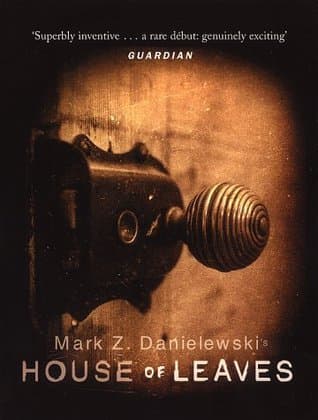
Synopsis
Covers the whole plot, including the ending.
- Difficulty
- Hard
- Pacing
- Variable
- Mood
- Atmospheric, Disturbing, Mind-bending, Existential, Unsettling
- Read it if
- You enjoy experimental literature, psychological thrillers, and stories that challenge the very definition of a book. Perfect for those who love complex narratives, unreliable narrators, and a deep dive into the psychological impact of the unknown.
- Skip it if
- You prefer straightforward narratives, conventional formatting, or get easily frustrated by ambiguity and a lack of clear resolution. Not for readers who dislike horror or deeply unsettling psychological experiences.
House of Leaves Plot Summary
Covers the whole plot, including the ending.
Zampanò's Death and Johnny's Discovery
The story begins with Johnny Truant, a troubled tattoo parlor apprentice in Los Angeles. His friend Lude calls him, saying an elderly, blind man named Zampanò has died in his apartment. Johnny, Lude, and a stripper named Thumper explore Zampanò's chaotic apartment and find a large, messy manuscript. This manuscript, which Zampanò had written for years, is a detailed academic analysis of a documentary film called 'The Navidson Record,' a film Johnny has never heard of. Johnny becomes engrossed with the manuscript, believing it holds a dangerous truth, and starts the difficult job of editing it, while also writing about his own declining mental state and past problems.
Introduction to 'The Navidson Record'
Zampanò's manuscript introduces Will Navidson, a Pulitzer Prize-winning photojournalist, and his partner Karen Green, a former fashion model, who move with their two children, Chad and Daisy, into a house on Ash Tree Lane in Virginia. They immediately notice strange architectural impossibilities: a new interior hallway appears, and the house's inside is larger than its outside. Navidson, a documentarian, films these oddities, creating 'The Navidson Record.' The discovery of a dark, maze-like space behind a closet door, called the 'Antechamber,' starts their terrifying encounters with the house's changing, impossible geography.
The First Explorations and the Labyrinth
Will Navidson, wanting to understand, goes into the house's expanding interior with his brother Tom and friends. They find vast, dark corridors, staircases leading nowhere, and seemingly endless rooms. The house does not follow physics or architecture, often changing its layout and making a low, guttural growl. During one early trip, Tom gets lost and almost dies, saved by Navidson. These early trips show the house as an active, malevolent thing that plays with its inhabitants' perceptions and sanity, always challenging their understanding of space and reality.
The Exploration Team and Holloway's Descent
As the house's mysteries deepen and the danger grows, Navidson puts together a team of explorers: the experienced Holloway Roberts, the young Jed Leeder, and the careful Kirby. Their goal is to map the maze. The house, however, begins to affect them deeply. Holloway, in particular, becomes paranoid and claustrophobic, convinced the house is a living thing trapping them. His mental state quickly worsens, leading to violent outbursts and eventually, a tragic fight with his teammates, ending with his disappearance (and implied death) inside the house, leaving Jed and Kirby traumatized.
Karen's Distress and Navidson's Obsession
Karen Green struggles with the horror in their home. Constant fear for her children, Chad and Daisy, and the house's unsettling presence push her to her limit. She asks Will to leave, but his journalistic instinct and obsession with 'The Navidson Record' keep him from abandoning the house. Tension between them grows as Karen feels isolated and terrified by Will's focus on documenting the inexplicable, even at the cost of their family's safety and her own sanity. She eventually takes the children and leaves the house, seeking refuge from its pervasive dread.
The Minotaur and Navidson's Solo Journey
After Karen and the children leave, Will Navidson, feeling responsible for his team and needing answers, goes on a solo trip into the house's deepest, most dangerous parts. He experiences extreme sensory deprivation, disorientation, and sees what he thinks is a 'Minotaur' – an unseen presence that embodies the house's evil. He gets badly hurt, including a broken leg, and almost dies from dehydration and exhaustion. This journey tests his resilience and his understanding of reality, pushing him to his physical and mental limits inside the house's impossible geometry.
Karen's Return and the Rescue
Despite her fear and trauma, Karen Green, driven by her love for Will, cannot leave him. She returns to Ash Tree Lane and, against all odds, goes into the maze-like house to find him. Her journey is full of terror and uncertainty, but her determination helps her navigate the shifting corridors. She eventually finds a badly injured and delirious Will. With help from Tom and others who stayed outside, she pulls him out of the house, bringing him to safety. This marks a reconciliation and reaffirmation of their bond amid extraordinary circumstances.
The Aftermath and the House's Persistence
After Will's rescue, the Navidson family tries to rebuild their lives away from Ash Tree Lane. However, the house's influence is inescapable. The trauma remains, and the house's mystery continues to haunt them, especially Will. He eventually makes a final, more reflective film, 'Stillness,' which explores the house's impact on his family and his own mind. The house itself eventually collapses or disappears under mysterious circumstances, but its legend and the questions it raised about reality, perception, and the unknown continue for the characters and for readers of Zampanò's manuscript.
Johnny's Deterioration and the Editor's Notes
Throughout editing Zampanò's manuscript, Johnny Truant's mental state steadily worsens. His footnotes, which increasingly fill the text, show his descent into paranoia, drug abuse, promiscuity, and self-harm. He deals with traumatic memories of his institutionalized mother, Pelafina H. Lievre, whose letters from the asylum are mixed into Johnny's narrative. He sees similarities between the maze-like house and his own internal struggles, convinced that Zampanò's work is cursed or actively manipulating his mind. The line between his reality and 'The Navidson Record's' fictional world blurs, leading to a psychological breakdown.
The Minotaur and Johnny's Search for Truth
As Johnny's sanity erodes, he fixates on the recurring Minotaur symbol in Zampanò's text, seeing it as a key to the house's (and perhaps his own) deepest secrets. He looks into philosophical and mythological discussions, seeing connections between the house, the Minotaur, and his own internal demons. His search for truth in Zampanò's impossible narrative drives him to extreme measures, including more drug use and dangerous encounters. He tries to find proof of 'The Navidson Record's' existence, but finds none, further blurring reality and fiction and increasing his mental anguish.
Pelafina's Letters and Johnny's Origins
Mixed with Johnny's footnotes are poignant and increasingly fragmented letters from his mother, Pelafina H. Lievre, written from the mental institution where she was. Her letters describe her own descent into madness, her love for Johnny, and cryptic references to a 'house' and other unsettling images. These letters offer a crucial, though unreliable, look into Johnny's traumatic childhood and the potential hereditary nature of his mental instability. They suggest a cycle of madness and a deep sense of loss and abandonment that underlies Johnny's present struggles, connecting his personal story directly to the themes of the Navidson story.
The Editor's Conclusion and Ambiguity
The book ends with an editor's note, likely from a third party who has taken over Johnny's manuscript. This final voice expresses worry for Johnny's fate, hinting at his disappearance or death, and questions the truth of Zampanò's work, Johnny's footnotes, and even the editor's own role. The ending offers no clear answer, instead showing the unreliability of all stories and the subjective nature of truth. The reader is left to consider the reality of 'The Navidson Record,' the house's existence, Johnny's sanity, and the nature of the book they have just read, embracing the pervasive ambiguity and the unsettling idea that the 'house' is a metaphor for the human mind itself.
Principal Figures
Johnny Truant
Protagonist
A troubled tattoo artist who discovers and edits Zampanò's manuscript.
Johnny Truant is the primary narrator whose footnotes frame Zampanò's academic text. He is a deeply disturbed young man, haunted by a traumatic past involving his institutionalized mother, Pelafina. He lives a hedonistic lifestyle, marked by drug abuse, promiscuity, and self-harm, which he details with unflinching honesty. His sanity unravels as he delves deeper into 'The Navidson Record,' blurring the lines between fiction and reality. Johnny's journey is one of psychological deterioration, driven by his obsession with understanding the manuscript and his own elusive origins.
Relationships: Zampanò (Deceased author whose manuscript Johnny discovers and edits); Pelafina H. Lievre (His institutionalized mother, whose letters are interspersed throughout the text); Lude (Friend and fellow tattoo artist); Thumper (Stripper and Johnny's occasional sexual partner)
Zampanò
Author (within the narrative)
A deceased, blind academic whose manuscript forms the core of the book.
Zampanò is the enigmatic, blind author of the core manuscript, 'The Navidson Record.' His academic analysis of the seemingly non-existent film is incredibly detailed, scholarly, and obsessive, though often contradictory and filled with footnotes and references to non-existent sources. He is described as a reclusive figure, living in squalor. His manuscript is the catalyst for Johnny Truant's descent into madness. Zampanò's true identity and how he came to write such a comprehensive analysis of an impossible house remain one of the book's central mysteries, hinting at a profound connection to the house itself.
Relationships: Johnny Truant (His manuscript is discovered and edited by Johnny); The Navidsons (The subjects of his extensive academic analysis)
Will Navidson
Protagonist (within Zampanò's text)
A Pulitzer Prize-winning photojournalist who documents the impossible house.
Will Navidson is a renowned photojournalist, known for his stark, honest depictions of human suffering. He moves his family into the house on Ash Tree Lane, where he immediately begins documenting its impossible architectural anomalies. Driven by a journalistic compulsion and a profound need to understand, he becomes obsessed with exploring the house's labyrinthine interior, even at great personal cost. He is a complex character, torn between his love for his family and his professional dedication to capturing the truth, however terrifying. His journey into the house is both an external exploration and an internal struggle with his own fears and responsibilities.
Relationships: Karen Green (His long-term companion and mother of his children); Chad Navidson (His son); Daisy Navidson (His daughter); Tom Navidson (His brother); Holloway Roberts (Leader of the professional exploration team)
Karen Green
Supporting (within Zampanò's text)
Will Navidson's companion, a former model who struggles with the house's terror.
Karen Green is Will Navidson's long-term companion and the mother of their two children. A former fashion model, she represents a grounded, emotional counterpoint to Will's detached, analytical nature. She is deeply disturbed by the house's impossible geometry and its psychological toll on her family. Her primary concern is the safety and well-being of her children, leading her to eventually leave the house. However, her love for Will ultimately compels her to return and rescue him from the depths of the labyrinth. Karen embodies resilience, maternal instinct, and the human desire for normalcy in the face of the inexplicable.
Relationships: Will Navidson (Her long-term companion and father of her children); Chad Navidson (Her son); Daisy Navidson (Her daughter)
Pelafina H. Lievre
Supporting/Mentioned
Johnny Truant's institutionalized mother, whose letters reveal her own descent into madness.
Pelafina is Johnny Truant's mother, confined to a mental institution. Her fragmented and increasingly surreal letters to Johnny are interspersed throughout his narrative. These letters offer a disturbing glimpse into her own struggles with madness, her love for her son, and cryptic references that often echo the themes of the house, suggesting a possible hereditary link to Johnny's mental instability. Her story provides a parallel narrative of mental deterioration and loss, deeply impacting Johnny's understanding of his own identity and sanity.
Relationships: Johnny Truant (Her son)
Holloway Roberts
Supporting (within Zampanò's text)
The leader of the professional exploration team, who succumbs to the house's psychological horror.
Holloway Roberts is a seasoned explorer hired by Will Navidson to map the impossible house. Initially confident and pragmatic, he is the first of the professional team to succumb to the house's profound psychological effects. His descent into paranoia, claustrophobia, and violence is a stark example of the house's malevolent power. Convinced the house is alive and actively trying to trap them, Holloway's mental state deteriorates rapidly, leading to a tragic confrontation with his teammates, Jed and Kirby, and his ultimate disappearance within the labyrinth. He embodies the fragility of human reason in the face of the truly inexplicable.
Relationships: Will Navidson (His employer for the exploration mission); Jed Leeder (Member of his exploration team); Kirby (Member of his exploration team)
Tom Navidson
Supporting (within Zampanò's text)
Will Navidson's brother, who provides support and assists with explorations.
Tom Navidson is Will's brother, a more grounded and practical individual. He is initially skeptical but supportive, assisting Will in his early explorations of the house's interior. Despite the dangers, Tom remains a loyal and reliable figure, often providing a voice of reason and concern for his brother's increasingly obsessive behavior. He plays a crucial role in Will's rescue from the house's depths, demonstrating his unwavering familial bond. Tom represents the steadfast human element amidst the supernatural chaos, providing a sense of tangible reality when everything else is falling apart.
Relationships: Will Navidson (His brother); Karen Green (His sister-in-law)
Chad Navidson
Supporting (within Zampanò's text)
Son of Will and Karen, one of the first to encounter the house's anomalies.
Chad is the young son of Will Navidson and Karen Green. Along with his sister Daisy, he is one of the first to witness the house's impossible changes, particularly the appearance of the new hallway and the growing darkness. His innocence and vulnerability highlight the terror the house inflicts upon the family. His experiences, though less detailed than his parents', contribute to the pervasive sense of dread and the profound psychological impact the house has on its youngest inhabitants. He often internalizes the fear, making him a silent witness to the unfolding horror.
Relationships: Will Navidson (His father); Karen Green (His mother); Daisy Navidson (His sister)
Daisy Navidson
Supporting (within Zampanò's text)
Daughter of Will and Karen, whose encounter with the house is unsettling.
Daisy is the young daughter of Will Navidson and Karen Green. Like her brother Chad, she experiences the early, unsettling anomalies of the house. Her childish reactions and observations often underscore the surreal and frightening nature of their new home. Her fear and confusion are palpable, contributing to Karen's distress and decision to leave the house with the children. Daisy represents the innocent victims of the house's malevolence, her experiences serving as a poignant reminder of the profound impact of the supernatural on the most vulnerable members of the family.
Relationships: Will Navidson (Her father); Karen Green (Her mother); Chad Navidson (Her brother)
Themes & Insights
Identity and Self-Discovery
The novel explores how individuals define themselves when faced with the unknown and the collapse of established reality. Johnny Truant's search for his own identity connects to understanding Zampanò's manuscript and his mother's past. Similarly, Will Navidson's identity as a documentarian is challenged and changed by the impossible house, forcing him to confront his limits and the meaning of his art. The house acts as a mirror, reflecting and distorting the characters' internal states, making them question who they are without the stability of a known world.
“This is not for you.”
The Nature of Reality and Perception
'House of Leaves' constantly blurs the lines between reality and fiction, sanity and madness. Zampanò's manuscript describes an impossible house that defies physical laws, challenging the characters' (and the reader's) idea of what is real. Johnny Truant's footnotes further destabilize this, as his own mental state worsens and he questions 'The Navidson Record's' existence. The book uses unreliable narrators, conflicting information, and experimental formatting to suggest that reality is subjective, built through stories, and ultimately fragile.
“We all create our own monsters.”
Loss and Grief
Loss fills the story on many levels. Johnny Truant deals with losing his mother to mental illness and losing his own sanity. The Navidson family faces the potential loss of their home, their safety, and even their lives inside the house's maze. The house itself can represent an unfillable emptiness, a deep absence. This theme is explored through the characters' emotional responses to these losses, their attempts to cope, and the lasting scars left by their experiences, showing the psychological impact of deep absence and trauma.
“Some things are just too big to know.”
The Power of Narrative and Storytelling
The entire novel shows the power of stories. Zampanò's elaborate, fictional academic text creates a reality for 'The Navidson Record.' Johnny Truant's footnotes become his own desperate story, a story of his mind unraveling. The book itself is a nested story, a story about a story about a film. This theme shows how stories shape our understanding of the world, how they can create truth, spread myths, and even drive people to madness. It questions the author's authority and the reader's part in making meaning.
“And it is true, everything is true.”
Fear and the Unknown
At its core, 'House of Leaves' is a horror story driven by fear of the unknown. The house's impossible, changing interior represents an ultimate unknown, a space that cannot be understood. The characters' terror comes not just from physical danger, but from the existential dread of encountering something fundamentally alien to their understanding of the world. This fear appears as claustrophobia, paranoia, and deep disorientation. The novel suggests that the most terrifying things are those that cannot be categorized or explained, tapping into basic anxieties about chaos and meaninglessness.
“The greatest fear, however, is not the fear of darkness, but the fear of not knowing.”
Plot Devices & Literary Techniques
Nested Narratives / Frame Story
Multiple layers of storytelling, each with its own narrator and purpose.
The book employs a complex system of nested narratives. The outermost layer is the 'Editor's' introduction and conclusion. Within that is Johnny Truant's narrative, presented through his footnotes, detailing his discovery and editing of Zampanò's manuscript. The innermost layer is Zampanò's academic analysis of 'The Navidson Record.' This structure creates multiple layers of unreliability, as each narrator interprets and distorts the story, forcing the reader to constantly question the veracity of what they are reading and who is truly in control of the narrative.
Unreliable Narrators
Characters whose credibility is compromised, blurring truth and fiction.
Both Johnny Truant and Zampanò serve as unreliable narrators. Johnny's mental deterioration, drug abuse, and traumatic past make his accounts of editing the manuscript and his personal life highly suspect. Zampanò, a blind man analyzing a film he supposedly couldn't see, fills his manuscript with contradictions, non-existent sources, and increasingly deranged academic prose. This device ensures that the reader can never fully trust any single account, contributing to the book's pervasive sense of ambiguity and its exploration of the subjective nature of truth.
Experimental Typography and Formatting
Unconventional page layouts and text manipulation to reflect narrative themes.
Danielewski extensively uses experimental typography and formatting to enhance the narrative. This includes text arranged in unusual shapes (like the house's labyrinth), colored words (blue for the house, red for the Minotaur), footnotes within footnotes, text running vertically or upside down, and vast expanses of white space. This device visually represents the disorientation and impossible geometry of the house, the fragmented nature of Johnny's mind, and the overwhelming scholarly detail of Zampanò's work. It makes the physical book itself a part of the immersive, unsettling experience.
The Minotaur / Labyrinth Motif
A recurring mythological symbol representing the house's monstrous, confusing nature.
The Minotaur and labyrinth motif is central to both Zampanò's analysis and Johnny's interpretation. The house itself is a physical labyrinth, a confusing and dangerous maze. The Minotaur represents the unseen, monstrous entity or force within the house, a terrifying presence that torments its inhabitants. For Johnny, the Minotaur becomes a symbol of his own internal demons and the elusive truth he seeks. This mythological allusion grounds the supernatural horror in a timeless archetypal fear, emphasizing themes of entrapment, confusion, and the confrontation with the monstrous self.
Metafiction
A self-referential narrative that calls attention to its own artificiality.
The entire novel is a metafictional exercise. It is a book about a manuscript about a film that may or may not exist, constantly acknowledging its own construction. Johnny Truant frequently comments on the act of editing and writing, while Zampanò's footnotes often discuss the academic process itself. This device forces the reader to confront the nature of storytelling, authorship, and the relationship between text and reality. It blurs the line between the 'real' world of the reader and the fictional world of the book, inviting participation in the creation of meaning.
House of Leaves Quotes
“This is not for you.”
“The house is bigger on the inside than it is on the outside.”
“I am not a fool. I am not a madman. I am not a liar. I am not a thief.”
“The darkness is not empty. It is full of things we cannot see.”
“We all create stories to protect ourselves.”
“The labyrinth is not meant to be solved; it is meant to be experienced.”
“Sometimes the only way to find yourself is to get lost.”
“The house does not want to be understood. It wants to be feared.”
“Words are the only way to make sense of the senseless.”
“There is no center. There is only the endless.”
“The past is a ghost that haunts the present.”
“To enter the house is to leave the world behind.”
“The truth is not in the facts, but in the spaces between them.”
“Fear is the only thing that grows in the dark.”
Quiz
10 questions on the plot and the characters. Each answer comes with a short explanation.
Question 1
What is the central impossible phenomenon discovered by the Navidson family in their home on Ash Tree Lane?
- The house has no doors or windows
- The house is bigger on the inside than on the outside
- The house changes color every day
- The house is haunted by ghosts of previous owners
Show answer
B. The house is bigger on the inside than on the outside The core premise of the book is that the Navidson family's house defies physical laws by being larger internally than its external dimensions would allow, creating a labyrinthine and ever-changing interior space.
Question 2
Who are the two main adult occupants of the house on Ash Tree Lane?
- Will Navidson and Karen Green
- Johnny Truant and his mother
- Zampanò and Pelafina
- Tom and Daisy Buchanan
Show answer
A. Will Navidson and Karen Green Will Navidson (a Pulitzer Prize-winning photojournalist) and Karen Green are the couple who move into the house with their children and experience its supernatural properties firsthand.
Question 3
What unusual formatting elements are mentioned as being preserved in the published version of 'House of Leaves'?
- Colored words, vertical footnotes, and multiple appendices
- Blank pages and invisible ink
- Audio recordings and scent strips
- Pop-up illustrations and fold-out maps
Show answer
A. Colored words, vertical footnotes, and multiple appendices The book is known for its unconventional typography and layout, including colored text (particularly the word 'house' in blue), footnotes that run vertically or in other unusual arrangements, and multiple appendices that add layers to the narrative.
Question 4
According to the description, what initially happened to the manuscript of 'House of Leaves' before it was published?
- It was immediately rejected by all major publishers
- It was circulated as a poorly organized collection of papers and online fragments
- It was written as a series of anonymous blog posts
- It was discovered complete in a time capsule
Show answer
B. It was circulated as a poorly organized collection of papers and online fragments The book's backstory describes it originally existing as a disorganized manuscript that was passed around physically and digitally, gaining a cult following before being formally published with its distinctive formatting intact.
Question 5
What event triggers the Navidson family's full confrontation with the house's unnatural properties?
- A strange growling sound begins emanating from the walls
- Their two children wander off and their voices return telling another story
- Karen Green finds a hidden diary in the basement
- Will Navidson's photography equipment malfunctions mysteriously
Show answer
B. Their two children wander off and their voices return telling another story The children's disappearance and the eerie return of their voices—which tell a secondary narrative about darkness and an abyss—marks the point when the family can no longer ignore the house's terrifying reality.
Question 6
Which of these groups is mentioned as being among the early devotees of 'House of Leaves' when it was first circulating?
- Academic scholars and literary critics
- Musicians, tattoo artists, programmers, strippers, environmentalists, and adrenaline junkies
- Government agents and conspiracy theorists
- Retired librarians and historians
Show answer
B. Musicians, tattoo artists, programmers, strippers, environmentalists, and adrenaline junkies The description specifies that the book initially attracted a 'small but devoted following' of marginalized youth from various subcultures before reaching wider audiences.
Question 7
What broader thematic connection does the description suggest between older generations and the book's content?
- It helped them understand technological advances
- It provided investment advice hidden in the footnotes
- It offered a way to reconnect with their estranged children
- It contained secret government documents
Show answer
C. It offered a way to reconnect with their estranged children Beyond the horror plot, the book is described as creating intergenerational bridges, with older readers finding both themselves in the pages and a means to understand their children's lives better.
Question 8
What specific location within the house is described as containing 'an ever-growing abyss'?
- Behind the fireplace
- Under the floorboards of the master bedroom
- Behind a closet door
- Inside the kitchen pantry
Show answer
C. Behind a closet door The description mentions that the children's voices return a story that includes 'an ever-growing abyss behind a closet door,' highlighting how ordinary domestic spaces become portals to terrifying voids.
Question 9
Which element of the Navidson story is characterized as 'unholy' and capable of consuming dreams?
- The whispered voices of the children
- The ever-shifting hallways
- A growl that tears through the walls
- The blue color of the word 'house'
Show answer
C. A growl that tears through the walls The description ends by referencing 'that unholy growl which soon enough would tear through their walls and consume all their dreams,' emphasizing the auditory and psychological horror elements beyond just spatial distortion.
Question 10
What dual narrative function does the book's description imply about the children's voices?
- They provide comic relief from the main horror
- They reveal the house's architectural blueprints
- They return telling another story within the main story
- They sing songs that calm the growling entity
Show answer
C. They return telling another story within the main story The children's voices don't just signal danger; they actively narrate a secondary tale 'of creature darkness' and the abyss, creating a story-within-a-story structure that mirrors the book's layered narrative technique.
House of Leaves FAQ
What is 'House of Leaves' about?
'House of Leaves' centers on the Navidson family—photographer Will Navidson and his partner Karen Green—who move into a house on Ash Tree Lane that defies physics by being larger inside than outside. As they explore the ever-expanding, shifting labyrinth within, they encounter a mysterious darkness and unsettling phenomena that threaten their sanity and lives, while the story is framed through multiple layers of narration including the troubled Johnny Truant's discovery of the manuscript.
Why should I read 'House of Leaves'?
You should read 'House of Leaves' for its innovative, multi-layered narrative that blends horror, mystery, and psychological depth with unique typography and footnotes. It explores themes of obsession, reality, and the unknown through a haunting story about a house that physically and metaphorically consumes those who enter, offering a deeply immersive and unsettling experience.
What is the background/setting of 'House of Leaves'?
The primary setting is the Navidson family's house on Ash Tree Lane in Virginia, which appears normal from the outside but contains a vast, ever-changing labyrinth. The story is framed by Johnny Truant's life in Los Angeles as he discovers and annotates the academic manuscript about the house, creating a meta-narrative that spans different times and locations.
What are the most memorable quotes?
Memorable quotes include 'This is not for you' from the book's dedication, hinting at its exclusive nature, and 'The house is bigger on the inside than it is on the outside,' which encapsulates the central horror. Another is Johnny Truant's reflection: 'I am not a happy man, but I am a man who has found something to do,' highlighting the novel's themes of obsession and purpose.
What writing style does the author use?
Mark Z. Danielewski uses a complex, multi-layered style with academic footnotes, typographical experimentation (e.g., colored words, vertical text), and nested narratives. The book blends horror, mystery, and scholarly analysis, creating a disorienting effect that mirrors the labyrinthine house and characters' psychological states.
What minor details add significant meaning?
Minor details like the recurring phrase 'Yggdrasil' (the world tree in Norse mythology) and the use of the color blue in text hint at deeper mythological and psychological themes. The house's measurements, which change unpredictably, symbolize the instability of reality and memory, while Johnny Truant's tattoos and drug use reflect his fragmented identity.
What are some subtle foreshadowing moments?
Early mentions of the '5½ minute hallway' and the mysterious growls foreshadow the house's expanding, predatory nature. Johnny Truant's initial unease with the manuscript hints at its consuming influence, and Karen Green's claustrophobia subtly predicts her eventual breakdown when trapped in the labyrinth.
What unexpected character connections exist?
Unexpected connections include Zampanò, the blind author of the Navidson Record, whose past may link to the house's mysteries, and Johnny Truant's mother, who was institutionalized, mirroring his own descent into madness. The house itself acts as a character that connects all narratives, reflecting each person's inner turmoil.
What are unspoken character motivations?
Will Navidson is driven by an unspoken need to document and conquer the unknown, stemming from his photojournalistic career. Karen Green's motivation lies in her desire for stability and escape from her claustrophobic fears, while Johnny Truant seeks meaning and connection through the manuscript to cope with his traumatic past.
What psychological complexities do characters exhibit?
Characters exhibit deep psychological complexities: Will Navidson's obsession with exploration masks his fear of intimacy, Karen Green's claustrophobia reflects her emotional confinement, and Johnny Truant's paranoia and addiction stem from childhood trauma. The house amplifies these traits, leading to breakdowns and transformations.
What are the major emotional turning points?
Major emotional turning points include the children's disappearance into the house, triggering parental desperation; Karen's decision to enter the labyrinth to rescue Will, overcoming her claustrophobia; and Johnny's realization that the manuscript is consuming his sanity, leading to his fragmented narrative and eventual isolation.
How do relationship dynamics evolve?
Relationship dynamics evolve from tension to breakdown and tentative reconciliation: Will and Karen's partnership strains under the house's horrors but finds moments of connection in crisis. Johnny's relationship with the manuscript shifts from curiosity to obsession, mirroring his alienation from others, while the house itself becomes a destructive force in all interactions.
Which parts remain ambiguous or open-ended?
Ambiguous parts include the true nature of the house's darkness and the Minotaur-like growl, which are never fully explained. The fate of characters like Johnny Truant and the origins of Zampanò's manuscript remain open-ended, leaving readers to interpret whether the horrors are supernatural, psychological, or both.
What are controversial scenes or decisions?
Controversial scenes include the exploration team's descent into the abyss, where some members die or go mad, raising ethical questions about risk. Johnny's graphic descriptions of his drug use and mental decline spark debate on realism versus exploitation, and the book's non-linear, fragmented structure divides readers on its accessibility and effectiveness.
'House of Leaves' ending explained: how it ends & what it means
The ending sees Will and Karen escaping the house but forever changed, with Karen publishing a book about their ordeal. Johnny Truant's narrative dissolves into chaos, suggesting he is consumed by the manuscript's influence. It implies that the house represents an inescapable, psychological labyrinth—the ending underscores themes of trauma, the unknowable, and the haunting persistence of memory.
About the author

Mark Z. Danielewski is an American author known for his innovative and unconventional narrative styles. He is best recognized for his debut novel, House of Leaves, which blends multiple genres and formats to explore themes of reality and perception. Danielewski's work often challenges traditional storytelling conventions, making him a distinctive voice in contemporary fiction.
Similar books
- The Raw Shark Texts
Steven Hall
3.9 (16k) average on GoodreadsThrillerExplores themes of memory, identity, and an unseen, sentient entity that preys on information, with a unique narrative style.
- Infinite Jest
David Foster Wallace
4.3 (74k) average on GoodreadsLiterary FictionKnown for its extensive use of footnotes, complex structure, and a deep dive into postmodern themes and philosophical concepts.
- Pale Fire
Vladimir Nabokov
4.1 (43k) average on GoodreadsLiterary FictionBoth House of Leaves and Pale Fire employ elaborate textual apparatus (footnotes, commentary) to build unreliable narratives and explore themes of authorship and interpretation. However, Pale Fire's complexity primarily resides in its literary commentary and the unreliable narrator's voice, requiring intellectual deciphering. House of Leaves extends this to a visual and physical level, demanding a more tactile engagement with the book's layout and design, making the reading experience itself a disorienting, labyrinthine journey.
- Angels & Demons
Dan Brown
3.9 (2.7M) average on GoodreadsThrillerA Harvard symbologist races through Rome's ancient sites, deciphering cryptic clues to unmask the Illuminati and stop a vengeful plot to destroy the Vatican with a stolen antimatter weapon.
- Gone Girl
Gillian Flynn
4.1 (2.3M) average on GoodreadsThrillerA wife's sudden disappearance on her fifth anniversary reveals a web of lies and psychological warfare, exposing the secrets within a seemingly perfect marriage.
- The Girl on the Train
Paula Hawkins
3.9 (2.1M) average on GoodreadsThrillerA woman’s fascination with a seemingly perfect couple she watches from her daily train commute leads her into a dark investigation when she witnesses something that shatters their idyllic image.




Enjoyed the summary?
A summary gives you the shape of the book. The book itself has the detail, the examples and the voice.
Find House of Leaves on AmazonAs an Amazon Associate, BookBrief earns from qualifying purchases. How we're funded