
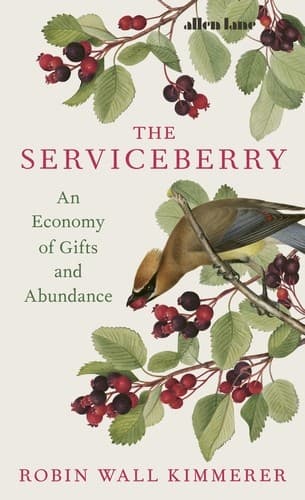
Core Idea
- Difficulty
- Medium
- Read it if
- You are interested in reimagining economic systems through an ecological and Indigenous lens, seeking alternatives to capitalism, or exploring the intersection of environmentalism, philosophy, and social justice.
- Skip it if
- You are looking for a traditional economics textbook with quantitative analysis or a purely philosophical treatise without a strong ecological focus.
Key Takeaways from The Serviceberry
The Serviceberry's Manifesto
An abundant model of reciprocal flourishing, not scarcity.
Kimmerer says the serviceberry tree shows an economic model opposite to current capitalist ideas. Our system works on scarcity, competition, and hoarding resources. The serviceberry shows an economy of plenty and generosity. It makes many fruits, more than it 'needs,' and shares this with a whole ecological community: birds, insects, and other animals. This sharing helps everyone survive and thrive, as these partners spread seeds and pollinate. This is very different from a human economy that often puts individual wealth over community well-being and environmental health, causing broken relationships and harm to nature.
“Hoarding won't save us, all flourishing is mutual.”
In the book: The very existence and life cycle of the serviceberry tree, which produces an excess of berries that are widely consumed by various species, ensuring the tree's propagation and the health of its ecosystem.
Try this: Re-evaluate personal and community resource allocation. Instead of asking 'How much can I accumulate?', ask 'How much can I share to foster mutual well-being?' Support local economies and initiatives that prioritize sharing and community over individual profit.
Related ideas: gift-economy, reciprocity, mutual-flourishing
From Scarcity to Superabundance
Challenging the foundational myth of economic limitation.
A main idea in standard economics is scarcity, which leads to competition and the need to gather wealth. Kimmerer shows this is a myth by pointing to nature's ability to create a lot, like the serviceberry. The tree does not make 'just enough'; it makes a surplus that feeds an entire ecosystem. This surplus is not wasted. It helps the community stay healthy and strong. Our human economic systems often create artificial scarcity by hoarding and unfair distribution, causing suffering even with many resources. Following the serviceberry's model means changing how we see things, understanding that true wealth is in shared abundance, not controlled resources.
“Our economy is rooted in scarcity, competition, and the hoarding of resources, and we have surrendered our values to a system that actively harms what we love.”
In the book: The sheer volume of berries produced by a single serviceberry tree, far exceeding what is needed for its individual reproduction, demonstrating nature's inherent generosity.
Try this: Critically examine personal and societal narratives around scarcity. Advocate for policies that promote equitable distribution of resources (e.g., food, housing, healthcare) rather than those that concentrate wealth. Support practices like community gardens and resource sharing networks.
Related ideas: scarcity-myth, resource-distribution, ecological-economics
Gratitude as Economic Currency
Shifting value from monetary gain to appreciative exchange.
Kimmerer suggests that gratitude, not profit, should be a main reason for economic interactions. In the serviceberry's gift economy, giving (berries) is met with 'payment' of gratitude, shown by seed spreading and a healthy ecosystem. This creates a good cycle where caring for each other helps everyone. Our modern economy often separates transactions from gratitude, making relationships just business deals and not valuing the true worth of goods and labor. Putting gratitude first means seeing the gifts in nature and human effort, creating deeper connections and a more lasting relationship with the world.
“How, she asks, can we learn from Indigenous wisdom and the plant world to reimagine what we value most?”
In the book: The symbiotic relationship between the serviceberry and the birds: the tree gives fruit, and the birds, by consuming and dispersing seeds, ensure the tree's future, an interaction underpinned by an implicit, ecological gratitude.
Try this: Practice conscious gratitude in daily transactions. Thank the farmer, the barista, the craftsperson. Consider how your purchases support systems of appreciation rather than exploitation. Engage in acts of unsolicited generosity within your community.
Related ideas: indigenous-wisdom, gratitude-economy, reciprocal-relationships
Interconnectedness as Economic Policy
Recognizing that no entity flourishes in isolation.
The serviceberry shows that real economic security and success come from deep connection, not being alone or self-sufficient. The tree's survival depends on birds and other animals; its generosity ensures it reproduces and the surrounding ecosystem stays healthy, which then helps the tree. This ecological lesson questions the individualistic ideas of standard economics, which often say self-interest and competition lead to success. Kimmerer argues that our human economies must think similarly, understanding that the well-being of individuals, communities, and the planet are all linked. Harming one part of the system eventually harms the whole, including the one doing the harming.
“The tree distributes its wealth--its abundance of sweet, juicy berries--to meet the needs of its natural community. And this distribution ensures its own survival.”
In the book: The serviceberry's reliance on birds for seed dispersal. Without this interconnected exchange, the tree's ability to reproduce and thrive would be severely limited, highlighting a foundational interdependence.
Try this: Support policies and practices that foster community resilience and ecological health (e.g., environmental protection, social safety nets). Build collaborative relationships in professional and personal life, recognizing that collective success often surpasses individual achievement.
Related ideas: ecological-interdependence, community-resilience, holistic-systems
Reclaiming Our Values from the Market
Aligning our economic choices with what we truly love.
Kimmerer strongly argues that our economic system often makes us give up our deepest values, such as love for nature, community, and future generations, to get money. We take part in systems that exploit labor, harm the environment, and create unfairness, even when these results go against our personal ethics. The serviceberry offers a way to get these lost values back by showing an economic model where giving and caring are central. It asks us to choose economic activities that match our love for the world, not just those driven by market forces. This needs thought, reflection, and a willingness to imagine and build different systems.
“We have surrendered our values to a system that actively harms what we love.”
In the book: The contrast between the serviceberry's inherent generosity and the human tendency to over-consume or exploit resources, even when knowing the long-term environmental consequences.
Try this: Consciously evaluate your consumption habits and investments. Do they support companies and practices that align with your values? Engage in ethical consumerism, support local and fair-trade businesses, and advocate for corporate social responsibility.
Related ideas: ethical-consumption, value-alignment, conscious-economy
The Economy of Belonging
From transactional relationships to deeply embedded community.
The serviceberry's gift economy creates a strong sense of belonging within its ecological community. Every creature that eats its fruit is part of a larger network that helps everyone. This is very different from human economic systems that often isolate people, make relationships into commodities, and break up communities. Kimmerer suggests that by using the serviceberry's model of shared exchange and generous distribution, we can fix broken relationships and build a stronger sense of community. This is not just about sharing resources; it is about recognizing our place in a living, connected web of life, where our well-being is tied to everyone else's.
“The Serviceberry is an antidote to the broken relationships and misguided goals of our times...”
In the book: The numerous species (birds, bears, insects, humans) that gather around the serviceberry tree, creating a temporary, multi-species community centered around the shared resource.
Try this: Actively participate in community-building initiatives. Prioritize local gatherings, shared meals, and collaborative projects over isolated consumption. Foster a sense of collective responsibility for shared spaces and resources.
Related ideas: community-building, social-cohesion, restorative-economics
Beyond Extraction: Cultivating a Giving Culture
Moving from taking from the Earth to nurturing its generosity.
Our main economic way of thinking mostly involves taking from nature, seeing it as a resource for human use. Kimmerer, using Indigenous wisdom and the serviceberry, suggests moving towards a culture of giving. This means not just harvesting sustainably, but actively helping the sources of abundance grow. The serviceberry does not just 'produce' fruit; it offers a gift that, when returned, ensures its continued life. This idea challenges us to do more than just cause less harm. It asks us to actively do things that make the natural world healthier and more generous, understanding that our well-being is tied to Earth's ability to give.
“As Indigenous scientist and author of Braiding Sweetgrass Robin Wall Kimmerer harvests serviceberries alongside the birds, she considers the ethic of reciprocity that lies at the heart of the gift economy.”
In the book: Kimmerer's own act of harvesting serviceberries alongside birds, embodying a respectful, reciprocal relationship with nature rather than one of mere extraction.
Try this: Engage in practices like gardening, composting, and reforestation. Support land stewardship efforts and Indigenous-led conservation initiatives. Learn about and practice responsible foraging, taking only what is needed and expressing gratitude.
Related ideas: regenerative-practices, land-stewardship, indigenous-conservation
The Wisdom of the Wild: Learning from Plant Teachers
Plants as mentors for a more ethical and sustainable economy.
Kimmerer always presents nature, especially plants like the serviceberry, as important teachers. The serviceberry is not just a symbol; it is a real example of a working, thriving economy based on generosity, sharing, and connection. This idea questions human-centered views that often ignore non-human intelligence and wisdom. By watching and listening to the 'lessons' from plants, we can learn about lasting living, ethical resource management, and peaceful community building that our human-focused economic models have mostly missed or stopped. It is a call to learn about ecology again as a basic part of understanding economics.
“How, she asks, can we learn from Indigenous wisdom and the plant world to reimagine what we value most?”
In the book: The entire premise of the book centers on deriving economic and philosophical lessons from the specific life cycle and interactions of the serviceberry tree.
Try this: Spend time observing nature, even in urban environments. Learn the names and ecological roles of local plants. Read more about ethnobotany and Indigenous ecological knowledge. Consider how natural systems solve problems that human systems struggle with.
Related ideas: plant-intelligence, ecological-literacy, ethnobotany
The Power of Collective Imagination
Envisioning and building economies beyond scarcity and exploitation.
Kimmerer's work does more than criticize; it invites us to imagine and create new economic realities together. The serviceberry provides a clear plan for what a thriving, sharing economy could look like. By giving a clear, natural example, she helps readers believe that other ways are possible and already exist in nature. This needs an act of imagination: to picture a society where generosity is valued more than greed, where community well-being is more important than individual profit, and where our relationships with Earth are full of gratitude and care. This shared imagining is the first step to making a 'serviceberry economy' real.
“The Serviceberry is an antidote to the broken relationships and misguided goals of our times, and a reminder that 'hoarding won't save us, all flourishing is mutual.'”
In the book: The book itself acts as a catalyst for this imagination, using the serviceberry as a concrete example to inspire new ways of thinking about economics.
Try this: Participate in discussions about alternative economic models (e.g., circular economy, solidarity economy). Support artists, writers, and thinkers who are envisioning positive futures. Engage in local initiatives that are already experimenting with gift economies and shared resources.
Related ideas: future-economics, social-innovation, collective-action
The Serviceberry Quotes
“Knowing the names of things is a way to call them to mind, to make them present. So, too, with the gifts of the earth.”
“For all of us, becoming indigenous to a place means living as if your children's future mattered, to take care of the land as if your life depended on it.”
“The serviceberry offers itself. It is a gift. A gift is not a commodity. It cannot be bought or sold. Its value is not in its price, but in its giving.”
“We need an economy that can distinguish between a gift and a commodity. The health of the land and the people depend on it.”
“When we take only what we need, and use it well, then the land can provide for us indefinitely.”
“How can we live in a way that honors the serviceberry, and all its kin, as a gift, rather than merely a resource?”
“The serviceberry teaches us that abundance is not about having more, but about having enough, and sharing it.”
“Science alone cannot save us. It is the marriage of scientific understanding with indigenous wisdom that holds the greatest promise.”
“What if our economies were modeled not on perpetual growth, but on perpetual reciprocity?”
“The work of restoration is not just about bringing back species, but about bringing back relationship.”
“To be truly sustainable, an economy must be rooted in an understanding of the ecology of its place.”
“The serviceberry reminds us that the earth provides, if we only listen and learn how to receive.”
“Our challenge is to make an economy that serves life, rather than one that life serves.”
“The real wealth of a nation is not in its bank accounts, but in the health of its land and its people.”
Quiz
10 questions on the main ideas. Each answer comes with a short explanation.
Question 1
According to Kimmerer in 'The Serviceberry,' what fundamental ethic lies at the heart of the gift economy she explores?
- Self-sufficiency
- Competition
- Reciprocity
- Accumulation
Show answer
C. Reciprocity The book explicitly states that Kimmerer considers the ethic of reciprocity to be at the heart of the gift economy, drawing parallels with the serviceberry's distribution of its fruit.
Question 2
What does Kimmerer suggest is the primary motivation behind the conventional economy, contrasting it with the serviceberry's example?
- Innovation and progress
- Scarcity, competition, and hoarding
- Efficiency and optimization
- Global interconnectedness
Show answer
B. Scarcity, competition, and hoarding Kimmerer argues that our current economy is 'rooted in scarcity, competition, and the hoarding of resources,' which stands in stark contrast to the serviceberry's abundance and sharing.
Question 3
How does the serviceberry's relationship with its natural community exemplify the principles Kimmerer advocates?
- It monopolizes resources to ensure its own survival.
- It strategically withholds fruit to increase demand.
- It distributes its abundance to meet community needs, ensuring its own survival through interconnectedness.
- It relies solely on human intervention for its propagation.
Show answer
C. It distributes its abundance to meet community needs, ensuring its own survival through interconnectedness. The book highlights that the serviceberry 'distributes its wealth—its abundance of sweet, juicy berries—to meet the needs of its natural community. And this distribution ensures its own survival,' embodying reciprocity and interconnectedness.
Question 4
What key question does Robin Wall Kimmerer pose regarding learning from Indigenous wisdom and the plant world?
- How can we maximize economic growth through natural resource extraction?
- How can we learn to reimagine what we value most by observing Indigenous wisdom and the plant world?
- How can we develop new technologies inspired by plant biology?
- How can we control natural cycles to benefit human society exclusively?
Show answer
B. How can we learn to reimagine what we value most by observing Indigenous wisdom and the plant world? Kimmerer specifically asks, 'How...can we learn from Indigenous wisdom and the plant world to reimagine what we value most?' This is a central philosophical query of the book.
Question 5
The phrase 'hoarding won't save us, all flourishing is mutual' serves as a core message. What practical application does Kimmerer imply from this statement?
- Individuals should prioritize personal wealth accumulation for security.
- Societies should dismantle systems that encourage accumulation and foster shared well-being.
- Nations should secure their own resources against external threats.
- Environmental conservation is only effective if resources are strictly controlled.
Show answer
B. Societies should dismantle systems that encourage accumulation and foster shared well-being. The quote directly challenges the notion that individual or national hoarding leads to security. Instead, it advocates for a system where mutual well-being and sharing are the pathways to flourishing, implying a need to change current economic structures.
Question 6
What is the primary role of gratitude in the alternative economic vision presented by Kimmerer?
- It is a polite social custom with no economic relevance.
- It acts as a foundation for acknowledging gifts and fostering the cycle of reciprocity.
- It is a feeling reserved for personal, non-material exchanges.
- It encourages individuals to take more, appreciative of what they receive.
Show answer
B. It acts as a foundation for acknowledging gifts and fostering the cycle of reciprocity. Gratitude, alongside reciprocity and community, is explicitly mentioned as a core principle for reorienting our lives. In a gift economy, gratitude acknowledges the gift and motivates the return, sustaining the reciprocal relationship.
Question 7
Kimmerer, as an Indigenous scientist, uses her dual perspective to argue for what kind of learning?
- A solely scientific understanding of ecological systems.
- A purely philosophical contemplation of nature's beauty.
- An integration of Indigenous wisdom with scientific understanding to reimagine societal values.
- A focus on economic models that prioritize human dominance over nature.
Show answer
C. An integration of Indigenous wisdom with scientific understanding to reimagine societal values. As an 'Indigenous scientist,' Kimmerer uniquely blends these perspectives. The book asks how we can 'learn from Indigenous wisdom and the plant world to reimagine what we value most,' indicating an integrated approach to knowledge.
Question 8
What does Kimmerer imply is the consequence of our current economy 'actively harms what we love'?
- It leads to greater efficiency in resource allocation.
- It creates a disconnect between our proclaimed values and our economic practices, leading to environmental degradation and social inequality.
- It fosters healthy competition that benefits all participants.
- It ensures that only the most resilient aspects of nature survive.
Show answer
B. It creates a disconnect between our proclaimed values and our economic practices, leading to environmental degradation and social inequality. The statement 'we have surrendered our values to a system that actively harms what we love' implies that the pursuit of economic growth based on scarcity and competition directly damages the environment and social fabric we claim to care for, leading to detrimental consequences.
Question 9
How does 'The Serviceberry' function as an 'antidote to the broken relationships and misguided goals of our times'?
- By advocating for a return to purely agrarian societies.
- By offering a model of interconnectedness, gratitude, and reciprocity derived from nature and Indigenous wisdom to heal societal ills.
- By proposing new technological solutions to environmental problems.
- By suggesting that individual actions alone can solve global crises without systemic change.
Show answer
B. By offering a model of interconnectedness, gratitude, and reciprocity derived from nature and Indigenous wisdom to heal societal ills. The book is described as an 'antidote' by presenting an alternative framework—based on the serviceberry's example and Indigenous wisdom—that emphasizes interconnectedness, gratitude, and reciprocity as a way to mend societal and environmental 'broken relationships and misguided goals.'
Question 10
Considering Kimmerer's background and the book's themes, what is the significance of her personal act of 'harvesting serviceberries alongside the birds'?
- It demonstrates a scientific method for measuring berry yield.
- It symbolizes a participatory, humble engagement with nature that embodies the gift economy, rather than an extractive, possessive approach.
- It highlights the importance of human competition with wildlife for resources.
- It shows a focus on personal foraging for self-sufficiency above all else.
Show answer
B. It symbolizes a participatory, humble engagement with nature that embodies the gift economy, rather than an extractive, possessive approach. Harvesting 'alongside the birds' implies a shared experience, not one of exclusive ownership or competition. This act embodies the principles of respect, co-existence, and participation in a shared abundance—a living example of the gift economy and reciprocity Kimmerer advocates.
The Serviceberry FAQ
What is the main idea of 'The Serviceberry' by Robin Wall Kimmerer?
'The Serviceberry' explores how we can reorient our lives around gratitude, reciprocity, and community, drawing lessons from Indigenous wisdom and the natural world, particularly the serviceberry tree. It critiques our current economy rooted in scarcity and competition, proposing an alternative based on the gift economy where flourishing is mutual.
Does the concept of a 'gift economy' work in modern society?
Robin Wall Kimmerer suggests that principles of the gift economy, centered on reciprocity and abundance rather than scarcity, can offer a viable antidote to many of our current societal and economic challenges. While not advocating for a complete overthrow of modern systems, it encourages integrating these values to foster more sustainable and equitable relationships.
What is the significance of the serviceberry tree in the book?
The serviceberry tree serves as a central metaphor and embodiment of reciprocity and interconnectedness. Its natural act of distributing its abundant berries to its community ensures its own survival and illustrates a model of wealth distribution that contrasts sharply with human economic systems based on hoarding.
How does 'The Serviceberry' differ from typical economic books?
Unlike typical economic books that often focus on market mechanisms, growth, and competition, 'The Serviceberry' integrates Indigenous philosophy, ecological science, and a deep ethical framework. It fundamentally questions the underlying values of our economic system and proposes a re-evaluation based on gratitude, reciprocity, and mutual flourishing rather than purely financial metrics.
What is the 'ethic of reciprocity' as discussed by Kimmerer?
The ethic of reciprocity is a core principle where giving and receiving are in balance, fostering mutual benefit and interdependence. It's about understanding that our well-being is intrinsically linked to the well-being of others and the natural world, encouraging actions that contribute to the flourishing of the whole community.
How does 'The Serviceberry' relate to Robin Wall Kimmerer's previous work, 'Braiding Sweetgrass'?
'The Serviceberry' builds upon the themes of Indigenous wisdom, ecological understanding, and gratitude explored in 'Braiding Sweetgrass.' While 'Braiding Sweetgrass' offers a broader collection of essays on these topics, 'The Serviceberry' specifically hones in on economic systems and the concept of the gift economy through the lens of a single, powerful metaphor.
Does the book offer practical steps for individuals to implement these ideas?
While 'The Serviceberry' is more philosophical and conceptual, it inspires readers to consider their own consumption habits, community involvement, and relationship with the natural world. It encourages a shift in mindset towards gratitude and mutual support, which can then inform individual choices and actions.
What does Kimmerer mean by 'hoarding won't save us, all flourishing is mutual'?
This phrase encapsulates the book's central argument against an economic system built on scarcity and accumulation. It suggests that true security and abundance come from sharing resources and ensuring the well-being of the entire community, rather than individual stockpiling, as interconnectedness is essential for collective survival and prosperity.
About the author

Robin Wall Kimmerer is an author and botanist known for her work in the fields of ecology and indigenous knowledge. Her book, The Serviceberry, explores the relationship between people and the natural world through the lens of traditional ecological wisdom. Kimmerer is recognized for her contributions to environmental literature and her efforts to bridge scientific and indigenous perspectives.
Similar books
- Freakonomics: A Rogue Economist Explores the Hidden Side of Everything
Steven D. Levitt
4.0 (709k) average on GoodreadsBusinessThis book uses economic principles to reveal the surprising incentives behind everything from drug dealing and real estate to cheating teachers and the decline of crime.
- The Tipping Point: How Little Things Can Make a Big Difference
Malcolm Gladwell
4.0 (690k) average on GoodreadsBusinessMalcolm Gladwell explains how small, targeted actions can start widespread changes in trends, behaviors, and ideas.
- Outliers: The Story of Success
Malcolm Gladwell
4.2 (556k) average on GoodreadsBusinessMalcolm Gladwell argues that true success is not just about individual talent, but about the hidden advantages of culture, opportunity, and unique experiences that shape extraordinary lives.
- Rich Dad, Poor Dad
Robert T. Kiyosaki
4.1 (369k) average on GoodreadsBusinessRobert Kiyosaki explains that financial literacy, owning assets instead of liabilities, and making money work for you are the real ways to build wealth, lessons he learned from his biological 'poor dad' and his best friend's entrepreneurial 'rich dad.'
- Atlas Shrugged
Ayn Rand
3.7 (354k) average on GoodreadsPoliticsIn a dystopian America where innovators vanish, a brilliant heiress races to uncover the truth behind the disappearing industrialists and the enigmatic John Galt, who vows to stop the world's progress.
- Thinking, Fast and Slow
Daniel Kahneman
4.2 (309k) average on GoodreadsBusinessExplore how your mind's fast intuition clashes with slow logic, revealing the hidden biases that shape every decision, from investing to vacation planning.





Enjoyed the summary?
A summary gives you the shape of the book. The book itself has the detail, the examples and the voice.
Find The Serviceberry on AmazonAs an Amazon Associate, BookBrief earns from qualifying purchases. How we're funded