
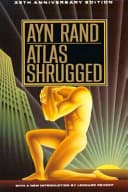
Synopsis
Covers the whole plot, including the ending.
- Difficulty
- Hard
- Pacing
- Moderate
- Mood
- Thought-provoking, intense, philosophical, challenging, inspiring (for some)
- Read it if
- you are interested in political philosophy, objectivism, economic theory, or a grand-scale narrative about individual achievement versus collectivism. If you enjoy character-driven stories with strong ideological themes and a sense of urgent societal collapse.
- Skip it if
- you dislike lengthy philosophical discussions, highly polemical narratives, or characters who embody specific ideological viewpoints. If you prefer subtle storytelling over overt messaging, or if you are averse to capitalist and individualist philosophies.
Atlas Shrugged Plot Summary
Covers the whole plot, including the ending.
The John Galt Line
The story begins with Dagny Taggart, Vice-President of Operations for Taggart Transcontinental. She fights against a declining national economy and increasing government rules. Skilled people are quitting their jobs and vanishing without explanation. Her brother, James Taggart, the President, is an incompetent social climber who works against her. Dagny's current problem is the failing Rio Norte Line. She plans to rebuild it as the 'John Galt Line' using new Rearden Metal. James opposes her, valuing political connections over progress, as does the public, which sees profit as wrong. Despite this, Dagny moves forward, partnering with Hank Rearden, the metal's inventor, showing her dedication to productive work.
The Mystery of Rearden Metal
Hank Rearden, a skilled industrialist, created Rearden Metal, a strong alloy that could change industry. He faces constant attacks from rivals like Orren Boyle, who tries to discredit his invention, and from government officials who want to control or take his ideas through laws like the 'Equalization of Opportunity Bill.' Rearden, a man of strong morals and great productive ability, struggles to understand why others want to harm him. He is also in an unhappy marriage with Lillian Rearden, who resents his success, and has an affair with Dagny Taggart, whom he respects as a fellow producer. His drive to make his metal succeed is a main force in the story.
The Vanishing Minds
As Dagny and Rearden continue, the 'strike' of intelligent people grows. Talented individuals from all fields—industry, art, science, and engineering—are quitting their jobs and disappearing. Francisco d'Anconia, a once-brilliant copper magnate and Dagny's childhood love, seems to be deliberately ruining his own business, confusing and angering Dagny. The economy keeps falling apart. Train lines fail, industries close, and important systems break down. The public and government react with increasingly desperate and illogical actions, blaming 'selfish' producers and adding more controls, which makes the crisis worse instead of better.
The Search for the Motor
Because of the worsening crisis and the confusing disappearances, Dagny Taggart starts her own search to understand the 'motor of the world'—the basic idea that drives human progress and production—and why it is failing. She is especially troubled by a revolutionary motor invented by a brilliant but unknown person, which was abandoned years ago. Her search leads her to an old factory and a cryptic note: 'I will not 'serve' a cause I do not choose to serve.' This clue, along with the ongoing 'strike,' slowly suggests a deliberate, organized withdrawal of the world's creators, rather than random bad luck.
The Colorado Directive
The government, under the 'Colorado Directive,' takes over all businesses in Colorado, including the successful John Galt Line. They try to run them through central planning. This bad decision immediately causes the line's efficiency and service to collapse. Dagny, not wanting to see her creation destroyed, tries to help and save operations, but she meets with bureaucratic incompetence and hostility. During this time, she meets a mysterious and very capable person working as a common laborer, who fixes a critical piece of equipment with amazing skill. This meeting further makes her suspect that the vanished minds are not just gone, but are choosing to withdraw.
The Unveiling of John Galt
Dagny's search for the motor's inventor leads her to a hidden valley in the Rocky Mountains, a refuge known as Galt's Gulch. There, she finally confronts John Galt, the brilliant engineer she has been looking for, and the strike's leader. Galt reveals that he and the other 'men of the mind' have deliberately left society. They refuse to give their talent to a world that punishes achievement and rewards mediocrity. He explains his philosophy of Objectivism, which values rational self-interest and productive work. Dagny is torn between her love for her railroad and her growing understanding and respect for Galt's cause.
Galt's Radio Address
John Galt, taking a great personal risk, broadcasts a three-hour speech to the entire nation. He explains the moral and philosophical reasons for his strike. He condemns altruism as a destructive moral code, saying it demands self-sacrifice and makes individuals subservient to the group. He declares the value of rational self-interest, the sacredness of individual rights, and the need for production and achievement. He asks all remaining producers to join the strike, warning that society will collapse without their minds. His speech gets mixed reactions: some are inspired, others are angry, but no one can ignore its challenge to the current social order.
The Collapse of Society
After Galt's speech and the continued loss of essential talent, the world outside Galt's Gulch quickly falls into disorder and hopelessness. The economy stops, systems break down, and the government's attempts to control through force and illogical policies only speed up the collapse. Food shortages become common, transportation systems fail, and public services stop working. The 'looters'—those who support collective ownership and control—find they cannot run anything, proving Galt's point that wealth comes from the mind, not from force or redistribution. The once-great nation becomes a wasteland of incompetence and starvation.
Dagny's Choice
Dagny Taggart, after seeing the complete ruin of the outside world and how useless her efforts to save Taggart Transcontinental were, finally makes her choice. She recognizes the truth in Galt's philosophy and the fairness of the strike. Leaving her ruined railroad and the decaying society, she formally joins the strikers in Galt's Gulch. Her decision shows a complete change in her beliefs, moving from a relentless fighter against destruction to a conscious participant in building a new, rational world. Her arrival is a major victory for Galt, as she represents one of the last great producers still trying to support the old world.
The Rebirth
With the collectivist society completely collapsed, John Galt and the strikers prepare to return. They waited for the world to reach a point where it could no longer exist without the minds of producers, where the 'looters' had used up all their stolen resources, and the public had learned the harsh lesson of dependence. The novel ends with Galt raising his hand, signaling the moment when the 'motor of the world' will restart. The world will be rebuilt on the ideas of reason, individual rights, and productive achievement. The future is uncertain, but a new, rational society is promised.
Atlas Shrugged Characters
Dagny Taggart
Protagonist
The Vice-President of Operations for Taggart Transcontinental, fighting to save her railroad.
Dagny Taggart is a brilliant, driven, and uncompromising businesswoman, dedicated to excellence and productive work. As the operating head of Taggart Transcontinental, she embodies the ideal of a productive individual, battling against incompetence, irrationality, and government interference. She values achievement above all else and possesses an unwavering commitment to her work. She is fiercely independent, rational, and deeply passionate about building and creating. Her struggle to keep the railroad running is a central conflict of the novel, representing the fight of the individual against collectivism.
Relationships: James Taggart (Antagonistic brother); Hank Rearden (Lover and professional ally); Francisco d'Anconia (Former lover and close friend); John Galt (Lover and philosophical mentor)
Hank Rearden
Protagonist
A brilliant industrialist and inventor of Rearden Metal.
Hank Rearden is a powerful, self-made industrialist who invents a revolutionary new alloy, Rearden Metal. He is a man of immense productive ability, integrity, and unwavering commitment to his work. He faces constant attacks from those who envy his success and seek to control or destroy his creation. Rearden embodies the moral ideal of the businessman and producer, struggling to understand and combat the irrationality of the world around him. He is a man of intense passion and strength, though initially vulnerable to manipulation due to his sense of duty.
Relationships: Lillian Rearden (Antagonistic wife); Dagny Taggart (Lover and professional ally); Francisco d'Anconia (Friend and philosophical ally)
John Galt
Protagonist/Antagonist (initially perceived)
The mysterious leader of the strike of the men of the mind.
John Galt is the enigmatic and brilliant philosopher-engineer who orchestrates the strike of the world's creative minds. He is the intellectual and moral leader of the movement to withdraw productive individuals from a society that punishes excellence and rewards mediocrity. Galt is the embodiment of Objectivism, advocating for rational self-interest, individual rights, and the virtue of production. He is uncompromising in his convictions and possesses an unparalleled intellect, charisma, and moral clarity. His goal is to demonstrate that the 'motor of the world' – the human mind – cannot be run by force.
Relationships: Dagny Taggart (Lover and philosophical convert); Francisco d'Anconia (Close friend and philosophical ally); Hugh Akston (Former professor and mentor)
Francisco d'Anconia
Supporting
A brilliant copper magnate who appears to be destroying his own empire.
Francisco d'Anconia is a childhood friend and former lover of Dagny, and a man of immense talent, wealth, and charisma. Initially perceived as a playboy and destroyer of his own copper empire, he is secretly one of John Galt's most dedicated lieutenants in the strike. His actions are a deliberate facade, designed to hasten the collapse of the collectivist system and to protect his wealth from being seized by the 'looters.' He is a powerful orator and a fierce advocate for the value of money and the morality of self-interest, serving as a philosophical voice for the strike.
Relationships: Dagny Taggart (Former lover and close friend); John Galt (Close friend and philosophical ally); Hank Rearden (Friend and philosophical ally)
James Taggart
Antagonist
The President of Taggart Transcontinental, who embodies incompetence and collectivism.
James Taggart is Dagny's older brother and the President of Taggart Transcontinental. He is utterly incompetent, driven by envy, resentment, and a desire for social approval rather than productive achievement. He actively undermines Dagny's efforts, preferring political connections and government intervention over merit and efficiency. James represents the destructive force of collectivism and the 'looter' mentality, believing that his lack of ability is a virtue and that wealth should be distributed, not earned. His actions consistently lead to the downfall of the railroad and society.
Relationships: Dagny Taggart (Antagonistic sister); Lillian Rearden (Acquaintance and mutual antagonist of producers); Wesley Mouch (Political ally)
Lillian Rearden
Antagonist
Hank Rearden's resentful and manipulative wife.
Lillian Rearden is Hank Rearden's wife, a woman consumed by envy and resentment for her husband's brilliance and success. She is a social climber who despises productivity and actively works to undermine Hank's self-esteem and reputation. Lillian embodies the destructive nature of altruism and the 'looter' mentality, seeking to diminish those who achieve and to gain status through social connections rather than merit. She represents the societal forces that seek to bind and destroy the creative individual, using guilt and manipulation as her weapons.
Relationships: Hank Rearden (Antagonistic wife); James Taggart (Acquaintance and mutual antagonist of producers)
Wesley Mouch
Antagonist
A former public relations man who rises to become the nation's economic dictator.
Wesley Mouch is a quintessential 'second-hander' and a symbol of bureaucratic incompetence and political opportunism. Starting as James Taggart's public relations man, he rises through the ranks of government to become the nation's 'economic dictator,' wielding immense power without any productive ability. He epitomizes the destructive nature of central planning and government control, implementing policies that cripple industry and punish achievement, all while claiming to act for the 'public good.' Mouch is driven by a desire for power and status, devoid of any genuine understanding of economics or production.
Relationships: James Taggart (Political ally); Cuffy Meigs (Political ally)
Hugh Akston
Supporting
A brilliant philosopher and former professor of Galt, Francisco, and Rearden.
Hugh Akston is a retired philosopher who serves as a mentor figure to John Galt, Francisco d'Anconia, and Hank Rearden during their college years. He represents the intellectual foundation of Objectivism, having taught the principles of reason, logic, and the importance of a consistent philosophy. Akston is a symbol of the intellectual integrity and clarity that the strikers embody. His presence in Galt's Gulch signifies that the strike is not merely an economic or political act, but a profound philosophical movement rooted in fundamental truths.
Relationships: John Galt (Former student and philosophical ally); Francisco d'Anconia (Former student and philosophical ally); Hank Rearden (Former student)
Atlas Shrugged Themes
The Virtue of Selfishness (Rational Self-Interest)
A main theme of 'Atlas Shrugged' is the morality of rational self-interest, which Rand called 'the virtue of selfishness.' The novel argues that individuals should pursue their own rational self-interest and happiness, rather than sacrificing themselves for others or for the group. It suggests that a truly selfish person, in the rational sense, is a producer who creates value, trades with others, and lives by their own mind. This is contrasted with altruism, which Rand shows as a destructive moral code that demands self-sacrifice and leads to mediocrity and societal collapse. The 'strikers' show this virtue by refusing to serve a society that belittles their achievements.
“The greatest good for the greatest number is a maxim which means: the greatest good for those who are not the greatest number, and who are not good. It is a maxim which means: the greatest good for those who are not good enough to achieve it for themselves.”
The Primacy of the Individual
The novel advocates for the individual as the basic unit of society, stating that individual rights, freedom, and initiative are most important. It argues that all progress and wealth come from the minds and efforts of individuals, not from groups or governments. The story shows the destructive results of collectivism, where the individual is sacrificed for the 'public good,' leading to stagnation, oppression, and ultimately, collapse. The strike of intelligent people dramatically shows the individual's essential role and how useless society is without its most capable members.
“The mind is an attribute of the individual. There is no such thing as a collective brain. There is no such thing as a collective thought. An agreement reached by a group of men is only a compromise or an average of many individual thoughts. It is a secondary consequence.”
The Morality of Production and Achievement
'Atlas Shrugged' values production, creativity, and achievement as the highest moral goods. It argues that creating, building, and innovating is good, and that those who produce wealth and progress are the true moral heroes. Conversely, the novel criticizes 'looters' and 'second-handers'—those who live off others' efforts, whether through government force, social parasitism, or copying others' ideas. The story clearly shows the world's decline when producers are suppressed and punished, and its potential for renewal when their value is recognized and celebrated.
“Money is the barometer of a society's virtue. When you see that trading is done, not by consent, but by compulsion – when you see that in order to produce, you need to obtain permission from men who produce nothing – when you see that money is flowing to those who deal, not in goods, but in favors – when you see that men get richer by graft and by pull than by work, and your laws don't protect you against them, but protect them against you – when you see corruption being rewarded and honesty becoming a self-sacrifice – you may know that your society is doomed.”
The Role of Reason
Reason is presented as humanity's main tool for survival and progress. The novel contrasts the rational, logical decisions of characters like Dagny Taggart and Hank Rearden with the irrationality, mysticism, and emotionalism of the 'looters' and government officials. It argues that abandoning reason for faith, tradition, or group agreement leads to self-destruction and societal chaos. John Galt's philosophy is based on the absolute need for reason as the only way to understand reality, make good judgments, and achieve human flourishing. The world's collapse is ultimately blamed on its rejection of reason.
“Do not ever say that you do not know what I mean by a rational man. I mean a man who does not allow his consciousness to be paralyzed by fear or by wish or by past experience or by any social pressure, but who holds his mind open to the facts of reality.”
The Dangers of Government Intervention
The novel criticizes government involvement in the economy and in people's lives. It shows how rules, controls, and socialist policies stop innovation, punish success, and ultimately lead to economic collapse and widespread suffering. The government's attempts to 'equalize' wealth and opportunity, or to manage industries through central planning, are consistently shown to fail. This proves that force cannot create wealth and that competence cannot be legislated. The 'looters' who control the government are shown as parasites who destroy the very system they claim to serve.
“When you have made evil the means of survival, do not expect men to remain good. Do not expect them to produce, when production is punished and plunder rewarded. Do not ask them to be moral, when virtue is sacrificed to vice. Do not ask them to be just, when justice is a self-immolation. Do not ask them to be honest, when honesty is the tool of those who wish to deceive.”
Plot Devices & Literary Techniques
The Strike of the Men of the Mind
The deliberate withdrawal of the world's most capable individuals.
This is the central plot device of the novel. Instead of protesting or fighting the oppressive system, the most talented and productive individuals across all fields (industrialists, scientists, artists, philosophers) mysteriously disappear, led by John Galt. Their absence is not random misfortune but a deliberate, organized 'strike' to demonstrate that society cannot function without the minds of its creators. This device allows Rand to illustrate, by negative example, the indispensable value of the individual producer and the destructive nature of collectivism, as the world outside Galt's Gulch collapses in their absence.
The Question 'Who Is John Galt?'
A recurring rhetorical question symbolizing societal apathy and despair.
The phrase 'Who is John Galt?' begins as a common expression of resignation and despair, uttered when facing an insurmountable or inexplicable problem. It signifies a collective shrug of helplessness and a lack of belief that anyone can or will solve the world's growing crises. As the plot progresses, the question transforms from a rhetorical sigh to a literal inquiry, driving Dagny Taggart's quest to find the individual who could 'stop the motor of the world.' It serves to highlight the pervasive sense of doom and the world's unconscious longing for a savior, even as it actively undermines its own creators.
Rearden Metal
A revolutionary new alloy symbolizing individual genius and productive achievement.
Rearden Metal is a fictional, superior alloy invented by Hank Rearden, representing the pinnacle of individual innovation and productive genius. Its creation and the subsequent struggle to protect it from government seizure and competitive sabotage serve as a microcosm of the larger conflict in the novel. The metal is stronger, lighter, and more durable than any existing material, symbolizing the potential for human progress when individual minds are free to create. Its eventual abandonment by society and its use by the strikers underscore the novel's themes of valuing achievement and the destructive nature of collective control over individual property.
Galt's Gulch (Atlantis)
A hidden valley sanctuary for the striking producers.
Galt's Gulch, also referred to as Atlantis, is a secret, self-sufficient community hidden in the Rocky Mountains where the striking 'men of the mind' reside. It functions as a utopian ideal, a society built on the principles of reason, individual rights, and voluntary trade, free from government interference and collectivist ideology. This plot device serves as a stark contrast to the decaying world outside, demonstrating that a rational, productive society is possible. It also acts as the physical manifestation of the strike, a place where the 'motor of the world' is kept running, ready to be reintroduced when the outside world has learned its lesson.
Atlas Shrugged Quotes
“I will not be the one who quits. I will not be the one who gives up. I will not be the one who surrenders.”
“The question isn't who is going to let me; it's who is going to stop me.”
“We are on strike against the men who have been robbing us, the men who have been exploiting us, the men who have been destroying us.”
“The only thing that can save this country is the realization by its people that they are being robbed.”
“It is not the vacuum that is the enemy of life, but the stagnant pool.”
“Money is a tool of exchange, which can facilitate trade and allow you to pursue your goals.”
“The pursuit of knowledge is a noble endeavor, one that should be celebrated and encouraged.”
“The greatest catastrophe in human history is the death of the mind.”
“You have the right to your own life, and the right to pursue your own happiness.”
“The mind is not a passive recipient of information, but an active creator of knowledge.”
“The motive and purpose of the strike is to stop the motor of the world.”
“When you see that in order to produce, you need permission from those who produce nothing; when you see that money flows to those who deal not in goods, but in favors; when you see that men get richer by graft and by your labor than by your work, and your laws don't protect you against them, but rather protect them against you; when you see corruption being rewarded and honesty becoming a self-sacrifice, then you can know that your society is doomed.”
“The only propertied class in the world is the man who is able to think.”
“I swear by my life and my love of it that I will never live for the sake of another man, nor ask another man to live for mine.”
Quiz
10 questions on the plot and the characters. Each answer comes with a short explanation.
Question 1
What is the primary genre of 'Atlas Shrugged' according to the provided text?
- Romance
- Mystery
- Science Fiction
- Historical Fiction
Show answer
C. Science Fiction The text explicitly lists 'Science Fiction' as one of the genres of 'Atlas Shrugged'.
Question 2
Who is referred to as Ayn Rand's 'magnum opus'?
- John Galt
- Objectivism
- The Great American Read
- Atlas Shrugged
Show answer
D. Atlas Shrugged The text states, 'Atlas Shrugged is Ayn Rand’s magnum opus'.
Question 3
What is the philosophical system that 'Atlas Shrugged' is an extensive statement of?
- Existentialism
- Objectivism
- Utilitarianism
- Stoicism
Show answer
B. Objectivism The text mentions that 'Atlas Shrugged' is 'Rand’s most extensive statement of Objectivism'.
Question 4
What does John Galt famously claim he will do to the world?
- He will rebuild it
- He will lead it
- He will stop the motor of the world
- He will expose its secrets
Show answer
C. He will stop the motor of the world The text poses the question, 'When he says that he will stop the motor of the world, is he a destroyer or a liberator?'
Question 5
According to the text, why does John Galt have to fight his hardest battle against the woman he loves?
- She is his greatest rival
- She misunderstands his mission
- She is the only one who can truly challenge him
- The text does not explicitly state the reason, but implies a complex relationship dynamic.
Show answer
D. The text does not explicitly state the reason, but implies a complex relationship dynamic. The text asks, 'Why does he fight his hardest battle against the woman he loves?' but does not provide the specific reason within the excerpt.
Question 6
What kind of characters are typically found in 'Atlas Shrugged'?
- Ordinary people facing everyday struggles
- Larger-than-life heroes and villains
- Relatable anti-heroes with moral ambiguity
- Average citizens caught in political intrigue
Show answer
B. Larger-than-life heroes and villains The text describes the book as 'Peopled by larger-than-life heroes and villains'.
Question 7
The novel explores 'towering questions of good and evil'. This suggests a focus on what aspect of human experience?
- Social conformity
- Moral philosophy
- Technological advancement
- Economic inequality
Show answer
B. Moral philosophy The phrase 'towering questions of good and evil' directly points to a focus on moral philosophy and ethical considerations.
Question 8
Why does a productive genius become a worthless playboy in the events of 'Atlas Shrugged'?
- Due to a personal tragedy
- Because of societal decay and the system's opposition to productivity
- He loses his motivation to innovate
- He is secretly working for the antagonists
Show answer
B. Because of societal decay and the system's opposition to productivity The text states, 'You will discover why a productive genius becomes a worthless playboy...' implying this is one of the baffling events caused by the book's central conflict.
Question 9
What is the nature of the conflict John Galt faces, as described in the text?
- He fights against external enemies who oppose his ideas.
- He struggles against those who rely on him the most, despite their opposition.
- His battles are primarily internal, against his own doubts.
- He confronts a corrupt government bureaucracy.
Show answer
B. He struggles against those who rely on him the most, despite their opposition. The text asks, 'Why does he have to fight his battles not against his enemies but against those who need him most?'
Question 10
The description of 'Atlas Shrugged' as an 'action thriller' that is also a 'philosophical revolution' suggests the novel aims to:
- Provide a dry, academic treatise on Objectivism.
- Entertain readers with a fast-paced plot while conveying deep philosophical ideas.
- Critique the thriller genre for its shallowness.
- Focus solely on the philosophical aspects, downplaying narrative.
Show answer
B. Entertain readers with a fast-paced plot while conveying deep philosophical ideas. The combination of 'action thriller' and 'philosophical revolution' indicates a narrative designed to engage readers emotionally and intellectually.
Atlas Shrugged FAQ
What is the main philosophy of Atlas Shrugged?
Atlas Shrugged is the primary literary statement of Ayn Rand's philosophy of Objectivism. This philosophy emphasizes reason, individualism, rational self-interest, and laissez-faire capitalism as the ideal moral and political system.
Who is John Galt and what is his role in Atlas Shrugged?
John Galt is the enigmatic hero of Atlas Shrugged. He is a brilliant inventor and philosopher who orchestrates a 'strike' of the nation's most productive individuals, believing that society has become parasitic and is destroying its creators.
What does it mean when John Galt says he will 'stop the motor of the world'?
When John Galt says he will 'stop the motor of the world,' he means he will withdraw the minds and talents of the nation's most creative and productive individuals. This withdrawal is intended to demonstrate society's dependence on these individuals and bring about its collapse, forcing a reevaluation of values.
Is Atlas Shrugged a political book?
Yes, Atlas Shrugged is deeply political. It presents a strong critique of collectivism, government intervention in the economy, and altruism, advocating instead for radical individualism and free-market capitalism.
What is the economic system depicted in Atlas Shrugged?
The book champions a laissez-faire capitalist system where individuals are free to pursue their own self-interest without government interference. It contrasts this with the collapsing economy driven by excessive regulation, taxation, and collectivist policies.
Why are the heroes in Atlas Shrugged considered larger-than-life?
The heroes in Atlas Shrugged are depicted as exceptionally intelligent, driven, and morally uncompromising individuals who embody the ideals of reason and productivity. They are often portrayed as geniuses and titans of industry who refuse to be exploited.
What is the significance of the title 'Atlas Shrugged'?
The title refers to the mythological Atlas, who carries the world on his shoulders. In the book, it symbolizes the burden carried by the producers and creators of society, who are ultimately 'shrugged off' by a failing world that exploits them.
Is Atlas Shrugged a science fiction novel?
While it contains elements of speculative fiction, such as advanced technology and a dystopian future, Atlas Shrugged is primarily considered a philosophical novel with elements of political and economic commentary rather than pure science fiction.
What is the central conflict in Atlas Shrugged?
The central conflict is between the individual producers and creators of wealth and society, which is depicted as increasingly parasitic, collectivist, and destructive. It's a battle for the recognition of individual rights and the value of productive achievement.
What does Ayn Rand mean by 'rational self-interest'?
Rational self-interest, a core tenet of Objectivism, means that an individual's highest moral purpose is the achievement of their own happiness. This is pursued through reason and productive work, not by sacrificing oneself for others or by exploiting others.
About the author

Alice O'Connor, better known by her pen name Ayn Rand, was a Russian-born American writer and philosopher. She is known for her fiction and for developing a philosophical system she named Objectivism. Born and educated in Russia, she moved to the United States in 1926. After two early novels that were initially unsuccessful and two Broadway plays, she achieved fame with her 1943 novel, The Fountainhead. In 1957, Rand published her best-selling work, the novel Atlas Shrugged. Afterward, until her death in 1982, she turned to non-fiction to promote her philosophy, publishing her own periodicals and releasing several collections of essays.
Similar books
- The Fountainhead
Ayn Rand
3.9 (297k) average on GoodreadsLiterary FictionExplores similar themes of individualism, integrity, and the struggle against collectivism through the story of an architect.
- 1984
George Orwell
4.2 (3.1M) average on GoodreadsPoliticsA classic dystopian novel depicting a totalitarian society, though with a different philosophical outlook.
- Brave New World
Aldous Huxley
4.0 (1.4M) average on GoodreadsFantasyAnother foundational dystopian novel exploring societal control and the suppression of individuality, but through technological and psychological means.
- Nineteen Eighty-Four
George Orwell
4.2 (5.5M) average on GoodreadsFictionWhile both 'Atlas Shrugged' and 'Nineteen Eighty-Four' are dystopian novels that critique totalitarianism, their approaches and target ideologies differ significantly. Orwell's novel is a cautionary tale against an oppressive socialist state that crushes individual thought and freedom through surveillance and psychological manipulation. Rand, conversely, critiques a 'mixed economy' sliding towards collectivism, where the productive are exploited by a government that champions altruism and mediocrity. Orwell's dystopia is one of enforced scarcity and suffering for all, while Rand's depicts a collapse brought on by the withdrawal of the 'men of the mind.' Orwell's characters are complex and psychologically tormented, making his critique more humanistic, whereas Rand's characters are more allegorical and ideologically driven.
- Animal Farm
George Orwell
4.0 (2.7M) average on GoodreadsPoliticsA farm animals' rebellion against humans turns into a pig-led dictatorship, showing how power corrupts and revolutionary ideals are betrayed.
- Freakonomics: A Rogue Economist Explores the Hidden Side of Everything
Steven D. Levitt
4.0 (709k) average on GoodreadsBusinessThis book uses economic principles to reveal the surprising incentives behind everything from drug dealing and real estate to cheating teachers and the decline of crime.




Enjoyed the summary?
A summary gives you the shape of the book. The book itself has the detail, the examples and the voice.
Find Atlas Shrugged on AmazonAs an Amazon Associate, BookBrief earns from qualifying purchases. How we're funded