
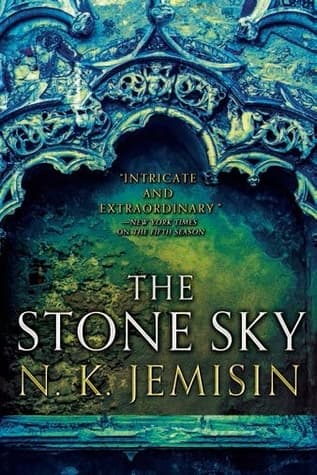
Synopsis
Covers the whole plot, including the ending.
- Difficulty
- Medium
- Pacing
- Moderate
- Mood
- Epic, Dark, Intense, Hopeful, Cathartic
- Read it if
- You love intricate world-building, morally complex characters, and a powerful exploration of trauma, prejudice, and the fight for survival against a dying world.
- Skip it if
- You prefer lighthearted fantasy, don't enjoy stories with significant emotional weight, or haven't read the preceding books in the Broken Earth trilogy.
The Stone Sky Plot Summary
Covers the whole plot, including the ending.
Essun's Desperate Journey and Schaffa's Revelation
Essun, a powerful Orogene using the Obelisk Gate, travels across the damaged Stillness with Hoa, her Guardian-turned-Stone Eater. They head towards the equatorial region where Nassun is thought to be. Essun wants to find Nassun and, with her power, fix Earth's orbit to bring the Moon back without destroying the world. Meanwhile, Nassun, who left her father and embraced her own great orogenic power, travels with Schaffa, her former Guardian, and the boy, Steel. Schaffa, becoming more transparent and showing his Stone Eater nature, tells Nassun the truth about Guardians: they are Stone Eaters, forced to harvest orogenes for Earth's core, which is sentient and dying. He tells Nassun to use her power to destroy Earth and end its suffering.
Nassun's Choice and the City of Corepoint
Nassun, guided by Schaffa, arrives at Corepoint, a hidden city deep inside Earth that only Stone Eaters and powerful orogenes can reach. Here, she learns more about the Stone Eaters' old conflict with humanity and their goal: to end Earth's suffering by destroying it. Nassun, hurt by the world's cruelty and losing her family, starts to agree with this extreme plan. She sees Earth's constant quakes and its consumption of orogenes as an endless cycle of pain that only complete destruction can stop. Schaffa, seeing her determination, encourages her more. He believes her great power, with the Moon's return, could be the way to finally end the world's torment.
Essun's Arrival at Castrima and the Stone Eater Conflict
Essun and Hoa eventually reach the ruins of Castrima, their old underground refuge, finding it destroyed. There, they meet the remaining humans trying to survive. Essun's journey includes meeting other Stone Eaters. Some, like Hoa, want to help Essun save the world, while others, like the group led by 'Father Earth,' support Nassun's goal of destruction. Essun learns that Stone Eaters are not united; they are split into different groups with different plans for Earth's fate. This split reflects the larger conflict between Essun's desire to repair and Nassun's decision to destroy.
The Origin of the Obelisk Gate and the Moon's Loss
Through Hoa and her growing connection to Earth's core, Essun starts to understand the Stillness's old history. She learns that humanity, in its arrogance, tried to make Earth's core a weapon, turning it into a sentient being that feeds on orogenes. The Obelisk Gate, a network of floating obelisks, was made to channel power for this process. The Moon, it turns out, was deliberately pushed out of orbit by old orogenes to stop the weaponized Earth from consuming all life. This caused the devastating Fifth Seasons and constant seismic activity. Essun understands that bringing the Moon back without addressing the core's hunger would only restart the cycle of destruction.
The Reunion and the Core's Plea
Essun finally reaches Nassun at Corepoint. Their reunion is tense; Nassun is cold and distant, hardened by her experiences and committed to her path of destruction. Essun tries to reason with her, explaining her plan to fix Earth, but Nassun is not convinced. She sees Essun's efforts as pointless. During this talk, Earth's core itself starts to talk directly to both Essun and Nassun. It expresses its great pain, its hunger, and its desperate wish for release. It reveals it is a 'child' made by humanity, suffering endlessly. This direct communication from the planet's core makes their conflict more urgent and tragic, forcing both mother and daughter to face the true extent of the world's suffering.
The Battle of Ideologies and the Moon's Return
As the Moon quickly nears the planet, its gravity causing damage, Essun and Nassun have a deep battle of ideas and power. Essun wants to heal Earth by feeding it 'clean' energy and restoring its balance, letting the Moon return safely and ending the Fifth Seasons. Nassun, though, believes Earth is beyond healing and must be destroyed to end its torment and prevent future suffering. Their orogenic powers, boosted by the Obelisk Gate and the approaching Moon, are immense. Steel, the young boy with Nassun, plays a role. His innocence and hope influence Nassun at times, reminding her of what could be saved.
Schaffa's Sacrifice and Nassun's Catalyst
At the climax of their confrontation, Schaffa, fully a Stone Eater, makes a final, selfless act. He absorbs the great destructive power Nassun is channeling, sacrificing himself to protect her and let her choose. This act of love and protection from her Guardian, who has always been there for her, deeply affects Nassun. It is a moment of deep emotional realization for her, making her rethink her complete commitment to destruction. Schaffa's sacrifice becomes a turning point, shifting Nassun's focus from pure annihilation to a better understanding of Earth's problems and her part in its future.
Essun's Ultimate Choice: The Earth's Heart
Essun, seeing Schaffa's sacrifice and feeling the core's pain, realizes that just repairing Earth is not enough; its pain must be acknowledged. She makes a choice: to merge with Earth's core, becoming its 'heart.' This allows her to talk directly to and comfort the core, giving it the connection and understanding it has wanted since it was made. By becoming part of the planet, Essun becomes Earth's new, kind sentience, guiding its power and ending its destructive hunger for orogenes. This is her ultimate sacrifice, transforming into the essence of the world she wanted to save.
Nassun's Act of Restoration
With Essun now merged with Earth's core, Nassun has the great power of the Obelisk Gate. Guided by her mother's new presence within Earth and moved by Schaffa's sacrifice, Nassun chooses to use her power not for destruction, but for creation and repair. She uses her vast orogenic abilities, controlling the strong gravitational forces to gently guide the Moon back into a stable orbit around Earth. This act is delicate and hard, needing great control and accuracy, but she succeeds. The Moon returns, ending the centuries of Fifth Seasons and bringing stability back to the Stillness for the first time in millennia.
The New World and Hoa's Story
Afterward, the world begins to heal. The Fifth Seasons stop, and the constant quakes calm down. Humanity, though greatly reduced, has a chance to rebuild on a stable planet. Hoa, the Stone Eater, is the only one left who saw Essun's sacrifice and Nassun's act of repair. He starts traveling the world, telling the story of Essun, who became Earth, and Nassun, who brought back the Moon. He makes sure their story, the true history of how the world was saved, is remembered, becoming the storyteller of the new era. The ending is bittersweet; the world is saved, but Essun's individual life is gone.
Principal Figures
Essun
Protagonist
An Orogene mother seeking her daughter and a way to save the world.
Essun is the central protagonist, a powerful Orogene who has endured immense suffering, including the loss of her family and the devastation of her world. In 'The Stone Sky,' she wields the power of the Obelisk Gate, seeking her daughter Nassun and determined to fix the Earth's orbit, ending the Fifth Seasons. Her journey is driven by a profound love for Nassun and a desire to create a safe world for all orogenes, even if it means sacrificing herself. She embodies resilience and a deep-seated hope for healing, contrasting with her daughter's destructive impulses. Her ultimate act is to merge with the Earth's core, becoming its new, benevolent sentience.
Relationships: Nassun (Daughter, complex and strained relationship, ultimately a shared goal); Hoa (Stone Eater companion, guide, and loyal friend); Alabaster (Former lover and mentor, whose power she inherits); The Earth's Core (Antagonistic/symbiotic, ultimately merging with it)
Nassun
Deuteragonist/Antagonist
Essun's daughter, a powerful Orogene seeking to destroy the world.
Nassun is Essun's daughter, an exceptionally powerful Orogene who has suffered profound trauma, including witnessing her father murder her brother and being abandoned by her mother. Her experiences have hardened her, leading her to believe the world is inherently corrupt and beyond saving. She travels with Schaffa and Steel, growing in power and resolving to destroy the Earth to end its suffering. Nassun's journey is one of immense pain and a search for agency, ultimately leading her to choose between destruction and a difficult path of restoration, influenced by her mother's sacrifice and Schaffa's love.
Relationships: Essun (Mother, estranged and conflicted, but deeply connected); Schaffa (Guardian, surrogate father, and loyal protector); Steel (Young companion, symbol of innocence and hope); Jija (Father, who murdered her brother and tried to kill her)
Hoa
Supporting
A Stone Eater, Essun's loyal companion and chronicler.
Hoa is a Stone Eater, a sentient being made of rock, who has been Essun's companion throughout her journey. He is ancient and possesses vast knowledge of the Earth's history and the Stone Eaters' origins. Hoa is deeply loyal to Essun, acting as her guide, protector, and confidante. He represents the faction of Stone Eaters who believe in saving the world rather than destroying it. His narrative perspective occasionally breaks through, hinting at his role as the future storyteller of Essun's deeds. He is crucial in revealing the true history of the Earth and the Moon.
Relationships: Essun (Close companion, guide, and protector); Alabaster (Former companion, shares a deep history)
Schaffa
Supporting
Nassun's Guardian, a Stone Eater bound by a geas.
Schaffa is Nassun's Guardian, a member of an ancient order tasked with controlling orogenes. In 'The Stone Sky,' his Stone Eater nature becomes increasingly apparent, and he reveals the truth about the Guardians' origins and their geas to serve the Earth's core. Despite his duty, he has a deep, paternal love for Nassun, which conflicts with his core programming. He encourages Nassun's destructive path initially, seeing it as the only way to end the Earth's suffering, but ultimately sacrifices himself to protect her, affirming his love over his ancient programming.
Relationships: Nassun (Ward, deeply paternal bond, ultimately sacrifices for her); Guardians (Member of the order, bound by their geas); The Earth's Core (Servant, bound by geas)
Steel
Supporting
A young boy, Nassun's innocent companion.
Steel is a young, non-orogene boy who travels with Nassun and Schaffa. He represents innocence, hope, and the future of humanity. His presence serves as a moral compass for Nassun, reminding her of what is at stake and the potential for a better world. He is a constant source of wonder and simple joy amidst the devastation, and his survival is a driving force for Nassun, providing a reason to consider a path other than total destruction. He is a symbol of the ordinary life that Essun and Nassun are fighting for, even if their methods differ.
Relationships: Nassun (Companion, innocent charge); Schaffa (Travel companion, protected by him)
The Earth's Core
Antagonist/Setting
A sentient, suffering entity created by ancient humans.
The Earth's core is revealed to be a sentient entity, a 'child' created by ancient humans who tried to weaponize the planet's power. It is in constant agony, feeding on orogenes to sustain itself and causing the Fifth Seasons and seismic activity. It communicates its immense suffering directly to Essun and Nassun, expressing a desperate desire for release. Its hunger and pain are the root cause of the world's devastation, making it a central antagonistic force, but also a tragic figure deserving of empathy. Essun ultimately merges with it, becoming its new, benevolent heart.
Relationships: Essun (Antagonistic, then symbiotic, finally merging with her); Nassun (Antagonistic, then empathetic connection); Guardians (Its servants, bound by geas)
Father Earth
Supporting
A powerful Stone Eater leader, advocating for the Earth's destruction.
Father Earth is a prominent Stone Eater who leads a faction committed to the destruction of the Earth. He believes the planet is beyond repair and that its annihilation is the only way to end its suffering and humanity's endless cycle of pain. He is an ancient and formidable figure, representing the extremist view within the Stone Eater community. He actively supports Nassun's plan to destroy the world, seeing her immense power as the means to achieve their goal. He stands in direct opposition to Essun's desire to heal and save the world.
Relationships: Nassun (Supporter and guide towards destruction); Essun (Opponent)
Alabaster Tenring
Mentioned/Influential
Essun's former lover and mentor, whose power she now wields.
Alabaster is not physically present in 'The Stone Sky' but his legacy and power are central. He was Essun's former lover and mentor, an incredibly powerful Orogene who, in the previous book, sacrificed himself to connect to the Obelisk Gate and initiate the Moon's return, setting the stage for the trilogy's conclusion. Essun now wields his immense power, essentially continuing his work. His actions and philosophy profoundly influence Essun's understanding of her abilities and the nature of the Earth. His sacrifice is a foundational event that enables the final conflict.
Relationships: Essun (Former lover, mentor, and spiritual successor); Hoa (Former companion)
Themes & Insights
Sacrifice and Selflessness
Sacrifice is a theme in 'The Stone Sky.' Essun merges with Earth's core, giving up her individual life to become the planet's kind sentience. This is the clearest example. Schaffa sacrifices himself to protect Nassun, breaking his old geas and showing the power of love. Even the ancient orogenes who pushed the Moon out of orbit made a huge sacrifice to save humanity from Earth's weaponized core. These acts show that real change and healing often require great personal cost. They show that saving many sometimes needs the ultimate gift from a few.
“This is how the world changes: A mother lets go. A daughter finds her way. The Earth, a great beast, finds its heart. And the Moon, a lonely wanderer, comes home.”
Healing vs. Destruction
This is the main conflict of the novel. Essun wants to heal Earth, and Nassun wants to destroy it. Essun believes the world, despite its pain, can be fixed and brought back to balance. Nassun, hurt by trauma, sees only a cycle of suffering that can only end with complete destruction. The story explores both views, acknowledging the great pain that drives Nassun's choice while supporting Essun's path of empathy and repair. The ending suggests that real healing means understanding the cause of suffering, not just stopping the symptoms.
“Sometimes, what is corrupt cannot be cleansed, only destroyed. And sometimes, what is broken can be mended, if you have the will and the power.”
Mother-Daughter Relationships and Trauma
The complex relationship between Essun and Nassun is at the emotional center of the story. Both are powerful orogenes who have experienced trauma, but they react very differently. Essun's love for Nassun makes her want to save the world, hoping to make a safe place for her daughter. Nassun's anger and pain over her mother's perceived abandonment fuel her destructive impulses. Their reunion is not an easy reconciliation but a clash of wills. It is resolved through mutual understanding and a shared, though different, way to save the world. The theme explores how trauma shapes people and how love, even broken, can last and change.
“You are my heart, my daughter. And I will never abandon you again, not even now.”
The Nature of Sentience and Humanity's Hubris
The novel looks at the nature of sentience, especially through Earth's core. It is revealed to be a suffering, sentient being made by old human arrogance. This questions common ideas of life and consciousness. Humanity's attempt to weaponize the planet caused its suffering, creating a cycle of destruction that mirrors their own flaws. The Stone Eaters, also sentient beings of rock, expand this theme, showing different forms of life and intelligence. The story suggests that humanity's biggest failure was not recognizing the sentience it created and not empathizing with its suffering.
“We made a child, and then we let it starve, and we let it hurt, and we let it learn to hate.”
Memory, History, and Truth
The story consistently asks how history is recorded, changed, and remembered. The true story of the Moon's displacement, Earth's core's origins, and the Stone Eaters' role has been lost or altered over thousands of years. Essun and Nassun's journeys involve finding these hidden truths, which completely change how they understand their world and their purpose. Hoa, as the eventual storyteller, stresses the importance of accurate storytelling to ensure future generations understand the sacrifices made and the lessons learned. The theme shows that understanding the past helps shape a better future.
“Stories are how we learn. Stories are how we survive.”
Plot Devices & Literary Techniques
The Obelisk Gate
A network of floating obelisks, channeling immense orogenic power.
The Obelisk Gate is a network of floating obelisks that function as a massive power conduit, amplifying and directing orogenic energy. It was originally created by ancient civilizations to control the Earth's core, but later repurposed by Alabaster to initiate the Moon's return. In 'The Stone Sky,' both Essun and Nassun learn to wield its immense power. It acts as a central plot device, enabling their world-altering feats of orogeny. Its connection to the Earth's core and the Moon's orbit makes it the ultimate tool for either destruction or salvation, providing the means for the climax of the story.
The Earth's Core (as a Character/Setting)
A sentient, suffering entity that drives the world's devastation.
Beyond being a physical location, the Earth's core functions as a character and a key plot device. Its sentience and suffering are revealed as the primary cause of the Fifth Seasons and the hunger for orogenes. Its direct communication with Essun and Nassun drives much of the emotional and ideological conflict. The core's existence, created by ancient human hubris, provides the ultimate stakes for the story and necessitates Essun's final, profound sacrifice. It is both the antagonist and the ultimate victim, requiring resolution for the world to heal.
The Moon's Return
The central impending event, threatening destruction or offering salvation.
The Moon's impending return is the overarching plot driver, creating a ticking clock for the entire trilogy. Its absence caused the Fifth Seasons, and its uncontrolled return threatens to destroy the world entirely. It serves as the catalyst for Essun and Nassun's final confrontation and their monumental decisions. The Moon's gravitational pull and its symbolic significance as a lost piece of the world's balance make its return the ultimate goal, and its successful re-orbiting marks the true end of the apocalyptic cycle and the beginning of a new era.
Stone Eaters
Ancient, sentient beings of rock, serving various agendas.
The Stone Eaters are sentient beings made of rock, some of whom were once human. They act as guides, protectors, and antagonists, depending on their faction. Hoa, Schaffa, and Father Earth represent different facets of their ancient history and conflicting goals regarding the Earth's fate. They possess immense knowledge of the deep past and the Earth's core, serving as key expository characters. Their unique physiology and long lifespans allow them to witness and influence events over millennia, making them crucial to uncovering the true history of the Stillness and the Earth.
The Stone Sky Quotes
“Let's start with the end of the world, why don't we? Get it over with and move on to more interesting things.”
“There is no such thing as a broken system. Only systems that work differently than intended.”
“Power is a strange and terrible thing. It can make you a god or a monster, and sometimes both.”
“The earth is not a dead thing. It is alive, and it remembers.”
“Sometimes, survival is the only victory you can hope for.”
“You cannot fix a broken world by breaking it further.”
“Love is not a weakness. It is the only thing that makes us human.”
“The sky is a lie. The earth is a truth.”
“We are all monsters, in our own way. The trick is to choose what kind of monster you want to be.”
“History is written by the survivors, but it is lived by the broken.”
“The end of the world is not an event. It is a process.”
“To change the world, you must first understand it. And to understand it, you must listen.”
“There is no justice in the world. Only balance.”
“The stone sky is not a prison. It is a promise.”
Quiz
10 questions on the plot and the characters. Each answer comes with a short explanation.
Question 1
What is the primary goal that drives Essun throughout 'The Stone Sky'?
- To destroy the Stillness and start anew
- To find her daughter Nassun and create a safe world for orogenes
- To take revenge on the Fulcrum for Alabaster's death
- To become the most powerful orogene in history
Show answer
B. To find her daughter Nassun and create a safe world for orogenes Essun's central motivation is finding Nassun and using Alabaster's power to build a world where orogene children are safe, as highlighted in the book's description and her journey.
Question 2
What major celestial event is imminent in 'The Stone Sky'?
- A solar eclipse that will trigger a Season
- The return of the Moon to orbit the Earth
- A comet collision that will end all life
- The alignment of obelisks causing a magical surge
Show answer
B. The return of the Moon to orbit the Earth The book's description states 'The Moon will soon return,' which is a key plot point that could lead to destruction or transformation, depending on Essun and Nassun's actions.
Question 3
What power has Essun inherited from Alabaster Tenring?
- The ability to control the Obelisk Gate
- The skill to commune with stone eaters
- The knowledge to stop all Seasons permanently
- The power to resurrect the dead
Show answer
A. The ability to control the Obelisk Gate The description mentions Essun inheriting 'the power of Alabaster Tenring' and her 'mastery of the Obelisk Gate,' which is crucial for her plans in the story.
Question 4
Why does Nassun believe that sometimes destruction is necessary, contrary to Essun's hopes?
- Because she has lost faith in humanity's ability to change
- Because she thinks the Moon's return will cleanse everything anyway
- Because she has seen the world's evil and believes some corruption can only be destroyed
- Because she wants to prove herself stronger than her mother
Show answer
C. Because she has seen the world's evil and believes some corruption can only be destroyed The description states Nassun 'has seen the evil of the world, and accepted what her mother will not admit: that sometimes what is corrupt cannot be cleansed, only destroyed,' highlighting her cynical perspective.
Question 5
What is the Obelisk Gate, as referenced in the book?
- A physical gate that leads to the Moon
- A network of ancient obelisks that can control geological forces
- A ritual performed by orogenes to end Seasons
- A government system in the Stillness for managing orogenes
Show answer
B. A network of ancient obelisks that can control geological forces In the trilogy, the Obelisk Gate refers to the system of obelisks that orogenes like Essun and Alabaster use to wield immense power over the earth, central to the plot.
Question 6
How does the conflict between Essun and Nassun symbolize a larger theme in 'The Stone Sky'?
- It represents the struggle between old and new generations
- It embodies the choice between preservation through reform or destruction for renewal
- It shows the inevitability of family betrayal in times of crisis
- It highlights the superiority of orogene powers over non-orogenes
Show answer
B. It embodies the choice between preservation through reform or destruction for renewal Essun seeks to save and reform the world for orogenes, while Nassun leans toward destroying corruption, reflecting the book's themes of hope vs. despair and the ethics of change.
Question 7
What role does the Moon play in the potential outcomes for humankind in 'The Stone Sky'?
- It is a neutral object with no real impact on events
- Its return could either destroy humankind or lead to something worse, depending on key actions
- It will definitely bring about a new golden age for the Stillness
- It serves as a symbol of hope that unites all characters
Show answer
B. Its return could either destroy humankind or lead to something worse, depending on key actions The description says the Moon's return may 'herald the destruction of humankind or something worse,' and this hinges on Essun and Nassun's decisions, making it a pivotal element.
Question 8
In the context of the trilogy, what is a 'Season' as mentioned in 'The Stone Sky'?
- A period of political upheaval in the Stillness
- A catastrophic geological event that threatens civilization
- A time of celebration for orogenes
- A cycle of magical energy from the obelisks
Show answer
B. A catastrophic geological event that threatens civilization Throughout the Broken Earth trilogy, a 'Season' refers to a long-lasting apocalyptic event caused by geological disasters, central to the world-building and plot.
Question 9
What does Nassun's acceptance of destruction over cleansing reveal about her character development?
- She has become more compassionate and forgiving
- She has grown cynical and pragmatic due to her experiences of trauma and evil
- She is secretly planning to betray all orogenes
- She believes she is destined to rule the Stillness
Show answer
B. She has grown cynical and pragmatic due to her experiences of trauma and evil Nassun's view that some corruption must be destroyed stems from her harsh journey and witnessing the world's evils, showing her shift from an innocent child to a hardened, pragmatic figure.
Question 10
How does 'The Stone Sky' serve as a conclusion to the themes established in 'The Fifth Season'?
- It abandons the trilogy's focus on orogenes for new sci-fi elements
- It resolves the personal and societal conflicts around oppression, survival, and change that began in the first book
- It introduces a completely new set of characters and ignores prior events
- It focuses solely on action scenes without deeper meaning
Show answer
B. It resolves the personal and societal conflicts around oppression, survival, and change that began in the first book As the final book, 'The Stone Sky' ties together themes from the trilogy, such as systemic oppression, resilience, and the cost of revolution, through Essun and Nassun's climactic choices.
The Stone Sky FAQ
What is 'The Stone Sky' about?
The novel follows Essun, who has inherited the immense orogenic power of Alabaster Tenring, as she seeks to find her daughter Nassun and use the Obelisk Gate to create a safe world for orogenes. Meanwhile, Nassun has grown disillusioned with the world's corruption and believes destruction is the only solution, setting up a climactic mother-daughter conflict over the fate of humanity as the Moon returns to orbit.
Why should I read 'The Stone Sky'?
As the conclusion to the groundbreaking Broken Earth trilogy, it delivers a powerful, emotionally resonant ending that explores themes of oppression, motherhood, and systemic change. The novel won the Hugo, Nebula, and Locus awards, featuring Jemisin's masterful world-building and complex character dynamics that challenge traditional fantasy tropes.
What is the background/setting of 'The Stone Sky'?
Set in the Stillness, a supercontinent plagued by catastrophic seismic events called Fifth Seasons, the world has been shattered by ancient geological manipulation. Society is rigidly stratified with orogenes (those who can control seismic energy) persecuted as dangerous subhumans, while stone eaters and guardians maintain mysterious roles in the world's fragile balance.
What are the most memorable quotes?
"This is the way the world ends. For the last time." opens the novel, setting its apocalyptic tone. Essun reflects, "Love is a choice you make every day," while Nassun's realization that "Sometimes what is corrupt cannot be cleansed, only destroyed" encapsulates their ideological divide about saving versus remaking the world.
What writing style does the author use?
Jemisin employs a distinctive second-person narrative for Essun's perspective, creating intimate immediacy, while using third-person for other characters. The prose blends geological terminology with emotional depth, and the structure interweaves present action with flashbacks to the ancient past when the Moon was originally lost.
What minor details add significant meaning?
The recurring motif of stone eaters' missing body parts symbolizes their connection to the Earth's trauma. Hoa's gradual memory recovery as a stone eater reveals he was originally a human child, highlighting how all beings in this world are shaped by geological cataclysm. The different colors of obelisks correspond to different types of magical energy manipulation.
What are some subtle foreshadowing moments?
Early references to the 'Rifting' that created the Stillness hint at the Moon's artificial removal. Nassun's increasing coldness toward humanity mirrors how the original orogenes felt before causing the first catastrophe. The stone eaters' ambiguous loyalty throughout the trilogy foreshadows their crucial role in the final choice between Essun and Nassun's plans.
What unexpected character connections exist?
Alabaster Tenring, Essun's mentor and lover, is revealed to have been manipulated by the stone eater Antimony, who also influenced Nassun's guardian Schaffa. The network of relationships shows how both human and non-human actors have been pawns in the long game to either restore or permanently sever the Moon's connection to Earth.
What are unspoken character motivations?
Essun's quest to find Nassun masks her deeper need for redemption as a mother who failed to protect her son Uche. Nassun's embrace of destruction stems from unprocessed trauma from watching her father murder Uche and her subsequent indoctrination by Schaffa. Hoa's devotion to Essun originates from his own lost humanity and desire for connection.
What psychological complexities do characters exhibit?
Essun embodies the tension between revolutionary change and maternal protection, struggling to reconcile her world-saving mission with personal relationships. Nassun demonstrates how childhood trauma can calcify into nihilistic certainty, her young age contrasting with her ruthless worldview. Schaffa represents how even oppressors can be victims of the system they enforce.
What are the major emotional turning points?
Essun's realization that she must potentially sacrifice her relationship with Nassun to save humanity. Nassun's decision to use the Obelisk Gate not for connection but for severance. The moment when both women understand they represent two irreconcilable solutions to the world's suffering. Hoa's final choice to support Essun despite his stone eater nature.
How do relationship dynamics evolve?
The mother-daughter relationship shifts from Essun's desperate search to a philosophical confrontation where Nassun becomes her moral opposite. Hoa transforms from observer to active participant in human affairs. The stone eaters' collective decision to intervene marks their evolution from passive witnesses to engaged actors in the world's fate.
Which parts remain ambiguous or open-ended?
The exact nature of the relationship between the original orogenes and the stone eaters is never fully explained. Whether the new world Essun creates will truly be better remains uncertain. The fate of individual characters like Tonkee and Lerna after the climax is left to interpretation, emphasizing that history continues beyond the narrative.
What are controversial scenes or decisions?
Essun's choice to use the Obelisk Gate to reconnect the Moon rather than destroy it conflicts with Nassun's belief that the corrupt system must be eradicated. Some readers debate whether Essun's decision perpetuates cycles of oppression or enables true change. The stone eaters' final intervention raises questions about non-human agency in human destiny.
'The Stone Sky' ending explained: how it ends & what it means
Essun succeeds in using the Obelisk Gate to bring the Moon back into orbit, restoring the planetary balance but at the cost of her life. Nassun, witnessing her mother's sacrifice, chooses not to destroy the world but to live in the new one. The ending suggests that change requires both systemic intervention (the Moon's return) and personal transformation (Nassun's choice), with the implication that future generations might build a better society.
What is the significance of the Moon's return?
The Moon's restoration ends the geological instability causing the Fifth Seasons, but more importantly, it symbolizes reconnection after trauma. Where the original severing represented humanity's fear of powerful others (orogenes), its return represents the possibility of integration and balance, though the novel acknowledges this comes with continued struggle rather than easy resolution.
How does the trilogy's structure enhance the themes?
The three books mirror the three types of orogenic magic: the first book establishes the broken system, the second explores resistance within it, and the third offers transformation beyond it. This structure reinforces the theme that systemic change requires multiple phases and perspectives, with 'The Stone Sky' providing the catalytic conclusion that makes sense of the preceding chaos.
About the author

N.K. Jemisin is an American author known for her speculative fiction, particularly in the realm of fantasy. Her notable works include The Fifth Season, The Obelisk Gate, The Stone Sky, and The Broken Kingdoms, which explore complex themes of culture, oppression, and resilience. Jemisin has received multiple prestigious awards for her writing, including the Hugo Award.
Similar books
- The Priory of the Orange Tree
Samantha Shannon
4.2 (40k) average on GoodreadsFantasyAn epic fantasy with a focus on powerful female characters and world-altering events.
- A Wizard of Earthsea
Ursula K. Le Guin
4.0 (241k) average on GoodreadsFantasyWhile Le Guin's Earthsea series also explores themes of power, balance, and societal roles through magic, Jemisin's The Stone Sky delves far more explicitly into systemic, racialized oppression and the direct, brutal consequences of environmental collapse. Le Guin's magic system is more spiritual and internal, whereas Jemisin's Orogeny is a raw, physical, and often weaponized force, directly tied to the planet's geological instability. Jemisin's narrative is also more overtly political and critical of established societal structures than Le Guin's, which often focuses on individual mastery and responsibility within a more stable, albeit flawed, world.
- Dune
Frank Herbert
4.2 (766k) average on GoodreadsFantasyBoth The Stone Sky and Dune feature intricate, harsh worlds where survival is paramount and powerful individuals manipulate vast forces (ecology, prescience). Herbert's Dune focuses on messianic figures, ecological warfare, and political machinations on a galactic scale, with a strong emphasis on eugenics and human evolution. Jemisin's work, however, is more grounded in the immediate, visceral experience of systemic oppression and generational trauma on a single, dying planet. While both explore the relationship between humans and their environment, Jemisin's narrative is more explicitly concerned with the ethics of survival and the agency of the oppressed, rather than the rise and fall of dynasties and chosen ones, offering a more critical look at the very nature of power itself.
- Harry Potter and the Sorcerer's Stone
J.K. Rowling
4.5 (7M) average on GoodreadsFantasyRescued from a miserable life under the stairs, an orphaned boy discovers he's a wizard destined for a magical school, where he uncovers a dangerous secret tied to the dark wizard who murdered his parents.
- The Hunger Games
Suzanne Collins
4.3 (6.4M) average on GoodreadsFantasyIn a future where children fight to the death on live television, Katniss Everdeen volunteers for the arena, turning a death sentence into a fight for survival and a spark of rebellion.
- 1984
George Orwell
4.2 (3.1M) average on GoodreadsPoliticsIn a future where surveillance and thought control are absolute, a man's search for truth clashes with the Party, showing that hope can be a form of rebellion.





Enjoyed the summary?
A summary gives you the shape of the book. The book itself has the detail, the examples and the voice.
Find The Stone Sky on AmazonAs an Amazon Associate, BookBrief earns from qualifying purchases. How we're funded