
Synopsis
Covers the whole plot, including the ending.
- Difficulty
- Medium
- Pacing
- Moderate
- Mood
- Adventurous, Inspiring, Wholesome, Educational
- Read it if
- You enjoy classic adventure stories about survival, resourcefulness, and family bonds in the face of adversity. Perfect for young readers interested in nature, exploration, and problem-solving.
- Skip it if
- You prefer fast-paced plots with complex character development or are sensitive to outdated cultural perspectives on colonialism and animal interactions.
The Swiss Family Robinson Plot Summary
Covers the whole plot, including the ending.
Shipwreck and First Glimmers of Hope
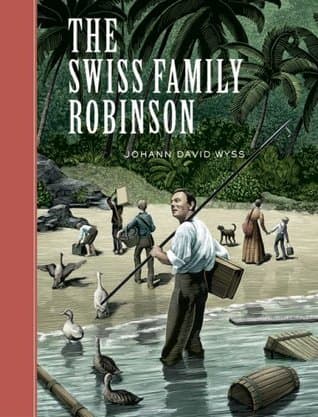
A Swiss pastor, his wife, and their four sons (Fritz, Ernest, Jack, and Francis) are on a ship going to a new colony when a storm hits. The rest of the crew and passengers leave the ship, seemingly leaving the Robinson family alone. With their father's resourcefulness and faith, they tie together a raft from tubs and barrels. They load it with food and tools, including a dog and some farm animals, and make a dangerous trip to a nearby tropical island. After reaching shore, they set up a temporary camp, thanking God for their safety and starting to look at their surroundings and immediate needs.
Establishing a Beachhead and Early Discoveries
The family begins exploring their new environment. Fritz, the oldest, is a good hunter, providing food. Ernest, who likes to learn, identifies different plants and animals. Jack, the adventurous middle son, wants to explore, while young Francis, the youngest, is curious and sometimes mischievous. They find many useful plants, including gourds for containers and coconuts for food and drink. They also find various animals, some familiar and some new. The father stresses the importance of faith, hard work, and learning in their new life, making sure the boys learn practical skills and scientific knowledge.
Building a Treehouse and Securing Their Home
Knowing the danger from wild animals, the family decides to build a more permanent and safe home. They find a large banyan tree with strong branches, good for a treehouse. Using tools saved from the ship and their cleverness, they build a comfortable, elevated home. This new house keeps them safe from predators and gives them a good view of their surroundings. They also start a garden, planting seeds saved from the ship, aiming to grow their own food. The mother, Elizabeth, manages their household and cooking.
Further Explorations and New Discoveries
Over time, the family continues to explore the different areas of their island. They find a cave which they name 'Falconhurst' and later decide to make it their winter home, furnishing it with saved items and natural materials. They meet many animals, some of which they tame, like a buffalo they name 'Grizzly' and an onager. They also find useful things like rubber trees, sugar cane, and different types of wood for building. Each son uses his skills on these trips, with Fritz often leading the hunting, Ernest providing plant knowledge, and Jack showing good agility.
Encountering a Young Woman and a New Companion
During one of his solo hunting trips, Fritz finds signs of another person. Following a trail, he finds a note and eventually rescues a young Englishwoman named Jenny Montrose, who had been shipwrecked on a nearby island and left by pirates. He brings her back to the family, who welcome her. Jenny quickly joins the family, bringing new ideas and skills. Her arrival provides companionship, especially for the mother, and adds a new element to the family's isolated life, possibly starting a romance between her and Fritz.
Expanding Their Colony and Building a Boat
With Jenny's arrival and time passing, the family continues to build their island colony. They set up different outposts, including a 'Farm' where they keep their tamed animals and grow large gardens. They also decide to build a larger, more sea-worthy boat, a pinnace, hoping it might one day help them return to civilization or at least explore further. This big project requires much effort and cleverness, using the many trees and their combined skills in carpentry and engineering. Building the boat becomes a main focus for the whole family.
A Search for Others and a Message in a Bottle
Hoping for rescue or contact with the outside world, the family, especially the father, decides to send a message in a bottle. They write a detailed account of their survival and location, hoping it will reach someone. They continue their daily routines of farming, hunting, and exploring, always watching the horizon. The boys grow into capable young men, each learning skills needed for their survival and the success of their settlement. Jenny, fully recovered, helps the family's well-being and education.
The Arrival of a Ship and the Prospect of Return
Years after their shipwreck, a European ship, the 'Lizard,' led by Captain Littlestone, finds the island. The ship had found the family's message in a bottle. The ship's arrival creates a difficult choice for the Robinsons. They have built a successful, self-sufficient colony, and the island has become their home. The idea of returning to civilization brings mixed feelings, especially for the younger boys who have known little else but island life. The captain and his crew are amazed by the family's cleverness and their settlement.
Decisions and Departures
After much discussion, the family makes their decisions. Fritz, now a young man, decides to return to Europe with Jenny to marry and live in society. Ernest, wanting more education, also chooses to return. Jack, though at first unsure, decides to go with them, perhaps looking for adventure. Francis, the youngest, wants to stay with his parents. The pastor and his wife, along with Francis, decide to remain on the island, having grown fond of their self-made home and feeling a desire to continue their unique life. They say an emotional goodbye to those leaving.
Life Continues on the Island
The pastor, Elizabeth, and Francis continue their lives on the island, happy with their decision to stay. They keep farming, building, and exploring, now with a stronger sense of permanence and purpose. They think about their journey, their faith, and the strength of their family. The island remains their home, showing human endurance, cleverness, and the ability to find happiness in unexpected places. They continue to do well, content in their self-sufficient life and the natural beauty around them.
The Swiss Family Robinson Characters
Father (Pastor Robinson)
Protagonist
The resourceful and devout patriarch who guides his family's survival.
The unnamed Swiss pastor is the spiritual and practical leader of the Robinson family. He is deeply religious, often citing scripture and attributing their survival to divine providence. He possesses extensive knowledge in various fields, including botany, zoology, engineering, and navigation, which he uses to educate his sons and overcome challenges. His calm demeanor, ingenuity, and unwavering faith are central to the family's ability to not only survive but thrive on the island. He teaches his sons practical skills, moral lessons, and scientific principles.
Relationships: Elizabeth Robinson (devoted husband); Fritz Robinson (father, mentor); Ernest Robinson (father, intellectual guide); Jack Robinson (father, adventurous guide); Francis Robinson (father, nurturer)
Elizabeth Robinson
Supporting
The nurturing and resilient mother who maintains the family's domestic life.
Elizabeth is the steadfast and nurturing mother of the Robinson family. She is practical, resourceful, and essential for maintaining the family's domestic well-being. She manages their food, clothing, and comfort, often devising clever solutions for everyday problems, such as making candles from wax or producing flour. Her gentle nature and unwavering support provide emotional stability for her husband and sons. She is also a keen observer of nature and contributes to their discoveries, always ensuring the family's health and happiness.
Relationships: Father Robinson (devoted wife); Fritz Robinson (mother); Ernest Robinson (mother); Jack Robinson (mother); Francis Robinson (mother)
Fritz Robinson
Supporting
The eldest son, a skilled hunter and adventurous explorer.
Fritz is the eldest and most adventurous of the Robinson sons. He is a skilled hunter, brave, and impulsive, often taking the lead in dangerous expeditions. He is strong and responsible, always looking out for his younger brothers. Fritz is also the first to discover signs of another human presence on the island and ultimately rescues Jenny Montrose, forming a romantic attachment with her. His practical skills and courage are invaluable to the family's survival and exploration efforts.
Relationships: Father Robinson (son); Elizabeth Robinson (son); Ernest Robinson (brother); Jack Robinson (brother); Francis Robinson (brother); Jenny Montrose (love interest, future husband)
Ernest Robinson
Supporting
The intelligent and studious second son, providing scientific knowledge.
Ernest is the second eldest son, known for his intelligence, studiousness, and keen observational skills. He is less physically inclined than Fritz or Jack but excels in intellectual pursuits, often identifying plants, animals, and minerals based on his extensive reading. He acts as the family's resident natural historian and scientist, contributing valuable knowledge to their understanding of the island's ecosystem. While sometimes portrayed as less adventurous, his intellectual contributions are vital for the family's long-term planning and resource management.
Relationships: Father Robinson (son); Elizabeth Robinson (son); Fritz Robinson (brother); Jack Robinson (brother); Francis Robinson (brother)
Jack Robinson
Supporting
The mischievous and agile third son, always eager for adventure.
Jack is the third son, characterized by his vivacity, agility, and sometimes mischievous nature. He is quick-witted, brave, and always ready for an adventure. He is particularly good at climbing and can move through the jungle with ease. While sometimes impulsive, his energy and enthusiasm are infectious, and he often makes valuable discoveries through his explorations. He is a skilled rider and helps with the domestication of animals. Jack's adventurous spirit is a driving force in the family's broader explorations of the island.
Relationships: Father Robinson (son); Elizabeth Robinson (son); Fritz Robinson (brother); Ernest Robinson (brother); Francis Robinson (brother)
Francis (Franz) Robinson
Supporting
The youngest son, innocent and beloved, representing the future of the island.
Francis, often called Franz, is the youngest of the Robinson sons. He is innocent, sweet-natured, and deeply attached to his parents. While still a child, he contributes in his own way, often through his observations and innocent questions. He represents the generation that truly knows the island as home, having spent most of his formative years there. His desire to stay on the island with his parents highlights the family's deep connection to their self-made paradise. He learns from his older brothers and parents, growing up in a unique, self-sufficient environment.
Relationships: Father Robinson (son); Elizabeth Robinson (son); Fritz Robinson (brother); Ernest Robinson (brother); Jack Robinson (brother)
Jenny Montrose
Supporting
A young Englishwoman rescued by Fritz, who becomes part of the family.
Jenny Montrose is a young Englishwoman whom Fritz discovers and rescues from a nearby island. She was the sole survivor of another shipwreck, abandoned by pirates. Jenny is initially weak and traumatized but quickly recovers and integrates into the Robinson family. She is intelligent, kind, and provides companionship, especially for Mrs. Robinson. Her arrival adds a new dimension to the family dynamic and a potential romantic interest for Fritz, leading to their eventual decision to marry and return to civilization. She brings an outside perspective to the island life.
Relationships: Fritz Robinson (rescued by, love interest, future wife); Robinson Family (adopted family member)
Captain Littlestone
Mentioned
The captain of the 'Lizard' who discovers the Robinson family.
Captain Littlestone is the commander of the European ship 'Lizard' that eventually discovers the Robinson family on their island. He found their message in a bottle and sailed to their rescue. He is portrayed as a kind and honorable man, astonished by the family's ingenuity and the thriving colony they have established. His arrival precipitates the family's difficult decision about whether to return to civilization or remain on the island. He represents the link to the outside world and the catalyst for the story's conclusion.
Relationships: Robinson Family (rescuer, facilitator of return)
The Swiss Family Robinson Themes
Ingenuity and Self-Sufficiency
The Robinsons' survival and success come from their great cleverness. From tying together a raft from barrels to building a treehouse, making tools, growing crops, and taming animals, the family constantly invents and adapts. The father's wide knowledge and the sons' practical skills allow them to turn a basic existence into a comfortable and productive colony. This theme appears in their creation of candles, rubber shoes, flour, and even a boat, all from the island's resources, showing human endurance and creativity.
“'Necessity is the mother of invention,' said my father, 'and you see, my children, how many things we have already learned to do by her teaching.”
Faith and Providence
The family's strong religious faith is a constant source of strength and guidance. The father, a pastor, often says their survival and good luck are due to God. Prayer, Bible readings, and moral lessons are part of their daily lives. This faith helps them keep hope when things are hard, provides values, and encourages them to be thankful for their blessings. It supports their positive outlook and their belief that they are not truly alone, even on an island, as God watches over them.
“Let us thank God, my children, who has so wonderfully preserved us, and brought us to this place of safety.”
Education and Knowledge
Education is very important to the Robinson family. The father teaches his sons about plants, animals, geography, and practical skills, making their island a living classroom. Ernest's interest in learning, in particular, shows the value of knowledge. This theme suggests that intelligence and learned skills are as important for survival as physical strength. The family's ability to identify useful plants, understand animal behavior, and use scientific principles directly helps them build a sustainable life on the island.
“Knowledge is power, my boys, and with it, we can conquer many difficulties.”
Family Unity and Cooperation
The Robinson family's strength is in their unity and cooperation. Every member, from youngest to oldest, gives their unique skills and efforts for the group's good. The father leads and shares knowledge, the mother manages the home, and each son develops specific skills (hunting, intellect, agility, observation). Their ability to work together, solve problems, and support each other is key to overcoming challenges and building a thriving community. This theme highlights the importance of family connections in survival.
“United we stand, divided we fall, my children. Remember that our strength lies in our love and cooperation.”
Man vs. Nature
The story explores the relationship between people and nature. The family must learn to manage their environment, using its resources while also protecting themselves from its dangers. They adapt to the island's climate, learn about its plants and animals, and turn raw nature into a livable and productive home. Nature also offers beauty, abundance, and lessons in harmony. The Robinsons' journey shows humanity's ability to adapt, innovate, and live with the wilderness.
“This island, though wild, is a true garden of Eden if we but know how to cultivate it.”
Plot Devices & Literary Techniques
The Deserted Island Setting
A classic backdrop for survival and ingenuity.
The deserted island serves as the primary stage for the entire narrative. It forces the Robinson family to rely solely on their wits, salvaged materials, and the island's natural resources. This setting isolates them from civilization, highlighting their self-sufficiency and resourcefulness. The island itself is depicted as a rich and diverse ecosystem, providing both challenges (wild animals, unknown plants) and bountiful resources (timber, fruit, animals, minerals), making it a dynamic character in its own right and driving the plot forward through exploration and discovery.
The Message in a Bottle
A traditional means of communication and a catalyst for rescue.
The message in a bottle is a classic plot device used to connect the isolated family with the outside world. It represents their enduring hope for rescue and acts as the direct means by which Captain Littlestone's ship eventually discovers them. This device builds suspense and anticipation throughout the story, as the family continues their life on the island while holding onto the possibility of being found. Its success ultimately forces the family to confront the choice between their established island paradise and a return to European society.
The Salvaged Ship
A treasure trove of tools and resources for survival.
The wrecked ship, initially a symbol of disaster, transforms into an invaluable resource for the Robinsons. Its hold contains tools, seeds, livestock, weapons, books, and various provisions that are crucial for the family's immediate survival and long-term development. The repeated trips to the wreck allow the family to acquire everything from carpentry tools to gunpowder, accelerating their progress from mere survival to building a sophisticated colony. It functions as a deus ex machina of sorts, providing essential items that would be impossible to create from scratch.
Character Archetypes (Four Sons)
Each son embodies a distinct personality and skill set.
The four Robinson sons represent distinct archetypes, each contributing a different strength to the family's survival and exploration. Fritz is the brave hunter/adventurer, Ernest the intellectual/naturalist, Jack the agile/mischievous explorer, and Francis the innocent/beloved youngest. This differentiation allows for a wide range of activities and discoveries, as each son's unique talents are utilized. It also provides opportunities for character development and highlights the importance of diverse skills in a cooperative environment, making the family a microcosm of society.
The Swiss Family Robinson Quotes
“As long as we are content with what we have, and make the best of it, we shall be happy.”
“God grant that we may all find a safe harbor after the storms of life.”
“Necessity is the mother of invention.”
“The greatest joy of life is to be able to do good.”
“It is not what we have, but what we do with what we have, that determines our success.”
“Education is the best provision for the journey to old age.”
“Patience and perseverance overcome all difficulties.”
“Every day brought its new duties and its new pleasures.”
“The true wealth of a family consists not in its possessions, but in the love and harmony that bind its members together.”
“Where there is a will, there is a way.”
“We are not alone, even in the wilderness, if we have God for our companion.”
“To be truly happy, one must have both work and recreation.”
“A good book is a true friend, always ready to entertain and instruct.”
“The most important thing is to learn to adapt to circumstances.”
Quiz
10 questions on the plot and the characters. Each answer comes with a short explanation.
Question 1
What is the primary reason the Robinson family originally leaves Switzerland?
- To escape a war in Europe
- To seek adventure and explore new lands
- To settle in a new colony half a world away
- To find a cure for a widespread illness
Show answer
C. To settle in a new colony half a world away The book states that the Robinsons were planning to settle 'half a world away,' indicating their intention to establish a new home in a distant colony, not just to explore or escape conflict.
Question 2
How do the Robinsons initially get from their shipwrecked vessel to the island?
- They build a raft from salvaged planks.
- They use a large tub they modify with sails.
- They swim to shore clinging to debris.
- They are rescued by another passing ship.
Show answer
B. They use a large tub they modify with sails. The family constructs a vessel from a large tub, rigging it with sails, to transport themselves and their initial supplies from the wrecked ship to the shore.
Question 3
Which of the following is NOT one of the initial challenges the Robinson family faces on the island?
- Finding fresh water.
- Protecting themselves from wild animals.
- Learning a new language to communicate with natives.
- Building shelter from the elements.
Show answer
C. Learning a new language to communicate with natives. The story focuses on their survival against nature and their ingenuity in building a new life, not on interactions with native populations or learning new languages. The other options are all direct challenges they face.
Question 4
What is the name of the oldest Robinson son, known for his intelligence and scientific curiosity?
- Fritz
- Ernest
- Jack
- Franz
Show answer
A. Fritz Fritz is consistently depicted as the eldest and most capable of the sons, often leading expeditions and demonstrating a keen intellect.
Question 5
What primary theme does the Robinson family's ability to create a 'civilization of their own' in the wilderness most strongly represent?
- The danger of isolation from society.
- The resilience and ingenuity of the human spirit.
- The superiority of European culture.
- The inevitable destruction of nature by humans.
Show answer
B. The resilience and ingenuity of the human spirit. The Robinsons' success in building a functioning society from nothing showcases their remarkable ability to adapt, invent, and overcome obstacles using their intelligence and determination, highlighting human resilience and ingenuity.
Question 6
Which animal do the Robinsons NOT encounter or domesticate early in their time on the island?
- Monkeys
- Ostriches
- Goats
- Dogs (from the ship)
Show answer
B. Ostriches While they encounter various exotic animals and domesticate some, ostriches are not among the creatures they interact with or tame in the early stages of their island life. They bring dogs from the ship and find goats and monkeys.
Question 7
What is the family's first more permanent dwelling after leaving their tent on the beach?
- A cave they discover and enlarge.
- A treehouse built high in a large tree.
- A hut constructed from bamboo.
- A shelter made from salvaged ship parts.
Show answer
B. A treehouse built high in a large tree. After their initial tent, the Robinsons build a substantial treehouse in a giant mangrove tree to provide better protection from animals and the elements.
Question 8
The father frequently emphasizes the importance of 'faith' to his sons. How does this theme manifest in their survival efforts?
- They pray for miraculous interventions rather than working.
- Their belief in divine providence gives them hope and perseverance.
- They believe the island is a sacred place with magical properties.
- They convert local tribes to their religion.
Show answer
B. Their belief in divine providence gives them hope and perseverance. The father often reminds his family that their faith in God will sustain them through hardships, providing a moral compass and a source of strength and hope that fuels their perseverance, rather than relying on magic or proselytizing.
Question 9
What significant discovery does Fritz make later in the story that changes their perspective on being alone?
- A map leading to buried treasure.
- A native village on another part of the island.
- Another castaway, a young Englishwoman named Jenny.
- Evidence of a previous, failed colonization attempt.
Show answer
C. Another castaway, a young Englishwoman named Jenny. Fritz discovers Jenny, a young Englishwoman who was also shipwrecked, which brings another human into their isolated world and offers the possibility of eventual rescue or a larger community.
Question 10
According to the book's description, why has this Townsend Library classic been 'carefully edited'?
- To remove outdated scientific theories.
- To make it more accessible to today's students.
- To shorten the story for younger readers.
- To update the language to modern English idioms.
Show answer
B. To make it more accessible to today's students. The book description explicitly states, 'This Townsend Library classic has been carefully edited to be more accessible to today's students,' indicating the primary goal of the revisions.
The Swiss Family Robinson FAQ
What is 'The Swiss Family Robinson' about?
'The Swiss Family Robinson' follows the adventures of a Swiss pastor, his wife, and their four sons (Fritz, Ernest, Jack, and Francis) who are shipwrecked on a deserted island while emigrating to the 'New World.' They must use their ingenuity, resourcefulness, and faith to survive, build a new home, and create a self-sufficient civilization in the wild tropical environment.
Why should I read 'The Swiss Family Robinson'?
You should read 'The Swiss Family Robinson' for its inspiring tale of family unity, resilience, and ingenuity in the face of adversity. It's a classic adventure story that encourages problem-solving, celebrates the wonders of nature, and offers a glimpse into 19th-century scientific and survival knowledge, all while being an accessible read for young adults.
What is the background/setting of 'The Swiss Family Robinson'?
The story begins with the Robinson family on a ship bound for a new colony, but they are shipwrecked during a fierce storm. They wash ashore on a lush, uninhabited tropical island, which becomes their new home. The setting is diverse, featuring beaches, dense jungles, caves, and various exotic flora and fauna, providing both challenges and resources for their survival.
What are the most memorable quotes?
While the Townsend Library edition is edited for accessibility, key themes often revolve around 'necessity is the mother of invention' and the importance of faith and family. Memorable lines would emphasize their constant innovation, like 'We must make use of what we have and not lament what we have not' or expressions of wonder at their discoveries.
What writing style does the author use?
Johann David Wyss employs a didactic and descriptive writing style, typical of the 19th century, especially for children's literature. The narrative is often interspersed with explanations of scientific principles, natural history, and moral lessons. The Townsend Library edition has been carefully edited to make this style more accessible to today's readers without losing the original essence.
What minor details add significant meaning?
The meticulous detail with which the family names their various discoveries and settlements on the island, such as 'Tentholm' or 'Falconhurst,' adds significant meaning. It reflects their desire to bring order, civilization, and a sense of belonging to their wild environment, transforming a mere survival camp into a true home.
What are some subtle foreshadowing moments?
Subtle foreshadowing includes early discussions about the diverse resources they salvage from the shipwreck, which hint at the complex tools and structures they will later build. Also, the discovery of various animal tracks and signs of life, even before direct encounters, subtly prepares the reader for the island's rich biodiversity and potential dangers.
What unexpected character connections exist?
The most significant unexpected connection is the discovery of Emily Montrose, a young English girl shipwrecked on a nearby island, whom Fritz eventually rescues. Her arrival introduces an external human element to the isolated family, expanding their world and offering the possibility of a return to society.
What are unspoken character motivations?
Beyond survival, an unspoken motivation for the father, William, is to educate his sons and instill in them strong moral values and practical skills. For Elizabeth, the mother, her unspoken drive is to maintain a sense of normalcy, comfort, and domesticity amidst the wilderness, protecting her family's emotional well-being.
What psychological complexities do characters exhibit?
While simplified for a younger audience, the characters exhibit complexities like Fritz's burgeoning leadership and romantic interest in Emily, Ernest's intellectual curiosity contrasting with Jack's adventurous impulsiveness, and Francis's innocent wonder. The parents grapple with the immense responsibility of recreating society and education from scratch.
What are the major emotional turning points?
Major emotional turning points include the initial despair and fear after the shipwreck transforming into hope and determination. The first successful harvest of crops brings immense relief and joy, signifying self-sufficiency. The discovery and rescue of Emily Montrose is another significant turning point, bringing a mix of excitement, hope for rescue, and a shift in family dynamics.
How do relationship dynamics evolve?
The relationship dynamics evolve from a traditional patriarchal family structure to a more collaborative unit where each member, including the younger boys, contributes significantly. The boys mature rapidly, taking on adult responsibilities and developing individual skills. The parents transition from sole providers to educators and guides, fostering independence in their sons.
Which parts remain ambiguous or open-ended?
The exact location of the island remains ambiguous, referred to only as being in the East Indies. While a ship eventually arrives, the long-term future of all family members is somewhat open-ended; some choose to stay on the island, while others, like Fritz and Emily, opt to return to civilization, leaving their eventual fates to the reader's imagination.
What are controversial scenes or decisions?
Controversial aspects, particularly from a modern perspective, include the family's approach to colonizing the island, often exploiting its resources and introducing non-native species. The casual hunting and taming of wild animals, sometimes for sport or simply to assert dominance, might also be seen as controversial.
'The Swiss Family Robinson' ending explained: how it ends & what it means
The book ends with the arrival of an English ship commanded by Captain Littleton, who was searching for Emily Montrose. The family is given the choice to return to Europe or remain on the island. The parents, Ernest, and Jack decide to stay, having built a thriving community. Fritz and Emily, along with Francis, choose to return to civilization. This ending signifies that true home can be found in different places and that each individual must choose their own path, whether it's embracing a wild, self-sufficient life or rejoining established society.
About the author

Johann David Wyss was a Swiss author known for his adventure fiction. He is best recognized for his novel "The Swiss Family Robinson," which tells the story of a family shipwrecked on a deserted island and their efforts to survive. This work has become a classic in children's literature and has inspired numerous adaptations.
Similar books
- Robinson Crusoe
Daniel Defoe
3.7 (248k) average on GoodreadsHistorical FictionBoth feature protagonists shipwrecked on a deserted island, focusing on survival and self-sufficiency.
- Hatchet
Gary Paulsen
3.7 (309k) average on GoodreadsChildren'sFocuses on a young boy's survival in the wilderness after a plane crash, relying on wit and resourcefulness.
- Treasure Island
Robert Louis Stevenson
Stevenson's Treasure Island offers a more thrilling and morally complex adventure, featuring ambiguous characters, genuine danger, and a focus on moral choices under duress. The Swiss Family Robinson, in contrast, presents a more sanitized and didactic adventure, where challenges are overcome with less internal conflict and the stakes often feel lower, prioritizing instruction over intense suspense and character evolution.
- Harry Potter and the Sorcerer's Stone
J.K. Rowling
4.5 (7M) average on GoodreadsFantasyRescued from a miserable life under the stairs, an orphaned boy discovers he's a wizard destined for a magical school, where he uncovers a dangerous secret tied to the dark wizard who murdered his parents.
- The Hobbit, or There and Back Again
J.R.R. Tolkien
4.3 (2.9M) average on GoodreadsFantasyA comfort-loving hobbit named Bilbo Baggins is whisked away by a mischievous wizard and a band of dwarves on an unexpected journey to reclaim stolen treasure from a fearsome dragon, discovering courage and a magical ring along the way.
- Harry Potter and the Goblet of Fire
J.K. Rowling
4.6 (2.6M) average on GoodreadsFantasyA bewildered Harry Potter, underage and thrust into a deadly Triwizard Tournament, must brave dragons, mermaids, and a resurgent dark magic to survive a year that will forever alter the wizarding world.




Enjoyed the summary?
A summary gives you the shape of the book. The book itself has the detail, the examples and the voice.
Find The Swiss Family Robinson on AmazonAs an Amazon Associate, BookBrief earns from qualifying purchases. How we're funded