
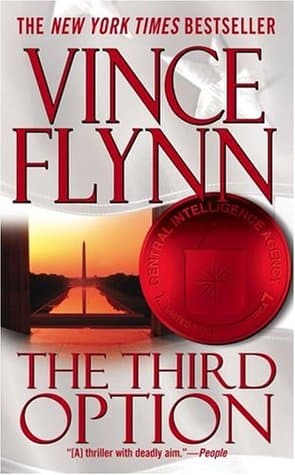
Synopsis
Covers the whole plot, including the ending.
- Difficulty
- Medium
- Pacing
- Fast
- Mood
- Suspenseful, Intense, Gritty, Conspiratorial
- Read it if
- You enjoy fast-paced political thrillers with a highly skilled, morally ambiguous protagonist and complex conspiracies.
- Skip it if
- You prefer character-driven dramas over plot-driven action, or are looking for a lighthearted read.
The Third Option Plot Summary
Covers the whole plot, including the ending.
A Deadly Assignment in Hamburg
CIA agent Mitch Rapp, still sad about losing his fiancé, gets what is supposed to be his last mission before moving to a desk job: kill German industrialist and arms dealer, Wolfgang Schmidt. Schmidt has been giving advanced technology to terrorist states, including Iran. Rapp, working undercover, gets into Schmidt's heavily guarded Hamburg estate. The operation is carefully planned, but during the assassination, Rapp finds a young woman, Anna R Reilly, Schmidt's mistress and a former CIA asset, in the house. He has to kill her to stay hidden, a choice that bothers him and leads to problems later. The mission is called a success, but Rapp feels the burden of the additional deaths.
The Aftermath and Lingering Doubts
After the Hamburg operation, Rapp goes back to the United States, expecting to be debriefed and start his new job. But CIA Director Irene Kennedy sees problems in the mission report and Rapp's behavior. She asks her deputy, Thomas Stansfield, to review the operation. Stansfield, an experienced intelligence officer, worries about Rapp's emotional state and if killing Anna Reilly was necessary. Rapp defends his actions, sure it was the only way to avoid being exposed. Unknown to them, the assassination has started a complex set of political and intelligence moves. Powerful people in the US government, who care about the outcome, are scrutinizing Rapp's actions.
A Plot Unravels in Washington
In Washington D.C., a secret group led by Senator Hank Clark and former CIA Director, now Deputy National Security Advisor, Paul Frehley, starts a plan to expose Rapp and use the Schmidt assassination to their benefit. They want to discredit the current administration's foreign policy and push their own plan for military action in the Middle East. They manipulate intelligence, leak information, and plant false evidence to make Rapp look like a rogue agent and the Schmidt operation an unauthorized, failed assassination. They plan to use Anna Reilly's death to their advantage, saying she was an innocent victim of the CIA going too far.
Rapp Becomes a Target
As the plot grows, Rapp feels he is being watched. His apartment is bugged, and he notices surveillance. He realizes he has been set up, and the information about Anna Reilly's past as a CIA asset was hidden from him, making him look careless. With his life and reputation at risk, Rapp goes into hiding, using his training to avoid capture and start his own investigation. He knows he can only trust a few people in the agency. Kennedy and Stansfield, though unsure at first, start to see the extent of the betrayal and work to protect Rapp and find the truth from inside the CIA.
Hunting for Answers
Working in secret, Rapp uses his contacts and skills to put the plot together. he finds that Anna Reilly was not just Schmidt's mistress but was involved in another sensitive intelligence operation about Schmidt's deals and a secret arms transfer. He also finds connections between Schmidt and powerful American figures who were profiting from illegal arms trade, making the official story more complicated. Rapp's investigation links the assassination, the leaks, and the attempts to frame him, pointing to a high-level plan to destabilize the government and change foreign policy.
Kennedy and Stansfield Fight Back
While Rapp is on the run, Irene Kennedy and Thomas Stansfield deal with the difficult political situation within the CIA and the White House. They face pressure from Senator Clark and Paul Frehley, who want Rapp captured immediately and a public inquiry. Kennedy and Stansfield, however, secretly believe Rapp's claims and start their own internal investigation, looking through intelligence reports and interviewing staff. They realize the plot goes deep into the government, and exposing it will need great care and good timing to avoid hurting national security and the agency.
Confrontation and Escalation
Rapp, with enough evidence, decides to confront the conspirators directly. He targets people in Frehley and Clark's network, using his methods to get information and send a message. He creates events that show the conspirators' weaknesses, causing problems and forcing them to act. This includes intercepting communications and directly threatening those who have been leaking information or manipulating evidence. His actions are meant to draw out the leaders and give Kennedy and Stansfield the proof they need to act against the powerful figures involved.
The Net Closes In
Rapp, Kennedy, and Stansfield's efforts start to work. Rapp gives important intelligence that helps Kennedy understand Frehley and Clark's full plan, including their money reasons and their goal of putting in a more aggressive administration. Stansfield uses his political skill to get support and prepare for the conflict. The conspirators, seeing their plans fail, become desperate, making mistakes that further show their involvement. The evidence points to a big breach of national security and a planned attempt to manipulate foreign policy for personal and ideological reasons.
Showdown and Resolution
In a big confrontation, the full plot involving Senator Clark and Paul Frehley is revealed to the President and other key officials. Rapp helps get undeniable proof, often using unusual ways. Kennedy and Stansfield present the evidence, showing how Rapp was set up, how intelligence was manipulated, and the true reasons behind the plot. The conspirators are exposed, their careers ruined, and some face criminal charges. Rapp, though cleared, remains a controversial figure, but his loyalty and effectiveness are confirmed. The experience makes his role as a critical, though unusual, asset to the CIA stronger, securing his place in the agency's fight against terrorism.
Principal Figures
Mitch Rapp
Protagonist
CIA's top counterterrorism operative, driven by duty and a thirst for justice.
Mitch Rapp is a highly skilled and ruthless CIA operative, initially recruited after his fiancé was killed in the Pan Am 103 bombing. He possesses exceptional combat skills, tactical brilliance, and an unwavering dedication to protecting American interests, often through morally ambiguous means. In 'The Third Option,' he is struggling with the emotional toll of his work and the recent loss of his fiancé, making him more volatile but still incredibly effective. He is fiercely independent and distrustful of bureaucratic politics, preferring direct action. His personal code of ethics, while brutal, is driven by a desire to prevent future terrorist attacks.
Relationships: Irene Kennedy (mentor and protector); Thomas Stansfield (boss and strategic ally); Wolfgang Schmidt (assassination target); Anna R Reilly (collateral damage, key to the conspiracy)
Irene Kennedy
Supporting
CIA Director, Rapp's primary handler and a shrewd political operator.
Irene Kennedy is the astute and politically savvy Director of the CIA. She is a strong leader, deeply committed to national security, and one of the few people Rapp truly trusts. She recognizes Rapp's unique value to the agency despite his unconventional methods and often acts as his protector within the complex Washington political landscape. In 'The Third Option,' she is central to uncovering the conspiracy from within the agency, meticulously piecing together evidence and navigating political pressures to clear Rapp's name and expose the traitors. She is intelligent, strategic, and fiercely loyal to her people and her mission.
Relationships: Mitch Rapp (mentor/handler, protector); Thomas Stansfield (trusted deputy and colleague); Paul Frehley (political adversary)
Thomas Stansfield
Supporting
Deputy Director of Operations, a seasoned intelligence veteran.
Thomas Stansfield is the Deputy Director of Operations at the CIA, a highly experienced and respected intelligence officer. He is pragmatic, methodical, and possesses a deep understanding of intelligence gathering and political maneuvering. Initially, Stansfield is skeptical of Rapp's actions in Hamburg, questioning the necessity of killing Anna Reilly. However, as the conspiracy unfolds, he becomes a crucial ally to Irene Kennedy, lending his experience and political acumen to investigate the internal betrayal. He plays a vital role in validating the evidence against Frehley and Clark, using his credibility to sway opinion within the White House.
Relationships: Irene Kennedy (trusted colleague); Mitch Rapp (colleague, later ally)
Paul Frehley
Antagonist
Deputy National Security Advisor and mastermind of the conspiracy.
Paul Frehley is a former CIA Director who has transitioned to Deputy National Security Advisor. He is the cunning and ruthless mastermind behind the conspiracy to discredit Mitch Rapp and manipulate US foreign policy. Driven by a combination of ideology, ambition, and financial gain through his connections to the illegal arms trade, Frehley orchestrates the leaks and false narratives. He is intelligent, manipulative, and uses his extensive network within the intelligence community to further his agenda. He sees Rapp as a disposable pawn in his larger game and is willing to sacrifice anyone to achieve his objectives, including using Anna Reilly's death as political leverage.
Relationships: Mitch Rapp (target/adversary); Senator Hank Clark (co-conspirator); Irene Kennedy (political adversary)
Senator Hank Clark
Antagonist
Powerful Senator and Frehley's political enabler in the conspiracy.
Senator Hank Clark is a powerful and ambitious politician who serves as Paul Frehley's key political ally in the conspiracy. He is a hawkish figure, eager to push a more aggressive foreign policy agenda, and sees the opportunity to use the Schmidt assassination to his advantage. Clark uses his position on intelligence committees to apply pressure on the CIA, demand investigations into Rapp, and disseminate false information to the media. He is driven by a desire for increased political influence and shares Frehley's ideological leanings regarding military intervention. He is a public face of the conspiracy, using his platform to shape public opinion.
Relationships: Paul Frehley (co-conspirator); Mitch Rapp (political adversary)
Wolfgang Schmidt
Mentioned
German industrialist and arms dealer, Rapp's initial target.
Wolfgang Schmidt is a wealthy German industrialist who secretly acts as a major arms dealer, selling sensitive technology and weapons to terrorist states like Iran. He is the initial target of Mitch Rapp's 'final mission.' Schmidt's illicit activities are a significant threat to global security, making him a high-priority target for the CIA. His assassination by Rapp sets off the chain of events that exposes the deeper conspiracy, as his death disrupts a complex network of political and financial interests that extend to powerful figures within the US government. He is portrayed as a dangerous, opportunistic figure.
Relationships: Mitch Rapp (assassin/target); Anna R Reilly (mistress)
Anna R Reilly
Supporting
Wolfgang Schmidt's mistress and a former CIA asset, whose death becomes central to the plot.
Anna R Reilly is Wolfgang Schmidt's mistress. Unbeknownst to Rapp during the assassination, she was also a former CIA asset involved in a highly sensitive operation related to Schmidt's dealings. Her presence and subsequent death at Rapp's hands become the central piece of leverage for the conspirators, who portray her as an innocent victim to discredit Rapp and the CIA. Her true role and connections are deliberately obscured by Frehley and Clark to fuel their narrative. Her death is a major point of contention and emotional burden for Rapp, driving much of the internal and external conflict.
Relationships: Mitch Rapp (killed by); Wolfgang Schmidt (mistress)
President Hayes
Supporting
The President of the United States, caught in the political crossfire.
President Hayes is the current President of the United States. He is a relatively inexperienced but well-meaning leader who finds himself caught in the middle of a high-stakes political and intelligence crisis. He relies heavily on his intelligence advisors, particularly Irene Kennedy and Thomas Stansfield, but is also subject to immense pressure from powerful figures like Senator Clark and Paul Frehley. His character represents the ultimate authority that must sift through the conflicting narratives to determine the truth and make critical decisions regarding national security and the fate of Mitch Rapp.
Relationships: Irene Kennedy (advisor); Paul Frehley (advisor (antagonist))
Themes & Insights
Betrayal and Corruption within Power
The novel looks at betrayal and corruption within the top levels of government. Paul Frehley and Senator Hank Clark, trusted national security figures, manipulate intelligence, leak information, and frame a loyal agent for personal gain and ideological reasons. This shows how power can corrupt, making people risk national security for their own plans, as seen in their willingness to profit from illegal arms deals and destabilize the government. Rapp's personal betrayal by those he serves highlights the danger of enemies within.
“The greatest threats often come from within, Mitch. Not from the enemies we can see, but the ones hiding in plain sight.”
The Morality of Intelligence Operations
The book explores the complex moral side of secret intelligence operations, especially through Mitch Rapp's actions. His killing of Wolfgang Schmidt and then Anna Reilly, though seen as necessary for the mission, bring up questions about unintended harm and the ethical lines agents must cross. Rapp's internal struggle, along with the political problems, forces characters like Irene Kennedy and Thomas Stansfield to deal with the 'third option' – the uncomfortable area between what is legal and what is necessary to protect national interests. It asks if the results always justify the methods in the world of espionage.
“There are no clean hands in this business, Mitch. Just degrees of dirt.”
Truth vs. Perception
A main theme is the manipulation of truth and the power of how things are seen in politics and intelligence. The conspirators, Frehley and Clark, purposely twist the facts about the Schmidt assassination and Anna Reilly's death to make Rapp look like a rogue agent and to push their political agenda. They leak carefully chosen information to the media, shaping public opinion against Rapp and the current administration. The story constantly shows how hard it is for the truth to come out when powerful figures actively try to hide it, forcing Rapp and his allies to fight not just physical threats, but also a battle over the story.
“In Washington, the truth is often less important than the story you can sell.”
Loyalty and Trust
Loyalty and trust are important, especially in the relationships between Mitch Rapp, Irene Kennedy, and Thomas Stansfield. Rapp's deep distrust of bureaucracy is challenged when he realizes he has been betrayed by high-ranking officials. His ability to trust Kennedy and Stansfield, who risk their careers to defend him and uncover the plot, shows how important loyalty is in a dangerous environment. On the other hand, Frehley and Clark's betrayal shows the damaging effect of disloyalty on national security and personal integrity. The novel looks at who can truly be trusted when the stakes are highest.
“When everyone else is trying to hang you, you learn very quickly who your real friends are.”
Plot Devices & Literary Techniques
The Unreliable Narrative/Misinformation
The manipulation of information to mislead characters and the audience.
This device is central to 'The Third Option.' The conspirators, Paul Frehley and Senator Clark, actively manipulate the narrative surrounding the Schmidt assassination. They leak partial truths, fabricate evidence, and control media perception to frame Mitch Rapp and push their political agenda. This creates a sense of uncertainty for the reader and for characters like Irene Kennedy, who must sift through layers of lies to uncover the real truth. The device highlights the dangers of disinformation and how easily public and official opinions can be swayed, making Rapp's fight not just physical, but also a battle for the truth.
The 'Third Option' (Metaphorical)
Represents the morally ambiguous choices made in intelligence operations.
While not a physical object, the 'Third Option' acts as a significant metaphorical plot device. It refers to the difficult, often morally grey choices that intelligence operatives like Mitch Rapp must make when conventional methods are insufficient, and the stakes are national security. It encapsulates the dilemma of doing what is necessary, even if it is illegal or ethically questionable, to achieve a greater good. Rapp's decision to kill Anna Reilly, though later revealed to be manipulated, is a prime example of such a 'third option' that drives the plot's conflict and explores the moral complexities of his world.
The Frame-Up
The deliberate act of making an innocent person appear guilty.
The entire central conflict of 'The Third Option' hinges on the frame-up of Mitch Rapp. Paul Frehley and Senator Clark meticulously construct a scenario where Rapp appears to be a rogue, out-of-control operative who committed an unauthorized assassination and needlessly killed a civilian. This device creates immense tension and drives Rapp's actions as he fights to clear his name while simultaneously exposing the true perpetrators. It forces him underground and makes him an enemy of the state he serves, highlighting the vulnerability of even the most effective agents to internal manipulation and betrayal.
The Double Agent/Hidden Agenda
Characters with concealed loyalties or ulterior motives.
This device is crucial in revealing the depth of the conspiracy. Anna R Reilly, initially perceived as mere collateral damage, is later revealed to have been a former CIA asset, complicating the narrative of her death. More significantly, Paul Frehley, a former CIA Director and current Deputy National Security Advisor, operates with a hidden agenda. His trusted position allows him to manipulate intelligence and orchestrate the frame-up from within, making him a 'double agent' against the very government he serves. This device creates suspense and underscores the theme of betrayal within power structures.
The Third Option Quotes
“The price of freedom is eternal vigilance.”
“Sometimes you have to do bad things to bad people to protect the good ones.”
“Trust was a luxury he couldn't afford.”
“The world was a dangerous place, and someone had to be willing to get their hands dirty.”
“He didn't seek revenge; he sought balance.”
“In their line of work, assumptions could get you killed.”
“The truth was rarely simple, and often inconvenient.”
“He was a weapon, finely tuned and exceptionally deadly.”
“Fear was a tool, and he knew how to wield it.”
“Every decision had consequences, some unforeseen.”
“Patriotism wasn't just about flags and anthems; it was about protecting what you believed in, no matter the cost.”
“The enemy wasn't always obvious, and sometimes came from within.”
“He lived in the shadows so others could live in the light.”
Quiz
10 questions on the plot and the characters. Each answer comes with a short explanation.
Question 1
What is the primary target of Mitch Rapp's final mission at the beginning of 'The Third Option'?
- A rogue Russian intelligence officer
- A German industrialist selling sensitive equipment
- An Iranian nuclear scientist
- A Libyan arms dealer
Show answer
B. A German industrialist selling sensitive equipment At the outset of 'The Third Option', Mitch Rapp is tasked with eliminating a German industrialist who is illicitly supplying sensitive technology to state sponsors of terrorism.
Question 2
Which organization does Mitch Rapp primarily work for in 'The Third Option'?
- FBI
- NSA
- CIA
- Department of Defense
Show answer
C. CIA Mitch Rapp is famously known as the CIA's top counterterrorism operative, and this affiliation is central to his role in 'The Third Option'.
Question 3
What is the 'third option' referred to in the book's title?
- A diplomatic solution to international terrorism
- A covert operation that avoids conventional warfare or diplomacy
- An alternative energy source developed by the industrialist
- A secret alliance between intelligence agencies
Show answer
B. A covert operation that avoids conventional warfare or diplomacy The 'third option' typically refers to covert action, often lethal, taken when diplomacy and open military conflict are deemed unsuitable or ineffective. It's a hallmark of Rapp's methods.
Question 4
Why is Mitch Rapp's mission described as his 'final mission' at the beginning of the book?
- He plans to retire after this operation.
- He is expected to be promoted to a desk job.
- He is being reassigned to a different agency.
- He is gravely injured during a previous mission.
Show answer
A. He plans to retire after this operation. At the start of 'The Third Option', Rapp is contemplating retirement from field operations, making this mission an intended swansong before a more administrative role or complete departure.
Question 5
What kind of equipment is the German industrialist selling to sponsors of terrorism?
- Advanced biological weapons
- Nuclear warheads
- Sensitive technology and components
- Conventional firearms and ammunition
Show answer
C. Sensitive technology and components The book specifies that the industrialist is trafficking 'sensitive equipment' or 'sensitive technology', implying components that could be used for WMDs or advanced surveillance, rather than finished weapons.
Question 6
How does Rapp typically operate when targeting high-value individuals like the German industrialist?
- He attempts to capture them for interrogation.
- He uses diplomatic pressure to have them extradited.
- He executes them covertly to prevent further harm.
- He leaks compromising information to ruin their reputation.
Show answer
C. He executes them covertly to prevent further harm. As the CIA's top counterterrorism operative, Rapp's methods are often direct and lethal, focusing on neutralizing threats permanently and discreetly, which involves covert assassination.
Question 7
What is a recurring theme explored through Mitch Rapp's character in Vince Flynn's novels, including 'The Third Option'?
- The pursuit of personal wealth and power.
- The moral ambiguities and necessary evils of national security.
- The importance of international cooperation in espionage.
- The struggle for a work-life balance in a demanding career.
Show answer
B. The moral ambiguities and necessary evils of national security. A core theme in the Rapp series is the difficult choices and moral compromises intelligence operatives must make to protect their country, often operating outside conventional legal or ethical boundaries.
Question 8
How does the plot typically escalate in a Mitch Rapp thriller like 'The Third Option' after the initial mission?
- Rapp immediately retires and lives a peaceful life.
- The initial mission uncovers a much larger, more complex conspiracy.
- Rapp is caught and held for trial by international authorities.
- The focus shifts to a love interest for Rapp.
Show answer
B. The initial mission uncovers a much larger, more complex conspiracy. In most Vince Flynn thrillers, an initial mission serves as a catalyst, quickly unraveling a deeper, more dangerous plot that often involves betrayal, high-level corruption, or a grander terrorist scheme.
Question 9
What kind of 'sponsors of terrorism' would typically be targeted by Rapp in the context of selling sensitive equipment?
- Small, independent criminal organizations
- State-backed entities or rogue nations
- Local street gangs
- Environmental activist groups
Show answer
B. State-backed entities or rogue nations The term 'notorious sponsors of terrorism' implies entities with significant resources and state-level backing, as they would be the primary clients for a German industrialist selling 'sensitive equipment' rather than petty criminals.
Question 10
How does 'The Third Option' likely portray the political landscape surrounding counterterrorism operations?
- As straightforward and universally supported.
- As complex, with internal conflicts and political maneuvering.
- As irrelevant to the actions of field operatives.
- As dominated by international treaties and conventions.
Show answer
B. As complex, with internal conflicts and political maneuvering. Vince Flynn's novels frequently delve into the bureaucratic and political infighting within Washington and intelligence agencies, showing how these dynamics often complicate or endanger covert operations, making the landscape far from straightforward.
The Third Option FAQ
What is 'The Third Option' about?
'The Third Option' centers on Mitch Rapp, a highly skilled CIA operative, as he undertakes what is intended to be his final mission: assassinating a German industrialist named Helmut Frey, who is secretly supplying advanced weapons technology to international terrorist organizations. The mission quickly unravels into a complex web of betrayal and political maneuvering, forcing Rapp to confront enemies from within his own government.
Why should I read 'The Third Option'?
You should read 'The Third Option' for its relentless pacing, intricate plot twists, and deep dive into the murky world of international espionage and government corruption. It offers a compelling look at Mitch Rapp's unique brand of justice and the moral ambiguities faced by those who operate in the shadows to protect national security.
What is the background/setting of 'The Third Option'?
The story begins in Germany with the assassination attempt on Helmut Frey, quickly shifting to Washington D.C. and various European locations as Rapp uncovers a conspiracy reaching into the highest levels of the U.S. government. The backdrop is a post-Cold War world grappling with new forms of terrorism and the ethical dilemmas of preemptive strikes.
What are the most memorable quotes?
While specific quotes are often nuanced in thrillers, a recurring theme is Rapp's pragmatic view of justice, often paraphrased as 'When the rules don't work, you make your own.' Another memorable sentiment revolves around the isolation and burden of those who carry out the 'third option' – the unsanctioned actions necessary for national security.
What writing style does the author use?
Vince Flynn employs a direct, fast-paced, and gritty writing style, characteristic of the thriller genre. His prose is lean, focusing on action, dialogue, and internal monologues that reveal Rapp's calculating mind, making for a propulsive and immersive reading experience.
What minor details add significant meaning?
The seemingly minor detail of the specific type of advanced weaponry Helmut Frey is selling, and its potential impact if acquired by terrorists, underscores the extreme stakes of Rapp's mission. Furthermore, subtle hints about the political motivations behind the initial authorization of Frey's assassination, and its subsequent revocation, reveal the deep-seated corruption at play.
What are some subtle foreshadowing moments?
Early in the mission, Rapp's unease and his gut feeling that something is 'off' about the intelligence or the sudden change in mission parameters subtly foreshadow the betrayal he will face. The unusual haste and lack of typical CIA protocols surrounding Frey's assassination also hint at a deeper, more sinister agenda.
What unexpected character connections exist?
A major unexpected connection is the involvement of high-ranking U.S. government officials, including some within the CIA, who are secretly colluding with Frey and attempting to eliminate Rapp. This betrayal from within his own ranks is a central and shocking revelation.
What are unspoken character motivations?
Beyond patriotism, Rapp's unspoken motivation is often a profound sense of personal responsibility and a desire for absolute justice, stemming from past traumas. For the corrupt officials, their unspoken motivations are power, greed, and a twisted belief that their actions, however heinous, serve a 'greater good' or personal gain, even at the cost of national security.
What psychological complexities do characters exhibit?
Mitch Rapp exhibits the psychological complexity of a man constantly balancing extreme violence with a strict moral code, grappling with the weight of his actions and the isolation it brings. The antagonists, particularly the orchestrators of the conspiracy, display complex justifications for their treachery, often rationalizing their destructive acts as necessary evils or calculated risks for power.
What are the major emotional turning points?
A major emotional turning point is when Rapp realizes he has been set up and is being hunted by his own agency, shifting his emotional state from focused operative to a man fighting for survival against those he once trusted. Another is his confrontation with Irene Kennedy, where he expresses his profound disillusionment and anger over the betrayal.
How do relationship dynamics evolve?
The relationship dynamic between Mitch Rapp and Irene Kennedy, his handler and mentor, evolves significantly. Initially built on trust and mutual respect, it is severely strained by the conspiracy, forcing Kennedy to choose between institutional loyalty and her belief in Rapp. Their dynamic ultimately shifts towards a more guarded but still potent alliance forged through shared adversity.
Which parts remain ambiguous or open-ended?
While the main conspiracy is resolved, the long-term political fallout and the true extent of the damage done by the corrupt officials often remain somewhat open-ended. The moral ambiguity of Rapp's methods, and whether his brand of justice is sustainable, also provides lingering questions for readers.
What are controversial scenes or decisions?
One controversial aspect is Rapp's willingness to operate outside legal boundaries and use extreme interrogation tactics, which some readers might debate as necessary versus morally compromising. The decision by certain high-ranking officials to collude with a known terrorist supplier for perceived political gain is also highly controversial within the narrative.
'The Third Option' ending explained: how it ends & what it means
The book ends with Mitch Rapp successfully exposing and neutralizing the corrupt network within the U.S. government responsible for the conspiracy, including the mastermind, Secretary of State Paul Frehley. While justice is served through Rapp's ruthless efficiency, he remains an outsider, a ghost operative whose methods are too extreme for public knowledge. The ending signifies Rapp's permanent role as the 'third option' – the necessary, unacknowledged force that protects the nation when conventional means fail, solidifying his status as a permanent fixture in the shadows.
About the author

Vince Flynn was an American author known for his political thriller novels. His notable works include "American Assassin," "Transfer of Power," "Memorial Day," "The Third Option," "Pursuit of Honor," and "Protect and Defend," which often feature themes of espionage and counterterrorism. Flynn's writing has garnered a dedicated readership and has contributed significantly to the genre of contemporary thrillers.
Similar books
- American Assassin
Vince Flynn
4.2 (75k) average on GoodreadsThrillerAnother Mitch Rapp origin story, showcasing his early development and intense training.
- Clear and Present Danger
Tom Clancy
4.1 (131k) average on GoodreadsThrillerInvolves complex geopolitical plots, covert operations, and government betrayals.
- Executive Orders
Tom Clancy
4.1 (46k) average on GoodreadsPoliticsBoth novels are geopolitical thrillers involving high-level government conspiracies and intelligence operations. However, Flynn's Rapp is a more overtly violent and less morally conflicted protagonist than Clancy's Jack Ryan, who often grapples more deeply with ethical implications. Flynn focuses more on the tactical aspects of covert action rather than Clancy's detailed technical specifics.
- The Bourne Identity
Robert Ludlum
4.0 (397k) average on GoodreadsThrillerBoth feature highly skilled operatives entangled in vast conspiracies. Ludlum's Bourne series, however, places a greater emphasis on identity, memory, and the protagonist's profound internal struggle to uncover his past. Flynn's Rapp, while facing external threats, has a more consistent and less internally conflicted motivation driven by patriotism, offering a more direct and less introspective look at black ops.
- Angels & Demons
Dan Brown
3.9 (2.7M) average on GoodreadsThrillerA Harvard symbologist races through Rome's ancient sites, deciphering cryptic clues to unmask the Illuminati and stop a vengeful plot to destroy the Vatican with a stolen antimatter weapon.
- Gone Girl
Gillian Flynn
4.1 (2.3M) average on GoodreadsThrillerA wife's sudden disappearance on her fifth anniversary reveals a web of lies and psychological warfare, exposing the secrets within a seemingly perfect marriage.


Enjoyed the summary?
A summary gives you the shape of the book. The book itself has the detail, the examples and the voice.
Find The Third Option on AmazonAs an Amazon Associate, BookBrief earns from qualifying purchases. How we're funded