
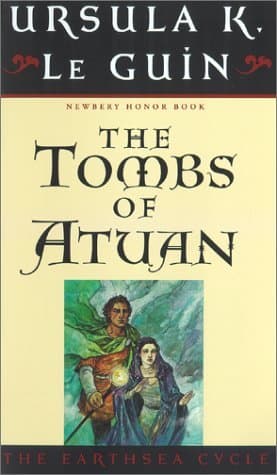
Synopsis
Covers the whole plot, including the ending.
- Difficulty
- Medium
- Pacing
- Slow
- Mood
- Atmospheric, Introspective, Dark, Hopeful
- Read it if
- You enjoy character-driven fantasy with deep psychological exploration and themes of identity, freedom, and the transition from darkness to light.
- Skip it if
- You prefer fast-paced action, complex magic systems, or a large cast of characters.
The Tombs of Atuan Plot Summary
Covers the whole plot, including the ending.
The Eaten One
Tenar, a young girl from the Kargad Lands, is born the night the old High Priestess of the Tombs of Atuan dies. This event marks her as the chosen reincarnation of the Priestess, destined to serve the Nameless Ones. At age five, she is taken from her parents, and her name, Tenar, is removed, replaced by 'Arha,' meaning 'the Eaten One.' She is brought to the Place of the Tombs, a desolate complex of temples and underground labyrinths. Her childhood is spent in strict training under Kossil, Priestess of the Godking, and Thar, Priestess of the Twin Gods. Arha learns the rituals, the Tombs' history, and, most importantly, the dark pathways of the Undertomb, the Nameless Ones' domain.
Life in the Darkness
As Arha grows, her life is defined by the Tombs' strict, unchanging routines. She oversees sacred ceremonies, including the sacrifice of prisoners in the Black House. Her closest companions are Thar and Kossil, who have different views on their worship. Thar, old and frail, genuinely respects the Nameless Ones and teaches Arha ancient lore and labyrinth secrets. Kossil, however, is practical, more concerned with the Godking's political power and the temples' wealth, often dismissing the Nameless Ones' true power. Arha feels a growing isolation and dissatisfaction with her fate, yet she finds a strange comfort in her role's absolute authority and dark majesty.
The Prisoner
During a patrol of the Undertomb—a vast, dark maze of tunnels, chambers, and abysses known only to her—Arha senses a foreign presence. Following faint sounds and disturbances in the oppressive darkness, she discovers an intruder: a young, dark-skinned man with a staff, a wizard. This is Ged, a sorcerer from the Archipelago, who seeks the legendary Ring of Erreth-Akbe, a powerful artifact hidden deep within the Tombs. Arha, filled with fear, anger, and curiosity, traps him by collapsing a tunnel, sealing him in a hidden chamber. She decides to keep his presence secret from Kossil and Thar, sensing a unique chance.
The Wizard's Captivity
Arha keeps Ged imprisoned in the labyrinth, visiting him secretly. She brings him water and meager food, but also torments him psychologically, threatening him with the Nameless Ones and the Tombs' dark punishments. Ged, though weak, remains calm and speaks to her of light, the outside world, and true magic, which contrasts sharply with her existence's death and darkness. He explains his purpose: to get the Ring of Erreth-Akbe, which he believes can help fix a great rift in the world. Their conversations slowly challenge Arha's beliefs and her absolute faith in the Nameless Ones. She finds herself drawn to his stories and the promise of a world beyond the Tombs, even as she keeps her authority over him.
Kossil's Suspicion
As Arha spends more time in the Undertomb with Ged, her behavior becomes erratic and secretive. She neglects some duties and avoids Kossil and Thar more often. Kossil, always watchful and politically smart, notices these changes. She suspects Arha is hiding something, perhaps dabbling in forbidden magic or trying to gain more power within the temple. Kossil's suspicion grows into an open challenge when she questions Arha's recent actions and her strange focus on the dark places. Arha feels the pressure, knowing that if Kossil discovers Ged, both their lives would be lost, and the Tombs' ancient secrets would be exposed to the Godking.
Thar's Demise and Arha's Decision
Old Thar, the Priestess of the Twin Gods and Arha's main mentor in the ways of the Nameless Ones, weakens further and dies. Her death leaves Arha feeling alone and vulnerable. Thar had been a link to the Tombs' ancient, spiritual aspects, and her passing removes a moderating influence, leaving Arha more exposed to Kossil's ambitious plans. In her grief and isolation, Arha's inner conflict grows. She is torn between her lifelong devotion to the Tombs and the Nameless Ones, and the appealing possibility of freedom and a different life that Ged represents. Thar's death pushes Arha toward a decisive action regarding Ged and the Ring, realizing she can no longer keep things as they are.
The Reveal of the Ring
Driven by an unexplained urge, Arha decides to get the Ring of Erreth-Akbe. She navigates the deepest, most sacred, and dangerous parts of the Undertomb, places where even she rarely goes. She finds the hidden chamber, a small, dark room, and uncovers the ancient, broken ring. It is a simple, heavy circlet, half gold and half silver, with a faint inscription. She returns to Ged with the Ring, showing it to him. He explains its importance: it is a legendary artifact, belonging to the ancient hero Erreth-Akbe, and has the power to unite the divided lands of the Archipelago and the Kargad Empire. The Ring symbolizes balance and unity, a sharp contrast to the Tombs' darkness and division.
The Labyrinth's Collapse
With the Ring, Arha decides to help Ged escape. She leads him through the labyrinth, using her knowledge of its passages and her ability to navigate in absolute darkness. As they move, Ged uses his magic, not to attack, but to bring light and clarity, showing the paths and ancient carvings. Their actions, especially removing the Ring, seem to awaken the Nameless Ones, or perhaps simply trigger instability in the ancient structures. The earth shakes, and the Tombs begin to collapse. Arha, for the first time, feels genuine fear for her life, but also a strange sense of freedom as her world literally falls apart.
Escape and Rebirth
Navigating falling debris and shifting ground, Arha and Ged race toward the surface. They pass through the main temple, now in ruins, and encounter Kossil, who is overwhelmed by the destruction. Arha feels no pity, only a strong will to escape. They emerge from the collapsing Tombs into the starlight, finding themselves on the desolate plain outside. For the first time she can remember, Arha sees the moon and stars, a sight that overwhelms her with its beauty and vastness. Ged, seeing her change, asks her true name. She hesitates, then remembers and says, 'Tenar.' She has shed the identity of Arha, the Eaten One, and is reborn, ready to face the unknown world with Ged.
Journey to Havnor
Tenar and Ged leave the ruined Tombs, beginning their long journey across the vast, dry Kargad Lands. Ged, still weak from his ordeal, relies on Tenar's knowledge of the land and her practical skills. They travel slowly, facing the harsh environment and the dangers of a world Tenar barely knows. Ged shares more about the Archipelago, his own life, and the larger world, gradually expanding Tenar's understanding beyond the Tombs' narrow confines. Tenar, in turn, adapts to the freedom and uncertainty of her new life, learning to trust Ged and to embrace her own identity. Their destination is the Archipelago, where Ged hopes to use the Ring of Erreth-Akbe to restore balance.
The Tombs of Atuan Characters
Tenar / Arha
Protagonist
The Eaten One, High Priestess of the Nameless Ones, who finds freedom and her true identity.
Tenar is the protagonist, chosen at birth to be Arha, the High Priestess of the Nameless Ones at the Tombs of Atuan. Stripped of her name and identity, she grows up in a world of darkness, ritual, and absolute power over life and death within the labyrinthine Undertomb. She is initially fiercely devoted to her role and the ancient, malevolent deities she serves, finding comfort in the absolute authority and the structured routine of the Tombs. Despite her upbringing, she possesses an innate curiosity, a strong will, and a deep, though suppressed, yearning for light and freedom.
Relationships: Ged (Captor/captive, then mentor/mentee, eventually companion and catalyst for her freedom.); Kossil (Rival and political adversary within the temple hierarchy.); Thar (Mentor and maternal figure, who teaches her the ancient ways of the Tombs.); The Nameless Ones (Deities she serves, but eventually rejects.)
Ged
Supporting
A powerful wizard from the Archipelago who seeks the Ring of Erreth-Akbe.
Ged, also known as Sparrowhawk, is a powerful and renowned wizard from the Archipelago, who enters the Tombs of Atuan seeking the ancient Ring of Erreth-Akbe. He is calm, wise, and patient, even in captivity, and represents the forces of light, balance, and true magic, in stark contrast to the darkness and death of the Tombs. He acts as a catalyst for Tenar's liberation, sharing knowledge of the outside world and challenging her deeply ingrained beliefs. He is not just a seeker of power, but a responsible guardian of balance in the world.
Relationships: Tenar / Arha (Captive/captor, then companion and student, who he guides to freedom.)
Kossil
Antagonist
The pragmatic and ambitious Priestess of the Godking, who challenges Arha's authority.
Kossil is one of the three main priestesses of the Tombs, serving the Godking. She is pragmatic, ambitious, and politically minded, more concerned with the material wealth and power of the temples and the Godking's influence than with the ancient, dark powers of the Nameless Ones. She is often dismissive of the true spiritual aspects of the Tombs and views Arha with suspicion and jealousy, constantly seeking to undermine her authority and expand her own power. She embodies the corrupting influence of earthly power within a spiritual institution.
Relationships: Tenar / Arha (Rival and political adversary.); Thar (Colleague, with whom she often disagrees on temple matters.)
Thar
Supporting
The elderly Priestess of the Twin Gods and Arha's primary mentor.
Thar is the oldest of the three priestesses and serves the Twin Gods. She is a frail, ancient woman who genuinely reveres the Nameless Ones and the old traditions of the Tombs. She acts as Arha's primary mentor, teaching her the intricate rituals, the history of the Tombs, and the secrets of the Undertomb. Thar represents the fading, genuine spiritual devotion to the ancient powers, contrasting with Kossil's pragmatism. She is kind to Arha in her own way, providing what little emotional connection Arha experiences in her early life.
Relationships: Tenar / Arha (Mentor and a maternal figure.); Kossil (Colleague, with whom she often disagrees on temple matters.)
The Nameless Ones
Antagonist
Ancient, malevolent deities of the Earth worshipped at the Tombs of Atuan.
The Nameless Ones are ancient, dark, and malevolent entities of the Earth, worshipped at the Tombs of Atuan. They are unseen but deeply felt, representing primordial chaos, death, and the void. Their power is linked to the darkness and the labyrinthine Undertomb. They demand absolute devotion and sacrifice, feeding on fear and the suppression of light and life. They are the ultimate source of Arha's authority and fear, embodying the oppressive, inescapable nature of her fate.
Relationships: Tenar / Arha (Deities she serves as High Priestess, her life dedicated to them.); Ged (Their power is antithetical to his light and magic.)
Manan
Supporting
The eunuch chief guard of the Tombs, devoted to Arha.
Manan is the chief eunuch of the Tombs, responsible for the physical security and daily operations of the temple complex. He is fiercely loyal and devoted to Arha, serving as her personal attendant and confidant in many ways. Manan is a silent, watchful presence, always ready to carry out Arha's commands without question. He represents the unquestioning, traditional devotion to the High Priestess and the established order of the Tombs, even as that order begins to unravel.
Relationships: Tenar / Arha (Devoted servant and personal guard.)
The Tombs of Atuan Themes
Identity and Self-Discovery
The main theme is Tenar's journey to reclaim her true identity after her name and self are taken at a young age. As Arha, she is a vessel for the Nameless Ones, defined only by her role. Her interactions with Ged and the outside world force her to question who she is beyond the 'Eaten One.' Remembering and reclaiming her name, Tenar, is a strong symbol of her freedom and self-acceptance, showing that true identity is chosen, not forced. This is clear when she leaves the Tombs and Ged asks her name, and she finally says 'Tenar,' shedding the burden of Arha.
“A name is a great thing. It is yours. You are Arha, the Eaten One. But you were Tenar once. That was your name. What is your name now?”
Light vs. Darkness
This theme is a literal and metaphorical core of the novel. The Tombs of Atuan are a place of constant darkness, both physically (the Undertomb) and spiritually (the worship of the Nameless Ones, death, and fear). Ged, the wizard, represents light and reason, bringing actual light into the labyrinth's darkness and metaphorical light into Tenar's understanding. Their struggle represents the conflict between ignorance and knowledge, oppression and freedom, and ultimately, life and death. Tenar's choice to leave the Tombs is a move from darkness into the light of the outside world, ending with her seeing the stars for the first time.
“Darkness is the world. Light is only a fire, by which the world is seen. The world is dark, and the light is fire. The fire is not the world.”
Freedom vs. Captivity
Tenar is born into a life of captivity, not just physically within the Tombs, but spiritually and psychologically. Her role as Arha ties her to ancient rituals, a predetermined fate, and the Nameless Ones' malevolent will. Ged, though a prisoner himself, represents true freedom—freedom of thought, movement, and choice. The story explores the nature of true freedom, which is not just the absence of physical chains but the liberation of the mind and spirit. Tenar's journey is a gradual process of breaking free from her upbringing's psychological chains, ending with her physical escape from the collapsing Tombs.
“Only in silence the word, only in darkness the light, only in dying life: bright is the hawk's flight on the empty sky.”
The Corrupting Influence of Power and Tradition
The Tombs of Atuan, ancient and full of tradition, also show how power and strict adherence to tradition can corrupt. The priestesses hold immense, unquestioned power over life and death, leading to a stagnant, fear-driven society. Kossil shows this, prioritizing political influence and material gain over spiritual devotion. The traditions themselves, especially human sacrifices, are barbaric and serve to maintain fear and control rather than genuine worship. The Tombs' destruction can be seen as a necessary cleansing, freeing the land from a long-standing, corrupting influence.
“Power is a heavy thing. It is not for the light-hearted.”
Plot Devices & Literary Techniques
The Labyrinth (Undertomb)
A vast, lightless underground maze that serves as both a sacred space and a prison.
The Undertomb is a complex, lightless labyrinth beneath the Tombs of Atuan, known only to Arha. It functions as a sacred domain of the Nameless Ones, a burial place, a treasury, and a prison. For Arha, it is both her sanctuary and her ultimate cage, embodying her identity as 'the Eaten One.' Its darkness and intricate passages symbolize her isolated, convoluted inner world and the impenetrable traditions she serves. It serves as the primary setting for Arha and Ged's interactions and the site of their escape, which ultimately leads to its destruction.
The Ring of Erreth-Akbe
A powerful, broken artifact sought by Ged, symbolizing unity and balance.
The Ring of Erreth-Akbe is a legendary, broken artifact, half gold and half silver, hidden deep within the Tombs. It represents ancient power, unity, and balance, capable of mending rifts in the world. For Ged, it is the object of his quest, a tool to restore harmony. For Tenar, its discovery and her act of giving it to Ged signify her breaking away from the darkness and embracing a larger purpose. Its dual nature (gold and silver, broken yet powerful) reflects the balance of light and darkness, and the potential for wholeness that lies beyond the Tombs.
The Nameless Ones
Ancient, malevolent deities representing primordial darkness and chaos.
The Nameless Ones are the unseen but ever-present deities of the Tombs, embodying primordial darkness, chaos, and death. They are a powerful plot device, driving Arha's devotion and fear, and providing the central conflict against Ged's light and order. Their malevolent influence permeates the Tombs, making it a place of dread and stagnation. Their 'presence' and the fear they inspire are what keep Arha bound to her role, and their eventual 'awakening' during the escape leads to the physical destruction of the Tombs, symbolizing the collapse of the old, dark order.
The Stripping of the Name
The ritualistic removal of Tenar's birth name and the imposition of 'Arha'.
The act of taking Tenar's name and giving her 'Arha' (the Eaten One) is a crucial plot device that establishes her loss of identity and her symbolic death to her former self. This ritual immediately sets up the central conflict of her personal journey: reclaiming her true self. It signifies her complete assimilation into the cult of the Nameless Ones, making her a vessel rather than an individual. Her eventual reclamation of 'Tenar' at the end of the book is a powerful symbolic act of self-determination and rebirth, marking her true liberation.
The Tombs of Atuan Quotes
“When you light a candle, you also cast a shadow.”
“To shut your eyes is to be blind; to open your eyes is to see.”
“The dark cannot be banished, but it can be made to serve.”
“A man who knows his name cannot be hurt.”
“Freedom is a heavy load, a beautiful burden, a dream dreamed by exiles.”
“Only in silence the word, only in darkness the light, only in dying life: bright the hawk's flight on the empty sky.”
“To be the hand, the instrument, the tool of the Nameless Ones, that was all she was, all she had been since she was five years old.”
“A thing is what it is, and not another thing.”
“She had thought there was no other life, no other world but this one. Now she knew there was.”
“One cannot be a master until one is a servant.”
“Fear is the only dark place.”
“The way home is never the shortest way.”
“She was not Arha, the Eaten One, she was Tenar.”
“To unmake what has been made, to undo what has been done, that is the way to the heart of the world.”
Quiz
10 questions on the plot and the characters. Each answer comes with a short explanation.
Question 1
What is the name given to Tenar when she is chosen as high priestess?
- Kossil
- Arha
- Thar
- Manan
Show answer
B. Arha When Tenar is chosen as high priestess, her name is taken away and she is given the new name Arha, meaning 'the Eaten One'.
Question 2
What is the primary role of Arha as the Eaten One?
- To lead the daily rituals of the Godking
- To transcribe ancient prophecies
- To guard the ominous Tombs of Atuan
- To train new priestesses in the Labyrinth
Show answer
C. To guard the ominous Tombs of Atuan Arha's central duty and identity are tied to her role as the guardian of the Tombs of Atuan and the nameless Powers within them.
Question 3
What is the name of the wizard who enters the Tombs of Atuan?
- Ogion
- Vetch
- Ged
- Lebannen
Show answer
C. Ged The young wizard who comes to the Tombs to seek the Ring of Erreth-Akbe is named Ged.
Question 4
What specific treasure does Ged seek within the Tombs of Atuan?
- The Sword of Serriadh
- The Crown of the Kargad Empire
- The Ring of Erreth-Akbe
- The Staff of the Earthsea Archmage
Show answer
C. The Ring of Erreth-Akbe Ged's primary objective in venturing into the dangerous Tombs is to retrieve the legendary Ring of Erreth-Akbe.
Question 5
What does the phrase 'Eaten One' (Arha) signify about Tenar's role?
- She is nourished by the offerings made to the Powers.
- Her individual identity has been consumed by her duty to the Powers.
- She has eaten forbidden fruit from the Tombs' gardens.
- She is destined to be sacrificed to the Nameless Ones.
Show answer
B. Her individual identity has been consumed by her duty to the Powers. The name Arha, 'the Eaten One,' symbolizes how Tenar's personal identity, home, and family are consumed by her role as high priestess to the ancient Powers.
Question 6
What is the nature of the 'Powers of the Earth' that Arha serves?
- Benevolent deities who grant wishes
- Ancient, nameless, and dark entities tied to the earth
- Spirits of the departed priestesses
- Elemental forces that control weather
Show answer
B. Ancient, nameless, and dark entities tied to the earth The Powers of the Earth are described as ancient, nameless, and dark, representing a primal, often terrifying force connected to the very foundations of the world, rather than benevolent gods.
Question 7
How does Ged initially bring 'light' into Arha's domain, beyond literal illumination?
- By sharing stories of the outside world
- By offering her a way out of her constricted life and revealing other possibilities
- By teaching her new magic spells
- By revealing the true history of the Tombs
Show answer
B. By offering her a way out of her constricted life and revealing other possibilities Ged brings 'light' not just through his magic's literal illumination, but by offering Arha an alternative perspective on her life, revealing the possibility of freedom and a world beyond the Tombs, which had previously been her entire existence.
Question 8
What is the significance of the labyrinth within the Tombs of Atuan for Arha?
- It is a place of solitary meditation and spiritual growth.
- It represents her profound knowledge and mastery over her domain, but also her imprisonment.
- It is a training ground for combat against intruders.
- It serves as a storage area for the Tombs' vast wealth.
Show answer
B. It represents her profound knowledge and mastery over her domain, but also her imprisonment. The labyrinth is Arha's domain, a place she knows intimately and navigates effortlessly in the dark, symbolizing her deep connection to the Powers and her authority. However, it also represents her confinement and isolation from the outside world.
Question 9
What is the ultimate decision Arha makes regarding her life and loyalty?
- She decides to stay and become the sole ruler of the Tombs after Ged's departure.
- She sacrifices Ged to the Nameless Ones to prove her loyalty.
- She chooses to abandon her role as Arha and escape the Tombs with Ged.
- She attempts to destroy the Tombs and the Powers within them.
Show answer
C. She chooses to abandon her role as Arha and escape the Tombs with Ged. Despite her lifelong indoctrination, Arha ultimately chooses to reject her identity as the Eaten One and escape the darkness of the Tombs with Ged, seeking freedom and a new life.
Question 10
What does the escape from the Tombs with Ged represent for Tenar (Arha)?
- A temporary reprieve before her inevitable return.
- The reclamation of her true name and individual identity.
- The beginning of her training as a wizard.
- A new mission to spread the influence of the Nameless Ones.
Show answer
B. The reclamation of her true name and individual identity. The escape signifies Tenar's liberation from the oppressive identity of Arha and the reclaiming of her original self, marking a profound shift from being an 'Eaten One' to a free individual.
The Tombs of Atuan FAQ
What is the central conflict in 'The Tombs of Atuan'?
The central conflict revolves around Tenar, also known as Arha, the High Priestess of the Nameless Ones, and her internal struggle with the oppressive, dark religion she serves, contrasted with the arrival of the wizard Ged who offers her a path to freedom and the outside world. She grapples with her duty to the Tombs versus a burgeoning desire for self-determination and light.
Who is Arha and what is her role in the Tombs of Atuan?
Arha, meaning 'The Eaten One,' is the reincarnation of the priestess who serves the Nameless Ones, ancient dark powers of the Earth. She is the supreme priestess, responsible for maintaining the labyrinthine Tombs, overseeing the eunuchs and other priestesses, and performing dark rituals, including human sacrifice, to appease the Nameless Ones.
What is the significance of the Ring of Erreth-Akbe?
The Ring of Erreth-Akbe is a powerful ancient artifact, a symbol of unity and peace from the time of the Old Kingdom, broken into two pieces. Ged seeks it because it is fabled to heal divisions and bring light, representing a stark contrast to the darkness and emptiness of the Tombs, and is crucial for restoring balance in Earthsea.
How does Ged end up trapped in the Tombs?
Ged enters the Tombs stealthily, seeking the Ring of Erreth-Akbe. He uses light magic to navigate the dark passages but is eventually discovered by Arha, who, driven by her duty to the Nameless Ones, traps him in the Labyrinth, intending to sacrifice him to the dark powers.
What prompts Tenar's decision to help Ged escape?
Tenar's decision to help Ged is a gradual process fueled by their conversations, his refusal to fear her or the Nameless Ones, and his offer of freedom and a life beyond the Tombs. She begins to question the emptiness and cruelty of her faith, seeing a genuine alternative in Ged's magic and his connection to the vibrant world outside.
What is the connection between 'The Tombs of Atuan' and the broader Earthsea cycle?
'The Tombs of Atuan' is the second book in the Earthsea Cycle, following 'A Wizard of Earthsea.' It continues the story of Ged, showing his growth and further challenges after his initial triumph over the shadow. It also introduces the crucial character of Tenar, whose journey of self-discovery is central to the narrative and future events in Earthsea.
Were there any other treasures or significant items hidden in the Tombs besides the Ring?
While the Ring of Erreth-Akbe is the primary treasure Ged seeks, the Tombs of Atuan also contain vast amounts of other ancient gold, jewels, and artifacts. These are largely ignored by the priestesses, who value only the emptiness and the rituals, highlighting their detachment from worldly wealth and their focus on the unseen powers.
What is the significance of Tenar reclaiming her original name?
Reclaiming her name, Tenar, is a profound act of self-reclamation and defiance against the Nameless Ones, who stripped her of her identity upon becoming Arha. It symbolizes her rejection of the 'Eaten One' persona and her embrace of her individual self, marking her transition from a tool of darkness to a free, independent person.
How does Tenar's experience with the labyrinth reflect her internal state?
Tenar's intimate knowledge and mastery of the labyrinth's dark, winding passages and hidden chambers mirror her internal state of being trapped and defined by the oppressive, confusing, and ultimately empty religion of the Nameless Ones. Her eventual escape from the labyrinth parallels her psychological liberation from that spiritual darkness.
How does Ged's presence challenge Tenar's worldview and identity?
Ged's presence fundamentally challenges Tenar by introducing light, reason, and a connection to a vibrant, living world outside her dark domain. He sees her as Tenar, not Arha, and his magic and calm demeanor directly contradict the fear and emptiness her religion instills, forcing her to question everything she has ever known about herself and the world.
What psychological impact does the constant darkness and isolation of the Tombs have on its inhabitants?
The constant darkness and isolation of the Tombs instill a deep sense of fear, emptiness, and spiritual stagnation in its inhabitants, particularly the priestesses. They become accustomed to a life devoid of light, joy, and individual identity, fostering a rigid, unquestioning obedience to the Nameless Ones and a fear of anything external or bright.
How does the relationship between Tenar and Ged evolve throughout the story?
Initially, Tenar views Ged as an intruder and an enemy to be sacrificed, while Ged sees her as his captor. Their relationship slowly transforms through forced proximity and dialogue, evolving from captor-prisoner to a hesitant alliance, then to mutual respect, and finally to a profound bond of trust and companionship as they rely on each other for survival and freedom.
Is the 'evil' of the Nameless Ones an active, malevolent force or simply an absence of good?
The nature of the Nameless Ones is complex; they are presented as ancient, powerful entities associated with darkness, emptiness, and consumption, implying an active malevolence through their demand for sacrifice and the fear they inspire. However, their 'power' also seems to stem from the absence of light and life, suggesting their strength is amplified by a void rather than a direct, conscious will to harm.
How does the book explore themes of freedom versus bondage?
The book deeply explores freedom versus bondage through Tenar's literal and spiritual imprisonment within the Tombs, contrasted with Ged's offer of physical escape and the freedom of self-determination. Her journey is about breaking free from the psychological chains of a restrictive religion and claiming her own path, rather than being bound by inherited duty.
What is the significance of the light and dark imagery throughout the novel?
Light and dark imagery is central to the novel, symbolizing the fundamental conflict between the oppressive, empty religion of the Nameless Ones (darkness) and the vibrant, life-affirming magic and self-awareness Ged represents (light). Tenar's journey is a movement from the literal and metaphorical darkness of the Tombs towards the light of consciousness, choice, and the wider world.
Does the ending suggest a complete triumph over the Nameless Ones, or a more nuanced resolution?
The ending suggests a nuanced resolution rather than a complete triumph. While Tenar and Ged escape with the Ring, and the power of the Nameless Ones within the Tombs is diminished by the presence of light, the entities themselves are ancient and likely still exist. The resolution is primarily Tenar's personal liberation and the restoration of a significant artifact, not the eradication of all darkness.
How does the portrayal of religion in the Tombs of Atuan differ from typical fantasy depictions?
The religion of the Tombs of Atuan differs significantly by portraying a faith based on emptiness, fear, and negation, rather than divine guidance, clear morality, or spiritual fulfillment. The Nameless Ones offer no comfort or reward, only demands and a terrifying void, making it a critique of oppressive, identity-erasing religious systems rather than a typical fantasy 'good vs. evil' divine conflict.
What role do the other priestesses, such as Kossil and Thar, play in Tenar's development?
Kossil represents the rigid, dogmatic adherence to the old ways, embodying the cruelty and fear that define the Tombs. Thar, while also a priestess, shows a glimmer of human warmth and a less fanatical devotion, offering Tenar a more complex view of duty and subtly influencing her burgeoning doubts about the absolute nature of the Nameless Ones' power.
About the author
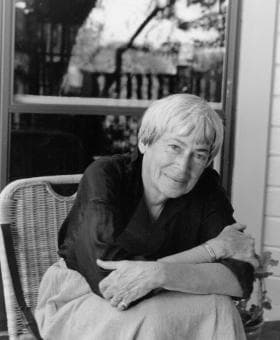
Ursula Kroeber Le Guin was an American author best known for her works of speculative fiction, including science fiction works set in her Hainish universe, and the Earthsea fantasy series. She was first published in 1959, and her literary career spanned nearly sixty years, producing more than twenty novels and over a hundred short stories, in addition to poetry, literary criticism, translations, and children's books. Frequently described as an author of science fiction, Le Guin has also been called a "major voice in American Letters". Le Guin said she would prefer to be known as an "American novelist".
Similar books
- A Wizard of Earthsea
Ursula K. Le Guin
4.0 (241k) average on GoodreadsFantasyShares the same world, themes of power and responsibility, and introspective tone.
- The Left Hand Of Darkness
Ursula K. Le Guin
4.1 (120k) average on GoodreadsFantasyExplores complex societal structures and individual identity within a unique world.
- The Hobbit, or There and Back Again
J.R.R. Tolkien
4.3 (2.9M) average on GoodreadsFantasyFeatures a journey of self-discovery from a sheltered existence into a larger world, though with a different tone.
- Sabriel
Garth Nix
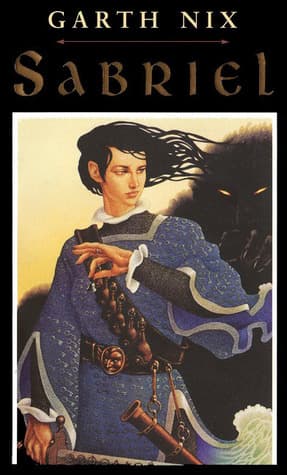
4.2 (185k) average on GoodreadsFantasySabriel is a prominent young adult fantasy novel featuring a strong female protagonist who undertakes an epic quest to save her kingdom from the dead. It is characterized by its fast-paced action, unique magic system involving bells and necromancy, and a clear mission-driven plot. The Tombs of Atuan, while also featuring a strong young female protagonist, is far less action-oriented. Arha's journey is one of internal awakening rather than an external quest. The magic in Sabriel is overt and combative, whereas in Tombs, magic (through Ged) is more a catalyst for change and revelation than a tool for direct conflict, making Le Guin's narrative significantly more contemplative and less reliant on high-stakes external battles.
- Harry Potter and the Sorcerer's Stone
J.K. Rowling
4.5 (7M) average on GoodreadsFantasyRescued from a miserable life under the stairs, an orphaned boy discovers he's a wizard destined for a magical school, where he uncovers a dangerous secret tied to the dark wizard who murdered his parents.
- The Hunger Games
Suzanne Collins
4.3 (6.4M) average on GoodreadsFantasyIn a future where children fight to the death on live television, Katniss Everdeen volunteers for the arena, turning a death sentence into a fight for survival and a spark of rebellion.





Enjoyed the summary?
A summary gives you the shape of the book. The book itself has the detail, the examples and the voice.
Find The Tombs of Atuan on AmazonAs an Amazon Associate, BookBrief earns from qualifying purchases. How we're funded