
Synopsis
Covers the whole plot, including the ending.
- Difficulty
- Easy
- Pacing
- Moderate
- Mood
- Inspiring, Clever, Educational, Whimsical
- Read it if
- You enjoy stories about young entrepreneurs, practical economics, and problem-solving, or if you're looking for a charming historical fiction for young readers.
- Skip it if
- You prefer complex character-driven narratives or high-stakes fantasy/adventure.
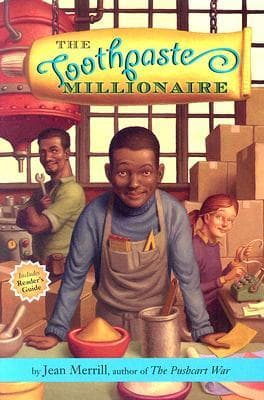
The Toothpaste Millionaire Plot Summary
Covers the whole plot, including the ending.
The Toothpaste Challenge Begins
The story opens in 1960s Cleveland, Ohio, with sixth-grader Rufus Mayflower, who wants to save money. After his father buys him an expensive tube of toothpaste, Rufus calculates the cost per ounce and finds it too high. He tells his friend Kate MacKinstrey that he can make a gallon of toothpaste for the same price as one store-bought tube. Kate, practical and good with numbers, at first doubts him but is interested. Their first attempt involves mixing baking soda, salt, and red food coloring in the Mayflower kitchen, creating a gritty, unpalatable concoction. Despite the initial failure, Rufus keeps going, seeing it as a learning experience and the first step in his ambitious, money-saving project.
Formulating the Perfect Paste
Rufus and Kate start experimenting to improve their toothpaste formula. They research ingredients, focusing on cost and function. Kate carefully tracks their expenses and ingredient ratios, using her math skills to optimize the formula. They try combinations of baking soda, salt, peppermint oil, and a bit of chalk for texture, often using household items for measurements. Their goal is to make a toothpaste that is cheap, effective, and pleasant to use. The kitchen becomes their lab, filled with trial-and-error batches, some successful, many not, but each step brings them closer to a marketable product.
Scaling Up Production and Initial Sales
Once Rufus and Kate finalize an acceptable formula — a minty, slightly gritty paste packaged in small plastic bags — they decide to sell it. They calculate their production costs, including ingredients and packaging, and set a competitive price. Their first customers are their classmates. Rufus, with his entrepreneurial spirit, handles sales and marketing, while Kate manages production and finances. They quickly realize demand is greater than their small kitchen operation can handle, leading them to consider more efficient production methods and more raw materials. This initial success confirms their efforts and fuels their ambition.
The Factory in the Basement
To meet growing demand, Rufus and Kate set up a production line in Rufus's basement. They enlist other classmates, hiring them to mix ingredients, fill containers, and package the toothpaste. This introduces them to managing labor, inventory, and quality control. They improvise equipment, using a cement mixer for large batches and a modified cake decorator for filling tubes. Kate, with her organizational skills, creates a system for tracking production and sales, ensuring efficiency and profitability. The basement factory becomes a busy place, transforming their small project into an amateur manufacturing operation.
Facing Supply Chain Challenges
As their production scales up, Rufus and Kate face challenges in getting raw materials. They can no longer rely on small grocery store purchases for baking soda, salt, and peppermint oil. They learn about wholesale suppliers and buying in bulk to reduce costs. This means contacting different distributors, comparing prices, and negotiating deals, which is a learning experience. They also consider storage for larger quantities of ingredients. These logistical hurdles make them think like real business owners, understanding a reliable and cost-effective supply chain is important to maintain profit margins.
Competition and Marketing Strategies
The success of Rufus's toothpaste, now called 'Mayflower Toothpaste,' starts to get attention, both good and bad. Local drugstores and established toothpaste companies begin to notice the disruption their product is causing. Rufus and Kate learn about competition and the need for marketing. They use word-of-mouth, school announcements, and local newspaper ads to promote their product. They emphasize the low cost and quality of their toothpaste, appealing to consumers looking for an affordable alternative. This period shows their growing understanding of market dynamics and consumer behavior.
Expansion and Distribution
With demand surging, Rufus and Kate realize they need to expand their distribution. They start selling their toothpaste to other schools and small shops in different neighborhoods. This involves recruiting more classmates as distributors, teaching them about sales, and managing delivery. They even consider using bicycles for local deliveries. This expansion phase introduces them to managing a wider sales network, ensuring consistent product quality across different locations, and collecting payments. Their initial small operation is rapidly becoming a regional company.
Legal and Financial Hurdles
As the business grows, Rufus and Kate face more adult challenges. They need a bank account to manage their increasing revenue and expenses. They learn about opening a business account and the importance of financial records. They also encounter questions about business permits and regulations, prompting them to seek advice from adults, including Rufus's father and a local lawyer. These experiences expose them to the legal and financial frameworks governing businesses, teaching them about responsibility, compliance, and the importance of professional advice. They are no longer just kids making toothpaste; they are running a legitimate, youth-led company.
The Million-Dollar Milestone
Through hard work, shrewd calculations, and a strong product, Mayflower Toothpaste becomes successful. Rufus and Kate, now in eighth grade, have built a thriving company from scratch. They have streamlined production, established a robust distribution network, and maintained a loyal customer base because of their affordable and effective product. The story ends with Rufus realizing his dream, and more: the business's profits reach the million-dollar mark, making Rufus Mayflower a millionaire. This achievement shows their entrepreneurial spirit, mathematical skill, and determination, proving that even kids can build a successful business with the right approach.
Reflecting on Success and Future Endeavors
At the end of the story, Rufus and Kate reflect on their journey from a simple idea to a million-dollar business. They discuss the lessons learned about economics, business management, marketing, and the value of hard work. While Rufus has achieved financial success, the experience has also been an educational one for both of them. They consider what's next for Mayflower Toothpaste and their own futures, hinting at potential for continued innovation and entrepreneurship. The story closes with the satisfaction of their achievement and the enduring friendship that supported their success.
The Toothpaste Millionaire Characters
Rufus Mayflower
Protagonist
Sixth-grader with an entrepreneurial spirit, driven by a desire for cost-efficiency.
Rufus is the imaginative and ambitious force behind the toothpaste venture. He is characterized by his strong sense of thrift and his ability to identify a market need. While sometimes impulsive, he possesses a natural knack for business, sales, and problem-solving. He's the idea man, constantly thinking of ways to improve the product and expand the business. His determination to prove he can make a gallon of toothpaste for the price of one tube is the catalyst for the entire story, showcasing his entrepreneurial drive and his confidence in his own ideas.
Relationships: Kate MacKinstrey (Best friend and business partner); Mr. Mayflower (Father, initially skeptical but later supportive)
Kate MacKinstrey
Supporting
Rufus's pragmatic and mathematically inclined best friend and business partner.
Kate is the logical and analytical counterpart to Rufus's visionary nature. She is excellent with numbers, meticulous in her calculations, and provides the practical backbone for the business. Kate is responsible for managing finances, tracking expenses, optimizing the formula, and organizing the production process. Her skepticism often serves as a necessary check on Rufus's more ambitious ideas, ensuring their plans are grounded in reality and sound economics. Without Kate's organizational skills and mathematical prowess, Rufus's dream would likely not have materialized into a successful business.
Relationships: Rufus Mayflower (Best friend and business partner)
Mr. Mayflower
Supporting
Rufus's father, initially skeptical of his son's schemes but eventually proud and supportive.
Mr. Mayflower represents the adult perspective on Rufus's unconventional ideas. Initially, he's somewhat amused and dismissive of Rufus's attempts to make his own toothpaste, viewing it as a childish endeavor. However, as Rufus and Kate's business grows and becomes more serious, he transitions into a supportive figure, offering advice on business matters, legalities, and banking. His gradual acceptance and pride in Rufus's success underscore the legitimacy of the children's enterprise and the valuable lessons they are learning.
Relationships: Rufus Mayflower (Father-son relationship)
Mrs. Mayflower
Supporting
Rufus's mother, who provides the initial 'laboratory' (the kitchen) and general support.
Mrs. Mayflower is a more background character but plays a crucial role by allowing Rufus and Kate to use her kitchen for their initial experiments. She tolerates the mess and the unusual activities, providing a nurturing environment for their creativity. Her support is more passive but essential, as she doesn't hinder their efforts and, by extension, enables their early development. She represents the supportive home environment that allows the children to pursue their ambitious project.
Relationships: Rufus Mayflower (Mother-son relationship)
Mr. Contini
Mentioned
Local drugstore owner, representing established businesses affected by Rufus's competition.
Mr. Contini is a local drugstore owner who is indirectly affected by the success of Mayflower Toothpaste. He represents the established market that Rufus and Kate are disrupting. While not a direct character with dialogue, his business is mentioned as losing sales to the children's cheaper alternative, highlighting the real-world impact of their entrepreneurial venture. He symbolizes the competitive forces and market dynamics that Rufus and Kate learn to navigate.
Mr. Ziminski
Supporting
Another local store owner who initially dismisses Rufus, then considers selling his toothpaste.
Mr. Ziminski is another local shopkeeper who initially views Rufus's idea with skepticism, similar to Mr. Mayflower. However, as Mayflower Toothpaste gains traction, he becomes interested in stocking the product in his store. He represents the broader business community's reaction to the children's success, moving from disbelief to recognition of a viable product. His interaction highlights the expansion of their distribution beyond just school sales.
Relationships: Rufus Mayflower (Business acquaintance)
Henry
Supporting
Classmate hired to help with production in the basement factory.
Henry is one of the classmates Rufus and Kate hire to help with the increased production in the basement factory. He represents the labor force that the young entrepreneurs manage. His involvement highlights the challenges and responsibilities of managing employees, including paying wages and ensuring efficient work. He is part of the team that helps scale the business from a two-person operation to a small manufacturing enterprise.
Relationships: Rufus Mayflower (Employer-employee relationship); Kate MacKinstrey (Employer-employee relationship)
The Toothpaste Millionaire Themes
Entrepreneurship and Innovation
The main theme is entrepreneurship, as Rufus and Kate, wanting to save money, create a successful business from scratch. The book details their journey from an idea to a million-dollar company, showing the challenges and triumphs of starting a business. It highlights identifying a market need (affordable toothpaste), developing a product, managing production, marketing, and distribution. Their innovative approach to cost-cutting and problem-solving is a core aspect, showing how creativity can lead to success.
“What makes it so expensive? Rufus asked. 'It's the stuff they put in it,' said Kate. 'The stuff that makes it taste good and makes it foam up.' 'Well,' said Rufus, 'I bet I could make a gallon of toothpaste for the price of one tube.'”
Practical Mathematics and Economics
Mathematics and basic economic principles are throughout the story, as essential tools for Rufus and Kate's success. Kate uses math for calculating ingredient costs, profit margins, scaling recipes, and managing inventory. The story illustrates concepts like cost-per-unit, wholesale vs. retail pricing, supply and demand, labor costs, and economies of scale in an accessible way. The characters constantly solve real-world math problems to ensure the profitability and efficiency of their business, showing the practical use of these subjects.
“Kate worked out the figures. 'If we sell it for twenty cents a bag, we'll make ten cents profit on each bag.'”
Resourcefulness and Problem-Solving
Rufus and Kate show resourcefulness in overcoming obstacles. From improvising a cement mixer as a large-scale mixing device to finding bulk suppliers for ingredients, they creatively solve problems in production, finance, and distribution. Their ability to adapt, experiment, and find unconventional solutions to business challenges is a recurring idea. This theme emphasizes that success often comes from thinking outside the box and making the most of available resources, even when resources are limited.
“Rufus found an old cement mixer in his backyard. 'This will do for mixing,' he said. 'We can make big batches now!'”
Friendship and Collaboration
The friendship between Rufus and Kate is fundamental to their success. Rufus provides the vision and salesmanship, while Kate offers the analytical skills and organizational ability. Their complementary strengths highlight the power of collaboration in achieving a common goal. They support each other through failures and celebrate successes, showing that teamwork and mutual respect are important in any endeavor, especially a challenging business venture. Their partnership is more effective than either could have been alone.
“We make a good team,' said Kate. 'You have the ideas, and I have the numbers.”
The Power of a Simple Idea
The book shows how a simple idea — making cheaper toothpaste — can become a significant company. It shows that great businesses don't always start with complex innovations but often with a straightforward solution to an everyday problem. Rufus's initial desire to save money on a basic household item sparks events that lead to a million-dollar company, emphasizing that observation, initiative, and persistence can transform a small concept into something monumental.
“It all started with a simple question: Why was toothpaste so expensive?”
Plot Devices & Literary Techniques
Problem-Solution Narrative
The story is structured around identifying a problem and systematically solving it.
The entire plot is driven by Rufus's initial problem: store-bought toothpaste is too expensive. The subsequent events detail the step-by-step process of solving this problem by creating an alternative product. Each challenge encountered – from formulating the recipe to scaling production and distribution – is presented as a problem that Rufus and Kate must analyze and overcome, providing a clear, engaging, and educational narrative arc for young readers. This device effectively demonstrates the practical application of critical thinking and entrepreneurial skills.
Mathematical Problems Integrated into Plot
Actual math calculations are woven into the dialogue and narrative.
Instead of abstract math problems, the book presents real-world calculations that the characters must perform to advance their business. Kate frequently calculates costs, profits, ingredient ratios, and production efficiency. This device makes mathematics tangible and relevant, showing its direct application in business and daily life. It helps young readers understand the importance of math beyond the classroom, demonstrating how it directly impacts the success or failure of an enterprise.
First-Person Narration (from Kate's perspective)
The story is told through the eyes of Kate MacKinstrey.
The entire story is narrated by Kate MacKinstrey, Rufus's best friend and business partner. This narrative choice provides a grounded, analytical, and often slightly skeptical perspective on Rufus's grand ideas. Kate's voice allows for the integration of mathematical details and practical considerations in a natural way, as she is the one tracking the numbers and organizing the logistics. Her perspective offers a balanced view, highlighting both Rufus's ambition and the meticulous planning required for success, and makes the economic concepts more accessible.
Symbolism of the 'Gallon of Toothpaste'
The gallon represents the initial, seemingly impossible, goal.
The initial bet of making a 'gallon of toothpaste for the price of one tube' serves as a powerful symbolic goal. It represents Rufus's ambitious vision and the challenge he sets for himself. As the story progresses, the 'gallon' evolves from a literal measurement into a symbol of their growing success and profitability. By the end, they make not just a gallon, but enough to earn a million dollars, demonstrating how a small, specific goal can lead to much larger achievements and the realization of unexpected potential.
The Toothpaste Millionaire Quotes
“If you can make something better and cheaper, you can sell it.”
“A million dollars isn't a million dollars until you've earned it.”
“Why pay for fancy packaging when what's inside matters most?”
“We started in my basement, with a recipe and a dream.”
“Sometimes the best ideas come from asking simple questions.”
“Big companies forget that kids can be smart about money too.”
“It's not just about making money; it's about making sense.”
“Every tube we sell proves that good things don't have to cost a lot.”
“Friends make the best business partners when they believe in the idea.”
“A little math and a lot of grit can change everything.”
“Why should toothpaste be a luxury? It's a necessity.”
“Our biggest competition was our own doubt, not the other brands.”
“You don't need a factory to start; you just need to start.”
“In business, every penny saved is a penny earned for something better.”
“The real treasure wasn't the money, but what we learned along the way.”
Quiz
10 questions on the plot and the characters. Each answer comes with a short explanation.
Question 1
What is the main reason Rufus Mayflower initially decides to make his own toothpaste?
- To impress his classmates with his scientific skills
- To save money on toothpaste
- To win a school science fair competition
- To help his family's struggling finances
Show answer
B. To save money on toothpaste Rufus's initial motivation is purely practical: he calculates that he can make a gallon of toothpaste for the same price as one store-bought tube, aiming to save money. This simple economic idea sparks his entire business venture.
Question 2
Who is Rufus's primary partner and helper in developing the toothpaste business?
- His teacher, Mr. Terwilliger
- His friend Kate MacKinstrey
- His older brother, James
- A local chemist named Dr. Smithers
Show answer
B. His friend Kate MacKinstrey Kate MacKinstrey is Rufus's good friend who assists him from the start, helping with the production plan and business operations. Her support is crucial to the success of their venture.
Question 3
In what city and state is the story set?
- Chicago, Illinois
- Cleveland, Ohio
- New York City, New York
- Boston, Massachusetts
Show answer
B. Cleveland, Ohio The story takes place in Cleveland, Ohio, during the 1960s. This setting provides the backdrop for Rufus's entrepreneurial journey and the real-life mathematical problems he encounters.
Question 4
What grade is Rufus in when he first starts making toothpaste?
- Fourth grade
- Fifth grade
- Sixth grade
- Seventh grade
Show answer
C. Sixth grade Rufus is in sixth grade when he begins his toothpaste-making project. By the time he reaches eighth grade, his business has grown significantly, leading to his millionaire status.
Question 5
Which of the following best describes a key theme explored in the book?
- The importance of following strict rules in business
- How creativity and math can solve everyday problems
- The dangers of corporate greed and exploitation
- The necessity of formal education for success
Show answer
B. How creativity and math can solve everyday problems The book emphasizes using creativity and practical mathematics to address real-world issues, as Rufus applies step-by-step planning and problem-solving to build his business from a simple idea.
Question 6
What does Rufus bet he can do that sparks his toothpaste project?
- Make a better-tasting toothpaste than store brands
- Sell toothpaste to his entire school within a month
- Make a gallon of toothpaste for the price of one store tube
- Invent a new toothpaste formula in a week
Show answer
C. Make a gallon of toothpaste for the price of one store tube Rufus's initial challenge is to produce a gallon of toothpaste at the cost of a single commercial tube. This bet drives the plot and demonstrates the book's focus on cost-efficiency and innovation.
Question 7
How does the book incorporate educational elements for readers?
- Through fictionalized accounts of historical events
- By including real-life mathematical problems the characters solve
- With detailed scientific explanations of chemistry
- Through moral lessons about honesty and integrity
Show answer
B. By including real-life mathematical problems the characters solve The story integrates real-life mathematical problems that Rufus and Kate must solve to succeed in their business, making it both entertaining and educational for young readers interested in math and economics.
Question 8
What milestone does Rufus achieve by the time he is in eighth grade?
- He wins a national entrepreneurship award
- He makes a million dollars from his toothpaste business
- He patents his toothpaste formula
- He expands his business internationally
Show answer
B. He makes a million dollars from his toothpaste business The title 'The Toothpaste Millionaire' refers to Rufus's success in earning a million dollars by eighth grade, highlighting the rapid growth of his small-scale project into a lucrative enterprise.
Question 9
Which aspect of the 35th anniversary edition is mentioned as an exclusive feature?
- A new chapter written by the author
- Color illustrations instead of black-and-white
- An author interview and reader's guide
- An audio version narrated by the author
Show answer
C. An author interview and reader's guide The 35th anniversary edition includes an exclusive author interview and a reader's guide with a book summary and discussion questions, adding value for educators and book clubs.
Question 10
What practical lesson does Rufus's story primarily teach about entrepreneurship?
- Success requires large initial investments and corporate backing
- Innovation can start with simple, everyday observations and careful planning
- Businesses must focus on marketing over product quality to thrive
- Entrepreneurship is only for adults with formal business training
Show answer
B. Innovation can start with simple, everyday observations and careful planning Rufus demonstrates that entrepreneurship can begin with a basic idea (saving money on toothpaste) and grow through methodical planning and problem-solving, inspiring young readers to see business opportunities in daily life.
The Toothpaste Millionaire FAQ
What is 'The Toothpaste Millionaire' about?
The book follows sixth-grader Rufus Mayflower in 1960s Cleveland, who starts making his own toothpaste to save money. With help from his friend Kate MacKinstrey, he develops a production plan that grows into a successful business, eventually making him a millionaire by eighth grade through clever problem-solving and entrepreneurship.
Why should I read 'The Toothpaste Millionaire'?
It's an engaging introduction to entrepreneurship and practical math for young readers, wrapped in a fun, accessible story. The book combines real-life mathematical problems with a relatable protagonist, making concepts like production costs and business growth both entertaining and educational.
What is the background/setting of 'The Toothpaste Millionaire'?
Set in 1960s Cleveland, Ohio, the story reflects mid-20th century American suburban life. This historical context shapes Rufus's entrepreneurial journey, as he navigates challenges without modern technology, relying instead on ingenuity and community support.
What are the most memorable quotes?
While specific quotes vary, key themes include Rufus's initial bet: 'I can make a gallon of toothpaste for the same price as one tube from the store.' Another memorable moment is when characters discuss business ethics, emphasizing honesty and fair pricing in their growing enterprise.
What writing style does the author use?
Jean Merrill employs a fun, breezy narrative with clear, straightforward prose suitable for young readers. The story integrates black-and-white illustrations by Jan Palmer and includes real mathematical problems, making it interactive and educational while maintaining a lighthearted tone.
What minor details add significant meaning?
Details like Rufus's step-by-step production plan highlight the importance of process and planning in business. The use of everyday items in toothpaste-making underscores resourcefulness, while small interactions with neighbors show how community support fuels his success.
What are some subtle foreshadowing moments?
Early scenes where Rufus meticulously calculates costs foreshadow his eventual millionaire status. Kate's initial skepticism turning into active involvement hints at her crucial role in scaling the business, and minor setbacks in production preview larger challenges they'll overcome.
What unexpected character connections exist?
Rufus and Kate's friendship evolves from casual schoolmates to business partners, demonstrating how collaboration drives innovation. Minor characters like local shopkeepers or family members become integral to the supply chain, showing how entrepreneurship can strengthen community ties.
What are unspoken character motivations?
Rufus is driven not just by saving money but by a desire for independence and proving his ideas. Kate's involvement stems from a latent interest in math and business, though she initially joins out of friendship, revealing her own growth into a confident entrepreneur.
What psychological complexities do characters exhibit?
Rufus balances childhood innocence with mature problem-solving, showing resilience when faced with production hiccups. Kate navigates gender expectations of the 1960s, asserting herself in a male-dominated field, while both characters learn to manage success without losing their values.
What are the major emotional turning points?
Key moments include Rufus's first successful batch of toothpaste, boosting his confidence. When demand exceeds supply, stress tests his determination, and reaching millionaire status brings pride but also reflections on responsibility, marking his transition from kid to young entrepreneur.
How do relationship dynamics evolve?
Rufus and Kate start as friends with a simple project, but as the business grows, their partnership deepens into mutual respect and shared goals. Relationships with adults shift from skepticism to support, illustrating how success can bridge generational gaps and foster trust.
Which parts remain ambiguous or open-ended?
The book leaves some business details vague, such as exact financial figures or long-term impacts on Rufus's life. It also doesn't specify if he continues entrepreneurship into adulthood, allowing readers to imagine his future beyond the millionaire milestone.
What are controversial scenes or decisions?
Some readers might debate Rufus's risk-taking, like betting on homemade toothpaste safety or scaling production rapidly. Others may question the realism of a child becoming a millionaire, though the story uses this to highlight themes of innovation and perseverance.
'The Toothpaste Millionaire' ending explained: how it ends & what it means
Rufus achieves millionaire status by eighth grade, symbolizing the power of ingenuity and hard work. The ending emphasizes that success comes from solving real problems ethically, with Rufus and Kate's journey inspiring readers to pursue their own ideas with determination and community spirit.
About the author

Jean Merrill was an American author known for her children's fiction. She wrote notable works such as The Pushcart War, which explores themes of conflict and community through a whimsical narrative, and The Toothpaste Millionaire, a story about entrepreneurship and creativity. Her books often blend humor with insightful commentary on social issues.
Similar books
- The Lemonade War
Jacqueline Davies
3.9 (16k) average on GoodreadsChildren'sFeatures young protagonists in a business competition, focusing on economics and strategy.
- Frindle
Andrew Clements
3.8 (104k) average on GoodreadsChildren'sShowcases a child's innovative idea that takes on a life of its own, impacting a wider world.
- Freakonomics: A Rogue Economist Explores the Hidden Side of Everything
Steven D. Levitt
4.0 (709k) average on GoodreadsBusinessThis book uses economic principles to reveal the surprising incentives behind everything from drug dealing and real estate to cheating teachers and the decline of crime.
- The Tipping Point: How Little Things Can Make a Big Difference
Malcolm Gladwell
4.0 (690k) average on GoodreadsBusinessMalcolm Gladwell explains how small, targeted actions can start widespread changes in trends, behaviors, and ideas.
- Outliers: The Story of Success
Malcolm Gladwell
4.2 (556k) average on GoodreadsBusinessMalcolm Gladwell argues that true success is not just about individual talent, but about the hidden advantages of culture, opportunity, and unique experiences that shape extraordinary lives.
- Rich Dad, Poor Dad
Robert T. Kiyosaki
4.1 (369k) average on GoodreadsBusinessRobert Kiyosaki explains that financial literacy, owning assets instead of liabilities, and making money work for you are the real ways to build wealth, lessons he learned from his biological 'poor dad' and his best friend's entrepreneurial 'rich dad.'



Enjoyed the summary?
A summary gives you the shape of the book. The book itself has the detail, the examples and the voice.
Find The Toothpaste Millionaire on AmazonAs an Amazon Associate, BookBrief earns from qualifying purchases. How we're funded