
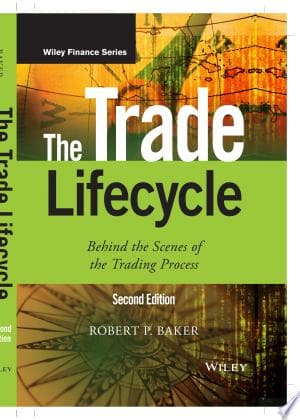
Core Idea
- Difficulty
- Medium
Key Takeaways from The Trade Lifecycle
The Trade Lifecycle as an Organizational Spine
Understanding how a trade's journey connects every department within a financial institution.
Baker's main idea is that the trade lifecycle is not just a back-office function. It is the fundamental link for all operations within a financial firm. From the first sales pitch to the final settlement, each trade stage directly affects and relies on various departments: front office for execution, middle office for risk management, back office for settlement, legal for documentation, IT for infrastructure, and compliance for regulations. This connection means that problems at any point can spread through the whole organization. This shows how important a complete, integrated approach to trade processing is. The book carefully breaks down these links, showing how a small operational issue can have effects across the entire firm.
“Every person working in a bank is highly connected to the lifecycle of a trade. It is the glue by which all departments are bound, and the aggregated success or failure of each trade determines the entire organization's survival.”
In the book: The book's overarching structure and repeated emphasis on the 'glue' metaphor for departmental connection.
Try this: Financial professionals should cultivate a cross-functional understanding of trade processing, moving beyond siloed perspectives to anticipate downstream impacts and foster inter-departmental collaboration. This includes understanding the data flows and handoffs between teams.
Deconstructing Trade Components and Their Risks
Breaking down complex trades into their fundamental parts to identify inherent risks and cashflows.
Baker offers a method for breaking down any trade, no matter how complex, into its basic parts: instrument type, notional amount, tenor, payment schedules, and underlying assets. This detailed breakdown is important because each part creates specific cashflow patterns and risk exposures. For example, an FX exotic trade might involve multiple currencies, complex option features, and non-standard settlement dates. Each element contributes to market, credit, and operational risks. By understanding these parts, firms can accurately model possible profits, losses, and the full range of legal, operational, liquidity, credit, and market risks. This careful analysis is necessary for good risk management and accurate valuation.
“The Trade Lifecycle catalogues and details the various types of trades, including the inherent cashflows and risk exposures of each.”
In the book: The book's detailed analysis of various trade types and their inherent characteristics, like FX exotics and commodity counterparty risk.
Try this: Analysts and risk managers should adopt a modular approach to trade analysis, identifying and isolating each component to assess its individual contribution to overall risk and cashflow profiles. This facilitates more precise risk mitigation strategies.
The Post-Crisis Thrust on Risk Control
How the 2008 financial crisis reshaped the focus on trade processing, settlement, and risk management.
The book stresses that the 2008 global financial crisis was a sharp wake-up call. It greatly raised the importance of strong trade processing, careful settlement, and full risk control. Before the crisis, many firms did not fully grasp the system-wide risks in complex, unclear trades and inefficient post-trade operations. The crisis revealed weaknesses in counterparty risk management, collateralization, and the large number of uncleared derivatives. Because of this, regulators set stricter rules, demanding more transparency, standard processing, and better capital buffers. Baker argues that this change requires a proactive, not reactive, approach to risk. Risk should be part of every stage of the trade lifecycle, not an afterthought. This argument is especially relevant for people entering the field after the crisis.
“Trade processing and settlement combined with control of risk has been thrust into the limelight with the recent near collapse of the global financial market.”
In the book: The book's acknowledgment of the 2008 crisis as a catalyst for renewed focus on trade processing and risk.
Try this: Financial institutions must continuously review and enhance their post-trade infrastructure and risk frameworks, ensuring they meet evolving regulatory standards and address lessons learned from past crises. This involves investing in technology and skilled personnel.
The Evolving Role of Information Technology
IT's critical and expanding influence in enabling efficient and compliant trade processing.
A major update in this edition is the increased focus on information technology. This reflects its essential role in modern finance. Baker shows how IT supports every part of the trade lifecycle, from automated trade capture and real-time risk calculations to electronic settlement and regulatory reporting. The large number and complexity of trades, along with the need for speed and accuracy, make manual processes impossible. IT systems help with straight-through processing (STP), reduce operational errors, improve data quality, and provide the analytical tools needed for complex risk management (e.g., Credit Valuation Adjustment, CVA). This deep integration means that IT professionals in finance need to understand trade mechanics, and finance professionals must understand what their technology can and cannot do.
“This comprehensive guide includes major new coverage of... the role of information technology.”
In the book: The explicit mention of 'major new coverage' on IT, indicating its growing importance since the first edition.
Try this: Firms should prioritize strategic IT investments in areas like automation, data analytics, and cloud infrastructure to optimize trade processing, minimize manual intervention, and ensure regulatory compliance. Collaboration between business and IT teams is paramount.
Credit Valuation Adjustment (CVA) in Focus
Understanding the complex measure of counterparty credit risk and its impact on derivatives valuation.
The inclusion of Credit Valuation Adjustment (CVA) as a new topic shows its growing importance in derivatives trading. Baker explains CVA as the market value of counterparty credit risk. It is a deduction from the fair value of a derivative portfolio to account for the chance of a counterparty defaulting. This concept became vital after the crisis as firms realized they needed to price in counterparty risk directly, instead of assuming risk-free transactions. Calculating CVA is very complex, involving probability models, exposure simulations, and credit default swap (CDS) spreads. The book details how CVA affects pricing, capital needs, and risk management plans. It emphasizes that accurate CVA assessment is crucial for both profit and regulatory compliance, especially for global derivatives initiatives.
“This comprehensive guide includes major new coverage of... credit valuation adjustment.”
In the book: Specific mention of 'credit valuation adjustment' as a new coverage area.
Try this: Derivatives traders and risk managers must integrate CVA into their pricing and risk models, understanding its drivers and sensitivities. This requires sophisticated analytical tools and robust data for accurate calculation and management.
The Spectrum of Risks: Beyond Market Risk
A comprehensive view of legal, operational, liquidity, credit, and market risks inherent in trades.
While market risk often gets the most attention, Baker broadens the scope of risk. He argues that a trade faces a much wider range of dangers. Legal risks come from contracts, documentation, and regulatory changes (e.g., global derivatives initiatives). Operational risks result from human error, system failures, or process breakdowns (e.g., equity settlement issues). Liquidity risk concerns the ability to meet cashflow obligations or close positions without major price impact. Credit risk, as discussed with CVA, addresses counterparty default. The book provides a practical way to identify and manage this full range of risks. It uses case studies like commodity counterparty risk to show how these different risks appear and interact throughout the trade lifecycle. This broad risk view is vital for overall firm stability.
“You will become familiar with the full extent of legal, operational, liquidity, credit, and market risks to which it is exposed.”
In the book: The explicit enumeration of 'legal, operational, liquidity, credit, and market risks' as areas of focus.
Try this: Risk management strategies should extend beyond traditional market risk to encompass a multi-dimensional view, integrating assessments of legal, operational, and liquidity exposures into every stage of trade planning and execution. This calls for diversified risk expertise.
Case Studies: Bridging Theory and Practice
Real-world examples illustrate the practical application of trade lifecycle principles and risk management.
A strength of Baker's approach is the inclusion of practical case studies. These examples cover areas such as FX exotics, commodity counterparty risk, equity settlement, bond management, and global derivatives initiatives. They connect theoretical ideas to real-world application. For instance, a case study on equity settlement might detail the complexities of matching, confirmation, and reconciliation across different countries, showing potential operational problems. An example of bond management could illustrate how interest rate changes or credit rating downgrades affect valuation and risk. These real scenarios help readers understand the details of trade processing, identify possible failure points, and see how various risks appear in concrete situations. This practical view is crucial for aspiring and current finance professionals.
“Case studies of real projects cover topics like FX exotics, commodity counterparty risk, equity settlement, bond management, and global derivatives initiatives.”
In the book: The explicit mention of specific case study topics.
Try this: Readers should actively engage with the case studies, analyzing the problems presented and considering alternative solutions. This practice helps develop critical thinking skills necessary for navigating real-world financial challenges and applying theoretical knowledge.
From Preconception to Maturity: Tracking the Trade
Following a trade's journey through its entire lifecycle, from initiation to expiration.
The book carefully maps the entire path of a trade. It starts from its initial idea or client request, through execution, confirmation, settlement, and finally to its maturity or expiration. This chronological approach is key to understanding a trade's dynamic nature and its changing impact. At each stage, new risks appear, different departments get involved, and various data points are generated. For example, a trade started by the front office moves to the middle office for risk validation, then to the back office for settlement instructions, and finally to accounting for P&L recognition. This full tracking mechanism allows for a clear understanding of the sequential dependencies and possible bottlenecks. This is crucial for improving workflows and ensuring compliance across the entire timeline.
“By reading this, you’ll dissect a trade into its component parts, track it from preconception to maturity, and learn how it affects each business function of a financial institution.”
In the book: The stated goal of tracking a trade 'from preconception to maturity.'
Try this: Professionals should develop a 'lifecycle mindset,' understanding the sequential steps and interdependencies of every trade they encounter. This helps in anticipating future requirements, managing expectations, and identifying potential issues before they escalate.
Profit and Risk: The Inseparable Twins
Understanding that every trade's potential for profit is inherently tied to its associated risks.
Baker consistently reinforces the idea that profit and risk are two sides of the same coin in finance. They are inseparable and must be managed at the same time. No trade makes a profit without taking on some risk, and managing risk well is essential for lasting profitability. The book argues against a purely revenue-driven approach. It favors a balanced perspective where potential rewards are always weighed against the risks. This involves not just identifying risks but also quantifying them, hedging when needed, and understanding the capital effects. This balanced view is critical for sound financial decisions and aligns with post-crisis regulatory focus on careful risk management as necessary for creating shareholder value. The book's subtitle, focusing on both 'profit' and 'risk,' is telling.
“Drive profit and manage risk with expert guidance on trade processing... This book provides thorough, practical guidance toward processing the trade, and the risks and rewards it entails.”
In the book: The book's explicit goal to 'drive profit and manage risk' and its mention of 'risks and rewards.'
Try this: Decision-makers should always evaluate trades through a risk-adjusted return lens, ensuring that expected profits adequately compensate for the level of risk undertaken. This means integrating risk metrics into all performance evaluations and strategic planning.
The Foundational Nature of Trade Processing
Trade processing as a core, fundamental aspect of finance for all professionals.
Baker consistently presents trade processing as a fundamental aspect of finance, not a niche specialty. This is a crucial point for anyone working or hoping to work in the financial industry. No matter one's specific role—be it sales, trading, risk, compliance, IT, or operations—a strong understanding of how trades are executed, confirmed, settled, and managed is essential. The book's comprehensive nature, covering everything from product types to regulatory impacts, highlights this basic importance. It suggests that mastering the trade lifecycle provides a complete view of a financial firm's operations, risks, and regulatory environment. This makes it a critical knowledge base for career advancement and effective contribution within the sector. This argument is especially valuable for new entrants to finance.
“This book provides thorough, practical guidance toward processing the trade... to help you build a strong background in this fundamental aspect of finance.”
In the book: The repeated use of 'fundamental aspect of finance' and the book's comprehensive scope.
Try this: All finance professionals, regardless of their specific department, should prioritize building a solid understanding of the trade lifecycle. This foundational knowledge enhances communication, problem-solving, and strategic thinking across the organization.
Quiz
10 questions on the main ideas. Each answer comes with a short explanation.
Question 1
What is the primary focus of "The Trade Lifecycle" by Robert P. Baker?
- Algorithmic trading strategies
- The complete process of a trade from initiation to maturity and its associated risks
- Stock market prediction models
- International monetary policy
Show answer
B. The complete process of a trade from initiation to maturity and its associated risks The book details the various types of trades, their cashflows, risk exposures, and how they are tracked from preconception to maturity, affecting business functions within a financial institution.
Question 2
Which of the following is NOT mentioned as a type of risk a trade can be exposed to, according to the book description?
- Legal risk
- Operational risk
- Reputational risk
- Market risk
Show answer
C. Reputational risk The description explicitly mentions legal, operational, liquidity, credit, and market risks. Reputational risk is not listed.
Question 3
The second edition of "The Trade Lifecycle" includes major new coverage of which of the following?
- Cryptocurrency trading and blockchain technology
- Traded products, credit valuation adjustment, regulation, and IT
- Mergers and acquisitions in the financial sector
- Behavioral finance and investor psychology
Show answer
B. Traded products, credit valuation adjustment, regulation, and IT The book's description states that the second edition includes major new coverage of traded products, credit valuation adjustment, regulation, and the role of information technology.
Question 4
What is the significance of a trade's lifecycle for a financial institution, as described in the book?
- It is a minor operational detail with little impact on the overall business
- It dictates the success or failure of the entire organization
- It primarily affects the IT department's workload
- It is only relevant for high-frequency trading firms
Show answer
B. It dictates the success or failure of the entire organization The book states that 'the aggregated success or failure of each trade determines the entire organization's survival' and that it is 'the glue by which all departments are bound'.
Question 5
Case studies mentioned in the book cover topics such as:
- The history of central banking and monetary policy
- FX exotics, commodity counterparty risk, and equity settlement
- The development of financial software and algorithms
- Economic forecasting and econometric modeling
Show answer
B. FX exotics, commodity counterparty risk, and equity settlement The description lists FX exotics, commodity counterparty risk, equity settlement, bond management, and global derivatives initiatives as topics covered in the case studies.
Question 6
What role does "The Trade Lifecycle" play in the context of recent financial market events?
- It explains the causes of the global financial crisis in detail
- It provides practical guidance on trade processing and risk control, which has been highlighted by market instability
- It argues that regulation is no longer necessary after the crisis
- It focuses on predicting future market collapses
Show answer
B. It provides practical guidance on trade processing and risk control, which has been highlighted by market instability The book description mentions that 'Trade processing and settlement combined with control of risk has been thrust into the limelight with the recent near collapse of the global financial market' and provides thorough, practical guidance.
Question 7
According to the book, what does dissecting a trade into its component parts allow a reader to understand?
- Only the initial investment required
- The trade's impact on each business function of a financial institution
- The historical price movements of the asset
- The competitor's trading strategies
Show answer
B. The trade's impact on each business function of a financial institution The book states that by dissecting a trade, you will 'learn how it affects each business function of a financial institution.'
Question 8
What additional resources are available to complement the book's content?
- Live trading floor simulations
- A companion website with video training
- Access to a private investor forum
- Personalized financial advice from the author
Show answer
B. A companion website with video training The description mentions that the 'companion website features additional video training on specific topics'.
Question 9
The book aims to provide knowledge to help readers succeed in the market by understanding:
- The psychology of successful traders
- The fundamentals of trade processing and its implications
- Advanced statistical arbitrage techniques
- The history of economic thought
Show answer
B. The fundamentals of trade processing and its implications The final paragraph states, 'The Trade Lifecycle explains the fundamentals of trade processing and gives you the knowledge you need to further your success in the market.'
Question 10
What is implied by the statement that 'Every person working in a bank is highly connected to the lifecycle of a trade'?
- Only the trading and operations departments are involved
- The trade lifecycle is a universal concept relevant across all banking functions
- The concept is only relevant for senior management
- It refers to physical trading locations within a bank
Show answer
B. The trade lifecycle is a universal concept relevant across all banking functions The phrase 'Every person working in a bank is highly connected' and 'It is the glue by which all departments are bound' implies a pervasive relevance of the trade lifecycle across all functions within a financial institution.
The Trade Lifecycle FAQ
What is the trade lifecycle?
The trade lifecycle refers to the entire process a financial trade goes through, from its inception and execution to its settlement and maturity. It encompasses all the steps and activities involved in managing a trade's risks and operational processes.
What are the main topics covered in "The Trade Lifecycle"?
The book details various trade types, their cash flows and risks, and covers new areas like traded products, credit valuation adjustment, regulation, and IT's role. It dissects trades into components, tracks them from start to finish, and explains their impact on different business functions.
Who is the target audience for "The Trade Lifecycle"?
This book is essential for anyone working in a bank or financial institution who is connected to the lifecycle of a trade. It provides fundamental knowledge crucial for success in the market.
What types of risks are discussed in the book?
The book covers the full extent of risks a trade is exposed to, including legal, operational, liquidity, credit, and market risks. It aims to help readers understand and manage these exposures effectively.
Does the book include practical examples?
Yes, "The Trade Lifecycle" features case studies of real projects covering topics such as FX exotics, commodity counterparty risk, equity settlement, bond management, and global derivatives initiatives.
What are the benefits of reading "The Trade Lifecycle"?
By reading this book, you will gain a deep insight into emerging subject areas, understand each step of the trade process, examine individual trade components, and learn how trades affect all aspects of a financial institution.
What is new in the second edition of "The Trade Lifecycle"?
The second edition includes major new coverage of traded products, credit valuation adjustment (CVA), regulation, and the role of information technology in the trade lifecycle.
How does "The Trade Lifecycle" relate to recent financial market events?
The book provides thorough, practical guidance on processing trades, managing risks, and understanding rewards, which is particularly relevant given the near collapse of the global financial market and the increased focus on trade processing and settlement controls.
Are there any online resources available with the book?
Yes, the book comes with a companion website that features additional video training on specific topics to help readers build a strong background in the fundamentals of finance related to trade lifecycles.
Similar books
- Freakonomics: A Rogue Economist Explores the Hidden Side of Everything
Steven D. Levitt
4.0 (709k) average on GoodreadsBusinessThis book uses economic principles to reveal the surprising incentives behind everything from drug dealing and real estate to cheating teachers and the decline of crime.
- Rich Dad, Poor Dad
Robert T. Kiyosaki
4.1 (369k) average on GoodreadsBusinessRobert Kiyosaki explains that financial literacy, owning assets instead of liabilities, and making money work for you are the real ways to build wealth, lessons he learned from his biological 'poor dad' and his best friend's entrepreneurial 'rich dad.'
- Think and Grow Rich
Napoleon Hill
4.2 (218k) average on GoodreadsBusinessLearn the thirteen principles of success from early 20th-century business leaders to achieve financial independence and personal fulfillment.
- Zero to One: Notes on Startups, or How to Build the Future
Peter Thiel
4.2 (189k) average on GoodreadsBusinessTo build the future, Peter Thiel argues, you must embrace the idea that true innovation lies not in small improvements, but in creating something entirely new that avoids competition.
- The 4-Hour Workweek
Timothy Ferriss
3.9 (181k) average on GoodreadsBusinessLearn how to leave the traditional work-life by creating automated income, outsourcing tasks, and taking 'mini-retirements' to live a life of freedom and adventure, all while working only four hours a week.
- intelligent investor
Benjamin Graham
4.2 (153k) average on GoodreadsFinanceBenjamin Graham's 'value investing' guide, updated for modern markets, helps investors navigate financial changes with classic strategies and disciplined long-term thinking.




Enjoyed the summary?
A summary gives you the shape of the book. The book itself has the detail, the examples and the voice.
Find The Trade Lifecycle on AmazonAs an Amazon Associate, BookBrief earns from qualifying purchases. How we're funded