
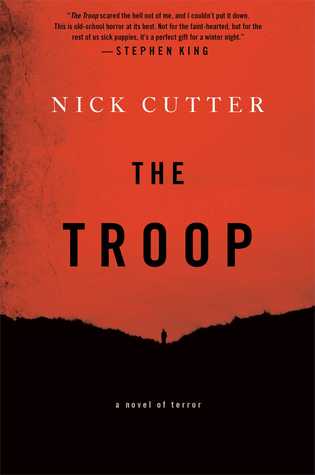
Synopsis
Covers the whole plot, including the ending.
- Difficulty
- Medium
- Pacing
- Fast
- Mood
- Gruesome, Suspenseful, Dark, Disturbing, Claustrophobic
- Read it if
- You enjoy intense, gory body horror and psychological thrillers with a Lord of the Flies vibe.
- Skip it if
- You have a weak stomach for graphic descriptions of bodily decay, parasites, and violence, especially involving children.
The Troop Plot Summary
Covers the whole plot, including the ending.
The Arrival at Falstaff Island
Scoutmaster Tim Riggs leads his five-boy troop (Kent, Max, Ephraim, Shelley, and Newton) to Falstaff Island, a remote, uninhabited island off Prince Edward Island, for their annual three-day camping trip. The boys have different personalities: Kent, the athletic leader; Max, quiet and thoughtful; Ephraim, sensitive and asthmatic; Shelley, the aggressive bully; and Newton, the science-focused introvert. They set up camp, and Tim, a former medical student, checks everything, stressing safety, unaware of the horror that awaits them.
The Intruder
On their first night, a gaunt, skeletal man, shockingly thin and confused, stumbles into their camp. He is clearly ill, suffering from extreme hunger and an unknown sickness. Tim, concerned, tries to help him, offering food and water. However, the man's hunger is unending, and he eats food ravenously, even a live turtle. The boys are disturbed by his look and behavior, especially his unusual sores and his animal-like eating, which suggests something beyond normal illness.
Initial Infection and Quarantine
The stranger, who calls himself Frank, quickly gets worse. His body visibly changes, with grotesque worms coming out of his skin. Tim, seeing how serious and contagious the situation is, tries to quarantine Frank in a tent, using his medical knowledge to understand the threat. The boys are terrified, and the reality of their isolation on Falstaff Island becomes clear. This incident starts their horrifying exposure to the bioengineered parasite, later called 'Trojan'.
Kent's Desperation and First Fatality
Panicked by Frank's worsening condition and the lack of communication, Kent, the strongest boy, tries to hike to the island's highest point for a cell signal. On his way, he finds the stranger's abandoned boat and a cooler with vials of the 'Trojan' pathogen, confirming the man carried a biological weapon. On his way back, he meets a now monstrous Frank, who attacks him. Kent escapes, but Frank later dies, his body bursting with worms, leaving a terrifying mess for the boys to find.
The Spread of the Parasite
Newton, the curious and smart boy, secretly dissects Frank's remains, exposing himself to the parasite. He soon shows symptoms, developing an unending hunger and clear physical decline. The boys, now aware of the contagion, must face the horrifying fact that one of their own is infected. Tim struggles to keep control and protect the uninfected, while the boys' trust in each other begins to break under the immense pressure and fear of the spreading pathogen.
The Search for Answers and Supplies
Realizing their problem, Tim leads the boys to search the island for any way to escape or communicate. They find an old, rundown lighthouse, hoping for a radio. Inside, they find more evidence of Frank's presence and the pathogen's origin, including a scientific journal detailing the 'Trojan' project. This discovery confirms they are dealing with a deliberate biological weapon, not just a random illness, increasing their fear and helplessness.
Shelley's Betrayal and Violence
Shelley, already a bully, gives in to paranoia and fear, believing Newton is a threat and that others might be infected. He becomes increasingly violent and unreasonable, attacking Newton and challenging Tim's authority. His actions break the group apart, turning them against each other. This internal conflict, fueled by the external threat, shows how extreme situations can destroy human morality and cooperation.
Ephraim's Sacrifice
As the situation gets worse, and with Newton's infection progressing fast, Ephraim, the asthmatic and physically weakest boy, makes a sacrifice. He lures the monstrous Newton away from the others, giving them a chance to escape. His selfless act, despite his physical limits, shows courage amid the horror, though it comes at a terrible personal cost.
The Final Confrontation and Escape Attempt
Tim, Kent, and Max are the only uninfected survivors. They face a horrifying fight with the fully transformed Newton and later, Shelley, who is also infected and monstrous. The boys must kill their former friends to survive. With the island now a biological hazard, they desperately try to fix Frank's boat, their only hope of escaping Falstaff Island and the spreading contagion before they too get sick.
The Rescue and Aftermath
Tim and Max, the sole survivors, get Frank's boat working and are rescued by the Coast Guard. They are immediately quarantined and questioned by government agents, who reveal the 'Trojan' parasite is a highly classified bioweapon. The agents cover up the incident, calling it a tragic camping accident. Both Tim and Max are left with severe psychological trauma, haunted by what they saw and the friends they lost, forever changed by their experience on Falstaff Island.
The Troop Characters
Tim Riggs
Protagonist
The dedicated scoutmaster trying to protect his troop.
Tim Riggs is a former medical student and the scoutmaster, a responsible and caring adult who takes his role seriously. He is disciplined, resourceful, and possesses practical medical knowledge. Initially, he believes he can manage any situation, but the arrival of the infected stranger quickly pushes him to his limits. His primary motivation is the safety of the boys, and he grapples with immense guilt and the moral dilemmas presented by the escalating horror.
Relationships: Kent (mentor/mentee, but Kent often challenges his authority); Max (protective mentor figure); Ephraim (caring leader, concerned for Ephraim's well-being); Shelley (authority figure, often clashing with Shelley's rebellious nature); Newton (caring leader, sees Newton's potential)
Kent
Supporting
The athletic, natural leader of the boys.
Kent is the oldest and most physically capable of the scouts, often assuming a leadership role among his peers. He is competitive, brave, and initially resourceful, attempting to find help when the situation deteriorates. However, he also struggles with arrogance and a desire to prove himself, which sometimes leads him to make impulsive decisions. His confidence is slowly chipped away by the escalating horror, revealing his vulnerability.
Relationships: Tim Riggs (respectful but occasionally defiant); Max (close friend); Shelley (rivalry, often clashing with Shelley's bullying); Ephraim (protective older boy); Newton (tolerates him but doesn't fully understand him)
Max
Protagonist
The quiet, observant, and thoughtful scout.
Max is the most introspective and morally grounded of the boys. He is observant, empathetic, and often the voice of reason or caution. While not as physically dominant as Kent or as aggressive as Shelley, Max possesses a quiet strength and resilience. He is deeply affected by the horrors unfolding around him, struggling to reconcile the loss of his friends with the brutal reality of survival. He represents the moral conscience of the group.
Relationships: Tim Riggs (looks up to Tim as a father figure); Kent (close friend); Ephraim (sympathetic and protective); Shelley (dislikes Shelley's bullying); Newton (initially annoyed by Newton, but grows to understand him)
Ephraim
Supporting
The sensitive, asthmatic boy.
Ephraim is physically weaker than the other boys due to his asthma, making him more vulnerable and often the target of Shelley's bullying. He is sensitive, artistic, and prone to fear, but he also possesses an underlying courage. Despite his physical limitations, he demonstrates surprising resilience and ultimately makes a profound sacrifice, highlighting that heroism can come from unexpected places. His struggle with his physical condition adds another layer of vulnerability to the group.
Relationships: Tim Riggs (looks to Tim for protection and guidance); Max (finds comfort in Max's presence); Shelley (victim of Shelley's bullying); Newton (neutral, sometimes annoyed by Newton's eccentricities)
Shelley
Antagonist
The aggressive, bullying scout.
Shelley is the troop's resident bully, characterized by his aggression, cruelty, and tendency to challenge authority. He is impulsive and lacks empathy, often tormenting Ephraim and clashing with Kent. As the situation on the island deteriorates, Shelley's worst traits are amplified by fear and paranoia, turning him into a dangerous and unpredictable threat to his own troop. He represents the breakdown of social order under extreme duress.
Relationships: Tim Riggs (defiant and disrespectful); Kent (rivalry and animosity); Ephraim (bully and tormentor); Newton (antagonistic, dismissive)
Newton
Supporting
The intelligent, science-obsessed introvert.
Newton is the intellectual of the group, fascinated by science and often lost in his own thoughts. He is socially awkward and sometimes oblivious to social cues, making him an easy target for Shelley. His scientific curiosity, while a strength, ultimately leads to his downfall when he can't resist dissecting Frank's infected body. He represents the dangerous allure of forbidden knowledge and the tragic consequences of intellectual hubris.
Relationships: Tim Riggs (respects Tim's knowledge); Shelley (victim of Shelley's bullying); Max (initially an annoyance, later a source of fear)
Frank (The Intruder)
Mentioned
The initial carrier of the bioengineered parasite.
Frank is the emaciated, ravenous man who stumbles into the scout troop's camp. He is the unwitting carrier of the 'Trojan' parasite, a bioengineered weapon. His appearance and rapid deterioration serve as the catalyst for the entire horrifying ordeal. Though he dies early in the narrative, his presence and the information found in his belongings (the cooler with vials, his journal) are crucial to understanding the nature of the threat and its origins.
Dr. Arnie Neudorf
Mentioned
The scientist behind the Trojan parasite.
Dr. Arnie Neudorf is the lead scientist responsible for the creation of the 'Trojan' parasite, a highly classified biological weapon. He is not physically present in the main narrative but is revealed through Frank's journal entries and later through government documents. He represents the ethical dangers of scientific hubris and the potential for devastating consequences when science is weaponized. His meticulous notes provide chilling insight into the parasite's design and intent.
The Troop Themes
The Fragility of Civilization and Social Order
The isolated Falstaff Island, along with the 'Trojan' parasite, quickly removes the veneer of civilization. The boys, at first bound by scout's honor and Tim's authority, fall into paranoia, violence, and self-preservation. Shelley's bullying becomes outright aggression, and even Kent, the natural leader, struggles with moral compromises. This theme is clear when the boys must kill their infected friends, showing how quickly social norms break down under extreme threat.
“What happens when the rules don't apply anymore? When the only thing that matters is staying alive, no matter the cost?”
Loss of Innocence
The book details the psychological impact of the ordeal on the young scouts. What starts as a normal camping trip quickly becomes a nightmarish fight for survival, forcing the boys to face death, make impossible choices, and witness horrors. Max, especially, shows this theme, losing his innocence and leaving the island a deeply traumatized survivor. The boys lose their childhood, replaced by the grim realities of violence and loss, as seen in their forced acts of self-defense against their changed friends.
“They were just boys, but the island had made them something else, something harder and colder.”
The Nature of Fear
Fear is a strong force in 'The Troop,' appearing as both a reasonable response to a deadly threat and a corrupting influence. The fear of infection, isolation, and death drives many characters' actions, both heroic and terrible. It fuels Shelley's paranoia and aggression, turning him against his friends, and it pushes the uninfected boys to make desperate, violent choices. The story explores how fear can strip away humanity, reducing individuals to their most basic instincts, making them as dangerous to each other as the external threat.
“Fear was a virus, too. It spread just as fast, and it consumed just as completely.”
Scientific Hubris and Unintended Consequences
The 'Trojan' parasite is a bioengineered weapon, a result of secret scientific experiments. Dr. Arnie Neudorf's notes detail its design and potential as a bioweapon. This theme highlights the ethical dangers of unchecked scientific ambition and the catastrophic results that can happen when knowledge is used without enough moral oversight. The island becomes a contained experiment gone wrong, showing the destructive potential of such creations when they escape human control.
“They had engineered hunger, perfected it, and set it loose.”
Survival vs. Morality
A main conflict for the characters is the constant tension between their desire to survive and their moral compass. Tim, as the adult, struggles to keep order and protect the boys while dealing with the horrible need for extreme measures. The boys must make decisions that go against their previous moral codes, such as abandoning or even killing their infected friends. This theme explores the hard choices individuals make when their lives are at stake, and how far they will go to ensure their own survival, often at the cost of their humanity.
“There were no good choices left, only less terrible ones.”
Plot Devices & Literary Techniques
Isolated Setting (Falstaff Island)
A remote island trapping the characters with the threat.
Falstaff Island serves as a crucial plot device, creating a sense of inescapable dread and amplifying the horror. Its remoteness ensures that help cannot easily reach the troop, forcing them to confront the escalating threat entirely on their own. This isolation also prevents the contagion from spreading to the mainland, effectively making the island a contained biological horror experiment. The lack of communication and escape routes intensifies the psychological pressure on the characters, highlighting their vulnerability.
The 'Trojan' Parasite
A bioengineered organism designed to consume and replicate.
The 'Trojan' parasite is the central antagonist and the driving force of the plot. It is not merely a disease but a sophisticated bioengineered organism designed to induce insatiable hunger and rapid physical deterioration, transforming its hosts into monstrous, worm-filled entities. Its rapid spread and grotesque symptoms create constant tension and body horror. The parasite's origins as a bioweapon add a layer of scientific horror and political intrigue, making the threat both biological and man-made.
Flashbacks and Interspersed Documents
Non-linear narrative elements providing context and foreshadowing.
The narrative is interspersed with 'evidence' such as government documents, scientific journal entries, and interview transcripts from the aftermath. These non-linear elements serve multiple purposes: they gradually reveal the origin and nature of the 'Trojan' parasite, provide chilling foreshadowing of the horrors to come, and offer a detached, clinical perspective on the unfolding tragedy. This device builds suspense, deepens the mystery, and grounds the fantastical horror in a veneer of scientific realism.
Body Horror
Visceral depictions of physical transformation and decay.
Body horror is a primary plot device, used to create intense visceral disgust and fear. The descriptions of Frank's and later Newton's and Shelley's physical deterioration, the worms emerging from their skin, and their insatiable hunger are meticulously detailed. This device emphasizes the grotesque, unnatural nature of the 'Trojan' parasite and the complete loss of humanity suffered by the infected, making the transformations profoundly disturbing and terrifying for both the characters and the reader.
The Troop Quotes
“The island was a living, breathing thing, and it was hungry.”
“Fear was a virus, and it had found a host in each of them.”
“The rules of civilization were thin, fragile things, easily broken when the right pressure was applied.”
“Sometimes, the most terrifying things were the ones you couldn't see.”
“There was a beast in every man, and on this island, it was being fed.”
“The silence of the island was not peaceful; it was a hungry, waiting silence.”
“Hope was a dangerous thing to hold onto when you were surrounded by despair.”
“The world was a cruel place, and sometimes, it took more than it gave.”
“They were just boys, but the island was making men of them, in the worst possible way.”
“The infection wasn't just physical; it was burrowing into their minds, twisting them.”
“Sometimes, the greatest horror was watching someone you loved change into something monstrous.”
“Survival was a messy business, and it didn't always leave you whole.”
“The ocean, usually a source of comfort, now seemed an impassable, indifferent barrier.”
“In the end, all that mattered was getting off this rock, no matter the cost.”
Quiz
10 questions on the plot and the characters. Each answer comes with a short explanation.
Question 1
What is the name of the scoutmaster who leads the troop on their annual camping trip?
- Frank Miller
- Tim Riggs
- Gary Peterson
- Mark Johnson
Show answer
B. Tim Riggs Tim Riggs is established at the beginning of the book as the scoutmaster leading the annual trip.
Question 2
Where does the troop go for their annual three-day camping trip?
- The American Rockies
- The Canadian wilderness
- The New England forests
- The Appalachian Mountains
Show answer
B. The Canadian wilderness The book explicitly states that Tim Riggs leads the troop into the Canadian wilderness.
Question 3
What is the initial appearance of the unexpected intruder who stumbles upon the campsite?
- Muscular and aggressive
- Shockingly thin, disturbingly pale, and voraciously hungry
- Well-dressed and confused
- Injured but seemingly normal
Show answer
B. Shockingly thin, disturbingly pale, and voraciously hungry The description of the intruder is given early on as 'shockingly thin, disturbingly pale, and voraciously hungry,' hinting at his infected state.
Question 4
What is the primary characteristic of the bioengineered nightmare that infects the intruder?
- It causes rapid cellular regeneration.
- It makes the host incredibly strong but slow.
- It induces extreme hunger and rapid metabolism, leading to emaciation.
- It turns the host's skin green and scaly.
Show answer
C. It induces extreme hunger and rapid metabolism, leading to emaciation. The core symptom of the infection is an insatiable hunger and accelerated metabolism, causing the infected to consume everything and rapidly waste away.
Question 5
Which scout is portrayed as the most pragmatic and ruthless in the face of the escalating horror?
- Max
- Kent
- Ephraim
- Shelly
Show answer
B. Kent Kent quickly becomes the most morally ambiguous and survival-driven character, making difficult and often brutal decisions to ensure his own survival.
Question 6
What is the main theme explored in 'The Troop' regarding human nature under extreme duress?
- The triumph of cooperation and self-sacrifice.
- The fragility of civilization and the descent into primal instincts.
- The importance of faith and spiritual resilience.
- The power of forgiveness and redemption.
Show answer
B. The fragility of civilization and the descent into primal instincts. A central theme of the novel is how quickly societal norms break down and individuals resort to their most basic, often violent, survival instincts when faced with an existential threat.
Question 7
What happens to Max, the scout who initially tries to help the intruder?
- He successfully cures the intruder and escapes.
- He is infected early on by the intruder's vomit and eventually succumbs.
- He manages to isolate himself and survive the entire ordeal.
- He is rescued by military personnel early in the story.
Show answer
B. He is infected early on by the intruder's vomit and eventually succumbs. Max, in an act of kindness, attempts to assist the intruder, leading to his direct exposure and subsequent infection through the intruder's vomit, marking a significant early turning point in the plot.
Question 8
The pathogen is revealed to be a bioweapon developed by what organization?
- A rogue terrorist group
- The US military
- A pharmaceutical company
- A cult of doomsday preppers
Show answer
B. The US military Through the interspersed documents and reports, it's revealed that the pathogen, known as 'Troop B,' was a bio-weapon experiment by the US military that escaped containment.
Question 9
What specific act does Kent commit that most clearly demonstrates his extreme survival instincts and betrayal of the group?
- He steals all the food and hides it from the others.
- He deliberately sabotages the troop's only working radio.
- He lures Shelly into a trap and leaves him to be consumed by the infected Max.
- He sets fire to their only shelter to create a diversion.
Show answer
C. He lures Shelly into a trap and leaves him to be consumed by the infected Max. In a particularly gruesome and chilling act, Kent manipulates Shelly into a situation where he is attacked and consumed by the infected Max, ensuring Kent's own escape and demonstrating his ruthless self-preservation.
Question 10
What is the ultimate fate of the infected scoutmaster, Tim Riggs?
- He is rescued and successfully treated for the infection.
- He manages to contain the infection and sacrifices himself to save the last scout.
- He becomes a grotesque, emaciated creature, eventually trapped and consumed by the other infected.
- He transforms into a highly intelligent, predatory version of the infected.
Show answer
C. He becomes a grotesque, emaciated creature, eventually trapped and consumed by the other infected. Tim Riggs, after being infected, slowly deteriorates into a horrifyingly emaciated and voracious creature, eventually trapped in a latrine pit and consumed by maggots and other infected organisms, a tragic and drawn-out end.
The Troop FAQ
What is the central premise of 'The Troop'?
'The Troop' follows scoutmaster Tim Riggs and his five-boy troop (Kent, Max, Ephraim, Shelley, and Newton) on a remote Canadian island camping trip. Their annual tradition turns horrific when an emaciated, infected man stumbles into their camp, unleashing a rapidly spreading parasitic organism that forces them into a desperate struggle for survival against the infection and each other.
Who are the main characters in the scout troop and what are their initial personalities?
The troop consists of Kent, the athletic bully; Max, the quiet, observant one; Ephraim, the sensitive, asthmatic boy; Shelley, the intellectual and somewhat detached one; and Newton, the youngest and most innocent. Scoutmaster Tim Riggs is initially presented as a kind, responsible leader, though his past holds secrets.
What is the nature of the biological threat the troop encounters?
The threat is a highly aggressive, rapidly reproducing parasitic organism, later identified as GM-E, a bioengineered creation from the pharmaceutical company Cerberus. It consumes its host from the inside, causing extreme hunger, rapid weight loss, and an insatiable desire to spread itself through bodily fluids or direct contact, often manifesting as worms.
How does the remote setting of Falstaff Island contribute to the horror?
Falstaff Island's isolation is crucial, cutting off the troop from any immediate help or escape. The lack of communication, the harsh wilderness, and the limited resources amplify their desperation and paranoia, making the island itself feel like a character trapping them with the spreading horror.
What is the significance of the initial infected man, Dr. Thurn?
Dr. Thurn is the initial carrier of the GM-E parasite, having escaped from a Cerberus research facility. His appearance at the camp serves as the catalyst for the entire horrifying ordeal, directly exposing Tim and the boys to the infection and setting off the chain of events.
What is the true purpose of Cerberus's GM-E project?
Cerberus developed GM-E as a bioweapon, a highly virulent and adaptable parasite designed for rapid destruction of enemy populations. Its terrifying efficiency and resistance to conventional countermeasures highlight the extreme dangers of unchecked scientific ambition and corporate secrecy.
Are there any clues to Tim Riggs's past before the reveal of his military background?
Subtle hints include Tim's unusual calm under pressure and his quick, decisive actions, which go beyond typical scoutmaster training. His knowledge of survival tactics and his ability to maintain a semblance of control in chaos suggest a history of dealing with extreme situations, foreshadowing his special forces past.
How does the novel use the 'Troop' structure to explore themes of leadership and peer pressure?
The troop structure initially provides comfort but quickly devolves, showing how leadership fails under extreme stress and how peer dynamics shift. Kent's bullying intensifies, while Max's quiet observations become crucial, demonstrating how group hierarchies can collapse and reform in a crisis.
What psychological impact does the infection have on the boys beyond physical symptoms?
The infection profoundly amplifies paranoia, fear, and hostility among the boys, stripping away their humanity. Their desperate hunger and the knowledge of the spreading parasite lead them to turn on each other, breaking down trust and moral boundaries, and revealing their darkest instincts.
How does the character of Ephraim embody the psychological toll of the horror?
Ephraim, already sensitive and asthmatic, quickly succumbs to fear and the physical symptoms of the infection. His deteriorating mental state, hallucinations, and eventual desperate acts highlight the psychological fragility of youth confronting an unimaginable terror, leading to his tragic demise.
What role does Shelley's intellectualism play in his survival, or lack thereof?
Shelley's intelligence initially allows him to deduce the nature of the threat and strategize, but it also isolates him from the others. His logical, detached approach prevents him from forming crucial bonds and ultimately makes him a target, as his perceived weakness and others' paranoia lead to his demise.
How does the ending of 'The Troop' challenge traditional notions of survival and heroism?
The ending subverts heroic tropes by presenting a bleak, ambiguous resolution where survival comes at an immense moral cost. The government's brutal containment, the boys' ultimate fates, and the lingering threat of the parasite suggest that even 'survival' can be a form of damnation, with no true heroes.
What is the broader commentary on humanity's relationship with nature in the book?
The book suggests that nature, while beautiful, is indifferent and unforgiving, acting as a neutral backdrop for human horrors. It also implies that humanity's attempts to control or weaponize nature (like GM-E) inevitably backfire, unleashing forces beyond our control and exposing our own savagery.
Is there a definitive 'villain' in 'The Troop', or is the horror more systemic?
While the GM-E parasite is the immediate threat, the true 'villain' is arguably systemic: the unethical science of Cerberus and the government's ruthless containment protocols. The boys themselves become villains to each other under duress, suggesting that human nature is as terrifying as any biological horror.
How does the novel use the interspersed 'aftermath' reports to enhance the horror?
The reports, interviews, and scientific documents provide a chilling, clinical perspective on the horror, confirming the scale of the disaster and the government's ruthless response. They create a sense of dread and inevitability, revealing the tragic fates of the characters and the broader implications long before the narrative reaches those points.
What is the significance of the character Newton and his ultimate fate?
Newton, the youngest and most innocent, represents the vulnerability of childhood in the face of unspeakable horror. His slow, painful descent into infection and his eventual, horrific transformation highlight the loss of innocence and the indiscriminate cruelty of the parasite, making his fate particularly tragic.
How does the dynamic between Kent and Max evolve throughout the story?
Kent, initially the aggressive bully, becomes increasingly savage and desperate as the infection spreads, driven by a primal need for dominance. Max, initially quiet and observant, gradually asserts himself through resourcefulness and a grim determination, often clashing with Kent as their survival instincts diverge.
What specific details hint at the government's involvement and cover-up early on?
The swift and absolute quarantine of the island, the immediate deployment of specialized military units, and the highly classified nature of the operation all point to a deliberate government cover-up. The lack of public knowledge about the incident despite its severity also suggests a powerful entity at work.
About the author

Nick Cutter is a Canadian author known for his work in the horror and thriller genres. His notable book, The Troop, explores themes of survival and human nature in a terrifying scenario. Cutter's writing often blends elements of suspense and psychological depth.
Similar books
- The Ruins
Scott Smith
3.6 (32k) average on GoodreadsThrillerFeatures a group isolated in a remote location facing a biological, sentient threat.
- Lord of the Flies
William Golding
3.7 (2.3M) average on GoodreadsYoung AdultExplores the breakdown of civilization and morality among a group of stranded boys.
- Angels & Demons
Dan Brown
3.9 (2.7M) average on GoodreadsThrillerA Harvard symbologist races through Rome's ancient sites, deciphering cryptic clues to unmask the Illuminati and stop a vengeful plot to destroy the Vatican with a stolen antimatter weapon.
- Gone Girl
Gillian Flynn
4.1 (2.3M) average on GoodreadsThrillerA wife's sudden disappearance on her fifth anniversary reveals a web of lies and psychological warfare, exposing the secrets within a seemingly perfect marriage.
- The Girl on the Train
Paula Hawkins
3.9 (2.1M) average on GoodreadsThrillerA woman’s fascination with a seemingly perfect couple she watches from her daily train commute leads her into a dark investigation when she witnesses something that shatters their idyllic image.
- The Da Vinci Code
Dan Brown
3.9 (1.9M) average on GoodreadsThrillerA symbologist and a cryptologist race through European landmarks, deciphering ancient codes and uncovering a conspiracy that could rewrite the foundations of Christianity.





Enjoyed the summary?
A summary gives you the shape of the book. The book itself has the detail, the examples and the voice.
Find The Troop on AmazonAs an Amazon Associate, BookBrief earns from qualifying purchases. How we're funded