
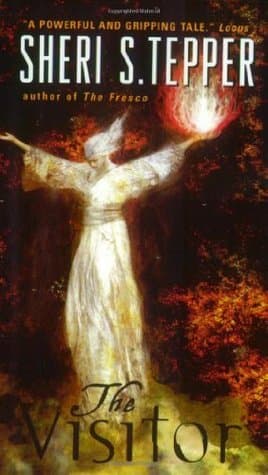
Synopsis
Covers the whole plot, including the ending.
- Difficulty
- Medium
- Pacing
- Moderate
- Mood
- Thought-provoking, Hopeful, Dark, Philosophical, Transformative
- Read it if
- You enjoy post-apocalyptic stories with a strong ecological message, philosophical depth, and a hopeful, transformative journey led by a determined female protagonist.
- Skip it if
- You prefer fast-paced action over introspective world-building and social commentary, or are averse to themes of environmental decay and societal oppression.
The Visitor Plot Summary
Covers the whole plot, including the ending.
Dismé's Forbidden Discovery
Dismé Latimer lives a hard life in the village of Haven, under the Paters' harsh rule. She spends her days doing chores, caring for her sick mother, and putting up with her father, Pater Latimer, a high-ranking official. One day, while cleaning an old chest, Dismé finds a hidden, ancient book – a science text by her ancestor, Dr. Eva Latimer, from 'Before' times. This book, full of strange symbols and new ideas about nature, goes against the Paters' rules, which forbid all knowledge of the 'Old World.' Dismé, though scared of the consequences, is drawn to its forbidden wisdom, feeling it holds answers to the world's mysteries and her own unhappiness.
Escape from Haven
Dismé's father, Pater Latimer, discovers her secret reading. Furious at her defiance and the book's 'blasphemous' nature, he severely beats her. This violence, along with her mother's quiet acceptance of it, strengthens Dismé's resolve. She realizes she cannot stay in Haven under her father's control and the Paters' strict rules. Gathering a few things, including the precious book, she decides to leave her home. Under cover of darkness, she sneaks away from the village, going into the unknown and dangerous 'Wasted World' beyond Haven's walls, a place rumored to have monsters and evil.
Encounters in the Wasted World
As Dismé travels through the Wasted World, she quickly sees that the Paters' warnings, though exaggerated, have some truth. She meets strange, mutated creatures and the ruins of a past civilization. She crosses paths with 'Weavers,' nomadic people with their own knowledge and traditions, mostly free from Pater rule. Among them, she befriends Tork, a young man interested in her book and her unusual knowledge. Through these meetings, Dismé starts to build a clearer picture of the world, learning about the 'Visitor' – the asteroid that caused the Cataclysm – and the different groups struggling to survive afterward.
The Whispering Forest and the Old Woman
Dismé, often with Tork, goes through the Whispering Forest, a place of both strange beauty and hidden dangers. The forest seems alive, with unusual plants and animals that challenge her understanding of nature. Here, they meet an old, solitary woman known only as the Old Woman, who lives deep in the woods. The Old Woman, with her own ancient wisdom and a deep connection to the land, sees something special in Dismé. She gives cryptic advice and warnings about the 'Visitor' and upcoming changes, hinting at a deeper threat stirring beneath the Earth. Her words confirm Dismé's growing belief that her book holds important clues.
The City of the Paters and the Unveiling of Lies
Dismé and Tork eventually reach a major city controlled by the Paters. Here, Dismé sees firsthand the full extent of their power and the deliberate ignorance they impose. She observes how the Paters use fear, superstition, and selective readings of 'ancient texts' to keep their authority, suppressing scientific knowledge and any opposing ideas. The city is a sharp contrast to the Wasted World, a place of strict order built on lies. Dismé's book, with its clear scientific explanations, directly contradicts the Paters' beliefs, making her an even bigger threat if her true purpose is found out. She and Tork must navigate this dangerous place carefully, gathering information about the Paters' real intentions.
The Awakening Beast
Throughout Dismé's journey, subtle but increasingly alarming signs appear that something vast and ancient is stirring beneath the Earth. Earthquakes happen more often, strange geological events occur, and nature itself seems uneasy. The Old Woman had spoken of a 'beast' sleeping deep below. Dismé's book, full of science, offers a different, more frightening explanation: a huge, dormant organism, perhaps from the Visitor's impact or an ancient life form, is beginning to wake. This awakening is an existential threat, not just to the Paters' rule, but to all life on the planet. The urgency of Dismé's quest to understand and possibly lessen this danger grows.
Confrontation with Pater Authority
Dismé's growing understanding of her ancestor's book, along with her presence in Pater-controlled areas, leads to a direct conflict with the Pater leaders. Her 'heretical' knowledge and the existence of Dr. Eva Latimer's text are seen as a major challenge to their power. She is captured and questioned by high-ranking Paters, who try to discredit her and take the book. During this intense time, Dismé shows remarkable courage and intelligence, defending the scientific truths in her book against the Paters' superstitious beliefs. This confrontation is a key moment, forcing Dismé to fully accept her role as a truth-teller and challenging the basis of the Paters' oppressive rule.
The Nature of the Visitor Revealed
Through careful study of Dr. Eva Latimer's book and her own observations, Dismé finally understands the true nature of the 'Visitor' and its devastating impact. It was not just a simple asteroid; it carried a unique, powerful life form or a dormant biological entity that, upon impact, merged with Earth's geology, becoming the 'beast' that now stirs. The book reveals that this entity is not evil but a massive, complex organism now reactivating, threatening to reshape the planet in a way that could be ruinous for human life. This revelation changes the 'beast' from a mythical monster into a scientific problem, needing understanding rather than just fear.
Uniting the Factions
Realizing the scale of the coming global disaster, Dismé understands that no single group can survive alone. She tries to bridge the large ideological gaps between the Paters, the Weavers, and other independent groups she has met. This is a huge task, as centuries of suspicion, dogma, and power struggles have created deep divisions. Dismé, armed with the clear scientific evidence from her book and the growing signs of the beast's awakening, tries to convince them that their survival depends on cooperation and shared knowledge. She stresses that the 'Visitor' threat goes beyond their small disputes and requires a united, scientific approach.
The Plan for Survival
Using the advanced scientific principles detailed in Dr. Eva Latimer's book, Dismé creates a daring and complex plan to reduce the catastrophic effects of the 'beast's' full awakening. The plan involves understanding the entity's biological functions and finding a way to either calm it, redirect its energy, or guide its transformation in a way less destructive to the surface world. This needs precise knowledge of geology, biology, and the Visitor's unique properties. It is a plan that demands huge resources, cooperation from all groups, and a deep leap of faith from a population steeped in superstition. Dismé becomes the reluctant leader of this desperate effort.
The Grand Experiment
With a fragile alliance formed and the beast's stirrings becoming more violent and widespread, Dismé and her diverse allies, including former Paters, Weavers, and others, begin the dangerous execution of her plan. This involves activating old 'Before' technologies, understanding complex geological processes, and taking difficult, calculated risks. The process is full of danger, setbacks, and moments of despair, as Earth itself seems to resist. Dismé, though often scared, relies on her intelligence, her ancestor's book, and the trust she has carefully built with her companions to guide them through the growing crisis, hoping their efforts are not in vain.
Transformation and a New Beginning
Dismé's plan culminates in a profound change for Earth. While not fully 'tamed,' the 'Visitor' entity's awakening is guided and its most destructive potential avoided, though the landscape changes permanently. This success, even if partial, completely shatters the Paters' authority, as their lies are exposed by undeniable scientific reality. Humanity emerges from the crisis forever changed, with new respect for science and a greater understanding of their place in the universe. Dismé, no longer just a frightened girl, becomes a symbol of truth and hope, leading a fragmented world toward a future built on cooperation, learning, and a deeper connection to their transformed planet.
Principal Figures
Dismé Latimer
Protagonist
A gentle, troubled young woman destined to lead her world out of darkness.
Dismé is initially a timid and abused young woman living under the oppressive thumb of her father and the Paters. She is deeply empathetic and possesses a quiet intelligence, often observing the world around her with a critical eye, even if she doesn't voice her thoughts. Her discovery of her ancestor's book ignites a profound curiosity and a desperate need for truth, pushing her beyond the boundaries of her sheltered, miserable existence. She is driven by a desire for knowledge and a deep-seated sense of justice, which grows as she witnesses the Paters' manipulative control.
Relationships: Pater Latimer (Abusive father); Tork (Trusted companion and ally); Dr. Eva Latimer (Ancestor whose book guides her); Old Woman (Mysterious mentor and guide)
Pater Latimer
Antagonist
Dismé's cruel and oppressive father, a high-ranking official in the ruling Paters.
Pater Latimer embodies the tyranny and patriarchal control of the Paters. He is a harsh, abusive man who rules his household with an iron fist and extends that rigid authority to his official duties. He is deeply entrenched in the Paters' dogma, believing absolutely in their pronouncements and fiercely suppressing any form of dissent or 'heretical' knowledge. His cruelty stems from a combination of ingrained power, fear of change, and a genuine belief in the Paters' right to control. He represents the forces of ignorance and oppression that Dismé must overcome.
Relationships: Dismé Latimer (Abused daughter); Dismé's Mother (Dominant husband)
Tork
Supporting
A curious and loyal Weaver who becomes Dismé's steadfast companion.
Tork is a young man from the nomadic Weaver tribe, characterized by his openness, resourcefulness, and a natural curiosity about the world. Unlike the villagers under Pater rule, Tork is not bound by rigid dogma and is receptive to new ideas. He is fascinated by Dismé's book and her scientific explanations, quickly becoming a believer in her quest. He is brave, skilled in survival, and provides much-needed practical support and emotional companionship to Dismé throughout her arduous journey. He represents the potential for collaboration and independent thought outside the Paters' control.
Relationships: Dismé Latimer (Trusted companion and ally)
Dr. Eva Latimer
Mentioned
Dismé's scientist ancestor, author of the forbidden book.
Dr. Eva Latimer is not a living character but her presence is central to the entire narrative through her scientific journal. She was a brilliant scientist from the 'Before' time, who meticulously documented her research and understanding of the 'Visitor' and its potential long-term effects. Her book is a testament to scientific inquiry, foresight, and courage, as she clearly anticipated the dangers and tried to leave a legacy of knowledge for future generations. Her work provides the foundation for Dismé's understanding and her plan for humanity's survival.
Relationships: Dismé Latimer (Ancestor whose scientific work guides her descendant)
The Old Woman
Supporting
A reclusive elder with ancient wisdom, living in the Whispering Forest.
The Old Woman is a mysterious and enigmatic figure who lives in harmony with nature, possessing a deep, intuitive understanding of the Wasted World. She represents an older, perhaps pre-Pater, form of wisdom, one rooted in observation and a connection to the natural cycles of the Earth. While her language is often metaphorical and cryptic, she offers crucial guidance and warnings to Dismé, sensing the profound significance of her quest and the stirring of the 'beast.' She acts as a spiritual and philosophical mentor, bridging the gap between ancient lore and emerging scientific truth.
Relationships: Dismé Latimer (Mentor and guide)
The Paters
Antagonist
The oppressive ruling order that controls society through superstition and ignorance.
The Paters are the hierarchical, authoritarian religious and political power structure that governs most of the known world after the Cataclysm. They maintain control by suppressing scientific knowledge, promoting superstition, and enforcing rigid dogma about the 'Old World' and the 'Visitor.' They exploit fear and ignorance to keep the populace subservient, believing their interpretation of history and morality is the only truth. They are resistant to change and view any challenge to their authority as heresy, making them the primary institutional antagonists against Dismé's quest for truth.
Relationships: Dismé Latimer (Oppressors of her and her quest); Pater Latimer (High-ranking member)
The Weavers
Supporting
Nomadic, independent tribes living outside Pater control.
The Weavers are a diverse group of nomadic people who have developed their own distinct culture, traditions, and survival methods in the Wasted World. They are less bound by the Paters' dogma and possess a more adaptable, pragmatic worldview. They are often wary of outsiders but are also curious and open to new ideas, especially when faced with undeniable evidence. They represent resilience, self-sufficiency, and the potential for alternative ways of life outside the dominant oppressive system. Their practical skills and knowledge of the land prove invaluable to Dismé's mission.
Relationships: Tork (Member of their tribe); Dismé Latimer (Initial wary interactions, later allies)
The Visitor/The Beast
Antagonist
The sentient, subterranean entity that threatens to reshape the planet.
The 'Visitor' refers to the asteroid that crashed into Earth centuries ago, but also, more importantly, to the gargantuan, dormant biological entity it carried or created upon impact. This 'beast' is not sentient in a human sense, but a massive, complex, and ancient organism integrated into the planet's geology. Its awakening is a natural, yet catastrophic, process that threatens to unleash immense geological and environmental upheaval, making it an existential threat to humanity. It represents the ultimate force of nature, indifferent to human concerns, and requiring scientific understanding rather than simple brute force to address.
Relationships: Dismé Latimer (The focus of her scientific efforts to understand and manage)
Themes & Insights
The Power of Knowledge and Truth
The main theme is the liberating power of scientific knowledge and truth against ignorance and superstition. Dismé's journey starts with the forbidden book, a source of scientific facts that directly contradict the Paters' beliefs. The book, and the truths it reveals about the 'Visitor' and nature, empower Dismé to challenge oppressive authority and ultimately guide humanity to a solution for an existential threat. The Paters' power falls as their lies are exposed by clear scientific reality, showing that truth, no matter how inconvenient or scary, is vital for survival and progress.
“What they call 'magic' is only science they do not understand, or science they forbid you to understand.”
Oppression and Liberation
This theme looks at how oppressive regimes work and the fight for individual and group freedom. The Paters represent a totalitarian system that controls all life through fear, violence, and suppressing information. Dismé's personal freedom begins with her escape from her abusive father and Haven village, a small example of the larger oppressive society. Her quest then helps bring about collective freedom, as she encourages others to question authority and unite against a common threat. The story shows how freedom from oppression is linked to having access to knowledge and the courage to challenge existing power structures.
“They teach us to fear the world, so we will never leave the cage they built for us.”
Humanity's Relationship with Nature
The novel deeply examines humanity's complex and often difficult relationship with the natural world, especially after an ecological disaster. The 'Visitor' is a powerful, indifferent force of nature that humanity must learn to understand and live with, rather than just fear or try to control. The Paters ignore or demonize nature, while the Weavers have a more integrated, though superstitious, understanding. Dismé's scientific approach, informed by Dr. Eva Latimer's book, seeks balance – to understand nature's processes and adapt human life, rather than forcing human will upon it. This theme highlights respect for the planet's power and the need for ecological awareness for survival.
“The Earth is not a tame beast, nor is it a malevolent one. It simply is, and we must learn its ways if we are to remain upon it.”
The Legacy of the Past
The story explores how the past, both its successes and failures, shapes the present and future. The 'Before' world, with its advanced science and eventual collapse, serves as a warning and a source of possible salvation. Dr. Eva Latimer's book is a direct legacy from the past, providing crucial knowledge that was lost and then rediscovered. The fragmented memories and superstitions around the Cataclysm show how history can be twisted and manipulated. The novel argues that understanding and learning from the past, especially its scientific achievements, is vital for humanity's survival and progress, rather than being stuck by its mistakes or romanticizing a lost era.
“The past is not dead; it waits for us to remember, to learn, to build anew.”
Plot Devices & Literary Techniques
The Forbidden Book
Dr. Eva Latimer's scientific journal, a catalyst for discovery and rebellion.
The forbidden book, written by Dismé's ancestor, Dr. Eva Latimer, is the primary plot device. It serves as the inciting incident, sparking Dismé's quest for truth. It functions as a literal guide, providing scientific explanations for the 'Wasted World,' the 'Visitor,' and the underlying mechanisms of the planet that contradict the Paters' teachings. The book's very existence is an act of defiance, and its contents provide the knowledge necessary to understand and ultimately address the global threat, driving the narrative forward and facilitating Dismé's transformation.
The Wasted World
The post-apocalyptic landscape scarred by the 'Visitor' and teeming with dangers.
The Wasted World is more than just a setting; it's a dynamic plot device that constantly challenges Dismé and reveals the true extent of the Cataclysm. Its dangers (mutated creatures, harsh environments) force Dismé to grow and adapt, while its remnants of 'Before' civilization provide clues to the past. It contrasts sharply with the Paters' controlled cities, highlighting the wild, untamed nature of reality outside their dogma. The Wasted World forces Dismé to apply the scientific principles from her book, making the abstract knowledge tangible and immediately relevant for survival.
The 'Visitor' / The 'Beast'
A massive, dormant biological entity from an asteroid, now awakening to reshape the planet.
The 'Visitor,' initially presented as a mythical disaster and later revealed as a massive, subterranean biological entity, serves as the ultimate antagonist and the central driving force of the plot. Its slow awakening provides escalating tension and a clear deadline for Dismé's mission. It represents a scientific problem of global scale, forcing humanity to unite and move beyond superstition. Its transformation of the planet is the ultimate stakes of the story, making the abstract threat concrete and pushing characters to their limits.
The Visitor Quotes
“The wind was cold, and the sky a bleak, uncompromising gray.”
“There are some things you cannot unsee, and some things you cannot unhear. They become part of you, like an extra limb, or a missing one.”
“Magic is not a force, it is a language. And like any language, it can be learned, and misused.”
“The greatest prison is a mind that refuses to open itself to new possibilities.”
“Sometimes the only way to find your way home is to get utterly, hopelessly lost first.”
“Fear is a tool. It can be used to control, or it can be used to protect. The choice is yours.”
“The past is a stubborn ghost, always lingering, always whispering.”
“Even the smallest act of kindness can ripple outwards, changing things in ways you can never predict.”
“Truth is rarely simple, and never convenient.”
“The world doesn't care about your intentions; it only cares about your actions.”
“To truly see, you must first stop looking through the lens of what you expect to find.”
“Silence can be a weapon, or a shield, depending on who wields it.”
“Every ending is just a new beginning, if you're brave enough to step into it.”
“The greatest monsters are not found in shadows, but in the hearts of men.”
Quiz
10 questions on the plot and the characters. Each answer comes with a short explanation.
Question 1
What cataclysmic event is said to have caused the 'magic' of America to die and most of the Earth's inhabitants to perish?
- A global war
- A devastating plague
- An asteroid crash
- Climate change
Show answer
C. An asteroid crash The book description explicitly states that an asteroid crashing into the planet caused the 'magic' to die and most of the population to perish.
Question 2
Who is the protagonist chosen by destiny to lead the wasted world?
- Sheri S. Tepper
- Dismé Latimer
- A courageous scientist ancestor
- The Visitor
Show answer
B. Dismé Latimer The synopsis clearly names Dismé Latimer as the young woman chosen by destiny.
Question 3
What specific item compels Dismé Latimer to abandon her abusive home and seek truth?
- A map of the old world
- A sacred, unsettling book
- A message from a visitor
- A prophetic dream
Show answer
B. A sacred, unsettling book Dismé is compelled by 'a book. Written by a courageous scientist ancestor, it is a sacred, unsettling tome'.
Question 4
What is the primary characteristic of the ruling order in the post-cataclysmic world?
- Benevolent and guiding
- Democratic and fair
- Repressive and tyrannical
- Chaotic and disorganized
Show answer
C. Repressive and tyrannical The populace 'suffers greatly under the tyranny of a repressive ruling order,' indicating its primary characteristic.
Question 5
What type of individual is described as the author of the 'sacred, unsettling tome' that influences Dismé?
- A wise elder
- A courageous scientist ancestor
- A religious prophet
- A tyrannical ruler
Show answer
B. A courageous scientist ancestor The book is described as 'Written by a courageous scientist ancestor,' making this the correct answer.
Question 6
What is the general state of knowledge about the time before the cataclysm?
- Well-preserved and accurate
- Completely forgotten
- Fragmented memories distorted by superstition
- Only accessible to the ruling class
Show answer
C. Fragmented memories distorted by superstition The description states, 'all that remains of the time before are fragmented memories distorted by superstition.'
Question 7
What specific danger is mentioned as stirring in the depths of the Earth?
- A new plague
- A gargantuan beast
- Ancient robots
- Volcanic eruptions
Show answer
B. A gargantuan beast The text warns, 'And in the depths of the Earth, a gargantuan beast asleep for centuries has begun to stir.'
Question 8
How does 'common wisdom' and lore characterize the world outside Dismé's home?
- A place of peace and prosperity
- Full of opportunities for advancement
- Rife with grave dangers and malevolence beyond imagining
- An empty, desolate wasteland
Show answer
C. Rife with grave dangers and malevolence beyond imagining The synopsis explicitly states, 'common 'wisdom' and lore warn of grave dangers out in the world. Evil is there, a malevolence beyond imagining.'
Question 9
What is the overarching theme or goal that compels Dismé Latimer's journey?
- To escape the beast stirring beneath the Earth
- To find truth and her true self
- To overthrow the tyrannical ruling order directly
- To spread the 'magic' that once was America
Show answer
B. To find truth and her true self Dismé is compelled by 'an impossible hope that compels a gentle, troubled young woman to abandon her abusive home in search of truth and her true self.'
Question 10
The 'magic' of America is described as having 'died horribly.' What does this imply about the pre-cataclysmic world in contrast to the current one?
- It was a world without any form of technology or science.
- It possessed a vibrant, perhaps supernatural, essence that is now lost.
- It was a primitive society based solely on superstition.
- It was a world where only evil existed.
Show answer
B. It possessed a vibrant, perhaps supernatural, essence that is now lost. The use of 'magic' implies a previous state of wonder, power, or extraordinary qualities now tragically absent, contrasting with the current 'wasted world' and 'darkness.'
The Visitor FAQ
What is the core premise of 'The Visitor' and what event shaped its world?
'The Visitor' is set hundreds of years after an asteroid impact in the 21st century devastated Earth, destroying most of humanity and what was perceived as 'magic.' The remnants of society live under a tyrannical, repressive ruling order, with fragmented memories of the past distorted into superstition.
Who is Dismé Latimer and what is her initial motivation?
Dismé Latimer is the protagonist, a gentle but troubled young woman chosen by destiny to lead her world out of darkness. She initially seeks to escape her abusive home and find truth, compelled by a sacred book written by her scientist ancestor.
What is the significance of the book Dismé possesses?
The book is a sacred, unsettling tome written by one of Dismé's courageous scientist ancestors. It contains disturbing ideas, revelations, and an 'impossible hope,' challenging the prevailing superstitions and driving Dismé's quest for truth and self-discovery.
What kind of dangers does Dismé face upon leaving her home?
Dismé faces grave dangers beyond imagining, as common 'wisdom' and lore warn of evil and malevolence out in the world. This includes the repressive ruling order's reach and possibly supernatural threats, echoing the distorted memories of the past.
Is there a significant non-human threat mentioned in the synopsis?
Yes, the synopsis mentions a gargantuan beast that has been asleep for centuries in the depths of the Earth and has begun to stir. This creature represents a major, perhaps ancient, malevolent force in the narrative.
How does the 'magic' of the past relate to the scientific understanding presented in Dismé's ancestor's book?
The 'magic' is implied to be the advanced technology and understanding of the pre-asteroid world, which was lost and then reinterpreted as supernatural by the surviving populace. Dismé's ancestor's book likely provides a scientific explanation for these 'magical' phenomena, demystifying them.
What specific elements suggest the ruling order is actively suppressing knowledge?
The ruling order is described as 'tyrannical' and 'repressive,' and the populace's memories are 'fragmented' and 'distorted by superstition.' This suggests the rulers benefit from ignorance and actively maintain the superstitious worldview to control the population, perhaps by destroying or altering historical records.
Could the 'gargantuan beast' be a metaphor, or is it a literal creature?
Given the blend of fantasy and science fiction, the 'gargantuan beast' is likely a literal creature, perhaps a bio-engineered entity or a naturally evolved species from Earth's deep past. However, its awakening could also symbolize the resurgence of ancient evils or forgotten truths.
How might Dismé's ancestor have managed to preserve the book despite the catastrophic events?
Her ancestor, being a 'courageous scientist,' likely anticipated the catastrophe or understood its implications, taking extraordinary measures to protect the book and its knowledge. This could involve deep bunkers, advanced preservation techniques, or passing it down through a hidden lineage.
What psychological impact does living under a 'tyrannical, repressive ruling order' have on the general populace?
The populace likely suffers from widespread fear, paranoia, and learned helplessness, making them susceptible to superstition and resistant to new ideas. This environment would foster a lack of critical thinking and a deep-seated distrust of outsiders or those who question authority.
How does Dismé's abusive home environment prepare or hinder her for her larger quest?
Her abusive home likely fosters a strong desire for escape and independence, hardening her resolve and making the dangers of the outside world seem less daunting than her current reality. However, it might also leave her with psychological scars, trust issues, or a tendency towards self-doubt.
What is the psychological significance of 'fragmented memories distorted by superstition' for the society?
This signifies a collective trauma response where rational understanding of the past is replaced by comforting or fear-inducing narratives. It allows the ruling order to manipulate history, while for individuals, it creates a reality where cause and effect are often attributed to mystical forces rather than scientific principles.
How might the 'impossible hope' mentioned in the book affect Dismé's mental state during her journey?
This 'impossible hope' would serve as a powerful psychological anchor, providing motivation and resilience against despair and overwhelming odds. It could also make her vulnerable to disillusionment if the hope proves too difficult to achieve or is challenged by harsh realities.
Is 'destiny has chosen Dismé Latimer' an indication of actual fate, or is it a narrative device reflecting her unique circumstances?
While it could be literal fate in a fantasy context, it's more likely a narrative device highlighting that Dismé's unique possession of the book and her personal struggles make her the most suitable, if not the only, candidate to initiate change. Her agency in choosing to follow the book's path is key.
What is the author's likely commentary on the relationship between science, technology, and 'magic' in this post-apocalyptic setting?
The author seems to be exploring how advanced science, when lost and misunderstood, can be reinterpreted as 'magic' or dangerous superstition. The narrative likely advocates for the pursuit of knowledge and critical thinking over blind faith, suggesting that true 'magic' lies in understanding the world.
How does the theme of 'truth' vs. 'common wisdom' reflect contemporary societal issues?
This theme directly parallels modern debates about misinformation, fake news, and the rejection of scientific consensus in favor of popular, often unfounded, beliefs. The book seems to critique societies that prioritize comforting lies or convenient narratives over challenging, verifiable truths.
What role might 'self-discovery' play in Dismé's journey beyond simply finding external truths?
Dismé's journey of self-discovery is likely intertwined with her quest for external truth. As she uncovers the realities of her world, she will also shed her past conditioning, overcome personal fears, and understand her own capabilities and purpose, transforming from a 'troubled young woman' into a leader.
Could the 'malevolence beyond imagining' be a human-created evil, rather than purely supernatural?
Yes, given the blend of genres, the 'malevolence' could very well be the legacy of pre-asteroid human actions, such as unchecked scientific experimentation, environmental destruction, or the corrupting influence of power that persists in the ruling order. It might not be a separate entity but a consequence of human failings.
About the author
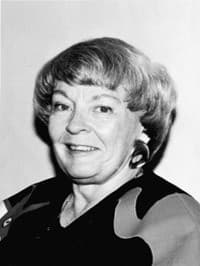
Sheri S. Tepper was an American author known for her contributions to speculative fiction. Her notable works include "Grass," a complex exploration of ecology and society, "The Visitor," which delves into themes of alien contact, "After Long Silence," a reflection on trauma and memory, and "Beauty," a reimagining of classic fairy tales.
Similar books
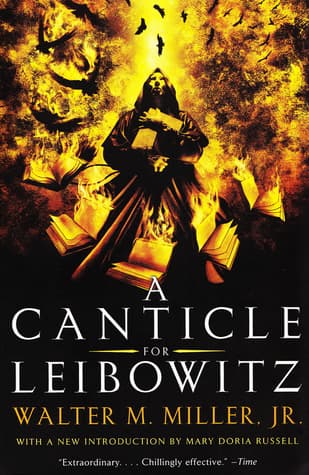
- A Canticle for Leibowitz
Walter M. Miller Jr.
4.0 (93k) average on GoodreadsFantasyDeals with post-apocalyptic societies, the loss and rediscovery of knowledge, and the role of religion and science after a global catastrophe.
- Dune
Frank Herbert
4.2 (766k) average on GoodreadsFantasyFeatures complex ecological systems, societal control through religion and myth, and a protagonist's journey to transform their world.
- The Handmaid's Tale
Margaret Atwood
4.1 (1.5M) average on GoodreadsFantasyWhile both "The Visitor" and "The Handmaid's Tale" explore dystopian societies with rigid social controls and female protagonists challenging the status quo, Tepper's work broadens its critique to include a more explicit ecological dimension. Atwood focuses intensely on patriarchal oppression and reproductive rights within a specific human society, whereas Tepper integrates these themes into a larger narrative of planetary survival and interspecies relationships. Tepper's world-building also tends to be more fantastical and far-reaching in its scientific speculative elements, offering a different kind of allegorical depth.
- Harry Potter and the Sorcerer's Stone
J.K. Rowling
4.5 (7M) average on GoodreadsFantasyRescued from a miserable life under the stairs, an orphaned boy discovers he's a wizard destined for a magical school, where he uncovers a dangerous secret tied to the dark wizard who murdered his parents.
- The Hunger Games
Suzanne Collins
4.3 (6.4M) average on GoodreadsFantasyIn a future where children fight to the death on live television, Katniss Everdeen volunteers for the arena, turning a death sentence into a fight for survival and a spark of rebellion.
- 1984
George Orwell
4.2 (3.1M) average on GoodreadsPoliticsIn a future where surveillance and thought control are absolute, a man's search for truth clashes with the Party, showing that hope can be a form of rebellion.





Enjoyed the summary?
A summary gives you the shape of the book. The book itself has the detail, the examples and the voice.
Find The Visitor on AmazonAs an Amazon Associate, BookBrief earns from qualifying purchases. How we're funded