
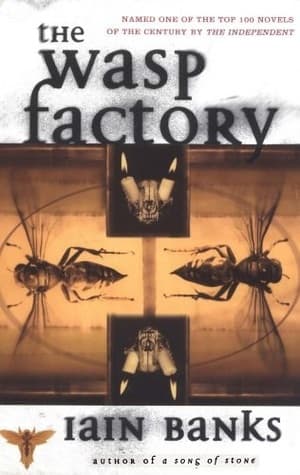
Synopsis
Covers the whole plot, including the ending.
- Difficulty
- Medium
- Pacing
- Moderate
- Mood
- Dark, Disturbing, Psychological, Macabre, Ironic
- Read it if
- You enjoy dark, psychologically disturbing thrillers with unreliable narrators and shocking twists, and are not easily offended by graphic content.
- Skip it if
- You prefer light-hearted stories, are sensitive to animal cruelty or child violence, or dislike morally ambiguous protagonists.
The Wasp Factory Plot Summary
Covers the whole plot, including the ending.
The Island and the Factory
Sixteen-year-old Frank Cauldhame lives with his unusual father, Angus, on a remote Scottish island connected to the mainland by a causeway. Frank describes his childhood, marked by ritualistic killings of small animals and a severe leg injury from a dog attack when he was five. He introduces his main creation, the Wasp Factory, a large clock face where wasps are tortured and killed in various, often elaborate, ways, each method having a symbolic meaning. Frank believes these sacrifices affect his future and keep order in his strange world. He details his routine, his distrust of adults, and his unique view on life and death, setting the tone for his disturbed story.
Eric's Escape and Frank's Preparations
Frank receives phone calls from his older brother, Eric, who has escaped from the mental hospital where he was held. Eric's calls are increasingly strange and unsettling, filled with cryptic statements about 'the heads' and his plan to come home. Frank is both fascinated and cautious about Eric's return. He starts making his own preparations, including getting a stored cache of rockets and building a 'bomb' from a discarded gas cylinder. These actions show Frank's deep need for control and his expectation of a confrontation or a major event, hinting at an underlying tension in his family history.
Childhood Murders Revealed
Frank calmly describes the murders of three children and a dog from his past. He tells how he killed his cousin, Blyth, by pushing him off a pier; his younger brother, Paul, by dropping an adder into his pram; and a local girl, Esmeralda, by trapping her in a disused pipe. He also describes killing his own dog, Old Saul, after it bit him. He gives these confessions with a chilling lack of regret, presenting them as logical, even necessary, actions within his own moral framework. He sees these acts as experiences that shaped him, forming his identity and his understanding of power and consequence.
The Skull and the Sacrifice
Frank finds a sheep's skull and decides to use it in a protective ritual to keep Eric away. He carefully cleans and decorates the skull, then places it in a visible spot, believing its presence will create a powerful ward. This act highlights Frank's reliance on his self-made belief system and his attempts to control his environment through symbolic actions. He is deeply committed to these rituals, seeing them as essential for his safety and sanity in a world he sees as chaotic and threatening, especially with Eric's coming return.
Eric's Philosophical Monologues
Eric's phone calls to Frank become more frequent and intense. He delivers rambling, philosophical talks about 'the truth,' 'the heads,' and the nature of reality, often mixed with violent images. Eric's mental state seems to worsen quickly, and his words are a mix of deep insight and delusional paranoia. Frank listens, trying to understand Eric's fragmented thoughts, which often touch on control, identity, and hidden family truths. These calls increase the tension and hint at a major revelation when Eric finally arrives.
Angus's Eccentricities
Frank details his father Angus's extreme quirks, especially his unusual eating habits. Angus often prepares meals using ingredients far past their expiration dates, explaining it with elaborate, pseudoscientific reasons about 'good bacteria' and 'preserving nature's bounty.' Frank finds these habits both annoying and interesting, a constant source of confusion. Angus's behavior further emphasizes the isolated and unconventional environment Frank grew up in, showing the lack of normal parental guidance and the strange worldview he developed in response to his father's influence. This adds to Frank's own distorted sense of reality.
The Rocket Launch
Frank decides to launch his collection of homemade rockets, an act he sees as both a celebration and a show of his power. He carefully prepares the rockets, each named after one of his childhood victims. The launches are a ritualistic display of his control over his environment and a reassertion of his identity as the 'controller' of his island domain. This event is a moment of release for Frank, allowing him to express his underlying aggression and his desire for dominance, further illustrating his unique psychological state and his way of processing his past actions.
Eric's Arrival and the Confession
Eric finally arrives back on the island, disheveled and deeply disturbed. He finds Frank and, in a highly agitated state, begins to reveal the truth about their family. Eric explains that Frank was born female, and that Angus, wanting a son after Eric's own mental breakdown, secretly raised Frank as a boy after a botched 'sex-change' operation at birth. Angus, fearing Frank would be taken away if his true sex was discovered, gave Frank female hormones to stunt her development, leading to her unusual appearance and lack of menstruation. This confession shatters Frank's entire understanding of himself and his past.
The Wasp Factory's True Purpose
Reeling from Eric's revelation, Frank re-examines her entire life through a new lens. The Wasp Factory, her childhood murders, her obsession with control, and her perceived masculinity all take on new meaning. She realizes that her violent rituals and her attempts to assert dominance were, in part, a desperate attempt to embody the male identity imposed upon her. The Wasp Factory, once a symbol of her power and foresight, now represents the confusion and manipulation that defined her upbringing. The shock of the truth leads to a deep internal crisis, forcing Frank to confront the constructed nature of her identity.
Frank's New Beginning
The revelation of her true sex leaves Frank in a state of deep shock and confusion, but also a strange sense of liberation. She begins to process what it means to be female, recalling fleeting moments from her past that now make sense. The immediate implications of her father's deception are overwhelming, but there is a budding sense of possibility. Frank, now realizing she is 'Frances,' starts to think about a future free from the constraints of her imposed identity and the violent rituals that defined her. The novel ends with Frank looking towards an uncertain, yet potentially more authentic, future, having shed the lies of her past.
The Wasp Factory Characters
Frank Cauldhame
Protagonist
A disturbed and isolated sixteen-year-old living on a remote Scottish island.
Frank is a highly intelligent, yet profoundly disturbed, sixteen-year-old. He lives a solitary life with his eccentric father, Angus, on a remote island. Frank is responsible for the ritualistic killings of animals in his 'Wasp Factory' and has a history of murdering children and a dog, all recounted with chilling detachment. He is obsessed with control, rituals, and maintaining order in his self-created world. Frank perceives himself as male, a perception deeply ingrained by his upbringing, and views his violent acts as logical necessities or powerful rites of passage.
Relationships: Angus Cauldhame (Father and deceiver; their relationship is one of isolation and manipulation.); Eric Cauldhame (Elder brother; a source of both fascination and dread, whose return precipitates the truth.); Jamie (A childhood friend, now a casual acquaintance; Frank uses him for information and company.)
Angus Cauldhame
Supporting/Antagonist
Frank's eccentric and manipulative father, living in self-imposed isolation.
Angus is Frank's highly eccentric and intellectually arrogant father. He lives an unconventional life, characterized by bizarre eating habits, a distrust of modern society, and a deep-seated need for control. He is a former academic, now a recluse, who spends his time building rockets and propounding strange theories. Angus is ultimately revealed to be the architect of Frank's deception, having secretly raised her as a boy and administered hormones to stunt her development, driven by a desire to have a 'normal' son after Eric's breakdown.
Relationships: Frank Cauldhame (Father and deceiver; he raised Frank under a false identity.); Eric Cauldhame (Son; Angus is deeply affected by Eric's mental illness, which fueled his deception of Frank.); Sally (Ex-wife and mother of Frank and Eric; Angus fabricated stories about her abandonment.)
Eric Cauldhame
Supporting
Frank's mentally unstable elder brother, confined to a psychiatric hospital.
Eric is Frank's elder brother, institutionalized in a mental hospital after a series of disturbing incidents, including feeding maggots to children and setting dogs on fire. He is highly intelligent but deeply disturbed, prone to philosophical ramblings and violent outbursts. Eric's escape and his subsequent phone calls to Frank drive much of the plot, as he slowly reveals cryptic clues about their family's past. Despite his instability, Eric is the one who ultimately exposes the truth about Frank's identity, acting as a catalyst for Frank's self-discovery.
Relationships: Frank Cauldhame (Brother; their relationship is complex, marked by a shared, disturbing history and Eric's ultimate role as truth-teller.); Angus Cauldhame (Son; his mental breakdown profoundly affected Angus, leading to his deception of Frank.)
Jamie
Supporting
Frank's only real friend and a source of information.
Jamie is Frank's childhood friend and one of the few people Frank interacts with regularly. He is depicted as a typical, somewhat naive young man who often falls victim to Frank's manipulative tendencies. Jamie is a source of outside information for Frank, providing news from the mainland and serving as a sounding board, albeit an unwitting one, for Frank's peculiar observations. His normalcy highlights Frank's profound deviance and isolation.
Relationships: Frank Cauldhame (Friend; their friendship is one-sided, with Frank often using Jamie for his own purposes.)
Blyth
Mentioned
Frank's cousin, one of her childhood victims.
Blyth was Frank's young cousin, whom Frank murdered by pushing him off a pier. His death is one of the first detailed acts of violence Frank recounts, establishing the chilling nature of Frank's childhood and her lack of empathy. Blyth represents the innocent victims of Frank's early, ritualistic violence, which she views with detached logic.
Relationships: Frank Cauldhame (Cousin and victim.)
Paul
Mentioned
Frank's younger brother, another childhood victim.
Paul was Frank's younger brother, whom Frank murdered as an infant by placing an adder in his pram. This act further solidifies Frank's capacity for cold-blooded violence and her early engagement with death rituals. Paul's death is a key event in Frank's past, contributing to the dark mythology Frank builds around herself.
Relationships: Frank Cauldhame (Younger brother and victim.)
Esmeralda
Mentioned
A local girl, another of Frank's childhood victims.
Esmeralda was a local girl Frank murdered by trapping her in a disused pipe, leaving her to die. Her death is another example of Frank's calculated and cruel acts of violence, demonstrating a pattern of targeting vulnerable children. Esmeralda's story further illustrates the depth of Frank's psychological disturbance and her unique moral compass.
Relationships: Frank Cauldhame (Acquaintance and victim.)
The Wasp Factory Themes
Identity and Self-Deception
The central theme is Frank's constructed male identity and the deep self-deception Angus encouraged. Frank's entire worldview, her violent rituals, and her self-perception are based on a lie. The revelation of her biological sex destroys this fabricated identity, forcing her to confront who she truly is. This theme appears in Frank's internal monologues, where she constantly reinforces her 'maleness' through her actions and thoughts, only for it to be completely dismantled by Eric's confession, as seen when she reinterprets past events with a new, feminine understanding.
“I was a boy, I was a male, I was a man. What could be more obvious?”
Nature vs. Nurture
The novel explores how natural tendencies and environmental upbringing interact. Frank's violent behaviors and unusual moral code are heavily shaped by her isolated childhood and Angus's quirks, as well as hormonal manipulation. The question arises whether Frank's disturbed behavior comes from her unique 'nurture' – the deception and isolation – or if there is an underlying 'nature' at play. The revelation of her sex suggests that much of her 'male' identity and associated aggression was a performance, a result of her father's manipulation, rather than an innate trait. This is clear in her immediate re-evaluation of her past actions.
“What do you think, Frank? Is it nature or nurture, eh? Are we products of our genes or our environment?”
Control and Ritual
Frank's life is controlled by an obsessive need for control, shown through elaborate rituals. The Wasp Factory is the main example, where Frank gives symbolic meaning to different ways of killing wasps, believing these acts can influence her future. Her childhood murders are also presented as ritualistic acts meant to exert power and shape her world. These rituals give Frank a sense of order and agency in an otherwise chaotic and isolated life. This is especially clear in her preparations for Eric's return, where she builds a 'bomb' and uses a sheep's skull for protection, believing these acts will ensure her safety.
“My Wasp Factory, for example, is a place of blood and magic, of decision and death. It is my oracle, my guide, my friend.”
The Corrupting Influence of Isolation
The physical and social isolation of the Cauldhame family on their remote island greatly contributes to their psychological deviance. Cut off from normal society, Frank and Angus develop their own distorted moral codes and realities. This isolation allows Angus's deception to thrive unchecked and prevents Frank from developing a healthy sense of self or understanding of the outside world. The lack of outside influence and the reinforcement of their unusual behaviors within their confined environment directly contribute to Frank's disturbed mindset and Angus's extreme quirks, creating a cycle of abnormality.
“We were cut off, almost literally, from the rest of the world.”
Plot Devices & Literary Techniques
Unreliable Narrator
Frank's perspective is skewed by her delusions and the hidden truth of her identity.
Frank Cauldhame serves as a profoundly unreliable narrator. Her recounting of events, particularly her childhood murders and her perception of her own gender, is presented with a chilling detachment and a distorted moral compass. The reader is led to believe Frank is a male protagonist, only for this foundational assumption to be shattered at the novel's climax. This device creates suspense and forces the reader to constantly question Frank's interpretations and the 'reality' she presents, ultimately leading to a shocking re-evaluation of everything that has been read.
Foreshadowing (Eric's Calls)
Eric's cryptic phone calls hint at the dark family secrets to be revealed.
Eric's increasingly bizarre and philosophical phone calls to Frank serve as significant foreshadowing. His fragmented pronouncements about 'the heads,' 'the truth,' and his own mental state subtly hint at the deep-seated secrets within the Cauldhame family. These calls build tension and create a sense of impending doom and revelation, preparing the reader for a major plot twist without explicitly giving it away. They also establish Eric's role as the catalyst for the truth, even in his disturbed state.
The Wasp Factory
A symbolic structure representing Frank's control, rituals, and internal turmoil.
The Wasp Factory is more than just a physical contraption; it is a powerful symbolic device. It embodies Frank's obsessive need for control, her ritualistic approach to violence, and her unique, disturbed worldview. Each method of killing wasps and the associated 'omens' reflect Frank's attempts to impose meaning and order on her life. After the revelation of her true identity, the Wasp Factory's symbolism shifts, becoming a representation of the manipulation she suffered and the constructed nature of her 'masculine' identity, highlighting the profound impact of her past.
The Island Setting
The isolated island physically manifests the characters' psychological isolation and deviance.
The remote Scottish island setting functions as a crucial plot device, mirroring the psychological isolation of Frank and Angus. Its physical detachment from the mainland allows their eccentricities and Frank's disturbing behaviors to flourish unchecked by societal norms. The causeway, connecting and disconnecting them, symbolizes their tenuous link to conventional reality. This isolation creates a claustrophobic atmosphere, intensifying the focus on the family's internal dynamics and making their actions seem both inevitable and profoundly disturbing within their self-contained world.
The Wasp Factory Quotes
“I was born. I was given a name. I was given a family. I was given a home. I was given a life. I was given a death.”
“The Factory was my own creation, my own private place of judgment and execution.”
“You can never tell what's going on inside someone's head, can you?”
“I've killed three people. All of them children.”
“I was a god. I was a king. I was a killer. I was Frank.”
“The past is never dead. It's not even past.”
“Sometimes you have to break things to fix them.”
“My father always said there were two kinds of people in the world: those who did things and those who talked about doing things.”
“The greatest trick the Devil ever pulled was convincing the world he didn't exist.”
“It's not what you are that counts, but what you think you are.”
“There are no accidents. Only intentions we don't understand.”
“The world is full of people who are trying to make sense of things that don't make sense.”
“I was a girl, then. I was a boy, now. What did it matter?”
“Sometimes the most dangerous things are the ones you can't see.”
Quiz
10 questions on the plot and the characters. Each answer comes with a short explanation.
Question 1
What is the primary purpose of the Wasp Factory for Frank?
- To create new species of wasps for scientific study.
- To predict the future based on the deaths of wasps.
- To perform ritualistic sacrifices and seek answers to his problems.
- To manufacture a unique kind of honey for his father.
Show answer
C. To perform ritualistic sacrifices and seek answers to his problems. Frank uses the Wasp Factory as a means of ritualistic sacrifice, where he places wasps inside and interprets their deaths to find solutions or answers to his personal dilemmas.
Question 2
Which of these animals does Frank NOT kill as part of his 'sacrifices' or rituals?
- A lamb
- A rabbit
- A bird
- A dog
Show answer
A. A lamb Frank recounts killing various animals, including a rabbit, several birds, and a dog, as part of his childhood 'games' or rituals, but there is no mention of him killing a lamb.
Question 3
What is the main reason Frank's elder brother, Eric, is confined to a psychiatric hospital?
- He attempted to burn down the family home.
- He began showing people his brain, among other disturbing acts.
- He developed an extreme phobia of wasps.
- He tried to drown his younger brother, Frank.
Show answer
B. He began showing people his brain, among other disturbing acts. Eric's mental breakdown involved him showing his brain to strangers and other highly erratic and disturbing behaviors, leading to his institutionalization.
Question 4
What is the significant secret Frank's father keeps from him throughout his childhood?
- That he is not Frank's biological father.
- That Frank was actually born a girl.
- That his mother did not abandon them, but died in an accident.
- That he has a secret stash of gold hidden on the island.
Show answer
B. That Frank was actually born a girl. The climactic revelation of the novel is that Frank's father, Angus, surgically altered Frank's sex and raised 'him' as a boy after a childhood accident, due to his own misogynistic views.
Question 5
What object does Frank's father use to measure out his eccentricities, as mentioned in the synopsis?
- A compass
- An imperial scale
- A sundial
- A barometer
Show answer
B. An imperial scale The synopsis states, 'his father measures out his eccentricities on an imperial scale,' highlighting Angus's peculiar and meticulous nature.
Question 6
What is Frank's reaction when he finally learns the truth about his sex?
- He is horrified and immediately tries to flee the island.
- He falls into a deep depression and becomes catatonic.
- He experiences a profound sense of calm and a new understanding of his past actions.
- He murders his father in a fit of rage.
Show answer
C. He experiences a profound sense of calm and a new understanding of his past actions. Upon learning the truth, Frank surprisingly feels a sense of peace and understanding, realizing that many of his past behaviors, particularly his violence, were an unconscious response to his true biological identity.
Question 7
What is the significance of the 'three places' Frank maintains around the island, besides the Wasp Factory?
- They are locations where he buried treasure.
- They mark the graves of people he has killed.
- They are observation posts for monitoring his father.
- They are sites for growing specific herbs for his rituals.
Show answer
B. They mark the graves of people he has killed. These 'three places' are where Frank buried the bodies of the children he murdered in his childhood, a dark secret he meticulously maintains.
Question 8
What does the novel suggest about the nature versus nurture debate through Frank's character arc?
- That one's environment is solely responsible for shaping personality.
- That biological predispositions are entirely unchangeable.
- That an unnatural upbringing can profoundly distort one's inherent identity and behavior.
- That society's influence is negligible compared to individual will.
Show answer
C. That an unnatural upbringing can profoundly distort one's inherent identity and behavior. Frank's story strongly implies that his violent and disturbed behavior stems significantly from being raised as a boy when he was biologically female, highlighting the profound impact of an unnatural upbringing on identity and actions.
Question 9
What is the name of the remote Scottish village located near Frank and his father's home?
- Portkil
- Lochranza
- Inveraray
- Oban
Show answer
A. Portkil The village frequently mentioned in the novel, where Frank occasionally goes for supplies or to interact with others, is Portkil.
Question 10
How does the novel use humor, despite its dark subject matter?
- Through slapstick comedy involving Frank's violent acts.
- By having characters constantly tell jokes and puns.
- Through Frank's dry, detached narration and matter-of-fact descriptions of horrific events.
- By introducing absurd, fantastical elements that lighten the mood.
Show answer
C. Through Frank's dry, detached narration and matter-of-fact descriptions of horrific events. The novel's 'comic ferocity' (as described in the synopsis) largely comes from Frank's unique, often detached and almost clinical narration, which describes disturbing events with an unsettling matter-of-factness that can be darkly humorous.
The Wasp Factory FAQ
What is the central premise of 'The Wasp Factory'?
The novel centers on Frank Cauldhame, a sixteen-year-old living an isolated, unconventional life with his eccentric father on a remote Scottish island. Frank details his strange rituals, including animal sacrifices at his 'Wasp Factory' and other 'sacred' sites, all while awaiting the return of his institutionalized brother, Eric.
Who is Frank Cauldhame, and what makes him an unreliable narrator?
Frank Cauldhame is the protagonist and narrator, a disturbed teenager who has committed three murders in his childhood and engages in elaborate, violent rituals. His unreliability stems from his skewed moral compass, his distorted perception of reality, and the significant secret about his past that he either represses or is unaware of until the novel's climax.
What is the significance of the Wasp Factory itself?
The Wasp Factory is a contraption Frank built where he subjects wasps to various tortures, believing their deaths foretell future events or influence his luck. It serves as a microcosm of his violent tendencies and his attempt to impose order and meaning on his chaotic world through ritualized cruelty.
Who are Eric and Angus Cauldhame, and what are their roles?
Eric is Frank's elder brother, confined to a psychiatric hospital after a mental breakdown triggered by seeing children injured. Angus is Frank's eccentric father, who fosters Frank's isolation and feeds him a diet of strange stories and unconventional education. Both play crucial roles in shaping Frank's reality and ultimately revealing the truth about his past.
What event propels the main narrative forward?
The primary catalyst for the plot is the news of Eric's escape from the mental institution. This event forces Frank to confront his past and prepare for Eric's inevitable return, which he anticipates will bring significant change and potential danger, while also receiving increasingly bizarre phone calls from Eric.
What is the shocking twist revealed at the end of the novel regarding Frank?
The novel's climax reveals that Frank was born female, named Frances, and his father performed a crude sex-change operation on him as a toddler. Angus then raised Frances as a boy, administering hormones to stunt female development, profoundly altering Frank's identity and understanding of his own past.
How do Frank's childhood murders connect to the final revelation?
Frank's murders of children – Esmeralda, Blyth, and Paul – are shown to be a misguided attempt to prove his masculinity or to eliminate perceived threats to his 'male' identity. This violent behavior is implicitly linked to his father's actions, creating a deeply disturbed coping mechanism for his unacknowledged biological reality.
What role do the 'sacred sites' and rituals play in Frank's life before the revelation?
Frank's 'sacred sites' and elaborate rituals, including the Wasp Factory, the Sacrifice Poles, and the 'bomb' on the beach, are his attempts to control his environment, predict the future, and find meaning in his isolated existence. They are a manifestation of his psychological need for order and power in the face of deep-seated confusion about his identity.
How does Frank's relationship with his father, Angus, contribute to his psychological state?
Angus Cauldhame's extreme eccentricity, his deliberate isolation of Frank, and his withholding of the truth about Frank's birth deeply warp Frank's psychological development. Angus fosters Frank's violent tendencies and provides a skewed moral framework, effectively creating the disturbed individual Frank becomes.
Discuss Eric's mental breakdown and its connection to the overall themes.
Eric's mental breakdown, triggered by witnessing children injured by a dog, symbolizes the fragility of sanity and the impact of trauma. His subsequent escape and increasingly deranged phone calls highlight the theme of inherited madness or the destructive consequences of a dysfunctional family environment, mirroring Frank's own psychological instability.
How does the novel explore the theme of nature versus nurture?
The novel heavily weighs on the 'nurture' side, suggesting Frank's violent and disturbed nature is primarily a product of his father's manipulation, isolation, and the unacknowledged trauma of his altered sex. While there's a hint of inherent predisposition (perhaps in Eric), Frank's identity is largely constructed by his environment.
Is 'The Wasp Factory' a critique of traditional gender roles or a more general exploration of identity?
While the novel explicitly deals with gender identity through Frank's sex reassignment, its broader scope explores the construction of identity itself, regardless of biological sex. It questions how our understanding of ourselves is shaped by family, environment, and the secrets we keep or are kept from us.
How does the novel use dark humor and irony?
Banks employs dark humor through Frank's detached, matter-of-fact descriptions of horrific acts and his bizarre, often logical, justifications for them. Irony is present in Frank's perceived masculinity and control, which are entirely undermined by the truth of his biological sex and his father's manipulation, making his rituals tragically absurd.
What is the significance of the ending, particularly Frank's reaction to the truth?
Frank's reaction to the truth of his biological sex is surprisingly calm and accepting, leading to a sense of liberation rather than despair. The ending suggests a potential for Frank to forge a new identity, free from the lies of his past, but leaves open questions about whether he can truly escape his violent tendencies.
What is the novel's stance on morality and the definition of 'normal'?
The novel challenges conventional morality by presenting Frank's actions through his own skewed lens, forcing the reader to confront an 'alien' system of values. It deconstructs 'normalcy' by showcasing how easily an individual can be shaped into something profoundly abnormal through isolation and manipulation, questioning society's boundaries of acceptable behavior.
About the author
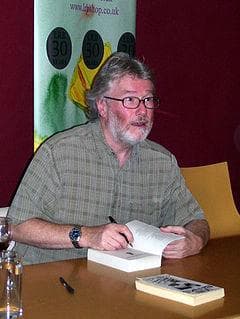
Iain Banks was a Scottish author, writing mainstream fiction as Iain Banks and science fiction as Iain M. Banks, adding the initial of his adopted middle name Menzies. After the success of The Wasp Factory (1984), he began to write full time. His first science fiction book, Consider Phlebas, appeared in 1987, marking the start of the Culture series. His books have been adapted for theatre, radio, and television. In 2008, The Times named Banks in their list of "The 50 greatest British writers since 1945".
Similar books
- American Psycho
Bret Easton Ellis
3.8 (242k) average on GoodreadsThrillerExplores the mind of a disturbed narrator with graphic violence and a detached tone.
- We Have Always Lived in the Castle
Shirley Jackson
4.0 (118k) average on GoodreadsThrillerFeatures an isolated, eccentric protagonist with a dark past and a unique, unsettling worldview.
- The Cement Garden
Ian McEwan
3.5 (29k) average on GoodreadsLiterary FictionDeals with isolated children, dark secrets, and a decaying family unit in a disturbing setting.
- Angels & Demons
Dan Brown
3.9 (2.7M) average on GoodreadsThrillerA Harvard symbologist races through Rome's ancient sites, deciphering cryptic clues to unmask the Illuminati and stop a vengeful plot to destroy the Vatican with a stolen antimatter weapon.
- Gone Girl
Gillian Flynn
4.1 (2.3M) average on GoodreadsThrillerA wife's sudden disappearance on her fifth anniversary reveals a web of lies and psychological warfare, exposing the secrets within a seemingly perfect marriage.
- The Girl on the Train
Paula Hawkins
3.9 (2.1M) average on GoodreadsThrillerA woman’s fascination with a seemingly perfect couple she watches from her daily train commute leads her into a dark investigation when she witnesses something that shatters their idyllic image.



Enjoyed the summary?
A summary gives you the shape of the book. The book itself has the detail, the examples and the voice.
Find The Wasp Factory on AmazonAs an Amazon Associate, BookBrief earns from qualifying purchases. How we're funded