
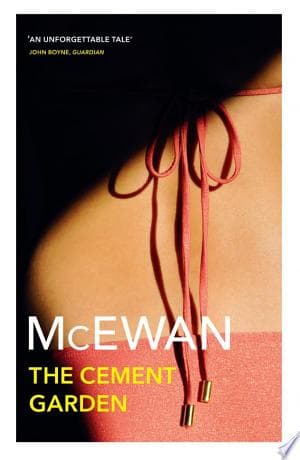
Synopsis
Covers the whole plot, including the ending.
- Difficulty
- Medium
- Pacing
- Moderate
- Mood
- Dark, Disturbing, Atmospheric, Unsettling
- Read it if
- You enjoy dark, psychological literary fiction exploring themes of isolation, forbidden desires, and the disintegration of innocence.
- Skip it if
- You prefer lighthearted stories, are sensitive to incestuous themes, or dislike ambiguous and disturbing narratives.
The Cement Garden Plot Summary
Covers the whole plot, including the ending.
The Father's Sudden Death and the Cement Garden Project
The story opens with the four children – Jack, Julie, Sue, and Tom – living with their parents in an isolated house. Their father, a stern and somewhat distant man, collapses and dies suddenly while working on a project to cement over the overgrown garden. His death shocks the family and affects the children, particularly Jack, the narrator, who watches the events with a mix of morbid curiosity and detachment. Their mother, overwhelmed by grief and a desire for order, becomes obsessed with finishing her late husband's project, systematically concreting the entire garden. This further isolates the house and its inhabitants.
The Mother's Illness and Demise
After her husband's death, the children's mother grows increasingly weak and withdrawn. She dies from an unspecified illness, leaving the children completely orphaned. Fearing they will be separated and sent to orphanages or foster care if her death is reported, the older children, especially Julie and Jack, decide to hide her death. They bury her in the cellar, encasing her body in cement, like their father did with the garden. This macabre act changes their lives, forcing them to take on adult responsibilities and further cutting off their ties with normal society.
Life Without Parents and Shifting Dynamics
With both parents gone and buried, the four children live a strange, unsupervised life. Julie, the eldest, takes on the role of primary caregiver, cooking, cleaning, and managing the household, though she grows tired. Jack, the second eldest, moves between passive observation and active involvement in their increasingly distorted reality, often retreating into his own world of adolescent fantasies. Sue, the quieter middle child, spends much of her time reading and observing, while the youngest, Tom, acts like a younger child, wearing dresses and demanding constant attention. Their isolation deepens as they avoid outside contact, creating a self-contained, almost wild, family unit.
Tom's Regression and Cross-Dressing
As weeks pass, Tom, the youngest, starts to act younger. He stops wearing boy's clothes and insists on wearing dresses, especially his deceased mother's. His siblings tolerate this behavior, then accept it, especially Julie, who seems to find comfort in caring for him in this new way. Jack, though initially bothered, gets used to it, seeing it as another strange part of their changed family life. Tom's cross-dressing becomes a symbol of their separation from societal norms and their creation of a private world with their own rules and desires.
Jack's Growing Obsession with Julie
As summer continues and their isolation grows, Jack's adolescent sexual awakening focuses on his older sister, Julie. He watches her constantly, noticing her changing body and her maternal care for Tom, which he sees through his growing desire. His thoughts are full of fantasies and observations about Julie, often blurring the lines between sibling affection and incestuous longing. This growing obsession further complicates the already tense dynamics in the house, adding unspoken tension and forbidden desire to their unique family structure.
The Arrival of Derek
The children's carefully built isolation is threatened by Derek, a young road builder who often passes their house. Derek is drawn to Julie and begins to visit, trying to court her. His presence introduces an outside element the children have actively avoided, forcing them to face the possibility of their secret being exposed. Jack, especially, views Derek with suspicion and jealousy, seeing him as an intruder who threatens his unspoken claim on Julie and the unstable balance of their family.
Julie's Relationship with Derek and Jack's Jealousy
Despite Jack's unspoken objections and the general unease among the siblings, Julie begins a relationship with Derek. She goes out with him, spending time away from the house, which further destabilizes the children's isolated world. Jack's jealousy increases, fueled by his incestuous desires for Julie and his fear of losing her to an outsider. He grows more resentful of Derek, seeing him as a rival and a threat to their secret and their unique family bond. This period shows Jack's struggle with his own developing sexuality and his possessive attachment to his sister.
The Birthday Party and the Discovery
The children hold a small birthday party for Tom, dressing him in his mother's wedding dress. Derek is there, and during the party, he goes into the cellar, where he discovers the cement-encased body of the children's mother. The discovery shatters the fragile world the children have built, revealing their dark secret. The immediate aftermath is chaotic, with Derek's shock and the children's fear of exposure. This moment means the collapse of their isolated existence and a confrontation with the results of their actions.
The Aftermath and Police Intervention
After Derek's discovery, the police are called. The children's deception and the burial of their mother are fully exposed. The story ends with the police arriving at the house, presumably taking the children into custody and starting an investigation. The final scenes show the end of their strange, unsupervised existence, as the outside world finally enters their isolated home. The children's future is uncertain, but their lives as they knew them are over, their dark secret brought into the harsh light of reality.
Principal Figures
Jack
Protagonist
The narrator, a detached and observant adolescent grappling with forbidden desires.
Jack is the second eldest child and the narrator of the story. He is a detached, often morbidly observant adolescent, prone to introspection and sexual fantasies. After his parents' deaths, he struggles with his burgeoning sexuality, which becomes fixated on his older sister, Julie. He is a passive participant in many of the family's decisions but keenly observes and internalizes the strange events unfolding around him. His inner world is a mix of adolescent angst, a desire for order, and a growing fascination with the forbidden. He often retreats into his own thoughts, making him an unreliable but compelling narrator.
Relationships: Julie (Older sister, object of his incestuous desire); Sue (Younger sister); Tom (Youngest brother); Derek (Rival for Julie's affection)
Julie
Supporting
The eldest sister, who takes on a maternal role but also explores her own desires.
Julie is the eldest of the four children and takes on the primary maternal role after her parents' deaths. She is responsible for cooking, cleaning, and caring for her younger siblings, particularly Tom. Despite her newfound responsibilities, she is also exploring her own burgeoning sexuality and desires, which lead her to a relationship with Derek. She is both a caregiver and a figure of desire for Jack, representing a complex blend of innocence, responsibility, and burgeoning womanhood in their isolated world. Her decisions often drive the plot, particularly regarding the concealment of their mother's death.
Relationships: Jack (Younger brother, object of his incestuous desire); Sue (Younger sister); Tom (Youngest brother, whom she mothers); Derek (Boyfriend)
Sue
Supporting
The quiet middle sister, often withdrawn and observing.
Sue is the middle sister, often quiet and withdrawn. She spends much of her time reading and observing the strange goings-on in the house, rarely intervening or expressing strong opinions. She is more of an observer than an active participant in the family's darker secrets, though she is aware of them. Her quiet nature makes her seem somewhat detached, a contrast to the more emotionally charged dynamics between Jack, Julie, and Tom. She represents a more passive acceptance of their unusual circumstances.
Relationships: Jack (Older brother); Julie (Older sister); Tom (Younger brother)
Tom
Supporting
The youngest child who regresses developmentally and cross-dresses.
Tom is the youngest child. After his parents' deaths, he undergoes a significant developmental regression, reverting to more infantile behaviors. He starts wearing dresses, particularly his mother's, and demands constant attention, becoming a focal point for the siblings' strange parental roles. His cross-dressing is a powerful symbol of the family's detachment from societal norms and their creation of an internal, self-governing world. He is a catalyst for some of the more unsettling aspects of the children's lives, including the incestuous undertones, and his birthday party ultimately leads to the discovery of their secret.
Relationships: Jack (Older brother); Julie (Older sister, who mothers him); Sue (Older sister)
Derek
Supporting
An outsider who becomes Julie's boyfriend and discovers the family's secret.
Derek is an outsider, a road worker who begins to visit the house and develops a relationship with Julie. His presence disrupts the children's isolated world and acts as a catalyst for the climax of the story. He is initially portrayed as a somewhat naive but persistent suitor. Unaware of the dark secrets within the house, his discovery of the mother's body in the cellar is the pivotal moment that brings the children's twisted existence to an end. He represents the intrusion of the outside world and conventional morality into their self-contained, amoral environment.
Relationships: Julie (Girlfriend); Jack (Rival and object of his jealousy)
Father
Mentioned
The stern patriarch whose death precipitates the family's descent.
The father is a stern and somewhat detached figure who dies suddenly at the beginning of the novel while cementing the garden. His death is the initial catalyst for the children's subsequent actions and the unraveling of their normal lives. His project of cementing the garden symbolizes the family's increasing isolation and the mother's subsequent obsession with order. Though he appears briefly, his presence looms over the narrative, setting the stage for the children's macabre decisions.
Relationships: Mother (Wife); Jack (Son); Julie (Daughter); Sue (Daughter); Tom (Son)
Mother
Mentioned
The grieving matriarch whose death the children conceal.
The mother is a grieving figure after her husband's death. She becomes obsessed with completing the cement garden project, a symbol of her desire for control and order amidst chaos. She falls ill and dies shortly after her husband, leaving the children orphaned. Her body, encased in cement in the cellar, becomes the central secret the children strive to protect, defining their new, isolated existence. Her dresses and belongings are later used by Tom, further intertwining her memory with the children's twisted reality.
Relationships: Father (Husband); Jack (Son); Julie (Daughter); Sue (Daughter); Tom (Son)
Themes & Insights
Loss of Innocence and Childhood
The sudden deaths of both parents make the children lose their innocence and take on adult responsibilities, though in a warped way. Their childhood routines break down, replaced by a desperate struggle for survival and secrecy. Tom's regression to acting like a baby, Jack's early sexual awakening, and Julie's burdened maternal role all show how their childhood is lost, replaced by a darker, more complex reality where normal rules do not apply. Burying their mother in cement is the ultimate symbol of this lost innocence, marking their entry into a world of forbidden knowledge and actions.
“We buried her in the cellar. I remember the smell of the damp earth, and the cement mixer droning, and the fear that tightened my throat.”
Isolation and Confinement
The house's physical setting, with its newly cemented garden, reflects the children's psychological isolation. Their decision to hide their mother's death cuts their ties to the outside world, creating a self-imposed prison. This isolation creates an environment where unusual behaviors, like Tom's cross-dressing and Jack's incestuous desires, can grow without outside judgment. Derek's arrival threatens to break their confined world and expose their secrets.
“The cement garden was finished, a grey, hard crust that sealed us off from the world.”
Incest and Forbidden Desire
A central and unsettling theme is the development of incestuous desires, particularly Jack's growing obsession with his older sister, Julie. The extreme isolation and lack of outside moral guidance create an environment where these taboos slowly disappear. Jack's thoughts reveal his sexual fantasies and jealousy towards Derek, showing the blurring of boundaries within the family. While not explicitly acted on between Jack and Julie, the strong sexual tension and implied incestuous relationships (e.g., Julie bathing Tom, Jack's fantasies) show the disturbing psychological state of the children's lives, where traditional family structures have completely dissolved.
“I watched Julie, her hips, the way her skirt clung to her. She was a woman now, and I hated Derek for seeing it.”
Control and Order vs. Chaos
The novel explores the human desire for control when things are chaotic. The father's initial project to cement the garden, and the mother's later obsession with finishing it, represent an attempt to impose order on nature and, symbolically, on their lives. However, the children's later actions – burying their mother and making their own rules – ultimately lead to a deeper internal chaos and a loss of control over their own lives. Their attempts to keep order through secrecy paradoxically create a more disordered and morally unclear existence, eventually collapsing under their own wrongdoings.
“With the garden gone, there was nowhere to hide, nothing to grow. Just grey.”
The Nature of Family
McEwan takes apart the traditional idea of family, showing a unit that, without parents, turns into a distorted, self-governing group. The children create their own rules and roles, with Julie becoming a surrogate mother and Jack struggling with his identity and desires. This 'family' exists outside normal society, bound by shared secrets and an unhealthy affection. The novel questions what a family truly is when traditional structures are absent, showing how bonds can become twisted and disturbing in extreme circumstances, yet still hold a powerful, if unhealthy, grip on its members.
“We were a family, yes, but a family of our own making, with our own rules, our own buried secrets.”
Plot Devices & Literary Techniques
First-Person Narration (Jack)
Provides a subjective, often detached, and unreliable perspective on events.
The story is narrated entirely from Jack's perspective, offering an intimate yet often disturbing insight into his thoughts, observations, and burgeoning sexuality. This subjective viewpoint allows the reader to experience the events through his detached, often morbid, lens, making the narrative particularly unsettling. Jack's unreliability stems from his adolescent fantasies and his emotional distance, which colors his perception of the family's actions and his own role within them. This technique draws the reader into his insular world, forcing them to confront the disturbing aspects of the children's lives through a deeply personal filter.
The Cement Garden
A powerful symbol of isolation, control, and the entombment of life.
The cement garden is both a literal and symbolic device. Initially, it represents the father's desire for order and control over nature. After his death, the mother's completion of it signifies her grief and further isolates the house. Symbolically, the cement represents the entombment of life and nature, mirroring the children's emotional and physical confinement. It also foreshadows the eventual burial of the mother in cement, linking the garden's barrenness to the family's moral decay and the suppression of their secrets. It is a constant visual reminder of their detachment from the living world.
Tom's Cross-Dressing
Symbolizes the family's rejection of gender norms and the regression of childhood.
Tom's insistence on wearing dresses, especially his mother's, serves multiple symbolic functions. It signifies his regression to an infantile state and a blurring of gender identities within the isolated household, where societal norms no longer apply. It also represents a symbolic 'resurrection' or continued presence of the mother figure, particularly for Julie, who nurtures him in this role. This device highlights the extent of the children's detachment from conventional society and the creation of their own, often disturbing, internal logic.
The Isolated House
A physical and psychological setting that fosters abnormal behavior.
The house itself functions as a crucial plot device, acting as a contained environment that allows the children's peculiar behaviors and secrets to develop unchecked. Its isolation, exacerbated by the cemented garden, physically separates the children from external influences and moral judgment. This creates a hothouse atmosphere where taboos like incest can fester. The house becomes a character in itself, embodying the family's twisted reality and serving as the stage for their descent into an amoral existence. Its eventual breach by Derek and the police signifies the end of their self-contained world.
The Cement Garden Quotes
“I did not kill my father, but I sometimes felt I had helped him on his way.”
“We were left alone in a house that was gradually falling apart.”
“The garden was a wilderness of weeds and broken glass.”
“I wanted to be free of all that, free of the house, free of the past.”
“We had become a secret society, bound by our own rules.”
“The cement was like a skin over the earth, holding everything in.”
“I felt a strange excitement, as if we were living in a story.”
“There was no one to tell us what to do, and that was the problem.”
“We were like animals, living by instinct.”
“The house was a tomb, and we were the ghosts.”
“I wanted to break everything, to see it all in pieces.”
“We had to invent our own morality.”
“The world outside seemed like a distant dream.”
“Nothing was permanent, not even the cement.”
Quiz
10 questions on the plot and the characters. Each answer comes with a short explanation.
Question 1
What is the immediate cause of the children becoming orphaned in 'The Cement Garden'?
- Their parents die in a car accident
- Their mother dies of an illness and their father had previously died of a heart attack
- Their parents abandon them and move away
- Their parents are arrested and imprisoned
Show answer
B. Their mother dies of an illness and their father had previously died of a heart attack In the book, the father dies first from a heart attack while working in the garden, and later the mother dies from a prolonged illness, leaving the four children completely orphaned.
Question 2
What unusual method do the children use to dispose of their mother's body?
- They bury her in the backyard at night
- They encase her in a trunk filled with cement in the basement
- They cremate her in the fireplace
- They dump her body in a nearby river
Show answer
B. They encase her in a trunk filled with cement in the basement To avoid authorities discovering their mother's death and being separated, the children mix cement and pour it into a trunk in the basement, placing her body inside to conceal it.
Question 3
Which character is the youngest and most vulnerable, often retreating into infantile behavior after their parents' deaths?
- Sue
- Julie
- Jack
- Tom
Show answer
D. Tom Tom, the youngest sibling, responds to the trauma by regressing to baby-like behavior, such as wearing diapers and seeking comfort from Julie, reflecting the breakdown of normal childhood development.
Question 4
What symbolic role does the unfinished cement garden play in the novel?
- It represents the father's unfulfilled dreams and the family's stagnation
- It serves as a playground for the children to escape their troubles
- It is a source of food through hidden vegetables
- It becomes a burial site for family pets
Show answer
A. It represents the father's unfulfilled dreams and the family's stagnation The cement garden, started by the father before his death, symbolizes the halted progress and decay of the family, mirroring how the children's lives become frozen and distorted after their parents die.
Question 5
How does Jack, the narrator, primarily spend his time after becoming orphaned?
- He takes on a job to support the family
- He obsessively masturbates and withdraws into his own fantasies
- He becomes the strict disciplinarian for his siblings
- He focuses on academic studies to secure a future
Show answer
B. He obsessively masturbates and withdraws into his own fantasies Jack's narrative reveals his intense focus on sexual awakening and isolation, spending much time alone in his room, which highlights the psychological unraveling in the absence of parental guidance.
Question 6
What is Julie's boyfriend Derek's primary motivation for getting involved with the family?
- He genuinely wants to help the children and provide stability
- He is suspicious and aims to uncover the secret of the mother's disappearance
- He plans to steal valuables from the house
- He hopes to adopt Tom and give him a better home
Show answer
B. He is suspicious and aims to uncover the secret of the mother's disappearance Derek becomes increasingly curious and intrusive, sensing something is amiss, which builds tension as he threatens to expose the children's hidden secret about their mother.
Question 7
Which theme is most prominently explored through the children's secretive and incestuous dynamics?
- The innocence of childhood and play
- The collapse of social norms and morality in isolation
- The importance of community and neighborly help
- The benefits of self-reliance and independence
Show answer
B. The collapse of social norms and morality in isolation The novel delves into how the loss of adult supervision leads to a breakdown of conventional boundaries, exemplified by the children's hidden actions and the developing relationship between Jack and Julie.
Question 8
What practical step do the children take to maintain the illusion that their mother is still alive?
- They forge her signature on school documents
- They use her savings to pay bills automatically
- They tell neighbors she is bedridden and too ill to see visitors
- They hire an actress to impersonate her in public
Show answer
C. They tell neighbors she is bedridden and too ill to see visitors To avoid suspicion, the children claim their mother is gravely ill and confined to her bed, preventing outsiders from checking on her and discovering the truth.
Question 9
How does the novel's setting contribute to the atmosphere of decay and isolation?
- It is set in a bustling city where the children are overlooked in the crowd
- It takes place in a remote, decaying house on the edge of a wasteland during a hot summer
- It occurs in a snowy, isolated mountain cabin
- It is set in a futuristic, automated home that malfunctions
Show answer
B. It takes place in a remote, decaying house on the edge of a wasteland during a hot summer The house, located in a desolate area with a hot, arid summer, amplifies the sense of entrapment and moral decay, mirroring the children's psychological state.
Question 10
In the climax, what event forces the children's secret to be at risk of exposure?
- A police investigation into missing persons in the neighborhood
- Derek discovering the cemented trunk in the basement and confronting them
- Sue confessing everything to a teacher at school
- The smell from the mother's body becoming unbearable and noticeable
Show answer
B. Derek discovering the cemented trunk in the basement and confronting them Derek's growing suspicion leads him to explore the basement, where he finds the trunk containing the mother's body, creating a crisis that threatens to unravel the children's fragile world.
The Cement Garden FAQ
What is 'The Cement Garden' about?
The novel follows four siblings—Jack, Julie, Sue, and Tom—who are orphaned after their parents die in quick succession. To avoid being separated by social services, they hide their mother's body in the basement, encasing it in cement, and attempt to maintain a facade of normalcy while their domestic world descends into isolation, neglect, and transgressive behavior.
Why should I read 'The Cement Garden'?
It's a compelling exploration of childhood trauma, loss of innocence, and the psychological unraveling of a family unit in extreme circumstances. McEwan's unflinching portrayal of the siblings' descent into a private, lawless world offers profound insights into human nature under pressure, making it a haunting and thought-provoking read.
What is the background/setting of 'The Cement Garden'?
The story is set in a dilapidated suburban house in an unnamed British city during an arid summer. The oppressive heat and the family's isolated, decaying home mirror the children's emotional and psychological disintegration, creating a claustrophobic atmosphere that intensifies as the plot unfolds.
What are the most memorable quotes?
Notable quotes include Jack's reflection, 'We were like survivors of a shipwreck, clinging to the wreckage of our family,' and Julie's ominous statement, 'We're not children anymore.' These lines capture the siblings' sense of abandonment and their forced, premature adulthood in the wake of their parents' deaths.
What writing style does the author use?
Ian McEwan employs a sparse, detached prose style narrated from Jack's perspective, which contrasts sharply with the disturbing events. This clinical narration amplifies the horror by presenting the siblings' actions matter-of-factly, forcing readers to grapple with the moral ambiguities without overt judgment.
What minor details add significant meaning?
The recurring motif of the cement garden itself—a failed project of the father—symbolizes the children's attempt to bury and conceal their trauma. Similarly, the decaying food and unwashed dishes in the house subtly reflect their neglect and the breakdown of societal norms.
What are some subtle foreshadowing moments?
Early mentions of the father's illness and the mother's frailty hint at the impending orphanhood. Jack's fascination with bodily functions and decay foreshadows the gruesome act of encasing the mother's body, while Tom's regression to infantile behavior prefigures the family's overall collapse.
What unexpected character connections exist?
The bond between Julie and Jack evolves into a quasi-incestuous relationship, blurring the lines between sibling care and romantic entanglement. Derek, Julie's boyfriend, serves as an outsider whose presence threatens to expose their secret, highlighting the tension between the children's insular world and societal norms.
What are unspoken character motivations?
Jack is driven by a deep-seated fear of abandonment and a desire to preserve the family unit at any cost, leading him to rationalize the concealment of their mother's death. Julie seeks control and maturity in the chaos, often taking on a maternal role while grappling with her own adolescent desires.
What psychological complexities do characters exhibit?
Jack exhibits a mix of detachment and obsession, numbly narrating horrific events while being fixated on bodily decay. Tom regresses to infancy, symbolizing a retreat from reality, and Sue withdraws into books, using intellectual escape to cope with the trauma, showcasing varied psychological responses to loss.
What are the major emotional turning points?
Key moments include the father's death, which destabilizes the family; the mother's death and subsequent cement burial, marking their descent into secrecy; and Derek's discovery of the hidden body, which forces a confrontation with the outside world and the impending collapse of their fabricated reality.
How do relationship dynamics evolve?
Initially, the siblings rely on each other for survival, but as isolation deepens, their roles distort: Julie and Jack's relationship becomes sexualized, Sue grows distant, and Tom becomes increasingly dependent. The arrival of Derek introduces external judgment, straining their fragile unity and exposing their dysfunction.
Which parts remain ambiguous or open-ended?
The novel's ending is deliberately ambiguous: it's unclear whether Derek will report the children to authorities or become complicit. The fate of the siblings—whether they face legal consequences or continue their descent—is left unresolved, inviting readers to ponder the consequences of their actions.
What are controversial scenes or decisions?
The most controversial elements include the graphic depiction of the mother's corpse being encased in cement and the incestuous undertones in Julie and Jack's relationship. These scenes challenge readers' moral boundaries and spark debate about the limits of human behavior under trauma.
'The Cement Garden' ending explained: how it ends & what it means
The novel ends with Derek discovering the mother's body in the basement, while the children await his reaction. This cliffhanger symbolizes the inevitable intrusion of society into their private nightmare, suggesting that their attempt to create a self-contained world is unsustainable and that reality will ultimately impose itself.
About the author

Ian Russell McEwan is an English novelist and screenwriter. In 2008, The Times featured him on its list of "The 50 greatest British writers since 1945" and The Daily Telegraph ranked him number 19 in its list of the "100 most powerful people in British culture".
Similar books
- Lord of the Flies
William Golding
3.7 (2.3M) average on GoodreadsYoung AdultExplores the breakdown of civilization and morality among isolated children.
- We Have Always Lived in the Castle
Shirley Jackson
4.0 (118k) average on GoodreadsThrillerFeatures isolated siblings and a dark, unsettling family secret.
- The Wasp Factory
Iain Banks
3.8 (83k) average on GoodreadsThrillerA coming-of-age story with a deeply disturbed protagonist and morbid themes.
- The Old Man and the Sea
Ernest Hemingway
3.8 (831k) average on GoodreadsLiterary FictionA Cuban fisherman's long struggle with a giant marlin becomes a story of endurance and dignity, now retold for young adults with illustrations, phonetic guides, and writing prompts in Traditional Chinese.
- One Hundred Years of Solitude
Gabriel García Márquez
4.1 (753k) average on GoodreadsLiterary FictionThrough the multi-generational story of the Buendía family, a mythical town deals with the repeating patterns of time, love, and solitude, as the extraordinary mixes with the ordinary.
- The Goldfinch
Donna Tartt
3.9 (720k) average on GoodreadsLiterary FictionHaunted by a tragic explosion and clutching a stolen Dutch masterpiece, a young orphan navigates the opulent drawing rooms of New York and the gritty underbelly of the art world, desperately seeking connection and redemption amidst a life spiraling into crime and obsession.





Enjoyed the summary?
A summary gives you the shape of the book. The book itself has the detail, the examples and the voice.
Find The Cement Garden on AmazonAs an Amazon Associate, BookBrief earns from qualifying purchases. How we're funded