
Core Idea
- Difficulty
- Hard
- Pacing
- Variable
- Mood
- Bleak, Disillusioned, Profound, Allusive, Fragmented
- Read it if
- You are interested in modernist poetry, the cultural aftermath of WWI, or challenging literary works that reward close reading and intellectual engagement.
- Skip it if
- You prefer straightforward narratives, accessible language, or poetry that offers clear, unambiguous meaning without extensive interpretation.
The Waste Land Quotes
“April is the cruellest month, breeding Lilacs out of the dead land, mixing Memory and desire, stirring Dull roots with spring rain.”
“I will show you fear in a handful of dust.”
“HURRY UP PLEASE ITS TIME”
“These fragments I have shored against my ruins”
“The river's tent is broken: the last fingers of leaf Clutch and sink into the wet bank.”
“I think we are in rats' alley Where the dead men lost their bones.”
“O O O O that Shakespeherian Rag— It's so elegant So intelligent”
“Here is no water but only rock Rock and no water and the sandy road”
“The awful daring of a moment's surrender Which an age of prudence can never retract”
“London Bridge is falling down falling down falling down”
“I have heard the key Turn in the door once and turn once only”
“And I will show you something different from either Your shadow at morning striding behind you Or your shadow at evening rising to meet you”
“Weialala leia Wallala leialala”
“Shantih shantih shantih”
Quiz
10 questions on the main ideas. Each answer comes with a short explanation.
Question 1
In which year was T.S. Eliot's 'The Waste Land' first published?
- 1919
- 1922
- 1925
- 1930
Show answer
B. 1922 The book description specifies that 'The Waste Land' is Eliot's 1922 masterpiece, indicating its first publication year.
Question 2
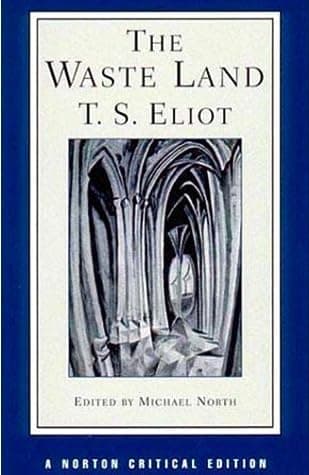
Which edition of 'The Waste Land' does this Norton Critical Edition present for ease of reading?
- The British edition published by Faber & Faber
- The manuscript version with Ezra Pound's edits
- The American edition published by Boni & Liveright
- A revised edition from later in Eliot's career
Show answer
C. The American edition published by Boni & Liveright The description states that this edition presents the poem as it first appeared in the American edition by Boni & Liveright, making it the version used for readability.
Question 3
What is included in the 'Contexts' section of this Norton Critical Edition?
- Only Eliot's original notes to the poem
- Materials on the poem's sources, composition, and publication history
- A collection of modern literary criticism
- Biographical essays about T.S. Eliot's life
Show answer
B. Materials on the poem's sources, composition, and publication history According to the book description, the 'Contexts' section provides invaluable materials specifically on 'The Waste Land's' sources, composition, and publication history.
Question 4
Which of the following critics is NOT included in the 'Criticism' section of this edition?
- Virginia Woolf
- F. Scott Fitzgerald
- Cleanth Brooks
- Conrad Aiken
Show answer
B. F. Scott Fitzgerald The description lists many critics included in the 'Criticism' section, such as Virginia Woolf, Cleanth Brooks, and Conrad Aiken, but F. Scott Fitzgerald is not mentioned among them.
Question 5
How are Eliot's notes presented in this Norton Critical Edition?
- Integrated within the poem's text for immediate reference
- At the end of the poem, as they first appeared
- Omitted entirely to focus on the poem itself
- Replaced with modern annotations only
Show answer
B. At the end of the poem, as they first appeared The book description specifies that Eliot's notes are placed at the end of the poem, following the format of its first appearance in the American edition.
Question 6
What additional feature does this edition include to help understand Eliot's complex notes?
- A glossary of literary terms
- Thorough explanatory annotations
- A summary of each section
- Illustrations depicting key scenes
Show answer
B. Thorough explanatory annotations The description mentions that the text is accompanied by thorough explanatory annotations, which are necessary because Eliot's own notes are described as 'knotty' and sometimes require further clarification.
Question 7
Which publication's reviews are included in the 'Criticism' section of this edition?
- The New York Times
- The Times Literary Supplement
- The Paris Review
- The Atlantic Monthly
Show answer
B. The Times Literary Supplement The book description explicitly states that reviews published in the Times Literary Supplement are included in the 'Criticism' section, highlighting early critical responses.
Question 8
What does the description imply about Eliot's original notes for 'The Waste Land'?
- They are straightforward and easy to understand
- They are unnecessary and often ignored by scholars
- They are so complex that they sometimes need their own annotations
- They were added by editors after Eliot's death
Show answer
C. They are so complex that they sometimes need their own annotations The description refers to Eliot's notes as 'knotty' and notes that 'some of which require annotation themselves,' indicating their complexity and the need for further explanation in this edition.
Question 9
In addition to the poem and criticism, what two reference materials are included in this Norton Critical Edition?
- A biography of T.S. Eliot and a timeline of his works
- A chronology and a selected bibliography
- An index of characters and a map of locations in the poem
- A collection of Eliot's letters and unpublished drafts
Show answer
B. A chronology and a selected bibliography The description concludes by stating that 'A Chronology and Selected Bibliography are included,' which are standard reference tools in Norton Critical Editions to aid research and understanding.
Question 10
What is the primary purpose of the 'Criticism' section in this edition, based on the description?
- To provide only negative reviews of the poem
- To trace the poem's reception from first reactions through the end of the twentieth century
- To compare 'The Waste Land' with other modernist poems
- To focus exclusively on Eliot's own interpretations
Show answer
B. To trace the poem's reception from first reactions through the end of the twentieth century The description specifies that the 'Criticism' section traces the poem's reception with twenty-five reviews and essays, covering a historical range from initial reactions to late twentieth-century perspectives.
The Waste Land FAQ
What is 'The Waste Land' about?
'The Waste Land' is a modernist poem that explores the spiritual and cultural desolation of post-World War I Europe through fragmented narratives, mythological allusions, and diverse voices. It depicts a world of broken relationships, failed communication, and emotional sterility, moving through sections like 'The Burial of the Dead' and 'What the Thunder Said' to suggest both despair and potential renewal.
Why should I read 'The Waste Land'?
You should read 'The Waste Land' because it is a foundational work of modernist literature that captures the disillusionment of the 20th century with innovative poetic techniques. Its dense allusions to myth, religion, and literature, along with its exploration of themes like fragmentation and rebirth, make it a rich, challenging text that rewards careful study and annotation.
What is the background/setting of 'The Waste Land'?
The background of 'The Waste Land' is post-World War I Europe, particularly London and other urban landscapes, reflecting the social and spiritual decay of the era. It draws on diverse settings from myth (like the Fisher King's wasteland) to contemporary scenes, such as the pub in 'A Game of Chess,' to create a fragmented, global perspective on modernity.
What are the most memorable quotes?
Memorable quotes include 'April is the cruellest month' from the opening, which inverts traditional spring renewal themes, and 'These fragments I have shored against my ruins' from the end, highlighting the poem's reliance on cultural debris. Another is 'Hurry up please it's time' from the pub scene, emphasizing urgency and mortality.
What writing style does T.S. Eliot use?
T.S. Eliot uses a fragmented, allusive style with abrupt shifts in voice, language, and perspective, blending high culture references with colloquial speech. He employs free verse, multiple languages (like Sanskrit in 'What the Thunder Said'), and dense symbolism to convey the disintegration and potential synthesis of modern experience.
What minor details add significant meaning?
Minor details like the 'drowned Phoenician Sailor' card in the tarot reading foreshadow death and rebirth themes, while the 'rat's alley' in 'The Fire Sermon' symbolizes urban decay. The repeated water imagery, from the Thames to the drought, subtly connects to themes of purification and sterility throughout the poem.
What are some subtle foreshadowing moments?
Subtle foreshadowing includes the 'Unreal City' description in 'The Burial of the Dead,' which hints at the pervasive emptiness later explored, and the hyacinth girl's memory, which prefigures lost love and spiritual dryness. The thunder's 'DA' sounds in the finale are foreshadowed by earlier references to drought and renewal.
What unexpected character connections exist?
Unexpected connections include the link between the typist in 'The Fire Sermon' and the mythological figure of Tiresias, who observes her mechanical affair, blending ancient prophecy with modern alienation. The Fisher King's wound parallels the emotional sterility of characters like the nervous woman in 'A Game of Chess,' unifying myth and contemporary trauma.
What are unspoken character motivations?
Unspoken motivations include the typist's passive acceptance of her lover's visit, driven by societal ennui rather than desire, and the nervous woman's frantic questioning in 'A Game of Chess,' rooted in fear of emptiness. The Fisher King's silence reflects a deeper spiritual paralysis that motivates the quest for renewal in the poem.
What psychological complexities do characters exhibit?
Characters exhibit complexities like the fragmented psyche of Tiresias, who embodies both male and female perspectives, and the hysterical woman in 'A Game of Chess,' whose anxiety masks a terror of meaninglessness. The drowned Phoenician Sailor represents a subconscious desire for escape from the wasteland's pressures.
What are the major emotional turning points?
Major emotional turning points include the shift from despair in 'The Burial of the Dead' to the chaotic sexuality of 'The Fire Sermon,' and the climax in 'What the Thunder Said,' where the thunder's teachings offer a tentative hope. The hyacinth garden memory marks a turning point from lost innocence to ongoing desolation.
How do relationship dynamics evolve?
Relationship dynamics evolve from the failed communication in 'A Game of Chess,' where couples talk past each other, to the impersonal encounter of the typist and clerk in 'The Fire Sermon.' By the end, the thunder's advice to 'give, sympathize, control' suggests a potential shift toward more meaningful connections, though it remains ambiguous.
Which parts remain ambiguous or open-ended?
Ambiguous parts include the identity of the 'third who walks always beside you' in 'What the Thunder Said,' which could be a spiritual guide or illusion, and the poem's ending 'Shantih shantih shantih,' a Sanskrit peace blessing left untranslated, inviting interpretation. The hyacinth girl's significance is also open to debate.
What are controversial scenes or decisions?
Controversial scenes include the typist's mechanical sexual encounter in 'The Fire Sermon,' criticized for its bleak portrayal of modernity, and Eliot's use of fragmented form, which some early reviewers found incoherent. His decision to include extensive notes has sparked debate over whether they clarify or further obscure the poem's meaning.
'The Waste Land' ending explained: how it ends & what it means
The poem ends with the thunder's teachings 'DA' (give, sympathize, control) and the repeated 'Shantih,' suggesting a tentative peace or spiritual resolution after the wasteland's chaos. It implies that renewal is possible through ethical action and inner stillness, though the fragmentation persists, leaving the outcome open to interpretation.
About the author

T.S. Eliot was an American-British poet, essayist, and playwright, active primarily in the early to mid-20th century. He is best known for his influential works, including "The Waste Land," a landmark poem of modernist literature, and "Murder in the Cathedral," a verse drama exploring themes of faith and morality. Eliot received the Nobel Prize in Literature in 1948 for his contributions to poetry and drama.
Similar books
- Ulysses
James Joyce
3.7 (111k) average on GoodreadsLiterary FictionBoth are foundational modernist works known for their experimental structure, stream-of-consciousness, and vast allusions.
- The Cantos
Ezra Pound
3.9 (5k) average on GoodreadsFictionA lengthy, fragmented epic poem by a contemporary of Eliot, also rich in historical and literary allusions.
- Mrs Dalloway
Virginia Woolf
3.8 (361k) average on GoodreadsFictionWhile both explore post-war disillusionment and fragmented selves, Woolf's novel focuses on internal psychological states and memory through stream of consciousness, whereas Eliot's poem uses a broader, more impersonal, and historical-mythical lens to convey collective spiritual malaise.
- Nineteen Eighty-Four
George Orwell
4.2 (5.5M) average on GoodreadsFictionWinston Smith dreams of truth and rebellion in a world where Big Brother watches all, but he confronts the terrifying power of a regime that controls not just actions, but thoughts.
- The Frozen River
Ariel Lawhon
4.4 (600k) average on GoodreadsFictionIn 1789 Maine, a heroic midwife's diary helps her expose a murder and get justice in a town that wants to silence her.
- A Man Called Ove
Fredrik Backman
4.4 (569k) average on GoodreadsFictionA stubborn widower, who lives by strict rules, finds his quiet world changed by a lively new family next door, making him face his past and find happiness in human connection.





Enjoyed the summary?
A summary gives you the shape of the book. The book itself has the detail, the examples and the voice.
Find The Waste Land on AmazonAs an Amazon Associate, BookBrief earns from qualifying purchases. How we're funded