
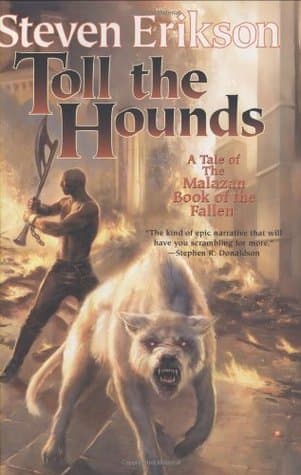
Synopsis
Covers the whole plot, including the ending.
- Difficulty
- Hard
- Pacing
- Variable
- Mood
- Dark, Philosophical, Epic, Melancholy, Intense
- Read it if
- You crave extremely complex, philosophical epic fantasy with a massive cast, intricate world-building, and a willingness to explore deep themes of sacrifice, justice, and the nature of power.
- Skip it if
- You prefer straightforward narratives, lighthearted fantasy, or struggle with a large number of point-of-view characters and dense prose that requires significant commitment.
Toll the Hounds Plot Summary
Covers the whole plot, including the ending.
A City Under Shadow: Darujhistan and the Crimson Guard's Return
Darujhistan, once a center of intrigue, now feels oppressive under summer heat and unease. Baruk, the alchemist, gets reports that the Crimson Guard, led by K'rul, is active in the city again. Kruppe, the nobleman, watches the T'orrud Cabal, a group trying to take advantage of the city's weaknesses. People are restless, with rumors and old complaints spreading. Bellurdan, a former assassin, returns to the city's underworld. The Bridgeburners, now disbanded, feel a storm coming. K'rul, an ancient being, uses his blood-oath with the Crimson Guard to prepare for a new conflict, aiming to restore balance by confronting powerful beings.
Black Coral's Burden: Anomander Rake's Vigil
In Black Coral, Anomander Rake, Son of Darkness and ruler of the Tiste Andii, keeps a somber watch. He has lived through centuries of war and loss, carrying the burden of his people's survival and a threat to their existence. Rake considers justice and revenge, especially regarding Draconus, the Elder God he imprisoned in Dragnipur. He knows ancient powers are returning and a convergence is coming that could break reality. His captains, Spinnock Durav and Endest Silann, see his serious mood and the pressure he is under. Rake's secret plan begins to form, meant to confront the biggest threat to the Tiste Andii and perhaps all existence.
The Rise of Chaos: Hood's Influence and the Cult of the Crippled God
Hood, the God of Death, starts to act more directly in the mortal world. His reasons are unclear but linked to the events unfolding. His servant, Hood's Breath, a ghost-like figure, moves through Darujhistan, taking souls and causing fear. Meanwhile, the Cult of the Crippled God, though supposedly suppressed, gains followers among the poor and desperate. Their talk of suffering and divine help appeals to those who feel abandoned. This growing cult, controlled by hidden forces, becomes a powerful, unpredictable part of the brewing conflict, threatening Darujhistan and Black Coral. The Crippled God's distant influence is strong, subtly moving events toward a huge confrontation.
The Jaghut's Return: Gothos and the Ritual of Telas
Gothos, the old Jaghut Tyrant and Icarium's father, wakes from his long sleep. Deeply saddened by endless violence and the suffering of those he loved, Gothos begins a terrifying ritual to break reality itself. His plan involves bringing together powerful beings and using Elder Warrens, promising an end to all pain, even if it means ending all life. His return causes fear and anticipation among those who know his power, especially Anomander Rake, who understands Gothos's intentions. The ritual's success would have terrible results, making Gothos a central, though tragic, opponent in the story.
Whispers of Vengeance: Draconus and the Sword of Dark
Draconus, the Elder God of Light and Dragons, is imprisoned in Anomander Rake's sword, Dragnipur, which has caused tension for a long time. As events get worse, Draconus's potential release or escape becomes a big worry. His return promises not only great power but also a reckoning for past wrongs, especially his old feud with Tiam. The sword itself, a channel for vast power and a prison for souls, plays a larger part as Rake's plans near their end. Draconus's fate and what his freedom means are deeply connected to the final battle, adding another layer of old conflict to the already unstable situation.
The Assailant's Game: Seerdomin and the T'orrud Cabal
The T'orrud Cabal, a criminal group in Darujhistan, becomes a major player in the city's increasing chaos. Their assassins, especially the skilled Seerdomin, first work to keep the Cabal in power. But as the larger, older conflicts unfold, Seerdomin and his group find themselves caught between loyalty to the Cabal and the huge forces at work. Their targets change, their alliances strain, and their work faces challenges from the scale of the coming war. The Cabal's internal struggles and its interactions with other groups, like the Crimson Guard, add a layer of mortal intrigue to the divine and Elder conflicts.
The Bridgeburners' Return: A Gathering of Old Friends
Even though they tried to live peaceful lives, several former members of the disbanded Bridgeburners are drawn back into Darujhistan's unfolding drama. Picker, Blend, and Rallick Nom, among others, see the growing unrest and the actions of various groups. Their skills and experience, gained from years of war, are valuable as they navigate the city's dangerous situation. While not officially reunited, their individual actions and shared past create a network of resistance, often working with Baruk and Kruppe to protect people and stop harmful plans. Their presence reminds people of past heroics and promises future defiance.
The Crimson Guard's Gambit: K'rul's Plan Unfolds
K'rul, the Elder God and patron of the Crimson Guard, carefully carries out his long-planned strategy to counter the Crippled God's growing influence and restore balance. Through his blood-oath with the Guard, he arranges events, including gathering powerful mages and using ancient energies. The Crimson Guard, led by K'rul's chosen, acts as a main force, challenging the T'orrud Cabal and other groups causing instability in Darujhistan. Their actions are not just about control but about preparing for a much bigger spiritual and magical fight, meant to cut the Crippled God's ties to the world and prevent creation from collapsing.
The Convergence of Powers: Black Coral and Darujhistan Unite
As Gothos's ritual nears its terrible peak and the Crippled God's influence grows, Anomander Rake makes his move. In a powerful and sacrificial act, he uses all the might of Dragnipur and the Warren of Starvald Demelain to move Black Coral and its Tiste Andii inhabitants to the skies above Darujhistan. This amazing arrival means all major players have gathered for the final battle. Rake's goal is clear: to confront Gothos, Draconus, and the Crippled God's influence directly, even if it means his own death. Black Coral hovering over the burning city creates awe and terror, signaling an era's end and a new one's start.
Anomander Rake's Sacrifice: A Hero's End and a New Beginning
In the final confrontation, Anomander Rake carries out his last, devastating plan. Facing Dragnipur's destructive power, which threatens to pull all souls into Chaos, and Draconus's impending release, Rake confronts Hood, God of Death. In a pre-arranged duel, Rake lets Hood kill him, using his own death to trigger events. This sacrifice frees Draconus from Dragnipur, letting him return to the mortal world. More importantly, Rake's soul enters Dragnipur, taking the place of the millions of trapped souls, ending the sword's horrific purpose. His death, a selfless act, also reshapes the Tiste Andii and opens a path for their future, changing the cosmic balance and setting the stage for future events in the Malazan world.
The Aftermath: Grief, Reckoning, and Lingering Shadows
After Anomander Rake's sacrifice, deep grief settles over Darujhistan and the surviving Tiste Andii. The city is damaged but not destroyed. Hood, having done his part in Rake's plan, leaves, leaving behind a changed world. Draconus, now free, deals with his new reality and Rake's sacrifice. The Crimson Guard, having met their goals, start to scatter, their mission changed. The T'orrud Cabal is broken, its power less. Some find peace, while others are left to rebuild, remembering Rake and the high cost of survival. The battle's echoes, both physical and spiritual, continue, hinting at future conflicts and the lasting impact of what happened.
Principal Figures
Anomander Rake
Protagonist
Son of Darkness, Lord of the Tiste Andii, and wielder of Dragnipur
Anomander Rake is an ancient, powerful figure, burdened by millennia of leading his people, the Tiste Andii. He is characterized by his stoicism, immense wisdom, and a profound sense of duty. Rake carries the weight of countless lives on his shoulders, constantly seeking a way to protect his dwindling race and restore balance to a chaotic world. His motivations are often shrouded in mystery, but they are consistently driven by a deep, self-sacrificing love for his people and a desire to end suffering, even if it means his own demise. He is a master swordsman, a formidable mage, and a strategic genius, respected and feared by gods and mortals alike. His ultimate plan involves a grand sacrifice to free Draconus and save the souls trapped in Dragnipur.
Relationships: Draconus (Ancient ally and rival, imprisoned in Rake's sword); Spinnock Durav (Loyal captain of the Tiste Andii); Endest Silann (Elder mage of the Tiste Andii); Hood (God of Death, with whom Rake forms a pact)
Kruppe
Supporting
Rotund, enigmatic chronicler, manipulator, and Ascendant
Kruppe is a seemingly harmless, perpetually hungry, and verbose nobleman from Darujhistan. Beneath his bumbling exterior lies a keen intellect, profound wisdom, and an uncanny ability to influence events. He is an Ascendant, though he rarely uses his power directly, preferring to subtly manipulate others and observe the grand narrative unfolding around him. Kruppe serves as a chronicler of events, often breaking the fourth wall to address the reader, providing philosophical insights and comic relief. His primary motivation is the protection of Darujhistan and its people, often working behind the scenes with Baruk and other allies to thwart threats. He understands the intricate dance of power better than most.
Relationships: Baruk (Close confidant and fellow influential figure in Darujhistan); Rallick Nom (Acquaintance and fellow resident of Darujhistan)
Baruk
Supporting
Master alchemist and influential figure in Darujhistan
Baruk is a powerful alchemist and a key political figure in Darujhistan. He is a pragmatic and cautious individual, deeply committed to the welfare of his city. Baruk possesses a vast network of informants and a deep understanding of both mundane and magical politics. He works closely with Kruppe, often providing the logistical and strategic support for their subtle interventions. While not a direct combatant, his knowledge of ancient lore, alchemy, and his political acumen make him an invaluable ally against the forces threatening Darujhistan. His home serves as a hub for discussions and planning among those seeking to protect the city.
Relationships: Kruppe (Close confidant and strategic partner); Rallick Nom (Acquaintance and often a recipient of his aid)
Hood
Antagonist/Supporting
God of Death, playing a crucial role in Anomander Rake's plan
Hood is the ancient God of Death, often perceived as an antagonist due to his domain, but in 'Toll the Hounds,' his role is more complex. He is a formidable and ancient entity, weary of his endless duty. Hood becomes a crucial, albeit reluctant, participant in Anomander Rake's grand plan, forming a pact that involves Rake's death. His motivations are driven by a desire to alleviate the suffering of souls trapped in Dragnipur and to restore a semblance of order to the cosmic balance. He is a powerful figure, capable of immense destruction, yet bound by ancient agreements and a deep understanding of destiny. His presence in Darujhistan signals the impending cataclysm.
Relationships: Anomander Rake (Forms a pact with Rake for his death); Gothos (Ancient acquaintance, both are Elder Gods)
Gothos
Antagonist
Jaghut Tyrant and father of Icarium, seeking to end all suffering
Gothos is an ancient and immensely powerful Jaghut Tyrant, driven by profound grief and a desire to end suffering. He is the father of Icarium and has witnessed countless cycles of violence and loss. His return to the mortal realm is motivated by a plan to unleash a cataclysmic ritual, the Telas, aimed at severing all ties to the Warrens and essentially ending all life to prevent further pain. Gothos is a tragic figure, his immense power matched only by his despair. He is a master of Jaghut magic, capable of reshaping reality. His actions serve as a major catalyst for the convergence of forces in Darujhistan, forcing others to confront his destructive vision.
Relationships: Icarium (His son, whose suffering deeply affects him); Hood (Ancient acquaintance and fellow Elder God)
Draconus
Supporting
Elder God of Light and Dragons, imprisoned within Dragnipur
Draconus is an Elder God of immense power, a First Son of Dark, and the progenitor of the Tiam race of dragons. He was imprisoned within Anomander Rake's sword, Dragnipur, millennia ago, a fate he both resents and understands. His release is a central element of Rake's plan. Draconus represents a raw, untamed power, capable of immense destruction but also a deep sense of ancient justice. His long imprisonment has given him a unique perspective on the nature of existence and the flow of souls. His eventual freedom has profound implications for the balance of power among the Elder Gods and the future of the world.
Relationships: Anomander Rake (His imprisoner and eventual liberator); Tiam (His ancient, estranged mate and progenitor of dragons)
Rallick Nom
Supporting
Former assassin, seeking a quieter life but drawn back into conflict
Rallick Nom is a skilled former assassin from Darujhistan, now trying to live a peaceful life with his beloved, Murillio's daughter. Despite his attempts to leave his past behind, the escalating chaos in Darujhistan inevitably draws him back into the fray. He is a practical and morally grounded individual, often acting to protect the innocent and fight against injustice, even when it puts him in great danger. Rallick possesses exceptional combat skills and a deep understanding of the city's underbelly. His involvement brings a grounded, mortal perspective to the epic conflicts, highlighting the personal stakes for the city's residents.
Relationships: Kruppe (Acquaintance and occasional ally); Baruk (Acquaintance and source of aid)
Seerdomin
Supporting
A ruthless assassin and leader within the T'orrud Cabal
Seerdomin is a highly capable and cold-blooded assassin, a prominent figure within the T'orrud Cabal. He is fiercely loyal to the Cabal and its interests, executing their directives with brutal efficiency. Seerdomin is a pragmatic and intelligent individual, observant of the shifting power dynamics within Darujhistan. As the city descends into deeper chaos, he finds his loyalties tested and his understanding of the world challenged by the ancient forces at play. His actions, though often violent, are driven by a desire to maintain order (as he understands it) and protect the Cabal's dominance, making him a formidable, if morally ambiguous, player in the unfolding drama.
Relationships: T'orrud Cabal (Leader and enforcer within the organization)
K'rul
Supporting
Elder God and patron of the Crimson Guard, seeking cosmic balance
K'rul is an ancient Elder God, creator of the Warrens, and the patron of the Crimson Guard. He is a powerful and enigmatic figure, driven by a deep understanding of cosmic balance and the need to rectify ancient wrongs. K'rul forms a blood-oath with the Crimson Guard, using them as his instruments to confront the influence of the Crippled God and other destabilizing forces. His presence in Darujhistan is a significant catalyst for the events, as he orchestrates a complex plan to restore order. K'rul is a force of creation and preservation, though his methods can be indirect and his true intentions often hidden.
Relationships: Crimson Guard (Patron and leader through a blood-oath)
Spinnock Durav
Supporting
Captain of the Tiste Andii, loyal to Anomander Rake
Spinnock Durav is one of Anomander Rake's most trusted and loyal captains among the Tiste Andii. He is a seasoned warrior, dedicated to his people and his Lord. Spinnock possesses a calm and stoic demeanor, often serving as a voice of reason and strength for his brethren. He is deeply aware of the immense burden Rake carries and understands the gravity of the impending conflicts. Spinnock's unwavering loyalty and combat prowess make him a crucial figure in the defense of Black Coral and the execution of Rake's final plan. He represents the enduring spirit and discipline of the Tiste Andii warriors.
Relationships: Anomander Rake (Loyal captain and confidant); Endest Silann (Fellow Tiste Andii leader)
Themes & Insights
Sacrifice and Redemption
This theme is key to 'Toll the Hounds,' seen most clearly in Anomander Rake's final act. Rake sacrifices himself to free Draconus and many souls from Dragnipur, giving the sword a new purpose and opening a new path for the Tiste Andii. His death is not an end but an act of love and selflessness, showing that true redemption often costs a great deal personally. Hood's reluctant involvement in Rake's plan, despite his role, suggests a kind of redemption from the endless suffering he oversees. The story asks if some violent acts can be redeemed by their ultimate goal.
“What is it about sacrifice that we mortals find so... irresistible?”
Justice vs. Vengeance
The conflict between justice and vengeance runs through the story, especially in what drives Gothos and Draconus. Gothos seeks a drastic 'justice' by ending all suffering, even if it means ending all life, driven by his grief. Draconus, imprisoned for thousands of years, struggles with his desire for revenge against those who wronged him, including Tiam. Anomander Rake's actions, while seeming like justice for the souls in Dragnipur, also stop a greater vengeance from Draconus. The book questions if any act, even one seen as just, can truly be free of vengeful feelings, and the terrible results of uncontrolled retribution.
“Justice. A word that has been twisted into more shapes than any other. And none of them are fair.”
The Burden of Immortality and Ancient Powers
Many characters, especially Anomander Rake, Gothos, and Draconus, are ancient beings burdened by thousands of years of life. They carry the weight of countless wars, losses, and their people's slow decline. This theme looks at the mental cost of immortality, where love turns to grief, and power becomes a heavy duty. Rake's tiredness is clear, driven by a wish to end his and his people's suffering. Gothos's extreme solution comes from his inability to bear endless pain. The story suggests that even gods and Ascendants feel deep despair and a longing for peace, however it might be achieved.
“We are old, Spinnock. And the older we get, the heavier the weight becomes.”
The Nature of Love and Loss
Love and loss are strongly connected in 'Toll the Hounds,' often appearing together, as the book's description says. Rake's actions are driven by his love for the Tiste Andii and his wish to end their suffering. Gothos's destructive plan comes from deep grief for his son, Icarium, and the loss he has seen. The personal stories of characters like Rallick Nom, trying to protect his loved one, show how fragile love is in a world of great power and violence. The novel shows love not just as joy, but as a strong, often sad, reason that can lead to great sacrifice and terrible acts.
“Love and death, it is said, shall arrive dancing. And so they do, again and again.”
The Role of the Witness/Chronicler
Kruppe is the main example of this theme, constantly watching, writing, and subtly influencing events. His narration often speaks directly to the reader, giving comments and thoughts on the story. This shows how important storytelling and memory are for understanding and preserving history. Even though he is an Ascendant, Kruppe chooses to be a chronicler, suggesting that observing and sharing stories is a powerful role. His presence reminds the reader that even in the biggest conflicts, someone is always watching and recording, making sure lessons are learned, or at least remembered.
“Ah, mortals. Such a delightful mess they make of things. And I, of course, am ever so fond of cleaning up after them.”
Plot Devices & Literary Techniques
Dragnipur
Anomander Rake's sentient sword, a prison for souls and a conduit to Chaos
Dragnipur is not merely a weapon but a central plot device, a sentient Elder God (Draconus) trapped within its blade, and a terrifying prison for countless souls, including Hood's wagon. It actively drains souls from those it kills, forcing them to pull a wagon that prevents Chaos from consuming the universe. Its purpose is both destructive and preservative. Rake's ultimate plan revolves around freeing Draconus and the souls, culminating in his own sacrifice to take their place. Dragnipur represents the ultimate burden, the cost of power, and the complex nature of sacrifice, as it is both a tool of destruction and a necessary evil for cosmic balance.
The Telas Ritual
Gothos's cataclysmic ritual to sever all ties to the Warrens and end suffering
The Telas Ritual is a major plot device driving the climax of the novel. Orchestrated by Gothos, this ancient Jaghut ritual aims to completely sever the world from all Warrens, effectively ending all magic and, by extension, all life and suffering. Its activation forces a convergence of various powers, as many seek to either stop it or exploit its chaos. The ritual represents an extreme solution to profound grief and serves as a ticking clock, creating immense tension and forcing Anomander Rake to accelerate his own complex plans. It highlights the destructive potential of unchecked despair and the desperate measures some are willing to take to achieve their version of peace.
The Crimson Guard's Blood-Oath with K'rul
An ancient pact linking the Crimson Guard to the Elder God K'rul, guiding their actions
The blood-oath between the Crimson Guard and K'rul is a foundational plot device that explains the Guard's presence and actions in Darujhistan. This ancient pact allows K'rul to subtly guide the Guard's movements, transforming them from mere mercenaries into instruments of cosmic balance. The oath provides a supernatural justification for their enduring purpose and their fight against the Crippled God's influence. It demonstrates how ancient agreements can continue to shape mortal destinies and how divine will can be enacted through mortal agents, blurring the lines between military campaign and spiritual crusade. This device adds a layer of ancient, predetermined purpose to their otherwise mundane struggles.
Kruppe's Narrator/Chronicler Role
A meta-narrative device where Kruppe directly addresses the reader and provides commentary
Kruppe's unique role as a self-aware narrator and chronicler is a significant meta-narrative plot device. He frequently breaks the fourth wall, directly addressing the reader, offering philosophical insights, humorous asides, and often foreshadowing events. This device allows the author to provide context, thematic depth, and a unique perspective on the unfolding drama without resorting to traditional exposition. Kruppe's commentary helps to deconstruct the epic scale of events, making them more accessible and personal. It also emphasizes the theme of storytelling and the importance of remembering history, as Kruppe literally records the events for posterity.
Toll the Hounds Quotes
“We are all children of the same, terrible Mother. We are all children of grief.”
“The price of wisdom is eternal doubt.”
“There are no heroes left, for all have been consumed by the very causes they sought to champion.”
“Love is a wound, and the wound is all that remains.”
“To be human is to be a question mark. To be a god is to be an answer that makes no sense.”
“Hope is a coin, and it is spent too easily.”
“The past is a beast, and it has teeth. And it will find you, sooner or later.”
“Compassion is a burden. It is the weight of the world on your shoulders.”
“What is courage but a choice to stand in the face of what frightens you?”
“Every soul is a universe, and every universe is dying.”
“We are all but shadows, dancing in the light of a fading sun.”
“The heart, in its own way, is a weapon. And it can be sharper than any blade.”
“There is no justice, only consequences.”
“To suffer is to live. To live is to suffer. There is no escape.”
“Sometimes, the only way to save a life is to take another.”
Quiz
10 questions on the plot and the characters. Each answer comes with a short explanation.
Question 1
Which city is the primary setting for the events involving the 'small round man in the faded red waistcoat' and the initial intrigues?
- Black Coral
- Malaz City
- Darujhistan
- Capustan
Show answer
C. Darujhistan The book description explicitly states, 'In Darujhistan, the city of blue fire, it is said that love and death shall arrive dancing. It is summer and the heat is oppressive, but for the small round man in the faded red waistcoat, discomfiture is not just because of the sun.' This establishes Darujhistan as the primary initial setting.
Question 2
Who is described as the ruler of the 'distant city of Black Coral'?
- K'rul
- Anomander Rake
- Hood
- Dassem Ultor
Show answer
B. Anomander Rake The description clearly states, 'And in the distant city of Black Coral, where rules Anomander Rake, Son of Darkness, ancient crimes awaken, intent on revenge.'
Question 3
What common phrase is used to describe the arrival of 'Love and Death' in Darujhistan?
- Hand in hand, singing
- Arm in arm, battling
- Dancing
- Whispering
Show answer
C. Dancing The description repeats this motif: 'it is said that love and death shall arrive dancing' and 'It seems Love and Death are indeed about to arrive...hand in hand, dancing.'
Question 4
The initial description of Darujhistan highlights a specific environmental condition. What is it?
- A harsh winter with heavy snow
- An oppressive summer heat
- A perpetual autumn mist
- Constant torrential rain
Show answer
B. An oppressive summer heat The text states, 'It is summer and the heat is oppressive.' This detail sets a specific mood and atmosphere for the city.
Question 5
What is the primary motivation stated for the 'ancient crimes' awakening in Black Coral?
- To forge new alliances
- To claim a lost treasure
- To seek revenge
- To establish a new empire
Show answer
C. To seek revenge The description clearly states, 'ancient crimes awaken, intent on revenge.' This establishes a key plot driver for the events in Black Coral.
Question 6
The 'small round man in the faded red waistcoat' is experiencing 'discomfiture'. Besides the sun, what is contributing to his unease?
- A recent financial loss
- Dire portents plaguing his nights
- A personal illness
- The disapproval of his peers
Show answer
B. Dire portents plaguing his nights The text states, 'discomfiture is not just because of the sun. All is not well. Dire portents plague his nights and haunt the city streets like fiends of shadow.' This indicates a supernatural or ominous source of his distress.
Question 7
What specific sound is mentioned as being heard 'in the distance' while bards sing tragic tales?
- The ringing of church bells
- The baying of Hounds
- The clash of swords
- The roar of a dragon
Show answer
B. The baying of Hounds The title of the book, 'Toll the Hounds,' is foreshadowed by the line: 'somewhere in the distance can be heard the baying of Hounds...'
Question 8
The book describes a shift in power dynamics concerning assassins. What is this shift?
- Assassins are being hired by the city guard.
- Assassins have become the rulers of the city.
- The quarry has turned, making the hunters the hunted.
- Assassins are abandoning their trade.
Show answer
C. The quarry has turned, making the hunters the hunted. The description states, 'Assassins skulk in alleyways, but the quarry has turned and the hunters become the hunted.' This indicates a reversal of roles and a new level of danger for the assassins themselves.
Question 9
Beyond war and intrigue, what other significant element is highlighted as a characteristic of the novel?
- Technological advancements
- Dark, uncontrollable magic
- Interstellar travel
- Philosophical debates
Show answer
B. Dark, uncontrollable magic The summary describes the novel as 'A thrilling, harrowing novel of war, intrigue and dark, uncontrollable magic,' indicating magic is a core element, and specifically 'uncontrollable' magic suggests a deeper, more dangerous aspect.
Question 10
The phrase 'Hidden hands pluck the strings of tyranny like a fell chorus' suggests what about the nature of power and control in Darujhistan?
- The city is ruled by a benevolent council.
- Power is openly contested in public elections.
- There are unseen, manipulative forces controlling events.
- The government is entirely decentralized and chaotic.
Show answer
C. There are unseen, manipulative forces controlling events. The metaphor 'Hidden hands pluck the strings of tyranny' implies that there are powerful, clandestine entities or individuals secretly manipulating the city's governance and fate, leading to oppressive rule.
Toll the Hounds FAQ
What is Toll the Hounds about?
Toll the Hounds is primarily set in the city of Darujhistan and also Black Coral, focusing on the interwoven fates of numerous characters as ancient powers awaken and converge. It explores themes of love, death, sacrifice, and the consequences of past actions, all under the oppressive summer heat and the looming threat of the Hounds of Darkness.
Why should I read Toll the Hounds?
You should read Toll the Hounds for its profound philosophical depth, intricate character studies, and the masterful execution of tragedy and heroism. It delves deeply into the nature of compassion and sacrifice, offering a rich, emotionally resonant narrative that culminates in one of the most impactful events in the Malazan series.
What is the background/setting of Toll the Hounds?
The book is set in two primary locations: Darujhistan, the Free City of blue fire, where many familiar characters like Crokus and Murillio navigate rising tensions and ancient threats, and Black Coral, the fortress-city of the Tiste Andii ruled by Anomander Rake. Both cities are experiencing a period of escalating unrest, driven by both mortal intrigue and the reawakening of elder gods and entities.
What are the most memorable quotes?
One memorable quote is 'Witness.' which is often spoken by characters observing profound, often tragic, events, encapsulating the theme of bearing witness to history and suffering. Another is related to the nature of compassion and sacrifice, often articulated through the musings of various philosophers and the actions of characters like Anomander Rake.
What writing style does the author use?
Steven Erikson employs a dense, philosophical, and often poetic writing style, characterized by multiple shifting perspectives and a deep dive into character internal monologues. He uses rich, descriptive language and often presents complex ideas through dialogue and narrative, demanding close attention from the reader.
What minor details add significant meaning?
The recurring motif of the 'small round man in the faded red waistcoat' (Nimander) and his internal struggles subtly reflects the broader themes of identity and purpose that many characters grapple with. Also, the seemingly mundane details of daily life in Darujhistan serve to ground the epic fantasy elements, making the eventual devastation more impactful.
What are some subtle foreshadowing moments?
The constant references to 'love and death dancing' in Darujhistan subtly foreshadow the ultimate convergence of these themes, particularly in Anomander Rake's final actions. The increasing frequency of dire portents and the baying of the Hounds throughout the narrative also build a sense of impending doom long before the actual events unfold.
What unexpected character connections exist?
The unexpected connection between Seerdomin and the ancient entity Draconus, revealing their shared history and Draconus's paternal role, adds significant depth to both characters. Another is the complex, often fraught, relationship between the Crippled God and Anomander Rake, whose destinies are far more intertwined than initially perceived.
What are unspoken character motivations?
Anomander Rake's unspoken motivation for his ultimate sacrifice is a deep-seated desire to protect humanity and prevent a cosmic catastrophe, stemming from his ancient responsibilities and weariness. Similarly, the Crippled God's actions, while seemingly malevolent, are often driven by a desperate desire for release from his suffering and the injustices inflicted upon him.
What psychological complexities do characters exhibit?
Characters like Crokus grapple with existential dread and the weight of their choices, leading to moments of profound self-doubt and heroism. Nimander also exhibits deep psychological complexity, battling his own self-loathing and the shadow of his powerful father, Rake, as he tries to find his own path.
What are the major emotional turning points?
A major emotional turning point is the death of Murillio, which profoundly impacts Crokus and other Darujhistan residents, highlighting the fragility of life and the cost of the unfolding conflicts. The ultimate emotional climax is Anomander Rake's sacrifice, which sends shockwaves through the entire Malazan world and evokes a powerful sense of tragedy and awe.
How do relationship dynamics evolve?
The relationship between Crokus and Apsalar evolves from a complicated romantic tension to a deeper understanding and mutual respect, forged through shared dangers and losses. The dynamic between Anomander Rake and Draconus also evolves, moving from ancient animosity to a complex alliance rooted in shared purpose and a tragic understanding.
Which parts remain ambiguous or open-ended?
The ultimate fate of some minor characters and the long-term implications of Anomander Rake's actions for the Tiste Andii and the world itself are left somewhat open-ended. The exact nature of the Crippled God's plans beyond the immediate conflict also retains a degree of ambiguity, allowing for future developments in the series.
What are controversial scenes or decisions?
Anomander Rake's decision to sacrifice himself through a ritual duel with Hood, the Lord of Death, is one of the most controversial and debated scenes. While some view it as a necessary and noble act, others question its strategic wisdom and the profound ripple effects it has on the balance of power and the fate of multiple races.
Toll the Hounds ending explained: how it ends & what it means
The ending of Toll the Hounds culminates in Anomander Rake's planned sacrifice, where he duels Hood and offers his own soul to seal the gate to Starvald Demelain, preventing the Tiste Andii from being consumed by their own war and freeing the Crippled God from his torment. This act signifies the ultimate expression of compassion and the profound price of peace, leaving a lasting impact on the Malazan world and its inhabitants.
About the author
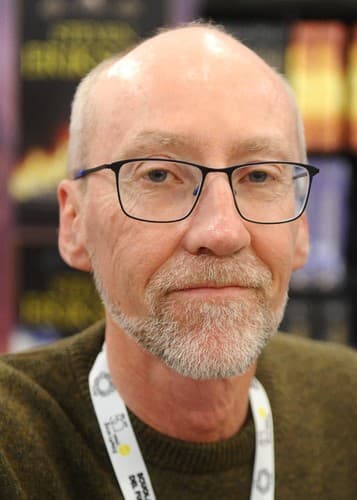
Steven Erikson is a Canadian author known for his epic fantasy series, "Malazan Book of the Fallen." His notable works include "Deadhouse Gates," "House of Chains," "Midnight Tides," "The Bonehunters," "Toll the Hounds," and "Dust of Dreams." Erikson's writing is characterized by its complex narratives and extensive world-building.
Similar books
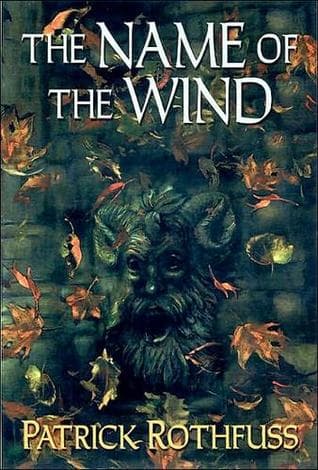
- The Name of the Wind
Patrick Rothfuss
4.5 (716k) average on GoodreadsFantasyFeatures a strong narrative voice and deep world-building, though less sprawling in scope.
- A Game of Thrones
George R.R. Martin
4.5 (2M) average on GoodreadsFantasyWhile both Erikson and Martin deconstruct traditional fantasy tropes and feature extensive casts, Toll the Hounds delves far deeper into philosophical and existential themes. Martin's focus is more on political intrigue, power struggles, and character-driven drama, with magic often serving as a backdrop or plot device. Erikson, by contrast, uses his vast pantheon and magical systems to explore the very nature of existence, compassion, and the burden of history, making Toll the Hounds a more intellectually demanding read. Erikson's narrative style is also significantly less direct than Martin's, often withholding information to build mystery, whereas Martin provides more immediate insights into character motivations and plot mechanics.
- The Way of Kings
Brandon Sanderson
4.6 (305k) average on GoodreadsFantasySanderson's The Way of Kings (and the larger Stormlight Archive) shares Erikson's epic scope and ambition, with vast worlds and intricate magic systems. However, Sanderson prioritizes clear, propulsive plotting, accessible prose, and often features more straightforward heroic arcs, even with his complex characters. Erikson's Toll the Hounds is far more deliberately paced, morally ambiguous, and less concerned with immediate gratification. While Sanderson meticulously explains his magic systems (e.g., Surgebinding), Erikson often leaves his ascendant powers and ancient histories shrouded in mystery, challenging the reader to piece together the implications. Sanderson's themes often revolve around responsibility and redemption in a more direct manner, whereas Erikson grapples with the inherent tragedy and futility of many heroic endeavors, making Toll the Hounds a significantly darker and more introspective work.
- Harry Potter and the Sorcerer's Stone
J.K. Rowling
4.5 (7M) average on GoodreadsFantasyRescued from a miserable life under the stairs, an orphaned boy discovers he's a wizard destined for a magical school, where he uncovers a dangerous secret tied to the dark wizard who murdered his parents.
- The Hunger Games
Suzanne Collins
4.3 (6.4M) average on GoodreadsFantasyIn a future where children fight to the death on live television, Katniss Everdeen volunteers for the arena, turning a death sentence into a fight for survival and a spark of rebellion.
- 1984
George Orwell
4.2 (3.1M) average on GoodreadsPoliticsIn a future where surveillance and thought control are absolute, a man's search for truth clashes with the Party, showing that hope can be a form of rebellion.




Enjoyed the summary?
A summary gives you the shape of the book. The book itself has the detail, the examples and the voice.
Find Toll the Hounds on AmazonAs an Amazon Associate, BookBrief earns from qualifying purchases. How we're funded