
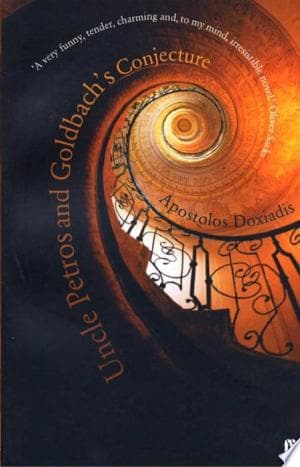
Synopsis
Covers the whole plot, including the ending.
- Difficulty
- Medium
- Pacing
- Moderate
- Mood
- Thought-provoking, Melancholy, Inspiring, Intellectual
- Read it if
- You enjoy intellectual adventures, stories about genius and obsession, or have an interest in mathematics and its human side.
- Skip it if
- You dislike books with a strong focus on abstract concepts or prefer fast-paced thrillers.
Uncle Petros and Goldbach's Conjecture Plot Summary
Covers the whole plot, including the ending.
The Enigmatic Uncle Petros
The narrator, a young boy in Athens, is curious about his Uncle Petros Papachristos, whom his family considers a failure. Petros lives a quiet, solitary life, gardening and playing chess, but the narrator senses a deeper story. His parents call Petros's past a 'shame' and a 'catastrophe,' hinting at a brilliant but failed academic career in mathematics. The narrator's father, a successful businessman, dismisses Petros's pursuits as impractical, while his mother feels pity. Despite his family's judgment, the narrator is drawn to Petros's quiet intensity and the mystery of his past, sensing a hidden greatness beneath his reclusive life.
Unveiling the Past
As the narrator grows older and develops an interest in mathematics, he begins to ask his uncle about his past. Petros, at first evasive, gradually reveals he was once a prodigy, a celebrated mathematician who studied at Cambridge University. He recounts his early brilliance, his mentors, and his meetings with other mathematical figures of the early 20th century. The narrator learns Petros dedicated his life to one monumental task: proving Goldbach's Conjecture, a seemingly simple statement about prime numbers that had remained unproven for centuries. This changes the narrator's view of his uncle from a family eccentric to a tragic, heroic figure.
Cambridge and Early Brilliance
Petros talks about his time at Cambridge, where his exceptional talent quickly became clear. He describes the lively academic environment, the friendships with other mathematicians, and the excitement of discovery. He details his early work in number theory, which brought him recognition. During this period, he first became fascinated by Goldbach's Conjecture, seeing it as the ultimate intellectual challenge. His early successes and his professors' encouragement made him believe he was destined to solve this old problem, leading him to dedicate his entire intellectual life to it.
The Allure of Goldbach's Conjecture
Petros explains Goldbach's Conjecture, stating that every even integer greater than 2 is the sum of two prime numbers. He describes its deceptive simplicity and the immense difficulty in proving it, despite its truth for all tested numbers. He conveys the strong intellectual pull it had on him, comparing it to a siren song promising ultimate glory. The narrator, now an aspiring mathematician, starts to understand his uncle's deep obsession. Petros describes the various failed attempts by other great mathematicians throughout history, further showing the size of the challenge he had set for himself.
Encounters with Mathematical Giants
Petros shares stories about his interactions with other famous mathematicians. He describes his awe and respect for Srinivasa Ramanujan's intuitive genius; Ramanujan's unconventional methods both fascinated and frustrated the more formally trained Petros. He also speaks of meeting a young Alan Turing, noting Turing's groundbreaking work in computability and his impact on mathematics and logic. These stories show the intellectual excitement of the era and place Petros among brilliant minds, while also hinting at the limits of his own singular, human approach to a difficult problem.
The Descent into Obsession
As years pass, Petros's early optimism turns into a relentless, consuming obsession. He spends every waking moment on Goldbach's Conjecture, isolating himself and sacrificing personal relationships and other academic chances. The initial excitement of the chase slowly becomes a grueling, solitary struggle. He describes periods of intense frustration, near breakthroughs that disappear, and the heavy weight of repeated failure. His life narrows to his mathematical quest, his mind a battleground where he fights an unyielding problem, pushing himself to the edge of mental exhaustion.
The 'Petrosian Fallacy'
Petros reveals a key turning point in his research: the 'Petrosian Fallacy.' He explains how, after years of intense work, he began to subconsciously trick himself. Whenever he met a difficulty in his proof, his mind would automatically 'resolve' it by assuming the very thing he was trying to prove, creating circular logic that made his proof seem valid to him, only for him to later find the basic flaw. This self-deception, born from immense pressure and desire for success, became a recurring pattern, draining his energy and pushing him further into despair, making him question his own sanity and ability.
The Breakdown and Retreat
The combined weight of repeated failures and the realization of the 'Petrosian Fallacy' eventually breaks Petros. He experiences a deep mental and emotional collapse, abandoning his mathematical career and leaving the academic world. He returns to Athens, finding comfort in a simple, anonymous life, gardening and playing chess. This period marks his change into the reclusive figure the narrator first knew. He sees his life's work as a catastrophic failure, haunted by the unsolved conjecture and the great personal cost of his pursuit.
The Narrator's Own Journey
Inspired and warned by his uncle's story, the narrator follows his own path in mathematics, becoming a successful professor of computational mathematics. He understands the beauty and challenges of the field but also the dangers of obsessive pursuits. He grapples with his uncle's legacy, trying to reconcile the brilliance with the breakdown. His own career, focused on applied mathematics and computational solutions, contrasts with Petros's pure, theoretical quest, offering a different view on the purpose and practice of mathematics.
A Final Encounter and a New Hope
Years later, after achieving his own academic success, the narrator visits his elderly uncle. He brings a new mathematical paper, a groundbreaking proof by a young female mathematician, which offers a new approach to a problem related to Goldbach's Conjecture. The narrator, knowing his uncle's deep connection to the problem, carefully presents it. Petros, at first resistant and resigned, slowly becomes re-engaged. The paper, while not a direct proof of Goldbach's Conjecture, is a significant step forward in number theory, rekindling a spark of intellectual curiosity and hope in Petros, suggesting his life's work was not entirely in vain.
The Unveiling of the 'Proof'
In a moving moment, after being re-energized by the new mathematical discovery, Petros reveals to his nephew a long-hidden secret: a complete, handwritten 'proof' of Goldbach's Conjecture that he had worked on for years. He presents it with a mix of pride and fear, knowing its fatal flaw. As the narrator carefully examines it, he finds the exact point where the 'Petrosian Fallacy' takes hold, confirming his uncle's self-deception. This act is a cathartic confession for Petros, a final acknowledgment of his lifelong struggle and the ultimate, tragic flaw in his grand ambition.
Redemption and Acceptance
The revelation of his flawed proof, combined with the new mathematical insights, brings Petros a strange sense of peace. He accepts the limits of his quest and the reality of his failure, but also recognizes the beauty and profound intellectual journey he took. The narrator's understanding and compassion offer Petros a form of redemption, validating his passion even in defeat. Petros, no longer burdened by the silent weight of his ambition, finds a quiet dignity in his past, realizing that the pursuit itself, with all its triumphs and heartbreaks, held its own value, independent of the final outcome.
Principal Figures
Uncle Petros Papachristos
Protagonist
A reclusive former mathematical prodigy obsessed with Goldbach's Conjecture.
Petros is a brilliant but ultimately tragic figure. Initially a celebrated mathematician at Cambridge, he dedicates his entire adult life to proving Goldbach's Conjecture. His single-minded pursuit leads to self-imposed isolation and a profound mental breakdown due to the 'Petrosian Fallacy' – a self-deceptive circular logic in his proofs. He is proud, stubborn, and deeply passionate about pure mathematics, viewing the conjecture as the ultimate challenge. His reclusive life in Athens is a testament to his perceived failure, yet he retains a deep, almost spiritual, connection to the beauty of numbers.
Relationships: The Narrator (Nephew) (mentor/mentee, confessor/confidant); Ramanujan (respected contemporary, intellectual inspiration); Alan Turing (respected contemporary, intellectual inspiration)
The Narrator
Supporting/Protagonist
Petros's nephew, an aspiring mathematician who eventually becomes a professor.
The unnamed narrator serves as both the chronicler of Petros's story and a character in his own right. He is initially a curious boy fascinated by his eccentric uncle, growing into an aspiring mathematician inspired by Petros's brilliance but also wary of his fate. He pursues a more pragmatic, computational path in mathematics, contrasting with Petros's pure theoretical quest. His compassion and intellectual curiosity ultimately help Petros achieve a form of redemption. He represents the next generation, learning from the triumphs and failures of the past.
Relationships: Uncle Petros (mentee/mentor, compassionate listener); Father (son, differing views on academic pursuits)
Narrator's Father
Supporting
A pragmatic businessman who views Petros as a failure.
The narrator's father represents the practical, success-oriented world, contrasting sharply with Petros's academic pursuits. He views Petros's life as a 'shame' and a 'catastrophe,' unable to comprehend the value of pure, unapplied mathematics. He is dismissive of Petros's intellectual struggles, prioritizing tangible achievements. His perspective highlights the societal pressure and misunderstanding that mathematicians like Petros often face, emphasizing the isolation inherent in their abstract work.
Relationships: Uncle Petros (brother, disapproving); The Narrator (father, attempts to steer son towards practicality)
Srinivasa Ramanujan
Mentioned
The intuitive Indian mathematical prodigy.
Ramanujan is presented as a legendary figure whose intuitive, almost mystical, approach to mathematics both awes and perplexes Petros. His existence challenges conventional academic methods and inspires Petros, even as Petros struggles to reconcile Ramanujan's genius with his own systematic, logical training. Ramanujan symbolizes the raw, untamed brilliance that can exist outside established structures, influencing Petros's understanding of mathematical truth.
Relationships: Uncle Petros (respected contemporary, intellectual inspiration)
Alan Turing
Mentioned
The young British mathematician and pioneer of computer science.
Alan Turing appears as a young, brilliant mind, whose work on computability and logic foreshadows the future of mathematics and technology. Petros acknowledges Turing's profound insights, particularly in the realm of decision problems, which implicitly highlights the limitations of purely human, intuitive methods when faced with intractable problems. Turing represents the emerging computational era, a stark contrast to Petros's classical, pen-and-paper approach to number theory.
Relationships: Uncle Petros (respected contemporary, intellectual inspiration)
The Young Female Mathematician
Mentioned
A contemporary mathematician whose work re-energizes Petros.
This unnamed mathematician represents the ongoing progress and evolution of the field. Her groundbreaking paper, related to Goldbach's Conjecture, offers a new perspective and method that reignites Petros's intellectual curiosity. She symbolizes hope, the continuous pursuit of knowledge, and the idea that mathematical problems, even seemingly intractable ones, can be approached from new angles, providing a sense of closure and future possibility for Petros.
Relationships: Uncle Petros (indirect intellectual influence, source of renewed hope)
Themes & Insights
The Nature of Mathematical Truth and Proof
The novel explores mathematical truth and the difficult process of proving it. Goldbach's Conjecture, empirically true but unproven, is a main example. Petros's struggle shows the difference between intuition and rigorous proof, and the 'Petrosian Fallacy' illustrates how even brilliant minds can deceive themselves. The narrator's introduction of new computational methods contrasts with Petros's classical approach, suggesting truth can be found in different ways, but proof requires absolute, unwavering logic. The book emphasizes that mathematical truth is not just about finding an answer, but about showing its undeniable validity.
“Mathematical truth is not just about knowing something is true, but about knowing why it is true, and being able to convince anyone else of its truth beyond any shadow of a doubt.”
Obsession and its Consequences
Petros's life is a warning about the destructive power of single-minded obsession. His dedication to Goldbach's Conjecture consumes his entire existence, leading to isolation, the sacrifice of relationships, and a mental breakdown. The novel shows how a noble intellectual pursuit can become a relentless, self-destructive force when it overshadows all other parts of life. His reclusive later years are a direct result of this obsession, showing the high personal cost of chasing an 'impossible' goal. The narrator's more balanced approach to mathematics offers a contrast, highlighting the importance of perspective.
“I had become a prisoner of my own ambition, trapped in a labyrinth of numbers.”
Failure, Redemption, and the Value of the Journey
The novel deals with the concept of failure, especially in intellectual endeavors. Petros sees his life as a catastrophic failure because he did not prove the conjecture. However, the narrative, particularly through the narrator's view, suggests that the journey itself, the passion, the struggle, and the deep engagement with the problem, has inherent value. Petros's eventual, though partial, redemption comes not from solving the conjecture, but from accepting his limitations and finding peace in the beauty of the pursuit. His story implies that true success might lie not in achieving a definitive outcome, but in the courage to strive for the impossible and the wisdom gained along the way.
“Perhaps the greatest lesson of all is that not every problem is meant to be solved, but every problem is meant to be wrestled with.”
The Human Element in Pure Mathematics
Beyond abstract numbers, the novel humanizes pure mathematics, revealing the passions, rivalries, ego, and deep personal sacrifices involved. Petros's meetings with Ramanujan and Turing show the diverse personalities and approaches in the field. His 'Petrosian Fallacy' highlights the fallibility of even the most brilliant minds, showing that human psychology, with its desires and self-deceptions, plays a significant role in scientific effort. The book shows that mathematics, while seemingly objective, is deeply tied to human experience, ambition, and vulnerability.
“Mathematics is not just about cold logic; it is about passion, intuition, and sometimes, even self-deception.”
Plot Devices & Literary Techniques
First-Person Narrator
The story is told through the eyes of Petros's nephew.
The use of a first-person narrator, Petros's nephew, allows for a gradual unveiling of Petros's past. The narrator's initial curiosity and evolving understanding of mathematics mirror the reader's own journey into Petros's complex world. This perspective provides both objective distance and subjective intimacy, allowing the reader to witness Petros's story through the eyes of someone who deeply cares for him, while also offering an analytical, mathematical counterpoint to Petros's more emotional account. It creates a sense of discovery and personal connection to the intellectual drama.
Flashback/Retrospective Narrative
Petros's life story is revealed through his recollections to his nephew.
The novel primarily employs a retrospective narrative, with Petros recounting his past to his nephew. This allows for a structured reveal of Petros's academic career, his triumphs, and his descent into obsession. The present-day interactions between uncle and nephew serve as a frame, grounding the historical accounts in a contemporary emotional context. This device builds suspense, as the narrator (and reader) slowly piece together the reasons behind Petros's reclusive state, culminating in the understanding of his 'failure' and eventual peace.
Goldbach's Conjecture as a MacGuffin/Central Symbol
The unsolved mathematical problem drives the plot and symbolizes life's intractable challenges.
Goldbach's Conjecture functions as more than just a mathematical problem; it is the central symbol around which Petros's life revolves. It acts as a MacGuffin, driving Petros's ambition and ultimately leading to his downfall, but the true 'story' is about his internal struggle, not the conjecture's solution. It symbolizes the allure of the impossible, the limits of human intellect, and the profound personal cost of relentless pursuit. The conjecture represents any monumental, perhaps unwinnable, challenge that consumes an individual's life, making Petros's story relatable beyond the realm of mathematics.
The 'Petrosian Fallacy'
A self-deceptive logical flaw that plagues Petros's attempts at proof.
The 'Petrosian Fallacy' is a crucial plot device that explains Petros's inability to solve Goldbach's Conjecture despite his brilliance. It's a psychological and logical trap where, under immense pressure, he would subconsciously assume the truth of what he was trying to prove, creating a circular argument. This device not only provides a concrete reason for his failure but also delves into the psychology of obsession and self-deception in intellectual pursuits. It highlights the rigorous demands of mathematical proof and the human vulnerability to cognitive bias when faced with an overwhelming desire for success.
Uncle Petros and Goldbach's Conjecture Quotes
“Mathematics is not a spectator sport.”
“The feeling of being on the verge of discovery, the thrill, the anxiety, the hope...”
“Some problems are like mountains: you climb them, and you find another peak behind.”
“Genius, like madness, has an element of singularity.”
“Goldbach's Conjecture, to him, was not merely a mathematical problem but a personal challenge, a test of his very being.”
“The true mathematician lives in a world of his own, a world of pure thought, untouched by the mundane.”
“There are problems that are not meant to be solved by humans, or at least not by humans in their current form.”
“The greatest discoveries often come not from trying to solve a problem directly, but from exploring the landscape around it.”
“To be a mathematician is to live in a constant state of yearning, a longing for truth and beauty that few others can comprehend.”
“The world of numbers is a harsh mistress; she demands everything and gives little in return, save for the fleeting glimpse of her beauty.”
“Sometimes the greatest challenge is not to find the answer, but to accept that there might be no answer.”
“He lived in the shadow of a conjecture, a ghost that haunted his every waking moment.”
“The beauty of a mathematical proof lies not just in its correctness, but in its elegance, its simplicity, its inevitability.”
“Every mathematician is an explorer, charting unknown territories of thought.”
Quiz
10 questions on the plot and the characters. Each answer comes with a short explanation.
Question 1
What is the primary mathematical problem that Uncle Petros dedicates his life to solving?
- Fermat's Last Theorem
- The Riemann Hypothesis
- Goldbach's Conjecture
- The Poincaré Conjecture
Show answer
C. Goldbach's Conjecture The entire novel revolves around Uncle Petros's obsessive pursuit of a proof for Goldbach's Conjecture.
Question 2
How does the narrator, Petros's nephew, initially perceive his uncle before learning about his past?
- As a celebrated genius
- As a successful businessman
- As a recluse and a 'family joke'
- As a kind but forgetful old man
Show answer
C. As a recluse and a 'family joke' The book's synopsis explicitly states that Uncle Petros is considered a 'family joke' and an 'ageing recluse' at the beginning.
Question 3
Which historical mathematician is NOT mentioned as someone Uncle Petros came into contact with during his quest?
- Srinivasa Ramanujan
- Alan Turing
- Albert Einstein
- G.H. Hardy
Show answer
C. Albert Einstein The synopsis mentions Ramanujan and Turing by name, and Hardy is a well-known collaborator of Ramanujan, making his inclusion plausible even if not explicitly in the synopsis. Einstein, while a great scientist, is not noted as a mathematician Petros encountered in his specific pursuit.
Question 4
What is the central theme highlighted by Uncle Petros's struggle with Goldbach's Conjecture?
- The importance of collaboration in scientific discovery
- The destructive nature of obsessive, single-minded pursuit of impossible goals
- The financial rewards of mathematical breakthroughs
- The ease with which mathematical problems can be solved with enough dedication
Show answer
B. The destructive nature of obsessive, single-minded pursuit of impossible goals The synopsis explicitly states his struggle is 'lonely and single-minded, and by the end it has apparently destroyed his life,' linking to the theme of the destructive nature of such pursuits.
Question 5
What is the significance of the 'final encounter with his nephew' for Uncle Petros?
- It leads to the nephew discovering a proof for the conjecture himself.
- It rekindles Petros's appreciation for the 'deep mysterious beauty of mathematics'.
- It results in Petros finally publishing his failed attempts.
- It convinces Petros to abandon mathematics entirely.
Show answer
B. It rekindles Petros's appreciation for the 'deep mysterious beauty of mathematics'. The synopsis states this encounter 'opens up to Petros, once more, the deep mysterious beauty of mathematics,' suggesting a rekindling of his passion.
Question 6
What kind of setting does Uncle Petros live in during his later years?
- A bustling city apartment in London
- A quiet village in the English countryside
- Alone in a suburb of Athens
- A university campus dormitory
Show answer
C. Alone in a suburb of Athens The text specifies he 'lives alone in a suburb of Athens, playing chess and tending to his garden.'
Question 7
What does Goldbach's Conjecture state?
- Every even integer greater than 2 is the sum of two primes.
- There are infinitely many prime numbers.
- Every integer greater than 1 is either a prime number itself or can be represented as the product of prime numbers.
- The square of the hypotenuse is equal to the sum of the squares of the other two sides.
Show answer
A. Every even integer greater than 2 is the sum of two primes. Goldbach's Conjecture is indeed the statement that every even integer greater than 2 is the sum of two primes. This is a key detail for understanding the problem Petros is tackling.
Question 8
The novel explores the 'rivalry and antagonism' among mathematicians. What is a likely source of this antagonism in the context of Goldbach's Conjecture?
- Competition for funding and academic positions.
- Disputes over credit for partial proofs or original ideas.
- Philosophical differences on the nature of mathematical truth.
- Personal grudges unrelated to mathematics.
Show answer
B. Disputes over credit for partial proofs or original ideas. In the pursuit of difficult, unsolved problems like Goldbach's, mathematicians often vie for the prestige of being the one to solve it, leading to 'rivalry and antagonism' over claims and recognition.
Question 9
What does the phrase 'proud genius' in the description suggest about Uncle Petros's character in his prime?
- He was humble and collaborative in his work.
- He possessed exceptional intellect but also a strong sense of self-importance or arrogance.
- He was easily discouraged by mathematical challenges.
- He prioritized practical applications of mathematics over pure theory.
Show answer
B. He possessed exceptional intellect but also a strong sense of self-importance or arrogance. The term 'proud' combined with 'genius' implies not just intelligence, but also a certain hubris or strong ego, which can contribute to the 'single-minded' and isolated nature of his pursuit.
Question 10
Why is Goldbach's Conjecture described as a problem that has 'defied all attempts at proof for nearly three centuries'?
- It was only recently discovered by mathematicians.
- It has no known counterexamples but remains unproven, indicating its profound difficulty.
- Mathematicians lost interest in the problem after a few decades.
- The problem can only be solved using modern computer algorithms.
Show answer
B. It has no known counterexamples but remains unproven, indicating its profound difficulty. The enduring nature of Goldbach's Conjecture without a proof, despite being easily stated and having no known counterexamples, is what makes it such a famous and difficult problem, spanning centuries of mathematical effort.
Uncle Petros and Goldbach's Conjecture FAQ
What is the central mathematical problem that Uncle Petros dedicates his life to solving?
Uncle Petros dedicates his life to proving Goldbach's Conjecture, a famous unsolved problem in number theory. The conjecture states that every even integer greater than 2 is the sum of two prime numbers, a seemingly simple statement that has eluded proof for centuries.
Who is the narrator of the story, and what is his relationship to Uncle Petros?
The narrator is Petros's unnamed nephew, a young philosophy student who initially views his uncle as an eccentric recluse. His growing curiosity about Petros's past leads him to uncover the truth about his uncle's former life as a brilliant mathematician.
What is the primary reason Uncle Petros became a recluse?
Uncle Petros became a recluse after his decades-long, obsessive, and ultimately unsuccessful quest to prove Goldbach's Conjecture. The failure, coupled with the immense intellectual and emotional toll it took, led him to abandon mathematics and retreat from society.
Which famous mathematicians does Petros encounter or interact with during his career?
Petros encounters or is aware of several prominent mathematicians of his time, including the Indian prodigy Srinivasa Ramanujan, who he observes, and the brilliant logician Alan Turing, with whom he has a direct, albeit competitive, interaction.
What is the significance of the 'final encounter' between Petros and his nephew mentioned in the synopsis?
The final encounter is crucial because it suggests a potential breakthrough or a renewed appreciation for mathematics in Petros. The nephew's persistent questioning and shared intellectual curiosity might reignite Petros's passion, hinting at a resolution or a new perspective on his life's work.
What specific 'trick' or method does Petros believe he is close to discovering for Goldbach's Conjecture?
Petros believes he is on the verge of discovering a 'trick' related to the distribution of prime numbers, often referred to as a sieve method or a variation of it. He feels it's a profound, elegant insight that will unlock the conjecture, rather than a brute-force calculation.
How does the author subtly hint at Petros's past brilliance before the full reveal?
The author hints at Petros's past brilliance through his complex chess games, his meticulous garden, and the lingering aura of intense focus. The nephew also observes his uncle's profound, almost melancholic, gaze when certain mathematical concepts are indirectly discussed.
What role does the 'curse' or 'jinx' of Goldbach's Conjecture play in Petros's psychological state?
The 'curse' of Goldbach's Conjecture becomes a significant psychological burden for Petros, manifesting as a deep-seated fear of failure and intellectual inadequacy. He believes the problem itself is designed to trap and destroy those who attempt it, leading to paranoia and self-doubt.
How does Petros's relationship with his mentor, Professor Hardy, influence his approach to mathematics?
Petros's relationship with G.H. Hardy, though not explicitly mentioned as his mentor in the synopsis, would likely instill in him a purist's view of mathematics, emphasizing beauty, elegance, and intellectual challenge over practical application. This fosters his single-minded dedication to a 'useless' problem like Goldbach's.
Describe the psychological impact of Petros's rivalry with other mathematicians, particularly his encounter with Alan Turing.
Petros's encounter with Alan Turing is marked by intense intellectual rivalry and a sense of being outmaneuvered or overshadowed. This interaction likely fuels his isolation, as he perceives other mathematicians as competitors rather than collaborators, intensifying his solitary struggle and exacerbating his feelings of inadequacy.
How does the novel explore the concept of intellectual pride and its potential downfall?
The novel deeply explores intellectual pride through Petros's unwavering belief in his own genius and his conviction that he alone can solve Goldbach's Conjecture. This pride, however, leads to his downfall, as it isolates him, blinds him to alternative approaches, and ultimately contributes to his despair when he fails.
What psychological defense mechanisms does Petros employ to cope with his failure?
Petros employs denial, retreating into reclusion and abandoning mathematics entirely, effectively suppressing the memory of his grand failure. He also exhibits intellectualizing, transforming his personal defeat into a 'curse' of the problem itself, rather than a personal shortcoming.
Is Petros's ultimate failure to prove Goldbach's Conjecture presented as a tragedy or as a necessary part of the intellectual journey?
The novel presents Petros's failure as a complex blend of tragedy and a necessary, albeit painful, part of the intellectual journey. While his personal life is destroyed, his relentless pursuit highlights the profound human endeavor within mathematics, suggesting that the journey itself holds value beyond the solution.
How does the novel challenge or affirm the traditional view of a 'successful' life?
The novel challenges the traditional view of a 'successful' life by presenting Petros, initially seen as a failure, as a figure of profound intellectual ambition and dedication. It suggests that a life dedicated to an impossible intellectual pursuit, despite its personal cost, can hold a unique kind of success and meaning.
What is the significance of the nephew's role in the narrative – is he merely an observer or an active participant in Petros's redemption?
The nephew is more than just an observer; he is an active catalyst for Petros's potential redemption. His persistent curiosity, intellectual empathy, and ability to reconnect Petros with the beauty of mathematics offer a lifeline, suggesting that shared understanding can alleviate isolation and rekindle passion.
Does the book suggest that pure mathematics is inherently a lonely pursuit, or is Petros's isolation unique to his personality?
The book suggests that while pure mathematics can be a solitary pursuit, Petros's extreme isolation is a result of his personality, particularly his pride and competitive nature. His inability to collaborate or accept help amplifies the inherent loneliness of tackling an impossible problem.
How does the author use the metaphor of chess to reflect Petros's mathematical quest?
The author uses chess as a powerful metaphor for Petros's mathematical quest, highlighting its strategic depth, the need for foresight, and the solitary nature of the challenge. Just as in chess, Petros seeks an elegant solution, a 'checkmate' for Goldbach's Conjecture, often overlooking simpler paths in favor of complex beauty.
What deeper philosophical questions about the nature of truth and knowledge does the novel implicitly raise?
The novel implicitly raises deep philosophical questions about the nature of mathematical truth – whether it is discovered or invented – and the limits of human knowledge. It explores the idea that some truths might be inherently unknowable or beyond current human comprehension, challenging the absolute power of reason.
About the author

Apostolos K. Doxiadis is a Greek writer. He is best known for his international bestsellers Uncle Petros and Goldbach's Conjecture (2000) and Logicomix (2009).
Similar books
- The Housekeeper and the Professor
Yoko Ogawa
4.0 (100k) average on GoodreadsFictionExplores the beauty of mathematics and human connection through a unique relationship.
- A Beautiful Mind
Sylvia Nasar
4.1 (123k) average on GoodreadsPsychologyBiography of a brilliant mathematician grappling with genius and mental health, similar themes of obsession.
- Arcadia
Tom Stoppard
3.9 (5k) average on GoodreadsFantasyWhile "Arcadia" uses mathematics and physics (chaos theory, Fermat's Last Theorem) as intelligent backdrops for broader philosophical, romantic, and historical themes, "Uncle Petros" places the specific mathematical pursuit (Goldbach's Conjecture) and its psychological impact directly at the core of the protagonist's life and tragedy. "Uncle Petros" is more singularly focused on the internal world and specific struggles of a mathematician.
- Nineteen Eighty-Four
George Orwell
4.2 (5.5M) average on GoodreadsFictionWinston Smith dreams of truth and rebellion in a world where Big Brother watches all, but he confronts the terrifying power of a regime that controls not just actions, but thoughts.
- The Frozen River
Ariel Lawhon
4.4 (600k) average on GoodreadsFictionIn 1789 Maine, a heroic midwife's diary helps her expose a murder and get justice in a town that wants to silence her.
- A Man Called Ove
Fredrik Backman
4.4 (569k) average on GoodreadsFictionA stubborn widower, who lives by strict rules, finds his quiet world changed by a lively new family next door, making him face his past and find happiness in human connection.



Enjoyed the summary?
A summary gives you the shape of the book. The book itself has the detail, the examples and the voice.
Find Uncle Petros and Goldbach's Conjecture on AmazonAs an Amazon Associate, BookBrief earns from qualifying purchases. How we're funded