“Every man has a right to a proper childhood. It is the one thing I have learned in my life.”
— Magnus Pym reflecting on his past and the impact of his father.


Sign in to track this book
A British intelligence officer vanishes, leading to a desperate search that uncovers his elaborate life of lies, showing a man shaped by the deceptions he mastered to survive in espionage.
Ask anything about A Perfect Spy and get instant answers grounded in the summary.
Magnus Pym, a senior British intelligence officer and a man of many secrets, attends his con man father Rick Pym's funeral in England. After the funeral, Magnus disappears, alarming his wife, Mary, and his handler, Jack Brotherhood. His absence starts a frantic search by British and American intelligence, who fear he may have defected or been compromised. Brotherhood, Pym's long-time friend, mentor, and handler, is especially worried, knowing how complex Magnus's life and loyalties are. Meanwhile, Magnus has gone to a remote coastal hideout in Devon, using a false identity and writing his memoirs, focusing on his relationship with his father, Rick.
As Jack Brotherhood leads the investigation into Magnus's disappearance, the story often shifts to Magnus's past, as told in his hidden memoir. We learn about his upbringing under his father, Rick Pym, a charming and amoral con artist who constantly reinvented himself and exploited everyone, including his son. Rick's world was a constant act, a series of lies and manipulations that shaped Magnus's view of truth and identity. Magnus's early life involved moving homes, schools, and countries, always adapting to Rick's latest scheme or escape. This unstable environment unintentionally taught Magnus deception and observation, making him a natural for espionage.
The memoir describes Magnus's time studying in Prague, where British intelligence recruits him, partly thanks to Brotherhood. There, he meets Axel, a charming and smart Czech intelligence officer who seems to be a friend and mentor. However, Axel subtly starts to manipulate Magnus, using his weaknesses and his complicated relationship with his father. Axel's influence grows, eventually leading Magnus into a complex double game, where he appears to work for both sides. The lines between loyalty, friendship, and betrayal become blurred for Magnus, reflecting the duplicity he learned from Rick. Axel becomes a father figure in some ways, offering a different but equally strong kind of manipulation than Rick's.
Rick Pym's criminal life and his ability to survive and thrive through scams are detailed. His activities often bring him into contact with various intelligence agencies, British and foreign, who see value in his network and his talent for gathering information, however unreliable. Rick, always an opportunist, often uses Magnus as a pawn or a shield in his dealings, further involving his son in his illicit world. Magnus, despite his intelligence career, cannot fully escape his father's influence, constantly helping him, covering for him, or even inadvertently aiding his schemes. This ongoing dynamic between father and son is a central theme, showing how Magnus's personal life continually affects his professional one.
In the present, the search for Magnus becomes more intense, with British and American intelligence investigators questioning his friends, colleagues, and family. His wife, Mary, faces intense questioning from Brotherhood and others. Through her often bitter and frustrated testimony, a new side of Magnus emerges: his evasiveness, charm, ability to compartmentalize, and the deep loneliness that seemed to define him. Mary, despite loving Magnus, always knew about the secrets he kept and the masks he wore, leading to a marriage built on unspoken truths and anxieties. Her insights offer a crucial, though incomplete, picture of the man they seek.
Magnus's memoir continues to reveal his double life. Under Axel's guidance, Magnus becomes a very effective, though compromised, agent. He gives information to Axel, some real, some carefully crafted misinformation, all while keeping up his facade as a loyal British officer. This intricate dance requires constant watchfulness, psychological manipulation, and a deep understanding of human nature—skills honed during his upbringing with Rick. The story explores the moral ambiguity of his actions, his justifications, and the toll it takes on him. He believes he is serving a higher purpose, or at least surviving, by playing both sides, but the cost is his authentic self.
Rick Pym's death, a figure who had been a constant source of both frustration and affection for Magnus, is a key event. Despite their complicated relationship and Rick's many betrayals, Magnus feels real grief. Rick's death, though perhaps a release, also removes the last tangible link to his past and a significant part of his identity. It is immediately after the funeral, perhaps feeling an overwhelming sense of freedom and loss, that Magnus decides to disappear. He wants to finally confront and express the truth of his life, especially his father's lasting impact, by writing his memoir, a process that becomes both a confession and a way to rid himself of past burdens.
As Brotherhood and his team investigate, they uncover pieces of Magnus's double life, his connections to Axel, and his father's long history of questionable activities. Interrogations of Magnus's friends, lovers, and colleagues slowly build a picture of a man living multiple lives, each carefully constructed. Brotherhood, with his deep understanding of Magnus's character and history, is uniquely able to interpret the clues. The intelligence community, especially the Americans, grows more suspicious and aggressive, fearing a major defection or a long-term mole. Pressure mounts on Brotherhood to find Magnus before he can cause more damage or be permanently lost.
In his remote hideout, Magnus finishes his memoir, a long and deeply personal account that exposes his entire life: his childhood with Rick, his recruitment by British intelligence, his cultivation by Axel, and decades of double-dealing. He details the information he gave Axel, the operations he compromised, and the intricate psychological games he played. This act of writing is a desperate attempt to create an authentic story for himself, to understand who he truly is among the layers of deception. Simultaneously, Brotherhood, through brilliant deduction and relentless investigation, finally finds Magnus's hiding place, setting the stage for their meeting.
Brotherhood confronts Magnus in his secluded cottage. Magnus, having finished his memoir, is profoundly exhausted and clear-headed. He does not resist. Instead, he gives Brotherhood his completed manuscript, a full confession of his double life. The conversation between the two men shows a deep, tragic understanding; Brotherhood, once a father figure to Magnus, now sees the devastating results of the life he helped create. Magnus, having finally expressed his truth, seems to find some peace. However, knowing the unavoidable consequences of his revelations and the further betrayals they would cause, Magnus takes his own life, choosing to end his performance on his own terms rather than face capture and interrogation.
The Protagonist
From a chameleon-like spy who embodies the lies of his father, Magnus moves towards a desperate attempt at self-revelation through writing, ultimately choosing to end his own performance.
The Antagonist/Catalyst
Rick remains largely static in his nature as a con man, serving as the foundational influence that shapes Magnus's entire being.
The Supporting
Brotherhood moves from a determined investigator to a figure burdened by the tragic culmination of Magnus's life, confronting the moral costs of their shared profession.
The Antagonist
Axel remains a constant, manipulative force, representing the 'other side' and the enduring trap of Magnus's double life.
The Supporting
Mary is forced to confront the full extent of her husband's deception, leading to a painful re-evaluation of their shared life.
The Supporting
Tom remains a largely static symbol of innocence and the future, untouched by the direct consequences of his father's actions.
The Supporting
Boyd remains a consistent professional, providing a contrast to Brotherhood's more personal and emotionally charged involvement.
The Supporting
Lederer consistently represents the external, pragmatic pressure on the British investigation, remaining focused on results.
The novel explores how identity is formed, especially through deception. Magnus Pym's entire life is an act, a series of roles he plays for different people—his father, his handlers, his wife. His identity is so tied to his lies that he struggles to find an authentic self. Rick Pym, the ultimate con man, shows this theme, constantly reinventing himself. Magnus's memoir is a desperate attempt to combine these different selves into a clear story, to finally 'be' someone rather than just 'perform.' The tragic irony is that his search for authenticity can only happen through a final act of self-erasure, escaping the roles completely.
“He was an artist of self-effacement, the perfect spy because he had no self to betray.”
A father's lasting influence on his son is a central theme. Rick Pym, a charming but amoral con artist, fundamentally shapes Magnus's character, teaching him manipulation, charm, and deceit. Magnus's entire espionage career extends the skills he learned navigating his father's chaotic and dishonest world. Even as an adult, Magnus remains emotionally connected to Rick, always seeking his approval or reacting against his influence. Rick's death acts as a trigger for Magnus's final breakdown and his desperate need to write his own story, freeing himself from the narrative his father imposed. The novel suggests that the 'perfect spy' is born not in training camps, but in a deeply troubled family.
“For Magnus, Rick was the source, the great, glittering, fraudulent source of all his life's lessons.”
In espionage, these ideas are constantly blurred. Magnus Pym is a master of betrayal, serving multiple masters and ultimately betraying them all, including himself. However, his betrayals often come from a twisted form of loyalty—to Rick, to Axel, to Brotherhood, and perhaps even to the idea of a 'game' where loyalty changes. The novel questions what true loyalty means when one's entire existence is built on lies. Brotherhood, for example, feels a deep personal loyalty to Magnus, even as he hunts him down. The ultimate betrayal, perhaps, is Magnus's betrayal of his own potential for an authentic life, caught in an endless cycle of deception.
“He chose his betrayals as carefully as another man might choose his loyalties.”
Le Carré consistently explores the unclear ethical landscape of intelligence work, and 'A Perfect Spy' is a prime example. The lines between good and evil, loyalty and betrayal, are constantly blurred. Spies must often lie, manipulate, and betray for what they believe is a greater good, but this process inevitably harms the self. Magnus's story shows how the tools of the trade—deception, compartmentalization, psychological manipulation—become ingrained character traits. The novel suggests that the 'perfect spy' is not a hero, but a tragic figure, separated from their true self and ultimately consumed by the very profession that defines them. The 'Circus' itself is shown to be a place of moral compromise and internal politics.
“We were all products of the same dirty school, the difference was only in how well we learned to dissemble.”
Despite living a life of deep lies, Magnus Pym is driven by a desire for truth. His memoir is a desperate attempt to create an authentic story for himself, to understand the 'who' and 'why' behind his actions. He seeks to reconcile the different parts of his life—Rick's son, Brotherhood's agent, Axel's tool. This search for truth is ironically done through writing, a confession that exposes all his deceptions. His final act of suicide can be seen as his ultimate, though tragic, assertion of authenticity, choosing to end his performance rather than continue living a fabricated existence.
“He wrote to find himself, to lay claim to a truth that had always eluded him.”
The story constantly shifts between Magnus's present disappearance and his past through his memoir.
The novel employs a non-linear narrative structure, constantly alternating between the present-day manhunt for Magnus Pym and extensive flashbacks, primarily through Magnus's own written memoir. This device allows le Carré to gradually reveal the layers of Magnus's complex past, showing how his upbringing with his con man father, Rick, shaped him into the 'perfect spy.' The flashbacks are not merely exposition; they are integral to understanding Magnus's motivations and the psychological genesis of his double life, creating a layered and deeply psychological portrait of the protagonist.
Magnus Pym's written account of his life serves as a central plot driver and a window into his psyche.
Magnus Pym's act of writing his life story in a secluded cottage is the primary narrative device for revealing his past. This memoir functions as both a confession and a desperate attempt at self-actualization. It allows the reader direct access to Magnus's internal world, his justifications, his memories, and his profound struggle with identity. The memoir is not just a recounting of events; it's an act of creation, an attempt to impose order and meaning on a life defined by chaos and deception. Its completion coincides with the closing in of his pursuers, making it the culmination of his life's 'performance'.
Magnus Pym's ability to seamlessly adopt different identities and loyalties.
Magnus Pym embodies the 'chameleon' archetype, a character so adept at assuming different personas and loyalties that his true self becomes elusive, even to himself. This device is crucial for a spy novel, as it explains Magnus's effectiveness in deception and his ability to operate as a double agent for decades. It's a skill honed from childhood, having to constantly adapt to his father Rick's various schemes. The chameleon nature highlights the theme of identity and self-deception, as Magnus's entire life is a performance, making him the 'perfect spy' because he has no fixed self to betray.
The dynamic between Magnus and Rick Pym mirrors the nature of espionage itself.
The complex, manipulative, yet deeply intertwined relationship between Magnus and his con man father, Rick, serves as a powerful metaphor for the world of espionage. Rick's life of lies, charm, and constant performance directly trains Magnus in the skills required for spying: deception, observation, and psychological manipulation. The emotional entanglement and endless betrayals within their personal relationship reflect the moral ambiguities and shifting loyalties inherent in Magnus's professional life. Rick is, in essence, the original 'handler,' making Magnus's entry into the intelligence world a natural progression of his upbringing.
“Every man has a right to a proper childhood. It is the one thing I have learned in my life.”
— Magnus Pym reflecting on his past and the impact of his father.
“The secret to a good lie is to believe it yourself, and then make sure everyone else believes you.”
— Pym's father, Rick, explaining his philosophy of deception.
“We are all of us, always, in some sort of prison. What matters is how we decorate the walls.”
— Magnus Pym's internal monologue about his life choices and constraints.
“He was a man who lived by his wits, and his wits were often on the run.”
— A description of Rick Pym's constantly shifting and improvisational life.
“The less you say, the more important everything you do say sounds.”
— A lesson learned by Magnus Pym in the art of espionage and manipulation.
“To be a perfect spy, you must first be a perfect human being. And there are no perfect human beings.”
— A central paradox of the novel, concerning the impossibility of true perfection.
“Sometimes the best way to hide something is to put it in plain sight.”
— A principle of spycraft that Rick Pym often inadvertently applied to his life.
“He had a gift for making himself indispensable, and then making himself scarce.”
— Describing Rick Pym's pattern of charming and then abandoning people.
“The past is a foreign country; they do things differently there.”
— While not original to le Carré, it resonates deeply with Pym's constant grappling with his history.
“Every secret you keep is a little bit of yourself you lose.”
— Magnus Pym's reflection on the cost of a life built on secrets.
“The greatest trick the devil ever pulled was convincing the world he didn't exist.”
— Used to illustrate the subtle and pervasive nature of deception, particularly Rick Pym's influence.
“He had perfected the art of appearing to be exactly what he was not.”
— A concise description of Magnus Pym's lifelong skill in espionage and personal relationships.
“To betray is to be human. To betray often is to be a spy.”
— A cynical view of the nature of human relationships and the requirements of espionage.
“The only way to keep a secret is to have no one to tell it to.”
— Magnus Pym's grim realization about the isolation inherent in his chosen path.
“Life is a series of adjustments, some voluntary, some forced.”
— A pragmatic view of life's challenges, especially relevant to Pym's constant adaptations.
Ready to see how well you understood this book? Take our interactive quiz with 10 questions.
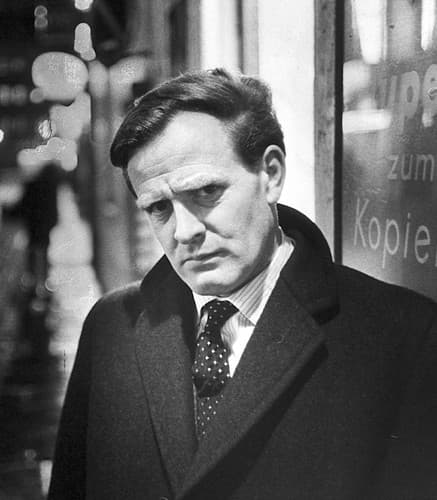
David John Moore Cornwell, better known by his pen name John le Carré, was a British and Irish author, best known for his espionage novels, many of which were successfully adapted for film or television. "A sophisticated, morally ambiguous writer", he is considered one of the greatest novelists of the postwar era. During the 1950s and 1960s he worked for both the Security Service (MI5) and the Secret Intelligence Service (MI6).
Support the author — grab the full book.
As an Amazon Associate, BookBrief earns from qualifying purchases, at no extra cost to you. How we're funded.