
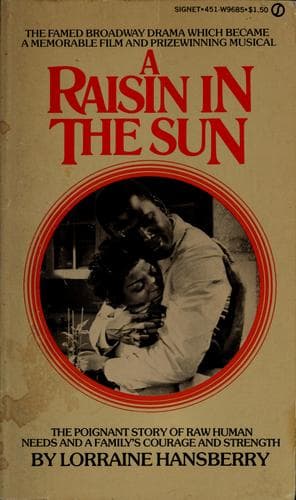
Synopsis
Covers the whole plot, including the ending.
- Difficulty
- Easy
- Read it if
- You're interested in classic American plays, stories about racial discrimination and economic struggle, the complexities of family dynamics, and the pursuit of dreams in the face of adversity. It's a powerful and poignant exploration of the African American experience in the mid-20th century.
- Skip it if
- You prefer fast-paced thrillers or lighthearted comedies. While not without its moments of humor, the play deals with serious themes and can be emotionally heavy.
A Raisin in the Sun Plot Summary
Covers the whole plot, including the ending.
The Lingering Check and Dreams Deferred
The Younger family, residing in a cramped, dilapidated apartment on Chicago's South Side in the 1950s, is eagerly anticipating a $10,000 life insurance check following the death of the patriarch, Walter Younger Sr. Each family member harbors distinct dreams for how this money will alleviate their financial struggles and improve their lives. Matriarch Lena (Mama) dreams of buying a house, Walter Lee Jr. yearns to invest in a liquor store, and Beneatha hopes to fund her medical school education. This initial anticipation sets the stage for the family's differing aspirations and the inevitable conflicts that arise from them.
Mama's Decision and Walter's Disappointment
When the check finally arrives, Lena, prioritizing family stability and a better environment, uses a significant portion of it as a down payment on a house in Clybourne Park, an entirely white, middle-class neighborhood. She allocates $3,000 for Beneatha's medical education and gives the remaining $3,500 to Walter, instructing him to deposit it in a savings account, with some for Beneatha's tuition. Walter, who had desperately hoped to invest all the money in a liquor store with his friends Willy Harris and Bobo, feels deeply betrayed and emasculated by his mother's decision, leading to a period of profound despondency and increased drinking.
Beneatha's Cultural Awakening and Romantic Pursuits
Beneatha Younger, a college student, is on a journey of self-discovery, exploring her African heritage through her relationship with Joseph Asagai, a Nigerian student who encourages her to embrace her roots. She also dates George Murchison, a wealthy, assimilationist African American man who represents the antithesis of Asagai's ideals. Beneatha grapples with her identity, her aspirations to become a doctor, and her romantic choices, which reflect her intellectual and cultural awakening, often clashing with her family's more traditional views and expectations.
Walter's Desperation and Reckless Investment
Feeling increasingly stifled and disrespected, Walter, despite Mama's explicit instructions, succumbs to the allure of quick wealth. He gives all of the remaining $6,500 – including Beneatha's medical school fund – to Willy Harris, his supposed business partner, for the liquor store investment. Walter believes this venture is his last chance to achieve financial independence and prove his worth as a man, a decision born out of his deep-seated frustrations and a misguided attempt to fulfill his deferred dreams.
The Loss and Crushing Reality
The family's fragile hope is shattered when Bobo, Walter's other business partner, arrives with devastating news: Willy Harris has disappeared with all the investment money, including Beneatha's tuition. This catastrophic loss plunges the Younger family into despair, particularly Walter, who is overwhelmed by guilt and shame. The dream of the liquor store, and Beneatha's medical education, evaporates, leaving the family in an even more precarious financial position and threatening to unravel their plans for a new home.
Karl Lindner's Offer and Racial Prejudice
Amidst their personal tragedy, the family receives a visit from Karl Lindner, a representative from the Clybourne Park Improvement Association. Lindner, under the guise of neighborly concern, offers to buy the house from the Youngers at a profit, openly admitting that the white residents do not want a Black family moving into their neighborhood. This blatant display of racial prejudice and systemic discrimination forces the Youngers to confront the external forces that threaten their aspirations and dignity, adding another layer of conflict to their struggles.
Walter's Moment of Temptation
Overwhelmed by his failure and the family's dire financial straits, Walter, in a moment of profound weakness and desperation, contemplates accepting Lindner's offer. He plans to bring his son, Travis, to witness the transaction, hoping to teach him a harsh lesson about survival in a racist world and perhaps recoup some of their lost money. This consideration marks Walter's lowest point, where his dreams are shattered, and he is willing to compromise his family's pride and integrity for financial relief, much to Mama's dismay.
Mama's Intervention and Walter's Reawakening
Seeing Walter's moral decline, Mama intervenes, reminding him of his father's hard work, dignity, and the legacy he represents. She implores him to remember the family's pride and the importance of standing up for what is right, rather than succumbing to despair and racial prejudice. This powerful appeal, coupled with the silent presence of Travis, sparks a profound reawakening in Walter, forcing him to confront his values and the meaning of true manhood beyond material wealth.
Walter's Stand for Dignity
When Karl Lindner returns, Walter, having undergone a significant transformation, gathers his family and, with newfound conviction, rejects the buyout offer. He articulates, with quiet dignity, that his family is a proud, hardworking people who have earned the right to live wherever they choose. This pivotal moment signifies Walter's reclamation of his manhood, his embrace of his family's values, and a defiant stand against racial discrimination, demonstrating a powerful commitment to their future.
The Move to Clybourne Park
Despite the financial setbacks and the looming threat of racial hostility in Clybourne Park, the Younger family, now more united and resilient than ever, prepares to move into their new home. Mama, holding her cherished plant, symbolizes their enduring hope and the nurturing of their dreams. The play concludes with the family leaving their old apartment, ready to face the challenges of their new life with courage and an unwavering belief in their collective future, having found strength in their unity and dignity.
Principal Figures
Lena 'Mama' Younger
Matriarch
The unwavering moral compass and foundation of the Younger family.
Lena, affectionately known as Mama, is the deeply religious and morally steadfast matriarch of the Younger family. She is practical, hardworking, and deeply rooted in traditional values, prioritizing family unity, dignity, and a better life for her children and grandson. Her dream is to own a house with a garden, a symbol of stability and growth. Mama often struggles to understand her children's modern aspirations, particularly Walter's ambition for quick money, but her love and wisdom ultimately guide the family through their trials. She embodies resilience and an unwavering faith in the future.
Relationships: Walter Lee Younger Jr. (Son; often at odds due to differing visions for the family's future, but deeply loved.); Beneatha Younger (Daughter; supportive of her education, but sometimes bewildered by her modern views.); Ruth Younger (Daughter-in-law; a close confidante and source of mutual support.); Travis Younger (Grandson; dotes on him, representing the future generations.)
Walter Lee Younger Jr.
Protagonist
A dreamer yearning for financial independence and respect, often frustrated by his circumstances.
Walter Lee Younger Jr. is a chauffeur in his mid-thirties, consumed by a burning desire to escape his impoverished existence and achieve financial success. He dreams of investing in a liquor store, believing it will provide him with the respect, power, and independence he craves. Walter often feels emasculated and overlooked, leading to frustration, heavy drinking, and strained relationships with his family, particularly Mama and Ruth. His journey is one of profound internal conflict, struggling between his materialistic desires and his deeper moral obligations to his family.
Relationships: Lena 'Mama' Younger (Mother; frequently clashes over money and life choices, but deeply respects her.); Ruth Younger (Wife; their marriage is strained by their financial woes and his perceived failures.); Beneatha Younger (Sister; often teases and argues with her, but also seeks her respect.); Travis Younger (Son; loves him deeply and wants to provide a better life for him.)
Ruth Younger
Wife and Mother
A weary but resilient woman striving to hold her family together.
Ruth Younger is Walter's wife and Travis's mother, a pragmatic and long-suffering woman in her early thirties. She works tirelessly as a domestic servant, constantly trying to maintain peace and order within the cramped apartment and her strained marriage. Ruth is weary from the endless struggle against poverty and her husband's unfulfilled ambitions. Her primary concern is the well-being of her son and the stability of her family. She quietly endures much, but her resilience and deep love for her family shine through, particularly in her efforts to support their move.
Relationships: Walter Lee Younger Jr. (Husband; their relationship is tense due to financial stress and his dissatisfaction, but they share a deep history.); Travis Younger (Son; her primary concern and motivation for a better life.); Lena 'Mama' Younger (Mother-in-law; shares a close, supportive bond with her.); Beneatha Younger (Sister-in-law; generally supportive and understanding of her.)
Beneatha Younger
Student and Seeker
An aspiring doctor searching for identity and purpose beyond societal expectations.
Beneatha, known as Bennie, is Lena's daughter and Walter's younger sister, a college student with intellectual aspirations to become a doctor. She is a fiercely independent and articulate woman, constantly challenging societal norms and her family's traditional views. Beneatha explores her identity through various hobbies, including guitar and photography, and delves into her African heritage, rejecting assimilationist ideals. She is ambitious, sometimes idealistic, and determined to forge her own path, often clashing with Walter's materialism and Mama's conventionality, yet deeply committed to her family.
Relationships: Lena 'Mama' Younger (Mother; loves and respects her, but often finds her modern views challenging.); Walter Lee Younger Jr. (Brother; often bickers and argues with him, particularly over money and ambition.); Joseph Asagai (Suitor/Mentor; encourages her cultural awakening and proposes marriage.); George Murchison (Suitor; represents an assimilationist path she ultimately rejects.)
Travis Younger
Child
The innocent hope and future of the Younger family.
Travis is Walter and Ruth's ten-year-old son, a bright and observant boy who often witnesses the adult struggles around him. He represents the innocent hope for the future and is a significant motivator for all the adults' dreams. Travis is often used by Walter as a symbol of his desire to provide for his family, and his presence often brings out the best in his father. He is a constant reminder of what the Younger family is fighting for – a better life for the next generation, free from the constraints of poverty and prejudice.
Relationships: Walter Lee Younger Jr. (Father; deeply loved and a primary motivation for Walter's ambitions.); Ruth Younger (Mother; cared for and protected by her.); Lena 'Mama' Younger (Grandmother; cherished and doted upon.)
Joseph Asagai
Beneatha's Suitor/Mentor
A Nigerian student who inspires Beneatha's exploration of African identity.
Joseph Asagai is a Nigerian college student who is romantically interested in Beneatha. He is intelligent, articulate, and deeply proud of his African heritage, encouraging Beneatha to embrace her roots and reject assimilation. Asagai serves as a foil to George Murchison, representing a path of cultural pride and intellectual depth. He challenges Beneatha's idealism, urging her to commit to her dreams even in the face of adversity, and ultimately offers her a new beginning in Nigeria, symbolizing a future beyond American racial confines.
Relationships: Beneatha Younger (Romantic interest and intellectual mentor; inspires her cultural awakening.)
George Murchison
Beneatha's Suitor
A wealthy, assimilationist African American man who represents a different path for Beneatha.
George Murchison is a wealthy, educated African American man who dates Beneatha. He represents the assimilationist perspective, embracing white American culture and dismissing Beneatha's interest in her African heritage as frivolous. George is superficial, arrogant, and more concerned with appearances and social status than intellectual pursuits or racial identity. He serves as a stark contrast to Joseph Asagai and highlights Beneatha's struggle to define her own path, ultimately being rejected for his lack of understanding and depth.
Relationships: Beneatha Younger (Romantic interest; their relationship is fraught with intellectual and cultural disagreements.)
Karl Lindner
Antagonist
The white representative of the Clybourne Park Improvement Association.
Karl Lindner is a polite but insidious white man who represents the Clybourne Park Improvement Association. He visits the Youngers to offer them money to not move into the white neighborhood, thinly veiling his racial prejudice under the guise of community harmony and property values. Lindner embodies the systemic racism and housing discrimination prevalent in 1950s America, forcing the Youngers to confront external forces that threaten their dignity and dreams. He is the face of institutionalized bigotry.
Themes & Insights
The American Dream and Deferred Dreams
The play profoundly explores the elusive nature of the American Dream for African Americans in the 1950s. Each Younger family member harbors a distinct dream—Mama's house, Walter's business, Beneatha's medical career—all contingent on the insurance money. The narrative highlights how societal barriers like racism and poverty constantly defer or even crush these aspirations, forcing the characters to redefine success and happiness amidst systemic injustice. The central question is whether the American Dream is truly accessible to all, or if it remains a 'dream deferred,' as Langston Hughes's poem suggests.
“What happens to a dream deferred? / Does it dry up / like a raisin in the sun?”
Family and Identity
Family is the bedrock of the play, with its members constantly navigating their individual aspirations against their collective identity and loyalty. The cramped apartment symbolizes their shared struggles and interdependence. Conflicts arise from differing visions for the future, but ultimately, the play emphasizes the power of family unity, mutual respect, and shared dignity in overcoming adversity. The Youngers learn that their strength lies not just in individual success, but in their collective identity and unwavering support for one another, especially in the face of external prejudice.
“We don't want to make no trouble for nobody or fight no causes, but we will try to be good neighbors. That's all we got to say. We don't want your money.”
Racial Discrimination and Social Justice
The play unflinchingly exposes the pervasive racial discrimination faced by African Americans in mid-20th century America. From their dilapidated living conditions to the overt racism of Karl Lindner and the Clybourne Park Improvement Association, the Youngers constantly confront systemic injustice. The decision to move into a white neighborhood becomes a powerful act of defiance and a fight for social justice, asserting their right to equality and dignity. The play critiques the hypocrisy of a society that preaches freedom while denying basic rights based on race.
“Negroes are a cheerful people, and they have so much to be cheerful about.”
Manhood and Dignity
Walter Lee Younger's journey is central to the exploration of manhood. He struggles with feelings of emasculation due to his low-paying job and lack of financial power, believing that money is the sole measure of a man's worth. His desperate pursuit of the liquor store is an attempt to reclaim his dignity and provide for his family. Ultimately, Walter learns that true manhood lies not in material wealth, but in integrity, moral courage, and the ability to stand up for his family's pride and values, especially in the face of adversity.
“There is always something left to love. And if you ain't learned that, you ain't learned nothing.”
The Importance of Home and Belonging
The desire for a home—a place of stability, belonging, and growth—is a central driving force, particularly for Mama. The cramped apartment symbolizes their confinement and deferred aspirations, while the dream of a house in Clybourne Park represents not just physical space, but dignity, opportunity, and a better future for the Younger generations. The family's unwavering decision to move, despite the racist opposition, asserts their right to define their own sense of home and belonging, regardless of societal prejudice, making the house a symbol of their collective triumph and hope.
“Seem like God didn't see fit to give the black man nothing but dreams – but He did give us children to make them dreams seem worthwhile.”
Plot Devices & Literary Techniques
Mama's Plant
A symbol of hope, nurture, and the family's enduring dreams.
Mama's small, struggling plant is a powerful symbol throughout the play. It represents her unwavering hope for a better future, her nurturing spirit, and her persistent efforts to cultivate life and growth even in the most barren conditions (the sunless apartment). The plant's survival against the odds mirrors the Younger family's own resilience and their determination to thrive despite their impoverished environment and societal challenges. It is the first thing Mama takes with her when they leave for the new house, signifying the continuation of their dreams.
The Insurance Check
A catalyst for conflict and a test of family values.
The $10,000 life insurance check from Walter Younger Sr.'s death serves as the central catalyst for the entire plot. It represents both a potential salvation and a source of profound conflict. The differing aspirations for the money—Mama's house, Walter's liquor store, Beneatha's education—expose the family's individual dreams and create deep divisions. The check ultimately tests their values, forcing them to confront their priorities and ultimately decide what truly constitutes a 'better life' for the Younger family, leading to both despair and eventual triumph.
The New House in Clybourne Park
A symbol of the American Dream, dignity, and a battleground for racial equality.
The house in Clybourne Park is more than just a dwelling; it symbolizes the Younger family's aspiration for the American Dream, their desire for dignity, and a tangible step towards social advancement. Its location in an all-white neighborhood immediately transforms it into a battleground for racial equality, forcing the family to confront systemic prejudice directly. The house represents a place where the Youngers can finally grow and thrive, free from the confines of their old life, making their decision to move a profound act of courage and self-determination.
A Raisin in the Sun Quotes
“Walter: We one group of men tied to a race of women with small minds.”
“Mama: There is always something left to love. And if you ain't learned that, you ain't learned nothing.”
“Beneatha: I just can't get excited about no men. I'm too busy thinking about my future.”
“Ruth: Eat your eggs, Walter.”
“Mama: Son—I come from five generations of people who was slaves and sharecroppers—but ain't nobody in my family never let nobody pay 'em no money that was a way of telling us we wasn't fit to walk the earth. We ain't never been that poor.”
“Walter: I want to make a transaction. I'm going to get my license and I'm going to open up a liquor store.”
“Beneatha: What do you want from me, Brother—that I give up my dream and marry some rich man?”
“Mama: Seems like God didn't see fit to give the black man nothing but dreams—but He did give us children to make them dreams come true.”
“Mr. Lindner: What I am trying to say is that we feel that most of you people—for the most part, are happier when you live in your own communities.”
“Walter: My son said, 'Daddy, what's with your eyes?' I said, 'Son, I'm a man!'”
“Mama: When you starts measuring somebody, measure him right, child, measure him right. Make sure you done taken into account what hills and valleys he come through before he got to wherever he is.”
“Beneatha: I'm going to be a doctor. I'm not going to be a nurse.”
“Walter: We don't want to make no trouble for nobody or fight no causes, and we will try to be good neighbors. And that's all we got to say about that. We don't want your money.”
Quiz
10 questions on the plot and the characters. Each answer comes with a short explanation.
Question 1
What is the name of the Younger family's deceased patriarch, whose life insurance check is central to the play's plot?
- Walter Younger Sr.
- Beneatha Younger
- George Murchison
- Joseph Asagai
Show answer
A. Walter Younger Sr. The life insurance check comes from the death of Walter Younger Sr., the husband of Lena Younger (Mama) and father to Walter Lee and Beneatha.
Question 2
What is Lena Younger's (Mama's) dream for how to use the insurance money?
- To open a liquor store with Walter
- To buy a house with a yard for Travis
- To fund Beneatha's medical school tuition
- To invest in a dry cleaning business
Show answer
B. To buy a house with a yard for Travis Mama's primary dream is to buy a house, a long-held aspiration for her family to escape their crowded apartment and have a better life.
Question 3
What does Walter Lee Younger desperately want to do with the insurance money?
- Buy a new car
- Invest in a liquor store
- Travel the world
- Start a new career as a musician
Show answer
B. Invest in a liquor store Walter sees the liquor store as his only path to financial independence and respect, a dream he tries to convince his family to support.
Question 4
Which character represents the struggles of a young Black woman trying to find her identity and pursue higher education?
- Ruth Younger
- Lena Younger (Mama)
- Beneatha Younger
- Mrs. Johnson
Show answer
C. Beneatha Younger Beneatha is an aspiring doctor who explores her African heritage and struggles with societal expectations and her own self-discovery.
Question 5
What is the name of the white neighborhood into which the Younger family plans to move?
- Clybourne Park
- Lincoln Park
- Hyde Park
- Washington Park
Show answer
A. Clybourne Park The Youngers purchase a house in Clybourne Park, a decision that leads to conflict with the neighborhood's white residents.
Question 6
Who is Karl Lindner?
- Beneatha's Nigerian suitor
- Walter's business partner
- A representative from the Clybourne Park Improvement Association
- Ruth's employer
Show answer
C. A representative from the Clybourne Park Improvement Association Karl Lindner visits the Youngers to offer them money to not move into Clybourne Park, representing the systemic racism and segregation of the time.
Question 7
What does Beneatha's African suitor, Joseph Asagai, encourage her to do?
- Marry George Murchison
- Embrace her African heritage and consider moving to Nigeria
- Give up on her dream of becoming a doctor
- Invest in Walter's liquor store
Show answer
B. Embrace her African heritage and consider moving to Nigeria Asagai is a strong influence on Beneatha, encouraging her to connect with her roots and offering her a vision of a life beyond America.
Question 8
What significant personal decision does Ruth Younger contemplate early in the play?
- Leaving Walter
- Having an abortion
- Going back to school
- Moving out on her own
Show answer
B. Having an abortion Ruth discovers she is pregnant and considers abortion due to the family's dire living conditions and financial struggles.
Question 9
What ultimately happens to the portion of the insurance money that Mama entrusts to Walter?
- He successfully invests it in the liquor store, making a profit.
- He uses it to buy Beneatha a medical school scholarship.
- He is swindled out of it by his business partner, Willy Harris.
- He uses it to pay off the family's existing debts.
Show answer
C. He is swindled out of it by his business partner, Willy Harris. Walter's 'friends' Willy Harris and Bobo run off with the investment money, leaving the Youngers devastated.
Question 10
Despite the financial setbacks, what does the Younger family ultimately decide to do regarding the house in Clybourne Park?
- They decide to sell the house and stay in their current apartment.
- They accept Karl Lindner's offer and take the money not to move.
- They decide to move into the house, standing firm against prejudice.
- They use the remaining money to open a new business in their old neighborhood.
Show answer
C. They decide to move into the house, standing firm against prejudice. Motivated by Mama's strength and Walter's newfound resolve, the family collectively decides to move into their new home, asserting their right to live where they choose.
A Raisin in the Sun FAQ
What is the central theme of 'A Raisin in the Sun'?
The central theme revolves around the American Dream and the various obstacles, particularly racial discrimination and economic hardship, that prevent African Americans from achieving it. It explores the dreams and aspirations of each Younger family member and their collective struggle.
Who are the main characters in 'A Raisin in the Sun'?
The main characters are Mama (Lena Younger), her son Walter Lee Younger, his wife Ruth Younger, their son Travis Younger, and Mama's daughter Beneatha Younger. Each character embodies different hopes and frustrations within the family dynamic.
What is the significance of the play's title?
The title 'A Raisin in the Sun' comes from Langston Hughes's poem 'Harlem' (also known as 'Dream Deferred'), which asks what happens to a dream deferred. It symbolizes the dreams and aspirations of the Younger family that have been postponed or dried up due to societal limitations.
What is the primary conflict in the play?
The primary conflict is the Younger family's struggle for a better life and their differing ideas on how to use a $10,000 insurance check from the deceased Mr. Younger's life insurance. This financial decision becomes a catalyst for internal family conflicts and external societal pressures.
How does racial discrimination manifest in the play?
Racial discrimination is evident through the family's inability to secure decent housing in a black neighborhood, leading them to attempt moving into the all-white Clybourne Park. Mr. Lindner's offer to buy them out explicitly highlights the systemic racism and segregation of the era.
What role does Beneatha Younger play in the story?
Beneatha represents the intellectual and aspiring side of the family, pursuing a medical career and exploring her African heritage. Her journey reflects themes of identity, feminism, and the search for purpose beyond traditional expectations for women in the 1950s.
What is the significance of Mama's plant?
Mama's plant symbolizes her enduring hope, her nurturing spirit, and the family's resilience despite harsh conditions. Despite its frail appearance, it persists, much like Mama's dreams for her family's growth and future in a better environment.
How does Walter Lee Younger evolve throughout the play?
Walter Lee undergoes a significant transformation, initially consumed by his desire for financial success and often making poor decisions. He ultimately matures, embracing his role as the head of the family and choosing dignity over money in the face of racial prejudice.
What is the setting of 'A Raisin in the Sun'?
The play is set in the cramped, rundown apartment of the Younger family on the South Side of Chicago during the 1950s. This specific setting underscores the limited opportunities and harsh realities faced by African American families during that era.
Is 'A Raisin in the Sun' based on a true story?
While not a direct true story, Lorraine Hansberry drew heavily from her own family's experiences with housing discrimination when they moved into a white neighborhood in Chicago. The play reflects the broader socio-economic realities and struggles of many African American families.
How does the play address gender roles?
The play subtly addresses traditional gender roles through the aspirations of Ruth and Beneatha, who challenge the expectations placed upon women. Ruth dreams of a stable home, while Beneatha pursues a professional career, highlighting the evolving roles for women in society.
What is the resolution of the play?
The Younger family decides to move into their new house in Clybourne Park despite Mr. Lindner's offer and the threat of racial hostility. While the future is uncertain, their collective decision to stand together and pursue their dream of a better life represents a triumph of dignity and hope.
What makes 'A Raisin in the Sun' a significant work of American literature?
It was the first play by an African American woman to be produced on Broadway, breaking significant barriers. Its powerful exploration of racial discrimination, the American Dream, and family dynamics continues to resonate, making it a timeless and essential piece of American theatre.
Similar books
- Death of a Salesman
Arthur Miller
3.5 (186k) average on GoodreadsFictionBoth plays are iconic American dramas that explore the disillusionment of the American Dream, the struggles of working-class families, and the pressures of societal expectations on individual aspirations.
- Fences
August Wilson
3.9 (18k) average on GoodreadsHistorical FictionThis play, part of Wilson's 'Pittsburgh Cycle,' also delves into the lives of a Black family in the mid-20th century, examining themes of race, family legacy, dreams, and the impact of societal limitations on personal ambition.
- The Glass Menagerie
Tennessee Williams
3.7 (112k) average on GoodreadsFictionBoth plays feature strong female characters and explore the suffocating nature of family expectations, the fragility of dreams, and the yearning for escape from challenging circumstances.
- Harry Potter and the Sorcerer's Stone
J.K. Rowling
4.5 (7M) average on GoodreadsFantasyRescued from a miserable life under the stairs, an orphaned boy discovers he's a wizard destined for a magical school, where he uncovers a dangerous secret tied to the dark wizard who murdered his parents.
- The Hunger Games
Suzanne Collins
4.3 (6.4M) average on GoodreadsFantasyIn a future where children fight to the death on live television, Katniss Everdeen volunteers for the arena, turning a death sentence into a fight for survival and a spark of rebellion.
- Nineteen Eighty-Four
George Orwell
4.2 (5.5M) average on GoodreadsFictionWinston Smith dreams of truth and rebellion in a world where Big Brother watches all, but he confronts the terrifying power of a regime that controls not just actions, but thoughts.





Enjoyed the summary?
A summary gives you the shape of the book. The book itself has the detail, the examples and the voice.
Find A Raisin in the Sun on AmazonAs an Amazon Associate, BookBrief earns from qualifying purchases. How we're funded