
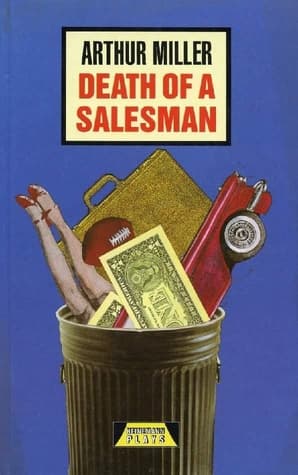
Synopsis
Covers the whole plot, including the ending.
- Difficulty
- Medium
- Pacing
- Moderate
- Mood
- Tragic, Melancholy, Reflective, Intense
- Read it if
- You appreciate classic American plays, stories about the dark side of the American Dream, or character studies of deeply flawed individuals.
- Skip it if
- You prefer lighthearted stories, fast-paced plots with clear resolutions, or find themes of failure and disillusionment too depressing.
Death of a Salesman Plot Summary
Covers the whole plot, including the ending.
Willy's Weariness and Failed Hopes
Willy Loman, a sixty-three-year-old traveling salesman, comes home to Brooklyn unexpectedly. He is very tired and recently had a near-accident. His wife, Linda, worries about his mental state, noticing his odd behavior and memory loss. Willy admits he can no longer drive long distances and is losing focus. Their two adult sons, Biff and Happy, are also home. Biff, thirty-four, has returned from working on farms out West, feeling lost. Happy, thirty-two, works as an assistant buyer but feels unhappy despite his womanizing. The family talks about Willy's falling sales and money problems. Willy holds onto his past successes and exaggerated stories.
A Father's Disappointment and Sons' Struggles
Willy thinks about the past, remembering Biff's high school athletic skills and popularity, and compares it to Biff's current lack of drive. He often criticizes Biff for not having a steady job, but also encourages him to pursue big, unclear business ideas. Biff and Happy, hearing their parents, discuss their own worries. Biff feels he has wasted his life and resents his father's unrealistic expectations and 'fake' values. Happy, despite his job and apparent success, says he feels lonely and empty, constantly seeking approval through women and small work achievements. They decide to try and make their father proud.
The Illusion of Success and Charley's Generosity
Flashbacks show Willy's past talks with his neighbor, Charley, and Charley's son, Bernard. Willy often mocked Bernard's studiousness while praising Biff's athletic charm, believing it would lead to greater success. In the present, Charley visits, worried about Willy. He offers Willy a job, understanding his difficulties, but Willy's pride stops him from taking it. Instead, he borrows money from Charley every week, pretending it is his salary. Willy remembers a painful event where Biff found him with another woman in Boston. This shattered Biff's admiration for his father and changed their relationship.
Willy's Desperate Plea and Dismissal
Willy, wanting a change, visits his young boss, Howard Wagner, hoping for an office job that does not require travel. He tries to impress Howard with stories of his past sales and his close relationship with Howard's father, Frank Wagner, the company's founder. However, Howard is not interested, caring more about his new wire recorder than Willy's requests. Howard reminds Willy that the business has changed and his sales are no longer profitable. Despite Willy's emotional pleas and poor health, Howard fires him, telling him to take a leave of absence without pay, ending his career.
A Plea for Help and a Harsh Reality
After being fired, a distressed Willy goes to Charley's office to borrow money, as he does weekly, but this time it is not for a salary. Charley tries to offer Willy a job again, which Willy again refuses due to pride. Willy is amazed by Charley's success and how Charley never needed to be 'liked' to achieve it, unlike Willy's own belief. While there, Willy sees Bernard, now a successful lawyer about to argue a case before the Supreme Court. Bernard gently asks Willy about what happened to Biff after high school, hinting at the Boston incident and Biff's later academic failure.
The Restaurant Disaster
Biff and Happy meet Willy at a restaurant. They plan to tell him about Biff's failed meeting with Oliver. However, Biff cannot lie and admits that Oliver did not remember him and he stole Oliver's pen. Willy, already upset from being fired, cannot handle this failure and retreats into a delusional flashback to the Boston hotel room. Embarrassed and frustrated, Happy tries to distract Willy by introducing him to women, while Biff, seeing the pointlessness of their efforts, leaves angrily. Happy follows, leaving a confused and alone Willy in the restaurant.
Linda's Outrage and Biff's Truth
The boys return home to find Linda very angry. She scolds them for leaving their father and reveals that Willy has been thinking about suicide, detailing the gas hose she found and removed. Biff, overcome by guilt and frustration, confronts Willy. He tries to make Willy face the truth about his life—that he is not a great salesman, that Biff is not meant for greatness, and that they are all 'low-men' who need to stop living a lie. Biff tearfully holds up the rubber hose, forcing Willy to confront his suicide attempts.
A Final, Tragic Decision
During the intense argument, Biff breaks down, crying and hugging Willy, saying he loves his father despite everything. This moment of real affection deeply moves Willy, who misinterprets Biff's emotional outburst as a sign that Biff still cares and will become a successful man. Willy believes that Biff will finally be 'magnificent' if he has an inheritance. Convinced that his life insurance policy will give Biff the money he needs to succeed, Willy imagines a final conversation with his beloved older brother, Ben, who tells him to make a 'diamond' out of his life. Willy then gets into his car and crashes it on purpose.
The Requiem
The play ends with Willy's funeral. Only Linda, Biff, Happy, Charley, and Bernard are there—a clear contrast to Willy's exaggerated claims of popularity. Linda, confused and heartbroken, wonders why Willy would die when they were finally out of debt. Biff says that Willy 'never knew who he was,' recognizing his father's mistaken pursuit of superficial success. Happy, however, promises to continue Willy's dream, believing it is the only way to honor him. Charley, offering the most thoughtful eulogy, says that 'a salesman has got to dream,' acknowledging the sadness of Willy's job and his great need to believe in something.
Death of a Salesman Characters
Willy Loman
Protagonist
A sixty-three-year-old traveling salesman, grappling with past failures and a crumbling present.
Willy is a man consumed by the American Dream, believing that likeability and charisma are the keys to success. He lives in a world of self-delusion, constantly exaggerating his accomplishments and those of his sons, particularly Biff. His mind frequently drifts between the present and fragmented memories of the past, making it difficult for him to face reality. He desperately seeks validation and struggles with feelings of inadequacy, often projecting his own unfulfilled ambitions onto his sons. His pride prevents him from accepting help, leading to his tragic downfall.
Relationships: Linda Loman (Wife, devoted and supportive, but also enabling of his delusions); Biff Loman (Eldest son, whom Willy idealizes and projects his dreams onto, leading to conflict); Happy Loman (Younger son, who seeks Willy's attention and validation but is largely ignored); Charley (Neighbor and friend, who is a successful businessman and offers Willy help, often met with resentment); Ben Loman (Older brother, a symbol of Willy's missed opportunities and a figure in his hallucinations)
Linda Loman
Supporting
Willy's devoted and long-suffering wife, who tries to protect him from harsh realities.
Linda is the emotional anchor of the Loman family, deeply loving and fiercely protective of Willy. She is acutely aware of Willy's mental deterioration and his suicidal tendencies, often making excuses for his behavior and shielding him from criticism. While her devotion is unwavering, she also inadvertently enables Willy's delusions by not challenging his unrealistic expectations. She represents the quiet strength and endurance of a woman trying to hold her family together amidst financial and emotional turmoil, ultimately heartbroken by Willy's tragic end.
Relationships: Willy Loman (Husband, whom she loves and protects unconditionally); Biff Loman (Son, whom she wants to see succeed and reconcile with his father); Happy Loman (Son, whom she worries about but also relies on for support)
Biff Loman
Supporting
Willy's eldest son, a former high school football star now struggling with identity and purpose.
Biff is thirty-four and deeply conflicted. Once Willy's golden boy, he has been unable to find lasting success or a meaningful career after failing math in high school and discovering Willy's affair. He feels trapped by his father's unrealistic expectations and the 'fake' values Willy instilled in him. Biff yearns for a simpler, more authentic life working with his hands, but struggles to break free from his father's influence and the pressure to achieve conventional success. He represents the crushing weight of unfulfilled potential and the struggle for self-discovery.
Relationships: Willy Loman (Father, whose approval he desperately seeks but whose values he ultimately rejects); Linda Loman (Mother, whom he loves and feels guilty for hurting); Happy Loman (Brother, with whom he shares a bond but also has differing views on life)
Happy Loman
Supporting
Willy's younger son, an assistant buyer who seeks validation through women and superficial success.
Happy, thirty-two, outwardly appears more successful than Biff, holding a steady job as an assistant buyer. However, he is deeply lonely and unfulfilled, constantly seeking attention and validation through womanizing and minor professional victories. He feels overlooked by Willy, who always favored Biff, and tries to gain his father's approval by promising to fulfill Willy's dreams. Despite seeing the destructive nature of Willy's illusions, Happy ultimately embraces them, vowing to continue his father's legacy, perhaps out of a desperate need to feel significant.
Relationships: Willy Loman (Father, whose attention and approval he constantly seeks); Linda Loman (Mother, whom he cares for but often disappoints); Biff Loman (Brother, with whom he shares a complex relationship of rivalry and camaraderie)
Charley
Supporting
Willy's successful and pragmatic neighbor, who offers him genuine friendship and financial aid.
Charley is Willy's foil: a successful, no-nonsense businessman who embodies practical, hard-earned success, rather than Willy's charismatic but ultimately hollow version. He genuinely cares for Willy, offering him a job and lending him money weekly, despite Willy's prideful refusals and frequent insults. Charley represents the quiet dignity of a man who understands the harsh realities of life and offers help without judgment. He is the voice of reason and reality, a stark contrast to Willy's delusional world.
Relationships: Willy Loman (Neighbor and friend, to whom he offers unwavering support despite Willy's resentment); Bernard (Son, a successful lawyer, whose achievements highlight Willy's misplaced values)
Bernard
Supporting
Charley's son, who grows from a studious boy into a successful lawyer, contrasting with the Loman boys.
Bernard is initially portrayed as a nerdy, studious boy whom Willy dismisses as unpopular, while praising Biff's athletic prowess. However, Bernard proves Willy's values wrong by becoming a highly successful and well-respected lawyer, about to argue a case before the Supreme Court. He serves as a direct contrast to Biff and Happy, demonstrating that hard work and intellect, rather than 'personality' or superficial charm, lead to true achievement. He is kind and concerned for Willy and Biff, gently trying to understand Biff's downfall.
Relationships: Charley (Father, who is proud of his son's achievements); Willy Loman (Neighbor, for whom he feels concern despite Willy's past dismissiveness); Biff Loman (Childhood friend, whose decline he tries to understand)
Ben Loman
Mentioned/Symbolic
Willy's deceased older brother, a symbol of missed opportunities and ruthless success.
Ben appears only in Willy's hallucinations and flashbacks. He represents the path Willy didn't take—one of ruthless, almost accidental, accumulation of wealth through venturing into the Alaskan wilderness. Ben is a symbol of wild, untamed success, often associated with diamonds and immediate riches. Willy idolizes him, seeing him as a figure of strength and material achievement, and frequently seeks his advice in his troubled mind. Ben's presence fuels Willy's delusions and his belief that a man can become rich quickly through sheer will, without hard work or integrity.
Relationships: Willy Loman (Brother, whom Willy idolizes and whose memory haunts him)
The Woman
Supporting
A woman with whom Willy had an affair, representing his infidelity and the shattering of Biff's idealism.
The Woman appears only in Willy's flashbacks. She is a buyer for a company in Boston, with whom Willy has an affair while on a sales trip. Her laughter and the stockings she receives from Willy symbolize his infidelity and the superficiality of his 'success' on the road. Her presence is crucial as she is discovered by a young Biff in Willy's hotel room, an event that profoundly traumatizes Biff, leading to his disillusionment with his father and his subsequent academic and life failures. She represents the hidden, destructive side of Willy's life.
Relationships: Willy Loman (Lover, whose affair with Willy destroys Biff's perception of his father)
Howard Wagner
Supporting
Willy's young, impersonal boss, who fires him without sentiment.
Howard is the son of Frank Wagner, the company's founder, and Willy's current boss. He is a young, detached, and pragmatic businessman focused on efficiency and profit. Unlike his father, who had a personal relationship with Willy, Howard has no sentimentality for Willy's long service or past contributions. He is more interested in his new wire recorder than Willy's emotional pleas for a new position. Howard represents the cold, modern corporate world that has no place for Willy's outdated sales methods or personal touch, ultimately firing him without remorse.
Relationships: Willy Loman (Employee, whom he dismisses due to declining sales and lack of relevance)
Death of a Salesman Themes
The American Dream and Its Illusions
The play criticizes the American Dream, especially the version that values material wealth, popularity, and superficial success over hard work, honesty, and self-knowledge. Willy Loman represents this flawed dream, believing that being 'well-liked' is the main way to succeed, rather than actual skill. His life shows the emptiness of this pursuit, as he dies poor and mostly alone, having chased an illusion. Biff, in contrast, eventually rejects this dream, seeking a more authentic, though less materially rich, life.
“He don't put a bolt to a nut, he don't tell you the law or give you medicine. He's a man way out there in the blue, riding on a smile and a shoeshine. And when they start not smiling back—that's an earthquake.”
Father-Son Relationships and Expectations
The difficult relationships between Willy and his sons, Biff and Happy, are central to the play. Willy projects his own unfulfilled goals onto Biff, idealizing him and setting him up for failure by teaching him false values and unrealistic expectations. Biff's discovery of Willy's affair destroys his admiration for his father, leading to resentment and a lifelong struggle for identity. Happy, constantly seeking Willy's attention, is largely overlooked, which leads to his own superficial pursuits. The play explores how parental dreams, when misguided, can harm a child rather than help them.
“I'm not a leader of men, Willy, and neither are you. You were never anything but a hard-working drummer who landed in the ash can I'm a dime a dozen, and so are you!”
Truth vs. Illusion
Willy's inability to tell truth from his own self-serving illusions causes much of the play's sadness. He constantly changes history, exaggerates his successes, and denies his failures, living in a fantasy world of past glories and future potential that never happens. Linda, aware of his delusions, tries to protect him, while Biff desperately tries to make his father face reality. The play suggests that living a lie, even a comforting one, eventually leads to destruction, as the truth eventually appears and breaks the fragile pretense.
“We're free and clear. We're free... We're free...”
Betrayal and Abandonment
Betrayal appears in many ways. Willy betrays Linda through his affair with The Woman, and he betrays Biff's trust, destroying his son's idealism. He also feels betrayed by the company he worked for his whole life, being fired without ceremony by his young boss, Howard. The Loman sons, in turn, abandon Willy at the restaurant, an act that deeply hurts him. This widespread sense of betrayal, both personal and professional, highlights how fragile relationships are and the harshness of a capitalist society that discards people once they are no longer useful.
“You can't just come to a business man and ask him for money. He don't know you. You're not his friend.”
The Price of Capitalism
Arthur Miller criticizes the dehumanizing aspects of unchecked capitalism, where people are valued only for what they produce and then discarded when they are no longer profitable. Willy Loman is a victim of this system, working tirelessly for decades only to be fired without feeling by his young boss, Howard. His identity becomes tied to his job, and without it, he loses his sense of self-worth. The play suggests that a society that prioritizes profit over human dignity leads to spiritual emptiness and sad outcomes for those who cannot adjust or compete.
“You can't eat the orange and throw the peel away—a man is not a piece of fruit!”
Plot Devices & Literary Techniques
Flashbacks/Stream of Consciousness
Willy's mind frequently shifts between past and present, blurring reality.
Miller employs a non-linear narrative structure where Willy's memories and hallucinations seamlessly blend with present-day events. These flashbacks are not chronological but rather triggered by current conversations, objects, or emotions. This device allows the audience direct access to Willy's fragmented mental state, revealing his idealized past, his deep-seated regrets (like the Boston affair), and the origins of his flawed worldview. It emphasizes his inability to escape the past and his struggle to differentiate between what is real and what he wishes were real, contributing to the play's dreamlike and tragic atmosphere.
Symbolism of the House and Yard
The Loman house and its shrinking yard symbolize Willy's diminishing life and dreams.
The Loman house, once surrounded by open space, is now 'boxed in' by towering apartment buildings, casting shadows and preventing sunlight from reaching their yard. This physical encroachment mirrors Willy's psychological confinement and the suffocation of his dreams. The absence of a garden where Willy tries to grow seeds symbolizes his inability to cultivate anything lasting or successful in his life. The house itself becomes a character, representing the fragile facade of the American Dream the Lomans desperately try to maintain, and its eventual freedom from mortgage debt ironically coincides with Willy's death.
The Rubber Hose
A literal object symbolizing Willy's suicidal ideation and his family's awareness.
The rubber hose, which Linda discovers attached to the gas heater, is a powerful and unsettling symbol of Willy's suicidal despair. It appears twice: first when Linda finds and removes it, revealing her knowledge of his attempts, and again when Biff confronts Willy with it. Its presence underscores the severity of Willy's mental breakdown and the silent suffering he endures. It represents his desperate attempts to escape his failures and, ultimately, the means by which he takes his own life, a stark and tangible manifestation of his tragic decision.
The Car
A recurring motif representing Willy's profession, his freedom, and his ultimate demise.
The car is central to Willy's identity as a traveling salesman; it is both his office and his means of livelihood. Initially, it symbolizes freedom and the open road, the promise of the American Dream. However, as Willy ages, the car becomes a source of exhaustion and frustration, contributing to his declining mental state and near-accidents. Ultimately, the car transforms into an instrument of his final, tragic act, as he intentionally crashes it to secure insurance money for his family. It represents the vehicle of his life's journey and its devastating end.
Seeds and Gardening
Willy's futile attempts to plant seeds symbolize his desire for tangible legacy and growth.
Throughout the play, Willy expresses a desire to plant seeds and grow a garden, particularly in the final act before his death. This act symbolizes his yearning for something tangible and lasting, something he can nurture and watch grow, in contrast to his ephemeral career as a salesman. His lament about not having anything 'to show for it' and his desperate attempt to plant seeds in the dark before his suicide highlight his unfulfilled desire for a legacy and a sense of rootedness. The barrenness of his yard reflects the barrenness of his life's achievements.
Death of a Salesman Quotes
“I spoke to your father today, he's coming home.”
“Willy Loman never made a lot of money. His name was never in the paper. He's not the finest character that ever lived. But he's a human being, and a terrible thing is happening to him. So attention must be paid. He's not to be allowed to fall into his grave like an old dog. Attention, attention must be finally paid to such a person.”
“He's liked, but he's not well liked.”
“The only thing you got in this world is what you can sell. And the funny thing is that you're a salesman, and you don't know that.”
“I'm not a dime a dozen! I am Willy Loman, and you are Biff Loman!”
“He's got a job, Linda, he's making forty dollars a week!”
“We're free and clear. We're free... We're free...”
“I don't say he's a great man. Willy Loman never made a lot of money. His name was never in the paper. He's not the finest character that ever lived. But he's a human being, and a terrible thing is happening to him. So attention must be paid. He's not to be allowed to fall into his grave like an old dog. Attention, attention must be finally paid to such a person.”
“He's got a couple of bucks in his pocket. He's got a couple of dollars in his pocket. He's got a couple of dollars, and he's going to be a big shot!”
“I'm not a leader of men, Willy, and neither are you. You were never a salesman. You were a good carpenter.”
“You can't eat the orange and throw the peel away—a man is not a piece of fruit!”
“Why must everybody conquer the world? You're not Ben. You're not a big man in Alaska, you're not a leader of men.”
“The woods are burning! I can't see the sky! There's no sun where you're going!”
“He had the wrong dreams. All, all wrong.”
“I'm gonna show you and everybody else that Willy Loman did not die in vain. He had a good dream. It's the only dream you can have—to come out number one man. He fought it out here, and this is where I'm gonna win it for him.”
Quiz
10 questions on the plot and the characters. Each answer comes with a short explanation.
Question 1
What is the primary reason Willy Loman returns home early at the beginning of the play?
- He forgot important sales samples at home.
- He was too tired and couldn't concentrate on driving.
- He had a sudden, unexpected meeting with a client.
- He felt ill and needed to see a doctor.
Show answer
B. He was too tired and couldn't concentrate on driving. Willy returns home early because he is exhausted from driving and his mind keeps wandering, making it unsafe for him to continue. This immediately establishes his deteriorating mental and physical state.
Question 2
Which of Willy's sons was once a star high school football player with a promising future?
- Happy
- Biff
- Bernard
- Stanley
Show answer
B. Biff Biff was the star football player, and his potential was a source of great pride and expectation for Willy. His eventual failure to live up to this potential is a major source of conflict and disappointment.
Question 3
What product does Willy Loman sell?
- Insurance policies
- Household appliances
- He sells a variety of goods, but the specific product is never explicitly stated.
- Automobiles
Show answer
C. He sells a variety of goods, but the specific product is never explicitly stated. Arthur Miller intentionally leaves the specific product Willy sells ambiguous. This emphasizes that Willy's identity is tied to the *act* of selling and the persona of a salesman, rather than to any particular commodity.
Question 4
What does Willy frequently fantasize or remember about his older brother, Ben?
- Ben's success as a respected doctor.
- Ben's adventurous journey to Alaska and Africa, where he became rich.
- Ben's advice on how to be a more effective salesman.
- Ben's loyalty and support during Willy's early struggles.
Show answer
B. Ben's adventurous journey to Alaska and Africa, where he became rich. Willy often recalls Ben's sudden and immense wealth gained from diamond mines in Africa and timber in Alaska. Ben represents the path not taken and the dream of easy, spectacular success that Willy constantly yearns for but never achieves.
Question 5
Why does Howard Wagner fire Willy Loman?
- Willy was caught stealing from the company.
- Willy's sales figures have drastically declined, and he is no longer productive.
- Willy refused to relocate to a new territory.
- Willy insulted Howard's family during a meeting.
Show answer
B. Willy's sales figures have drastically declined, and he is no longer productive. Howard fires Willy because he is no longer generating sales and has become a liability. Howard's cold, business-oriented approach highlights the harsh realities of capitalism and Willy's obsolescence.
Question 6
What significant event causes Biff to lose faith in his father and abandon his plans for college?
- Willy confessing he never really liked Biff's football career.
- Biff discovering Willy having an affair in Boston.
- Willy telling Biff he was adopted and not a true Loman.
- Willy losing his job and admitting he was a failure.
Show answer
B. Biff discovering Willy having an affair in Boston. Biff goes to Boston to ask Willy for help with a math class and discovers Willy with 'The Woman' in his hotel room. This revelation shatters Biff's idealized image of his father and marks a turning point in their relationship, leading to Biff's disillusionment.
Question 7
What does Charley offer Willy that Willy repeatedly refuses, despite being in dire financial straits?
- A loan to pay off his mortgage.
- A job working for him.
- A new car for his sales trips.
- Advice on how to improve his sales techniques.
Show answer
B. A job working for him. Charley repeatedly offers Willy a job, which Willy, out of pride and a sense of rivalry, always refuses, even while accepting money from Charley to pay his bills. This highlights Willy's stubborn adherence to his own flawed ideals of success and independence.
Question 8
What is Linda's primary role in the family dynamic, particularly concerning Willy?
- She is the strict disciplinarian for the boys.
- She constantly challenges Willy's delusions and forces him to face reality.
- She is Willy's unwavering supporter and protector, often enabling his fantasies.
- She secretly resents Willy and plans to leave him.
Show answer
C. She is Willy's unwavering supporter and protector, often enabling his fantasies. Linda is Willy's most loyal and devoted supporter. She defends him against his sons' criticisms and tries to shield him from the harsh truths, often at the expense of confronting his delusions, which some critics argue contributes to his tragic downfall.
Question 9
What is the 'final brave action' Willy takes at the end of the play?
- He successfully closes a major deal, securing his job.
- He confronts Howard and demands his job back, successfully getting it.
- He commits suicide by crashing his car, believing the insurance money will benefit Biff.
- He leaves his family to start a new life in Alaska, inspired by Ben.
Show answer
C. He commits suicide by crashing his car, believing the insurance money will benefit Biff. Willy intentionally crashes his car, believing that the life insurance payout will provide Biff with the capital to start his own business and achieve success, thus validating Willy's life and values. This act is central to the play's tragic conclusion.
Question 10
Which of the following themes is NOT central to 'Death of a Salesman'?
- The American Dream and its disillusionment.
- The importance of physical strength and athletic prowess.
- Father-son conflict and the burden of expectations.
- The destructive nature of self-delusion and false values.
Show answer
B. The importance of physical strength and athletic prowess. While Biff's athletic past is a plot point, the theme of 'physical strength and athletic prowess' itself is not central. The play focuses more on the *impact* of Biff's athletic past on Willy's perception of success and Biff's subsequent failure to live up to it. The other options are core themes.
Death of a Salesman FAQ
What is Death of a Salesman about?
Death of a Salesman is about Willy Loman, an aging traveling salesman in his 60s, who faces professional failure and personal disillusionment. The play explores his desperate attempts to reconcile his past dreams of success with his present reality, largely through a series of flashbacks and arguments with his wife, Linda, and two adult sons, Biff and Happy, ultimately leading to his tragic demise.
Why should I read Death of a Salesman?
You should read Death of a Salesman for its timeless exploration of the American Dream's darker side, the devastating impact of societal pressures on individual identity, and the complexities of family relationships. Arthur Miller's powerful dialogue and tragic portrayal of Willy Loman resonate deeply, prompting reflection on ambition, legacy, and self-worth.
What is the background/setting of Death of a Salesman?
The play is primarily set in the Loman family's small, increasingly encroached-upon house and yard in Brooklyn, New York, during the late 1940s. The setting reflects Willy's declining fortunes and the changing urban landscape, often shifting seamlessly between present reality and Willy's vivid, often idealized, memories and fantasies.
What are the most memorable quotes?
Memorable quotes include Linda's poignant plea, 'Attention, attention must be finally paid to such a person,' highlighting Willy's need for recognition. Also, Willy's own 'He's a man way out there in the blue, riding on a smile and a shoeshine,' encapsulates the precarious nature of his profession and identity.
What writing style does the author use?
Arthur Miller employs a dramatic style characterized by non-linear storytelling, blending present action with extensive flashbacks and imagined scenes that often blur the lines of reality for Willy. The dialogue is realistic yet poetic, revealing deep psychological states and societal critiques, making the play a seminal example of American realism.
What minor details add significant meaning?
The refrigerator breaking down, the car frequently needing repairs, and the house's dwindling garden space all symbolize Willy's deteriorating life and the erosion of his dreams. These recurring domestic failures mirror his professional and personal collapse, emphasizing his inability to maintain his material or emotional world.
What are some subtle foreshadowing moments?
Early mentions of Willy's erratic driving and his near-accidents subtly foreshadow his eventual death, suggesting his mental instability and increasing desperation. Furthermore, his fixation on the expensive life insurance policy and his discussions about 'going out with a bang' hint at his ultimate tragic decision.
What unexpected character connections exist?
While not entirely 'unexpected' in a plot twist sense, the deep, almost symbiotic connection between Willy and his older brother Ben, who appears only in Willy's fantasies, reveals Willy's yearning for a life of bold, uncomplicated success, contrasting sharply with his own struggles. Ben represents an alternative path Willy never took, constantly haunting his consciousness.
What are unspoken character motivations?
Willy's unspoken motivation is a profound fear of insignificance and being forgotten, driving his relentless pursuit of 'likability' and material success, even when it's clearly unattainable. Biff's unspoken motivation is a desperate desire to escape his father's suffocating expectations and find an authentic life, even if it means confronting harsh truths.
What psychological complexities do characters exhibit?
Willy Loman exhibits severe cognitive dissonance, constantly reinterpreting his past to fit his idealized self-image and avoid confronting his failures. Biff struggles with identity formation, torn between his father's grandiose projections and his own desire for a simpler, more honest existence, leading to deep internal conflict and resentment.
What are the major emotional turning points?
A major emotional turning point is Biff's realization during his visit to Bill Oliver's office that he was never truly 'partners' with Oliver, shattering his last illusion of future success. Another is Biff's climactic confrontation with Willy, where he tearfully pleads for his father to 'take off that phony dream and face the truth,' sparking a moment of clarity for Willy.
How do relationship dynamics evolve?
The relationship between Willy and Biff deteriorates from an idealized father-son bond in Willy's flashbacks to one of intense conflict and mutual misunderstanding in the present. Linda's relationship with Willy, while outwardly supportive, evolves into one of quiet desperation and a fierce, protective loyalty against his sons' criticisms.
Which parts remain ambiguous or open-ended?
The extent to which Willy's mental state is a result of his personal failings versus societal pressures remains somewhat ambiguous, inviting debate on the play's core message. While the ending is definitive for Willy, the future prospects for Biff and Happy are left open, hinting at whether they will escape the 'salesman's dream' or repeat their father's mistakes.
What are controversial scenes or decisions?
Willy's affair with 'The Woman' in Boston is a controversial scene, as it's the catalyst for Biff's disillusionment with his father and the subsequent collapse of their relationship. Willy's ultimate decision to commit suicide for the insurance money is also highly controversial, sparking debate on whether it's an act of love for his family or a final, self-deluding escape.
Death of a Salesman ending explained: how it ends & what it means
The play ends with Willy Loman driving his car off a cliff, committing suicide to secure his life insurance money for his family, particularly Biff. The 'Requiem' scene reveals the family's differing interpretations: Linda mourns the loss of her husband, Biff feels a sense of freedom from his father's oppressive dreams, and Happy vows to continue Willy's pursuit of the American Dream, suggesting the cycle of delusion may persist. It signifies Willy's final, desperate attempt to achieve worth and provide for his family, albeit through a tragic and self-destructive act.
About the author

Arthur Asher Miller was an American playwright, essayist and screenwriter in the 20th-century American theater. Among his most popular plays are All My Sons (1947), Death of a Salesman (1949), The Crucible (1953), and A View from the Bridge (1955). He wrote several screenplays and was most noted for his work on The Misfits (1961). The drama Death of a Salesman is considered one of the best American plays of the 20th century.
Similar books
- The Great Gatsby
F. Scott Fitzgerald
3.9 (3.8M) average on GoodreadsHistorical FictionExplores the disillusionment and unattainable nature of the American Dream.
- A Streetcar Named Desire
Tennessee Williams
4.0 (261k) average on GoodreadsFictionFeatures a tragic protagonist grappling with past illusions and a harsh reality.
- The Glass Menagerie
Tennessee Williams
3.7 (112k) average on GoodreadsFictionFocuses on family dynamics, unfulfilled dreams, and the burden of memory.
- Nineteen Eighty-Four
George Orwell
4.2 (5.5M) average on GoodreadsFictionWinston Smith dreams of truth and rebellion in a world where Big Brother watches all, but he confronts the terrifying power of a regime that controls not just actions, but thoughts.
- The Frozen River
Ariel Lawhon
4.4 (600k) average on GoodreadsFictionIn 1789 Maine, a heroic midwife's diary helps her expose a murder and get justice in a town that wants to silence her.
- A Man Called Ove
Fredrik Backman
4.4 (569k) average on GoodreadsFictionA stubborn widower, who lives by strict rules, finds his quiet world changed by a lively new family next door, making him face his past and find happiness in human connection.





Enjoyed the summary?
A summary gives you the shape of the book. The book itself has the detail, the examples and the voice.
Find Death of a Salesman on AmazonAs an Amazon Associate, BookBrief earns from qualifying purchases. How we're funded