
Synopsis
Covers the whole plot, including the ending.
- Difficulty
- Medium
- Pacing
- Moderate
- Mood
- Philosophical, Mystical, Hopeful, Thought-provoking
- Read it if
- You enjoy philosophical science fiction, stories about the power of naming and identity, or a spiritual journey through time.
- Skip it if
- You prefer hard science fiction, fast-paced action, or a straightforward narrative without mystical elements.
A Swiftly Tilting Planet Plot Summary
Covers the whole plot, including the ending.
A Thanksgiving Dinner and a Call for Help
On Thanksgiving Day, Meg Murry O'Keefe, married and pregnant, prepares dinner. Her younger brother, Charles Wallace, emerges from his room, looking troubled. He heard a voice, a 'kythe' from a dying star, calling for help to prevent nuclear war. A phone call from the President to Mr. Murry confirms a dictator, Madog Branzillo, threatens global destruction. Charles Wallace understands he must go on a perilous journey through time and space to stop Branzillo, guided by the runic riddle he heard. Meg, despite her pregnancy, promises to kythe with him, sharing his experiences and supporting him from a distance, becoming his link to their present.
The Arrival of Gaudior and the First Leap
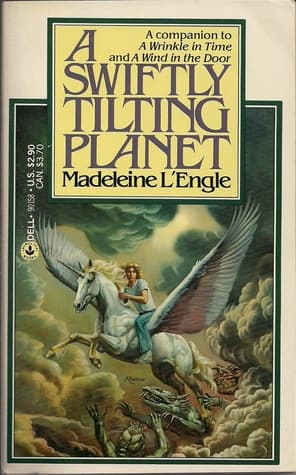
As Charles Wallace considers his task, a unicorn named Gaudior appears. Gaudior explains he is a 'cherubim,' a messenger of God, and will be Charles Wallace's guide. Gaudior reveals Charles Wallace must 'name' the right people in history to prevent 'might-have-beens' from becoming 'will-bes.' Their first leap through time and space takes them to a desolate, ancient landscape. Charles Wallace senses the suffering of the land and its inhabitants, understanding Branzillo's madness began far in the past. Meg, kything with him, experiences disorientation and profound displacement.
Encountering Bran and the Twins
Charles Wallace, in his first time-traveling 'naming,' lands in a primitive, prehistoric setting, taking the form of a young boy. He meets a family, including a boy named Bran and his twin sisters, Zyll and Zylle. He realizes Bran's lineage is important for understanding the future. Through kything, Meg experiences the simple, harsh life of this time, the strong family bonds, and the deep connection to the land. Charles Wallace observes the family's struggles and their sense of loss from a past tragedy. He begins to understand how all lives connect and how small past choices can affect generations.
The Tragedy of Zyll and the Naming of Madoc
Charles Wallace, still a young boy, witnesses a tragic event: Zyll, one of Bran's twin sisters, falls from a cliff and dies. This event deeply affects Bran and his remaining sister, Zylle. Charles Wallace realizes this tragedy is a 'might-have-been' that needs changing. He uses his ability to 'name' and, through an act of love and understanding, influences Bran to choose compassion over bitterness. He names Bran's future child 'Madoc,' hoping to instill a positive influence into the lineage that will eventually lead to Madog Branzillo, aiming to change the future through this act of naming and empathy.
The Desert and the Story of Madoc
Charles Wallace and Gaudior travel to a desert landscape, where Charles Wallace becomes a young man named Madoc, a descendant of Bran. Meg kythes with him, feeling the scorching sun and the vast emptiness of the desert. Charles Wallace, as Madoc, lives among a nomadic people. He learns their customs, their reverence for water, and their deep connection to the earth. He observes the beauty of their existence and their challenges. He finds this Madoc is a gentle soul, but also learns about the lingering pain and unresolved conflicts within the lineage, hinting at future darkness if not addressed.
The Betrayal and the Wasting Sickness
As Madoc, Charles Wallace experiences a betrayal by a trusted friend who steals valuable resources. This act leaves Madoc's community vulnerable. At the same time, a mysterious 'wasting sickness' afflicts the desert dwellers, causing them to lose vitality and connection to life. Charles Wallace, through Madoc, feels the despair and helplessness of the people. Meg, kything, shares his frustration and sorrow, sensing the growing darkness and the influence of the 'Echthroi' – forces of unbeing – trying to corrupt this timeline. Charles Wallace realizes the sickness is spiritual as much as physical.
The Healing of Madoc and the Naming of Tor
Charles Wallace, as Madoc, works to heal the sick and restore hope to the community, using his kindness and strength. He understands the 'wasting sickness' results from spiritual emptiness and a lack of love. Through his actions, he helps mend fractured relationships and brings purpose back to the desert dwellers. He also meets a troubled boy named Tor, a descendant of the betrayer. Recognizing the need to break the cycle of bitterness, Charles Wallace 'names' Tor with love and forgiveness, hoping to guide him towards peace and prevent the further descent into darkness that could lead to Branzillo.
The Welsh Landscape and the Warrior Llwch
Charles Wallace and Gaudior travel to a wild, ancient Welsh landscape, where Charles Wallace embodies a warrior named Llwch, a descendant of Tor. Meg kythes with him, feeling the cold, the dampness, and the readiness for battle. Llwch is involved in tribal conflicts and struggles for land and power. Charles Wallace experiences the harsh realities of this era, the constant threat of violence, and the strong loyalty to clan. He understands Llwch is a key figure whose choices will greatly impact the future. The pressures of leadership and the desire for revenge weigh heavily on Llwch, and thus on Charles Wallace.
Llwch's Choice and the Naming of Branwen
As Llwch, Charles Wallace faces a critical decision about a retaliatory attack against an enemy tribe. He feels immense pressure from his people to seek vengeance, but also senses the futility and destruction such a path would bring. Through his connection with Gaudior and Meg, he finds the strength to choose peace and reconciliation, despite initial resistance from his warriors. He 'names' his daughter Branwen, a name associated with peace and beauty, hoping to instill these qualities into the lineage and steer it away from the destructive path that could lead to Madog Branzillo. This act affirms love over hatred.
The Final Leap and the Confrontation with Branzillo's Ancestor
Charles Wallace and Gaudior make their final leap, landing in a time closer to their own, in a war-torn setting. Charles Wallace embodies a young man named Bran, a direct ancestor of Madog Branzillo. This Bran is about to make a decision that will set his descendant on the path to becoming the dictator. Meg, kything intensely, feels the immense pressure and the looming threat of nuclear war. Charles Wallace, as Bran, confronts the bitter, destructive forces within himself and his lineage. He understands the 'Echthroi' are pushing Bran towards a choice of hatred and despair, mirroring Branzillo's current madness.
The Naming of Madog and the Breaking of the Chain
In a climactic moment, Charles Wallace, as Bran, faces the choice to succumb to bitterness and violence or to embrace love and forgiveness. With Meg's constant kything and Gaudior's unwavering support, Charles Wallace finds the strength to 'name' the immediate ancestor of Madog Branzillo. He names him not with a curse, but with a profound act of love and understanding, breaking the chain of hatred and despair that has plagued the lineage. This act of 'naming' changes Madog Branzillo's destructive 'might-have-been' into a peaceful 'will-be,' averting global nuclear war and saving the world.
Return to the Present and the Baby's Name
Having completed his mission, Charles Wallace returns to his own time, exhausted but triumphant. Meg, still kything, feels the immense relief and peace that washes over him. The threat of nuclear war is gone. Later, as Meg's baby is born, a healthy boy, the family gathers. Charles Wallace, remembering his journey and the names he gave, suggests naming the baby 'Charles,' after himself, but also with deeper meaning tied to the lineage he healed. The family, especially Meg, understands the meaning behind this choice, a symbol of hope, love, and the victory of good over evil.
A Swiftly Tilting Planet Characters
Charles Wallace Murry
Protagonist
A highly intelligent and sensitive boy chosen to save the world.
Charles Wallace is a fifteen-year-old boy of extraordinary intellect and sensitivity, with a unique ability to 'kythe' – to communicate telepathically and emotionally. He is chosen by the celestial beings to embark on a perilous journey through time to prevent a global nuclear war. Despite his youth, he possesses immense courage and a deep understanding of the interconnectedness of life. His journey forces him to confront the darkness within humanity and within himself, using love and empathy as his primary weapons.
Relationships: Meg Murry O'Keefe (Sister and primary kything partner, providing emotional and spiritual support.); Gaudior (Unicorn guide and companion on his journey.); Mr. and Mrs. Murry (Loving and supportive parents, though not directly involved in his journey.)
Meg Murry O'Keefe
Supporting
Charles Wallace's older sister, who kythes with him throughout his journey.
Meg, now married and pregnant, possesses the ability to kythe, though less intensely than Charles Wallace. She acts as his anchor to reality, sharing his experiences and emotions across time and space. Her unwavering love and support are crucial for Charles Wallace's success. She experiences the physical and emotional toll of his journey, yet remains a steadfast source of strength and comfort, reminding him of his true identity and purpose. Her pregnancy also symbolizes the new life and hope that Charles Wallace is fighting to protect.
Relationships: Charles Wallace Murry (Brother and kything partner, their bond is central to the story.); Calvin O'Keefe (Husband, providing a stable, loving home life.); Mr. and Mrs. Murry (Parents, her connection to her family is strong.)
Gaudior
Supporting
A majestic unicorn and celestial messenger who guides Charles Wallace.
Gaudior is a cherubim, a celestial being in the form of a unicorn, sent to guide Charles Wallace on his mission. He possesses immense wisdom, patience, and a deep understanding of time, space, and spiritual truths. Gaudior explains the complexities of the 'might-have-beens' and 'will-bes,' emphasizing the importance of 'naming' with love. He is a constant source of reassurance and spiritual insight for Charles Wallace, often appearing at critical moments to offer guidance or strength. His presence embodies purity, wisdom, and divine intervention.
Relationships: Charles Wallace Murry (Guide and companion on his cosmic journey.)
Madog Branzillo
Antagonist (indirect)
A mad dictator threatening nuclear war, whose lineage Charles Wallace must alter.
Madog Branzillo is the unseen, but ever-present, antagonist. He is a mad dictator threatening to unleash nuclear war upon the world. He represents the culmination of generations of hatred, despair, and unaddressed negative choices within a specific lineage. Charles Wallace's entire mission is to prevent Branzillo's destructive actions by going back in time and altering the 'might-have-beens' that led to his existence. Branzillo is less a character with agency and more a symbol of the ultimate consequence of unchecked evil and the Echthroi's influence.
Relationships: Charles Wallace Murry (The target of Charles Wallace's intervention, though they never directly meet.)
Bran
Supporting (ancestor)
A boy in the primitive past, the first ancestor Charles Wallace 'names'.
Bran is a young boy in a primitive, pre-historic setting, whose lineage is crucial to the Branzillo family tree. Charles Wallace inhabits his form and helps him cope with the tragic death of his twin sister, Zyll. Bran represents the earliest point where Charles Wallace can begin to influence the future, instilling love and compassion to counteract the seeds of bitterness and despair that could lead to Branzillo. His choice to move past grief with love rather than resentment is a critical turning point in the altered timeline.
Relationships: Charles Wallace Murry (Charles Wallace temporarily inhabits his body and influences his choices.)
Madoc (Desert Dweller)
Supporting (ancestor)
A gentle desert nomad, another ancestor in Branzillo's lineage.
Madoc is a kind and spiritual desert dweller, a descendant of Bran. Charles Wallace inhabits his form during a period where the community faces betrayal and a 'wasting sickness.' Madoc's inherent goodness and Charles Wallace's influence help to heal the community and break cycles of mistrust. He represents a point where spiritual emptiness and lack of love threaten to corrupt the lineage. His ability to forgive and lead with compassion is vital in preventing the future rise of Branzillo.
Relationships: Charles Wallace Murry (Charles Wallace temporarily inhabits his body and influences his choices.)
Tor
Supporting (ancestor)
A troubled boy in the desert, influenced by Charles Wallace as Madoc.
Tor is a young boy encountered by Charles Wallace while he is inhabiting Madoc's form. Tor is a descendant of the individual who betrayed Madoc's community, carrying the burden of that past. Charles Wallace, as Madoc, 'names' Tor with forgiveness and love, aiming to break the cycle of bitterness and resentment that could plague the Branzillo lineage. Tor represents a crucial point where a potential path of continued conflict and anger is diverted towards reconciliation and peace.
Relationships: Charles Wallace Murry (as Madoc) (Influenced by Charles Wallace's act of naming and forgiveness.)
Llwch
Supporting (ancestor)
A fierce Welsh warrior whose choice between vengeance and peace is critical.
Llwch is a warrior in ancient Wales, a descendant of Tor. Charles Wallace inhabits his form during a time of tribal conflict and the pressure to seek vengeance. Llwch embodies the struggle between the desire for retribution and the wisdom of choosing peace. His decision to forgo a retaliatory attack, influenced by Charles Wallace, is a powerful act that steers the lineage away from a path of violence and destruction. His choice demonstrates the courage required to break cycles of conflict.
Relationships: Charles Wallace Murry (Charles Wallace temporarily inhabits his body and influences his choices.)
Branwen
Mentioned (ancestor)
Llwch's daughter, named by Charles Wallace as a symbol of peace.
Branwen is the daughter of Llwch, whom Charles Wallace, while inhabiting Llwch, names. Her name, associated with peace and beauty, is an intentional act to infuse positive energy and hope into the lineage, further diverting it from the destructive path that could lead to Madog Branzillo. She represents the positive outcome of Llwch's choice for peace, a symbol of the future he is fighting for.
Relationships: Charles Wallace Murry (as Llwch) (Named by Charles Wallace as a symbolic act.)
Mr. Murry
Supporting
Charles Wallace and Meg's father, a brilliant scientist.
Dr. Alex Murry is a physicist, known for his scientific brilliance and his loving, supportive nature. While not directly involved in Charles Wallace's time-traveling mission, his initial conversation with the President about Madog Branzillo is the catalyst for the entire quest. He provides a grounding presence in the Murry home and represents the intellectual and rational foundation of the family, contrasting with the more intuitive and spiritual abilities of Charles Wallace and Meg.
Relationships: Charles Wallace Murry (Father, deeply caring and protective.); Meg Murry O'Keefe (Father, providing intellectual and emotional support.); Mrs. Murry (Husband, a strong and loving partnership.)
Mrs. Murry
Supporting
Charles Wallace and Meg's mother, a brilliant scientist and loving matriarch.
Dr. Kate Murry is a biologist, equally brilliant as her husband, and the warm, nurturing heart of the Murry family. She provides emotional stability and a sense of normalcy amidst the extraordinary circumstances. Though she doesn't directly participate in Charles Wallace's journey, her love and the safe haven of their home are vital for Meg, who is kything with her brother. She represents the enduring strength of family and the quiet wisdom that underpins their extraordinary lives.
Relationships: Charles Wallace Murry (Mother, deeply loving and understanding.); Meg Murry O'Keefe (Mother, providing emotional strength and support.); Mr. Murry (Wife, a strong and loving partnership.)
A Swiftly Tilting Planet Themes
The Power of Naming and Identity
The central theme is the power of 'naming,' not just as a label, but as an affirmation of identity, purpose, and love. Charles Wallace's mission is to 'name' Branzillo's ancestors with love and forgiveness, altering their 'might-have-beens' and preventing the dictator's destructive 'will-be.' This appears when he names Bran's child 'Madoc' or Llwch's daughter 'Branwen,' giving these names positive potential. It suggests how we perceive and acknowledge others, and ourselves, affects destiny and the fight against 'unnaming' forces.
“And the naming of parts is the naming of the whole, and the naming of the whole is the naming of the parts.”
The Interconnectedness of Time and Lineage
The novel explores how all moments in time and all individuals within a lineage are connected. Charles Wallace's journey through the past shows that small choices made by ancestors can affect generations, influencing future events and personalities. The 'might-have-beens' that could lead to Branzillo's madness result from these past choices. The story emphasizes that the present is shaped by the past, and that intervention in the past can alter the future, showing a non-linear understanding of time and fate.
“All times are one time, and all places are one place.”
Love as a Force Against Evil
Love is the ultimate weapon against the forces of 'unbeing' (the Echthroi) and the destructive potential of hatred and despair. Charles Wallace's 'naming' acts are rooted in love, compassion, and forgiveness. When he helps Bran overcome grief with love, or when he forgives Tor as Madoc, these acts of love break the cycle of bitterness that could lead to Branzillo's tyranny. Meg's constant kything, an act of pure sisterly love, also sustains Charles Wallace through his journey, proving that love is a tangible, powerful force capable of altering destiny.
“Only through love can the might-have-been be changed to a will-be.”
The Battle Between Being and Unbeing
This theme continues from previous books, showing a cosmic struggle between 'Being' (life, love, creation) and 'Unbeing' (the Echthroi, chaos, destruction). Madog Branzillo is a manifestation of 'Unbeing's' influence, aiming for global destruction. Charles Wallace's mission is to reaffirm 'Being' by mending the brokenness in the Branzillo lineage, preventing 'Unbeing' from gaining a victory. The 'wasting sickness' in the desert is a physical manifestation of the spiritual decay caused by 'Unbeing,' showing how it diminishes life and hope.
“The Echthroi are the forces of unbeing, of chaos, of nothingness.”
The Burden and Responsibility of Choice
Throughout the narrative, characters face crucial choices with far-reaching consequences. Charles Wallace, in his ancestral forms, must make decisions that determine the future of the lineage. From Bran's choice to embrace love after tragedy, to Llwch's decision to pursue peace over vengeance, each choice carries responsibility. The story emphasizes that individual choices, even small ones, accumulate to shape destiny, and that the freedom to choose comes with the moral obligation to choose wisely and with love.
“Every choice we make, every word we speak, every thought we think, has its ripple effect through time and space.”
Plot Devices & Literary Techniques
Kything
Telepathic and emotional communication between individuals.
Kything is a unique ability, primarily possessed by Charles Wallace and Meg, allowing them to communicate telepathically and emotionally across vast distances and even through time. For Charles Wallace, it enables him to sense the needs of the universe. For Meg, it allows her to remain connected to Charles Wallace during his perilous journey, sharing his experiences, providing emotional support, and acting as his anchor to his true self and the present. It's a vital link that sustains Charles Wallace and reinforces the theme of interconnectedness and the power of love.
Naming
The act of affirming identity and purpose, often to alter destiny.
In 'A Swiftly Tilting Planet,' 'naming' is not merely assigning a label but a powerful act of spiritual and existential affirmation. Charles Wallace's mission involves 'naming' key ancestors of Madog Branzillo with love, understanding, and forgiveness. This act redefines their identity and purpose, steering them away from destructive 'might-have-beens' and towards positive 'will-bes.' It's a direct counter to the 'unnaming' forces of the Echthroi and highlights the creative power of language and intention, emphasizing that true identity is found in love and connection, not in bitterness or despair.
Time Travel / Body Swapping
Charles Wallace's ability to travel through time and inhabit the bodies of ancestors.
Charles Wallace's method of time travel involves not just moving through different eras but also temporarily inhabiting the bodies and minds of his ancestors. This allows him to directly experience their lives, understand their challenges, and, crucially, influence their choices from within. It's a highly immersive form of time travel that emphasizes empathy and personal agency. This device allows the narrative to explore the 'might-have-beens' and 'will-bes' of history, demonstrating how individual decisions across generations can shape the destiny of the world and the nature of a single individual like Madog Branzillo.
The Echthroi
Forces of 'Unbeing' and chaos, seeking to diminish existence.
The Echthroi are the primary antagonists in the cosmic struggle, representing 'Unbeing' – the forces of chaos, emptiness, and destruction. They are not physical beings but rather a spiritual influence that seeks to 'unname' or diminish existence, leading to despair, hatred, and ultimately, annihilation. Madog Branzillo's madness and his threat of nuclear war are direct manifestations of the Echthroi's influence on humanity. Their presence underscores the constant battle between good and evil, creation and destruction, and the importance of actively choosing love and being to resist their pervasive negativity.
A Swiftly Tilting Planet Quotes
“Kyrie eleison. Christe eleison. Kyrie eleison.”
“We can't take any credit for our talents. It's how we use them that counts.”
“You don't have to understand everything to love it.”
“The universe is full of things we don't understand, and we have to be open to them.”
“Love isn't just a feeling, it's a decision.”
“It's a very lonely thing, to be the only one who sees what's really happening.”
“Every act of love is a prayer.”
“The past is not dead, it is not even past.”
“We are not alone. Never, ever alone.”
“Sometimes the only way to find out what you are is to find out what you're not.”
“There are some things you can only see with your heart.”
“To be truly alive, you have to be willing to die.”
“The light shines in the darkness, and the darkness has not overcome it.”
“We all have our own particular darknesses to face.”
“Every choice you make changes the world.”
Quiz
10 questions on the plot and the characters. Each answer comes with a short explanation.
Question 1
What is the primary method Charles Wallace uses to travel through time and connect with different historical figures?
- He uses a tesseract, similar to his past journeys.
- He enters the minds and bodies of people from the past.
- He rides Gaudior through specific historical portals.
- He manipulates a time machine built by his father.
Show answer
B. He enters the minds and bodies of people from the past. Charles Wallace's unique ability in this book is to enter the minds and bodies of individuals throughout history, experiencing their lives and attempting to alter the destructive timeline.
Question 2
Who is the mad dictator whose actions threaten the world with destruction?
- Grandfather Branzillo
- Madog Branzillo
- Chuck Davidson
- Branzillo the Younger
Show answer
B. Madog Branzillo The central antagonist whose future actions threaten the planet is Madog Branzillo, and Charles Wallace's mission is to prevent his rise to power.
Question 3
What is the name of the unicorn who accompanies Charles Wallace on his journey?
- Progo
- Gaudior
- Unic
- Pegasus
Show answer
B. Gaudior Gaudior is the celestial unicorn who guides and aids Charles Wallace in his quest through time.
Question 4
What significant personal event is Meg Murry O'Keefe experiencing during the events of the book?
- She is preparing for a major scientific presentation.
- She is awaiting the birth of her first child.
- She is recovering from a serious illness.
- She is traveling abroad for her work.
Show answer
B. She is awaiting the birth of her first child. Meg is pregnant with her first child, which adds a layer of urgency and emotional connection to her 'kything' with Charles Wallace.
Question 5
What is the special ability that allows Meg to connect with Charles Wallace's thoughts and emotions across time and space?
- Telepathy
- Empathy
- Kything
- Astral projection
Show answer
C. Kything Kything is the unique, deep spiritual and mental connection that allows Meg to share Charles Wallace's experiences and guide him.
Question 6
Charles Wallace's journey involves encountering multiple individuals named Bran, each a potential ancestor of Madog Branzillo. What is the significance of the names they take on?
- The names are random and hold no specific meaning.
- Their names are anagrams of 'Branzillo' to hint at their future descendant.
- The names are often variations of 'Bran' combined with elements reflecting their character or circumstances.
- They all adopt the name 'Branzillo' at some point in their lives.
Show answer
C. The names are often variations of 'Bran' combined with elements reflecting their character or circumstances. The various iterations of Bran often have names that reflect their personalities or roles, such as Branwyn or Bran 'The Younger,' which are crucial for Charles Wallace to identify and influence them.
Question 7
What is the central theme explored through Charles Wallace's attempts to change the past, concerning free will and destiny?
- That destiny is unchangeable, and all efforts are futile.
- That free will can alter the course of history, but with great difficulty and moral responsibility.
- That every small change leads to catastrophic unintended consequences.
- That history repeats itself regardless of individual actions.
Show answer
B. That free will can alter the course of history, but with great difficulty and moral responsibility. The book heavily emphasizes the power of individual choices and the moral weight of influencing others' free will, suggesting that while destiny can be swayed, it requires careful, loving intervention.
Question 8
How does Gaudior assist Charles Wallace beyond simply transporting him through time?
- Gaudior provides Charles Wallace with advanced weaponry to fight enemies.
- Gaudior physically intervenes in historical events to protect Charles Wallace.
- Gaudior offers guidance, wisdom, and spiritual strength, often through riddles or poetic pronouncements.
- Gaudior casts spells to alter the memories of the historical figures Charles Wallace encounters.
Show answer
C. Gaudior offers guidance, wisdom, and spiritual strength, often through riddles or poetic pronouncements. Gaudior acts as a spiritual mentor and guide, providing cryptic but profound advice and emotional support, rather than direct physical intervention.
Question 9
What is the ultimate goal Charles Wallace must achieve to prevent Madog Branzillo's destructive future?
- He must kill Madog Branzillo in the past as a child.
- He must convince an ancestor to make a choice rooted in love rather than fear or pride, thereby altering the family line's destiny.
- He must gather a group of historical figures to fight against Madog Branzillo's ancestors.
- He must erase Madog Branzillo from the timeline entirely.
Show answer
B. He must convince an ancestor to make a choice rooted in love rather than fear or pride, thereby altering the family line's destiny. Charles Wallace's mission is not to eliminate a person, but to change the fundamental choices of an ancestor, specifically Bran, to ensure the Branzillo line is founded on love and not the negative traits that lead to Madog's tyranny.
Question 10
How does the concept of 'naming' play a significant role in the book's themes and Charles Wallace's journey?
- Naming is simply a way to identify different historical periods.
- Correct naming allows Charles Wallace to magically control the people he inhabits.
- True naming, understanding the essence of a person or thing, is presented as a profound act of love and knowledge, essential for Charles Wallace to connect and influence.
- The act of naming is a dangerous power that Charles Wallace must avoid using.
Show answer
C. True naming, understanding the essence of a person or thing, is presented as a profound act of love and knowledge, essential for Charles Wallace to connect and influence. True naming is a recurring motif in L'Engle's work, representing deep understanding, love, and connection to the essence of creation. Charles Wallace's ability to 'name' the people he enters is crucial to his success.
A Swiftly Tilting Planet FAQ
What is the central conflict that drives Charles Wallace's journey in 'A Swiftly Tilting Planet'?
The central conflict is the imminent threat of nuclear war, orchestrated by the tyrannical dictator Madog Branzillo. Charles Wallace, aided by the unicorn Gaudior, must travel through time to prevent this global catastrophe by understanding and altering the past connections that led to Branzillo's rise.
Who is Gaudior, and what is his role in Charles Wallace's mission?
Gaudior is a magnificent unicorn who serves as Charles Wallace's guide and companion on his perilous journey through time. He possesses the ability to travel across different eras and dimensions, facilitating Charles Wallace's encounters with various historical figures and helping him understand the intricate web of lineage and choices that impact the present.
How does Meg Murry O'Keefe participate in Charles Wallace's quest, despite being physically absent?
Meg participates through 'kything,' a form of telepathic and empathic communication that allows her to connect with Charles Wallace's thoughts, feelings, and even experiences across time and space. While pregnant and at home, her mental and emotional support is crucial, often guiding and comforting Charles Wallace during his most challenging moments.
What is the significance of the 'madog' poem and its connection to Madog Branzillo?
The 'madog' poem is a crucial ancient Welsh prophecy that foretells the coming of a destructive figure. Charles Wallace gradually uncovers its deeper meaning, realizing that 'Madog' is not just a name but a representation of a lineage cursed by hatred and bitterness, directly linked to the tyrannical Madog Branzillo threatening the present.
Who is Bran, and what is his relationship to the overarching narrative?
Bran is a pivotal character Charles Wallace encounters in the past, a young man from ancient Wales who embodies a crucial branch of the Branzillo family tree. His choices and experiences, particularly his internal struggles and relationships, are key to understanding how the destructive 'Madog' lineage began and how it might be altered.
How does the concept of 'naming' play a role in altering destiny throughout the story?
The concept of 'naming' is central to changing destiny; it's not just about saying a name but truly knowing and affirming a person's essence and potential. Charles Wallace must learn to 'name' individuals with love and understanding, particularly those who are part of the Branzillo lineage, to break cycles of hatred and despair that contribute to the dictator's existence.
What is the significance of the 'Small, Dry, Wrinkled Thing' from 'A Wind in the Door' and its subtle reappearance?
The 'Small, Dry, Wrinkled Thing' is Progo, a cherubim who helped Calvin and Meg save Charles Wallace in the previous book. While not explicitly named, its presence is subtly alluded to through the nurturing, life-affirming cosmic forces that assist Charles Wallace and Meg, representing the continued benevolent influence of the universe.
How do the various historical periods Charles Wallace visits connect to the present threat?
Each historical period Charles Wallace visits, from ancient Wales to colonial America and beyond, is a different branch of the Branzillo family tree. He interacts with ancestors who made choices that, over generations, either fostered love and connection or sowed seeds of bitterness and isolation, ultimately leading to Madog Branzillo's destructive ideology.
What role do the 'seraphim' and 'cherubim' play in the cosmic battle, even if not explicitly defined?
The 'seraphim' and 'cherubim' represent different orders of celestial beings, with seraphim embodying intense love and light, and cherubim representing wisdom and knowledge. While not explicitly introduced as characters, their presence is felt through the cosmic forces of good that aid Charles Wallace and Meg, providing guidance and protection in the fight against darkness.
How does Charles Wallace's kything with Meg impact his emotional and mental state during his journey?
Kything with Meg provides Charles Wallace with crucial emotional anchors and mental clarity. When he feels overwhelmed, lost, or tempted by despair, Meg's steadfast love and wisdom ground him, reminding him of his purpose and offering the strength to continue. It prevents him from succumbing to the darkness he encounters.
Analyze the psychological burden placed on Charles Wallace as he takes on the identities of his ancestors.
Charles Wallace experiences a profound psychological burden by temporarily inhabiting the lives and emotions of his ancestors. He grapples with their personal pains, failures, and moments of despair, risking losing his own identity. This process requires immense mental fortitude and empathy, highlighting his vulnerability and strength.
How does the book explore the psychology of tyranny through Madog Branzillo's lineage?
The book explores tyranny not as a singular evil but as a culmination of generations of unaddressed pain, bitterness, and isolation within a family lineage. Each ancestor's failure to choose love and connection, and their embrace of hatred or despair, contributes to the psychological foundation that ultimately allows Madog Branzillo's destructive ideology to flourish.
What is the psychological significance of the 'un-naming' or being forgotten within the narrative?
The 'un-naming' or being forgotten carries profound psychological significance, representing the ultimate erasure of identity and worth. It signifies a loss of connection, love, and purpose, leading to profound despair and a sense of non-existence. Charles Wallace's mission often involves remembering and 're-naming' those forgotten to restore their place in the cosmic tapestry.
Is the ending truly a definitive victory, or does it leave room for future threats, given the cyclical nature of conflict?
The ending presents a clear victory against the immediate threat of Madog Branzillo, as Charles Wallace's actions alter the timeline. However, the book's overarching theme suggests that the struggle between love and hate, connection and isolation, is ongoing. While one battle is won, the potential for future threats, born from similar human failings, always remains, implying a continuous need for vigilance and love.
To what extent does the book argue for free will versus a predetermined destiny?
The book strongly advocates for free will within a framework of cosmic interconnectedness. While certain patterns and influences exist across generations, individuals consistently have the choice to break cycles of negativity. Charles Wallace's success hinges on ancestors making choices of love and courage, demonstrating that destiny is shaped by conscious decisions rather than being rigidly predetermined.
How does 'A Swiftly Tilting Planet' expand upon the theological and philosophical themes introduced in 'A Wrinkle in Time'?
'A Swiftly Tilting Planet' deepens the exploration of good versus evil by focusing on the intricate, generational impact of individual choices and the power of 'naming' with love. It expands the concept of cosmic interconnectedness, showing how seemingly small actions in the past can have profound, far-reaching consequences on the present and future, reinforcing the idea of a universe imbued with moral order and the importance of active love.
What is the ultimate message about the power of love and connection in overcoming hatred?
The ultimate message is that love and genuine connection are the most potent forces against hatred and destruction. Through Charles Wallace's journey, the book illustrates that only by understanding, empathizing with, and 'naming' individuals with love, even those filled with bitterness, can the cycles of hatred be broken. It emphasizes that every act of love, no matter how small, contributes to the healing of the world.
How does the book's depiction of time travel differ from typical science fiction narratives?
The book's depiction of time travel is less about technological mechanics and more about spiritual and empathetic immersion. Charles Wallace doesn't physically travel in a machine; instead, he merges with the consciousness of his ancestors, experiencing their lives and influencing their choices through a profound connection enabled by Gaudior and Meg's kything. It's a journey of the spirit and mind, intertwined with cosmic forces, rather than purely scientific exploration.
About the author

Madeleine L'Engle was an American writer of fiction, non-fiction, poetry, and young adult fiction, including A Wrinkle in Time and its sequels: A Wind in the Door, A Swiftly Tilting Planet, Many Waters, and An Acceptable Time. Her works reflect both her Christian faith and her strong interest in modern science.
Similar books
- A Wrinkle in Time
Madeleine L'Engle
4.0 (1.1M) average on GoodreadsFantasyShares characters, kything, and themes of good versus evil and cosmic journeys.
- The Phantom Tollbooth
Norton Juster
4.2 (242k) average on GoodreadsFantasyFeatures a young protagonist on a fantastical quest with philosophical undertones and wordplay.
- Jonathan Livingston Seagull
Richard Bach
3.8 (202k) average on GoodreadsFantasyExplores spiritual growth and self-discovery through a non-human protagonist in a allegorical setting.
- The Dark Is Rising
Susan Cooper
4.1 (51k) average on GoodreadsFantasySusan Cooper's 'The Dark Is Rising' sequence, particularly the titular second book, offers a compelling comparison due to its shared reliance on ancient British mythology (specifically Welsh and Arthurian) and its exploration of a cosmic battle between light and dark. Both L'Engle and Cooper craft rich, atmospheric worlds where ordinary children are drawn into extraordinary struggles. However, Cooper's series tends to maintain a more consistent, epic fantasy tone with clearer antagonist figures and a more straightforward quest structure. A Swiftly Tilting Planet, by contrast, is more introspective and abstract, with the 'battle' taking place primarily within Charles Wallace's mind and across the consciousnesses of his ancestors, making its conflict more psychological and less overtly external than Cooper's work. Cooper's magic system is also more explicitly defined and rooted in ancient lore, whereas L'Engle's blends science and spirituality in a more ambiguous fashion.
- Harry Potter and the Sorcerer's Stone
J.K. Rowling
4.5 (7M) average on GoodreadsFantasyRescued from a miserable life under the stairs, an orphaned boy discovers he's a wizard destined for a magical school, where he uncovers a dangerous secret tied to the dark wizard who murdered his parents.
- The Hunger Games
Suzanne Collins
4.3 (6.4M) average on GoodreadsFantasyIn a future where children fight to the death on live television, Katniss Everdeen volunteers for the arena, turning a death sentence into a fight for survival and a spark of rebellion.



Enjoyed the summary?
A summary gives you the shape of the book. The book itself has the detail, the examples and the voice.
Find A Swiftly Tilting Planet on AmazonAs an Amazon Associate, BookBrief earns from qualifying purchases. How we're funded