
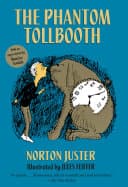
Synopsis
Covers the whole plot, including the ending.
- Difficulty
- Easy
- Pacing
- Moderate
- Mood
- Whimsical, Thought-provoking, Humorous, Adventurous
- Read it if
- You love clever wordplay, philosophical whimsy, and a charming adventure that sparks imagination and critical thinking.
- Skip it if
- You prefer realistic fiction or straightforward plots without allegorical elements and puns.
The Phantom Tollbooth Plot Summary
Covers the whole plot, including the ending.
A Mysterious Tollbooth Arrives
Milo, a young boy who finds everything in life dull and pointless, returns home from school to find a mysterious package in his room. Inside, he discovers a genuine turnpike tollbooth, a map, a book of rules, and a small car. With nothing better to do, Milo decides to set it up and drive through. He chooses a destination on the map at random, Dictionopolis, and, after paying the toll with a coin he finds, drives his small car through the tollbooth. The familiar surroundings of his room dissolve, and Milo finds himself on a dusty road in an unknown land, his adventure having begun.
Adventures in the Doldrums and Dictionopolis
Milo soon finds himself in the Doldrums, a place where thinking and doing are forbidden. He quickly succumbs to the lethargy of the inhabitants, the Lethargarians, until he is rescued by Tock, a watchdog with a literal clock for a body. Tock explains that the Doldrums are a place for those who waste time and encourages Milo to start thinking. Together, they travel to Dictionopolis, the kingdom of words, where Milo attends a Royal Banquet. Here, he meets King Azaz the Unabridged, the Wordmaker, and witnesses the lively, often chaotic, debates between the Duke of Definition, the Minister of Meaning, the Count of Connotation, the Earl of Etymology, and the Undersecretary of Understanding, all of whom are obsessed with words.
The Quest for Rhyme and Reason
During the Royal Banquet, Milo learns about the kingdom's greatest problem: the banishment of Princesses Rhyme and Reason. They were exiled to the Castle in the Air by the warring brothers, King Azaz of Dictionopolis and the Mathemagician of Digitopolis, after the princesses declared that both words and numbers are equally important. Without them, the Lands Beyond have descended into confusion and discord. King Azaz, impressed by Milo's earnestness, tasks him with rescuing the princesses, providing him with a box of all the words he'll ever need. Tock insists on accompanying Milo, and so their dangerous quest officially begins.
Through the Forest of Sight and Sound
Milo and Tock begin their journey, soon encountering the Spelling Bee, a giant bee who can spell any word, and the Humbug, a boastful, insincere insect who joins them on their quest. They travel through the Forest of Sight and Sound, where they meet the Soundkeeper, a woman who has hoarded all sounds, creating a world of silence. Milo helps her realize the importance of releasing sounds, and she allows him to choose a sound to take with him. This encounter shows the theme of appreciating what is often taken for granted and the consequences of hoarding resources, even abstract ones like sound.
The Dangers of Illusions and Ignorance
The journey continues, leading Milo, Tock, and the Humbug to various peculiar places. They visit the Island of Conclusions, which one reaches by literally jumping to them, a metaphor for making hasty judgments. They also journey through the Mountains of Ignorance, a perilous region inhabited by menacing demons. Here, they encounter the Terrible Trivium, a demon who traps travelers by assigning them endless, pointless tasks, and the Senses Taker, who robs people of their ability to perceive. These encounters show the dangers of thoughtlessness, procrastination, and the insidious nature of ignorance, which drains vitality and purpose.
Meeting the Mathemagician
After navigating through the treacherous landscape, Milo, Tock, and the Humbug finally reach Digitopolis, the kingdom of numbers. Here, they meet the Mathemagician, King Azaz's brother, who is equally obsessed with numbers as Azaz is with words. The Mathemagician lives in a world where numbers are harvested and where concepts like 'infinity' are tangible places. He challenges Milo's understanding of mathematics, demonstrating how numbers can be manipulated and how different perspectives can lead to vastly different conclusions, such as when he shows Milo that a small fraction can be larger than a big whole.
The Canyon and the Dodecahedron
The Mathemagician, still wary of words, initially refuses to help Milo rescue the princesses. However, after Milo demonstrates how words and numbers are interconnected, he reluctantly agrees, giving Milo a magic staff, a pencil that can write anything. Before leaving Digitopolis, they encounter the Dodecahedron, a creature with twelve faces, each expressing a different emotion. The Dodecahedron helps Milo understand that perspective changes everything and that there are always many ways to look at a problem, reinforcing the idea that both words and numbers, and thus logic and creativity, are essential.
Ascending the Mountains of Ignorance and Confronting Demons
Armed with new insights and tools, Milo, Tock, and the Humbug continue their ascent towards the Castle in the Air, which is located atop the treacherous Mountains of Ignorance. They encounter and outsmart several more formidable demons, including the Gelatinous Giant, who tries to make them blend in and be like everyone else, and the Demon of Insincerity, who speaks only in pleasantries while hiding malevolent intentions. Each demon represents a different intellectual or emotional trap, and Milo's growing confidence and understanding of the world allow him to overcome these challenges, often by simply thinking or questioning.
Reaching the Castle in the Air
After a harrowing climb and numerous close calls with the demons, Milo, Tock, and the Humbug finally reach the Castle in the Air. They find Princesses Rhyme and Reason patiently waiting, having foreseen their arrival. The princesses, embodying grace and wisdom, express their gratitude to Milo for undertaking such a perilous journey. Their presence immediately brings a sense of calm and clarity to Milo, who has grown significantly throughout his adventure. The stage is set for their return, but the escape from the Castle in the Air, now surrounded by a horde of angry demons, remains a formidable challenge.
The Escape and Return
With Rhyme and Reason rescued, the group must escape the Castle in the Air, which is now being attacked by all the demons they had previously encountered. The princesses use their wisdom and logic to help Milo and his companions navigate the chaos. They make a daring escape by literally jumping off the castle and falling through the air, only to be caught by a giant bird who carries them back to Dictionopolis. Their return is met with immense joy and celebration. King Azaz and the Mathemagician reconcile, and the Lands Beyond begin to heal, restoring balance and understanding.
Milo's Farewell and Transformation
With peace restored, Milo bids farewell to his newfound friends, including King Azaz, the Mathemagician, Tock, and the Humbug. The princesses thank him profusely, explaining that his courage and open-mindedness were essential for their rescue. Milo, no longer bored, realizes the impact his journey has had on him. He drives his little car back through the tollbooth, returning to his bedroom. The tollbooth, having served its purpose, vanishes as mysteriously as it appeared. Milo, now seeing the world with fresh eyes, is filled with curiosity and excitement for life, understanding that there's always something interesting to discover.
The Phantom Tollbooth Characters
Milo
Protagonist
A perpetually bored boy who embarks on a quest to save Rhyme and Reason.
Milo begins the story as a young boy who finds everything in life utterly boring and meaningless. He lacks curiosity, initiative, and engagement with the world around him. His journey through the Lands Beyond forces him to confront his apathy and develop critical thinking skills, courage, and a newfound appreciation for learning and life's complexities. He learns to value words, numbers, and the importance of perspective. By the end, he is transformed into an enthusiastic, imaginative, and engaged individual.
Relationships: Tock (loyal companion and guide); Humbug (reluctant companion, often comic relief); King Azaz (mentor, sends Milo on the quest); Mathemagician (initially an obstacle, later an ally); Princesses Rhyme and Reason (the objects of his quest, sources of wisdom)
Tock
Supporting
A watchdog with a literal clock body, who becomes Milo's loyal companion.
Tock is a loyal and sensible watchdog, distinguished by the large clock embedded in his side, which literally 'stops time' when he barks. He serves as Milo's first companion and guide, often providing practical advice and keeping Milo on track. Tock is a symbol of the importance of time, using it wisely, and the dangers of wasting it (like in the Doldrums). He is steadfast, courageous, and committed to the quest, representing responsibility and diligence.
Relationships: Milo (loyal companion and protector); Humbug (often exasperated by, but tolerant of, his antics)
The Humbug
Supporting
A boastful insect who inadvertently joins Milo's quest.
The Humbug is a pompous, self-important insect who is more concerned with appearing knowledgeable and important than actually being so. He frequently uses flowery, meaningless language and often finds himself in embarrassing situations due to his boastfulness and lack of genuine understanding. Despite his flaws, he is not malicious and eventually becomes a somewhat useful, if often comedic, companion on the quest, even showing moments of unexpected bravery. He represents superficiality and the dangers of empty rhetoric.
Relationships: Milo (companion, often guided by Milo); Tock (often the target of Tock's exasperation)
King Azaz the Unabridged
Supporting
The ruler of Dictionopolis, obsessed with words, and one of the warring brothers.
King Azaz is the boisterous and word-loving monarch of Dictionopolis. He presides over a kingdom where words are literally eaten and cherished. He is one of the two brothers who banished Rhyme and Reason, believing words to be superior to numbers. Despite his stubbornness, he is benevolent and recognizes Milo's potential, sending him on the quest. He represents the importance and power of language, but also the folly of valuing one form of knowledge over another.
Relationships: Mathemagician (estranged brother and rival); Princesses Rhyme and Reason (nieces, whom he banished); Milo (mentor, sends him on the quest)
The Mathemagician
Supporting
The ruler of Digitopolis, obsessed with numbers, and Azaz's estranged brother.
The Mathemagician is the equally stubborn and number-loving ruler of Digitopolis, living in a world where numbers are harvested and manipulated. He is King Azaz's brother and shares the blame for banishing Rhyme and Reason, believing numbers to be superior to words. He teaches Milo about the intricacies and vastness of mathematics. Like Azaz, he learns to see the value in both words and numbers, ultimately reconciling with his brother and accepting the princesses' return.
Relationships: King Azaz (estranged brother and rival); Princesses Rhyme and Reason (nieces, whom he banished); Milo (teacher, initially an obstacle)
Princess Rhyme
Supporting
One of the two banished princesses, embodying poetic justice and harmony.
Princess Rhyme is one of the two wise princesses who were banished for declaring that words and numbers are equally important. She embodies poetic justice, harmony, and the beauty of language. Her presence brings clarity and peace, and her wisdom is crucial in guiding Milo. She represents the creative, intuitive, and aesthetic aspects of understanding the world.
Relationships: Princess Reason (sister, co-ruler); King Azaz (uncle, who banished her); Mathemagician (uncle, who banished her); Milo (rescuer)
Princess Reason
Supporting
One of the two banished princesses, embodying logic and sound judgment.
Princess Reason is the other wise princess, banished alongside Rhyme for her balanced judgment. She embodies logic, sound judgment, and clear thinking. Her calm demeanor and rational insights are invaluable to Milo and his companions. She represents the analytical, logical, and practical aspects of understanding the world, emphasizing that sense and order are just as important as creativity and expression.
Relationships: Princess Rhyme (sister, co-ruler); King Azaz (uncle, who banished her); Mathemagician (uncle, who banished her); Milo (rescuer)
The Soundkeeper
Supporting
The ruler of the Valley of Sound, who hoards all noise.
The Soundkeeper is a stern woman who, out of a desire to preserve beautiful sounds, has collected and hoarded all sounds in her kingdom, creating a world of complete silence. She is initially resistant to releasing sounds but is eventually persuaded by Milo to share them with the world. She represents the dangers of monopolizing resources, even abstract ones, and the importance of sharing and appreciation.
Relationships: Milo (persuaded by Milo to release sounds)
The Dodecahedron
Supporting
A twelve-faced creature who helps Milo understand perspective.
The Dodecahedron is a geometric creature with twelve faces, each capable of expressing a different emotion or point of view. He lives near Digitopolis and helps Milo understand the concept of perspective—how looking at something from different angles can change one's understanding. He is a literal embodiment of the idea that there are many sides to every story and problem, reinforcing the message of open-mindedness.
Relationships: Milo (teacher of perspective)
The Phantom Tollbooth Themes
The Value of Learning and Curiosity
Milo's journey is about overcoming apathy and embracing the joys of learning. Initially bored with everything, he discovers that the world is full of wonders, words, numbers, and ideas if one only takes the time to explore them. His interactions with characters like the Spelling Bee, the Mathemagician, and the Soundkeeper show the value of knowledge, communication, and sensory experience. The book says that boredom is a choice, and curiosity is the antidote.
“You must never feel badly about making mistakes... as long as you take the trouble to learn from them. For you often learn more by being wrong for the right reasons than you do by being right for the wrong reasons.”
The Importance of Language and Mathematics
The central conflict between King Azaz (words) and the Mathemagician (numbers) directly addresses the perceived difference between humanities and sciences. The banishment of Rhyme and Reason symbolizes the chaos that ensues when these two fundamental ways of understanding the world are separated or deemed unequal. Milo's quest is to bring them back together, showing that both logical reasoning (numbers) and creative expression (words) are essential for a balanced and meaningful existence. The book celebrates the power and beauty of both disciplines.
“Words and numbers are only an artifice for saying what things are and how many there are.”
Overcoming Apathy and Procrastination
Milo's initial state of boredom and his encounter with the Lethargarians in the Doldrums are a metaphor for apathy and procrastination. The demons in the Mountains of Ignorance, such as the Terrible Trivium (who assigns pointless tasks) and the Senses Taker (who robs perception), embody the ways in which idleness and lack of engagement can drain one's vitality and purpose. Milo's growth throughout the story shows that active participation and a willingness to think are important for a fulfilling life.
“You see, 'cause you get there by not thinking, and if you don't stop to think, you can get there very quickly.”
Perspective and Critical Thinking
Throughout his journey, Milo is constantly challenged to think critically and consider different perspectives. Encounters like the Dodecahedron, who has twelve faces, or the Mathemagician's demonstration that a small fraction can be larger than a big whole, teach Milo that truth can be relative and that there are many ways to look at a situation. The book encourages readers to question assumptions, avoid hasty judgments (like jumping to Conclusions), and appreciate the complexity of ideas.
“You'll find that things are not always as they seem in this place.”
The Power of Imagination
The entire premise of the story, a tollbooth appearing in a child's bedroom that leads to a fantastical world, shows the power of imagination. The Lands Beyond are a whimsical, literal interpretation of abstract concepts, where words are eaten and numbers are harvested. Milo's ability to engage with this world, and ultimately to change it, comes from his willingness to open his mind and embrace the imaginative possibilities presented to him, demonstrating that imagination is a vital tool for understanding and enjoying life.
“For you see, the only thing you can do easily is be wrong, and that's hardly worth the effort.”
Plot Devices & Literary Techniques
The Phantom Tollbooth
The magical gateway to the Lands Beyond.
The mysterious tollbooth that appears in Milo's room serves as the primary portal device, transporting him from his mundane reality into the fantastical world of the Lands Beyond. It symbolizes the sudden, unexpected opportunities for adventure and learning that can arise, particularly when one is open to them. Its eventual disappearance after Milo's return suggests that its purpose was to awaken his inner curiosity and that the 'magic' now resides within him, allowing him to find wonder in his own world.
Personification and Anthropomorphism
Giving human qualities to abstract concepts and objects.
The book extensively uses personification to make abstract concepts tangible and engaging. Words are literally eaten in Dictionopolis, and numbers are harvested in Digitopolis. Characters like Tock (a watchdog with a clock body), the Spelling Bee, and the Humbug are anthropomorphic animals or insects that embody specific traits or ideas. This device allows complex themes like the value of time, the power of language, and the dangers of ignorance to be explored in a whimsical and accessible manner for young readers.
Pun and Wordplay
The extensive use of literal interpretations of idioms and phrases.
Juster's narrative is saturated with clever puns, idioms, and figures of speech that are taken literally. Milo 'jumps to Conclusions' by literally leaping onto an island. He meets a 'watchdog' who has a clock in his side (Tock). This device is central to the humor and the thematic exploration of language. It highlights the nuances and potential pitfalls of communication, while also demonstrating the richness and imaginative power of words themselves, especially within Dictionopolis.
Allegory and Metaphor
Characters and places representing abstract ideas.
The entire journey is an extended allegory for a child's intellectual and emotional development. The Doldrums represent apathy, the Mountains of Ignorance symbolize intellectual laziness, and the various demons embody different forms of intellectual and emotional traps (e.g., the Terrible Trivium as procrastination, the Senses Taker as disengagement). Princesses Rhyme and Reason are allegorical figures for wisdom, balance, and sound judgment. This allows the book to convey profound philosophical messages through a fantastical adventure.
The Word Market/Number Mine
Physical representations of abstract linguistic and mathematical concepts.
In Dictionopolis, words are sold, bought, and literally eaten at the Word Market, while in Digitopolis, numbers are mined and harvested. These imaginative settings serve as powerful metaphors for how we consume, create, and value language and mathematics. They make the abstract concepts of communication and calculation tangible, allowing Milo (and the reader) to understand their importance and the potential for both abundance and scarcity, depending on how they are managed and appreciated.
The Phantom Tollbooth Quotes
“The only thing you can do easily is be wrong, and that's hardly worth the effort.”
“Expectations are like a giant rubber band. You can stretch them pretty far, but they always snap back.”
“There's a lot of things you can do with words besides talk.”
“You can learn a lot from a mistake, but it's much harder to learn from a success.”
“It's not enough to know what something means. You have to know what it doesn't mean.”
“Pointless things are always interesting. That's why they're pointless.”
“You must never feel badly about making a mistake... as long as you take the trouble to learn from it.”
“The most important reason for going from one place to another is to see what's in between.”
“Everything is there for a purpose, if only we can find it.”
“You see, time is a gift, not a loan. You can't give it back.”
“We're not just going to sit here and do nothing. We're going to think.”
“It's bad enough that you have to do something, but to have to choose which one is really awful.”
“There are more things in heaven and earth, Horatio, than are dreamt of in your philosophy.”
“The Dodecahedron explained that if you can only make sense out of things by understanding how they work, then you'll never make sense out of anything.”
Quiz
10 questions on the plot and the characters. Each answer comes with a short explanation.
Question 1
What is the name of the ticking watchdog that accompanies Milo on his journey?
- Chrono
- Tock
- Watchdog Willie
- Timekeeper
Show answer
B. Tock Milo's first companion in the Lands Beyond is a large dog with an alarm clock for a body, whose name is Tock. He helps Milo understand the value of time.
Question 2
Where do you arrive if you get there by jumping?
- The Mountains of Ignorance
- The Castle in the Air
- The Island of Conclusions
- The Valley of Sound
Show answer
C. The Island of Conclusions Milo discovers that one can literally 'jump to conclusions' by leaping onto the Island of Conclusions, a literal interpretation of the idiom.
Question 3
What is Milo's initial feeling or state of mind at the beginning of the book?
- Excited and adventurous
- Curious and inquisitive
- Bored and uninterested
- Nervous and apprehensive
Show answer
C. Bored and uninterested The book opens with Milo feeling that everything is a bore and that he has nothing interesting to do, which sets the stage for his journey into the Lands Beyond.
Question 4
Who are the two princesses that Milo is tasked with rescuing?
- Princess Harmony and Princess Melody
- Princess Rhyme and Princess Reason
- Princess Wisdom and Princess Knowledge
- Princess Truth and Princess Justice
Show answer
B. Princess Rhyme and Princess Reason Milo's central quest is to rescue Princess Rhyme and Princess Reason, whose banishment by the Kings of Dictionopolis and Digitopolis has caused chaos in the Lands Beyond.
Question 5
What is the primary conflict between the two cities of Dictionopolis and Digitopolis?
- One values art over science, the other science over art.
- One believes words are superior, the other believes numbers are superior.
- One is ruled by a king, the other by a queen.
- One is rich, the other is poor.
Show answer
B. One believes words are superior, the other believes numbers are superior. Dictionopolis, ruled by the King Azaz, celebrates words, while Digitopolis, ruled by the Mathemagician, champions numbers. Their rivalry over which is more important led to the banishment of Rhyme and Reason.
Question 6
What happens to the Soundkeeper's domain in the Valley of Sound?
- It is filled with too much noise, causing distress.
- It has become completely silent because all sound has been hoarded.
- It constantly echoes every word spoken.
- It produces only music, no spoken words.
Show answer
B. It has become completely silent because all sound has been hoarded. Milo discovers that the Soundkeeper, in her desire to preserve all sounds, has hoarded them away, leaving the Valley of Sound in complete silence until Milo releases a sound.
Question 7
What special 'gift' does the Mathemagician give Milo that he initially struggles to understand?
- A box of all possible numbers
- A pencil that can draw anything
- A 'subtracting' machine that makes things disappear
- A staff that is 'half of what you see'
Show answer
D. A staff that is 'half of what you see' The Mathemagician gives Milo his staff, explaining it's 'half of what you see'. Milo only understands its true value (a measuring stick) when he realizes he only 'sees' half of its length, demonstrating a pun on 'half-staff'.
Question 8
Why are the Humbug and the Spelling Bee constantly bickering?
- They both want to be the sole guide for Milo.
- They disagree over the correct pronunciation of words.
- They argue over the superiority of words versus numbers.
- The Spelling Bee values precise spelling, while the Humbug is pompous and imprecise.
Show answer
D. The Spelling Bee values precise spelling, while the Humbug is pompous and imprecise. The Spelling Bee prides himself on his accurate spelling and extensive vocabulary, while the Humbug is a boastful, insincere insect who often uses vague or incorrect language, leading to their frequent disputes.
Question 9
What is the ultimate lesson Milo learns by the end of his journey?
- That fantasy worlds are always more exciting than reality.
- That the world is full of wonder and excitement if you choose to see it.
- That it's best to stay home and avoid adventures.
- That words and numbers are inherently more interesting than anything else.
Show answer
B. That the world is full of wonder and excitement if you choose to see it. Milo's journey teaches him to appreciate the world around him, to question, to learn, and to engage. He realizes that life is 'exciting beyond his wildest dreams' and that boredom is a choice, not an inevitability.
Question 10
What mythical creatures prevent travelers from reaching the Castle in the Air and rescuing the princesses?
- The Terrible Trivium, the Senses Taker, the Gelatinous Giant, and the Demon of Insincerity
- The Lethargarians, the Dodecahedron, and the Everpresent Wordsnatcher
- The Gross Exaggeration, the Triple Demons of Compromise, the Overbearing Know-It-All, and the Threadbare Excuse
- The Gaoler, the Minister of Meaning, and the Earl of Essence
Show answer
C. The Gross Exaggeration, the Triple Demons of Compromise, the Overbearing Know-It-All, and the Threadbare Excuse Milo and his companions face several 'demons' on their way to the Castle in the Air, including the Triple Demons of Compromise, the Overbearing Know-It-All, the Threadbare Excuse, and the Gross Exaggeration, among others, representing various pitfalls of thought and communication.
The Phantom Tollbooth FAQ
What is "The Phantom Tollbooth" about?
"The Phantom Tollbooth" is about a bored young boy named Milo who discovers a mysterious tollbooth in his room. Driving through it, he enters a fantastical world known as the Lands Beyond, embarking on a quest with companions like Tock, a watchdog with a clock for a body, and the Humbug, to rescue the princesses Rhyme and Reason and bring harmony back to the feuding kingdoms of Dictionopolis and Digitopolis.
Why should I read "The Phantom Tollbooth"?
You should read "The Phantom Tollbooth" for its brilliant wordplay, clever allegories, and imaginative world-building that subtly teaches valuable lessons about the importance of curiosity, learning, and finding joy in everyday life. It's a timeless adventure that appeals to both children and adults, celebrating language and critical thinking.
What is the background/setting of "The Phantom Tollbooth"?
The story begins in Milo's mundane bedroom in a typical, unspecified town, but quickly transports readers to the fantastical Lands Beyond. This realm is a vibrant tapestry of literal interpretations and personified concepts, featuring places like the Doldrums, Dictionopolis (where words are grown and sold), Digitopolis (where numbers are mined), and the Mountains of Ignorance, all connected by various illogical pathways and rules.
What are the most memorable quotes?
Some memorable quotes include "There's a place called the Doldrums, where nothing ever happens and nothing ever changes," and the Watchdog Tock's wisdom: "It's bad enough wasting time without throwing it away." Another is from Rhyme, "You must never feel badly about making a mistake... as long as you take the trouble to learn from it."
What writing style does the author use?
Norton Juster employs a witty, whimsical, and highly descriptive writing style, rich with puns, metaphors, and literal interpretations of common idioms. His prose is engaging and accessible, yet sophisticated enough to weave in profound philosophical ideas about logic, language, and perception, often with a dry humor that delights readers of all ages.
What minor details add significant meaning?
The repeated motif of Milo's initial boredom and the gradual shedding of his indifference is a subtle but significant detail. Each new experience, like visiting the Island of Conclusions or witnessing the word market in Dictionopolis, incrementally builds his engagement and appreciation for the world, symbolizing the transformative power of curiosity.
What are some subtle foreshadowing moments?
The initial appearance of the tollbooth itself, which Milo receives "for no particular reason," subtly foreshadows the arbitrary and imaginative nature of the Lands Beyond. Also, the fact that he has 'nothing to do' sets the stage for his eventual realization that the world is full of things to explore, a journey hinted at by the tollbooth's unexpected arrival.
What unexpected character connections exist?
The most significant 'connection' is Milo's evolving relationship with his companions, Tock and the Humbug. While not blood relations, their journey together forges a bond of mutual respect and dependence, transforming the initially self-serving Humbug into a more reliable, albeit still pompous, ally, and solidifying Tock as Milo's steadfast moral compass.
What are unspoken character motivations?
While explicitly stated that Rhyme and Reason were banished, the underlying motivation of the King of Dictionopolis and the Mathemagician was arguably a deep-seated pride and sibling rivalry, an unspoken desire for their respective domains (words and numbers) to be unilaterally superior, leading to the conflict that plunged the Lands Beyond into disarray.
What psychological complexities do characters exhibit?
Milo exhibits the psychological complexity of overcoming apathy and finding purpose. Initially overwhelmed by boredom, his journey forces him to confront his own preconceptions and fears, ultimately transforming him into an engaged, thoughtful individual. The Humbug, too, shows complexity in his internal struggle between self-preservation and burgeoning loyalty.
What are the major emotional turning points?
A major emotional turning point for Milo is when he truly understands the value of time, inspired by Tock's unwavering commitment to it. Another is his realization during the quest that he is no longer bored, but deeply invested in the fate of Rhyme and Reason and the Lands Beyond, marking his shift from passive observer to active participant.
How do relationship dynamics evolve?
The relationship dynamics primarily evolve between Milo and his companions, Tock and the Humbug. Initially, Tock is a guide and the Humbug a reluctant, self-interested tag-along. Over their perilous journey, Milo gains respect for Tock's wisdom, and the Humbug, despite his flaws, develops a genuine sense of camaraderie and even courage, evolving into a true, if still theatrical, friend.
Which parts remain ambiguous or open-ended?
The ultimate origin of the phantom tollbooth itself remains ambiguous; it simply appears in Milo's room. While it serves as a catalyst for his adventure, its creation and the mechanism by which it transports him are never fully explained, leaving it as a magical, unexplained gateway to imagination.
What are controversial scenes or decisions?
While not 'controversial' in a negative sense, the decision by the King of Dictionopolis and the Mathemagician to banish Rhyme and Reason, plunging their world into chaos over a petty argument, highlights the folly of human pride and the destructive nature of intellectual snobbery. It's a key decision that drives the entire plot.
"The Phantom Tollbooth" ending explained: how it ends & what it means
The book ends with Milo successfully rescuing Rhyme and Reason, restoring balance to the Lands Beyond. He returns home through the tollbooth, only to find it vanishes the next day, having served its purpose. The ending signifies that Milo has learned to appreciate the wonder and excitement in his own world, no longer needing external fantasy to cure his boredom. He now sees the magic in everyday life and learning.
About the author

Norton Juster was an American academic, architect, and writer. He was best known as an author of children's books, notably for The Phantom Tollbooth and The Dot and the Line.
Similar books
- Alice's Adventures in Wonderland
Lewis Carroll
4.0 (245k) average on GoodreadsFantasyBoth feature children entering fantastical, illogical worlds filled with wordplay and memorable characters.
- The Little Prince
Antoine De Saint Exupéry
Both are allegorical tales that explore profound philosophical themes through a child's journey and whimsical encounters.
- Charlie and the Chocolate Factory
Roald Dahl
4.1 (665k) average on GoodreadsFantasyBoth involve a child protagonist entering an extraordinary, often bizarre, world with unique rules and colorful characters.
- Harry Potter and the Sorcerer's Stone
J.K. Rowling
4.5 (7M) average on GoodreadsFantasyRescued from a miserable life under the stairs, an orphaned boy discovers he's a wizard destined for a magical school, where he uncovers a dangerous secret tied to the dark wizard who murdered his parents.
- The Hunger Games
Suzanne Collins
4.3 (6.4M) average on GoodreadsFantasyIn a future where children fight to the death on live television, Katniss Everdeen volunteers for the arena, turning a death sentence into a fight for survival and a spark of rebellion.
- 1984
George Orwell
4.2 (3.1M) average on GoodreadsPoliticsIn a future where surveillance and thought control are absolute, a man's search for truth clashes with the Party, showing that hope can be a form of rebellion.




Enjoyed the summary?
A summary gives you the shape of the book. The book itself has the detail, the examples and the voice.
Find The Phantom Tollbooth on AmazonAs an Amazon Associate, BookBrief earns from qualifying purchases. How we're funded