
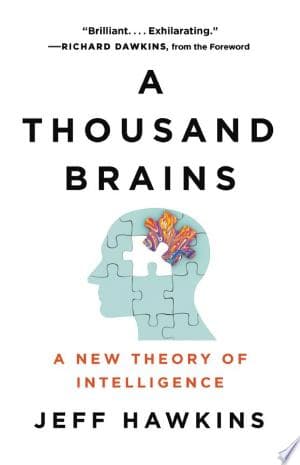
Core Idea
- Difficulty
- Medium
- Read it if
- You are fascinated by neuroscience, artificial intelligence, and a bold, unified theory of how the brain works. You want to understand a novel perspective on intelligence that departs from traditional computational models and emphasizes prediction and reference frames.
- Skip it if
- You prefer a purely philosophical or psychological exploration of consciousness without deep dives into neuroanatomy and theoretical models of brain function. You are looking for practical self-help or a light introduction to the brain.
Key Takeaways from A Thousand Brains
The Cortical Column: A Universal Learning Machine
Intelligence emerges from countless identical, interacting mini-brains.
Hawkins suggests that the neocortex is not a group of specialized regions but a sheet of 'cortical columns,' each acting as a complete, small learning system. Each column, no matter its location (visual, auditory, or somatosensory cortex), uses the same basic method to learn, predict, and model the world. This sameness is important: it means the brain does not need to create new methods for new tasks; it just uses the same strong, general learning mechanism for all sensory inputs and motor outputs. This idea challenges the traditional view of brain specialization, suggesting that intelligence is a distributed property, emerging from these thousands of identical processing units working at the same time.
“The secret to intelligence isn't a complex, centralized processing unit, but rather a vast number of nearly identical, highly interconnected learning machines.”
In the book: Hawkins's work at Numenta, particularly their Hierarchical Temporal Memory (HTM) theory, which models how cortical columns learn and make predictions based on sequences of sensory data. He cites anatomical evidence of the consistent six-layer structure and similar cellular composition across diverse cortical areas.
Try this: Appreciating the brain's modularity can inform how we approach complex problems, breaking them down into smaller, self-similar learning tasks. In AI, this suggests a shift from highly specialized, task-specific architectures to more generalized, column-like learning units that can adapt to diverse data.
Related ideas: cortical-column, neocortex, hierarchical-temporal-memory
Reference Frames: The Brain's GPS for Understanding
Our perception of the world is built on object-centric coordinate systems.
A key idea is that the brain does not just store sensory images. Instead, it builds and uses 'reference frames' for every object and idea it encounters. Think of a cup: the brain does not just recognize 'cup'; it understands the spatial relationships of its handle, rim, and base relative to the cup itself. When you move your hand to grab it, your brain is not calculating exact coordinates; it is mapping your fingers' position relative to the cup's reference frame. This system allows for strong object recognition from any angle and helps with motor control and predictive modeling, letting us interact with a changing world effectively.
“The brain doesn't just know 'what' an object is; it knows 'where' its features are relative to the object itself, using a multitude of internal reference frames.”
In the book: Hawkins draws parallels to grid cells and place cells in the hippocampus, which create internal maps of space. He extends this concept to the entire neocortex, arguing that every object and concept we know has an associated set of reference frames that define its features and their spatial relationships.
Try this: When learning a new skill or understanding a complex system, try to identify the fundamental 'objects' and their internal spatial relationships. For instance, when learning to play an instrument, mentally map the notes relative to the instrument's structure, rather than just memorizing absolute finger positions.
Related ideas: reference-frames, object-recognition, spatial-cognition
Thousand Brains Theory: A Distributed Model of Reality
Hundreds of thousands of cortical columns independently model the world and vote on reality.
The 'Thousand Brains' theory is the main point: each cortical column, with its reference frames, builds its own complete model of a specific object or idea. For example, when you see a coffee cup, thousands of columns might be modeling different parts of it at the same time — its color, handle, weight, and use. These independent models then 'vote' or share their findings to agree on a conclusion. This distributed, parallel processing makes the brain very robust (damage to one column does not break the whole system) and explains how we can quickly recognize objects from partial information and combine different sensory inputs into a clear perception. It is a truly democratic brain.
“Each cortical column is not merely a component; it is an independent learner, building its own model of a part of the world, and then communicating its conclusions to the rest of the brain.”
In the book: The theory is built upon the observed uniformity of cortical columns and their extensive interconnections. Hawkins argues that the brain's ability to maintain a stable perception despite constantly shifting sensory inputs (e.g., eye movements) is best explained by a voting mechanism among these numerous, independent models.
Try this: When faced with uncertainty or ambiguous information, consider gathering diverse perspectives or 'models' of the situation before making a decision. This mimics the brain's robust consensus-building process.
Related ideas: thousand-brains-theory, distributed-cognition, consensus-perception
Beyond Sensory Input: Cognition as Movement-Based Prediction
Thinking is the brain simulating movement and predicting its sensory consequences.
Hawkins argues that the brain's main job is not just to process static sensory input, but to predict what will happen next when we move. This applies to physical movement and also to 'mental' movement — shifting attention, remembering things, or thinking about ideas. When you 'think' about a cup, your brain simulates how your eyes would move to scan it, how your hand would feel it, and predicts the sequence of sensory inputs. This constant, active prediction, driven by an internal simulation of interaction, is the core of thinking. It explains why abstract thought feels so connected to our physical experiences.
“When we think, we are essentially simulating movement, imagining how our sensors would change if we were to move or interact with the world.”
In the book: The close anatomical and functional intertwining of sensory and motor cortices, and the discovery of 'mirror neurons' that fire both when an action is performed and when it is observed, supports the idea of simulation as a core neural process. Hawkins explicitly links this to the brain's use of reference frames for navigating both physical and conceptual spaces.
Try this: To enhance understanding or problem-solving, actively simulate scenarios in your mind. Don't just read about a concept; imagine interacting with it, moving around it, and predicting outcomes. This 'mental rehearsal' leverages the brain's fundamental predictive mechanism.
Related ideas: predictive-coding, motor-cognition, mental-simulation
The Origin of Self: Your Body's Constant Reference Frame
A stable sense of self emerges from the brain's continuous modeling of your own body.
Our lasting sense of self, the 'I' that continues through time and experience, is not a mysterious thing but a very consistent, constantly updated model of our own body. The brain continuously monitors and predicts the state of our physical form — its posture, internal feelings, and potential for movement. This 'body model' acts as a basic, unchanging reference frame to which all other perceptions and actions are tied. It is the stable base on which all other learned models of the world are built, providing the needed continuity for consciousness and identity. When this model is disrupted (e.g., in out-of-body experiences), the sense of self can become unstable.
“Your sense of self isn't a single entity but a continuous, stable model of your body's current state, serving as the ultimate reference frame for everything else.”
In the book: Hawkins connects this to the somatosensory cortex's continuous mapping of the body. He also references phenomena like phantom limb syndrome, where the brain's internal model of a limb persists even after its physical absence, highlighting the primacy of the internal model.
Try this: Cultivating body awareness through practices like mindfulness or yoga can strengthen this fundamental reference frame, potentially leading to a more grounded and coherent sense of self and presence.
Related ideas: sense-of-self, body-schema, consciousness, somatosensory-cortex
Understanding as Prediction: The Brain's Primary Drive
To understand something is to accurately predict its future behavior.
Hawkins argues that understanding is not about passively taking in information; it is about actively building predictive models. When we 'understand' an idea, a person, or a physical event, it means our internal models are accurate enough to anticipate its next state or behavior. The brain constantly predicts what it expects to sense next. Any difference from these predictions creates a 'prediction error,' which drives learning and model improvement. This continuous cycle of prediction and error correction is what drives intelligence, making the brain an active, rather than reactive, organ.
“The brain's primary task is not to react to the world, but to predict it. Understanding is prediction.”
In the book: The concept of 'predictive coding' is a well-established theory in neuroscience, where the brain attempts to minimize prediction errors by constantly updating its internal models. Hawkins integrates this into his framework of cortical columns and reference frames, explaining *how* these predictions are generated and refined.
Try this: When learning, focus on developing the ability to predict. Instead of just memorizing facts, try to anticipate outcomes, explain 'why' things happen, and formulate 'what if' scenarios. This shift from recall to prediction deepens understanding.
Related ideas: predictive-coding, learning, prediction-error, understanding
The Future of AI: Mimicking Cortical Columns, Not Human Brains
True AI requires replicating the brain's fundamental learning algorithm, not just its scale.
Hawkins states that current AI, despite its impressive successes in certain areas, is different from biological intelligence. Modern AI often uses large datasets and statistical relationships, lacking the brain's ability to build full, predictive models of the world using movement-based reference frames. He suggests a change in approach: instead of trying to force intelligence with bigger neural networks, AI research should focus on using the principles of cortical columns and reference frames. This means building AI systems that learn 'like the brain' — developing internal, object-focused models and making predictions based on simulated interactions — rather than just copying external behaviors.
“We need to build machines that learn like the neocortex, not just that are as big as the neocortex.”
In the book: Hawkins's work at Numenta on Hierarchical Temporal Memory (HTM) is a direct attempt to build AI based on these principles. He contrasts the 'brittleness' of current deep learning models (e.g., their susceptibility to adversarial attacks) with the robustness of biological intelligence, attributing the difference to the underlying learning mechanisms.
Try this: For those in AI development, consider exploring architectures that prioritize spatial modeling, prediction through simulated interaction, and distributed, independent learning units, rather than solely focusing on increasing model size or data volume.
Related ideas: artificial-intelligence, general-intelligence, hierarchical-temporal-memory, machine-learning
The Universality of Intelligence: Beyond Biology
Intelligence is an emergent property of a specific type of learning system, not confined to organic matter.
A major implication of Hawkins's theory is that intelligence does not have to be tied to biological brains or carbon-based life. If the neocortex uses a discoverable, universal method involving reference frames and distributed modeling, then this method could, in theory, be put into silicon or other materials. This makes intelligence less mysterious, moving it from a biological wonder to a computational event. It suggests that advanced, truly intelligent AI is not only possible but will happen once we fully understand and copy these core principles. It opens the door to a future where intelligence is common, not just a biological rarity on Earth.
“If we understand the principles of the neocortex, we will realize that intelligence is not magic, nor is it exclusive to biological brains. It is a set of computations that can be implemented in any substrate.”
In the book: The entire theory hinges on the idea that the neocortex is a uniform, algorithmic learning machine. If the algorithm is universal, then the substrate is secondary. Hawkins's confidence in building 'brain-like' AI is a testament to this belief.
Try this: This takeaway encourages a broader, less anthropocentric view of intelligence. It can inspire cross-disciplinary thinking, merging neuroscience, computer science, and philosophy to explore the fundamental nature of intelligence wherever it may arise.
Related ideas: universal-intelligence, substrate-independence, post-humanism, philosophy-of-mind
Abstract Thought: Navigating Conceptual Spaces
High-level reasoning reuses the brain's spatial mapping for physical objects.
Hawkins proposes that abstract thought — understanding math, philosophy, or complex social interactions — is not a different kind of processing but an extension of the same methods used for physical perception. Just as we create reference frames for a physical cup, our brains create conceptual 'reference frames' for abstract ideas. We 'move' through these conceptual spaces, making predictions, finding relationships, and building models, much like we navigate physical space. This unified theory of cognition suggests that our ability for abstract reasoning is deeply connected to our sensorimotor experiences and the brain's clever ability to generalize these spatial modeling techniques.
“When we think abstractly, our brains are still performing the same fundamental operations of building models and moving through reference frames, but now in conceptual spaces.”
In the book: Neuroscience research on how spatial language (e.g., 'grasping a concept,' 'falling behind') is deeply embedded in our cognitive processes. Hawkins's theory suggests that the underlying neural mechanisms for these linguistic metaphors are literal reuses of spatial navigation circuitry.
Try this: When trying to understand complex or abstract concepts, try to visualize them spatially or create mental models that allow you to 'move around' and interact with their components. This leverages the brain's natural tendency to map information spatially.
Related ideas: abstract-reasoning, conceptual-spaces, cognitive-mapping, metaphor
The Neocortex is a Predictor: Not a Processor
The brain's primary role is to anticipate the future, not just react to the present.
This point highlights a key difference: the brain is a prediction machine, not just a device that reacts to input. Every moment, it forms ideas about what will happen next, based on its many internal models. Sensory input then acts as feedback, either confirming predictions or creating errors that lead to learning. This active, forward-looking nature of the brain means that much of what we see as 'reality' is actually our brain's best guess, always being refined. This predictive framework explains how we can react quickly, fill in missing information, and even imagine future events, making us active participants in the world.
“The neocortex is not primarily a processor of sensory input; it is a predictor of future sensory input.”
In the book: The phenomenon of 'perceptual filling-in' (e.g., the blind spot in our vision) where the brain actively constructs missing information based on predictions. Also, reaction time studies showing that humans often anticipate events rather than merely responding to them.
Try this: Cultivate a proactive mindset in daily life by consciously anticipating potential outcomes and planning for them. In problem-solving, instead of just analyzing what is, actively predict what could be, and develop strategies based on those predictions.
Related ideas: predictive-brain, anticipation, proactive-cognition, neural-prediction
A Thousand Brains Quotes
“Your brain isn't just learning one model of the world; it's learning thousands of models of the world, in parallel, on every single cortical column.”
“The brain builds a predictive model of the world, and then constantly compares its predictions to actual sensory input.”
“Every object in the world has a 'location' relative to your body, and your brain is constantly tracking these locations.”
“We don't need a single 'master algorithm' for intelligence; intelligence emerges from a common algorithm applied repeatedly across many parallel models.”
“The brain doesn't just represent what is, but also what could be.”
“The neocortex is not a blank slate; it has an inherent structure and a common algorithm.”
“Understanding intelligence requires understanding how the brain builds a model of the world, not just how it processes information.”
“The brain is constantly exploring its environment, even when we are not consciously aware of it.”
“Your sense of self, your 'I,' is intimately tied to the world model your brain has constructed.”
“If we want to build truly intelligent machines, they must have body-based location, and they must learn thousands of models in parallel.”
“The entire neocortex uses the same algorithm, but it's applied to different sensory modalities and different levels of abstraction.”
“The brain's goal is not to perfectly represent reality, but to build a useful model that allows it to predict and act effectively.”
“Consciousness is not a magical property, but an emergent phenomenon of a complex, predictive system operating on a world model.”
“We are not passive observers of the world; we are active participants, constantly interacting and updating our internal models.”
“The brain doesn't just learn facts; it learns the structure of the world and how to interact with it.”
Quiz
10 questions on the main ideas. Each answer comes with a short explanation.
Question 1
According to the Thousand Brains Theory, what is the fundamental unit the brain uses to model the world?
- Individual neurons firing in isolation
- Cortical columns, each building a complete model of a specific object or concept
- Synaptic connections between distant brain regions
- The entire neocortex working as a single, undifferentiated unit
Show answer
B. Cortical columns, each building a complete model of a specific object or concept The core of the Thousand Brains Theory posits that the neocortex is composed of thousands of similar cortical columns, and each column builds a complete model of a part of the world, constantly updating its predictions.
Question 2
What role does movement play in the brain's understanding of objects, as described by Hawkins?
- Movement is primarily for locomotion and has little to do with object recognition.
- Movement is crucial for providing varied sensory inputs that allow cortical columns to learn the location and properties of objects relative to the body.
- Movement is a byproduct of high-level thought, not a foundation for it.
- Movement only serves to activate the motor cortex, separate from sensory processing.
Show answer
B. Movement is crucial for providing varied sensory inputs that allow cortical columns to learn the location and properties of objects relative to the body. Hawkins emphasizes that the brain learns about objects by actively moving and sensing them. This movement provides the 'location signals' that allow different cortical columns to integrate their models and form a coherent perception of an object's complete structure.
Question 3
According to the book, what is the primary mechanism by which the 'thousands of brains' within the neocortex achieve a unified perception of the world?
- A central processing unit in the brainstem that synthesizes all individual models.
- A voting or consensus mechanism among the cortical columns, where they agree on a single model.
- Each cortical column operating completely independently without interaction.
- Direct electrical stimulation from the thalamus coordinating activity.
Show answer
B. A voting or consensus mechanism among the cortical columns, where they agree on a single model. Hawkins proposes that the hundreds of thousands of cortical columns 'vote' on what they are perceiving. If enough columns agree on a particular model, that becomes the brain's unified perception of reality.
Question 4
What is the primary purpose of the 'reference frames' within the Thousand Brains Theory?
- To store long-term memories of past events.
- To encode the location of sensory features relative to an object or a body part.
- To regulate hormone levels and bodily functions.
- To control motor movements in a purely reflexive manner.
Show answer
B. To encode the location of sensory features relative to an object or a body part. Reference frames are crucial for defining locations. Each cortical column uses a reference frame to understand where a sensory input (like a touch or a visual feature) is located relative to the object it's modeling or relative to the body, allowing for invariant recognition.
Question 5
Hawkins argues that the neocortex doesn't just learn about the physical world but also about what other type of world?
- The purely emotional world, separate from cognition.
- The social and abstract world of concepts, language, and theories.
- The subcortical world of basic instincts.
- The quantum mechanical world at a subatomic level.
Show answer
B. The social and abstract world of concepts, language, and theories. A key argument in the book is that the same fundamental cortical algorithm that models physical objects also models abstract concepts, social structures, scientific theories, and language, extending the brain's modeling capabilities beyond just the tangible.
Question 6
What is one of the primary implications of the Thousand Brains Theory for the development of Artificial Intelligence?
- AI should focus solely on brute-force computation and data analysis.
- AI systems should be designed with numerous independent 'brains' that learn models of the world using location-based data, similar to cortical columns.
- Deep learning neural networks are already a complete replication of the neocortex.
- The future of AI lies in creating a single, extremely powerful central processing unit.
Show answer
B. AI systems should be designed with numerous independent 'brains' that learn models of the world using location-based data, similar to cortical columns. Hawkins directly addresses AI, suggesting that true intelligence will come from building systems that replicate the brain's method of using multiple, parallel models that learn through movement and location, rather than just pattern recognition.
Question 7
How does the Thousand Brains Theory explain the phenomenon of 'consciousness' or 'sense of self'?
- It posits a unique, non-physical component of the brain responsible for self-awareness.
- It suggests consciousness arises from the brain's ability to model itself as an object in the world, just as it models other objects.
- It attributes consciousness solely to the activity of the brainstem and limbic system.
- It argues that consciousness is an illusion with no grounding in neural activity.
Show answer
B. It suggests consciousness arises from the brain's ability to model itself as an object in the world, just as it models other objects. Hawkins proposes that the sense of self emerges when the brain applies its general modeling capabilities to itself. It builds models of its own body, its own thoughts, and its own existence, integrating these into a coherent 'self-model'.
Question 8
What is the significance of 'predictive coding' in the Thousand Brains Theory?
- It's a method for the brain to store memories in a compressed format.
- It's the process by which cortical columns constantly generate predictions about incoming sensory data and update their models based on prediction errors.
- It refers to the brain's ability to anticipate future events with perfect accuracy.
- It's a unique coding scheme used only for language processing.
Show answer
B. It's the process by which cortical columns constantly generate predictions about incoming sensory data and update their models based on prediction errors. Predictive coding is fundamental. Cortical columns are constantly making predictions about what they expect to sense next. When the actual sensory input deviates from the prediction, it generates a 'prediction error' that drives learning and updates the internal models.
Question 9
Hawkins suggests that the brain's mapping of the world is not just 'what' something is, but critically also 'where' it is. What does he mean by 'where' in this context?
- Only the absolute GPS coordinates of an object in the external world.
- The location of features relative to the object itself and relative to the body's sensors.
- The precise neural address of the information within the brain.
- The historical origin of the object's existence.
Show answer
B. The location of features relative to the object itself and relative to the body's sensors. The 'where' is crucial for invariant recognition. The brain models objects in terms of the locations of their features relative to the object's own intrinsic reference frame and how those features are sensed relative to the body's current position and orientation.
Question 10
What is the primary distinction Hawkins draws between the 'old view' of the neocortex and his 'Thousand Brains Theory'?
- The old view saw the neocortex as a simple reflex arc, while Hawkins sees it as a complex computational engine.
- The old view saw the neocortex as processing sensory inputs hierarchically in a single stream, while Hawkins argues for parallel processing by thousands of identical, interacting models.
- The old view emphasized the role of glial cells, while Hawkins focuses on neurons.
- The old view believed the neocortex was primarily for motor control, while Hawkins believes it's for sensory perception.
Show answer
B. The old view saw the neocortex as processing sensory inputs hierarchically in a single stream, while Hawkins argues for parallel processing by thousands of identical, interacting models. The 'old view' often depicted a hierarchical processing stream where sensory information moves up through different brain regions. Hawkins' theory revolutionizes this by proposing thousands of independent, yet interacting, cortical columns that each build complete models of the world in parallel.
A Thousand Brains FAQ
What is the core idea of 'A Thousand Brains'?
The book proposes the 'Thousand Brains Theory of Intelligence,' suggesting that the brain doesn't build a single model of the world, but rather hundreds of thousands of independent, map-like models, each learning a complete model of an object or concept. These models then vote or reach a consensus to create our perception of reality.
Does the 'Thousand Brains Theory' explain consciousness?
While the book doesn't offer a definitive answer to consciousness, it provides a compelling framework for understanding the origins of a sense of self and high-level thought. It suggests that our subjective experience arises from the continuous integration and consensus-building among these numerous individual models.
How is the 'Thousand Brains Theory' different from traditional AI approaches?
Traditional AI often relies on centralized processing and large datasets, whereas the 'Thousand Brains Theory' emphasizes distributed, parallel learning by numerous independent models. This fundamentally changes how intelligence is conceptualized, moving away from single, monolithic networks towards a more biological, modular architecture.
What is a 'reference frame' in the context of the Thousand Brains Theory?
A reference frame is a crucial concept, referring to the brain's ability to locate and understand objects and their features in relation to different spatial and sensory contexts. The theory posits that each cortical column learns a complete model of an object in its own reference frame.
How does the brain use 'map-like structures' to build models?
The book explains that the brain's neocortex is organized into columns, and each column contains cells that form 'maps' of the world. These maps encode information about an object's location and features relative to the body and other objects, allowing for a comprehensive, multi-perspective understanding.
What are the implications of this theory for the future of AI?
The 'Thousand Brains Theory' provides a blueprint for creating truly intelligent machines that can learn continuously, adapt to novel situations, and understand the world in a more human-like way. It suggests that future AI should emulate the brain's distributed, parallel, and reference-frame-based learning mechanisms.
Is this theory widely accepted in the neuroscience community?
While 'A Thousand Brains' presents a groundbreaking and well-researched theory, it is a relatively new perspective and, like many significant scientific theories, is subject to ongoing research, discussion, and validation within the broader neuroscience community. It has, however, garnered significant attention and praise from prominent figures.
How does this book relate to Jeff Hawkins' previous work, 'On Intelligence'?
'A Thousand Brains' builds upon and refines the ideas presented in 'On Intelligence,' offering a more detailed and expansive theory of how the neocortex works. It specifically introduces the concept of thousands of independent models and the role of reference frames, which were not as fully developed in his earlier work.
Can I understand this book without a background in neuroscience or AI?
Yes, Jeff Hawkins is known for making complex scientific concepts accessible to a general audience. While it delves into detailed scientific explanations, the book is written with clarity and includes analogies to help readers without a specialized background grasp the core ideas.
About the author

Jeff Hawkins is an American entrepreneur and neuroscientist known for his work in machine intelligence and brain theory. In his book "A Thousand Brains," he explores the implications of understanding the brain's structure and function for artificial intelligence. Hawkins is also recognized for co-founding Palm, Inc. and Handspring, Inc.
Similar books
- Freakonomics: A Rogue Economist Explores the Hidden Side of Everything
Steven D. Levitt
4.0 (709k) average on GoodreadsBusinessThis book uses economic principles to reveal the surprising incentives behind everything from drug dealing and real estate to cheating teachers and the decline of crime.
- The Tipping Point: How Little Things Can Make a Big Difference
Malcolm Gladwell
4.0 (690k) average on GoodreadsBusinessMalcolm Gladwell explains how small, targeted actions can start widespread changes in trends, behaviors, and ideas.
- The Immortal Life of Henrietta Lacks
Rebecca Skloot
4.1 (587k) average on GoodreadsBiographyA poor Southern tobacco farmer's unwitting contribution of 'immortal' cells starts a journey through scientific breakthroughs, medical ethics, and her family's decades-long fight for recognition and understanding.
- Outliers: The Story of Success
Malcolm Gladwell
4.2 (556k) average on GoodreadsBusinessMalcolm Gladwell argues that true success is not just about individual talent, but about the hidden advantages of culture, opportunity, and unique experiences that shape extraordinary lives.
- Sapiens: A Brief History of Humankind
Yuval Noah Harari
4.4 (502k) average on GoodreadsPsychologySapiens tells the story of Homo sapiens, showing how our ability to create shared fictions helped us go from an ordinary ape to the planet's main species, changing Earth and our future.
- Blink: The Power of Thinking Without Thinking
Malcolm Gladwell
3.9 (487k) average on GoodreadsBusinessExplore the hidden power of quick judgments and how 'thin-slicing' information helps skilled decision-makers succeed instantly, often without conscious thought.




Enjoyed the summary?
A summary gives you the shape of the book. The book itself has the detail, the examples and the voice.
Find A Thousand Brains on AmazonAs an Amazon Associate, BookBrief earns from qualifying purchases. How we're funded