
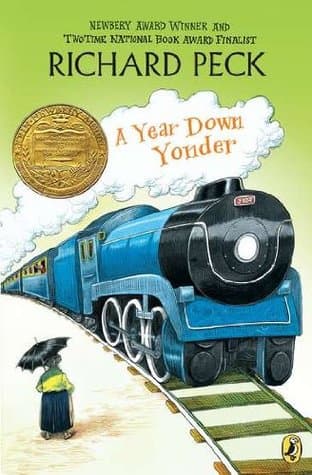
Synopsis
Covers the whole plot, including the ending.
- Difficulty
- Easy
- Pacing
- Moderate
- Mood
- Heartwarming, Humorous, Nostalgic, Quaint
- Read it if
- You enjoy heartwarming historical fiction with a strong, eccentric matriarch and a coming-of-age story filled with humor and small-town charm.
- Skip it if
- You prefer fast-paced, plot-driven narratives with high stakes and complex adult relationships, or dislike episodic storytelling.
A Year Down Yonder Plot Summary
Covers the whole plot, including the ending.
Mary Alice Arrives in Rural Illinois
In the fall of 1937, Mary Alice Peed, a fifteen-year-old from Chicago, is sent by her parents to live with her Grandma Dowdel in a tiny, rural Illinois town for a year. The Great Depression has hit her father's business hard, and her parents believe she will be safer and better fed in the country. Mary Alice arrives expecting a quiet, dull existence, but is immediately confronted by Grandma Dowdel's unconventional and often shocking methods. Her grandmother, a large, imposing woman, rules her household and the town with an iron fist, a sharp wit, and a surprising sense of justice. Mary Alice quickly realizes that life with Grandma Dowdel will be anything but boring, as her grandmother's reputation for shaking things up precedes her.
The Halloween Prank and Royce McNabb
Mary Alice's first major experience with Grandma Dowdel's unique approach to problem-solving occurs on Halloween. Grandma Dowdel, with Mary Alice reluctantly in tow, topples an outhouse onto the car of Royce McNabb, a local bully who had been harassing Mary Alice and other girls. This act of vigilantism is a display of power and a clear message to Mary Alice about her grandmother's protective nature. The incident solidifies Grandma Dowdel's reputation as someone not to be trifled with, and Mary Alice begins to see a method to her grandmother's ways, slowly adjusting to the rural life and her grandmother's eccentricities.
The Christmas Pageant and Shotgun Wedding
Christmas in the small town brings another of Grandma Dowdel's schemes. During the annual Christmas pageant, where Mary Alice is coerced into playing the Virgin Mary, Grandma Dowdel orchestrates a shotgun wedding. She forces the reluctant O.B. Dickey to marry his pregnant girlfriend, Mildred Burdick, right there on stage, in front of the entire congregation. Grandma Dowdel's actions, while scandalous and unorthodox, are driven by a desire to ensure the young couple does the right thing and to provide a stable future for the unborn child. Mary Alice is mortified but also witnesses her grandmother's deep sense of moral responsibility, even if her methods are extreme.
Saving the Halloween Money
When the local bank announces it will be closing, potentially causing many townspeople to lose their savings, Grandma Dowdel acts. She had been holding the town's Halloween money—funds collected from the pranks—and rather than depositing it in the failing bank, she orchestrates a dramatic, public withdrawal of all her own money and then uses the Halloween funds to pay off everyone's outstanding debts at the general store. This shrewd move saves the town's money and shows her resourcefulness and her commitment to the community, showing Mary Alice that her grandmother is a protector and a provider, even in economic hardship.
The Arrival of Junior Stubbs
In a display of compassion, Grandma Dowdel takes in Junior Stubbs, a neglected and often abused young boy from a struggling family. Junior is a scrawny, shy child who rarely speaks, but Grandma Dowdel provides him with food, shelter, and a sense of belonging that he has never known. Mary Alice, initially wary, observes her grandmother's quiet kindness towards Junior, teaching him to read and providing him with the stability he needs. This act of charity reveals a softer, more nurturing side to Grandma Dowdel, proving to Mary Alice that her grandmother's tough exterior often hides a caring heart, especially for those in need.
The Boy Scout Camp and Talent Show
Mary Alice and Grandma Dowdel attend a Boy Scout camp where Junior Stubbs is a participant. To help Junior gain confidence and win the talent show, Grandma Dowdel devises a plan. She has Mary Alice teach Junior to play a simple tune on a saw, and then has him perform it dressed as a ghost, complete with a sheet and a hat. The performance is a success, winning Junior first prize and boosting his self-esteem. This event shows Grandma Dowdel's ingenuity and her dedication to helping those she cares about, as well as Mary Alice's growing involvement in her grandmother's schemes and her developing affection for Junior.
The Homecoming Dance
Mary Alice attends the high school homecoming dance, a social event in the small town. She goes with a local boy, and the experience provides her with a glimpse into the social dynamics of rural youth. While she still feels somewhat an outsider, she is beginning to integrate into the community. The dance is a typical teenage experience, but it's framed by her year in the country, showing her gradual adaptation to a life different from Chicago. This scene marks a point where Mary Alice is not just observing, but actively participating in the town's events, further solidifying her place, however temporary, in the community.
The Flood and Rescue
A severe flood strikes the region, isolating many homes. Grandma Dowdel, with Mary Alice's help, takes her boat out to rescue a family stranded in their home. The dangerous mission shows Grandma Dowdel's bravery, resilience, and commitment to her neighbors. Mary Alice, initially frightened, assists her grandmother, demonstrating her own growing courage and resourcefulness. This harrowing experience deepens Mary Alice's respect and admiration for her grandmother, as she witnesses firsthand Grandma Dowdel's selflessness and leadership in a crisis, cementing their bond in the face of adversity.
Mary Alice's Departure
As the year draws to a close, Mary Alice's parents return to take her back to Chicago. The farewell is bittersweet. Mary Alice has transformed from a city girl who resented being sent away into a more resilient, observant young woman with an appreciation for her grandmother and the rural community. She has learned lessons about life, courage, and true character. While she is eager to return to her familiar life, she carries with her the mark of Grandma Dowdel's influence, knowing that her year down yonder has shaped her in lasting ways, making her a stronger, wiser individual.
A Year Down Yonder Characters
Mary Alice Peed
Protagonist
Fifteen-year-old city girl sent to live with her eccentric grandmother.
Mary Alice is a sophisticated, somewhat pampered fifteen-year-old from Chicago at the beginning of the story. She is initially reluctant and resentful about being sent to live in a small, rural town with her formidable Grandma Dowdel. Over the course of the year, she transforms from an observer into an active participant in her grandmother's schemes and the town's life. She is intelligent, observant, and possesses a dry wit, which she increasingly uses to articulate her thoughts and feelings. Her experiences force her to mature and develop a deeper understanding of human nature and resilience.
Relationships: Grandma Dowdel (Granddaughter, initially wary but grows to admire and love her); Royce McNabb (Victim of his bullying, then spectator to his comeuppance); Junior Stubbs (Friend and mentor, takes him under her wing)
Grandma Dowdel
Supporting/Mentor
Mary Alice's formidable, eccentric, and fiercely protective grandmother.
Grandma Dowdel is a large, imposing woman who is the undisputed matriarch of her household and a powerful, unconventional figure in her small Illinois town. She is known for her sharp wit, her no-nonsense attitude, and her willingness to bend or break rules to achieve what she believes is right. Despite her gruff exterior and often shocking methods, she possesses a deep moral compass, a strong sense of community, and a surprising capacity for kindness, particularly towards the vulnerable. She is resourceful, independent, and fiercely protective of those she cares about, including Mary Alice and Junior Stubbs.
Relationships: Mary Alice Peed (Grandmother, mentor, guardian); Junior Stubbs (Guardian, caretaker, teacher); Mildred Burdick (Intervenes to ensure her marriage); O.B. Dickey (Forces him into marriage)
Junior Stubbs
Supporting
A neglected, shy boy taken in by Grandma Dowdel.
Junior Stubbs is a small, quiet, and initially withdrawn boy from a poverty-stricken family in the town. He is often neglected and has a difficult home life. When Grandma Dowdel takes him in, he slowly begins to open up and thrive under her care and Mary Alice's friendship. He is a symbol of the vulnerability of children during the Depression and represents Grandma Dowdel's unexpected compassion. His growth, particularly his performance in the talent show, showcases the positive impact of a stable and caring environment.
Relationships: Grandma Dowdel (Caretaker, benefactor); Mary Alice Peed (Friend, mentor)
Royce McNabb
Antagonist/Supporting
A local bully who harasses Mary Alice and other girls.
Royce McNabb is a notorious local bully who represents the darker, more aggressive elements of the town's youth. He harasses girls, including Mary Alice, and is generally a disruptive force. His comeuppance at the hands of Grandma Dowdel during the Halloween prank serves as an early demonstration of her protective nature and her willingness to confront injustice directly. He is a relatively minor character but serves as a catalyst for one of Grandma Dowdel's most memorable acts.
Relationships: Mary Alice Peed (Harasses her); Grandma Dowdel (Victim of her Halloween prank)
Mildred Burdick
Supporting
Pregnant young woman forced into marriage by Grandma Dowdel.
Mildred Burdick is a young, pregnant woman who is in a relationship with O.B. Dickey. She is a sympathetic character, caught in a difficult situation during a time when out-of-wedlock pregnancy carried significant social stigma. Grandma Dowdel's intervention in her life, by orchestrating her marriage to O.B. during the Christmas pageant, is a controversial but ultimately protective act, ensuring Mildred and her unborn child have a name and a future within the community. She represents the social pressures and vulnerabilities of young women in the era.
Relationships: Grandma Dowdel (Benefactor, orchestrates her marriage); O.B. Dickey (Her fiancé/husband)
O.B. Dickey
Supporting
Reluctant groom forced to marry Mildred Burdick by Grandma Dowdel.
O.B. Dickey is the young man responsible for Mildred Burdick's pregnancy. He is portrayed as somewhat feckless and reluctant to take responsibility. Grandma Dowdel's forceful intervention during the Christmas pageant compels him to marry Mildred, ensuring he fulfills his obligations. While initially resistant, he ultimately complies, highlighting Grandma Dowdel's power and influence in the town. He represents the young men of the era who might shy away from responsibility without external pressure.
Relationships: Grandma Dowdel (Coerced by her into marriage); Mildred Burdick (His fiancée/wife)
Mr. Weidenbach
Supporting
The local banker who closes the town's bank.
Mr. Weidenbach is the local banker who announces the closure of the town's bank, a significant event during the Great Depression. His actions threaten the savings of many townspeople, including the Halloween money. He represents the economic instability and challenges faced by communities during this period. Grandma Dowdel's shrewd actions to withdraw her money and protect the community's funds directly counter the negative impact of his bank's failure.
Relationships: Grandma Dowdel (Opposite side in a financial standoff)
Mary Alice's Parents
Mentioned
Mary Alice's mother and father, who send her to live with Grandma Dowdel.
Mary Alice's parents are unseen characters who live in Chicago. They send Mary Alice to live with Grandma Dowdel due to financial difficulties caused by the Great Depression, believing she will be safer and better provided for in the country. Their decision sets the entire story in motion. They represent the distant, urban life Mary Alice left behind and eventually returns to. Their presence is felt through Mary Alice's occasional letters home and her anticipation of their return.
Relationships: Mary Alice Peed (Parents)
A Year Down Yonder Themes
Coming of Age and Self-Discovery
The novel charts Mary Alice's journey from a naive city girl to a more mature and resilient young woman. Her year with Grandma Dowdel forces her to confront harsh realities, adapt to a different lifestyle, and develop a stronger sense of self. She learns about independence, courage, and compassion through her grandmother's unconventional lessons. Events like the Halloween prank, the Christmas wedding, and the flood all contribute to her understanding of the world and her own capabilities, shaping her identity.
“A year down yonder. I was fifteen, and I’d never been anywhere. I’d never known anyone like Grandma Dowdel. I’d never been this far from home. And I’d never been so alive.”
Community and Belonging
Despite its small size, the town is a community where people rely on each other. Grandma Dowdel, through her often-unorthodox actions, acts as a protector and enforcer of community values, ensuring justice and support for her neighbors. Mary Alice, initially an outsider, gradually integrates into this community, participating in local events like the homecoming dance and witnessing the collective spirit during the flood. The novel explores the strengths of small-town life, where everyone knows everyone, and a strong sense of mutual responsibility exists.
“Grandma Dowdel wasn't just a part of the town. She was the town.”
Unconventional Wisdom and Justice
Grandma Dowdel embodies a unique brand of wisdom and justice that often defies societal norms and legal procedures. Her methods, such as toppling an outhouse onto a bully's car, orchestrating a shotgun wedding, or outwitting the bank, are shocking but consistently aim to achieve a moral outcome or protect the vulnerable. She operates on her own code of ethics, showing that true justice isn't always found in rules and regulations, but in decisive, often dramatic, action driven by a strong moral compass. Mary Alice learns to appreciate this practical, often humorous, approach to problem-solving.
“There's right, and there's wrong. And then there's Grandma Dowdel.”
Resilience and Adaptation During the Great Depression
The story is set during the Great Depression, and the characters, particularly Grandma Dowdel, show resilience in the face of economic hardship. Mary Alice's parents send her away because of their own financial struggles, and the town itself faces challenges like the closing bank. Grandma Dowdel's resourcefulness, her ability to make do with little, and her community-mindedness in protecting the town's money and taking in Junior Stubbs, all show the adaptive strategies used by people during this difficult era. The narrative shows how people found ways to survive and even thrive.
“In a time when some folks barely had enough to eat, Grandma always had plenty. She just knew how to make things stretch, and how to get things done.”
Plot Devices & Literary Techniques
First-Person Retrospective Narration
The story is told by an older Mary Alice reflecting on her teenage year.
The entire novel is narrated by an older Mary Alice, looking back on her fifteenth year with Grandma Dowdel. This allows for a blend of youthful immediacy and mature reflection. The retrospective lens enables the narrator to provide insightful commentary on her past self's reactions and to highlight the lasting impact of her experiences. It also allows for humor and a deeper understanding of Grandma Dowdel's character, as the adult Mary Alice can appreciate the wisdom behind her grandmother's eccentricities more fully than her teenage self could at the time.
Grandma Dowdel's Eccentricity
Her unconventional behavior drives much of the plot and character development.
Grandma Dowdel's unique and often shocking methods are not just character traits but a central plot device. Her eccentricity creates conflict, provides humor, and acts as a catalyst for Mary Alice's growth. Each of her major interventions—from the Halloween prank to the shotgun wedding and the bank rescue—propels the narrative forward and forces Mary Alice to reassess her understanding of right and wrong, justice, and effective problem-solving. Her unpredictable nature ensures that the plot remains dynamic and engaging, constantly challenging Mary Alice's expectations.
The Rural Setting (Yonder)
The small-town, rural Illinois setting during the Depression shapes the characters and events.
The setting of a small, isolated Illinois town during the Great Depression is more than just a backdrop; it is a crucial plot device. It provides the context for Mary Alice's displacement, the economic hardships faced by the characters, and the close-knit, self-reliant nature of the community. The 'yonder' signifies a world completely different from Mary Alice's urban upbringing, forcing her to adapt and learn new values. The specific challenges and opportunities presented by this rural environment, from floods to community gatherings, directly influence the plot's events and the characters' actions.
Symbolism of Food
Food represents survival, comfort, and Grandma Dowdel's provision.
Throughout the novel, food serves as a powerful symbol, especially in the context of the Great Depression. Grandma Dowdel is consistently portrayed as an abundant provider, her house always filled with delicious, hearty meals, contrasting sharply with the scarcity faced by others. The descriptions of her cooking and the generous portions she offers symbolize comfort, security, and her ability to sustain and care for those under her roof. For Junior Stubbs, food represents basic survival and the first step towards a stable life. It underscores Grandma Dowdel's nurturing side and her practical approach to well-being.
A Year Down Yonder Quotes
“Grandma Dowdel wasn't one to let a little thing like the law stand in her way.”
“You can't get a cat to do anything it doesn't want to do.”
“A body's got to look out for themselves in this world.”
“There's more than one way to skin a cat, and I know most of them.”
“You can't judge a book by its cover, but you can by its first chapter.”
“Sometimes you have to be a little bit bad to do a whole lot of good.”
“A quiet town is a town with nothing going on, and that's the worst kind.”
“You don't need money to be rich. You just need a good story.”
“The past is always with us, whether we like it or not.”
“A little mischief keeps the world turning.”
“You can't change the wind, but you can adjust your sails.”
“Home isn't a place, it's the people who make you feel like you belong.”
“Sometimes the best way to help someone is to let them help themselves.”
“Life is full of surprises, and most of them are good if you look at them right.”
Quiz
10 questions on the plot and the characters. Each answer comes with a short explanation.
Question 1
What historical event serves as the backdrop for Mary Alice's year with Grandma Dowdel?
- World War I
- The Great Depression
- The Dust Bowl migration
- World War II
Show answer
B. The Great Depression The story is set in 1937 during the Great Depression, which explains why Mary Alice's family sends her to live with Grandma Dowdel due to financial hardship.
Question 2
Why is Mary Alice sent to live with Grandma Dowdel for a year?
- Her parents are traveling abroad
- She is in trouble at school and needs discipline
- Her father loses his job during the Depression
- Grandma Dowdel is ill and needs help
Show answer
C. Her father loses his job during the Depression Due to the economic hardships of the Great Depression, Mary Alice's father loses his job, forcing the family to send her to live with Grandma Dowdel to save money.
Question 3
What is Grandma Dowdel's reputation in her small Illinois town?
- A quiet, reclusive woman who keeps to herself
- A wealthy philanthropist who donates to the community
- A stern but fair schoolteacher
- A formidable, cunning woman who shakes up her neighbors
Show answer
D. A formidable, cunning woman who shakes up her neighbors Grandma Dowdel is known for her unconventional and often mischievous methods of dealing with people, using her wit and resourcefulness to influence events in the town.
Question 4
How does Grandma Dowdel deal with the Burdick boys when they try to steal pecans from her tree?
- She calls the sheriff to arrest them
- She sets a trap involving a shotgun and turpentine
- She bribes them with money to leave
- She invites them in for a stern lecture
Show answer
B. She sets a trap involving a shotgun and turpentine Grandma Dowdel rigs a shotgun to fire blanks and coats the pecans with turpentine, teaching the Burdick boys a memorable lesson without actual violence.
Question 5
What role does Mary Alice take on at the school's Halloween party that showcases her growth?
- She performs a solo dance
- She helps Grandma Dowdel run the fortune-telling booth
- She wins the costume contest as a ghost
- She gives a speech about the Depression
Show answer
B. She helps Grandma Dowdel run the fortune-telling booth Mary Alice assists Grandma in the fortune-telling booth, where they cleverly expose a town scandal, demonstrating Mary Alice's increasing confidence and alignment with Grandma's methods.
Question 6
What is the significance of the 'WPA lady' incident in the story?
- It shows Grandma Dowdel's support for government programs
- It highlights Grandma's manipulation to get what she wants from authorities
- It introduces a romantic subplot for Mary Alice
- It leads to Grandma Dowdel getting a new job
Show answer
B. It highlights Grandma's manipulation to get what she wants from authorities Grandma Dowdel pretends to be poor and desperate to secure a new privy from the WPA, showcasing her cunning and ability to work the system to her advantage.
Question 7
How does Mary Alice's relationship with Grandma Dowdel evolve over the year?
- It remains distant and formal throughout
- Mary Alice grows to resent Grandma's strictness
- She develops a deep affection and respect for Grandma
- Grandma Dowdel becomes dependent on Mary Alice
Show answer
C. She develops a deep affection and respect for Grandma Initially apprehensive, Mary Alice learns to appreciate Grandma's wisdom, resilience, and unconventional kindness, forming a strong bond by the end of the year.
Question 8
What does Grandma Dowdel do with the fox fur that she and Mary Alice acquire?
- She sells it to buy groceries
- She uses it to make a coat for Mary Alice
- She trades it for a Christmas turkey
- She donates it to the church bazaar
Show answer
C. She trades it for a Christmas turkey Grandma Dowdel trades the fox fur to Mr. Eubanks for a turkey, ensuring they have a proper Christmas dinner, illustrating her resourcefulness and bartering skills.
Question 9
Which theme is most prominently explored through Grandma Dowdel's interactions with the community?
- The importance of formal education
- The value of cunning and nonconformity in achieving justice
- The dangers of rural isolation
- The inevitability of technological progress
Show answer
B. The value of cunning and nonconformity in achieving justice Grandma Dowdel often uses clever, unconventional tactics to address wrongs and help others, challenging social norms and highlighting how ingenuity can serve justice in a small town.
Question 10
What is the outcome of the 'pie auction' incident at the end of the school year?
- Grandma Dowdel wins the auction with a high bid
- Mary Alice's pie is bought by her love interest, Royce McNabb
- The auction is canceled due to a scandal
- Grandma Dowdel reveals the pies are poisoned as a prank
Show answer
B. Mary Alice's pie is bought by her love interest, Royce McNabb Royce McNabb buys Mary Alice's pie at the auction, symbolizing her integration into the community and hinting at a budding romance, marking a positive conclusion to her year.
A Year Down Yonder FAQ
What is 'A Year Down Yonder' about?
The book follows fifteen-year-old Mary Alice, who is sent from Chicago to live with her formidable Grandma Dowdel in rural Illinois during the Great Depression. Over the course of a school year, Mary Alice navigates small-town life, witnessing Grandma's unconventional schemes to help neighbors and stand up to bullies, which gradually transforms her perspective on family and community.
Why should I read 'A Year Down Yonder'?
It's a heartwarming, humorous tale of intergenerational bonding set against the backdrop of the Great Depression, offering rich historical details and memorable characters. The book explores themes of resilience, kindness, and the unexpected ways people connect, making it both entertaining and thought-provoking for readers of all ages.
What is the background/setting of 'A Year Down Yonder'?
Set in 1937 during the Great Depression, the story takes place in the small, rural town where Grandma Dowdel lives in Illinois. The setting reflects the economic hardships of the era, with details like food scarcity and community reliance, which contrast with Mary Alice's previous life in Chicago.
What are the most memorable quotes?
Notable quotes include Grandma Dowdel's pragmatic wisdom, such as 'You can't judge a book by its cover,' and Mary Alice's reflections like 'I was beginning to see that Grandma had a heart as big as all outdoors.' These lines capture the book's themes of hidden depths and personal growth.
What writing style does the author use?
Richard Peck employs a first-person narrative from Mary Alice's perspective, blending humor with poignant observations. The prose is accessible and engaging, using vivid descriptions and witty dialogue to bring the rural setting and characters to life, making it appealing to young adult and adult readers alike.
What minor details add significant meaning?
Details like Grandma's hidden stash of money and food, which she uses to secretly aid neighbors, reveal her compassionate nature beneath her tough exterior. Similarly, Mary Alice's gradual adjustment to rural life, such as learning to churn butter, symbolizes her growing connection to the community and her grandmother.
What are some subtle foreshadowing moments?
Early scenes where Grandma outsmarts local bullies, like the Cowgill boys, hint at her resourcefulness that will later protect Mary Alice. Mary Alice's initial fear of Grandma's eccentricities foreshadows her eventual admiration and understanding of Grandma's methods as acts of kindness.
What unexpected character connections exist?
Grandma's seemingly adversarial relationship with neighbors, such as Mrs. Weidenbach, masks a deeper mutual respect and unspoken alliances. Mary Alice's friendship with Royce McNabb, a local boy, develops from initial awkwardness to a supportive bond, reflecting the town's interconnectedness.
What are unspoken character motivations?
Grandma Dowdel's harsh exterior conceals a desire to protect and uplift her community, driven by past hardships and a sense of justice. Mary Alice's initial reluctance to embrace rural life stems from fear of change and loneliness, but she secretly yearns for stability and belonging.
What psychological complexities do characters exhibit?
Grandma exhibits a blend of stern independence and deep empathy, using unconventional tactics to mask her generosity. Mary Alice shows resilience and adaptability, grappling with adolescence and displacement while learning to appreciate subtle forms of love and support.
What are the major emotional turning points?
Key moments include Mary Alice's realization during the Halloween party that Grandma's schemes are acts of kindness, and when Grandma secretly pays for Mary Alice's train ticket home, showing her selfless love. These events deepen Mary Alice's emotional bond and understanding of her grandmother.
How do relationship dynamics evolve?
Mary Alice and Grandma's relationship shifts from fear and misunderstanding to mutual respect and affection, as Mary Alice witnesses Grandma's hidden compassion. Mary Alice also grows closer to townspeople like Royce McNabb, moving from outsider to an accepted member of the community.
Which parts remain ambiguous or open-ended?
The book leaves some aspects open, such as the full extent of Grandma's past experiences that shaped her tough demeanor, and what specific future Mary Alice envisions after returning home. These ambiguities invite readers to reflect on character depth and life's uncertainties.
What are controversial scenes or decisions?
Grandma's deceptive tactics, like tricking the Cowgill boys or manipulating events at the Halloween party, could be seen as unethical, but are interpreted as necessary for justice in a harsh time. Some readers might debate whether her methods are justified or overly manipulative.
'A Year Down Yonder' ending explained: how it ends & what it means
The story ends with Mary Alice returning to Chicago after the school year, having grown more confident and appreciative of Grandma. It signifies her personal growth and the lasting impact of her time with Grandma, emphasizing themes of family, resilience, and the unexpected joys found in difficult circumstances.
About the author

Richard Peck is an American author known for his contributions to children's and young adult literature. His notable works include "A Long Way from Chicago," "A Year Down Yonder," "The River Between Us," "Ghosts I Have Been," and "Remembering the Good Times," which often explore themes of family and coming-of-age. Peck's storytelling is characterized by its humor and historical context.
Similar books
- A Long Way from Chicago
Richard Peck
3.9 (32k) average on GoodreadsChildren'sPrequel to 'A Year Down Yonder' with the same characters and similar episodic, humorous storytelling.
- Because of Winn-Dixie
Kate DiCamillo
4.0 (206k) average on GoodreadsChildren'sFeatures a young protagonist navigating a new town and forming unexpected bonds with quirky characters.
- Out of the Dust
Karen Hesse
3.8 (69k) average on GoodreadsChildren'sBoth A Year Down Yonder and Out of the Dust are set during the Great Depression and explore themes of resilience and family hardship. However, Hesse's novel, written in free verse, offers a more stark and somber portrayal of the Dust Bowl's impact, focusing heavily on loss and survival in extreme conditions. Peck's narrative, while acknowledging hardship, maintains a lighter, more humorous tone, emphasizing resourcefulness and community spirit, making it perhaps more accessible for a slightly younger YA audience or those seeking a less emotionally intense experience. Hesse delves deeper into the psychological toll of poverty and environmental disaster, whereas Peck focuses on the everyday ingenuity and human connection that mitigate adversity.
- Harry Potter and the Sorcerer's Stone
J.K. Rowling
4.5 (7M) average on GoodreadsFantasyRescued from a miserable life under the stairs, an orphaned boy discovers he's a wizard destined for a magical school, where he uncovers a dangerous secret tied to the dark wizard who murdered his parents.
- The Hobbit, or There and Back Again
J.R.R. Tolkien
4.3 (2.9M) average on GoodreadsFantasyA comfort-loving hobbit named Bilbo Baggins is whisked away by a mischievous wizard and a band of dwarves on an unexpected journey to reclaim stolen treasure from a fearsome dragon, discovering courage and a magical ring along the way.
- Harry Potter and the Goblet of Fire
J.K. Rowling
4.6 (2.6M) average on GoodreadsFantasyA bewildered Harry Potter, underage and thrust into a deadly Triwizard Tournament, must brave dragons, mermaids, and a resurgent dark magic to survive a year that will forever alter the wizarding world.



Enjoyed the summary?
A summary gives you the shape of the book. The book itself has the detail, the examples and the voice.
Find A Year Down Yonder on AmazonAs an Amazon Associate, BookBrief earns from qualifying purchases. How we're funded