
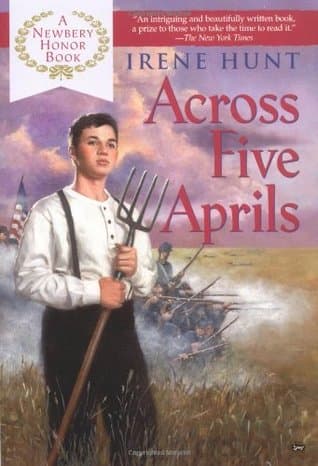
Synopsis
Covers the whole plot, including the ending.
- Difficulty
- Medium
- Pacing
- Moderate
- Mood
- Historical, Poignant, Reflective, Resilient
- Read it if
- You want a poignant, character-driven story about a young boy coming of age during the American Civil War, focusing on the home front and the divided loyalties within families.
- Skip it if
- You prefer fast-paced action or a story that focuses heavily on battlefield accounts rather than personal, emotional impact.
Across Five Aprils Plot Summary
Covers the whole plot, including the ending.
The War Clouds Gather
In spring 1861, ten-year-old Jethro Creighton lives with his family on a farm in southern Illinois. He is the youngest of a large family, many of whom have grown and moved away. The family, especially Jethro and his sister Jenny, enjoy the simple routines of farm life. However, the coming Civil War casts a long shadow. Talks about states' rights and slavery fill conversations, both at home and in the nearby town of Newton. Jethro's older brothers, Bill, Tom, and John, and his cousin Eb, all consider joining the Union, creating a clear tension that Jethro, despite his age, keenly feels and watches.
Family Divided
When Fort Sumter is fired upon, the war officially begins, and its immediate effects are felt within the Creighton family. Tom and Eb enlist in the Union Army, full of patriotism. Their departure leaves a big hole on the farm, increasing the workload for Jethro and his parents. But the deepest division comes from Bill, Jethro's quiet older brother. Unlike Tom and Eb, Bill shows sympathy for the Southern cause, believing the North is infringing on the South's rights. After a very emotional talk with Jethro, Bill makes the hard choice to leave home and fight for the Confederacy, changing the family forever and leaving Jethro with deep sadness and confusion.
Hardship and Responsibility
With Tom, Eb, and Bill gone, Jethro, at just eleven, becomes the man of the house, alongside his aging father, Matt Creighton. He must plow fields, get supplies from town, and take on responsibilities far beyond his years. During a trip to Newton, he faces hostility from men who resent Bill's choice to fight for the South. He is threatened and told to leave town. On his way home, Guy Wortman, a local troublemaker and Confederate sympathizer, ambushes him and tries to hurt him. Jethro bravely defends himself and escapes, but the incident shows the real dangers and hatred now present in their daily lives, even far from the battles.
News from the Front
The war, at first a distant idea, becomes a harsh reality with news from the front lines. The Creightons get a letter saying Tom has been killed in battle at Pittsburgh Landing (Shiloh). This loss plunges the family into deep grief, especially his mother, Ellen, and his sister, Jenny. Soon after, the family learns that Eb, overwhelmed by the horrors of war and bad conditions, has deserted the Union Army. Eb's desertion brings shame and possible legal trouble to the family. Jethro, finding Eb hiding in the woods, makes the hard choice to write to President Lincoln, asking for advice on how to help his cousin, showing his growing maturity and moral sense.
Lincoln's Pardon and Continued Struggle
In response to Jethro's letter, President Lincoln issues a general pardon for deserters who return to their posts, letting Eb rejoin the Union Army without severe punishment. This act of kindness brings great relief to the Creighton family and strengthens Jethro's respect for the President. However, the war's effects continue. The family faces ongoing challenges, including crop failures and the threat of starvation. Guy Wortman, still holding a grudge, tries to burn down their barn, but the community helps the Creightons, showing the strength of neighborly bonds even amid division. Jethro continues to carry the burden of farm work and the emotional weight of the war.
John's Return and Shad's Illness
John, another of Jethro's older brothers, comes home for a short leave from the Union Army, bringing vivid, often grim, stories of the war's realities. He shares news of the battles and the toll on soldiers, giving the family a direct link to the conflict. His presence offers a temporary sense of safety and connection. Meanwhile, Shad, Jethro's beloved schoolteacher and Jenny's fiancé, falls gravely ill while serving in the army. Jenny, very worried and heartbroken, decides to go to Washington D.C. to care for him. Her journey highlights the sacrifices and emotional stress on those waiting at home, and the desperate steps they take for their loved ones.
Jenny's Marriage and Shad's Recovery
Jenny arrives in Washington D.C. and nurses Shad back to health. Her steady care slowly brings Shad back from near death. During his recovery, they decide to marry, a simple ceremony during the war, but a meaningful moment of personal joy and commitment. The marriage offers a small but important sign of hope for the Creighton family, showing continuity and love even in the darkest times. Shad's gradual recovery also offers reassurance, a contrast to the many losses the family and nation have endured. Jenny sends letters home, keeping Jethro and her parents informed of their well-being.
The End of the War
Finally, after years of brutal conflict, news arrives that General Robert E. Lee has surrendered to General Ulysses S. Grant at Appomattox Court House, ending the Civil War. The entire nation, including the Creightons, feels immense relief and joy. The war is over, and the long wait for their loved ones to return can begin. However, this joy is tragically short-lived. Soon after, the devastating news of President Abraham Lincoln's assassination reaches the Creighton farm. The nation mourns, and the Creightons, who admired Lincoln's leadership and kindness, feel a deep sense of loss, tempering their relief with renewed sorrow.
The Return Home
After the war, the Creighton family anxiously awaits their soldiers' return. Eb is among the first to come home, a changed man, bearing the physical and emotional scars of battle, but grateful to be alive. John also returns, bringing news of Bill. He reveals that Bill survived the war and is now in California, unable to face returning to his family after fighting for the Confederacy. This news brings both relief and a lingering sadness to Jethro, who still deeply misses his brother. The returning soldiers show the lasting impact of the war, but their presence also marks the beginning of the family's healing and a gradual return to some sense of normal life.
A New Beginning
As the country rebuilds, Shad and Jenny finally return to the Creighton farm. Shad, though still recovering, is determined to resume his life as a teacher. He immediately sees Jethro's intelligence and desire for knowledge, offering to take him back to Newton to live with him and Jenny, where Jethro can continue his education. This offer is a great chance for Jethro, who has given up so much of his childhood for the farm. The novel ends with Jethro looking forward to a future beyond the farm, a future of learning and possibilities, symbolizing hope for a new generation rising from the ashes of war, ready to help a reunited nation.
Across Five Aprils Characters
Jethro Creighton
Protagonist
A young boy who comes of age during the Civil War.
Jethro is the youngest son of Matt and Ellen Creighton, intelligent and observant, with a deep love for his family and a keen sense of justice. He is initially a naive ten-year-old but is rapidly forced to mature as the Civil War depletes his family of its older male members. He takes on significant farm responsibilities, faces danger, and grapples with complex moral dilemmas, such as Bill's defection and Eb's desertion. His inner thoughts and struggles form the core of the narrative, making him a relatable and empathetic character.
Relationships: Matt Creighton (Son, caretaker, confidante); Ellen Creighton (Son, caretaker); Jenny Creighton (Close sibling, supportive friend); Bill Creighton (Adoring younger brother, confused by Bill's choices); Tom Creighton (Younger brother to Tom, looks up to him); Eb Carron (Cousin, friend, savior); Shad Yale (Student, mentee, friend, future brother-in-law)
Matt Creighton
Supporting
Jethro's wise and resilient father, the patriarch of the Creighton family.
Matt is a principled and deeply religious man who loves his family fiercely. He is a respected figure in the community, known for his wisdom and fairness. As the war progresses, he is burdened by the loss of his sons to battle and the division caused by Bill's choices. He relies heavily on Jethro as his health declines, demonstrating immense trust in his young son's capabilities. Despite the hardships, he maintains his moral compass and instills strong values in his children, particularly Jethro.
Relationships: Ellen Creighton (Husband, partner); Jethro Creighton (Father, relies heavily on Jethro); Bill Creighton (Father, deeply pained by Bill's choice but still loves him); Tom Creighton (Father, mourns his death); John Creighton (Father, proud of his service)
Ellen Creighton
Supporting
Jethro's loving and enduring mother, who bears the emotional weight of the war.
Ellen is a strong, resilient woman, deeply rooted in her faith and devoted to her family. She carries the emotional burden of the war most acutely, grieving the loss of her sons and worrying constantly about those still fighting. Her experiences with past losses, including children who died young, have instilled in her a quiet strength and a deep capacity for sorrow. She provides comfort and stability for Jethro, despite her own struggles, and represents the enduring spirit of the women left behind during the conflict.
Relationships: Matt Creighton (Wife, partner); Jethro Creighton (Mother, source of comfort); Bill Creighton (Mother, deeply saddened by his choice); Tom Creighton (Mother, mourns his death intensely); Jenny Creighton (Mother, relies on her for support)
Jenny Creighton
Supporting
Jethro's kind and responsible older sister, who finds love amidst the war.
Jenny is Jethro's closest sibling at the start of the book, acting as a surrogate mother figure and confidante. She is hardworking, compassionate, and deeply in love with Shad Yale. Her emotional journey throughout the war is marked by worry for Shad and her brothers, and her determination to be with Shad when he is critically ill demonstrates her unwavering loyalty and strength. Her eventual marriage to Shad offers a hopeful counterpoint to the pervasive sorrow of the war.
Relationships: Jethro Creighton (Older sister, confidante, friend); Shad Yale (Fiancée, wife, deeply devoted); Matt Creighton (Daughter, helps on the farm); Ellen Creighton (Daughter, provides emotional support)
Bill Creighton
Supporting
Jethro's quiet and principled older brother who fights for the Confederacy.
Bill is a thoughtful, introspective young man who feels a deep connection to Jethro. Unlike his brothers, he questions the Union cause and believes in the South's right to self-determination, though he abhors slavery. His decision to fight for the Confederacy is agonizing and driven by his personal convictions rather than malice. His departure creates a profound rift in the family and leaves a lasting impact on Jethro, who struggles to reconcile his love for Bill with the side he chose. He remains an enigma for much of the book, his fate only revealed at the very end.
Relationships: Jethro Creighton (Older brother, close bond, mentor); Matt Creighton (Son, his choice causes immense pain); Ellen Creighton (Son, deeply missed)
Shad Yale
Supporting
Jethro's kind schoolteacher and mentor, Jenny's fiancé.
Shad is an intelligent, compassionate young man who serves as Jethro's teacher and intellectual mentor. He encourages Jethro's love of learning and provides a stable, positive influence in his life. He is deeply in love with Jenny and enlists in the Union Army, where he is later gravely wounded. His recovery, aided by Jenny, and his eventual return represent a hope for the future and the power of education. He offers Jethro a path to continue his studies, symbolizing the promise of a new era.
Relationships: Jethro Creighton (Teacher, mentor, friend, brother-in-law); Jenny Creighton (Fiancé, husband, true love)
Eb Carron
Supporting
Jethro's cousin, who deserts the Union Army out of fear and despair.
Eb is Jethro's older cousin, who enlists in the Union Army with youthful enthusiasm but quickly becomes disillusioned by the horrors of war. Overwhelmed by fear and the harsh conditions, he deserts, bringing shame upon his family. His desperate situation and Jethro's compassion lead to President Lincoln's general amnesty for deserters, highlighting the human cost of the war and the possibility of redemption. He represents the common soldier's struggle with the brutal realities of combat.
Relationships: Jethro Creighton (Cousin, friend, saved by Jethro); Matt Creighton (Nephew, cared for by the family)
Tom Creighton
Supporting
Jethro's patriotic older brother, who is killed early in the war.
Tom is one of Jethro's older brothers who eagerly enlists in the Union Army, driven by a strong sense of patriotism. His youthful idealism and enthusiasm for the cause are cut short when he is killed in battle at Pittsburgh Landing. His death is the first major casualty of the war for the Creighton family, bringing the harsh reality of the conflict home in a devastating way. He serves as a poignant reminder of the countless young lives lost.
Relationships: Jethro Creighton (Older brother, admired); Matt Creighton (Son, mourned); Ellen Creighton (Son, mourned intensely)
John Creighton
Supporting
Jethro's older brother, who serves throughout the war and brings news of Bill.
John is another of Jethro's older brothers who serves in the Union Army. He is a steadfast and reliable soldier, enduring the length of the war. He provides a direct link to the conflict for his family, sharing stories and eventually bringing crucial news about Bill's fate. His return, though weathered by war, signifies the survival and endurance of some soldiers, offering a different perspective than Tom's tragic end.
Relationships: Jethro Creighton (Older brother, admired); Matt Creighton (Son, proud of his service); Ellen Creighton (Son, relieved by his return)
Across Five Aprils Themes
The Loss of Innocence
The novel clearly shows how war damages childhood, especially through Jethro's change. At ten, Jethro is a carefree boy, but the war quickly forces him into adult roles. He sees family division (Bill's leaving), experiences personal danger (Guy Wortman's attack), and endures deep grief (Tom's death). These events strip away his innocence, replacing it with a mature understanding of life's harsh realities and human complexities, making him a man too soon.
“He was growing up, and the world was a place of change and conflict; it was not the safe, familiar haven he had always known.”
The Divided Family and Nation
The Creighton family reflects the divided nation during the Civil War. Bill's choice to fight for the Confederacy, while his brothers Tom and Eb join the Union, creates a painful split in the household. This personal conflict highlights the wider ideological struggles and the deep pain caused when loved ones fight on opposite sides. The family's struggle with these divisions mirrors the national trauma and the difficulty of healing, even among the closest bonds.
“This war was not a thing to be entered into lightly; it was a thing that could tear a man's heart in two, or a family, or a nation.”
The Home Front Experience
While battles rage far away, the novel vividly shows the struggles of those on the home front. The Creightons face labor shortages, crop failures, money problems, and constant fear of news from the battlefield. Jethro's increased duties, Ellen's constant worry, and Jenny's trip to care for Shad all show how deeply the war affected daily life. The home front is not just a background but an active place where courage, resilience, and community support are tested against relentless hardship.
“The war was not only on the battlefields; it was here, on the prairies, in the hearts of the women and children who waited.”
Compassion and Forgiveness
Despite the brutal realities of war, compassion and forgiveness are key themes. Jethro's decision to write to President Lincoln for his deserting cousin Eb shows his deep empathy and moral courage. Lincoln's later general pardon for deserters shows a deep act of national forgiveness, offering a path to redemption. Even the community's support for the Creightons after the barn fire, despite some lingering resentment over Bill, shows the lasting power of human kindness and the chance for healing amid division.
“A man's heart ain't made to hold hate forever, Jethro. There comes a time when you gotta lay it down.”
Plot Devices & Literary Techniques
Coming-of-Age Narrative
The story follows Jethro's journey from childhood innocence to mature understanding during the Civil War.
The entire novel is structured around Jethro's growth and development. His experiences, from witnessing political debates to enduring personal losses and taking on adult responsibilities, directly shape his character. The war acts as a catalyst, forcing him to confront complex moral questions and understand the world beyond his sheltered farm life. His intellectual curiosity, particularly his love for learning, is a key aspect of his maturation, culminating in the opportunity for further education at the end of the book.
Epistolary Elements
Letters serve as crucial plot points, delivering news and connecting characters across distances.
Letters are a vital means of communication and plot advancement in the novel. They bring news from the front lines, both joyous and tragic, such as the reports of battles, Tom's death, and Shad's illness. Jethro's letter to President Lincoln is a pivotal moment, leading to Eb's pardon. These letters emphasize the vast distances and the anxiety of waiting for news during wartime, making the impact of the war personal and immediate for the Creighton family.
Symbolism of the Seasons/Aprils
The changing seasons and the recurring 'Aprils' symbolize cycles of life, death, and renewal.
The title 'Across Five Aprils' directly references the duration of the Civil War (April 1861 to April 1865). Each spring, with its promise of renewal, is juxtaposed with the ongoing conflict and its toll. The changing seasons parallel the family's journey through grief, hardship, and eventual hope. Spring represents new beginnings, but in the context of the war, each April brings renewed fighting and anxiety, only for the final April to bring the peace and the possibility of a new life for Jethro.
The Farm as a Microcosm
The Creighton farm represents the larger national struggle and the values at stake.
The Creighton farm is more than just a setting; it symbolizes the foundational values of hard work, family, and self-sufficiency that are tested by the war. The challenges faced on the farm—labor shortages, crop failures, threats from hostile neighbors—mirror the larger national struggle for survival and unity. The farm's perseverance, despite its losses, reflects the resilience of the American spirit, and its eventual return to peace signifies the hope for a reunited nation rebuilding itself.
Across Five Aprils Quotes
“There was no time for a boy to be a boy anymore.”
“The war was a monster with a thousand heads, and each head was a human being.”
“He knew that hate was a bad thing, but he could not help but hate the men who had brought such sorrow to his home.”
“Some things a man had to do, even if his heart was breaking.”
“It seemed to Jethro that the world had gone mad, and he was a small, bewildered boy caught in the midst of its madness.”
“There was a loneliness about being different, a kind of ache that never quite went away.”
“He learned that words could be weapons, sharper than any knife.”
“The price of freedom was high, and it was paid in blood and tears.”
“He wanted to shout at them, to tell them that war was not a game, that it was blood and pain and death.”
“Hope was a fragile thing, easily broken, but it was all they had left.”
“He had grown up in five Aprils, and in that time he had learned more than most men learn in a lifetime.”
“A man had to live with his conscience, and sometimes that was the hardest part of all.”
“The land was a part of them, and they were a part of the land.”
“Sometimes it seemed that the war would never end, that it would go on and on until there was nothing left but ashes.”
Quiz
10 questions on the plot and the characters. Each answer comes with a short explanation.
Question 1
What is the name of the youngest Creighton child, and the main protagonist of the story?
- Bill Creighton
- Jethro Creighton
- Tom Creighton
- Shadrach Yale
Show answer
B. Jethro Creighton Jethro Creighton is the youngest of the Creighton children and the central character through whose eyes the Civil War unfolds.
Question 2
Which member of the Creighton family initially decides to fight for the Confederacy (the South)?
- Tom Creighton
- John Creighton
- Bill Creighton
- Shadrach Yale
Show answer
C. Bill Creighton Bill Creighton, despite his family's Union sympathies, makes the difficult choice to fight for the Confederacy, causing great sorrow and division within the family.
Question 3
What significant event occurs in April 1861 that marks the official beginning of the Civil War?
- The Battle of Gettysburg
- The Emancipation Proclamation
- The attack on Fort Sumter
- The surrender at Appomattox
Show answer
C. The attack on Fort Sumter The attack on Fort Sumter in April 1861 is widely considered the start of the American Civil War, setting the stage for the events in the book.
Question 4
Who is Shadrach Yale to the Creighton family, and what is his profession?
- A neighbor and farmer
- A cousin and soldier
- The local schoolmaster and Jenny's sweetheart
- A traveling merchant and friend
Show answer
C. The local schoolmaster and Jenny's sweetheart Shadrach Yale is the local schoolmaster who boards with the Creightons and eventually marries Jenny, Jethro's sister.
Question 5
How does the community react to Bill Creighton's decision to fight for the Confederacy?
- They praise his courage and conviction.
- They express understanding and sympathy for his difficult choice.
- They harass the Creighton family, vandalizing their property and threatening them.
- They ignore the situation, as it is a private family matter.
Show answer
C. They harass the Creighton family, vandalizing their property and threatening them. The community, largely pro-Union, reacts with hostility towards the Creightons after Bill joins the Confederate army, leading to vandalism and threats against the family.
Question 6
What significant responsibility does Jethro take on after his father, Matt Creighton, suffers a heart attack?
- He enlists in the Union army.
- He becomes the primary caretaker of the farm and family.
- He leaves home to find work in a nearby town.
- He goes to live with his sister Jenny and Shadrach.
Show answer
B. He becomes the primary caretaker of the farm and family. After Matt's heart attack, Jethro, despite his young age, steps up to manage the farm and care for his family, demonstrating his growing maturity.
Question 7
What is the symbolic significance of the 'five Aprils' in the book's title?
- It refers to the number of major battles Jethro's brothers fought in.
- It represents the five years of the Civil War, from April 1861 to April 1865.
- It signifies the five Aprils of Jethro's life when he experienced significant personal growth.
- It marks the five times the Creighton family moved during the war.
Show answer
B. It represents the five years of the Civil War, from April 1861 to April 1865. The 'five Aprils' symbolize the duration of the Civil War, from its beginning in April 1861 to its end in April 1865, reflecting the period of Jethro's coming of age.
Question 8
What happens to Tom Creighton, Jethro's older brother, during the war?
- He is captured and held as a prisoner of war.
- He deserts the Union army and returns home.
- He is killed in battle at Pittsburgh Landing.
- He survives the war and returns home a hero.
Show answer
C. He is killed in battle at Pittsburgh Landing. Tom Creighton is tragically killed at the Battle of Pittsburgh Landing (Shiloh), a devastating loss for the Creighton family.
Question 9
How does the theme of loyalty versus division manifest most acutely within the Creighton family?
- Through disagreements about who should run the farm.
- Through the conflict arising from Bill joining the Confederate army while his brothers fight for the Union.
- Through Jenny's decision to marry Shadrach against her parents' wishes.
- Through Jethro's internal struggle about staying on the farm or seeking education.
Show answer
B. Through the conflict arising from Bill joining the Confederate army while his brothers fight for the Union. The most profound manifestation of loyalty versus division is the split between Bill, who fights for the Confederacy, and his brothers, Tom and John, who fight for the Union, tearing the family apart.
Question 10
At the very end of the novel, who comes to take Jethro away to pursue his education?
- His older brother John
- His parents, Matt and Ellen
- Shadrach Yale and Jenny
- A representative from the federal government
Show answer
C. Shadrach Yale and Jenny After the war ends, Shadrach Yale and Jenny, now married, return to take Jethro with them to pursue his education, fulfilling a long-held dream.
Across Five Aprils FAQ
What is the central conflict Jethro Creighton faces throughout the novel?
Jethro's central conflict is the moral and emotional turmoil caused by the Civil War, which divides his own family and community. He struggles to understand the motivations of both sides, particularly when his brothers fight on opposing sides and his community turns against him for housing a deserter.
How does the Civil War directly impact the Creighton family early in the story?
The war directly impacts the Creighton family when Jethro's older brothers, Tom and John, enlist in the Union army, and his beloved cousin Eb also joins. Most significantly, his eldest brother, Bill, makes the difficult decision to fight for the Confederacy, causing a deep rift within the family.
Who is Ross Milton and what role does he play in Jethro's development?
Ross Milton is the editor of the county newspaper and a highly educated, articulate man. He becomes Jethro's mentor, lending him books, teaching him proper English, and encouraging his intellectual growth, ultimately preparing Jethro for a life beyond manual labor on the farm.
What significant event occurs that forces Jethro to take on adult responsibilities at a young age?
Jethro is forced to assume adult responsibilities after his father, Matt Creighton, suffers a heart attack. This leaves Jethro, at only ten years old, as the primary male figure capable of managing the farm work, making critical decisions, and providing emotional support to his mother.
What is the outcome for Bill Creighton, Jethro's brother who fought for the Confederacy?
Bill Creighton survives the war but does not return home, instead choosing to head west to avoid the lingering animosity and the pain of his divided loyalties. He sends a letter through John, expressing his well-being and his intention to start anew, free from the war's shadows.
How does the novel subtly foreshadow the impact of war on the Creighton family before any major battles occur?
The novel subtly foreshadows the war's impact through early discussions and debates about states' rights and slavery, particularly between Bill and John. Bill's quiet, thoughtful nature and his eventual decision to join the Confederacy hint at the deep, personal divisions the war will cause, even within a single family.
What is the significance of the title 'Across Five Aprils'?
The title 'Across Five Aprils' signifies the duration of the Civil War, which spanned five spring seasons from 1861 to 1865. It emphasizes the passage of time and Jethro's personal growth and maturation as he experiences and endures the war from a young boy into a young man.
Are there any instances of irony regarding the 'justice' served during the war, particularly concerning deserters or vigilante actions?
Yes, there is irony in the 'justice' surrounding deserters. When Jethro shelters his cousin Eb, who has deserted, the community's initial harsh judgment contrasts with President Lincoln's later amnesty proclamation. This highlights the arbitrary and often brutal nature of wartime justice and vigilante actions, such as the burning of the Creighton barn.
What role do letters play in connecting the Creighton family members during the war?
Letters serve as crucial lifelines, connecting the scattered Creighton family members and providing updates on the war's progress and the well-being of soldiers. They are a primary source of information and emotional sustenance, though they also bring news of hardship, injury, and death, profoundly impacting Jethro and his family.
How does Jethro's emotional maturity develop throughout the novel, especially concerning his feelings about Bill?
Jethro's emotional maturity develops significantly as he grapples with the complexities of war. Initially, he struggles with Bill's decision, but through reflection and understanding, he moves past simple judgment to a profound empathy for Bill's internal conflict and his reasons for choosing the Confederate side, accepting his brother's path.
Describe the psychological impact of public shaming and threats on Jethro after he helps Eb.
The public shaming and threats Jethro receives after helping Eb have a deeply isolating and terrifying psychological impact. He experiences fear, loneliness, and a sense of injustice, which forces him to confront the harsh realities of community prejudice and stand firm in his moral convictions, despite his young age.
How does Jethro's relationship with his mother, Ellen, evolve as he takes on more responsibility?
As Jethro takes on more responsibility, his relationship with Ellen evolves from that of a dependent child to a more mature, supportive partnership. He becomes her confidant and pillar of strength, sharing the burdens of the farm and family, and offering emotional comfort, especially after Matt's heart attack and the news from the war front.
What internal struggles does Jethro face regarding the concept of 'heroism' versus the brutal reality of war?
Jethro initially holds a romanticized view of heroism, but this is shattered by the brutal realities of war, including the death of Tom and the suffering of others. He struggles to reconcile the glorious narratives with the mud, blood, and moral ambiguities, learning that true heroism often lies in quiet endurance and compassion, not just battlefield bravery.
How does the novel portray the moral ambiguity of the Civil War, rather than a clear-cut good vs. evil narrative?
The novel portrays the moral ambiguity of the Civil War by showing the profound divisions within families and communities, exemplified by Bill fighting for the Confederacy while his brothers fight for the Union. It emphasizes the personal struggles and motivations of individuals on both sides, making it clear that loyalty and conviction were complex, not simply 'good' or 'evil.'
Is there an argument to be made that Matt Creighton's initial neutrality or reluctance to fully engage with the war's causes contributed to his family's suffering?
One could argue that Matt Creighton's initial desire for neutrality and his focus on farm life, while understandable, left his family somewhat unprepared for the war's divisive impact. His reluctance to take a strong stance early on may have allowed the seeds of division, particularly with Bill, to take deeper root before the family fully grasped the conflict's gravity.
How does the author use the changing seasons and agricultural cycles to parallel Jethro's personal growth and the war's progression?
The author effectively uses the changing seasons and agricultural cycles to parallel Jethro's growth and the war's progression. Spring often symbolizes hope and new beginnings, which are repeatedly dashed by the war's violence, while winter brings hardship and reflection. Jethro's maturation is tied to his mastery of farm tasks across these cycles, symbolizing his endurance through the 'five Aprils' of the war.
What is the ultimate message of hope or reconciliation presented at the end of the novel, despite the immense loss?
Despite the immense loss and lingering scars, the novel ends with a message of hope and the promise of reconciliation, particularly through education. Jethro's decision to pursue learning with the support of Ross Milton and his family signifies a future built on knowledge and understanding, moving beyond the divisions of the past and embracing a new era for the nation.
How does the novel challenge traditional notions of masculinity through Jethro's character?
The novel challenges traditional notions of masculinity by showing Jethro, a young boy, taking on responsibilities typically associated with adult men, not through physical combat but through intellectual growth, emotional resilience, and compassionate leadership on the home front. His heroism is defined by his ability to care for his family and community, rather than by soldiering.
Similar books
- The Witch of Blackbird Pond
Elizabeth George Speare
4.0 (135k) average on GoodreadsChildren'sFeatures a young protagonist adapting to a new, challenging historical environment and dealing with social prejudices.
- The Red Badge of Courage
Stephen Crane
3.3 (92k) average on GoodreadsHistorical FictionCrane's novel offers an intense, psychological exploration of a soldier's experience in direct combat, focusing on fear, courage, and the chaos of battle. Hunt's Across Five Aprils, in contrast, provides a home-front perspective, detailing the war's impact on families, daily life, and the emotional toll on those left behind, rather than the immediate battlefield.
- Harry Potter and the Sorcerer's Stone
J.K. Rowling
4.5 (7M) average on GoodreadsFantasyRescued from a miserable life under the stairs, an orphaned boy discovers he's a wizard destined for a magical school, where he uncovers a dangerous secret tied to the dark wizard who murdered his parents.
- The Hobbit, or There and Back Again
J.R.R. Tolkien
4.3 (2.9M) average on GoodreadsFantasyA comfort-loving hobbit named Bilbo Baggins is whisked away by a mischievous wizard and a band of dwarves on an unexpected journey to reclaim stolen treasure from a fearsome dragon, discovering courage and a magical ring along the way.
- Harry Potter and the Goblet of Fire
J.K. Rowling
4.6 (2.6M) average on GoodreadsFantasyA bewildered Harry Potter, underage and thrust into a deadly Triwizard Tournament, must brave dragons, mermaids, and a resurgent dark magic to survive a year that will forever alter the wizarding world.
- Harry Potter and the Order of the Phoenix
J.K. Rowling
4.5 (2.5M) average on GoodreadsFantasyIn a year of oppressive secrets and the threat of Voldemort, Harry Potter and Dumbledore's Army secretly train for war, shown through Jim Kay and Neil Packer's dark illustrations.




Enjoyed the summary?
A summary gives you the shape of the book. The book itself has the detail, the examples and the voice.
Find Across Five Aprils on AmazonAs an Amazon Associate, BookBrief earns from qualifying purchases. How we're funded