
Synopsis
Covers the whole plot, including the ending.
- Difficulty
- Easy
- Pacing
- Fast
- Mood
- Darkly Humorous, Existential, Poignant, Witty
- Read it if
- You enjoy dark humor, philosophical musings presented in a simple, accessible format, and books that are both funny and a little bit sad. Perfect for a quick, thought-provoking read.
- Skip it if
- You prefer traditional narratives, are looking for a complex plot, or are sensitive to themes of death and existential dread, even when presented comically.
All My Friends Are Dead Plot Summary
Covers the whole plot, including the ending.
The Dinosaur's Lament
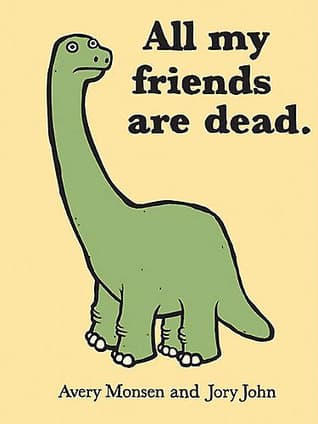
The book begins with a large, green dinosaur, looking sad. It states simply, "If you're a dinosaur, all of your friends are dead." This sets the sad yet funny tone for the book, immediately establishing the main idea: the loneliness or unavoidable death of one's companions, depending on the character. The dinosaur's situation is a direct, historical fact, making its statement a touching, if darkly funny, thought on death and time. The illustration shows the single dinosaur against a plain background, highlighting its solitude in a post-extinction world.
The Pirate's Plight
After the dinosaur, a rough-looking pirate with an eye patch and a peg leg appears, sharing his own problem: "If you're a pirate, all of your friends have scurvy." This scenario shifts from outright death to a chronic, disabling condition, offering a slightly different kind of bad luck. The humor here comes from the common yet historically accurate suffering of pirate life, contrasting the romanticized image with a dose of grim reality. The pirate's complaint shows the shared suffering within a specific group, where even if friends are not dead, they are certainly not well, adding a layer of collective misery.
The Tree's Transformation
A sturdy tree, with a few leaves, expresses its sorrow: "If you're a tree, all of your friends are end tables." This entry introduces the idea of friends turning into inanimate objects, a form of 'death' from the tree's view. The humor comes from the common, everyday items that were once living beings, making the reader think about the life cycle of natural resources from an unusual perspective. The tree's quiet acceptance of this fate emphasizes the theme of unavoidable change and loss, even if the 'friends' continue to exist in a different form, no longer able to offer companionship.
The Zombie's Predicament
A green-skinned zombie, with empty eyes, offers its perspective: "If you're a zombie, all of your friends are brains." This entry plays on the zombie idea, where the act of 'making friends' (or rather, eating them) leads to their death. The humor comes from the contradiction of a creature that wants companionship but whose nature requires destroying potential friends. It is a darkly funny take on the challenges of forming relationships when your existence depends on consuming others, showing a unique form of existential loneliness.
The Houseplant's Helplessness
A small potted houseplant, looking somewhat worried, shares its concern: "If you're a houseplant, all of your friends are being slowly killed by irresponsible plant owners (like you)." This breaks the fourth wall, directly accusing the reader and adding a meta-humorous layer. The houseplant's weakness and its friends' gradual death due to human neglect provide a relatable, if guilt-inducing, scenario. It shows the power dynamics in relationships and the helplessness of some beings in the face of others' actions, even if unintended, making a subtle jab at human responsibility.
The Sock's Disappearance
A lone, striped sock, looking sad, states: "If you're a sock, all of your friends are missing." This entry touches on a universal, common frustration — the mystery of disappearing socks. The personification of the sock and its complaint turns a minor household annoyance into a touching tale of loss and separation. The humor comes from raising a trivial object's problem to an existential crisis, making the reader feel for the simple, everyday object and its unexplainable solitude, a common experience for many.
The Clown's Gloom
A clown, despite its cheerful clothes and painted smile, shows a deeper sadness: "If you're a clown, all of your friends are sad." This entry goes against the expectation of joy with clowns, showing the irony of their job. The clown's friends are not dead, but they are always unhappy, creating a shared emotional burden. This highlights the theme of empathy and the weight of others' sorrows, suggesting that even in jobs meant to bring happiness, one can be surrounded by a different kind of sadness, making true companionship hard.
The Cassette Tape's Obsolescence
A retro cassette tape, looking a bit dusty, declares: "If you're a cassette tape, all of your friends are obsolete." This entry touches on the theme of technological outdatedness and the feeling of being left behind. The cassette tape's friends are not physically gone but have become irrelevant in a fast-changing world. The humor is bittersweet, appealing to those who remember older technologies and the unavoidable march of progress, where usefulness defines value, and loss is a result of innovation. It is a comment on the short-lived nature of trends and the loneliness of the outdated.
The Robot's Recharge
A simple, boxy robot, with one eye, states: "If you're a robot, all of your friends are recharging." This entry presents a unique form of temporary separation and weakness. The robot's friends are not dead or outdated, but simply unavailable due to a basic need. The humor comes from the common yet essential need for robots, showing how even in a technologically advanced world, basic needs can dictate social interaction, leading to periods of unwanted solitude. It is a reminder that even in a digital age, connection can be interrupted by practical matters.
The Final Reflection
The book ends with a final, overall statement, often given by a generic, simple character or the narrator, that generalizes the previous examples into a universal truth. While not explicitly stated on a single page, the combined effect of the various characters' complaints leads to the implied conclusion that, in some way, everyone faces loss, change, or separation from their 'friends.' The humor remains dark but moves into a more profound, yet simple, thought on the human (or object) condition, leaving the reader with a thoughtful, slightly sad, and ultimately accepting view on life's unavoidable challenges.
Principal Figures
The Dinosaur
Protagonist
The first character to introduce the theme of loss.
The dinosaur is presented as a large, green, and solitary creature. Its primary characteristic is its historical context, representing a species that has long since become extinct. It embodies the ultimate form of loss – the complete disappearance of its kind. Its expression is typically one of gentle sadness, conveying a quiet acceptance of its fate. The dinosaur's lament sets the tone for the entire book, grounding the abstract concept of 'all friends being dead' in a concrete, universally understood example.
The Pirate
Supporting
A swashbuckler whose friends suffer from scurvy.
The pirate is depicted with classic buccaneer accouterments: an eye patch, peg leg, and a generally grizzled appearance. Unlike the dinosaur, his friends aren't dead, but afflicted with a debilitating, though curable, disease. He represents the theme of shared suffering and chronic misfortune within a specific community. His role is to broaden the definition of 'friends being gone' to include those who are merely incapacitated or unwell, adding a layer of historical realism and a different kind of hardship.
The Tree
Supporting
A tree whose friends have been repurposed into furniture.
The tree is a simple, green, and rooted entity. Its predicament highlights transformation and the repurposing of natural life into inanimate objects. From its perspective, its friends are 'dead' because they no longer exist as fellow trees, but as utilitarian items. The tree embodies a quiet resignation to the cycle of nature and human intervention, presenting a more philosophical take on loss where existence merely shifts form rather than ceases entirely. It's a commentary on environmental impact through a melancholic lens.
The Zombie
Supporting
A creature whose friends become its food.
The zombie is a classic undead figure, green-skinned and somewhat vacant-eyed. Its dilemma is a dark comedic paradox: its very nature as a brain-eater prevents it from having lasting friendships. The zombie represents the inherent conflict between desire for companionship and a destructive nature. It highlights the impossibility of certain relationships given fundamental biological or existential drives, offering a morbidly humorous take on self-sabotage and the loneliness that can arise from one's own identity.
The Houseplant
Supporting
A vulnerable plant whose friends are killed by careless owners.
The houseplant is a small, potted, and somewhat anxious-looking entity. It represents vulnerability and the helplessness of some beings in the face of external forces, specifically human negligence. Its lament directly implicates the reader, breaking the fourth wall and adding a layer of meta-humor and gentle guilt-tripping. The houseplant embodies the fragility of life and the impact of seemingly minor actions, making a subtle point about responsibility and care in relationships.
The Sock
Supporting
A lone sock lamenting its perpetually missing partner.
The sock is a simple, often striped, and visibly forlorn piece of clothing. It personifies a common household frustration into an existential crisis of loss and separation. The sock represents the mystery of disappearance and the feeling of incompleteness. Its plight is relatable on a mundane level, yet elevated to a poignant commentary on the inexplicable absences in life and the longing for a lost counterpart. It emphasizes the concept of being half of a whole, forever searching.
The Clown
Supporting
A performer whose friends are always sad.
The clown, despite its traditional cheerful makeup and costume, carries an underlying sadness. Its predicament subverts expectations, revealing that even those meant to bring joy can be surrounded by sorrow. The clown represents the burden of empathy and the challenge of finding true, reciprocal happiness when one's social circle is perpetually downcast. It highlights a different kind of 'loss' – the loss of shared joy and lightness, replaced by a collective melancholy.
The Cassette Tape
Supporting
An obsolete technology whose friends have also become outdated.
The cassette tape is a retro, somewhat dusty piece of technology. It embodies the theme of obsolescence and the feeling of being left behind by progress. Its friends aren't physically gone, but have lost their relevance and utility in a rapidly advancing world. The cassette tape represents the bittersweet nature of technological change, where innovation leads to the 'death' of older forms, and those who remain feel isolated and forgotten. It's a commentary on the fleeting nature of trends.
The Robot
Supporting
A machine whose friends are frequently unavailable due to recharging.
The robot is a simple, often boxy figure with a single eye. Its situation highlights a unique form of temporary separation due to fundamental functional needs. The robot represents the interruptions and practicalities that can affect relationships, even in a futuristic context. Its friends are not dead but merely 'on pause,' illustrating that even in the most functional of beings, there are moments of forced solitude and waiting. It's a commentary on the practical limitations of connection.
Themes & Insights
Loss and Impermanence
The main theme is the unavoidable nature of loss in its many forms. Whether it is the extinction of the dinosaur's friends, the transformation of the tree's companions into furniture, or the outdatedness of the cassette tape's peers, the book consistently shows that everything and everyone changes, disappears, or eventually dies. This theme is presented with a dark, yet funny, acceptance, suggesting that acceptance is the only choice. The book does not focus on sadness but points out the universal nature of impermanence, making it a shared, though sad, experience.
“If you're a dinosaur, all of your friends are dead.”
Loneliness and Isolation
Directly from loss, the theme of loneliness is central. Each character, because of their specific problem, finds themselves isolated. The single sock looking for its missing partner, the zombie whose nature prevents lasting bonds, or the houseplant whose friends are systematically destroyed – all show different sides of being alone. The book highlights how various circumstances, from historical events to biological needs to human neglect, can lead to deep solitude. It suggests that, in some form, loneliness is a natural part of existence, often unavoidable.
“If you're a sock, all of your friends are missing.”
The Absurdity of Existence
The book uses humor well to highlight the absurdity of life's problems. By giving human qualities to inanimate objects (like a sock or a cassette tape) and giving voice to the existential worries of creatures (like a zombie or a houseplant), it turns common or tragic realities into darkly funny observations. The humor often comes from the contrast of a character's simple, wide-eyed expression with the deep, often grim, nature of their 'friend's' fate. This theme encourages readers to find humor in life's unavoidable challenges, accepting that some situations are simply beyond control and best met with a wry smile.
“If you're a houseplant, all of your friends are being slowly killed by irresponsible plant owners (like you).”
Perspective and Empathy
Each page offers a unique view on suffering and loss, inviting the reader to feel for a diverse range of characters and their specific complaints. From the large scale of extinction (dinosaur) to the common annoyance of lost items (sock), the book expands the idea of 'friends being dead' to include various forms of separation, illness, transformation, and outdatedness. This encourages readers to consider different viewpoints and understand that 'loss' is not a single experience, fostering a broader sense of empathy for the diverse challenges faced by all beings, real or imagined.
“If you're a pirate, all of your friends have scurvy.”
Plot Devices & Literary Techniques
Personification
Giving human qualities to non-human entities.
Personification is the central plot device, as every character in the book, whether an animal, object, or mythical creature, is given the ability to speak and express complex emotions, particularly sorrow and resignation. This device allows the authors to explore universal themes of loss and loneliness through a highly diverse and often absurd cast. By making a sock or a cassette tape lament its friends, the book makes abstract concepts relatable and humorous, creating empathy for unexpected 'characters' and highlighting the universality of their predicaments.
Dark Humor
Using morbid or depressing themes for comedic effect.
Dark humor is fundamental to the book's tone. The core premise—that 'all my friends are dead' or similarly afflicted—is inherently grim, but the simple, matter-of-fact delivery and the often absurd scenarios (a tree mourning its friends as end tables) transform tragedy into comedy. This device allows the book to tackle heavy themes like death, obsolescence, and loneliness without becoming overly depressing. It encourages readers to laugh at the inevitable, providing a coping mechanism and a sense of shared, albeit morbid, understanding of life's difficulties.
Juxtaposition
Placing contrasting elements side-by-side for effect.
The book frequently uses juxtaposition to create its unique blend of humor and poignancy. This is evident in the contrast between the simple, childlike illustrations and the profound, often melancholic statements made by the characters. For instance, a cute, wide-eyed houseplant laments its friends being killed by its owner. The innocent visual style alongside the grim reality creates a comedic tension. Furthermore, the diverse types of 'loss' juxtaposed against each other (extinction vs. scurvy vs. being an end table) highlight the varied nature of suffering while unifying them under a single theme.
Breaking the Fourth Wall
Directly addressing the audience.
While not constant, the book occasionally breaks the fourth wall, most notably with the houseplant character. When the houseplant states, "If you're a houseplant, all of your friends are being slowly killed by irresponsible plant owners (like you)," it directly addresses and implicates the reader. This device adds a layer of meta-humor and personal engagement, making the reader momentarily part of the narrative's world and its predicaments. It serves to draw the audience in more closely, making the abstract themes more immediate and relatable, and often generating a chuckle of recognition or guilt.
All My Friends Are Dead Quotes
“If you are a tree, all your friends are dead.”
“If you are a pirate, all your friends are dead.”
“If you are a zombie, all your friends are dead. (And they want to eat your brains.)”
“If you are a cowboy, all your friends are dead. (Probably from a shootout.)”
“If you are a unicorn, all your friends are dead. (Because you're magical and they're not.)”
“If you are a robot, all your friends are dead. (Or they're just turned off.)”
“If you are a dinosaur, all your friends are dead. (Because of a meteor.)”
“If you are a cupcake, all your friends are dead. (Because someone ate them.)”
“If you are a vampire, all your friends are dead. (Or they're just sleeping... forever.)”
“If you are a toy, all your friends are dead. (Or they're just in the toy box.)”
“If you are a ghost, all your friends are dead. (And you're all just hanging out.)”
“If you are a monster, all your friends are dead. (Because you probably ate them.)”
“If you are a cloud, all your friends are dead. (They just evaporated.)”
“If you are a sock, all your friends are dead. (They're lost in the laundry.)”
“If you are a book, all your friends are dead. (They've been read and put away.)”
Quiz
10 questions on the plot and the characters. Each answer comes with a short explanation.
Question 1
Which of the following characters has friends who have 'gone missing' according to the book?
- A dinosaur
- A sock
- A houseplant
- A pirate
Show answer
B. A sock The book explicitly states that for the sock, all of its friends have gone missing.
Question 2
What is the primary predicament faced by a tree in the book?
- All its friends have scurvy
- All its friends are end tables
- All its friends are being slowly killed by irresponsible owners
- All its friends are dead
Show answer
B. All its friends are end tables The book states, 'If you're a tree, all of your friends are end tables,' highlighting the transformation of wood products.
Question 3
What kind of book is 'All My Friends Are Dead' primarily described as?
- A historical non-fiction
- A suspense thriller
- A humor book for adults, disguised as a children's book
- A scientific textbook
Show answer
C. A humor book for adults, disguised as a children's book The description clearly states it's a 'hilarious children's book for adults' and a 'humor book.'
Question 4
What is the specific ailment affecting a pirate's friends in the book?
- They are lost at sea
- They have scurvy
- They have been eaten by sea monsters
- They are mutinying
Show answer
B. They have scurvy The book explicitly mentions, 'If you're a pirate, all of your friends have scurvy,' a common issue for sailors.
Question 5
According to the description, what is the 'valuable lesson' the book teaches?
- How to make new friends
- How to avoid existential predicaments
- Lessons about life and existential predicaments
- The importance of owning houseplants
Show answer
C. Lessons about life and existential predicaments The description states the book 'teaches valuable lessons about life' and presents 'hilariously entertaining stories about life and existential predicaments.'
Question 6
Which inanimate object's friends are described as being 'slowly killed by irresponsible plant owners'?
- A cassette tape
- An end table
- A houseplant
- A sock
Show answer
C. A houseplant The text specifically mentions 'the houseplant whose friends are being slowly killed by irresponsible plant owners (like you).'
Question 7
What literary device is noted as being used effectively in the book alongside simple imagery and short quips?
- Metaphor
- Alliteration
- Personification of inanimate objects
- Hyperbole
Show answer
C. Personification of inanimate objects The description highlights 'the personification of inanimate objects' as a key element contributing to the book's amusement.
Question 8
How does the Huffington Post review describe the book's tone?
- Dry and academic
- Laugh out loud funny, and a tiny bit disturbing
- Uplifting and inspirational
- Critically acclaimed and thought-provoking
Show answer
B. Laugh out loud funny, and a tiny bit disturbing The quote from The Huffington Post states, 'Laugh out loud funny, and a tiny bit disturbing. In other words, perfect.'
Question 9
What is the implied fate of a dinosaur's friends, according to the book's premise?
- They evolved into birds
- They are dead
- They migrated to another continent
- They were captured by humans
Show answer
B. They are dead The synopsis explicitly states, 'If you're a dinosaur, all of your friends are dead,' referring to their extinction.
Question 10
The authors, Avery Monsen and Jory John, share a specific relationship described at the end of the summary. What is it?
- They are brothers
- They are former colleagues
- They are friends, and neither is dead (yet)
- They are co-workers at a publishing house
Show answer
C. They are friends, and neither is dead (yet) The text explicitly states, 'They are friends, and neither is dead. Yet.' This adds a meta-humorous touch in line with the book's theme.
All My Friends Are Dead FAQ
What is the central premise of 'All My Friends Are Dead'?
The book explores the humorous and often morbid downsides of various existence, from living creatures to inanimate objects. Each page features a different character, like a dinosaur or a cassette tape, lamenting that 'all my friends are dead' or similarly afflicted, highlighting the inherent loneliness or tragic fate associated with their being.
Who are the primary authors of 'All My Friends Are Dead'?
The book was co-written by Avery Monsen, known for his work as an actor, artist, and writer, and Jory John, a writer, editor, and journalist. They collaborated to create this unique blend of humor and existential dread.
Is 'All My Friends Are Dead' actually a children's book?
While presented in an accessible cartoon form reminiscent of children's books, 'All My Friends Are Dead' is explicitly described as a 'children's book for adults.' Its humor and underlying themes of mortality and existential predicaments are intended for a mature audience.
What kind of humor can readers expect from the book?
The humor is dark and observational, often stemming from the juxtaposition of cute illustrations with bleak realities. It's described as 'laugh out loud funny' but also 'a tiny bit disturbing,' making light of inevitable misfortunes and the absurdities of life and death.
What is an example of a character and their predicament in the book?
One example is the dinosaur, who mournfully states that 'all of your friends are dead,' referencing the extinction event. Another is the pirate, whose friends all have scurvy, illustrating a common affliction for that profession. Each character's specific grievance is tailored to their identity.
How does the book use personification to convey its themes?
The book extensively uses personification, giving human emotions and dilemmas to inanimate objects and concepts. For instance, a tree laments that its friends are now end tables, or a cassette tape mourns its friends being unspooled, lending a relatable, albeit absurd, sense of loss to non-living entities.
Are there any recurring characters or a continuous narrative throughout the book?
No, the book operates as a series of standalone vignettes. Each page introduces a new character and their unique predicament, without a continuous storyline or recurring characters beyond the overarching theme of loss and existential dread.
What role do the illustrations play in the book's overall impact?
The simple yet effective cartoon imagery is crucial to the book's charm and humor. The 'wide-eyed dilemmas' of the characters are often conveyed through their expressions, creating a stark and amusing contrast between their cute appearance and their profound, often dark, lamentations.
Does the book offer any actual 'lessons' despite its humorous tone?
The book implicitly teaches 'valuable lessons about life' by encouraging readers to laugh at the inevitable and confront uncomfortable truths about mortality and loss in a lighthearted way. It serves as a primer for accepting the 'inevitable' with a sense of humor.
How does the book's tone navigate the line between funny and sad?
The book is described as both 'the saddest funny book and the funniest sad book,' skillfully balancing morbid humor with genuine moments of pathos. It achieves this by presenting tragic realities through a lens of absurdism and simple, almost childlike, lamentations, making the sadness palatable and even amusing.
What psychological effect might the personification of inanimate objects have on the reader?
The personification allows readers to project human feelings onto non-human entities, making abstract concepts like obsolescence (for a cassette tape) or destruction (for a houseplant) feel relatable and emotionally resonant. This can evoke empathy and a sense of shared existential angst.
How does the book utilize 'existential predicaments' for its humor?
The humor arises from the characters' recognition of their inherent, often unavoidable, tragic circumstances. Whether it's a sock missing its pair or a houseplant slowly dying due to neglect, the characters confront their specific, often bleak, 'existential predicaments' with a simple, direct honesty that is both funny and thought-provoking.
In what ways does 'All My Friends Are Dead' encourage a reevaluation of everyday objects or concepts?
By giving a voice to objects like end tables (formerly trees) or lost socks, the book subtly invites readers to consider the 'lives' and 'fates' of things around them. This can lead to a humorous, yet poignant, reevaluation of consumerism, environmental impact, or even just the life cycle of everyday items.
Could the book be interpreted as a commentary on contemporary anxieties or social isolation?
Yes, while humorous, the book's repeated theme of 'all my friends are dead' or similarly afflicted could be interpreted as a playful, yet pointed, commentary on feelings of social isolation, loneliness, or anxieties about loss prevalent in modern society, despite its lighthearted presentation.
What is the significance of the authors stating 'neither is dead. Yet.' in the book's description?
This statement serves as a meta-joke, extending the book's dark humor to the authors themselves. It reinforces the central theme that death is an inevitable part of existence for everyone, including the creators, and encourages readers to find humor even in that ultimate truth.
How does the book challenge traditional notions of 'children's literature'?
By adopting the accessible format of a children's book (cartoons, simple text) but imbuing it with sophisticated, adult themes of mortality and existential dread, it subverts expectations. It demonstrates that profound or uncomfortable topics can be explored through seemingly innocent means, blurring genre lines.
Is there a philosophical undercurrent to the book's repeated phrase 'all my friends are dead'?
The phrase, repeated with variations, acts as a memento mori, a reminder of the universality of death and loss. It suggests that, regardless of one's form or circumstance, the impermanence of connections and life itself is a shared experience, grounding the humor in a deeper philosophical observation.
How might different readers, depending on their life experiences, react to the book?
Readers who have experienced significant loss might find the book surprisingly comforting in its direct, humorous approach to grief, while others might find it unsettling. Its blend of cute and dark humor means individual reactions will vary based on personal resilience and comfort with morbid topics.
Similar books
- The Book with No Pictures
B.J. Novak
4.3 (22k) average on GoodreadsChildren'sShares a similar minimalist, humorous, and meta approach to children's books for adults.
- The Giving Tree
Shel Silverstein
4.4 (906k) average on GoodreadsFantasyWhile both books deal with themes of sacrifice and loss, Silverstein's 'The Giving Tree' frames these within a narrative of unconditional love and devotion, offering a more emotionally complex but ultimately redemptive, albeit bittersweet, experience. Monsen's book is starker, focusing solely on the pain of isolation without the softening lens of connection.
- I Want My Hat Back
Jon Klassen
4.4 (26k) average on GoodreadsFantasyKlassen's book, and its sequels, also employ dark humor and morally ambiguous characters in a minimalist style. However, Klassen maintains a level of playful absurdity and a clear, albeit darkly humorous, resolution to the immediate conflict, making its darker elements more palatable and less existentially weighty for children. Monsen's work is more direct in its confrontation of profound sadness and lack of resolution.
- Harry Potter and the Sorcerer's Stone
J.K. Rowling
4.5 (7M) average on GoodreadsFantasyRescued from a miserable life under the stairs, an orphaned boy discovers he's a wizard destined for a magical school, where he uncovers a dangerous secret tied to the dark wizard who murdered his parents.
- The Hobbit, or There and Back Again
J.R.R. Tolkien
4.3 (2.9M) average on GoodreadsFantasyA comfort-loving hobbit named Bilbo Baggins is whisked away by a mischievous wizard and a band of dwarves on an unexpected journey to reclaim stolen treasure from a fearsome dragon, discovering courage and a magical ring along the way.
- Harry Potter and the Goblet of Fire
J.K. Rowling
4.6 (2.6M) average on GoodreadsFantasyA bewildered Harry Potter, underage and thrust into a deadly Triwizard Tournament, must brave dragons, mermaids, and a resurgent dark magic to survive a year that will forever alter the wizarding world.




Enjoyed the summary?
A summary gives you the shape of the book. The book itself has the detail, the examples and the voice.
Find All My Friends Are Dead on AmazonAs an Amazon Associate, BookBrief earns from qualifying purchases. How we're funded