
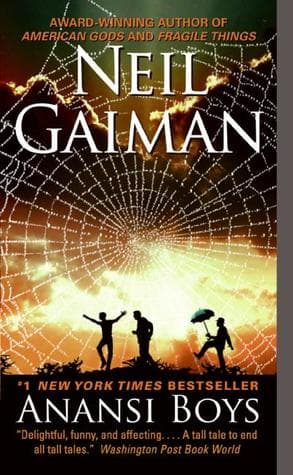
Synopsis
Covers the whole plot, including the ending.
- Difficulty
- Easy
- Pacing
- Moderate
- Mood
- Whimsical, Humorous, Mythic, Heartwarming, Slightly Dark
- Read it if
- You enjoy Neil Gaiman's unique blend of myth, humor, and heart, and are looking for a story about family, self-discovery, and the unexpected magic hidden in the mundane.
- Skip it if
- You prefer hard fantasy with strict rules and minimal whimsy, or dislike stories where the protagonist is often passive and put-upon.
Anansi Boys Plot Summary
Covers the whole plot, including the ending.
The Funeral and the Revelation
Fat Charlie Nancy, a mild-mannered, somewhat uninspired Londoner, receives news that his flamboyant, often embarrassing father, Mr. Nancy, has died during a karaoke performance in Florida. Despite their strained relationship, Charlie feels obligated to attend the funeral. While there, Mrs. Dunwiddy, an old family friend, makes a cryptic remark about Mr. Nancy having 'two boys.' When Charlie denies having a brother, Mrs. Dunwiddy insists and advises him to tell his brother that 'the birds are calling.' Back in London, Charlie's life, already mundane and overshadowed by his father's memory, takes an unexpected turn when a charismatic, handsome young man named Spider appears on his doorstep, claiming to be his brother. Spider's arrival immediately disrupts Charlie's carefully constructed, if unremarkable, existence, setting the stage for the unfolding magical chaos.
Spider's Arrival and the Disruption
Spider, charming and confident, quickly makes himself at home in Fat Charlie's flat, much to Charlie's discomfort and the delight of his fiancée, Rosie Noah. Spider's presence is a whirlwind, filled with late-night parties, inexplicable magic, and a general disregard for Charlie's quiet routines. He effortlessly wins over Rosie and Charlie's boss, Grahame Coats, a crooked talent agent. Spider's true nature as a god, specifically a trickster god like their father Anansi, begins to manifest through subtle but undeniable magical occurrences. This constant disruption and Spider's effortless charisma highlight Charlie's insecurities and his feeling of inadequacy, making him resent his newfound brother even as he's drawn into the magical world Spider represents. Spider's arrival completely upends Charlie's perception of his own life and reality.
The Prank and the Wish
Fed up with Spider's antics, which include stealing his clothes, charming Rosie, and generally making his life a misery, Fat Charlie confides his frustrations to Rosie. He wishes, in a moment of exasperation, that Spider would just 'go away.' Unbeknownst to Charlie, his father, Anansi, was a powerful god, and his children inherit certain abilities and connections to the magical world. Charlie's wish, spoken with genuine frustration and a touch of magical inheritance, inadvertently sets in motion a chain of events far beyond his comprehension. This casual wish, born of annoyance, taps into the latent power within Charlie and the inherent magic surrounding the Anansi family, leading to serious, unintended consequences for both brothers. The act serves as a catalyst for the escalating magical conflict.
Spider's Disappearance and the Aftermath
Following Charlie's ill-considered wish, Spider mysteriously vanishes. Initially, Charlie feels a sense of relief, believing his life can return to normal. However, Spider's disappearance has immediate and unsettling magical repercussions. Strange, dangerous creatures begin to appear, drawn by the disruption in the balance of the world caused by a god's sudden absence. The world itself seems to fray at the edges, and Charlie finds himself increasingly vulnerable to the magical forces his father had kept at bay. Rosie, heartbroken by Spider's disappearance, blames Charlie, creating a rift in their relationship. Charlie is forced to confront the reality that his wish had genuine power and that he is now responsible for the chaos it unleashed, further complicating his already stressful existence.
Seeking Help and Encountering the Animals
Desperate to understand what has happened and how to fix it, Fat Charlie remembers Mrs. Dunwiddy's advice about the 'birds calling.' He travels back to Florida and seeks out Mrs. Dunwiddy, who, along with her friend Maeve, reveals more about his father, Anansi, and the world of the animal gods. They explain that Anansi was a powerful trickster god, and his 'boys' are also gods. Charlie learns that by wishing Spider away, he has created a void that is attracting dangerous entities. Mrs. Dunwiddy instructs him on how to call upon the other animal gods for help. Charlie performs a ritual, calling out to the 'birds,' which leads him to a gathering of ancient, powerful animal deities, including Tiger, Lion, and Hyena, who are unimpressed by Charlie's lack of divine presence and his father's legacy.
The Deal with Tiger
At the gathering of animal gods, Fat Charlie is mocked and dismissed by most. However, the formidable and vengeful god Tiger, Anansi's ancient rival, sees an opportunity. Tiger, still bitter about Anansi's trickery that stripped him of his stripes and power, offers Charlie a deal: he will help Charlie get his brother back, but at a price. Tiger demands Anansi's old powers, which he believes Charlie inherited, and Charlie agrees, desperate to undo his mistake. This pact with Tiger is a grave miscalculation by Charlie, as he underestimates Tiger's cunning and his deep-seated desire for revenge against the Anansi lineage. The deal sets the stage for a dangerous confrontation between Charlie and the forces that seek to exploit his family's divine heritage.
The Return of Spider and the Wedding Preparations
With Tiger's intervention, Spider is returned to the world, much to Charlie's relief, though he remains unaware of the price Charlie paid. Spider, though back, is more subdued than before, having experienced the 'land of the dead.' Meanwhile, Charlie's life continues to spiral out of control. His boss, Grahame Coats, is revealed to be embezzling money, framing Charlie for his crimes. Rosie, still struggling with her feelings for both brothers, pushes forward with the wedding plans, creating immense pressure on Charlie. The magical threats also intensify, with strange creatures and events besieging Charlie, seemingly connected to his deal with Tiger and the lingering magical residue of his father. Charlie is now caught between the mundane disaster of his life and the escalating magical danger.
The Trap and the Betrayal
Grahame Coats, Charlie's corrupt boss, successfully frames Charlie for embezzlement, leading to his arrest and public humiliation. This mundane crisis is intertwined with the magical one. Tiger, having used Charlie to return Spider, begins to manifest his true intentions: to eliminate the Anansi line and seize ultimate power. He manipulates events, using his influence over other animal gods and the magical world to further isolate Charlie and weaken Spider. Tiger reveals that his 'help' was merely a means to an end, a way to gain leverage and access to Anansi's remaining power. Charlie realizes he has been played, and the stakes are much higher than he initially understood, with his brother's life and the balance of the world now at risk.
The Confrontation and the Song
As the magical and mundane crises converge, Charlie and Spider, now united, prepare to confront Tiger. They realize that physical prowess is not enough; they must outwit Tiger using the very tricks and stories that were their father Anansi's trademark. Spider, drawing on his inherent godly power, and Charlie, finally embracing his own latent trickster nature, devise a plan. They use the power of 'song' – which in this context refers to storytelling, wit, and the manipulation of reality through narrative – to challenge Tiger. The climax involves a battle of wits and magic, where the brothers must use their collective heritage and understanding of their father's legacy to defeat the powerful and vengeful Tiger, proving that Anansi's greatest power lay in his mind.
The Resolution and New Beginnings
In a climactic display of Anansi's trickery, Charlie, with Spider's help, outwits Tiger, trapping him and restoring balance. Charlie also manages to clear his name regarding Grahame Coats' embezzlement, exposing his former boss's crimes. Rosie, having witnessed the magical events and Charlie's transformation, makes a choice about her future. Charlie, no longer 'Fat Charlie' but simply Charlie, finally embraces his heritage and his own unique strengths. He finds his voice, not just literally, but in understanding his place in the world, both mundane and magical. The brothers, having faced danger and grown closer, part ways, but with a newfound respect and understanding. Charlie's journey culminates in him finding confidence, love, and a sense of belonging, stepping out of his father's shadow to forge his own identity.
Principal Figures
Fat Charlie Nancy
Protagonist
A mild-mannered, insecure man who discovers his divine heritage.
Charlie is initially presented as an uninspired, somewhat timid man living in London, constantly overshadowed by the memory of his flamboyant, larger-than-life father. He struggles with low self-esteem, often feeling inadequate and defined by the nickname 'Fat Charlie' given to him by his father. He desires a normal, quiet life and is engaged to Rosie Noah. His journey forces him to confront his insecurities, embrace his latent trickster heritage, and find his own voice and confidence, moving beyond his father's shadow.
Relationships: Mr. Nancy/Anansi (Estranged, complicated father-son relationship; Charlie resents his father's antics but later comes to understand and appreciate his legacy.); Spider (Initially resentful and competitive brotherly relationship, evolving into a bond of respect and partnership.); Rosie Noah (Fiancée; their relationship is tested by Spider's arrival and the magical chaos, but ultimately strengthens.); Grahame Coats (Boss and antagonist; Coats exploits Charlie and frames him for embezzlement.)
Spider
Deuteragonist/Supporting
Fat Charlie's charismatic, god-like brother, a true son of Anansi.
Spider is the embodiment of their father Anansi's trickster nature: charming, effortlessly charismatic, musically talented, and deeply connected to the magical world. He is a god, fully aware of his powers, and lives life with a carefree, sometimes irresponsible, attitude. He initially disrupts Charlie's life for amusement but genuinely cares for his brother. Spider acts as a catalyst for Charlie's transformation, pushing him into the magical world and helping him understand his heritage. He is the more overtly powerful and confident of the two brothers.
Relationships: Mr. Nancy/Anansi (Revered father; Spider fully embraces his father's legacy and powers.); Fat Charlie Nancy (Initially teasing and disruptive, but deepens into a supportive and loving brotherly bond.); Rosie Noah (Flirts with Rosie, causing tension with Charlie, but ultimately respects her choices.)
Mr. Nancy / Anansi
Posthumous Catalyst/Mentor
Fat Charlie and Spider's deceased father, the powerful trickster god.
Mr. Nancy, also known as Anansi, is the legendary West African trickster god, though his true nature is only revealed after his death. He was a flamboyant, often embarrassing figure in Charlie's life, but a powerful and respected (or feared) deity in the magical world. His death sets the entire plot in motion, bringing Spider into Charlie's life and forcing Charlie to confront his heritage. His influence, through his stories, tricks, and the legacy he left his sons, guides and challenges them even from beyond the grave.
Relationships: Fat Charlie Nancy (Complicated, often strained father-son relationship; Charlie felt overshadowed and embarrassed by him.); Spider (Closer, more understood father-son relationship; Spider embodies his father's godly nature.); Tiger (Ancient rival; Anansi famously tricked Tiger, leading to Tiger's lasting animosity.)
Rosie Noah
Supporting
Fat Charlie's fiancée, caught between the two brothers.
Rosie is Charlie's sensible, practical fiancée, initially providing a grounding force in his life. She is kind and loving but also capable of being firm. Her world is turned upside down by Spider's arrival, as she finds herself unexpectedly attracted to his charisma and charm, creating a significant emotional conflict. She struggles with her feelings for both brothers and is a central figure in Charlie's personal growth, forcing him to confront his own desires and insecurities. Her journey involves understanding the true nature of love and commitment.
Relationships: Fat Charlie Nancy (Fiancée; their relationship is tested by external pressures and her attraction to Spider, but they ultimately find a stronger bond.); Spider (Brief romantic interest; she is captivated by his charm but ultimately recognizes her true feelings.)
Grahame Coats
Antagonist
Fat Charlie's manipulative and corrupt boss.
Grahame Coats is Fat Charlie's boss at the talent agency, a seemingly successful but deeply corrupt individual. He is a master manipulator, exploiting those around him for personal gain. Coats serves as the primary mundane antagonist, framing Charlie for embezzlement and adding significant pressure to Charlie's already chaotic life. He represents the everyday evils and mundane challenges that Charlie must overcome, contrasting with the magical threats he faces. His actions force Charlie to develop a sense of self-preservation and cunning.
Relationships: Fat Charlie Nancy (Boss and victimizer; Coats exploits Charlie and frames him for his crimes.)
Tiger
Antagonist
An ancient, powerful, and vengeful animal god, Anansi's nemesis.
Tiger is an ancient and powerful animal god, characterized by his immense strength, pride, and a deep-seated, centuries-old grudge against Anansi. He was famously tricked by Anansi, losing his stripes and much of his dignity, and harbors a burning desire for revenge against Anansi's lineage. He is cunning and manipulative, using Charlie's desperation to achieve his own ends. Tiger represents the raw, dangerous power of the older gods and the consequences of Anansi's trickery, serving as the primary magical antagonist.
Relationships: Mr. Nancy/Anansi (Ancient rival and nemesis; Tiger seeks revenge for Anansi's past tricks.); Fat Charlie Nancy (Manipulates Charlie, using him as a pawn in his plan to destroy the Anansi line.); Spider (Seeks to destroy Spider as part of his revenge against Anansi's lineage.)
Mrs. Dunwiddy
Supporting
An old family friend with knowledge of the magical world.
Mrs. Dunwiddy is a wise, elderly woman who knew Mr. Nancy well and is aware of his true nature as Anansi. She acts as a guide and source of information for Fat Charlie, providing cryptic clues and direct advice that helps him understand his heritage and the magical world. She represents the hidden knowledge and the connection to the older ways, helping Charlie navigate the initial shock of his discoveries and pointing him towards the other animal gods. She is a benevolent figure, offering guidance without directly interfering.
Relationships: Mr. Nancy/Anansi (Old acquaintance, aware of his divine nature.); Fat Charlie Nancy (Mentor and guide, helping him understand his magical lineage.)
Maeve
Supporting
Mrs. Dunwiddy's friend and another keeper of magical knowledge.
Maeve is Mrs. Dunwiddy's equally knowledgeable friend, who also possesses an understanding of the magical world and the history of Anansi. She complements Mrs. Dunwiddy's guidance, offering additional context and support to Fat Charlie. Her presence reinforces the idea that there are others who are aware of the hidden magical reality, providing Charlie with a sense of connection to a larger world beyond his mundane existence. She helps to ground the magical revelations within a shared, albeit secret, human understanding.
Relationships: Mrs. Dunwiddy (Friend and fellow keeper of magical knowledge.); Fat Charlie Nancy (Provides additional guidance and context regarding his magical heritage.)
Themes & Insights
Identity and Self-Discovery
The novel explores Fat Charlie's journey to define his own identity, separate from his overbearing father and charismatic brother. He starts as 'Fat Charlie,' a nickname that encapsulates his insecurities and lack of self-worth. Through confronting magical threats and embracing his latent trickster nature, he sheds this imposed identity and discovers his true self, learning that his quiet strength and wit are just as valuable as Spider's overt charm. This theme is evident when Charlie finally stands up to Tiger, not with brute force, but with his own unique brand of Anansi-esque cunning, proving he is more than just 'Anansi's other son.'
“He knew who he was, now. He was Charlie Nancy, and he was a son of Anansi, and he had a brother, and he had a girl, and he was going to be fine.”
The Power of Stories and Song
Gaiman emphasizes that stories are not just entertainment but living, powerful entities that shape reality. Anansi's power comes from his ability to weave tales, and his sons inherit this. The 'song' in the book refers to the essence of a being, their narrative, and their connection to the world. Charlie learns to harness the power of his own story and the stories of his father to manipulate events and defeat his enemies. This is most vividly displayed in the climax where Charlie and Spider use narrative and wit, rather than physical strength, to outsmart and trap Tiger, demonstrating that the oldest magic is storytelling itself.
“Stories are a net, a web, a trap, and a liberation. They are the heart of the world, and they are the song of the world.”
Family and Brotherhood
At its core, the novel is about the complex bond between two brothers, Charlie and Spider, who are polar opposites but share a divine heritage. Their relationship evolves from resentment and rivalry to genuine love and mutual respect. They learn to rely on each other's unique strengths, realizing that together they are stronger. The narrative highlights that family, even a dysfunctional and magical one, is a source of both challenge and deep support. This is evident in their joint effort to defeat Tiger, where Spider's raw power and Charlie's cunning combine, showcasing their unbreakable bond.
“You're my brother, Charlie. We're family. That's what matters.”
The Mundane vs. The Magical
The story constantly contrasts the ordinary, everyday struggles of Fat Charlie's life (his job, his engagement, his financial woes) with the sudden intrusion of the fantastical and divine. This contrast highlights how magic can exist just beneath the surface of reality, often unnoticed until it demands attention. Charlie's journey involves learning to navigate and integrate these two worlds, realizing that his 'normal' life is inextricably linked to the extraordinary. The embezzlement plot involving Grahame Coats runs parallel to the magical battle with Tiger, demonstrating that both mundane and magical evils must be confronted.
“The world was not a safe place, not even for people who thought they were safe. There were things in the darkness, and things in the light, and things in the cracks between them.”
Consequences of Actions and Wishes
A central theme is that every action, especially a wish, has unforeseen and often powerful consequences. Charlie's casual wish for Spider to 'go away' sets off a chain of magical events that threaten to unravel the world. This emphasizes responsibility and the danger of wielding power without understanding its implications. The narrative repeatedly shows how even seemingly small choices can ripple outwards, affecting both the mundane and magical realms. This is powerfully demonstrated by the arrival of dangerous creatures and the imbalance caused by Spider's disappearance, all stemming from Charlie's frustrated wish.
“Wishes are not like money; there's no change. You get what you ask for, and that's it.”
Plot Devices & Literary Techniques
The Trickster Archetype
A character who uses cunning and deceit to achieve goals, often disrupting norms.
The trickster archetype is central, embodied by Anansi, Spider, and eventually Fat Charlie. Anansi's entire mythology is built on his cleverness and ability to outwit more powerful beings. Spider inherently possesses these traits, using charm and magic to navigate the world. Charlie, initially lacking these qualities, gradually develops his own trickster nature, using his intellect and his father's stories to defeat Tiger. This device allows for creative problem-solving and highlights the power of wit over brute strength, driving much of the conflict and resolution.
The MacGuffin (Anansi's Powers/Legacy)
An object or concept that drives the plot, though its specific nature may be secondary.
Anansi's powers and legacy serve as a MacGuffin. While not a tangible object, the desire for Anansi's 'song' or inherent power drives Tiger's motivation for revenge and Charlie's initial quest to understand his heritage. The brothers are literally 'Anansi's boys,' and their connection to his power is what makes them targets and heroes. The specific nature of this power is sometimes vague, but its existence is crucial for propelling the plot forward, forcing characters to act and revealing their true intentions.
Foreshadowing (Mrs. Dunwiddy's Clues)
Hints or warnings about future events.
Mrs. Dunwiddy's cryptic remarks, such as 'two boys' and 'the birds are calling,' serve as early foreshadowing. These seemingly innocuous statements gradually reveal their deeper, magical meaning as the plot progresses, preparing Charlie (and the reader) for the supernatural elements. This device builds suspense and allows for a gradual introduction of the fantasy elements into Charlie's mundane world, making the revelations more impactful and giving Charlie a path to follow when he's lost.
Symbolism (Animals and Their Traits)
The use of objects or concepts to represent deeper meanings.
The animal gods in the story are deeply symbolic. Anansi (the spider) represents cunning, storytelling, and trickery. Tiger embodies raw power, vengeance, and predatory nature. Lion, Hyena, and other animal gods carry their traditional mythical connotations. These animal forms are not just disguises but embody the very essence and personality of the gods, reinforcing their roles and conflicts within the narrative. The symbolism enriches the story by connecting the characters to established archetypes and cultural mythologies.
Anansi Boys Quotes
“Fat Charlie Nancy, unbeknownst to him, had a brother.”
“Gods do not like to be told they are gods.”
“Every story in the world is a door. A door into another world, another life.”
“The world is not always what it seems, and sometimes, the things we think are most ordinary are the most extraordinary.”
“You can't choose your family, but you can choose how much they annoy you.”
“It's not a question of 'if' you die. It's a question of 'when' and 'how'.”
“Sometimes, the hardest thing to do is to forgive yourself.”
“There are some things you can't run away from. Your past is one of them.”
“The things that make us different are the things that make us who we are.”
“Love is not a competition. It's a collaboration.”
“It's a good thing to be a little bit scared. It keeps you on your toes.”
“Some truths are better left unspoken. Some lies are better left believed.”
“The world is full of wonders, if you know where to look.”
“You can make a new story, if you're brave enough.”
Quiz
10 questions on the plot and the characters. Each answer comes with a short explanation.
Question 1
Where does Fat Charlie Nancy's father die?
- At home in London
- On a karaoke stage in Florida
- During a family dinner in Trinidad
- While telling a story at a pub
Show answer
B. On a karaoke stage in Florida Mr. Nancy, Fat Charlie's father, dies dramatically on a karaoke stage in Florida while singing a song.
Question 2
What is the name of Fat Charlie Nancy's previously unknown brother?
- Tiger
- Spider
- Snake
- Lion
Show answer
B. Spider Fat Charlie learns he has a brother named Spider, who appears on his doorstep shortly after their father's death.
Question 3
What is the primary reason Spider gives for visiting Fat Charlie after their father's death?
- To help Fat Charlie with funeral arrangements
- To tell Fat Charlie more about their father's true nature
- To 'cheer him up' and cause mischief, as a part of their father's legacy
- To claim his inheritance from their father
Show answer
C. To 'cheer him up' and cause mischief, as a part of their father's legacy Spider arrives with the stated intention of 'cheering Fat Charlie up,' but his presence immediately introduces chaos and magic into Charlie's life, echoing their father's trickster nature.
Question 4
What animal form is associated with Mr. Nancy and his sons?
- Lion
- Raven
- Spider
- Tiger
Show answer
C. Spider Mr. Nancy is Anansi, the trickster spider-god, and his sons, Spider and Fat Charlie, also possess aspects of this arachnid nature, with Spider being the more overt manifestation.
Question 5
What is Fat Charlie's fiancée's name?
- Daisy
- Rosie
- Lily
- Violet
Show answer
B. Rosie Fat Charlie is engaged to Rosie, a kind and practical woman whose life is turned upside down by Spider's arrival.
Question 6
What special ability does Spider possess that Fat Charlie initially lacks?
- The ability to control the weather
- The ability to shapeshift into an animal
- The power of prophecy
- The skill of perfect mimicry
Show answer
B. The ability to shapeshift into an animal Spider can readily transform into a spider, a direct manifestation of his godly heritage, whereas Fat Charlie's own powers are dormant or expressed differently.
Question 7
Which ancient entity does Spider accidentally release from a glass prison, causing significant trouble?
- The Spirit of the Wind
- The Bird Woman
- The Tiger
- The Serpent of the Deep
Show answer
C. The Tiger Spider, through his trickery, accidentally frees the ancient and dangerous Tiger from its magical prison, leading to a major conflict in the story.
Question 8
What is the core thematic struggle that Fat Charlie faces throughout the novel?
- Overcoming his fear of public speaking
- Accepting his heritage and finding his own identity beyond his father's shadow
- Choosing between a career in music or accounting
- Deciding whether to move back to Florida or stay in London
Show answer
B. Accepting his heritage and finding his own identity beyond his father's shadow Fat Charlie's journey is largely about coming to terms with his divine heritage, understanding his own unique form of 'Anansi-ness,' and stepping out of the shadow of his powerful, trickster father.
Question 9
What does Gussie, the elderly woman who helps Fat Charlie, instruct him to do to summon help from the animal gods?
- Sing a specific song into the wind
- Offer a blood sacrifice at a crossroads
- Call to the animals by their true names, and give them a place to stand
- Light a special candle made from spider silk
Show answer
C. Call to the animals by their true names, and give them a place to stand Gussie instructs Fat Charlie on how to summon the animal gods by calling them and offering them a 'place to stand,' which refers to a story or a belief to sustain them.
Question 10
What significant item does Fat Charlie inherit from his father that plays a crucial role in his journey?
- A magical flute that controls minds
- A collection of ancient, powerful stories
- A large sum of money hidden in a secret account
- A sentient pet monkey
Show answer
B. A collection of ancient, powerful stories Fat Charlie inherits his father's stories, which are not just tales but living, powerful entities that he can, with effort, learn to wield and use to shape reality.
Anansi Boys FAQ
What is the central premise of 'Anansi Boys'?
The novel revolves around Fat Charlie Nancy, a seemingly ordinary man, whose life is upended by the death of his estranged father. He discovers his father was Anansi, the West African trickster god, and that he has a hitherto unknown brother, Spider, who embodies the more divine and mischievous aspects of their shared heritage.
Who are the main characters and what is their relationship?
The main characters are Fat Charlie Nancy and his brother, Spider. Fat Charlie is an introverted, somewhat repressed individual who tries to live a 'normal' life, while Spider is charismatic, charming, and very much in tune with his godly nature. They are estranged brothers, only meeting after their father's death, and their relationship is initially fraught with tension and rivalry.
How does the death of Mr. Nancy (Anansi) impact the plot?
Mr. Nancy's death is the catalyst for the entire story, as it not only reveals his true identity as a god but also brings Spider into Fat Charlie's life. His passing triggers a series of events that force Fat Charlie to confront his family's magical legacy and Spider's disruptive presence, fundamentally altering his mundane existence.
What role does Rosie, Fat Charlie's fiancée, play in the narrative?
Rosie is Fat Charlie's long-suffering fiancée, representing his attempt at a stable, normal life away from his father's chaotic influence. Her perspective grounds Fat Charlie, but she also becomes a point of contention between him and Spider, as Spider's charm begins to sway her, leading to romantic complications.
What is the significance of the 'singing' in the Nancy family?
The 'singing' refers to the magical abilities and inherent trickster nature passed down through Anansi's lineage. Fat Charlie initially believes he has none of it, feeling inadequate compared to his father and Spider. However, he gradually discovers his own unique way of 'singing' through his quiet manipulation and subtle influence on events.
How does the character of Mrs. Dunwiddy connect to Anansi's past?
Mrs. Dunwiddy is revealed to be the bird-woman who was once wronged by Anansi in a past trickster tale, losing her feathers to him. Her grudge against Anansi is ancient and powerful, leading her to seek revenge on his sons. She represents the long-term consequences of Anansi's mythological antics.
What is the 'World Before' and how does it manifest in the story?
The 'World Before' is the realm of the old gods and primal forces, the source of Anansi's power and the other animal-headed deities. It manifests through Spider's innate connection to it, his ability to manipulate reality, and the arrival of other ancient beings who are drawn into the conflict, such as the Tiger.
What is the symbolic meaning of the 'blood and thunder' that Fat Charlie experiences?
'Blood and thunder' symbolizes the awakening of Fat Charlie's own dormant godly abilities and his connection to the trickster lineage. It's a visceral, often unpleasant, experience that signifies his growing understanding and acceptance of his supernatural heritage, manifesting as a heightened awareness and subtle magical influence.
How does Fat Charlie's internal conflict between 'normalcy' and his heritage drive his character arc?
Fat Charlie desperately clings to normalcy, viewing his father's life and Spider's presence as chaotic and undesirable. His character arc is driven by his gradual, reluctant acceptance of his heritage, realizing that his 'normal' life was unfulfilling and that embracing his trickster nature, even in his own quiet way, leads to greater self-discovery and agency.
Analyze Spider's psychological role as the 'shadow self' or 'id' for Fat Charlie.
Spider embodies the impulsive, charismatic, and unrestrained aspects that Fat Charlie suppresses. He acts as Fat Charlie's shadow self, representing the freedom, confidence, and magical power Fat Charlie denies himself. Spider's actions, though often disruptive, force Fat Charlie to confront his own desires and repressed aspects of his personality.
How does the novel explore themes of identity and self-acceptance through the brothers?
The novel explores identity through both brothers: Fat Charlie's struggle to define himself apart from his father's shadow and his brother's brilliance, and Spider's comfortable, yet perhaps limited, identity as a god. Ultimately, both learn to accept different facets of their heritage and their individual strengths, leading to a more complete sense of self.
What psychological impact does Mr. Nancy's parenting style have on Fat Charlie?
Mr. Nancy's neglectful, trickster-centric parenting instilled in Fat Charlie a deep-seated insecurity, a desire for stability, and a feeling of inadequacy. He spent his life trying to escape his father's influence and prove himself 'normal,' leading to his introverted nature and aversion to confrontation.
Is the ending truly a happy one for Fat Charlie, considering his transformation?
The ending presents a nuanced happiness for Fat Charlie. While he achieves a more fulfilling life, a stronger relationship with Rosie, and a place for himself in his family's legacy, it comes with the acceptance of a degree of chaos and magic he once abhorred. It's happy in that he finds self-acceptance, not necessarily a return to his old idea of 'normal.'
What is the novel's commentary on the nature of 'gods' and their relevance in the modern world?
The novel suggests that gods, particularly trickster figures like Anansi, thrive on stories and belief, adapting to the modern world rather than fading away. It implies that divinity is not always grand and distant, but can be mischievous, flawed, and intimately intertwined with human lives, finding new forms of expression.
How does the narrative challenge traditional notions of heroism?
'Anansi Boys' challenges traditional heroism by featuring Fat Charlie, an unlikely and reluctant hero who succeeds not through brute force or grand gestures, but through quiet cunning, manipulation, and the very 'trickster' qualities he initially disdains. His heroism lies in his growth and acceptance of his true self, rather than conventional bravery.
Could the ending imply a cyclical nature of Anansi's tricks, with Fat Charlie becoming a new iteration?
Yes, the ending strongly suggests a cyclical nature. Fat Charlie, by embracing his own form of 'singing' and subtly manipulating events and people (like his agent and Rosie), effectively steps into a new iteration of the Anansi trickster role. He becomes the quiet spider, weaving his own webs, ensuring the legacy continues in a subtly different way.
What is the significance of the other animal gods (Tiger, Leopard, etc.) and their interactions with Anansi's sons?
The other animal gods represent the broader pantheon of the 'World Before' and highlight the ancient, often violent, rivalries and alliances that shaped that realm. Their interactions with Anansi's sons, particularly Tiger's relentless pursuit, demonstrate the enduring consequences of Anansi's past tricks and the power dynamics among these primordial beings.
How does the novel use humor to convey its deeper themes?
The novel uses humor, particularly through the absurd situations Fat Charlie finds himself in and the witty banter, to make profound themes more accessible. The comedic elements often highlight the mundane clashing with the magical, easing the reader into the fantastical elements while subtly underscoring Fat Charlie's internal struggles and the absurdity of life.
About the author

Neil Richard MacKinnon Gaiman is an English author of short fiction, novels, comic books, graphic novels, audio theatre, and a screenwriter. His works include the comic book series The Sandman and the novels Good Omens, Stardust, Anansi Boys, American Gods, Coraline, and The Graveyard Book. He has won numerous awards, including the Hugo, Nebula, and Bram Stoker awards, as well as the Newbery and Carnegie medals. He is the first author to win both the Newbery and the Carnegie medals for the same work, The Graveyard Book (2008). In 2013, The Ocean at the End of the Lane was voted Book of the Year in the British National Book Awards. It was later adapted into a critically acclaimed stage play at the Royal National Theatre in London.
Similar books
- American Gods
Neil Gaiman
4.1 (758k) average on GoodreadsFantasyExplores ancient gods living in the modern world with a similar blend of myth and reality.
- Storm Front
Jim Butcher
4.0 (294k) average on GoodreadsFantasyAnansi Boys differs significantly from Butcher's Dresden Files series. While both blend magic with modern life, Butcher's mythological influences are predominantly European (e.g., fae, vampires, wizards) and his tone is more hard-boiled detective fiction, focusing on action and mystery. Gaiman, in contrast, delves into West African mythology with a focus on character-driven exploration and the psychological impact of divine inheritance, employing a more whimsical and reflective tone.
- Mort
Terry Pratchett
4.2 (196k) average on GoodreadsFantasyWhile both Gaiman and Pratchett share a masterful wit and often use satire, Anansi Boys differs from Pratchett's Discworld novels in its approach to mythology. Pratchett often creates entirely new, parodic fantastical systems and gods to comment on society, as seen with Death in Mort. Gaiman, however, directly reinterprets and personalizes existing cultural myths, grounding the fantastical within a specific human experience and exploring the legacy of those myths rather than satirizing their structures.
- Harry Potter and the Sorcerer's Stone
J.K. Rowling
4.5 (7M) average on GoodreadsFantasyRescued from a miserable life under the stairs, an orphaned boy discovers he's a wizard destined for a magical school, where he uncovers a dangerous secret tied to the dark wizard who murdered his parents.
- The Hunger Games
Suzanne Collins
4.3 (6.4M) average on GoodreadsFantasyIn a future where children fight to the death on live television, Katniss Everdeen volunteers for the arena, turning a death sentence into a fight for survival and a spark of rebellion.
- 1984
George Orwell
4.2 (3.1M) average on GoodreadsPoliticsIn a future where surveillance and thought control are absolute, a man's search for truth clashes with the Party, showing that hope can be a form of rebellion.



Enjoyed the summary?
A summary gives you the shape of the book. The book itself has the detail, the examples and the voice.
Find Anansi Boys on AmazonAs an Amazon Associate, BookBrief earns from qualifying purchases. How we're funded