
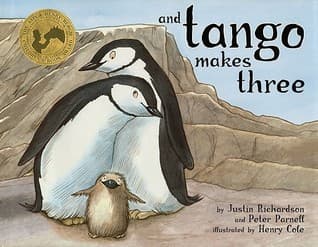
Synopsis
Covers the whole plot, including the ending.
- Difficulty
- Easy
- Pacing
- Slow
- Mood
- Heartwarming, Sweet, Educational
- Read it if
- You want a heartwarming true story about love, family, and acceptance told through the eyes of penguins, perfect for young children.
- Skip it if
- You are looking for a complex plot or adult themes, as this is a simple children's picture book.
And Tango Makes Three Plot Summary
Covers the whole plot, including the ending.
Roy and Silo's Unique Bond
In the Central Park Zoo, among many animal families, live two male chinstrap penguins named Roy and Silo. Unlike the other penguins who pair up as male and female, Roy and Silo are a male couple. They do everything together: they bow, sing, and swim with each other. When breeding season arrives, all the other penguin pairs begin to build nests and lay eggs. Roy and Silo, watching their neighbors, also decide to build a nest. They gather stones and arrange them carefully, just like the other penguin couples, showing they want a family.
A Nest Without an Egg
After building their nest, Roy and Silo wait for an egg, just as they've seen other penguin pairs do. Day after day, they take turns sitting on their empty nest, keeping it warm and safe, even though no egg is inside. They are very good at their job, carefully tending to the nest with the same care as the other penguins. But no egg ever appears. Their wish for a chick is clear in their ongoing but unsuccessful efforts to incubate their empty nest.
Zookeeper Finds a Solution
Zookeeper Mr. Gramzay watches Roy and Silo with their empty nest. He sees how faithfully they sit on it, day after day, and knows they deeply want to be parents. At the same time, another penguin couple in the zoo has laid two eggs, which is one more than they can easily care for. Mr. Gramzay has an idea: he takes the extra egg from the other penguin parents and places it carefully in Roy and Silo's nest. He hopes the dedicated male pair can successfully hatch and raise the chick.
The Arrival of Tango
Roy and Silo are happy when they find the egg in their nest. They immediately begin to take turns sitting on it, keeping it warm and safe, just as they had practiced with their empty nest. They are very careful and patient, showing their strong commitment. After some time, a tiny crack appears in the egg, and soon a small, fuzzy chick emerges. Roy and Silo are thrilled and proud; they are fathers! They name their baby Tango, because 'it takes two to make a tango,' and she is the first penguin in the zoo to have two daddies.
A Loving Family
Roy and Silo are good fathers to Tango. They feed her, protect her, and teach her what a young penguin needs to know. Tango grows bigger and stronger every day, surrounded by the love and care of her two dads. She learns to swim, to find her own food, and to be with the other penguins. She is a happy and healthy part of the Central Park Zoo's penguin group, showing the loving parenting of Roy and Silo, who proved that a family can be made in many ways.
And Tango Makes Three Characters
Roy
Protagonist
One of the two male chinstrap penguins who become parents to Tango.
Roy is a male chinstrap penguin at the Central Park Zoo. He forms a strong bond with Silo, another male penguin, and together they exhibit all the behaviors of a bonded pair, including nest-building. Roy is depicted as a loving and dedicated partner and father, diligently taking turns sitting on the nest and later caring for Tango. His actions demonstrate a deep desire for family and a capacity for nurturing, challenging traditional notions of parenthood.
Relationships: Silo (Life partner and co-parent); Tango (Adopted daughter)
Silo
Protagonist
One of the two male chinstrap penguins who become parents to Tango.
Silo is a male chinstrap penguin who partners with Roy at the Central Park Zoo. He shares Roy's desire for a family, actively participating in nest-building and the subsequent incubation of an empty nest. Silo is portrayed as a caring and committed partner and father, working alongside Roy to raise Tango. His character, like Roy's, highlights the idea that love and dedication, not gender, are the defining qualities of successful parents.
Relationships: Roy (Life partner and co-parent); Tango (Adopted daughter)
Tango
Supporting
The baby penguin hatched and raised by Roy and Silo.
Tango is the baby chinstrap penguin hatched from an egg given to Roy and Silo by Zookeeper Mr. Gramzay. She is significant as the 'child' of the two male penguins, symbolizing the non-traditional family structure. Her name, derived from 'it takes two to make a tango,' emphasizes her unique parentage. Tango thrives under the care of her two fathers, growing into a happy and healthy penguin, demonstrating that love and stability are what truly matter in a family.
Mr. Gramzay
Supporting
The observant zookeeper who facilitates Roy and Silo's parenthood.
Mr. Gramzay is the zookeeper at the Central Park Zoo who plays a crucial role in Roy and Silo's story. He observes their unique bond and their persistent, though fruitless, attempts to hatch an empty nest. Recognizing their strong parental instincts, he makes the compassionate decision to give them a fertile egg that another penguin couple couldn't manage. His actions are pivotal, enabling Roy and Silo to fulfill their desire for a family and demonstrating an open-minded approach to what constitutes a family.
And Tango Makes Three Themes
Family Diversity
The book shows that families come in many forms. Roy and Silo, two male penguins, form a loving pair and successfully raise a chick. This challenges the common idea of a 'mother and father' family. The story shows that the most important parts of a family are love, care, and dedication, not specific gender roles. Tango's happy childhood comes from her two fathers' commitment, showing that different family structures are just as good and loving.
“Roy and Silo were both boys. It didn't matter. They bowed to each other. They sang to each other. And they built a nest together.”
Love and Nurturing
A main theme is the power of love and caring instincts. Roy and Silo show deep love for each other and a natural wish to care for others. Their constant efforts to keep an empty nest warm, and their careful care for Tango, show that parental love goes beyond usual ideas. The zookeeper sees their dedication, which leads him to help. This means their ability to love and care makes them good parents, no matter their gender.
“They sat on the nest just like the other penguins. But Roy and Silo's nest was empty.”
Acceptance and Inclusivity
The book gently promotes acceptance by showing Roy and Silo's family as just another, though special, family in the zoo. No one judges their relationship; instead, their bond is simply seen and, finally, supported by Mr. Gramzay. The story makes their non-traditional family normal, showing Tango growing up happily among other penguin families. This sends a message that all loving families should be recognized and respected.
“And Tango was the very first penguin in the zoo to have two daddies.”
Plot Devices & Literary Techniques
Anthropomorphism
Giving human characteristics and emotions to animals.
The book uses anthropomorphism by attributing human-like emotions and behaviors to the penguins, Roy and Silo. They 'fall in love,' 'bow to each other,' 'sing to each other,' and 'want a family.' This device makes the complex themes of same-sex parenting and family diversity accessible and relatable to young children, allowing them to empathize with the penguins' desire for a chick and understand their loving bond without explicit human-to-human examples.
Symbolism of the Empty Nest
Represents longing and the desire for family.
The empty nest that Roy and Silo diligently sit on symbolizes their profound longing for a chick and their readiness for parenthood. It represents their hope, dedication, and the void they feel without a child. The zookeeper's observation of their consistent care for this empty nest is what convinces him of their parental capabilities, highlighting that their desire and capacity for nurturing are genuine, even in the absence of a biological offspring.
The Extra Egg
A plot device for enabling the non-traditional family.
The extra egg from another penguin couple serves as a crucial plot device that allows Roy and Silo to become parents. It's a practical solution to their inability to lay an egg themselves, facilitated by the observant zookeeper. This device highlights how resourceful solutions can enable diverse family formations and underscores the idea that not all families are formed biologically, but through care, opportunity, and a desire to nurture.
And Tango Makes Three Quotes
“In the penguin house at the Central Park Zoo, there are two penguins named Roy and Silo.”
“Roy and Silo were a little bit different. They were both boys.”
“They did everything together. They bowed to each other. And they walked together.”
“They made a nest of stones, just like the other penguin couples.”
“But no matter how they tried, they could not lay an egg.”
“Mr. Gramzay, the zookeeper, saw that Roy and Silo were trying to hatch a rock.”
“He found an egg that needed to be cared for, and he gave it to Roy and Silo.”
“Roy and Silo took turns sitting on the egg to keep it warm.”
“And then one day, the egg began to crack.”
“Out came a baby penguin! They named her Tango.”
“Tango made three.”
“Roy and Silo taught Tango how to swim and how to catch fish.”
“And the three of them lived happily together.”
“They were a family.”
Quiz
10 questions on the plot and the characters. Each answer comes with a short explanation.
Question 1
What is the name of the penguin chick raised by Roy and Silo?
- Pepper
- Tango
- Chilly
- Snowball
Show answer
B. Tango The book is titled 'And Tango Makes Three,' and Tango is the name of the penguin chick that Roy and Silo hatch and raise together.
Question 2
Where does the story take place?
- San Diego Zoo
- Central Park Zoo
- London Zoo
- Bronx Zoo
Show answer
B. Central Park Zoo The book is based on the true story of two male penguins at the Central Park Zoo in New York City who raised a chick together.
Question 3
What do Roy and Silo try to hatch before they get an egg from the zookeeper?
- A rock
- A tennis ball
- A plastic egg
- A pinecone
Show answer
A. A rock In the story, Roy and Silo build a nest and try to hatch a rock, mimicking the behavior of other penguin couples, before the zookeeper gives them a real egg.
Question 4
Who gives Roy and Silo the egg that becomes Tango?
- Another penguin couple
- A visitor to the zoo
- The zookeeper
- They find it abandoned
Show answer
C. The zookeeper The zookeeper notices Roy and Silo's efforts to hatch a rock and gives them a real egg that needs care, which they successfully hatch into Tango.
Question 5
What is one of the main themes of 'And Tango Makes Three'?
- The importance of zoos for conservation
- The diversity of family structures
- The dangers of city life for animals
- The migration patterns of penguins
Show answer
B. The diversity of family structures The book highlights that families can come in many forms, using the true story of two male penguins raising a chick to show love and care define a family, not traditional roles.
Question 6
How do Roy and Silo behave similarly to other penguin couples in the zoo?
- They swim together every day
- They build a nest and try to hatch an egg
- They teach Tango to fly
- They migrate to a warmer climate
Show answer
B. They build a nest and try to hatch an egg Roy and Silo imitate the nesting and egg-hatching behaviors of the other penguin pairs, showing their desire to form a family like the others.
Question 7
What type of penguins are Roy and Silo?
- Emperor penguins
- Chinstrap penguins
- King penguins
- Chinstrap penguins (specifically, in the book they are based on chinstrap penguins from the true story)
Show answer
D. Chinstrap penguins (specifically, in the book they are based on chinstrap penguins from the true story) While the book is illustrated and may not specify, it is based on the true story of Roy and Silo, who were chinstrap penguins at the Central Park Zoo.
Question 8
Why is Tango's family considered 'not like any of the others' in the zoo?
- Because Tango is the only penguin chick
- Because Roy and Silo are both male penguins
- Because they live in a separate enclosure
- Because Tango has three parents
Show answer
B. Because Roy and Silo are both male penguins The book emphasizes that while there are many animal families in the zoo, Tango's family is unique because it consists of two fathers, Roy and Silo, who raised her together.
Question 9
What does the book suggest about the role of the zookeeper in Tango's story?
- The zookeeper is indifferent to the penguins' behavior
- The zookeeper actively supports Roy and Silo's efforts to become parents
- The zookeeper tries to separate Roy and Silo
- The zookeeper only feeds the penguins and does not interact
Show answer
B. The zookeeper actively supports Roy and Silo's efforts to become parents The zookeeper plays a crucial role by observing Roy and Silo's attempts to hatch a rock and providing them with a real egg, showing support for their family.
Question 10
How does the book use the setting of the zoo to convey its message?
- By showing that all animals live in identical families
- By contrasting traditional animal families with Tango's unique family to highlight diversity
- By focusing on the educational aspects of zoo visits
- By depicting the zoo as a place of confinement for animals
Show answer
B. By contrasting traditional animal families with Tango's unique family to highlight diversity The book starts by describing various animal families in the zoo, then introduces Tango's family as different, using this contrast to teach that families come in many forms, all based on love.
And Tango Makes Three FAQ
What is 'And Tango Makes Three' about?
The book tells the true story of two male chinstrap penguins, Roy and Silo, at New York's Central Park Zoo who form a pair bond, build a nest together, and are given an egg to hatch and raise. They successfully raise a chick named Tango, creating a loving penguin family that is different from others but just as valid.
Why should I read 'And Tango Makes Three'?
It's a gentle, heartwarming introduction to diverse family structures for young children, based on actual events. The story celebrates love, care, and family bonds regardless of traditional norms, making it both educational and emotionally resonant.
What is the background/setting of 'And Tango Makes Three'?
The story is set in the Central Park Zoo in New York City, where various animal families live. The penguin house serves as the specific backdrop where Roy and Silo's relationship unfolds, mirroring real-world zoo environments where this true story occurred.
What are the most memorable quotes?
Key quotes include: 'Roy and Silo were a little bit different. They were both boys.' and 'And Tango was the very first penguin in the zoo to have two daddies.' These lines directly highlight the book's theme of diverse families in simple, child-friendly language.
What writing style does the author use?
Justin Richardson employs a straightforward, narrative style with clear, simple sentences suitable for young readers. The tone is warm and factual, blending storytelling with real-life elements to make the true story accessible and engaging for children.
What minor details add significant meaning?
Details like Roy and Silo trying to hatch a rock instead of an egg emphasize their natural parenting instincts and desire for a chick. The zookeeper Mr. Gramzay's role in providing them with a fertilized egg subtly shows supportive intervention in forming their family.
What are some subtle foreshadowing moments?
Early scenes of Roy and Silo doing everything together—swimming, singing, and building a nest—foreshadow their eventual role as parents. Their persistent nest-building with rocks hints at their readiness to care for an egg before one is even introduced.
What unexpected character connections exist?
The connection between the penguins and the zookeeper Mr. Gramzay is key; he observes their bond and facilitates their parenting by giving them an egg. This human-animal interaction bridges the zoo setting with the real-world inspiration behind the story.
What are unspoken character motivations?
Roy and Silo's motivation stems from an innate drive to form a family and nurture, mirroring other penguin pairs in the zoo. Their actions suggest a deep-seated need for companionship and caregiving, beyond just biological impulses.
What psychological complexities do characters exhibit?
Roy and Silo demonstrate resilience and adaptability in their parenting journey, overcoming the initial challenge of not having an egg. Their bond shows how love and dedication can transcend traditional family roles, offering a model of emotional support.
What are the major emotional turning points?
Key emotional moments include Roy and Silo's disappointment when their rock doesn't hatch, the joy of receiving a real egg from Mr. Gramzay, and the triumphant hatching and raising of Tango. Each step deepens their family bond and the story's emotional impact.
How do relationship dynamics evolve?
Roy and Silo's relationship evolves from being a couple to becoming parents, with their care for each other extending to nurturing Tango. The zookeeper's supportive role adds a layer of community acceptance, reinforcing the idea that families can thrive with external help.
Which parts remain ambiguous or open-ended?
The book doesn't delve into the penguins' backstories or how they first bonded, leaving their early relationship open to imagination. It also doesn't specify long-term outcomes beyond Tango's upbringing, allowing readers to reflect on the ongoing nature of family life.
What are controversial scenes or decisions?
The depiction of same-sex parenting in a children's book has sparked debate in some communities, leading to bans or challenges. The decision to fictionalize a true story about animal behavior to discuss human family diversity is also a point of discussion among readers and critics.
'And Tango Makes Three' ending explained: how it ends & what it means
The book ends with Tango thriving under the care of Roy and Silo, emphasizing that their family is 'just right' despite being different. This conclusion reinforces the message that love and care define a family, not traditional structures, celebrating diversity and inclusion.
About the author
Justin Richardson is an author known for his contributions to children's literature, particularly in the realm of non-fiction. He is best recognized for the picture book "And Tango Makes Three," which tells the true story of two male penguins raising a chick together. His work often explores themes of family and acceptance.
Similar books
- Harry Potter and the Sorcerer's Stone
J.K. Rowling
4.5 (7M) average on GoodreadsFantasyRescued from a miserable life under the stairs, an orphaned boy discovers he's a wizard destined for a magical school, where he uncovers a dangerous secret tied to the dark wizard who murdered his parents.
- The Hobbit, or There and Back Again
J.R.R. Tolkien
4.3 (2.9M) average on GoodreadsFantasyA comfort-loving hobbit named Bilbo Baggins is whisked away by a mischievous wizard and a band of dwarves on an unexpected journey to reclaim stolen treasure from a fearsome dragon, discovering courage and a magical ring along the way.
- Harry Potter and the Goblet of Fire
J.K. Rowling
4.6 (2.6M) average on GoodreadsFantasyA bewildered Harry Potter, underage and thrust into a deadly Triwizard Tournament, must brave dragons, mermaids, and a resurgent dark magic to survive a year that will forever alter the wizarding world.
- Harry Potter and the Order of the Phoenix
J.K. Rowling
4.5 (2.5M) average on GoodreadsFantasyIn a year of oppressive secrets and the threat of Voldemort, Harry Potter and Dumbledore's Army secretly train for war, shown through Jim Kay and Neil Packer's dark illustrations.
- The Lightning Thief
Rick Riordan
4.3 (2M) average on GoodreadsFantasyThrust into a world of mythological monsters and divine treachery, an ordinary boy discovers he's the son of Poseidon and must embark on a perilous quest across modern America to prevent an Olympian war.
- The Giver
Lois Lowry
4.1 (1.8M) average on GoodreadsFantasyIn a world where everyone is the same, a young boy named Jonas learns about true memory, forcing him to see the cost of his community's peaceful ignorance.






Enjoyed the summary?
A summary gives you the shape of the book. The book itself has the detail, the examples and the voice.
Find And Tango Makes Three on AmazonAs an Amazon Associate, BookBrief earns from qualifying purchases. How we're funded