
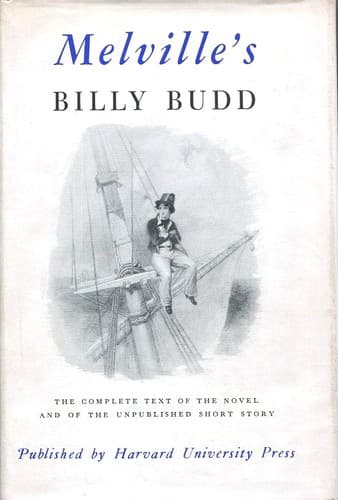
Synopsis
Covers the whole plot, including the ending.
- Difficulty
- Medium
- Pacing
- Moderate
- Mood
- Tragic, Philosophical, Somber, Reflective, Intense
- Read it if
- you enjoy psychological dramas, explorations of good versus evil, moral dilemmas, and the clash between individual innocence and institutional law. Perfect for those who appreciate classic literature with deep philosophical undertones and tragic narratives.
- Skip it if
- you prefer fast-paced action, lighthearted stories, or clear-cut resolutions. This book delves into complex moral ambiguities and can be emotionally heavy.
Billy Budd Plot Summary
Covers the whole plot, including the ending.
Aboard the Rights-of-Man
The story begins with Billy Budd, a well-liked young sailor, on the merchant ship Rights-of-Man. He is known for his innocence, good looks, and a slight stutter when stressed. Though content, Billy is forced into service on the HMS Bellipotent, a British warship, during the Napoleonic Wars. His former captain, sad to lose him, acknowledges Billy's excellent qualities. Billy accepts his new fate gracefully, even cheering his old ship as he leaves. This gesture impresses the Bellipotent's officers with his good nature.
The Handsome Sailor's Appeal
On the Bellipotent, Billy quickly earns the affection of most of the crew and officers. His cheerful attitude, strong work ethic, and natural good looks earn him the nickname 'the Handsome Sailor.' He is simple, with a childlike innocence and a strong sense of duty. His popularity, however, sets him apart from the often cynical mood of a warship. He is seen as pure, a contrast to the hardened sailors, yet he remains approachable and friendly to all, making him a beloved figure among his new shipmates.
Claggart's Malice
Despite Billy's popularity, he becomes the target of an intense dislike from John Claggart, the ship's Master-at-Arms. Claggart is a complex character, described as having a 'natural depravity' and a 'subtlety of malice.' He deeply envies Billy's goodness, innocence, and physical perfection, seeing them as a personal insult. Claggart's hatred is not based on anything Billy has done but on a deep psychological opposition that drives him to plot against the innocent sailor, seeking to destroy what he cannot understand.
Subtle Torment and False Accusations
Claggart's first attacks on Billy are subtle. He assigns Billy to unpleasant tasks, hoping to provoke him or damage his reputation. He also uses his subordinates, like corporals and Squeak, to spy on Billy and make up minor offenses. Billy, in his innocence, does not recognize Claggart's bad intentions, attributing the hardships to the usual difficulties of naval life. However, the constant small persecutions begin to bother Billy, though he struggles to express his unease because of his stutter and trusting nature.
The Night Visit
One night, a shadowy figure approaches Billy, trying to get him to join a mutiny. The figure speaks of discontent among the crew and suggests that Billy, being popular, could be a leader. Billy, loyal to the Crown, rejects the offer immediately, threatening to report the man. He is genuinely shocked by the suggestion of disloyalty. Unbeknownst to Billy, Claggart orchestrated this incident, hoping to gather evidence or create a situation that would allow him to implicate Billy in a conspiracy, destroying his reputation and possibly his life.
Claggart's Formal Accusation
Driven by his growing malice and recent mutinies within the British fleet, Claggart decides to formally accuse Billy. He approaches Captain Vere, the ship's commander, and claims that Billy Budd is a dangerous instigator of mutiny, despite having no credible evidence. Claggart presents his fabricated story with such conviction and an air of concern for the ship's welfare that Captain Vere, an intelligent and dutiful man, is troubled by the accusation, though he finds it hard to believe given Billy's known character.
The Confrontation in Vere's Cabin
Captain Vere, wanting to learn the truth, calls both Billy and Claggart to his cabin. He wants Claggart to repeat his accusation in Billy's presence. When Claggart repeats his charge of mutiny, Billy is overwhelmed with shock, horror, and a deep sense of betrayal. His stutter worsens, making him unable to speak or defend himself. In a moment of pure, involuntary rage and frustration, Billy instinctively strikes Claggart. The blow, delivered with unexpected force, hits Claggart on the forehead, killing him instantly.
The Court-Martial
After Claggart's death, Captain Vere immediately calls a drumhead court-martial. The court consists of the ship's officers, who are sympathetic to Billy and recognize Claggart's malicious nature. However, Captain Vere, presiding, insists on a strict interpretation of naval law. He argues that regardless of Claggart's character or Billy's provocation, striking and killing a superior officer, especially during wartime and recent mutinies, is a capital offense punishable by death. Vere emphasizes the need to maintain order and discipline above all else.
Vere's Soliloquy and Verdict
Despite the officers' reluctance and their clear understanding that Billy was not involved in mutiny, Captain Vere gives a powerful and agonizing speech. He explains that while moral justice might clear Billy, military law and the demands of wartime require a severe punishment to prevent further unrest and maintain the chain of command. He stresses the danger of setting a precedent that might encourage insubordination. Reluctantly, and swayed by Vere's authority and reasoning, the court finds Billy Budd guilty and sentences him to be hanged at dawn.
Billy's Acceptance and Execution
Billy Budd receives his death sentence with remarkable calm and no bitterness. In his final moments, he says, 'God bless Captain Vere!' This act of forgiveness and loyalty deeply moves all who witness it. At dawn, Billy is hanged from the yardarm. His death is swift and peaceful, almost without the usual spasms, a detail that highlights his pure and almost saintly nature. The crew is deeply affected, and a low murmur of discontent spreads among them.
Aftermath and Vere's Fate
The crew's initial murmurs of discontent after Billy's execution are quickly put down by the officers. The incident becomes a legend among sailors; the spar from which Billy was hanged is revered as a sacred relic. Captain Vere, though he did his duty, is deeply scarred by the event. He continues his command, but his spirit is broken. Months later, during a fight with a French ship, Vere is mortally wounded. His dying words, 'Billy Budd, Billy Budd,' show the lasting impact of the tragedy on his conscience, suggesting he never found peace with his decision.
Principal Figures
Billy Budd
Protagonist
The 'Handsome Sailor,' an innocent and morally pure young man.
Billy Budd is a young, handsome, and exceptionally good-natured sailor. Orphaned and uneducated, he possesses an innate innocence, cheerfulness, and physical prowess that makes him universally liked. He has a slight speech impediment, a stammer, which surfaces under emotional distress. Billy embodies a natural goodness and a lack of guile, making him incapable of understanding malice or deceit. He is loyal, dutiful, and fundamentally pure, representing a kind of Edenic man thrust into the complex and often corrupt world of human society and military law.
Relationships: Captain Vere (superior officer; judge and executioner); Claggart (target of Claggart's malice); The Crew of the Bellipotent (universally liked by)
Captain the Honorable Edward Fairfax Vere
Antagonist/Supporting
The intellectual and duty-bound captain of the Bellipotent.
Captain Vere is an intelligent, contemplative, and highly principled naval officer. Known as 'Starry Vere' due to his philosophical nature, he values intellect and order. He is a man of honor and duty, deeply committed to upholding military law and discipline, especially in a time of war and widespread mutiny. While he recognizes Billy's innocence and Claggart's depravity, he ultimately prioritizes the rigid demands of naval justice over personal moral sentiment. His decision to condemn Billy is born of a painful internal conflict between his heart and his duty, a choice that ultimately breaks him.
Relationships: Billy Budd (superior officer; judge and executioner); Claggart (superior officer; accuser); The Officers of the Bellipotent (commander and intellectual guide)
John Claggart
Antagonist
The Master-at-Arms, driven by inexplicable malice and envy.
John Claggart is the Master-at-Arms on the Bellipotent, a position of significant authority and control over the crew. He is characterized by an innate, almost metaphysical 'depravity' and 'malice.' Unlike Billy, Claggart is intelligent and cunning, capable of manipulating situations and people. He harbors an irrational, profound envy and hatred for Billy's natural goodness, innocence, and beauty, which he perceives as a direct affront to his own dark nature. Claggart acts as the embodiment of evil, seeking to corrupt and destroy what is pure, driven by a psychological compulsion rather than a rational motive.
Relationships: Billy Budd (antagonist; victim of Claggart's malice); Captain Vere (subordinate officer; accuser to)
The Dansker
Supporting
An old, experienced sailor who recognizes Claggart's evil.
The Dansker is an old, experienced, and somewhat cynical Danish sailor aboard the Bellipotent. He is one of the few characters who, through his worldly wisdom and understanding of human nature, immediately recognizes Claggart's underlying malice towards Billy. He tries to warn Billy, telling him that Claggart is 'down on' him, but Billy, in his innocence, cannot comprehend such unprovoked hatred. The Dansker serves as a voice of experienced wisdom, highlighting Billy's naiveté and the insidious nature of Claggart's evil.
Relationships: Billy Budd (wise mentor/observer)
Lieutenant Ratcliffe
Supporting
Officer who impresses Billy into service.
Lieutenant Ratcliffe is the officer from the HMS Bellipotent who boards the merchant ship Rights-of-Man to impress sailors. He is initially impressed by Billy's physical appearance and cheerful demeanor, noting his 'handsome' qualities. He carries out his duty impersonally but is not without a degree of appreciation for Billy's character, even as he forcibly removes him from his previous ship. He represents the impersonal machinery of naval recruitment and the arbitrary nature of impressment.
Relationships: Billy Budd (impressing officer)
Squeak
Supporting
Claggart's sniveling subordinate.
Squeak is one of Claggart's corporals, a petty, subservient figure whom Claggart uses to spy on and harass Billy. He is described as having a 'rat-trap' face and is a willing instrument of Claggart's malice, carrying out the Master-at-Arms's dirty work. Squeak embodies the minor, corrupt figures who enable greater evil through their own weakness and opportunism. He represents the lower echelons of authority that can be exploited for malicious purposes.
Relationships: Claggart (subordinate and accomplice); Billy Budd (harasser)
Themes & Insights
Innocence vs. Evil
This theme is central to the novel, shown by Billy Budd's inherent goodness and Claggart's 'natural depravity.' Billy's innocence is so deep that he cannot understand malice, making him vulnerable. Claggart, conversely, is driven by an inexplicable, almost spiritual evil that seeks to destroy purity. The story explores the tragic inability of pure innocence to defend itself against subtle, insidious evil, and how societal structures, like military law, can accidentally help the evil succeed, even when the good is recognized.
“The Master-at-arms was a man of such temperament, that from the beginning he evinced an unpleasant feeling toward the Handsome Sailor.”
Justice vs. Law
A main conflict comes from the difference between moral justice and the rules of military law. Captain Vere is torn between his personal belief in Billy's innocence and the absolute need to uphold naval discipline, especially during war and mutiny. The novel questions whether true justice can be served when legal codes demand a verdict that goes against moral truth. Vere's agonizing decision highlights the tragic results when system order is put before individual righteousness, leading to an outcome that is legally correct but morally devastating.
“How can we adjudge to death him who, in the eye of Heaven, is innocent?''But do you not see that under the circumstances of sudden revolt, nothing less than such rigor could hold the navy together?”
The Nature of Man
Melville explores the philosophical question of human nature, showing a range from Billy's 'noble savage' innocence to Claggart's inherent, inexplicable evil. Billy represents an uncorrupted man, while Claggart embodies a primal malice. Captain Vere, as the rational intellectual, tries to mediate between these extremes, representing the complexities and compromises of civilized society. The novel suggests that within humanity lies both deep goodness and deep-seated depravity, and that societal structures often struggle to accommodate or reconcile these opposing forces, sometimes crushing the innocent in the process.
“Ay, there is a mystery in iniquity, and it is a mystery that is a perpetual torment to the good.”
Duty vs. Conscience
This theme is best shown by Captain Vere's internal struggle. He is a man of deep conscience who recognizes Billy's moral innocence but feels bound by his duty as a naval officer to enforce the letter of the law. The novel explores the heavy burden of command and the tragic choices leaders sometimes face when personal morals clash with institutional demands. Vere's decision to condemn Billy, despite his own anguish, illustrates the deep personal cost of prioritizing the perceived greater good (maintaining order in the fleet) over individual moral conviction, a choice that ultimately destroys him.
“With mankind,' he would say, 'private conscience should at all times be an authoritative guide. But in the military life, and especially in the naval, there is no such thing as a private conscience; there is only the law.”
Plot Devices & Literary Techniques
The Speech Impediment (Stammer)
Billy's stammer prevents him from defending himself.
Billy's speech impediment is a crucial plot device. It symbolizes his inability to articulate complex thoughts or defend himself against verbal accusations, especially under stress. In the climactic confrontation, his stammer renders him speechless, leading to his impulsive, fatal blow against Claggart. This device highlights the vulnerability of the innocent and the limitations of purely physical expression in a world that demands verbal defense. It also underscores the tragic irony that a man of such purity cannot speak his truth when it matters most, allowing evil to gain a temporary upper hand.
The Drumhead Court-Martial
A swift, informal military trial.
The drumhead court-martial serves as a device to expedite the legal process and emphasize the rigid, unyielding nature of military law in wartime. Its swiftness and lack of formal deliberation underscore the urgency and perceived necessity of maintaining order, even at the expense of thorough justice. This device allows Captain Vere to exert his authority and influence over the verdict, transforming a potentially lengthy and sympathetic inquiry into a rapid condemnation, highlighting the power of command and the suppression of individual conscience in the face of institutional demands.
The 'Handsome Sailor' Archetype
Billy as an idealized, innocent figure.
Billy's portrayal as the 'Handsome Sailor' is an archetypal device that elevates him beyond a mere character to a symbol of natural, uncorrupted goodness. This archetype emphasizes his physical and moral purity, making his tragic downfall all the more poignant. It sets him apart from the cynical world of the warship and makes him a magnet for both admiration and malicious envy. This device allows Melville to explore the vulnerability of innocence when confronted with sophisticated evil and the societal mechanisms that struggle to accommodate or protect such a figure.
The Foreshadowing of Mutiny
References to real-life naval mutinies.
Melville frequently references the recent real-life naval mutinies at Spithead and the Nore. This serves as a significant plot device to heighten the stakes and provide a compelling justification for Captain Vere's strict adherence to military law. The constant threat of mutiny creates an atmosphere of fear and urgency, making Vere's decision to condemn Billy, despite his personal feelings, appear as a necessary evil to prevent widespread chaos. This historical context underscores the conflict between individual justice and collective security in a precarious military environment.
Billy Budd Quotes
“The gods that the ancient Greeks invoked, that the Romans invoked, that the Egyptians invoked, were all good gods. They were all benevolent.”
“Innocence, when it is also a beauty, is a most dangerous thing.”
“The truth is, that the greatest thing a human soul ever does in this world is to keep its own truth, its own integrity, its own innocence, and its own kindness.”
“It is by the goodness of God that we live. It is by His grace that we are preserved.”
“The sea has its moods, and so has man.”
“In a man-of-war, above all other places, a man is the least his own master.”
“To serve as a sailor is to be born into a world of discipline, of routine, of obedience.”
“The spirit of the world is not always the spirit of Christ.”
“There are things in the world that are not to be accounted for by reason or by law.”
“He was a foundling, and the foundling is always a waif.”
“The heart is the only judge that can condemn or acquit.”
“A man's conscience is his own, and no man can be held responsible for the conscience of another.”
“The more you try to understand, the more you will be confused.”
“It is by the grace of God that we are permitted to live.”
Quiz
10 questions on the plot and the characters. Each answer comes with a short explanation.
Question 1
What is the name of the warship where the story of Billy Budd takes place?
- The Pequod
- The Bellipotent
- The Neversink
- The Albatross
Show answer
B. The Bellipotent The story is set aboard the warship named the Bellipotent.
Question 2
What is Billy Budd's nickname?
- The Handsome Sailor
- The Innocent Sailor
- The Cheerful Sailor
- The Noble Sailor
Show answer
A. The Handsome Sailor Billy Budd is referred to as the Handsome Sailor throughout the text.
Question 3
Which character is envious of Billy Budd?
- Captain Vere
- Lieutenant Ratcliffe
- Master-at-Arms Claggart
- The Dansker
Show answer
C. Master-at-Arms Claggart Master-at-Arms Claggart is described as being envious of Billy Budd.
Question 4
What crime does Claggart plot to frame Billy Budd for?
- Theft
- Desertion
- Mutiny
- Treason
Show answer
D. Treason Claggart realizes he can frame Billy Budd for treason.
Question 5
What is Billy Budd's occupation aboard the ship?
- Cook
- Cabin boy
- Sailor
- Carpenter's mate
Show answer
C. Sailor Billy Budd is a sailor, specifically referred to as 'Billy Budd, Sailor' in the title.
Question 6
What sweeping event through the fleet gives Claggart an opportunity to frame Billy?
- A severe storm
- A fear of mutinies
- A disease outbreak
- A naval battle
Show answer
B. A fear of mutinies A fear of mutinies sweeping through the fleet provides Claggart with the context to falsely accuse Billy of treason.
Question 7
What is Billy Budd's overall demeanor described as?
- Brooding and quiet
- Aggressive and boastful
- Friendly, innocent, and cheerful
- Cynical and weary
Show answer
C. Friendly, innocent, and cheerful Billy is described as friendly, innocent, helpful, and ever-cheerful.
Question 8
What is Master-at-Arms Claggart's primary motivation for targeting Billy Budd?
- Billy's incompetence
- Claggart's personal ambition
- Claggart's envy and petty nature
- A misunderstanding of Billy's actions
Show answer
C. Claggart's envy and petty nature The text explicitly states Claggart was 'envious, petty' and plotted to make Billy's life miserable.
Question 9
The provided text is an excerpt from which literary work?
- Moby Dick
- The Scarlet Letter
- Billy Budd
- Typee
Show answer
C. Billy Budd The excerpt clearly identifies the story as 'Billy Budd' and discusses the character 'Billy Budd'.
Question 10
What does the text imply about Claggart's initial actions towards Billy before the 'fear of mutinies'?
- Claggart tried to befriend Billy.
- Claggart was indifferent to Billy.
- Claggart was actively tormenting Billy.
- Claggart was reporting Billy for minor infractions.
Show answer
C. Claggart was actively tormenting Billy. The text states, 'But when a fear of mutinies swept through the fleet, Claggart realized he could do more than just torment the Handsome Sailor...' This implies his prior actions were already tormenting Billy.
Billy Budd FAQ
What is Herman Melville's 'Billy Budd' about?
'Billy Budd' is a novella set on a British warship in 1797, focusing on the young, handsome, and innocent sailor Billy Budd. The story explores themes of good versus evil, innocence versus corruption, and the nature of justice when Billy is falsely accused of treason by the envious Master-at-Arms, Claggart.
Who are the main characters in Billy Budd?
The central characters are Billy Budd, the idealized young sailor known as the 'Handsome Sailor'; Master-at-Arms John Claggart, who represents envy and malice; and Captain Edward Vere, the ship's commander who must navigate a difficult moral and legal dilemma.
What does 'Billy Budd' symbolize?
Billy Budd is often interpreted as a symbol of innocence, natural goodness, and Christ-like purity. His tragic fate can be seen as a commentary on the harsh realities of the world and the ways in which inherent goodness can be destroyed by corruption and flawed systems of justice.
What is the significance of the setting in Billy Budd?
The setting aboard the British warship Bellipotent during a time of naval unrest and mutinies is crucial. It creates a claustrophobic environment where social hierarchies are rigid and the threat of rebellion looms, intensifying the conflict between Billy and Claggart and Captain Vere's predicament.
What is the main conflict in Billy Budd?
The primary conflict is between Billy Budd's innate goodness and innocence and Master-at-Arms Claggart's malicious envy and corruption. This personal conflict escalates into a larger struggle involving justice, law, and morality when Billy is accused of treason.
Is Billy Budd a true story?
While 'Billy Budd' is a work of fiction, Herman Melville was inspired by real events and maritime life of his time. The novella reflects the harsh conditions and legal proceedings common in naval services during the late 18th century.
What is the meaning of the ending of Billy Budd?
The ending is tragic and ambiguous. Billy, in a moment of impulsive rage after being falsely accused, strikes and kills Claggart. Captain Vere, bound by naval law, orders Billy's execution, highlighting the conflict between human compassion and rigid military justice.
How does Billy Budd compare to other Melville works like Moby Dick?
Unlike the epic scope of 'Moby Dick,' 'Billy Budd' is a more concise and focused novella. While both explore profound philosophical themes, 'Billy Budd' delves more deeply into individual morality, innocence, and the nature of justice within a confined social structure.
Where can I read Billy Budd?
'Billy Budd' is often published as part of collections of Herman Melville's shorter works or novellas. It can be found in various anthologies and standalone editions, including those that pair it with other famous Melville stories.
What are the themes explored in Billy Budd?
Key themes include the nature of good and evil, innocence versus experience, the conflict between natural law and civil law, loyalty, envy, and the complexities of justice and mercy.
About the author

Herman Melville was an American novelist, short story writer, and poet of the American Renaissance period. Among his best-known works are Moby-Dick (1851); Typee (1846), a romanticized account of his experiences in Polynesia; and Billy Budd, Sailor, a posthumously published novella. Although his reputation was not high at the time of his death, the 1919 centennial of his birth was the starting point of a Melville revival, and Moby-Dick grew to be considered one of the great American novels.
Similar books
- The Trial
Franz Kafka
4.0 (235k) average on GoodreadsLiterary FictionFeatures an innocent protagonist caught in an incomprehensible legal system, facing an absurd and inescapable fate.
- The Old Man and the Sea
Ernest Hemingway
3.8 (831k) average on GoodreadsLiterary FictionWhile both novellas explore themes of human struggle and dignity, "Billy Budd" delves into the systemic nature of injustice and moral compromise within a societal structure, whereas "The Old Man and the Sea" focuses more on the individual's epic battle against nature and their own limitations. Hemingway's prose is famously sparse and direct, contrasting with Melville's more elaborate, philosophical, and introspective style. Both protagonists, Billy Budd and Santiago, face insurmountable odds with a certain stoicism, but Billy's defeat is a result of human law, while Santiago's is a consequence of natural forces.
- Harry Potter and the Sorcerer's Stone
J.K. Rowling
4.5 (7M) average on GoodreadsFantasyRescued from a miserable life under the stairs, an orphaned boy discovers he's a wizard destined for a magical school, where he uncovers a dangerous secret tied to the dark wizard who murdered his parents.
- The Hunger Games
Suzanne Collins
4.3 (6.4M) average on GoodreadsFantasyIn a future where children fight to the death on live television, Katniss Everdeen volunteers for the arena, turning a death sentence into a fight for survival and a spark of rebellion.
- Nineteen Eighty-Four
George Orwell
4.2 (5.5M) average on GoodreadsFictionWinston Smith dreams of truth and rebellion in a world where Big Brother watches all, but he confronts the terrifying power of a regime that controls not just actions, but thoughts.
- Pride & Prejudice
Jane Austen
4.3 (4.9M) average on GoodreadsElizabeth Bennet and Mr. Darcy navigate love and misunderstanding, learning that first impressions can be wrong.





Enjoyed the summary?
A summary gives you the shape of the book. The book itself has the detail, the examples and the voice.
Find Billy Budd on AmazonAs an Amazon Associate, BookBrief earns from qualifying purchases. How we're funded