
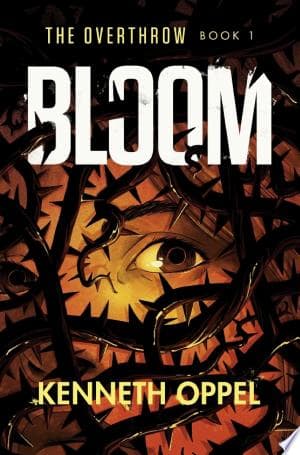
Synopsis
Covers the whole plot, including the ending.
- Difficulty
- Medium
- Pacing
- Fast
- Mood
- Suspenseful, Urgent, Mysterious, Thrilling
- Read it if
- You enjoy fast-paced YA sci-fi with a unique alien invasion concept and elements of body horror and survival.
- Skip it if
- You dislike plant-based threats, grotesque transformations, or stories with a sense of urgency and danger.
Bloom Plot Summary
Covers the whole plot, including the ending.
The Unnatural Rain
The story starts with an unusual black rain falling across Salt Spring Island, British Columbia. People are curious at first, but soon, an unprecedented plant invasion begins. Strange, fast-growing black plants sprout everywhere, quickly overwhelming local flora and human buildings. These plants are unlike anything seen before; they grow fast, wrap around houses, and burrow into the ground. Anaya, who is severely allergic to almost everything, reacts strangely to the rain, feeling a tingling sensation but no typical allergic response. The plants release a toxic pollen that causes severe breathing problems and even death in many island residents, forcing them indoors and isolating them.
Immunity and Peculiar Symptoms
Anaya, Petra, and Seth are three teenagers on Salt Spring Island who discover they are immune to the toxic pollen and the plants' effects. Anaya, who normally has extreme allergies, finds she can breathe freely among the pollen. Petra, a competitive swimmer, develops gills and can breathe underwater. Seth, a quiet boy, discovers he can communicate with the plants and even control their growth to some extent. These unusual symptoms and their immunity set them apart from the terrified population, leading them to believe they might be connected to the invasion in a deeper way than they first understand.
The Spore Pods and the Vanishing
As the black plants continue to grow, they begin to develop large, Venus flytrap-like pods. These pods are carnivorous, hunting and consuming small animals, and eventually, humans. People start disappearing, snatched by the pods, adding a terrifying new element to the invasion. The island's infrastructure collapses as roads become overgrown and communications fail. The government's attempts to fight the plants with herbicides and fire fail, only making the plants grow stronger and more aggressive. The three immune teenagers realize the threat is growing fast, and their unique gifts might be their only hope.
Meeting at the School
Because of their unexplained immunity, Anaya, Petra, and Seth are identified by the military and taken to a makeshift research facility set up in their local school. Scientists and military personnel are confused by their condition, running tests to understand why they are unaffected by the plants' toxins. The teenagers are initially wary of each other and the adults, but a sense of shared fate begins to form. They learn that their unique body changes—Anaya's heightened senses, Petra's gills, and Seth's plant communication—are directly linked to their exposure to the black rain and the alien plant life.
Escaping the Facility
The military's attempts to contain the plant invasion fail dramatically. The black plants break through the school's defenses, and the facility is quickly overrun. In the chaos, Anaya, Petra, and Seth realize they cannot rely on the adults for protection or solutions. They must escape to survive and perhaps find answers on their own. Their unique abilities are crucial during their escape. Seth uses his connection to the plants to navigate dangerous paths, Petra uses her enhanced swimming to cross flooded areas, and Anaya's heightened senses help them detect threats. They decide to venture into the increasingly hostile environment, seeking safety and understanding.
The Alien Ship and the Second Rain
Guided by their instincts and Seth's connection to the plants, the trio eventually discovers a massive, alien spacecraft hidden beneath the dense foliage. This discovery confirms their suspicions: the black plants are not from Earth. They realize the first rain was only the beginning, a seeding process. As a second, even heavier black rain begins to fall, the teenagers understand that this new rain might be more than just water; it could spur further evolution of the plants or even themselves. They prepare for the next stage of the invasion, knowing they are humanity's best, and perhaps only, hope.
Evolution and Transformation
The second black rain brings more significant changes in Anaya, Petra, and Seth. Anaya's senses become even sharper, allowing her to perceive the world in a new way, almost merging with the plants' sensory network. Petra's aquatic adaptations become more pronounced, giving her greater strength and speed in water, essential for navigating the flooded landscape. Seth's ability to communicate with and manipulate the plants grows stronger, allowing him to command them to an unprecedented degree. These transformations are both frightening and empowering, solidifying their roles as key figures in the unfolding crisis, but also making them less human and more alien.
Confronting the Source
With their enhanced abilities, Anaya, Petra, and Seth decide to confront the invasion's source: the alien spacecraft. They believe that understanding and potentially stopping the invasion lies within the ship. Their journey is dangerous, as they battle aggressive plant pods and navigate the treacherous, overgrown landscape. Seth's ability to command the plants helps them clear paths and defend themselves, while Petra's aquatic skills allow them to bypass flooded areas. Anaya's heightened senses guide them through the alien plants, helping them tell friend from foe and revealing hidden paths to the ship's entrance. The stakes are immense, as they are now humanity's last hope.
Inside the Ship
Upon entering the alien spacecraft, the teenagers discover it is not a mechanical vessel but a vast, living, organic entity. The ship and the black plants are connected, forming a single, collective intelligence. They realize the plants are not just invaders but extensions of this alien life form, designed to terraform Earth into a suitable habitat for their species. The ship's interior is a maze of organic pathways, pulsing with alien life. Anaya, Petra, and Seth are overwhelmed by the sheer scale and alienness of it all, realizing the invasion is far more complex and deeply rooted than they could have imagined. Their own transformations are a part of this alien design.
The Dilemma of Coexistence
Inside the living ship, the immune teenagers face a difficult choice. They learn that the alien life form is not evil but simply follows its biological need to survive and reproduce, transforming Earth into its ideal environment. Their own transformations are a result of this alien influence, making them hybrids. They realize that completely destroying the alien plants might be impossible, and perhaps undesirable, given their own altered bodies. The choice becomes clear: either find a way to fight an unstoppable force, potentially destroying themselves in the process, or seek a path towards coexistence, blurring the lines between human and alien. The book ends with this critical decision pending.
Bloom Characters
Anaya
Protagonist
A highly allergic girl who gains enhanced senses and immunity to the alien plants.
Anaya is introduced as a highly sensitive individual, afflicted by severe allergies to almost everything in her environment. This condition has made her cautious and somewhat isolated, but also exceptionally observant. Her initial reaction to the black rain is a tingling sensation rather than an allergic attack, signaling her unique connection to the alien flora. As the story progresses, Anaya develops heightened senses, allowing her to perceive the world with incredible detail and eventually connect with the plants' sensory network. She is driven by a desire to understand what is happening and protect her loved ones.
Relationships: Petra (Fellow immune, developing friendship); Seth (Fellow immune, developing friendship)
Petra
Protagonist
A competitive swimmer who develops gills and aquatic abilities.
Petra is a determined and physically capable individual, passionate about swimming. Her competitive nature drives her, but also makes her somewhat headstrong. After the black rain, she develops gills, allowing her to breathe underwater, and her strength and speed in aquatic environments significantly increase. This transformation positions her as a vital asset for navigating the flooded and altered landscape of Salt Spring Island. Petra struggles with the loss of her normal life and identity, but her resilience and courage push her to adapt and fight for survival, using her new gifts to protect others.
Relationships: Anaya (Fellow immune, developing friendship); Seth (Fellow immune, developing friendship)
Seth
Protagonist
A quiet boy who develops the ability to communicate with and control the alien plants.
Seth is initially portrayed as quiet and somewhat withdrawn, perhaps overshadowed by his peers. However, his unique connection to the alien plants quickly makes him indispensable. He develops the ability to communicate with the black plants, understanding their 'thoughts' and even influencing their growth and movement. This power makes him both a target of military interest and a crucial figure in navigating the plant-infested world. Seth's journey involves coming to terms with his extraordinary ability and learning to wield it responsibly, often acting as a bridge between humanity and the alien invaders. He struggles with the moral implications of his power.
Relationships: Anaya (Fellow immune, developing friendship); Petra (Fellow immune, developing friendship)
Dr. Aronson
Supporting
A scientist studying the alien plants and the immune children.
Dr. Aronson is a military scientist tasked with understanding the black plant invasion and the mysterious immunity of Anaya, Petra, and Seth. She represents the scientific, rational approach to the crisis, initially viewing the children as subjects for study. While her intentions are to find a cure or a solution, her methods are sometimes detached. She is intelligent and driven, but struggles to comprehend the truly alien nature of the invasion and the children's transformations. Her role is to try and make sense of the incomprehensible, often clashing with the teenagers' intuitive understanding.
Relationships: Anaya (Researcher/subject); Petra (Researcher/subject); Seth (Researcher/subject)
General Hayes
Supporting
A military leader attempting to contain the plant invasion.
General Hayes is the military commander responsible for the defense and containment efforts on Salt Spring Island. He embodies the military's strategic and forceful approach to the alien threat, prioritizing action and control. He is pragmatic and focused on protecting human lives and resources, often resorting to aggressive tactics like herbicides and fire, which prove ineffective. Hayes is initially skeptical of the children's immunity and powers, viewing them more as anomalies to be controlled rather than potential allies. His character highlights the limitations of conventional warfare against an unconventional, biological invasion.
Relationships: Dr. Aronson (Colleague/subordinate)
Anaya's Parents
Supporting
Concerned parents trying to protect Anaya amidst the crisis.
Anaya's parents are loving and protective, constantly vigilant due to Anaya's severe allergies. Their initial relief at Anaya's immunity quickly turns to fear and confusion as her transformation progresses. They represent the ordinary human experience of the invasion, trying to cope with an unimaginable threat while fearing for their child's safety and increasingly alien nature. Their struggle to understand and accept Anaya's changes adds an emotional layer to the story, highlighting the personal cost of the alien invasion beyond just physical danger.
Relationships: Anaya (Parents/daughter)
Bloom Themes
Adaptation and Evolution
The main theme is about the need for adaptation when facing an existential threat. The alien plants quickly adapt to Earth's environment, overwhelming existing life. More importantly, Anaya, Petra, and Seth undergo significant biological adaptations, developing new abilities like gills, heightened senses, and plant communication. This theme explores the idea that survival might mean evolving into something new, rather than staying 'human' in the traditional sense. For instance, Petra's development of gills (Plot Summary #2, #7) is a direct adaptation to the increasingly aquatic environment caused by the alien rain, showing a quick evolutionary response.
“We're not just fighting them; we're changing because of them.”
The Nature of 'Alien' and 'Otherness'
This theme explores how humanity views and reacts to something fundamentally 'other.' The alien plants are first seen as a hostile, invasive force, but as the story progresses, the immune children question this view. Their own transformations blur the lines between human and alien, forcing them to confront their own 'otherness.' The discovery that the alien ship is a living entity and the plants are its extensions (Plot Summary #9) challenges the idea of a malicious invader, suggesting a different life form simply following its own biological needs. This raises questions about empathy and understanding across species.
“Are we becoming the aliens, or were we always meant to be part of something bigger?”
Environmental Change and Humanity's Place
The book uses the alien plant invasion as a metaphor for drastic environmental change. The plants quickly terraform Earth, making it unrecognizable and inhospitable to most humans. This highlights humanity's vulnerability and lack of control when faced with overwhelming natural (or unnatural) forces. The theme questions humanity's assumed dominance over nature and forces characters to rethink their place within an altered ecosystem. The constant struggle to survive against the fast-growing plants (Plot Summary #1, #3) shows how quickly an environment can become hostile and how unprepared humanity is to cope with such a fundamental shift.
“The world isn't ours anymore. It belongs to them.”
Loss of Innocence and Identity
The three protagonists, Anaya, Petra, and Seth, are teenagers forced to confront unimaginable horror and undergo significant personal changes. They lose their childhoods, their sense of normalcy, and parts of their human identity as they transform. Petra grieves her life as a swimmer; Anaya struggles with her new sensory overload, and Seth deals with the power and burden of his plant connection. Their journey is one of accelerated maturation, where they must shed old selves to embrace new, often frightening, identities. This is clear in their evolving abilities and the growing distance they feel from ordinary humans (Plot Summary #7).
“We're not kids anymore. We're… something else.”
Plot Devices & Literary Techniques
The Black Rain
The catalyst for the alien plant invasion and human mutations.
The black rain serves as the primary inciting incident and a continuous plot driver. It's not just precipitation but a delivery mechanism for the alien seeds and a catalyst for the unique mutations in Anaya, Petra, and Seth. Its repeated occurrences (Plot Summary #1, #6, #7) escalate the threat and the protagonists' transformations. The rain's unusual color and composition immediately signal that something unnatural is occurring, creating an atmosphere of dread and mystery. It's a powerful symbol of the alien force's pervasive and unstoppable nature, literally seeping into every aspect of life.
Immunity and Mutation
The unique biological changes in the protagonists that make them both vulnerable and powerful.
This device is crucial for differentiating the protagonists from the general population and giving them the means to confront the alien threat. Their immunity to the toxic pollen and their subsequent mutations (gills, heightened senses, plant communication) are not merely protective but transformative (Plot Summary #2, #7). These changes position them as hybrids, blurring the lines between human and alien, and making them uniquely suited to understand and potentially interact with the invaders. It establishes their 'chosen one' status without making them invulnerable, as their mutations come with their own challenges and existential dilemmas.
The Living Alien Ship
The organic source of the invasion, revealing the alien's true nature.
The discovery of the alien ship as a vast, organic, living entity (Plot Summary #9) is a significant plot twist and a device to deepen the mystery and complexity of the invasion. It shifts the antagonist from a simple 'plant plague' to a sentient, biological force. This device allows for the exploration of the 'otherness' theme, as the protagonists realize the invasion isn't just an attack but a biological imperative. It also provides a tangible, albeit alien, destination for the protagonists' journey and a central hub for the alien intelligence, allowing for a potential direct confrontation or communication.
Bloom Quotes
“The wind was a living thing, and it was singing to them.”
“It was beautiful, yes, but it was also utterly terrifying.”
“The air itself seemed to thicken, to hum with an energy they couldn't quite comprehend.”
“We're not just fighting plants, are we? We're fighting something much older.”
“The world was being remade, and they were caught in the middle of its violent birth.”
“Sometimes, the biggest monsters aren't the ones with teeth and claws.”
“Hope was a fragile thing, easily crushed, but sometimes, just sometimes, it could take root.”
“The spores were everywhere, invisible, insidious, waiting.”
“It was a battle for the very soul of the planet.”
“Fear was a kind of fertilizer, making the strange things grow even faster.”
“They were explorers in a world that was no longer theirs.”
“The silence was the most disturbing thing of all, a silence that wasn't natural.”
“To survive, they would have to become as wild as the world around them.”
“There was a purpose to this, a vast, alien intelligence at work.”
Quiz
10 questions on the plot and the characters. Each answer comes with a short explanation.
Question 1
What is the initial event that signals the beginning of the plant invasion?
- A sudden earthquake
- A meteor shower
- Unusual rain carrying seeds
- A strange fog rolling in
Show answer
C. Unusual rain carrying seeds The invasion begins with rain that carries seeds, which then sprout everywhere.
Question 2
What happens to the plants that sprout from the mysterious rain?
- They wither and die quickly.
- They only grow in specific, isolated areas.
- They take over crop fields, twine up houses, and form carnivorous pods.
- They produce a sweet, intoxicating scent.
Show answer
C. They take over crop fields, twine up houses, and form carnivorous pods. The new plants are aggressive, taking over fields, houses, and forming Venus flytrap-like pods that consume living things.
Question 3
Which of the following is NOT one of the three children mentioned as being immune to the toxic plants?
- Anaya
- Petra
- Liam
- Seth
Show answer
C. Liam The three immune children are Anaya, Petra, and Seth. Liam is not mentioned.
Question 4
What characteristic do the three immune children share that might be related to their immunity?
- They all have a rare blood type.
- They each have strange allergies.
- They were all born on the same day.
- They all live in the same house.
Show answer
B. They each have strange allergies. The text states that Anaya, Petra, and Seth each have strange allergies, but not to these new plants, suggesting a connection to their immunity.
Question 5
What is the primary danger posed by the blooming of the new plants, besides forming carnivorous pods?
- They emit a blinding light.
- They release toxic pollens.
- They create loud, disorienting noises.
- They drain all moisture from the air.
Show answer
B. They release toxic pollens. The plants bloom and release toxic pollens, which is another significant threat alongside their physical invasiveness and carnivorous nature.
Question 6
Where are the three immune children located when the story begins?
- In a bustling city
- On a remote island
- In an underground bunker
- In a desert community
Show answer
B. On a remote island The text specifies that the three kids are on a remote island, which might contribute to their initial isolation and unique situation.
Question 7
The description compares the trilogy to 'part Hatchet, part Alien.' What aspect of 'Bloom' is most likely being compared to 'Hatchet'?
- The theme of space travel.
- The focus on a lone survivor against wilderness/nature.
- The presence of advanced technology.
- The exploration of ancient civilizations.
Show answer
B. The focus on a lone survivor against wilderness/nature. 'Hatchet' is known for its survivalist themes in the wilderness, which aligns with the idea of children battling an overwhelming natural threat.
Question 8
What is the primary motivation for the children to discover the secret of their immunity?
- To gain fame and recognition.
- To reverse their own allergies.
- To find a way to beat back the plant invasion.
- To cultivate the plants for their own benefit.
Show answer
C. To find a way to beat back the plant invasion. The urgent need is to figure out their secret 'fast, because it's starting to rain again....' implying they are the key to stopping the invasion.
Question 9
The plants are described as burrowing 'below streets.' What does this detail suggest about the extent and nature of the invasion?
- The plants are weak and easily contained.
- The invasion is purely superficial and aesthetic.
- The plants are deeply invasive and can disrupt infrastructure.
- The plants require darkness to grow.
Show answer
C. The plants are deeply invasive and can disrupt infrastructure. Burrowing below streets indicates a deep, structural invasion that can undermine human constructions and is not just a surface-level problem.
Question 10
The New York Times review describes 'Bloom' as 'the perfect book right now for young readers searching for hope, strength, inspiration.' Given the premise, what does this imply about the overall tone or message of the book despite the danger?
- It is a bleak and pessimistic story.
- It focuses solely on the scientific aspects of botany.
- It features resilient protagonists who can overcome adversity.
- It suggests the invasion is not truly dangerous.
Show answer
C. It features resilient protagonists who can overcome adversity. The review highlights 'hope, strength, inspiration,' suggesting that despite the dire threat, the story will emphasize the resilience and potential of the young protagonists to face and potentially overcome the challenge.
Bloom FAQ
What is the initial catalyst for the plant invasion in 'Bloom'?
The invasion begins with an unusual black rain that falls across the globe. This rain carries mysterious, rapidly germinating seeds that sprout overnight, quickly overwhelming existing flora and infrastructure with aggressive, alien plant life.
Who are the three main protagonists and what unique trait do they share?
The three main protagonists are Anaya, Petra, and Seth. They all live on a remote island and share a unique immunity to the toxic plants, despite having severe allergies to common earthly substances like grass, pollen, or certain foods.
What are some of the dangerous characteristics of the alien plants?
The alien plants are incredibly aggressive, growing at an alarming rate and releasing toxic pollens that are harmful to humans and animals. Some species also develop Venus flytrap-like pods capable of ensnaring and consuming larger creatures, including people.
Where do Anaya, Petra, and Seth initially discover their immunity?
Anaya, Petra, and Seth discover their immunity on their remote island home. While the rest of the world succumbs to the plants' toxic effects, they find themselves unaffected by the pollen and can even touch the plants without harm, a stark contrast to their usual severe allergic reactions.
What is the significance of the characters' existing allergies?
The characters' existing, severe allergies to common earthly substances are a crucial hidden detail. These allergies are a direct consequence of their unique genetic makeup, which also grants them immunity to the alien plants, hinting at a deeper connection between their biology and the extraterrestrial flora.
How do the 'black matter' and the characters' immunity potentially connect?
The 'black matter' found within the alien plants, and later discovered within the protagonists themselves, is a key connection. It suggests that Anaya, Petra, and Seth's immunity isn't just a resistance, but possibly a symbiotic or shared biological origin with the alien species, making them part of the invasion itself.
What is the 'thrumming' sensation the children occasionally feel?
The 'thrumming' sensation the children occasionally feel is a subtle but significant hidden detail. It suggests a deeper, almost telepathic or vibrational connection to the alien plants, indicating that their unique biology might allow them to sense or even interact with the extraterrestrial flora on a subconscious level.
How do Anaya, Petra, and Seth cope with the sudden shift in their identity?
Anaya, Petra, and Seth grapple with a profound shift in identity, moving from 'allergic' and 'normal' to 'immune' and 'different.' They experience confusion, fear, and a sense of isolation, questioning what their unique biology means for their humanity and their future in a world overrun by the very plants they can withstand.
What psychological impact does the global catastrophe have on the children?
The global catastrophe forces the children into a state of heightened anxiety and responsibility. They experience survivor's guilt, fear for their loved ones, and the immense pressure of potentially being humanity's last hope, leading to emotional strain and rapid maturation.
How does the remote island setting influence the children's psychological development?
The remote island setting initially provides a sense of isolation and perhaps a slower pace of life, which is abruptly shattered by the invasion. This isolation then becomes a double-edged sword, offering a temporary sanctuary but also intensifying their unique situation and reinforcing their separation from the broader human experience.
Discuss the symbolism of the 'bloom' in the book's title.
The 'bloom' in the title carries dual symbolism. It represents the destructive, rapid proliferation of the alien plants, signifying an unstoppable invasion. Simultaneously, it can symbolize the burgeoning potential and unique abilities of the three protagonists, who 'bloom' into their roles as humanity's potential saviors.
Is the alien plant invasion purely malicious, or could there be an alternative interpretation?
While the invasion appears malicious due to its destructive nature, an alternative interpretation could suggest it's a natural, albeit aggressive, form of terraforming or species propagation. The plants might not be actively malevolent, but simply following their biological imperative, with humans merely an obstacle or even a resource.
How does the book challenge traditional notions of 'alien' and 'human'?
The book challenges traditional notions by blurring the lines between alien and human. The protagonists, seemingly human, possess a biological connection to the alien invaders, suggesting that the definition of 'human' might be more fluid or that humanity itself could be a blend of terrestrial and extraterrestrial elements.
What moral dilemmas might arise from the children's unique abilities?
The children's unique abilities present significant moral dilemmas, particularly regarding their responsibility to humanity versus their own survival and developing identities. They might face choices about sacrificing themselves, using their powers in ways that could harm others, or deciding who deserves saving in a world on the brink.
What might be the ultimate goal of the alien plants, beyond mere growth?
Beyond mere growth, the ultimate goal of the alien plants could be to completely transform Earth's ecosystem to suit their own needs, effectively terraforming the planet for their species. This could involve creating a new atmosphere, nutrient cycle, or even a collective consciousness, turning Earth into a new home for their kind.
About the author

Kenneth Oppel is a Canadian author known for his works of children's and young adult fiction. His notable books include "Airborn," "Silverwing," "Skybreaker," "This Dark Endeavor," "Sunwing," and "Starclimber," which often blend adventure with elements of fantasy and science fiction. Oppel's storytelling has garnered recognition among young readers and educators alike.
Similar books
- Hatchet
Gary Paulsen
3.7 (309k) average on GoodreadsChildren'sShares themes of survival against nature and overcoming extreme odds in a hostile environment.
- Annihilation
Jeff VanderMeer
4.0 (5k) average on GoodreadsFantasyExplores a mysterious, transforming alien ecosystem with a sense of dread and biological strangeness.
- The 5th Wave
Rick Yancey
4.0 (388k) average on GoodreadsFantasyBoth Bloom and The 5th Wave deal with alien invasions and the fight for human survival, targeting a similar young adult audience. However, their execution differs. Yancey's The 5th Wave focuses more on a multi-layered, strategic invasion with different 'waves' of attack, emphasizing paranoia, military tactics, and the psychological toll of an unseen enemy. Oppel's Bloom presents a more visceral, biological invasion, where the threat is a rapidly evolving flora, forcing humans to adapt physically rather than just militarily or psychologically. While both feature strong, resilient protagonists, Bloom delves more into the concept of human evolution and the potential for a new species, whereas The 5th Wave is primarily concerned with resisting and understanding the alien threat to preserve humanity as it is. Oppel's narrative feels more ecologically driven, while Yancey's is more akin to a military thriller with sci-fi elements.
- The Hunger Games
Suzanne Collins
4.3 (6.4M) average on GoodreadsFantasyIn a future where children fight to the death on live television, Katniss Everdeen volunteers for the arena, turning a death sentence into a fight for survival and a spark of rebellion.
- 1984
George Orwell
4.2 (3.1M) average on GoodreadsPoliticsIn a future where surveillance and thought control are absolute, a man's search for truth clashes with the Party, showing that hope can be a form of rebellion.
- Divergent
Veronica Roth
4.2 (2.9M) average on GoodreadsFantasyIn a society divided by virtues, a sixteen-year-old's difference from the norm starts a rebellion that threatens her world.




Enjoyed the summary?
A summary gives you the shape of the book. The book itself has the detail, the examples and the voice.
Find Bloom on AmazonAs an Amazon Associate, BookBrief earns from qualifying purchases. How we're funded