
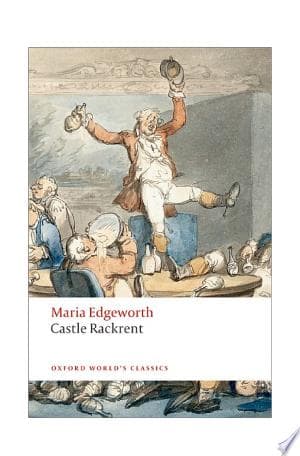
Synopsis
Covers the whole plot, including the ending.
- Difficulty
- Medium
- Pacing
- Moderate
- Mood
- Satirical, Observational, Melancholy, Historical
- Read it if
- You're interested in early Irish literature, satirical portrayals of the landed gentry, or the origins of the regional novel.
- Skip it if
- You prefer fast-paced plots with strong character development or find unreliable narrators frustrating.
Castle Rackrent Plot Summary
Covers the whole plot, including the ending.
Introduction to the Rackrent Family and Thady Quirk
Thady Quirk, the old and loyal steward of the Rackrent estate, introduces himself as the recorder of his masters' fortunes, or rather misfortunes. He starts by explaining the family name, from their practice of 'rack-renting' tenants. Thady's informal narration, full of Irish sayings, immediately creates a sense of authenticity. He sets the stage for the Rackrent landlords' story, hinting at their wasteful habits and the eventual fall of their once-grand estate. Thady's deep personal link to the family, despite their faults, is clear from the start, as he approaches their story with pride, sorrow, and some resignation.
Sir Patrick O'Shaughlin: The Founder of the Feast
Thady describes the time of Sir Patrick O'Shaughlin, the first baronet, whom he calls 'Sir Patrick, my grandfather's master.' Sir Patrick is shown as a man of great hospitality and extravagance, known for his endless feasting and drinking, especially his 'wake-houses' for the living. He is the classic 'old Irish gentleman' who values fun and generosity over financial sense. Thady explains how Sir Patrick's open-handedness, while making him popular, steadily reduced the family's wealth. His disregard for legalities and his choice of immediate pleasure over long-term stability set a bad example for future Rackrent generations, leading to their eventual ruin.
Sir Murtagh Rackrent: The Litigious Tyrant
After Sir Patrick's death, his nephew, Sir Murtagh Rackrent, inherits the estate. Sir Murtagh is very different from his uncle, known for his extreme thriftiness and constant lawsuits. Thady details how Sir Murtagh, instead of enjoying his wealth, spends his days in endless legal battles, often over small matters. His lawsuits, though sometimes successful, drain the estate's money and create widespread bad feelings among his neighbors and tenants. Thady recounts how Sir Murtagh's life is consumed by legal papers and court dates, eventually causing his death from a stroke brought on by a particularly annoying lawsuit. His legacy is one of conflict and financial stress.
Sir Kit Rackrent: The Absentee Gambler and Cruel Husband
Sir Kit Rackrent, Sir Murtagh's nephew, takes over the estate and brings a new kind of recklessness. He marries an English heiress, a Jewish woman, mainly for her money, which he quickly wastes through gambling and lavish spending in London. Sir Kit is an absentee landlord, neglecting his Irish estate and treating his wife very cruelly, locking her in her room for seven years on suspicions of unfaithfulness, though Thady suggests it was more to control her money. Thady recounts the sad death of the 'Jew Lady,' and Sir Kit's later death in a duel over a gambling debt. His time as landlord greatly speeds up the family's financial and moral decay.
Sir Condy Rackrent: The Improvident Dupe
The last baronet is Sir Condy Rackrent, Sir Kit's distant cousin. Sir Condy is shown as a kind but completely wasteful man, easily influenced by others and bad at business. Thady describes his master's attempts to keep up the old Rackrent traditions of hospitality, despite dwindling funds. Sir Condy's kindness often leads to his being taken advantage of. He is especially open to the influence of Thady's shrewd and ambitious son, Jason Quirk, who becomes Sir Condy's agent and slowly gains control over the estate. Sir Condy's true affection for his people contrasts sharply with his inability to manage his affairs, making his eventual ruin more sad.
Jason Quirk's Ascent and Manipulation
As Sir Condy's financial state worsens, Thady's son, Jason Quirk, a sharp and ambitious lawyer, becomes the agent. Jason, unlike his father, has no emotional tie to the Rackrent name and cares only about his own advancement. Thady, while seemingly loyal to Sir Condy, subtly reveals Jason's clever plans. Jason systematically buys up the Rackrent debts and mortgages, slowly but surely taking over the estate. He uses Sir Condy's good nature and financial ignorance, presenting himself as a helpful administrator while secretly working to dispossess his master. Thady tells this process with a mix of fatherly pride in Jason's cleverness and implicit sorrow for Sir Condy's fate.
Sir Condy's Political Aspirations and Decline
To restore his family's standing and money, Sir Condy Rackrent decides to run for Parliament. This venture, however, further drains his already low resources, as he spends heavily on campaigning and entertaining. Thady describes the chaotic and often silly nature of Irish elections, where votes are bought with drinks and promises. Sir Condy, despite good intentions, lacks the political skill and money to succeed. His political hopes ultimately fail, leaving him deeper in debt and more open to Jason Quirk's schemes. This period highlights Sir Condy's inability to adapt to changing times and his reliance on old customs.
The Final Ruin of Sir Condy
The inevitable happens: Sir Condy Rackrent, through Jason Quirk's legal actions and his own wastefulness, loses Castle Rackrent and its lands completely. Thady recounts the sad scenes of Sir Condy's final days as the landlord, trying to keep up appearances even as his property is sold off. He is left with nothing but his good humor and a few loyal servants, including Thady. Sir Condy must live in a small cottage, a stark contrast to his former grand life. His decline shows the results of unchecked extravagance and poor management, the end result of generations of Rackrent folly.
Sir Condy's Wake and Death
Sir Condy Rackrent's death is a somber but typical Rackrent event. Thady describes the preparations for Sir Condy's wake, a traditional Irish custom. In a final act of old Rackrent generosity, Sir Condy, even in death, arranges for a grand wake, paid for by the last bits of his credit. The wake is a scene of both mourning and lively celebration, with drink, food, and laments, much like Sir Patrick's 'wake-houses.' This event marks a symbolic end to the Rackrent line as landlords, the passing of an era and a way of life. Thady's description of the wake is full of finality and a nostalgic goodbye to his beloved master.
Jason Quirk as the New Master of Rackrent
After Sir Condy's death, Jason Quirk fully takes ownership of Castle Rackrent. Thady, with a mix of pride and a subtle hint of disapproval, describes his son's change from a humble lawyer to the estate owner. Jason immediately begins to modernize and 'improve' the property, a sharp contrast to the Rackrent family's traditional, often chaotic, management. He brings in efficiency and financial prudence, though at the cost of the old hospitality and the personal link the landlords had with their tenants. Jason's takeover shows the rise of the hardworking, practical Catholic middle class and the end of the Anglo-Irish gentry's careless rule, signaling a big change in Irish society.
Thady's Reflections and the Editor's Introduction
Thady ends his story, showing a mix of loyalty to the old family and a practical acceptance of the new order under his son, Jason. He thinks about the changes he has seen and his own lasting presence at Castle Rackrent. After Thady's story, an 'Editor' (likely Maria Edgeworth) provides an introduction, footnotes, and a glossary. This editorial frame explains Thady's dialect and Irish customs, making the story accessible to an English audience. The Editor also gives a more objective, critical view of the Rackrent family's behavior and the wider social and economic effects of their decline, adding a layer of scholarly comment to Thady's personal account.
Castle Rackrent Characters
Thady Quirk
Narrator and Supporting Character
The loyal, aged steward and chronicler of the Rackrent family's decline.
Thady Quirk is the seemingly simple, yet remarkably shrewd, old family retainer who narrates the entire history of Castle Rackrent. He serves four generations of Rackrent landlords with unwavering, if sometimes misguided, loyalty. His voice is rich with Irish idiom and a folksy wisdom, often presenting events with a deceptive innocence that belies a keen understanding of human nature and the shifting social landscape. Despite his loyalty to the Rackrents, he also takes a quiet pride in the financial success and ambition of his own son, Jason, who ultimately dispossesses the family. Thady embodies the traditional Irish tenantry, caught between affection for the old ways and the pragmatism of survival.
Relationships: Sir Patrick Rackrent (Master (grandfather's master), admired for hospitality); Sir Murtagh Rackrent (Master, tolerated despite his litigiousness); Sir Kit Rackrent (Master, served despite his cruelty and absenteeism); Sir Condy Rackrent (Master, deeply loyal and affectionate towards him); Jason Quirk (Son, proud of his ambition and success, despite its cost to the Rackrents)
Sir Condy Rackrent
Protagonist (final baronet)
The last, good-natured but utterly improvident baronet of Castle Rackrent.
Sir Condy is the final and most sympathetic of the Rackrent baronets. He is a man of generous spirit, good humor, and traditional Irish hospitality, but completely lacking in business sense, foresight, or self-control. He genuinely cares for his tenants and tries to uphold the 'ould Irish gentleman' traditions of his ancestors, but his efforts are always undermined by his financial ignorance and his susceptibility to flattery and manipulation, particularly from Jason Quirk. His attempts at a political career and his final impoverished state evoke a sense of pathos, as he is a victim of both his own character flaws and the changing times. He represents the final, tragic decline of the Anglo-Irish gentry.
Relationships: Thady Quirk (Loyal steward and confidante); Jason Quirk (Agent, then creditor, who manipulates and eventually dispossesses him); Judy M'Quirk (Wife, often neglected or ignored)
Jason Quirk
Antagonist/Supporting Character
Thady's ambitious, shrewd, and calculating lawyer son who orchestrates the Rackrent's downfall.
Jason Quirk is the antithesis of the Rackrent landlords. He is Thady's son, a sharp and pragmatic lawyer who represents the rising Irish Catholic bourgeoisie. Unlike his father, Jason has no sentimental attachment to the Rackrent family or their traditions. He is driven by ambition, a keen understanding of the law, and a ruthless desire for property and wealth. He systematically exploits Sir Condy's financial weakness and improvidence, gradually acquiring control of the Rackrent estate through legal means. Jason is a symbol of the new social order, replacing the wasteful gentry with a more efficient, albeit less charming, form of landlordism. Thady's narrative often presents Jason's actions with a subtle double meaning, praising his cleverness while lamenting its consequences.
Relationships: Thady Quirk (Son, whose ambition Thady both admires and implicitly laments); Sir Condy Rackrent (Agent and ultimately his dispossessor)
Sir Patrick O'Shaughlin
Supporting Character (First Baronet)
The original Rackrent baronet, known for his extravagant hospitality and legendary feasting.
Sir Patrick is the first of the Rackrent baronets recounted by Thady. He embodies the 'ould Irish gentleman' archetype, prioritizing lavish hospitality, endless feasting, and excessive drinking over any form of financial prudence. He is a popular figure, known for his 'wake-houses' for the living and his open-handed generosity, which, while endearing, lays the foundation for the family's financial ruin. He sets the precedent for the Rackrent family's characteristic improvidence and disregard for long-term planning. His reign is remembered as a golden age of boisterous merriment, but also as the beginning of the estate's decline.
Relationships: Thady Quirk (Master (grandfather's master), admired and remembered with nostalgia)
Sir Murtagh Rackrent
Supporting Character (Second Baronet)
The parsimonious and litigious baronet who drained the estate through endless lawsuits.
Sir Murtagh is the second Rackrent baronet and a stark contrast to his predecessor, Sir Patrick. He is characterized by extreme parsimony, neglecting the estate and his tenants, and an insatiable obsession with lawsuits. He spends his life embroiled in legal battles, often over trivial matters, which, despite occasional victories, ultimately deplete the family's wealth and foster widespread resentment. His focus on litigation rather than productive management further destabilizes the estate. His death, brought on by an apoplectic fit during a legal dispute, aptly symbolizes how his avarice and contentious nature consumed him.
Relationships: Thady Quirk (Master, served with less affection than others, but still with loyalty)
Sir Kit Rackrent
Supporting Character (Third Baronet)
The absentee landlord, gambler, and cruel husband who further ruined the estate.
Sir Kit is the third baronet and represents a new level of moral and financial degradation for the Rackrent family. He is an absentee landlord, spending most of his time gambling and living lavishly in England, completely neglecting his Irish estate. He marries an English heiress, the 'Jew Lady,' purely for her fortune, which he quickly dissipates. His cruel treatment of his wife, whom he locks up for years, highlights his brutal and unprincipled character. His death in a duel over a gambling debt perfectly encapsulates his reckless and destructive lifestyle, marking a significant acceleration in the family's financial and moral decay.
Relationships: Thady Quirk (Master, served despite his harshness); The Jew Lady (his wife) (Wife, cruelly imprisoned and neglected)
The Jew Lady (Lady Rackrent)
Mentioned/Supporting Character
Sir Kit's wealthy English wife, cruelly imprisoned and exploited for her fortune.
The 'Jew Lady' is Sir Kit Rackrent's wife, a wealthy English heiress whom he marries solely for her fortune. Her Jewish background is frequently mentioned by Thady, reflecting societal prejudices of the time. She is a tragic figure, cruelly imprisoned by Sir Kit for seven years, ostensibly on suspicions of infidelity, though Thady implies it was to control her money. Her isolation and suffering are a stark illustration of Sir Kit's brutality and the vulnerability of women in that era. Her death, while freeing her from her confinement, signifies the ultimate failure of her marriage to bring any stability or happiness to the Rackrent line.
Relationships: Sir Kit Rackrent (Husband, who imprisoned and exploited her)
Judy M'Quirk (Lady Rackrent)
Supporting Character
Sir Condy's wife, a pragmatic and resourceful woman from a lower social standing.
Judy M'Quirk is Sir Condy's wife, a woman of more practical sense and lower social standing than her husband. She is Thady's niece, making her connection to the Quirk family significant. While Thady describes her as sometimes 'cunning' and less refined than a baronet's wife should be, she often attempts to bring a degree of order and economy to Sir Condy's chaotic household. Despite her efforts, she is often overshadowed or ignored by Sir Condy, who is more concerned with maintaining appearances and traditions. Her pragmatism contrasts with Sir Condy's improvidence, but she ultimately cannot prevent his downfall.
Relationships: Sir Condy Rackrent (Wife, often ignored or overlooked); Thady Quirk (Niece)
Castle Rackrent Themes
The Decline of the Anglo-Irish Gentry
The novel carefully details the fall of the Rackrent family, an Anglo-Irish landlord class, because of their wastefulness, neglect of their estates, and outdated adherence to old traditions of hospitality and extravagance. Each baronet shows a different part of this decline, from Sir Patrick's wasteful feasting to Sir Murtagh's lawsuits, Sir Kit's absence and cruelty, and finally Sir Condy's kind but completely ineffective management. Their inability to adapt to changing economic and social realities, along with a basic lack of responsibility, leads to their certain loss of property, symbolizing the fading power of their class in Ireland.
“''Tis a pity of them, for they were good-for-nothing, but they were good-hearted.”
The Rise of the Irish Catholic Bourgeoisie
In contrast to the Rackrents' decline, the novel shows the rise of the hardworking and practical Irish Catholic middle class, personified by Jason Quirk. Jason, Thady's son, is a clever lawyer who systematically acquires the Rackrent estate through legal means, taking advantage of the baronets' debts and financial mismanagement. His rise represents a major shift in power and wealth in Ireland, from the old, often wasteful, Protestant gentry to a new class of financially smart and ambitious Catholic professionals. Jason's efficiency and focus on profit, though lacking the 'charm' of the old ways, are ultimately more effective in the changing economy.
“And so the law takes its course, and what can a poor man do against the law?”
Loyalty and Betrayal
Loyalty is a central theme, mainly through Thady Quirk, who remains devoted to the Rackrent family despite their many faults and the hardships they cause him. His narration is full of a deep, almost familial, attachment to his masters. However, this loyalty is subtly complicated by the ambition of his son, Jason, who, while working for Sir Condy as an agent, arranges his financial ruin. Thady's pride in Jason's success, even as it dispossesses his beloved master, highlights the complex interaction between personal faithfulness, family advancement, and the harsh realities of economic survival in a changing society. Thady's narration itself, while seeming loyal, also exposes the Rackrents' failures.
“I was always for the old family, for all I knowed them to be as bad as the worst.”
Irish Identity and Anglo-Irish Relations
The novel explores Ireland's distinct cultural identity in the late 18th century, especially the complex relationship between the native Irish and the Anglo-Irish gentry. Thady's narration, rich in Irish dialect, customs, and viewpoints, offers an authentic 'insider's' look at Irish life. The Rackrents, though Anglo-Irish, show many traditional Irish traits like excessive hospitality and a somewhat chaotic approach to life, contrasting with the more 'English' practicality and legalism that ultimately wins through Jason Quirk. The 'Editor's' footnotes and glossary further emphasize the cultural uniqueness and the need to explain Irish realities for an English audience, highlighting the divide and potential misunderstandings between the two cultures.
“These Rackrents were a family that had been for ever and a day upon the land in Ireland.”
The Corrupting Influence of Power and Wealth
The Rackrent family's story is a warning about the corrupting effect of unearned power and unchecked wealth. Each baronet, in their own way, misuses their position, leading to the decay of their estate and their moral standing. Sir Patrick's extravagance, Sir Murtagh's lawsuits, and Sir Kit's cruelty all come from a sense of entitlement and a lack of accountability inherent in their landlord status. Sir Condy, though kind, is equally corrupted by his inability to manage his affairs, leading to the exploitation of his tenants and his own eventual ruin. The novel suggests that without responsibility and prudence, inherited wealth and power inevitably lead to destruction.
“Ah, what times those were! The like will never be seen again; for the good old times are gone, and the new times are come.”
Plot Devices & Literary Techniques
Unreliable Narrator
Thady Quirk's subjective, biased, and often subtly ironic perspective.
Thady Quirk serves as the novel's unreliable narrator. While he presents himself as a simple, loyal retainer, his narrative is rife with his personal biases, affections, and a subtle, often unconscious, irony. His descriptions of the Rackrents, while seemingly admiring, frequently expose their flaws and follies. He praises his son Jason's cunning while lamenting its consequences for Sir Condy. This unreliability forces the reader to critically interpret his account, inferring the true nature of events and characters beyond Thady's stated loyalties, thereby adding depth and complexity to the social critique.
Framing Device (Editor's Introduction and Notes)
An external 'Editor' provides context and a more objective perspective.
The novel is framed by an 'Editor's Introduction' and numerous footnotes and a glossary. This device serves multiple purposes: it authenticates Thady's narrative by presenting it as a found manuscript, explains Irish colloquialisms and customs for an English audience, and provides a more objective, critical, and historical context for the Rackrent family's decline. The Editor often corrects or elaborates on Thady's naive or biased statements, offering a more academic and politically informed analysis of the social changes depicted, thereby broadening the novel's scope from a personal chronicle to a socio-historical commentary.
Satire and Irony
Humorous and critical portrayal of the Anglo-Irish gentry's follies.
Edgeworth employs satire and irony throughout the novel to critique the Anglo-Irish landlord class. Thady's seemingly innocent recounting of the Rackrents' extravagant and irresponsible behavior often highlights their absurdity and self-destructiveness. The descriptions of Sir Patrick's endless feasting, Sir Murtagh's legal battles, and Sir Kit's cruelty are presented in a manner that, while humorous, also underscores the serious consequences of their actions. This satirical approach allows Edgeworth to expose the systemic flaws of the gentry without resorting to overt didacticism, letting the characters' own actions speak volumes about their unsuitability for their positions.
Foil Characters
Jason Quirk and the Rackrents serve as contrasting figures.
The characters of Jason Quirk and the various Rackrent baronets act as foils to one another, highlighting their contrasting traits and the changing social landscape. The Rackrents, with their improvidence, emotional attachments, and adherence to outdated traditions, are starkly contrasted by Jason's pragmatism, legalistic cunning, and focus on financial gain. This juxtaposition underscores the novel's central theme of the decline of the old gentry and the rise of a new, more efficient, but less romantic, class. The foil relationship emphasizes the clash between sentimentality and practicality, and tradition versus modernity, in 18th-century Ireland.
Castle Rackrent Quotes
“I was but a slip of a boy when the old lady died.”
“It is a pity of them all that are not born to a good estate.”
“Sure enough, the Rackrents were a family that was famous for their hospitality.”
“He was a good-natured, hearty gentleman, and loved a glass of anything that was strong.”
“Oh, to be sure, it was a fine sight to see the tenants all come in with their rents.”
“And so, in a word, the family was always behindhand.”
“He was always for improving, as he called it, but he never improved anything but his own ruin.”
“It was a great pity that a gentleman of his birth should be so reduced.”
“The law was a thing he never much minded, except to get out of it.”
“For my part, I never knew a Rackrent that was not a good landlord at heart.”
“He was a great hand at a bargain, and could turn a penny as well as any man.”
“And so the old castle, after all, came into the hands of the right owner.”
“It is a great comfort to a poor man to have a good master.”
“They were always for living beyond their means, God bless them!”
Quiz
10 questions on the plot and the characters. Each answer comes with a short explanation.
Question 1
Who is the primary narrator of 'Castle Rackrent'?
- Sir Condy Rackrent
- Jason Quirk
- Thady Quirk
- Maria Edgeworth
Show answer
C. Thady Quirk Thady Quirk, an old family retainer, narrates the decline of the Rackrent family.
Question 2
Which of the following describes Sir Murtagh Rackrent?
- A dissipated spendthrift
- A litigating fiend
- A brutal husband and gambling absentee
- A lovable and improvident dupe
Show answer
B. A litigating fiend Sir Murtagh is characterized as the 'litigating fiend' among the four generations of Rackrent heirs.
Question 3
What significant literary genre did 'Castle Rackrent' pioneer?
- The Gothic novel
- The epistolary novel
- The regional novel
- The historical romance
Show answer
C. The regional novel Maria Edgeworth pioneered the regional novel with 'Castle Rackrent', influencing later authors like Sir Walter Scott.
Question 4
How does Maria Edgeworth's novel change the focus of conflict in Ireland, according to the description?
- From economics to religion
- From class to politics
- From religion to class
- From monarchy to democracy
Show answer
C. From religion to class The novel 'changed the focus of conflict in Ireland from religion to class,' highlighting the social stratification.
Question 5
Which of the Rackrent heirs is described as 'the lovable and improvident dupe of Thady's own son, Jason'?
- Sir Patrick
- Sir Murtagh
- Sir Kit
- Sir Condy
Show answer
D. Sir Condy Sir Condy is explicitly described as 'the lovable and improvident dupe of Thady's own son, Jason'.
Question 6
What class did Maria Edgeworth belong to, and whose voice did she adopt in the novel?
- She was Anglo-Irish and adopted an Irish Protestant voice.
- She was Irish Catholic and adopted an Anglo-Irish voice.
- She was Anglo-Irish and adopted an Irish Catholic voice.
- She was English and adopted an Anglo-Irish voice.
Show answer
C. She was Anglo-Irish and adopted an Irish Catholic voice. Edgeworth was from the Anglo-Irish class but 'adopted an Irish Catholic voice to narrate the decline of a family from her own Anglo-Irish class.'
Question 7
What political prediction did Edgeworth make through 'Castle Rackrent'?
- The decline of the Irish Catholic Bourgeoisie
- The rise of the Irish Catholic Bourgeoisie
- The end of Anglo-Irish landlordism without replacement
- The re-establishment of the Rackrent family fortunes
Show answer
B. The rise of the Irish Catholic Bourgeoisie Edgeworth 'boldly predicted the rise of the Irish Catholic Bourgeoisie' in her satire.
Question 8
What role does Thady's son, Jason Quirk, play in the final decline of the Rackrent family, specifically concerning Sir Condy?
- He attempts to restore the family's wealth.
- He marries into the Rackrent family to secure their future.
- He exploits Sir Condy's improvidence, becoming his dupe.
- He leaves Ireland to escape the family's troubles.
Show answer
C. He exploits Sir Condy's improvidence, becoming his dupe. Sir Condy is described as 'the lovable and improvident dupe of Thady's own son, Jason,' indicating Jason's role in exploiting him.
Question 9
The novel is described as a 'satire on Anglo-Irish landlords'. What specific characteristic of these landlords is frequently highlighted through the Rackrent family's actions?
- Their astute financial management and frugality.
- Their strong commitment to public service and community improvement.
- Their self-destructive extravagance, litigiousness, and neglect of their estates.
- Their progressive views on social reform and tenant rights.
Show answer
C. Their self-destructive extravagance, litigiousness, and neglect of their estates. The descriptions of the Rackrent heirs—'dissipated spendthrift,' 'litigating fiend,' 'brutal husband and gambling absentee,' 'improvident dupe'—collectively highlight their self-destructive mismanagement and neglect, forming the core of the satire.
Question 10
Sir Walter Scott's novel 'Waverly' (1814) was inspired by 'Castle Rackrent'. What common element or influence did Edgeworth's novel likely provide for Scott?
- The use of a strictly omniscient narrator.
- The focus on aristocratic English urban life.
- The pioneering of the regional novel, capturing local character and setting.
- The promotion of a specific political ideology through allegory.
Show answer
C. The pioneering of the regional novel, capturing local character and setting. The text states that Edgeworth 'pioneered the regional novel and inspired Sir Walter Scott's Waverly (1814),' indicating the regional focus was a key influence.
Castle Rackrent FAQ
What is the central premise of 'Castle Rackrent'?
The novel chronicles the decline of the Anglo-Irish Rackrent family through four generations of landlords, as narrated by their loyal, yet often subtly critical, steward, Thady Quirk. It depicts their various eccentricities, financial mismanagement, and eventual loss of the estate to Thady's ambitious son, Jason. The story is a satirical look at the Anglo-Irish gentry in the late 18th century.
Who is Thady Quirk and what is his role in the narrative?
Thady Quirk is the elderly, ostensibly loyal steward and the primary narrator of 'Castle Rackrent'. He provides a seemingly straightforward account of the Rackrent family's exploits, but his narrative is often infused with dramatic irony and a subtle, self-serving perspective, particularly concerning his son Jason's rise. Thady's voice is crucial to the novel's unique tone and its portrayal of Irish life.
Describe the four generations of Rackrent landlords depicted in the book.
The novel features Sir Patrick, the original dissipated spendthrift; Sir Murtagh, known as the 'litigating fiend' due to his obsession with lawsuits; Sir Kit, the brutal, gambling absentee landlord; and finally, Sir Condy, the lovable but utterly improvident last heir who loses the estate. Each landlord embodies a different vice contributing to the family's downfall.
What is the significance of the novel being narrated by an Irish Catholic voice?
Maria Edgeworth's choice to narrate through Thady Quirk, an Irish Catholic, was groundbreaking and rebellious for its time. It allowed her to satirize her own Anglo-Irish class from an 'insider-outsider' perspective, offering a critique of landlord abuses and predicting the rise of the Irish Catholic bourgeoisie, shifting the focus of conflict from religion to class.
How does Sir Condy Rackrent lose the family estate?
Sir Condy, though well-intentioned, is deeply improvident and easily manipulated. He squanders his remaining wealth, is tricked into ill-advised schemes, and ultimately falls prey to the machinations of Jason Quirk, Thady's son, who systematically acquires the Rackrent lands through legal and financial maneuvering until Sir Condy is left with nothing.
What subtle hints does Thady drop about Jason's true intentions?
While Thady consistently praises Jason's 'cleverness' and 'industry', he often reveals details that expose Jason's ruthless ambition, such as his meticulous record-keeping of Sir Condy's debts, his legal shrewdness in acquiring properties, and his cold dismissal of Sir Condy's plight. Thady's 'innocent' observations often highlight Jason's calculated rise.
Is there any irony in Thady's loyalty to the Rackrent family?
Thady's loyalty is deeply ironic. While he expresses profound devotion and grief for the Rackrents, his narrative simultaneously documents their flaws and indirectly celebrates his son Jason's success in dispossessing them. His 'loyalty' is often tied to the old ways and personal attachment, even as he facilitates the new order through his son.
How does the character of Sir Kit's wife, the 'Jewess', contribute to the novel's themes?
Sir Kit's 'Jewess' wife, brought from England, represents an outsider figure and a source of potential wealth that is ultimately squandered. Her mistreatment and eventual abandonment highlight Sir Kit's cruelty and the Rackrents' disregard for marital bonds and financial responsibility, further contributing to the family's decline. Her story also touches on themes of prejudice and isolation.
What does Thady's narrative style reveal about his own class and perspective?
Thady's narrative style, filled with colloquialisms, digressions, and a seemingly uncritical acceptance of the landlords' behavior, reflects the perspective of a loyal, uneducated servant. However, it also subtly critiques the gentry by exposing their folly and inefficiency, demonstrating a deep understanding of their weaknesses from a pragmatic, working-class viewpoint.
How does the novel explore the psychology of improvidence and financial ruin?
The novel vividly portrays the psychology of improvidence through characters like Sir Patrick and Sir Condy, who are driven by immediate gratification, a disregard for future consequences, and a sense of entitlement. Their inability to manage money or property stems from a combination of inherited habits, social pressures, and a lack of practical wisdom, leading inevitably to their downfall.
Discuss the psychological impact of the Rackrents' behavior on their tenants and staff.
The Rackrents' erratic and irresponsible behavior creates an environment of instability and hardship for their tenants and staff, including Thady. While Thady remains loyal, the constant legal disputes, financial demands, and neglect likely caused significant stress and economic precarity for those dependent on the estate, fostering a sense of resignation or, in Jason's case, a drive for self-advancement.
What motivates Jason Quirk's ambition, and how does it contrast with the Rackrents' motivations?
Jason Quirk is primarily motivated by a desire for upward social mobility, wealth, and land ownership, driven by a pragmatic understanding of the changing socio-economic landscape. This contrasts sharply with the Rackrents, whose motivations are often rooted in upholding a declining aristocratic lifestyle, indulging in personal vices, or maintaining an inherited, rather than earned, status.
Does Edgeworth ultimately condemn or sympathize with the Rackrent family?
Edgeworth's portrayal is complex; it's a satire that condemns the Rackrents' irresponsibility and ultimately celebrates the rise of a more efficient, if ruthless, class. However, there's also a degree of pathos, particularly with Sir Condy, suggesting some sympathy for the human element caught in the tide of historical change, even as their class is deemed obsolete.
How does 'Castle Rackrent' challenge traditional notions of loyalty and class structure?
The novel challenges traditional loyalty by showing how Thady's devotion to the Rackrents is intertwined with his family's ascent and the eventual downfall of his masters. It questions the inherent right of the gentry to rule by exposing their incompetence and suggests that class structure is not immutable, but subject to economic and social forces, allowing for the rise of figures like Jason.
What is the significance of the editor's notes and glossary in the Oxford World's Classics edition?
The editor's notes and glossary are crucial for a modern reader, as they clarify the historical context, explain Irish colloquialisms, and provide insight into the political and social nuances of late 18th-century Ireland. They help to fully appreciate Edgeworth's subtle critiques and the specific cultural references embedded in Thady's narrative, enhancing understanding of the novel's depth.
In what ways did 'Castle Rackrent' pioneer the 'regional novel'?
'Castle Rackrent' pioneered the regional novel by immersing itself deeply in a specific geographical and cultural setting—rural Ireland—and depicting its unique customs, dialect, and social dynamics. It focused on the local particularities of its characters and environment, a departure from more universal narratives, thereby influencing later authors like Sir Walter Scott.
Does the novel offer any hope for the future of Ireland, or is it purely pessimistic?
While the novel depicts the decline of the Anglo-Irish gentry, it also boldly predicts and implicitly validates the rise of the Irish Catholic bourgeoisie, represented by Jason Quirk. This shift, from an inefficient aristocracy to a more pragmatic, though perhaps less charming, class, suggests a future for Ireland, albeit one rooted in a new form of power and economic efficiency rather than traditional sentiment.
How does Edgeworth use humor and satire to convey her serious social commentary?
Edgeworth employs subtle irony and a dry, observational humor, largely through Thady's seemingly naive narration, to highlight the absurdities and inefficiencies of the Rackrent family. This satirical approach allows her to critique the Anglo-Irish landlord class and their impact on Ireland without resorting to overt moralizing, making her social commentary more palatable and effective.
About the author

Maria Edgeworth was a prolific Anglo-Irish novelist of adults' and children's literature. She was one of the first realist writers in children's literature and was a significant figure in the evolution of the novel in Europe. She held critical views on estate management, politics and education, and corresponded with some of the leading literary and economic writers, including Sir Walter Scott and David Ricardo. During the first decade of the 19th century she was one of the most widely read novelists in the British Isles. Her name today most commonly associated with Castle Rackrent, her first novel in which she adopted an Irish Catholic voice to narrate the dissipation and decline of a family from her own landed Anglo-Irish class.
Similar books
- Waverley
Walter Scott
3.4 (5k) average on GoodreadsHistorical FictionPioneered the historical and regional novel, influenced by Edgeworth's work.
- Pride and Prejudice
Jane Austen
4.3 (3M) average on GoodreadsHistorical FictionFeatures social satire, class dynamics, and examinations of inheritance and marriage within gentry society.
- Nineteen Eighty-Four
George Orwell
4.2 (5.5M) average on GoodreadsFictionWinston Smith dreams of truth and rebellion in a world where Big Brother watches all, but he confronts the terrifying power of a regime that controls not just actions, but thoughts.
- The Frozen River
Ariel Lawhon
4.4 (600k) average on GoodreadsFictionIn 1789 Maine, a heroic midwife's diary helps her expose a murder and get justice in a town that wants to silence her.
- A Man Called Ove
Fredrik Backman
4.4 (569k) average on GoodreadsFictionA stubborn widower, who lives by strict rules, finds his quiet world changed by a lively new family next door, making him face his past and find happiness in human connection.
- The Art of Racing in the Rain
Garth Stein
4.2 (452k) average on GoodreadsFictionThrough the eyes of Enzo, a wise and observant dog, a race car driver's family navigates a journey of love, loss, and resilience, learning that life's most important lessons often come in the curves, not just on the straightaways.





Enjoyed the summary?
A summary gives you the shape of the book. The book itself has the detail, the examples and the voice.
Find Castle Rackrent on AmazonAs an Amazon Associate, BookBrief earns from qualifying purchases. How we're funded