
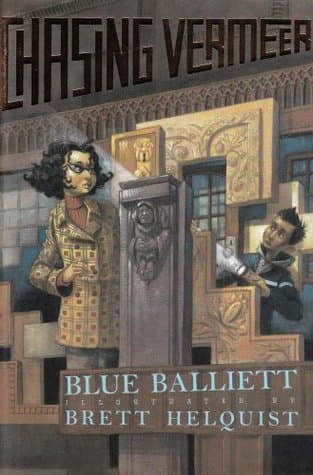
Synopsis
Covers the whole plot, including the ending.
- Difficulty
- Medium
- Pacing
- Moderate
- Mood
- Intriguing, Whimsical, Mysterious, Clever
- Read it if
- You enjoy a clever, character-driven mystery with puzzles, art history, and a touch of magic, perfect for young readers who love to think.
- Skip it if
- You prefer fast-paced action over intricate plotting and deciphering clues, or if you're looking for a dark, gritty thriller.
Chasing Vermeer Plot Summary
Covers the whole plot, including the ending.
A Mysterious Letter and Unlikely Allies
Petra Andalee, a new student at the University of Chicago Lab School, and Calder Pillay, who likes pentominoes, find their lives connected. Both get a mysterious, unsigned letter with random words and numbers that asks, 'Are you there?' Their sixth-grade teacher, Ms. Hussey, introduces them to Johannes Vermeer's art. Petra likes words and mysteries, and Calder thinks logically. They are careful around each other at first but are drawn together by the letter and strange events. They notice connections, including a shared interest in frogs and an old woman, Mrs. Sharpe, who lives nearby and seems to watch them.
Vermeer's 'A Lady Writing' is Stolen
The art world is surprised by the theft of Johannes Vermeer's "A Lady Writing." It was stolen from a heavily guarded crate during a train trip from the National Gallery of Art in Washington D.C. to an exhibition in Chicago. The thief, who calls himself 'The Uniter,' sends a letter to the Chicago Tribune. He says the painting was stolen because Vermeer's art is not appreciated. He will return it only if certain conditions are met. The FBI is confused. The news affects Petra and Calder, who just studied Vermeer in class.
The Uniter's Demands and a Hidden Clue
The Uniter's letters continue. He demands art experts acknowledge Vermeer's use of symbols and hidden messages, especially frogs and toads. He claims "A Lady Writing" has a secret only a true admirer can find. Petra and Calder remember studying Vermeer and their mysterious letters. They start to think The Uniter's demands are connected to their experiences. They notice a frog figurine appearing in different places, like Ms. Hussey's classroom and near Mrs. Sharpe's house. They believe The Uniter is sending a message through clues in plain sight.
Deciphering the Pentominoes and the Frog Clue
Calder, who likes pentominoes (shapes made of five squares), realizes the random words in their first letters match specific pentomino shapes. He uses his pentominoes to arrange letters, hoping to find a hidden message. Petra focuses on the frog. They discover a 'tree frog' appears subtly in several Vermeer paintings. They also link the frog to a book, 'Lo! A Key to Vermeer,' by a secluded art historian, Mrs. Sharpe, who lives nearby. They believe this book holds the key to The Uniter's demands and the painting's secret.
Mrs. Sharpe's Connection and the Book's Secret
Petra and Calder visit Mrs. Sharpe, an old woman living alone in a house full of books and art. They learn Mrs. Sharpe is a former art historian whose theories about hidden symbols in Vermeer's work, especially frogs, were mocked. She had a friend, Tommy Segovia, who believed her theories. Mrs. Sharpe says her book, 'Lo! A Key to Vermeer,' has a code she made to prove her theories. Petra and Calder realize The Uniter is likely someone who also believes Mrs. Sharpe's theories and wants them known, perhaps Tommy Segovia.
The School's Involvement and Suspicions
As Petra and Calder investigate, they notice that several people connected to their school act suspiciously. Ms. Hussey, their sixth-grade teacher, has a copy of Mrs. Sharpe's book and shows unusual interest in the Vermeer theft. She also has a copy of "A Lady Writing." They find an old art history textbook at school with a handwritten note about Vermeer's hidden symbols. This confirms their belief that the mystery's key is nearby. They begin to suspect Ms. Hussey because of her Vermeer knowledge and her closeness to them.
The Uniter's Ultimatum and the Pentomino Code
The Uniter sends a final message to the Chicago Tribune. He says if his demands are not met by a certain date, "A Lady Writing" will be destroyed. This makes Petra and Calder's investigation more urgent. Calder uses his pentominoes to crack a code from one of The Uniter's letters. The message reveals a location and time at the Art Institute of Chicago. It also hints at The Uniter's identity, suggesting it is someone close to Mrs. Sharpe and her theories. The children realize they must act fast to save the painting and learn the truth.
The Art Institute Confrontation
Following the pentomino code, Petra and Calder go to the Art Institute of Chicago. They arrive at the location and time and find Ms. Hussey. Ms. Hussey reveals she is The Uniter. She explains she is Tommy Segovia's granddaughter. Her grandfather, a friend of Mrs. Sharpe, died sad after their Vermeer theories were rejected. Ms. Hussey stole the painting to force the art world to acknowledge the hidden messages and symbols in Vermeer's work, like the frog, as her grandfather and Mrs. Sharpe had said. She wanted to bring justice to their ignored research.
The Painting's Return and a New Understanding
Petra and Calder confront Ms. Hussey. She realizes they understand her reasons and passion and agrees to return "A Lady Writing." She reveals the painting's hiding place in the museum. The FBI finds the painting unharmed. Ms. Hussey faces legal consequences, but her actions, meant to honor her grandfather and Mrs. Sharpe, cause the art world to re-evaluate Vermeer's work. Experts start looking more closely at subtle details and possible symbolism in his paintings, giving credit to the theories that had been dismissed. Petra and Calder become local heroes for their intelligence and investigation.
Friendship Forged and Mysteries Solved
Afterward, Petra and Calder think about their adventure. Their initial caution has turned into a strong friendship based on respect for each other's talents. Petra's love for words and Calder's logical approach with pentominoes were a powerful combination. They realize the world has many hidden connections. Observation, intuition, and looking beyond the obvious can reveal important truths. The mystery of "A Lady Writing" brought them together and showed them the complexities of art, history, and human motivation. They are left with a lasting sense of wonder and a deeper understanding of the world.
Principal Figures
Petra Andalee
Protagonist
A new student with a love for words, mysteries, and intuition.
Petra is a sharp, intuitive, and imaginative sixth-grader who has just moved to Chicago. She loves words, riddles, and the process of discovery. Initially reserved, she quickly develops a strong friendship with Calder, complementing his logical approach with her more intuitive insights. Her curiosity and willingness to embrace the unknown drive much of the investigation into the Vermeer theft. She is not afraid to challenge assumptions and often sees connections where others don't, making her an invaluable partner in solving the mystery.
Relationships: Calder Pillay (close friend and mystery-solving partner); Ms. Hussey (teacher and eventually, the suspect/culprit); Mrs. Sharpe (mentor figure, source of crucial information)
Calder Pillay
Protagonist
An observant boy with a passion for pentominoes and logical thinking.
Calder is a highly observant and logical sixth-grader, known for his love of pentominoes, which he carries everywhere and uses as a tool for thinking and problem-solving. He approaches challenges with a systematic mind, often seeing patterns and codes that others miss. While sometimes quiet, his keen intellect and ability to connect disparate pieces of information are crucial to deciphering The Uniter's messages. He balances Petra's intuition with his practical, analytical skills, making them an effective team.
Relationships: Petra Andalee (close friend and mystery-solving partner); Ms. Hussey (teacher and eventually, the suspect/culprit); Mrs. Sharpe (mentor figure, source of crucial information)
Ms. Hussey
Antagonist/Supporting
Petra and Calder's sixth-grade teacher, later revealed as 'The Uniter'.
Ms. Hussey is the passionate and eccentric sixth-grade teacher at the University of Chicago Lab School, who introduces her students to Vermeer. She possesses a deep knowledge of art history and a strong conviction about the hidden meanings in Vermeer's paintings, stemming from her family's connection to the discredited theories of her grandfather, Tommy Segovia. As 'The Uniter,' she orchestrates the theft of 'A Lady Writing' to force the art world to acknowledge these theories, driven by a desire to honor her grandfather's legacy and Mrs. Sharpe's work. Her actions are ethically ambiguous but rooted in a profound belief in artistic truth.
Relationships: Petra Andalee (student); Calder Pillay (student); Mrs. Sharpe (colleague and fellow believer in Vermeer's hidden symbols)
Mrs. Sharpe
Supporting
An elderly art historian ridiculed for her theories about Vermeer.
Mrs. Sharpe is an elderly, reclusive art historian living in Petra and Calder's neighborhood. She is the author of the obscure book 'Lo! A Key to Vermeer,' in which she detailed her theories about hidden symbols, particularly frogs, in Vermeer's paintings. Her theories were dismissed by the art establishment, leading her to withdraw from public life. She becomes a crucial source of information and inspiration for Petra and Calder, as her work is the foundation for The Uniter's demands. She represents the unacknowledged genius and the struggle against conventional thinking.
Relationships: Petra Andalee (confidante and student of her theories); Calder Pillay (confidante and student of her theories); Tommy Segovia (close friend and academic partner)
Tommy Segovia
Mentioned
Ms. Hussey's grandfather and Mrs. Sharpe's academic partner.
Tommy Segovia is Ms. Hussey's deceased grandfather and a close friend and colleague of Mrs. Sharpe. He was an art historian who collaborated with Mrs. Sharpe on theories about hidden symbols in Vermeer's work, specifically the significance of frogs. Like Mrs. Sharpe, his ideas were dismissed by the academic community, leading to his disillusionment and eventual death. His legacy and the injustice he faced are the primary motivations for Ms. Hussey's actions as 'The Uniter,' as she seeks to bring his and Mrs. Sharpe's work to light.
Relationships: Ms. Hussey (granddaughter); Mrs. Sharpe (academic partner and close friend)
Mr. Watch
Supporting
Petra's stepfather, a kind and supportive figure.
Mr. Watch is Petra's stepfather, a kind and understanding presence in her life. He is a practical and grounded individual who provides a stable home environment for Petra. While not directly involved in the mystery-solving, his presence offers emotional support to Petra as she navigates the strange events unfolding around her. He represents the loving, everyday aspects of Petra's life that contrast with the thrilling, secretive world of the Vermeer theft. He is attentive to Petra's well-being and her changing moods.
Relationships: Petra Andalee (stepdaughter)
Mrs. Andalee
Supporting
Petra's mother, supportive but initially unaware of the depth of the mystery.
Mrs. Andalee is Petra's mother, who, along with Mr. Watch, provides a loving and stable home. She is supportive of Petra's interests but, like most adults, is initially unaware of the true extent of the mystery her daughter is involved in. She represents the typical parent figure who trusts her child but is not privy to the secret world of their adventures. Her concern for Petra is evident, and she provides a sense of normalcy against the backdrop of the international art scandal.
Relationships: Petra Andalee (daughter); Mr. Watch (husband)
The Uniter
Antagonist
The anonymous thief of 'A Lady Writing,' later revealed to be Ms. Hussey.
The Uniter is the mysterious individual who steals Vermeer's 'A Lady Writing.' This character communicates through cryptic letters to the Chicago Tribune, demanding that the art world acknowledge hidden symbols in Vermeer's work, particularly the frog motif. The Uniter's motivations are not purely criminal; rather, they are driven by a deep-seated belief in artistic truth and a desire to vindicate the discredited theories of Mrs. Sharpe and Tommy Segovia. The identity of The Uniter is the central mystery of the book, ultimately revealed to be Ms. Hussey.
Relationships: Petra Andalee (opponent/recipient of clues); Calder Pillay (opponent/recipient of clues); Ms. Hussey (true identity)
Themes & Insights
Observation and Perception
The book shows the importance of observation and looking past what is obvious. Petra and Calder, with their different ways of seeing the world (Petra's intuition, Calder's logic), notice small details like the frog, pentomino shapes, and specific words that adults miss. This idea is important for understanding Vermeer's art, which is said to have hidden meanings, and for solving the mystery. The story suggests that understanding comes from seeing deeper connections and questioning common ideas, like Mrs. Sharpe's overlooked theories.
“What do you see when you look at a painting? Do you see only the surface, or do you see what lies beneath?”
The Power of Collaboration and Friendship
Petra and Calder's friendship is a main part of the story. They are different and independent, but their combined strengths (Petra's verbal intuition and Calder's logical, spatial reasoning) help them solve the complex mystery. Neither could have done it alone. Their teamwork shows how different views and mutual respect lead to new ideas. The story celebrates their growing bond, showing how their adventure strengthens their friendship and teaches them the value of working together.
“Sometimes it takes two different ways of looking at things to see the whole picture.”
Justice and Artistic Truth
A main theme is the search for artistic truth and the desire for justice for ignored ideas. Mrs. Sharpe and Tommy Segovia's theories about Vermeer's hidden symbols were dismissed by the art world, causing them pain. Ms. Hussey, as The Uniter, steals the painting not for money, but to make the art world reconsider these theories. She seeks justice for her grandfather's and Mrs. Sharpe's work. The book explores how 'truth' in art can be personal and how established groups can sometimes stop new but valid interpretations.
“There are truths in art that the world refuses to see.”
The Nature of Art and Creativity
The book explores the meaning of art, especially Vermeer's work, and the creative process. It looks at how art can have hidden meanings, communicate more than what is visible, and cause strong feelings. The characters' interaction with Vermeer's paintings—their beauty, mystery, and possible symbolism—is central. The book suggests that truly appreciating art means engaging with it, thinking critically, and exploring deeper layers. It also touches on the creativity in solving puzzles, whether with pentominoes or by decoding cryptic letters.
“Art is not just about what you see, but what you feel, and what you understand when you really look.”
Trust and Suspicion
Throughout the mystery, Petra and Calder constantly decide who to trust. They first suspect each other, then their teacher, and even their neighbors. The story shows that appearances can be misleading, and even people who seem trustworthy can have hidden reasons. This theme adds suspense and complexity to the plot, making the children rely on their own judgment and intuition instead of blindly trusting adults. Their ability to tell truth from lies is key to solving the crime.
“How do you know who to trust when everyone seems to have a secret?”
Plot Devices & Literary Techniques
Pentominoes
Geometric puzzle pieces used for coding and problem-solving.
Calder's ubiquitous pentominoes serve as a central plot device. They are not just a character quirk but a crucial tool for decoding The Uniter's cryptic messages. Each pentomino shape represents a letter, allowing Calder to transform seemingly random sequences of words into meaningful sentences. This device highlights Calder's logical mind and his unique way of perceiving patterns, providing a visual and tactile element to the code-breaking process. The pentominoes symbolize the idea that solutions often come from unconventional approaches and that puzzles can be found and solved in everyday objects.
The Recurring Frog Motif
A hidden symbol in Vermeer's paintings and a key to the mystery.
The frog, specifically the tree frog, acts as a significant symbolic and plot device. It is initially mentioned in Ms. Hussey's class as a possible hidden symbol in Vermeer's works, a theory championed by Mrs. Sharpe and Tommy Segovia. Its recurring appearance in various contexts—in Ms. Hussey's classroom, near Mrs. Sharpe's house, and in The Uniter's demands—serves as a crucial clue for Petra and Calder. The frog symbolizes the overlooked details and the hidden truths that The Uniter wants the art world to acknowledge, directly linking to Mrs. Sharpe's theories and the motive behind the theft.
Cryptic Letters and Codes
The primary means of communication for The Uniter and a challenge for the protagonists.
The anonymous, coded letters received by Petra, Calder, and later sent to the Chicago Tribune by 'The Uniter' are the driving force of the plot. These letters contain a mix of seemingly random words, numbers, and phrases that challenge the protagonists to decipher their hidden meanings. They serve to communicate The Uniter's demands, provide clues, and ultimately reveal his identity and motives. The act of decoding these messages engages the reader in the mystery alongside the children, highlighting themes of observation, interpretation, and critical thinking.
The Art Institute of Chicago
The setting for the stolen painting's exhibition and the climax.
The Art Institute of Chicago is more than just a setting; it's a significant plot device. It is the intended destination for 'A Lady Writing' before its theft, making it the focal point of the art world's attention. More importantly, it becomes the location for the climax of the story, where Petra and Calder confront The Uniter and the painting is finally recovered. The museum represents both the institutional art world that dismissed Mrs. Sharpe's theories and the place where those theories can finally gain recognition. Its grand, public nature contrasts with the secretive nature of the theft.
Chasing Vermeer Quotes
“Coincidence is just an explanation waiting to happen.”
“A letter can hold a secret, and a secret can change the world.”
“Sometimes you have to look at things from a different angle to see what's really there.”
“The truth is like a puzzle; you have to find all the pieces before you can see the whole picture.”
“Art isn't just about what you see; it's about what you feel.”
“Every problem has a solution, if you're willing to think outside the box.”
“Trust your instincts, even when others don't believe you.”
“Patterns are everywhere; you just have to know how to look for them.”
“A mystery is only impossible until you solve it.”
“Friendship is the best tool for solving any puzzle.”
“Sometimes the smallest detail can lead to the biggest discovery.”
“Curiosity is the key that unlocks every door.”
“Don't be afraid to question what everyone else accepts as truth.”
“The world is full of hidden connections, waiting to be found.”
Quiz
10 questions on the plot and the characters. Each answer comes with a short explanation.
Question 1
What is the name of the book that initially connects Petra and Calder in 'Chasing Vermeer'?
- The Book of Secrets
- A Wrinkle in Time
- Lo!
- The Mysterious Benedict Society
Show answer
C. Lo! Petra and Calder are brought together by reading 'Lo!' by Charles Fort, a book about unexplained phenomena that sparks their curiosity and sets the stage for their investigation.
Question 2
Which Vermeer painting is stolen, setting off the central mystery in the book?
- Girl with a Pearl Earring
- The Milkmaid
- The Art of Painting
- A Lady Writing
Show answer
D. A Lady Writing The theft of Vermeer's 'A Lady Writing' from a museum shipment triggers the art scandal that Petra and Calder become involved in, as they try to solve the mystery.
Question 3
What unique tool does Calder use to help solve puzzles and think through clues?
- A set of colored pencils
- A pocket calculator
- A set of pentominoes
- A magnifying glass
Show answer
C. A set of pentominoes Calder carries a set of pentominoes, geometric puzzle pieces, which he uses to manipulate and visualize patterns, aiding in his problem-solving throughout the mystery.
Question 4
Why does the eccentric old woman, Ms. Hussey, become a suspect in the art theft?
- She is a known art forger
- She was seen near the museum on the night of the theft
- She receives mysterious letters related to the painting
- She has a criminal record for theft
Show answer
C. She receives mysterious letters related to the painting Ms. Hussey, their teacher, becomes a suspect because she receives cryptic letters that seem connected to the stolen Vermeer painting, drawing suspicion from authorities and others.
Question 5
How do Petra and Calder first realize that their separate discoveries might be connected to the art theft?
- They find a hidden map in their school library
- They both dream about the same painting
- They notice coincidences and patterns in events around them
- The FBI directly contacts them for help
Show answer
C. They notice coincidences and patterns in events around them Inspired by the book 'Lo!', Petra and Calder start noticing strange coincidences and interconnected events in their lives, which leads them to suspect a larger mystery involving the stolen painting.
Question 6
What role does the concept of 'pentominoes' play beyond Calder's personal use in the story?
- They are used as a code by the thief
- They are a type of currency in the art world
- They are a gift from Petra to Calder
- They are part of a school math competition
Show answer
A. They are used as a code by the thief Pentominoes are not only Calder's tool but also part of the clues left by the thief, serving as a code that Petra and Calder must decipher to solve the mystery.
Question 7
Which of the following is a key theme explored in 'Chasing Vermeer'?
- The importance of trusting authority figures
- The conflict between science and religion
- The power of observation and intuition in solving problems
- The dangers of technology in modern life
Show answer
C. The power of observation and intuition in solving problems The book emphasizes how Petra and Calder use their intuition, careful observation, and creative thinking to uncover clues that others miss, highlighting the value of these skills in problem-solving.
Question 8
What is the significance of the 'delivery' that Petra and Calder intercept, which advances their investigation?
- A package containing a fake Vermeer painting
- A letter with a pentomino code hidden inside
- A key to a safe deposit box
- A map of the museum's security system
Show answer
B. A letter with a pentomino code hidden inside Petra and Calder intercept a mysterious delivery that contains a letter with a pentomino code, which provides crucial clues leading them closer to solving the theft.
Question 9
How does the book incorporate the idea of 'coincidence' as more than just random chance?
- It suggests that coincidences are always supernatural events
- It uses coincidences to show how art can predict the future
- It presents coincidences as patterns that, when noticed, can reveal hidden connections
- It argues that coincidences are meaningless and should be ignored
Show answer
C. It presents coincidences as patterns that, when noticed, can reveal hidden connections Drawing from 'Lo!', the book treats coincidences as meaningful patterns that Petra and Calder learn to interpret, helping them link seemingly unrelated events to the art theft.
Question 10
In the resolution of the mystery, what is revealed about the true motive behind the theft of the Vermeer painting?
- It was stolen to sell on the black market for profit
- It was a prank by a group of students
- It was taken to expose a forgery within the art world
- It was an accident during a museum renovation
Show answer
C. It was taken to expose a forgery within the art world The theft is ultimately revealed to be an act aimed at drawing attention to and proving that some Vermeer paintings in circulation are forgeries, challenging the art establishment.
Chasing Vermeer FAQ
What is 'Chasing Vermeer' about?
The story follows sixth-graders Petra Andalee and Calder Pillay as they investigate the theft of Johannes Vermeer's painting 'A Lady Writing'. After their teacher introduces them to Vermeer's art, they uncover clues through pentominoes, codes, and coincidences, eventually solving the mystery with help from their eccentric neighbor, Ms. Hussey.
Why should I read 'Chasing Vermeer'?
It's a clever mystery that encourages critical thinking and creativity, blending art history with puzzles. The book emphasizes intuition and pattern recognition, making it engaging for readers who enjoy solving problems alongside the characters.
What is the background/setting of 'Chasing Vermeer'?
Set in modern-day Hyde Park, Chicago, the story unfolds at the University School, Petra and Calder's homes, and local landmarks. The theft of Vermeer's painting from a museum shipment creates an international art scandal that draws the FBI into their neighborhood.
What are the most memorable quotes?
Notable quotes include 'Coincidence is a messenger sent by truth' and 'The world is full of obvious things which nobody by any chance ever observes.' These lines highlight the book's themes of intuition and observation central to solving the mystery.
What writing style does the author use?
Blue Balliett employs a puzzle-like narrative with codes, pentomino clues, and coincidences woven into the plot. The prose is descriptive yet accessible, encouraging readers to engage actively with the mystery through visual and logical elements.
What minor details add significant meaning?
The pentomino set Calder carries symbolizes problem-solving and connections; each piece corresponds to letters that form clues. The recurring number patterns, like 11s, subtly hint at the painting's location and the thief's identity.
What are some subtle foreshadowing moments?
Early mentions of Vermeer's use of light foreshadow the revelation that the painting was hidden in a place illuminated by natural light. Calder's habit of fiddling with pentominoes subtly hints at their role in decoding messages later.
What unexpected character connections exist?
Ms. Hussey, the eccentric neighbor, is secretly an art expert with ties to the museum world, aiding the investigation. The delivery man, Tommy, is revealed to have unknowingly transported the stolen painting, linking ordinary events to the crime.
What are unspoken character motivations?
Petra is driven by a desire to prove her intelligence and escape her mother's overprotectiveness, while Calder seeks to validate his logical mind against his father's academic expectations. Both use the mystery to assert their independence.
What psychological complexities do characters exhibit?
Petra balances creativity with skepticism, often doubting coincidences until they prove meaningful. Calder relies on logic but learns to trust intuition, showing growth in embracing uncertainty during the investigation.
What are the major emotional turning points?
Key moments include Petra and Calder's first breakthrough with the pentomino code, their confrontation with the thief, and the resolution where they reconcile their friendship after disagreements. Each strengthens their bond and confidence.
How do relationship dynamics evolve?
Petra and Calder start as classmates with mutual curiosity, develop a partnership based on trust and complementary skills, and end as close friends who respect each other's strengths. Their interactions with adults shift from suspicion to collaboration.
Which parts remain ambiguous or open-ended?
The exact reasons behind the thief's initial motive are left somewhat vague, focusing more on the how than the why. Some coincidences are never fully explained, leaving room for readers to interpret them as fate or luck.
What are controversial scenes or decisions?
Petra and Calder's decision to withhold clues from the FBI raises questions about child agency versus adult authority. The reveal that the thief was a respected community member challenges assumptions about trust and appearances.
'Chasing Vermeer' ending explained: how it ends & what it means
The story concludes with Petra and Calder recovering the stolen Vermeer painting, exposing the thief as someone within their trusted circle. The ending emphasizes that truth often lies in unexpected places and that collaboration and intuition can solve even baffling mysteries.
About the author

Blue Balliett is a critically acclaimed author of children's mystery novels. She is best known for the "Pentacle" series, which includes the award-winning "Chasing Vermeer." Her works are celebrated for their intricate puzzles and integration of art and history.
Similar books
- From the Mixed-Up Files of Mrs. Basil E. Frankweiler
E.L. Konigsburg
4.2 (189k) average on GoodreadsChildren'sFeatures children solving a mystery in an art museum and exploring themes of art and independence.
- The Westing Game
Ellen Raskin
4.0 (165k) average on GoodreadsChildren'sA complex ensemble mystery where seemingly disparate clues lead to a surprising resolution.
- Harry Potter and the Sorcerer's Stone
J.K. Rowling
4.5 (7M) average on GoodreadsFantasyRescued from a miserable life under the stairs, an orphaned boy discovers he's a wizard destined for a magical school, where he uncovers a dangerous secret tied to the dark wizard who murdered his parents.
- The Hobbit, or There and Back Again
J.R.R. Tolkien
4.3 (2.9M) average on GoodreadsFantasyA comfort-loving hobbit named Bilbo Baggins is whisked away by a mischievous wizard and a band of dwarves on an unexpected journey to reclaim stolen treasure from a fearsome dragon, discovering courage and a magical ring along the way.
- Harry Potter and the Goblet of Fire
J.K. Rowling
4.6 (2.6M) average on GoodreadsFantasyA bewildered Harry Potter, underage and thrust into a deadly Triwizard Tournament, must brave dragons, mermaids, and a resurgent dark magic to survive a year that will forever alter the wizarding world.
- Harry Potter and the Order of the Phoenix
J.K. Rowling
4.5 (2.5M) average on GoodreadsFantasyIn a year of oppressive secrets and the threat of Voldemort, Harry Potter and Dumbledore's Army secretly train for war, shown through Jim Kay and Neil Packer's dark illustrations.





Enjoyed the summary?
A summary gives you the shape of the book. The book itself has the detail, the examples and the voice.
Find Chasing Vermeer on AmazonAs an Amazon Associate, BookBrief earns from qualifying purchases. How we're funded