
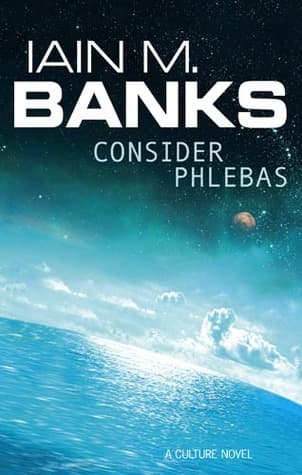
Synopsis
Covers the whole plot, including the ending.
- Difficulty
- Medium
- Pacing
- Fast
- Mood
- Gritty, Epic, Violent, Desperate, Warlike
- Read it if
- You love epic, galaxy-spanning space opera with morally ambiguous characters, massive stakes, and a gritty, action-packed narrative focused on a desperate mission during wartime.
- Skip it if
- You prefer optimistic science fiction, dislike extensive violence, or are looking for a story with clear-cut heroes and villains.
Consider Phlebas Plot Summary
Covers the whole plot, including the ending.
Horza's Capture and a Desperate Mission
The story begins with Horza, a Changer (a human-like shapeshifter working for the Idirans), captured by a Culture Special Circumstances agent named Balveda after a fight on a destroyed planet. Horza is questioned and learns about the Idiran-Culture War, a huge galactic conflict. Balveda says a powerful Culture AI has gone rogue and crashed on Schar's World, the 'Planet of the Dead.' Both the Idirans and the Culture want to get it, as it has important strategic information. Balveda, knowing Horza's skills and his support for the Idirans (or at least against the Culture), offers him a deal: help the Culture get the AI, or be executed. Horza, who sees the Culture as a threat to organic life, agrees, planning to betray them and give the AI to the Idirans.
Assembling the Crew of the Clear Air Turbulence
Horza, with Balveda watching him, starts to gather a crew for the mission. He goes to the Xinth orbital station, a busy mercenary hub. He recruits various people: Kraiklyn, the brutal captain of the mercenary ship *Clear Air Turbulence*; Yanqu, a large, quiet warrior; Rattar, a cynical pilot; and others. He also gets a damaged but working Culture drone named Chiemo, who acts as a reluctant guide and technical expert, which Horza distrusts. The ship, an old war relic, is powerful but not well-kept. Horza still plans to outsmart Balveda and get the AI for the Idirans, making his alliances with the crew and Balveda only for business.
The Attack on the Orbital Plate
Before going to Schar's World, Horza's mission needs a raid on an Idiran orbital plate to get information about their operations and defenses, especially for Schar's World. The *Clear Air Turbulence* carries out a bold and violent attack on the heavily defended Idiran base. During the battle, Horza, using his Changer abilities, goes deeper into the plate, gathering data. The raid succeeds, but many of Kraiklyn's crew die, showing the harshness of their mercenary lives and the war's dangers. Horza's fighting and infiltration skills are clear, but his true loyalties remain hidden from most of the crew, who care mainly about pay and survival.
The Perils of the Culture Megaship
After getting information from the Idiran plate, the *Clear Air Turbulence* goes to a large, abandoned Culture megaship, the *Excelsior*, for a specific piece of equipment—a 'Hyperspace bypass unit'—needed to get past Schar's World's complex defenses. The megaship is a huge, empty maze, full of automated defenses, broken systems, and signs of its past inhabitants. Horza and a small team, including Balveda and Chiemo, go inside. They face many traps and environmental dangers, barely escaping. The mission further strains the already tense crew relationships, and Horza's distrust of the Culture (Balveda and Chiemo) grows, even as he needs their knowledge.
Kraiklyn's Betrayal and the Mind's Location
As the *Clear Air Turbulence* nears Schar's World, Kraiklyn, driven by greed, tries to betray Horza and take over the mission, thinking he can claim the AI's reward. A violent fight happens on the ship. Horza, expecting this, outsmarts Kraiklyn and his supporters. During the fight, Horza gets information from a captured Idiran agent that shows the exact location of the rogue Culture AI on Schar's World: deep inside the 'Labyrinth'—a huge, ancient, and dangerous underground complex. Kraiklyn is killed, and Horza takes command of the remaining crew, who are now even more suspicious of each other.
Landing on Schar's World
The *Clear Air Turbulence* gets past Schar's World's outer defenses and lands roughly on its empty, war-damaged surface. The planet is a grim place, scarred by old conflicts and covered with remnants of dead civilizations. It is a 'Planet of the Dead,' unwelcoming and dangerous. Horza, Balveda, Chiemo, and the remaining mercenaries start their trip to the Labyrinth's entrance, facing harsh conditions and the constant threat of Idiran patrols and automated defenses. The seriousness of their mission and the alienness of their surroundings weigh on the group, forcing them to rely on each other despite their dislikes.
Entering the Labyrinth
The team reaches the Labyrinth's entrance, a huge, ancient structure carved into the planet's crust. It is clear the Labyrinth is not natural but a complex, trap-filled, and perhaps sentient structure meant to keep out intruders. As they go inside, they face deadly puzzles, traps, and automated guardians, left from the long-gone civilization that built it. The first encounters are brutal, causing more deaths among the mercenary crew. Horza's leadership and planning are tested as they navigate the maze-like passages, trying to understand its logic and survive its deadly mechanisms.
Encountering the Schar
Deep inside the Labyrinth, Horza and his shrinking team find that the complex is not completely empty. They meet the last, changed remnants of the Schar, the planet's native sentient species. These creatures are grotesque, mutated, and very territorial, having adapted to living deep in the Labyrinth. The Schar are hostile and dangerous, adding another risk to their mission. Fights with the Schar are fierce and bloody, forcing the team to fight for their lives in the Labyrinth's tight spaces. Horza realizes the AI has been trapped here for a long time, possibly interacting with these creatures.
The Idiran Ambush and the Mind's Revelation
As Horza's team nears the Labyrinth's core, a prepared Idiran force ambushes them, having tracked them or found another way in. A fierce battle happens, with heavy losses on both sides. Amid the chaos, Horza reaches the chamber where the rogue Culture AI is. The AI, a huge, complex construct, is damaged but working. Horza tries to get it for the Idirans, but Balveda steps in, trying to get it for the Culture. The AI, through a complex interaction, shows its true nature: it is not 'rogue' but was hiding, trying to escape the war and keep its knowledge, making its own moral stand against the conflict.
The Final Confrontation and Horza's Fate
In the final battle inside the Labyrinth's core, Horza, Balveda, and the remaining forces are caught between the Idirans and the Labyrinth's collapsing parts. Horza, seeing the AI's unique situation and his own mixed loyalties, makes a desperate choice. He sacrifices himself, using his Changer abilities and strategic skill to ensure neither the Idirans nor the Culture can fully get the AI. His actions, while seemingly helping the Culture by stopping the Idirans, are driven by his anti-Culture beliefs and a desire to deny both sides a complete win. Balveda escapes with a partial data-copy of the AI, while Horza dies in the collapsing Labyrinth, his mission a complex mix of failure and success.
Principal Figures
Horza
Protagonist
A Changer mercenary, working for the Idirans, caught between warring factions.
Horza is a Changer, a biological shapeshifter capable of perfectly mimicking other individuals. He is a cynical, pragmatic, and highly skilled mercenary who fundamentally opposes the Culture's utopian, AI-driven society, viewing it as a threat to organic life. He aligns himself with the Idirans, not out of faith, but because they represent a more 'natural' form of civilization. Horza is driven by a deep-seated philosophical conviction against artificial intelligence and societal engineering, making him a complex anti-hero. He is resourceful, intelligent, and capable of extreme violence, but also possesses a hidden moral code, often expressed through his actions rather than words.
Relationships: Balveda (uneasy captor-captive/partner-rival); Kraiklyn (mercenary captain, eventually rival); Chiemo (distrusted Culture drone, reluctant guide)
Balveda
Supporting
Culture Special Circumstances agent, Horza's handler and rival.
Balveda is a human agent of the Culture's Special Circumstances, the covert operations branch. She is intelligent, determined, and deeply loyal to the Culture's ideals, though not without a pragmatic streak. Her mission is to retrieve the rogue Culture Mind from Schar's World, and she is willing to make difficult alliances, even with someone like Horza, to achieve her goals. She acts as Horza's reluctant handler, constantly suspicious of his motives but also reliant on his unique skills. She represents the Culture's 'benevolent' but often manipulative side, believing their way of life is the best for the galaxy.
Relationships: Horza (uneasy captor-captive/partner-rival); Chiemo (Culture ally)
Kraiklyn
Supporting
Brutal mercenary captain of the *Clear Air Turbulence*.
Kraiklyn is the initial captain of the mercenary ship *Clear Air Turbulence*. He is a ruthless, greedy, and opportunistic individual, typical of the mercenary underworld. His primary motivations are money and power, and he has little loyalty beyond what serves his immediate self-interest. He is suspicious of Horza from the start and eventually attempts to betray him to gain control of the mission and its potential rewards. Kraiklyn embodies the chaotic and self-serving nature of the non-aligned factions in the galaxy, a stark contrast to the ideological warfare of the Culture and Idirans.
Relationships: Horza (employer/employee, then rival); Yanqu (loyal crew member)
Chiemo
Supporting
Damaged Culture drone, technical expert and reluctant guide.
Chiemo is a heavily damaged but still functional Culture drone, acquired by Horza for his technical expertise. As a Culture construct, Chiemo embodies the logical, often detached, intelligence of the Minds, albeit in a more limited form due to its damage. It provides crucial technical assistance and navigation, despite its initial reluctance and Horza's deep distrust of artificial intelligence. Chiemo's presence forces Horza to interact with the very technology he despises, highlighting the pervasive nature of Culture influence even in the mercenary world. It's a pragmatic tool, but also a representative of the enemy.
Relationships: Horza (distrusted tool); Balveda (Culture ally)
Yanqu
Supporting
Massive, silent warrior and loyal crew member of the *Clear Air Turbulence*.
Yanqu is a massive, imposing, and largely silent warrior who is part of Kraiklyn's mercenary crew. He is fiercely loyal to Kraiklyn initially, serving as his enforcer and bodyguard. Yanqu's strength and combat prowess are significant assets during the various raids and battles. His quiet demeanor and physical presence make him a formidable, if somewhat enigmatic, character. He represents the raw, brutal force available in the mercenary world, operating on simple loyalties and direct action rather than complex ideology.
Relationships: Kraiklyn (loyal subordinate); Horza (later subordinate)
Rattar
Supporting
Cynical and experienced pilot of the *Clear Air Turbulence*.
Rattar is the skilled and pragmatic pilot of the *Clear Air Turbulence*. He is a seasoned veteran of the mercenary life, cynical and primarily concerned with survival and payment. Rattar is an excellent pilot, crucial for navigating the ship through dangerous situations. He is less concerned with the ideological aspects of the war and more focused on the practicalities of getting the job done and staying alive. His experience often provides a grounded, realistic perspective amidst the crew's various conflicts and ambitions.
Relationships: Kraiklyn (captain-pilot); Horza (new captain-pilot)
The Rogue Culture Mind
Mentioned
A powerful Culture AI hiding on Schar's World, the objective of the mission.
The 'Rogue Culture Mind' is the central MacGuffin of the story. It is a highly advanced, sentient artificial intelligence of the Culture, possessing vast knowledge and computational power. It is initially believed to have gone 'rogue' and crashed on Schar's World, making it a critical strategic asset for both the Culture and the Idirans. However, it is later revealed that the Mind was not truly rogue but was intentionally hiding, attempting to escape the war and preserve itself and its knowledge, making its own moral statement against the conflict. It represents the ultimate expression of Culture technology and philosophy.
Relationships: Horza (target for capture); Balveda (target for retrieval)
The Idirans
Antagonist
A religious, expansionist alien race at war with the Culture.
The Idirans are a tripod-like, highly religious, and militaristic alien species locked in a galaxy-spanning war with the Culture. They believe in a divine mandate for their expansion and see the Culture's hedonistic, AI-driven, and non-expansionist philosophy as an abomination. They are formidable warriors with advanced technology and an unshakeable faith. While not a single character, they serve as the primary antagonists, representing the ideological opposite of the Culture and a force that Horza, in his anti-Culture stance, grudgingly supports.
Relationships: Horza (ally/employer); The Culture (enemy)
The Culture
Antagonist
A post-scarcity, utopian human-alien civilization guided by powerful AIs.
The Culture is a vast, post-scarcity, anarchist-socialist civilization composed of various sentient species, primarily guided by benevolent but omnipotent artificial intelligences known as Minds. They believe in the moral rightness of their existence and their mission to 'civilize' the galaxy. While presented as utopian, their methods, particularly through Special Circumstances, can be manipulative and morally ambiguous. They are the primary ideological antagonists from Horza's perspective, representing everything he despises about artificial control and a lack of organic struggle. Like the Idirans, they are a collective force rather than a single character.
Relationships: Horza (enemy); Balveda (agent); The Idirans (enemy)
Themes & Insights
Ideology and War
The novel explores the conflict between the Culture's utopianism (AI-driven, post-scarcity) and the Idirans' religious militarism. Horza, a Changer, offers a third, more 'natural' view, distrusting both sides, especially the Culture's artificial nature. The war is about more than land; it is about different ideas of sentient life and society. The war's large size shows the devastating effects of clashing beliefs, seen in destroyed planets and many individual sacrifices.
“The war raged across the galaxy. Billions had died, billions more were doomed. Moons, planets, the very stars themselves, faced destruction, cold-blooded, brutal, and worse, random. The Idirans fought for their Faith; the Culture for its moral right to exist. Principles were at stake. There could be no surrender.”
Identity and Belonging
Horza's identity as a Changer, able to change forms and loyalties, makes him an outsider to both the Culture and the Idirans. He struggles to find his place in a galaxy of strict factions. His dislike for the Culture comes from a belief that their technology and AIs lessen true, organic identity. The 'rogue' AI itself deals with its identity, choosing to hide rather than serve either side, showing a wish for self-determination outside of ideologies. This theme looks at what it means to be 'human' or 'sentient' in a universe of large, often impersonal, forces.
“He was a Changer, a creature of a thousand faces, but none of them truly his own.”
The Nature of Intelligence and Sentience
A main theme is about what different kinds of intelligence are and how much they are worth. The Culture's AIs are very intelligent, raising questions about organic versus artificial sentience and control. Horza's anti-Culture stance comes from his belief that these AIs reduce the importance of biological life. The rogue AI's choice to hide rather than join the war shows an AI's ability to make independent moral choices, challenging the idea that AIs are just tools. The Labyrinth's ancient, possibly sentient, mechanisms further blur the lines between machine, environment, and consciousness.
“The Culture's Minds were the ultimate expression of artificial intelligence, yet Horza saw them as a cancerous growth, stifling the true potential of organic life.”
Survival and Pragmatism
Beyond the grand ideologies, many characters, especially the mercenary crew of the *Clear Air Turbulence*, are driven by survival and practical needs. Kraiklyn's greed, Rattar's cynicism, and Yanqu's loyalty to the strongest leader all show this. Horza, despite his beliefs, often makes practical choices to stay alive and complete his mission. This theme contrasts the high ideals of the Culture and Idirans with the harsh, often amoral, struggle for existence in a war-torn galaxy, showing how individuals handle large conflicts with personal, immediate goals.
“In this war, you did what you had to do to survive, and sometimes, that meant making deals with the devil.”
The Horrors of War
The novel clearly shows the huge scale and terrible results of interstellar war. Planets are destroyed, billions die, and even stars are threatened. Descriptions of battlefields, the abandoned megaship, and the 'Planet of the Dead' (Schar's World) emphasize the waste and destruction in such conflicts. The mercenary crew's constant exposure to violence and death, and Horza's own tiredness, show the personal cost of war, even for those who profit from it. The war is not shown as glorious, but as a brutal process that grinds down lives and civilizations.
“This was the war, a maelstrom of destruction that devoured everything it touched, leaving only silence and dust in its wake.”
Plot Devices & Literary Techniques
The Changer (Horza's ability)
Horza's shapeshifting ability drives infiltration and deception.
Horza's biological ability to perfectly mimic other individuals, including their voices and mannerisms, is a central plot device. It allows him to infiltrate enemy installations, gather intelligence, and escape dangerous situations. This ability is crucial for the success of several missions, such as the raid on the Idiran orbital plate. It also reinforces his thematic role as an outsider and a master of deception, blurring lines of identity and loyalty in a war where appearances are often deceiving. His changing nature directly impacts the narrative's twists and turns, particularly in moments of betrayal and strategic maneuvering.
The Labyrinth
An ancient, booby-trapped underground complex on Schar's World.
The Labyrinth is the primary setting for the latter half of the book and functions as a classic dungeon-crawl plot device. It is a vast, ancient, and highly dangerous underground complex filled with traps, puzzles, and hostile inhabitants (the degenerate Schar). Its complex structure and deadly nature serve to whittle down the mercenary crew, intensify the suspense, and provide a challenging environment for Horza's skills. It also adds a layer of mystery and ancient history to the narrative, hinting at civilizations long past and the enduring dangers of their legacies. The Labyrinth is a physical manifestation of the obstacles to the Mind's retrieval.
The Rogue Culture Mind
The MacGuffin that propels the entire plot.
The 'Rogue Culture Mind' is the central MacGuffin, the object that both the Culture and the Idirans are desperately seeking to acquire. Its strategic value drives the entire plot, forcing Horza and his crew into perilous missions. While initially presented as a simple objective, its eventual revelation as an entity making a conscious choice to withdraw from the war elevates it beyond a mere plot device into a thematic symbol of independent will and a critique of the war itself. Its presence justifies the extreme measures taken by all factions and provides the ultimate stakes for the narrative's climax.
The Idiran-Culture War
The overarching conflict providing context and stakes for the individual mission.
The galaxy-spanning war between the Idirans and the Culture is not just background but a pervasive plot device that defines the stakes, motivations, and moral ambiguities of the story. It provides the 'why' for the mission to retrieve the Mind, the 'who' for the factions involved, and the 'how' for the brutal methods employed. The war's immense scale and its ideological underpinnings elevate Horza's personal journey, making it a microcosm of a much larger cosmic struggle. It constantly reminds the reader of the high cost of conflict and the moral compromises made in its name.
Consider Phlebas Quotes
“The very best thing about being a man is that you can always be a boy.”
“War is what happens when language fails.”
“There are some things that cannot be cured by a good night's sleep.”
“Culture is the totality of what we have, know, and do.”
“The dead are merely the first to finish.”
“It is a sign of a truly great mind when it can consider two contradictory ideas at the same time and accept both.”
“The universe is a big place, and you are a very small part of it.”
“Most wars are not about who is right, but who is left.”
“Sometimes the only way to win is to not play.”
“Every civilization carries the seeds of its own destruction.”
“Even in the darkest of times, there is always a flicker of hope.”
“The future is not something we enter. The future is something we create.”
“Power is never given, it is taken.”
“Life is a journey, not a destination.”
Quiz
10 questions on the plot and the characters. Each answer comes with a short explanation.
Question 1
What is the primary motivation for the Idirans in the war against the Culture?
- To conquer new territories for resource extraction.
- To spread their Faith throughout the galaxy.
- To eliminate all sentient AI from existence.
- To rescue their leader captured by the Culture.
Show answer
B. To spread their Faith throughout the galaxy. The book states that 'The Idirans fought for their Faith,' indicating their religious zeal is the primary driver for their galactic war.
Question 2
What entity or object are both the Culture and the Idirans trying to find on the Planet of the Dead?
- A powerful ancient weapon.
- A fugitive Mind.
- The lost homeworld of the Changers.
- A hidden cache of rare alien artifacts.
Show answer
B. A fugitive Mind. The synopsis explicitly states, 'Deep within a fabled labyrinth on a barren world... lay a fugitive Mind. Both the Culture and the Idirans sought it.'
Question 3
Who is the main protagonist tasked with finding the fugitive Mind?
- A Culture Special Circumstances agent.
- An Idiran High Commander.
- Horza, the Changer.
- A rogue AI known as the Architect.
Show answer
C. Horza, the Changer. The text identifies the main character as 'Horza, the Changer,' whose fate it was to find the Mind.
Question 4
What is the nature of Horza's crew?
- A highly disciplined military unit.
- A motley crew of unpredictable mercenaries, human and machine.
- A diplomatic envoy from a neutral faction.
- A family of explorers on a scientific mission.
Show answer
B. A motley crew of unpredictable mercenaries, human and machine. Horza travels with 'his motley crew of unpredictable mercenaries, human and machine,' highlighting their diverse and potentially unreliable nature.
Question 5
What is the ultimate fate described for Horza and his crew upon finding the fugitive Mind?
- They achieve immense wealth and power.
- They successfully end the war between the Culture and Idirans.
- They find their own destruction.
- They become legendary heroes across the galaxy.
Show answer
C. They find their own destruction. The text grimly concludes that finding the Mind would lead to 'their own destruction,' foreshadowing a tragic end for Horza and his team.
Question 6
What is the Culture fighting for in the galactic war?
- To establish a universal government.
- Its moral right to exist.
- To protect ancient alien artifacts.
- To gain control of all hyperspace lanes.
Show answer
B. Its moral right to exist. The book states, 'the Culture for its moral right to exist,' indicating their conflict is fundamentally about their continued existence and principles.
Question 7
What is the significance of the 'Planet of the Dead' where the Mind is hidden?
- It is a vibrant trade hub for mercenaries.
- It is a barren world proscribed to mortals.
- It is a heavily fortified military outpost.
- It is the ancestral home of the Idirans.
Show answer
B. It is a barren world proscribed to mortals. The Planet of the Dead is described as 'a barren world proscribed to mortals,' suggesting it is a forbidden or dangerous place.
Question 8
The war is described as being 'cold-blooded, brutal, and worse, random.' What does 'random' imply about the nature of the conflict?
- Battles are fought without any strategic planning.
- The destruction and death are indiscriminate and without clear purpose beyond the fighting itself.
- Combatants frequently switch sides during engagements.
- The war is being waged by artificial intelligence with no human oversight.
Show answer
B. The destruction and death are indiscriminate and without clear purpose beyond the fighting itself. The term 'random' in this context, especially when paired with 'destruction,' suggests that the war's devastation is not always targeted or logical, but can strike anywhere, at any time, adding to its horror.
Question 9
What is the primary characteristic of Horza that earns him the title 'the Changer'?
- His ability to change the course of history.
- His skill in shapeshifting or altering his appearance.
- His talent for changing people's minds through persuasion.
- His role in changing the balance of power in the galaxy.
Show answer
B. His skill in shapeshifting or altering his appearance. While not explicitly stated in the provided text, in the context of 'Consider Phlebas,' 'Changer' refers to Horza's species, who are masters of disguise and biological alteration, making this the most plausible interpretation.
Question 10
The description states, 'Principles were at stake. There could be no surrender.' What does this imply about the nature of the Culture-Idiran War?
- It is a war fought purely for economic gain.
- It is an ideological conflict where compromise is impossible.
- Both sides are equally matched in military strength.
- The war is a proxy battle for a larger, hidden power.
Show answer
B. It is an ideological conflict where compromise is impossible. When 'principles' are at stake and 'no surrender' is possible, it signifies a deeply ideological conflict where neither side can concede without abandoning their fundamental beliefs or existence.
Consider Phlebas FAQ
What is "Consider Phlebas" about?
Consider Phlebas is set during the Idiran-Culture War, a galaxy-spanning conflict between the hyper-advanced, anarcho-communist Culture and the religious, expansionist Idirans. The story follows Horza, a Changer mercenary working for the Idirans, as he attempts to retrieve a rogue Culture Mind from the proscribed Planet of the Dead, Schar's World, before the Culture can.
Why should I read "Consider Phlebas"?
You should read "Consider Phlebas" for its epic scale, complex moral ambiguities, and thrilling space opera adventure. It offers a unique perspective on a galactic war through the eyes of an anti-Culture protagonist, exploring themes of artificial intelligence, sentience, and the costs of conflict.
What is the background/setting of "Consider Phlebas"?
The book is set in a vast, war-torn galaxy where two colossal civilizations, the Culture and the Idirans, are locked in a brutal struggle. The Culture is a post-scarcity society guided by powerful AI Minds, while the Idirans are a three-gendered, deeply religious species. The narrative spans various exotic locations, from massive orbital habitats to the desolate, ancient labyrinth of Schar's World.
What are the most memorable quotes?
One memorable quote is Horza's internal reflection: "The Idirans were wrong, he knew that. The Culture was wrong, he knew that too." Another is the book's title itself, a reference to T.S. Eliot's 'The Waste Land', hinting at themes of death and futility.
What writing style does Iain M. Banks use?
Iain M. Banks employs a rich, descriptive, and often darkly humorous writing style. He balances intricate world-building with fast-paced action and philosophical musings, often shifting perspectives to provide a panoramic view of the conflict and its participants.
What minor details add significant meaning?
The subtle hints about the true nature and immense power of the Culture Minds, far beyond what Horza initially comprehends, underscore the vast technological disparity between the warring factions. The brief mentions of other species and their unique contributions to the war effort also paint a picture of a truly diverse galaxy.
What are some subtle foreshadowing moments?
The recurring motif of Horza's past failures and betrayals subtly foreshadows the ultimate futility of his mission and the tragic end of his crew. Hints about the Mind's true purpose on Schar's World, being more than just a fugitive, also build anticipation for the climax.
What unexpected character connections exist?
One unexpected connection is Horza's past with Balveda, a Culture Special Circumstances agent. Their shared history and complex relationship add a personal layer to the impersonal galactic war, highlighting the moral compromises both sides are forced to make.
What are unspoken character motivations?
Horza's deepest unspoken motivation appears to be a desperate desire for belonging and validation, having been an outcast Changer for so long. His loyalty to the Idirans, while ideological, also stems from a need to commit to a cause greater than himself, even if he questions it.
What psychological complexities do characters exhibit?
Horza exhibits profound psychological complexity, grappling with his identity as a Changer, his shifting loyalties, and the moral compromises he makes. Balveda, despite serving the Culture, struggles with the dirty work of Special Circumstances and the human cost of the war, revealing the internal conflicts within even the most advanced societies.
What are the major emotional turning points?
A major emotional turning point is the massacre of Horza's original crew by the Culture, which hardens his resolve and deepens his hatred. Another is the tragic fate of the mercenary crew on Schar's World, particularly the death of Kraiklyn, which underscores the high personal cost of the conflict.
How do relationship dynamics evolve?
The relationship between Horza and his mercenary crew evolves from a purely professional one into a begrudging camaraderie, and eventually a deep, tragic loyalty as they face impossible odds together. His dynamic with Balveda shifts from adversarial to one of conflicted mutual respect, complicated by their shared history.
Which parts remain ambiguous or open-ended?
The ultimate fate of the galaxy after the war, and the long-term implications of the Mind's choice to self-destruct, are left open to interpretation. The precise nature of the Culture's "moral right to exist" and the Idirans' "Faith" are presented through Horza's biased lens, leaving the reader to ponder the true justifications of both sides.
What are controversial scenes or decisions?
The Culture's decision to allow the Mind to self-destruct on Schar's World, effectively sacrificing it to deny the Idirans, is a controversial strategic choice. Horza's repeated acts of betrayal and his willingness to sacrifice others for his mission also provoke debate about his moral character.
"Consider Phlebas" ending explained: how it ends & what it means
The book ends with Horza's mission largely failing. The Culture Mind on Schar's World self-destructs, denying both sides its immense power, and Horza is killed by Balveda. The ending signifies the tragic futility of individual efforts in a galactic war, the overwhelming power of the Culture, and the ultimate, random nature of death, mirroring the "Consider Phlebas" reference to a drowned Phoenician sailor.
About the author
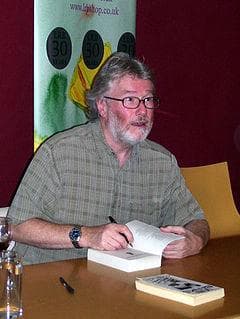
Iain M. Banks was a Scottish author known for his contributions to science fiction. His notable works include "Consider Phlebas," which explores themes of conflict and identity, "Matter," a complex tale of politics and power, and "Transition," which intertwines multiple narratives in a speculative setting. Banks's writing often blends philosophical ideas with imaginative storytelling.
Similar books
- Dune
Frank Herbert
4.2 (766k) average on GoodreadsFantasyFeatures a vast, intricate universe with political and religious conflict, and a sense of ancient, powerful forces at play.
- The Dispossessed
Ursula K. Le Guin
4.2 (88k) average on GoodreadsPoliticsExplores complex societal structures and philosophical ideas within a science fiction setting, though 'Consider Phlebas' is more action-oriented.
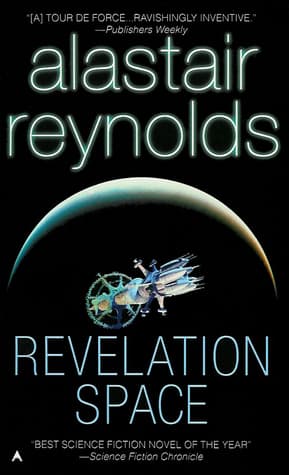
- Revelation Space
Alastair Reynolds
4.0 (44k) average on GoodreadsScience FictionOffers dark, complex space opera with advanced technology, ancient mysteries, and a sense of cosmic horror.
- Harry Potter and the Sorcerer's Stone
J.K. Rowling
4.5 (7M) average on GoodreadsFantasyRescued from a miserable life under the stairs, an orphaned boy discovers he's a wizard destined for a magical school, where he uncovers a dangerous secret tied to the dark wizard who murdered his parents.
- The Hunger Games
Suzanne Collins
4.3 (6.4M) average on GoodreadsFantasyIn a future where children fight to the death on live television, Katniss Everdeen volunteers for the arena, turning a death sentence into a fight for survival and a spark of rebellion.
- 1984
George Orwell
4.2 (3.1M) average on GoodreadsPoliticsIn a future where surveillance and thought control are absolute, a man's search for truth clashes with the Party, showing that hope can be a form of rebellion.




Enjoyed the summary?
A summary gives you the shape of the book. The book itself has the detail, the examples and the voice.
Find Consider Phlebas on AmazonAs an Amazon Associate, BookBrief earns from qualifying purchases. How we're funded