
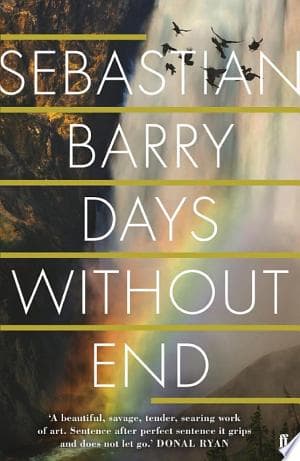
Synopsis
Covers the whole plot, including the ending.
- Difficulty
- Medium
- Pacing
- Moderate
- Mood
- Melancholy, Poignant, Brutal, Tender, Historical
- Read it if
- You appreciate beautifully written historical fiction with a focus on character relationships, set against a backdrop of war and societal change, and don't shy away from difficult themes.
- Skip it if
- You prefer fast-paced plot-driven narratives, or are sensitive to graphic descriptions of war and violence.
Days Without End Plot Summary
Covers the whole plot, including the ending.
Fleeing Famine and Finding John Cole
Thomas McNulty, recalling his life as an old man, describes his difficult childhood in County Sligo, Ireland, during the Great Famine. Orphaned and desperate, he escapes starvation and violence, eventually making his way to America. He lands in Missouri as a young boy with nothing. There, in a rough saloon, he meets John Cole, another young, displaced boy. Their first meeting is marked by shared loneliness and an unspoken understanding. They quickly form a strong bond, driven by their need for companionship and survival in a harsh new world, becoming each other's only family.
Cross-Dressing and Show Business
To survive in the rough frontier towns, Thomas and John take on various jobs. Their most lasting and profitable work comes from performing in saloons, where they dress as women to entertain miners and soldiers. Thomas becomes 'Miss Fanny' and John becomes 'Miss Jenny.' This act not only provides income but also a strange kind of protection. They develop distinct feminine personas, embracing the theatricality. This period strengthens their bond as they navigate the complexities of their gender-bending roles together, often experiencing both the humor and the dangers of their disguise.
Enlisting in the US Army
Despite their success in the saloons, life as traveling performers is unstable and dangerous. Seeking a more structured existence and perhaps a sense of belonging, Thomas and John decide to enlist in the US Army. They are barely seventeen, still boys, but the army offers regular food, pay, and a clear purpose, however brutal. They join together, ensuring they stay by each other's side. This decision marks a turning point, trading the relative freedom of their previous life for the strict discipline and dangers of military service, preparing them for the horrors of the Indian Wars.
The Indian Wars and Brutality
As soldiers, Thomas and John are sent to fight in the Indian Wars. They are part of cavalry units involved in skirmishes and massacres against various Native American tribes, including the Sioux. Thomas recounts the terrible violence, the burning of villages, and the senseless killing of men, women, and children. He describes how the enemy is dehumanized and the psychological toll it takes on the soldiers. Despite their disgust, they are involved in these acts, forced to follow orders in a war they barely understand, struggling to make sense of the horrors they commit.
The Arrival of Winona
During a brutal campaign against a Sioux village, Thomas and John find a young Native American girl, Winona, orphaned and traumatized by the violence. Against military rules and common prejudice, they take her in. Winona is a quiet, watchful child, a direct victim of the war they are fighting. Her presence changes their dynamic, awakening a parental instinct in both men. They commit to protecting her, seeing her as their own daughter, a symbol of innocence in their brutal world, and a chance for a different future.
The Civil War Begins
The Indian Wars eventually lead to a larger and bloodier conflict: the American Civil War. Thomas and John, along with Winona, are caught up in this national disaster. They enlist, or are conscripted, into the Union Army, again fighting side by side. The Civil War is on a much larger scale, with battles of unprecedented ferocity and casualties. This new war tests their endurance and their bond even further, forcing them to face the grim realities of large-scale combat and the moral uncertainties of fighting their own countrymen.
Life as Union Soldiers
Serving in the Union Army, Thomas and John experience the full horror of the Civil War. They take part in major battles, enduring starvation, disease, and the constant threat of death. Thomas describes the squalor of camp life, the terror of charges, and the sight of countless dead and wounded. They witness the deep divisions within the country and the great suffering of both sides. Winona stays with them, a constant reminder of their shared humanity and their hope for a future beyond the war. Their bond strengthens under the immense pressure, as they rely on each other for survival and emotional support.
Post-War Life and Settling Down
Thomas and John miraculously survive the Civil War. With Winona, they seek to establish a quiet, stable life. They settle in a small town in Tennessee, opening a photography studio, a skill Thomas learned during the war. They present themselves as a conventional family, with Thomas and John as Winona's parents. This period brings a fragile sense of peace and home life. They try to fit into the community, hiding the true nature of their relationship and their past, hoping to find acceptance and build a future for their unconventional family.
The Threat of Exposure and Prejudice
Despite their efforts to live a quiet life, their past and their unconventional family structure constantly threaten their peace. The fact that Winona is Native American, and their unspoken romantic relationship, makes them vulnerable in a society full of prejudice. Whispers and suspicions begin in the town. They live in constant fear of discovery, knowing that exposure could lead to their ostracization, or worse, the separation of their family. This tension highlights the societal pressures and the moral rules of the post-Civil War era.
A Life of Quiet Love and Enduring Hope
Throughout their lives, from the Irish famine and the American frontier to the Indian Wars and the Civil War, the steady love between Thomas and John, and their shared devotion to Winona, remains the center of their existence. Thomas, as the narrator, reflects on the beauty and resilience of their bond. Their love is not always spoken but deeply felt, a quiet rebellion against historical upheaval and personal trauma. Their story shows the lasting power of family, however unconventionally formed, and the human capacity for love and hope even in the darkest times.
Days Without End Characters
Thomas McNulty
Protagonist
The narrator, an Irish immigrant who finds love and family in the American frontier.
Thomas McNulty is an Irish immigrant, orphaned by the Great Famine, who flees to America. He is the novel's narrator, recounting his life in vivid, often poetic, prose. Thomas is observant, sensitive, and deeply empathetic, despite the horrors he witnesses and participates in. He possesses a pragmatic resilience, adapting to survive in brutal circumstances, whether performing as 'Miss Fanny' or fighting in wars. His driving force is his profound love for John Cole and later, Winona, which he views as the only true constant in a chaotic world. He seeks connection and belonging above all else.
Relationships: John Cole (Life partner, soulmate, fellow soldier, co-parent); Winona (Adopted daughter, source of hope and love)
John Cole
Protagonist
Thomas McNulty's lifelong companion, a quiet and steadfast presence.
John Cole is Thomas McNulty's inseparable companion and lover, met in Missouri. He is often portrayed as more reserved and stoic than Thomas, but his actions reveal a deep loyalty, courage, and tenderness. He is a formidable presence in battle and a gentle partner in their domestic life. Like Thomas, he has a traumatic past that is hinted at but never fully revealed, contributing to his quiet strength. John's unwavering presence and shared commitment to Winona provide stability and comfort for Thomas, forming the bedrock of their unconventional family.
Relationships: Thomas McNulty (Life partner, soulmate, fellow soldier, co-parent); Winona (Adopted daughter, source of hope and love)
Winona
Supporting
A young Sioux girl adopted by Thomas and John, symbolizing innocence and hope.
Winona is a young Sioux girl, orphaned by the Indian Wars, who is adopted by Thomas and John. She is initially silent and traumatized, a stark reminder of the brutality of the conflict. Her presence transforms Thomas and John's lives, awakening their paternal instincts and providing them with a profound sense of purpose and a future beyond war. She represents innocence, resilience, and the possibility of new beginnings. Her existence highlights the prejudice of the era, as her mixed heritage and unconventional family draw scrutiny, yet she remains a powerful symbol of their shared love and hope.
Relationships: Thomas McNulty (Adoptive father); John Cole (Adoptive father)
Captain Lige
Supporting
A Union Army officer who shows a surprising degree of tolerance and understanding.
Captain Lige is an officer in the Union Army under whom Thomas and John serve. He is a pragmatic and observant man who, despite the rigid military environment, seems to possess a more open mind than many of his peers. He implicitly understands the unique bond between Thomas and John, and their unconventional guardianship of Winona, often turning a blind eye or offering quiet support. He represents a rare glimmer of understanding and humanity within the brutal structures of war, providing a measure of protection for the trio.
Relationships: Thomas McNulty (Subordinate soldier, recipient of quiet support); John Cole (Subordinate soldier, recipient of quiet support)
The Irish
Mentioned
The collective memory of Thomas's homeland and the famine that drove him away.
The Irish, as a collective, represent Thomas's origins and the traumatic experiences of his childhood. The Great Famine and the subsequent emigration are foundational to his character, shaping his resilience and his deep need for connection. While no specific Irish characters play a direct role beyond his early memories, the pervasive shadow of his homeland's suffering informs his understanding of hardship, displacement, and the desperate search for a better life. It is the trauma of being Irish in a time of famine that drives him to America and ultimately to John Cole.
The Sioux
Mentioned
The Native American tribe targeted during the Indian Wars, from which Winona originates.
The Sioux represent the indigenous populations violently displaced and massacred during the Indian Wars, a conflict in which Thomas and John were complicit. While not individual characters, the Sioux as a people are central to the narrative through Winona, who is a direct survivor of their suffering. Their culture and traditions are largely seen through Winona's quiet presence and the remnants of her heritage. They embody the profound injustice and human cost of westward expansion and colonial violence, serving as a constant reminder of the moral complexities of the protagonists' past.
Days Without End Themes
Love and Family in Unconventional Forms
The novel explores how love and family can exist outside traditional societal norms. Thomas and John's relationship, openly romantic and committed, is central to the story. Their decision to adopt Winona, an orphaned Native American girl, further redefines 'family' in a time of strict social rules. Their bond shows that love goes beyond gender, race, and societal expectations, offering comfort and meaning amid war and prejudice. This theme is clear in their quiet home life after the wars, where they try to create a safe place for their unique family.
“What is a man to do when he finds another man to love? Just love him. Just love him.”
The Brutality and Absurdity of War
Sebastian Barry clearly shows the brutality and absurdity of both the Indian Wars and the American Civil War. Thomas McNulty's narration spares no detail in describing massacres, starvation, disease, and the psychological cost of combat. The senselessness of the violence, especially against Native American women and children, is a recurring idea. The characters are forced to commit and witness terrible acts, highlighting how war dehumanizes and the moral compromises soldiers must make. The contrast between war's horrors and the quiet home life Thomas and John desire emphasizes this theme.
“War is a great destroyer of boys. It takes a boy and it turns him into a man, and then it kills him.”
Identity and Performance
Identity, both personal and performed, is central to the novel. Thomas and John's early years are defined by their cross-dressing performances as 'Miss Fanny' and 'Miss Jenny,' where they take on female roles for survival and entertainment. This experience blurs gender lines and suggests that identity can be fluid and shaped by circumstances. Later, they act as conventional parents for Winona, hiding their true relationship to fit into society. This theme looks at the masks people wear, not just to survive, but also to define who they are and who they can be in a restrictive world.
“We were the wives of each other, in a way, on the stage. And then we were just ourselves again, two boys.”
Memory and Storytelling
The entire novel is a flashback, with an elderly Thomas McNulty telling his life story. This highlights how memory is subjective and how storytelling can shape and preserve one's past. Thomas's poetic, often rambling, narration emphasizes emotional truth over strict chronology. He revisits moments of joy and suffering, trying to understand a life lived through extraordinary times. The act of telling his story is an act of love and remembrance, ensuring that his experiences, and those of John and Winona, are not forgotten.
“A man's life is just a story, and if he doesn't tell it, who will?”
Plot Devices & Literary Techniques
First-Person Retrospective Narration
The entire story is told from the perspective of an elderly Thomas McNulty looking back on his life.
This device allows for a deeply personal and intimate account of the events. Thomas's voice is distinct, poetic, and often melancholic, providing insight into his emotional state as he reflects on his past. It also allows for foreshadowing and reflection, as the narrator can comment on the significance of events with the wisdom of hindsight. The retrospective nature creates a sense of profound memory and loss, emphasizing the enduring impact of his experiences and his enduring love for John Cole and Winona.
Cross-Dressing as a Survival Mechanism
Thomas and John perform as women in saloons to earn a living.
Initially a means of survival in the rough frontier towns, the act of cross-dressing serves multiple functions. It provides income, offers a strange form of protection, and allows Thomas and John to explore fluid identities. This device introduces themes of gender performance and societal expectations, highlighting how they adapt to circumstances. It also subtly reinforces their bond, as they share this unusual and intimate experience, further blurring the lines of conventional masculinity in a period of rigid gender roles.
The Found Family Trope
Thomas and John, both orphans, create their own family unit with each other and later, Winona.
This device emphasizes the human need for connection and belonging, especially for characters who have lost their biological families. Thomas and John's bond, forged out of mutual need and love, forms the initial 'found family.' The adoption of Winona expands this unit, creating a powerful symbol of hope and resilience against the backdrop of war and societal prejudice. It underscores the idea that family is defined by love and commitment, rather than by blood or conventional structures, providing a sanctuary in a brutal world.
Historical Allusions
The narrative is deeply embedded in specific historical events: the Irish Famine, the Indian Wars, and the American Civil War.
These historical allusions provide a rich and authentic backdrop for the personal story of Thomas and John. They ground the narrative in real-world events, giving weight and context to the characters' struggles and triumphs. The wars, in particular, serve as catalysts for much of the plot and reveal the moral complexities of the era. By placing the intimate story of an unconventional family within these grand historical moments, the novel highlights how personal lives are shaped by, and sometimes defy, the forces of history.
Days Without End Quotes
“Maybe it was all for nothing, all this trying to make something good of it, but it had been a good nothing, in the end.”
“We were just two young lads, and the world was a wide and dangerous place, and we were trying to make our way.”
“Love is a strange and mighty thing, it can make you do things you never thought you'd do.”
“A man could be a woman, and a woman could be a man, if the heart was in the right place.”
“The dead don't care about your sorrow, they just want to be left in peace.”
“Sometimes the only way to keep living is to forget some things, and remember others.”
“War makes monsters of us all, even the ones who try to be good.”
“There's a terrible beauty in the wildness of this land, and a terrible sadness too.”
“We were just trying to find a place where we could be ourselves, without fear.”
“The past is never really past, it just waits for you in the shadows.”
“You can lose everything, but if you have one true heart beside you, you have something still.”
“Life is a long road, full of twists and turns, and you never know what's waiting for you around the bend.”
“We were just trying to live our days without end, in a world that seemed determined to end them.”
Quiz
10 questions on the plot and the characters. Each answer comes with a short explanation.
Question 1
What is the primary reason Thomas McNulty and John Cole join the US army in the 1850s?
- They were seeking adventure and glory.
- They were conscripted against their will.
- They had fled terrible hardships and were looking for a new start.
- They wanted to fight for a specific political cause.
Show answer
C. They had fled terrible hardships and were looking for a new start. The book description explicitly states that Thomas and John 'Having both fled terrible hardships' signed up for the army.
Question 2
What is the name of the young Indian girl who significantly impacts Thomas and John's lives?
- Winona
- Little Dog
- Morning Star
- Blue Bird
Show answer
B. Little Dog The young Indian girl whom Thomas and John adopt and raise is named Little Dog.
Question 3
In which two major American conflicts do Thomas McNulty and John Cole fight?
- The Revolutionary War and the War of 1812
- The Indian Wars and the Civil War
- The Mexican-American War and the Spanish-American War
- World War I and World War II
Show answer
B. The Indian Wars and the Civil War The book description clearly states they 'fight in the Indian Wars and the Civil War'.
Question 4
What is the nature of the relationship between Thomas McNulty and John Cole?
- They are distant cousins who meet in the army.
- They are comrades-in-arms who eventually become lifelong partners.
- They are rivals who constantly compete for recognition.
- They are master and servant, with John serving Thomas.
Show answer
B. They are comrades-in-arms who eventually become lifelong partners. Thomas McNulty and John Cole develop a deep, enduring romantic relationship, becoming lifelong partners and a family unit.
Question 5
Which of the following best describes the narrative voice of 'Days Without End'?
- Third-person omniscient, detached and objective.
- First-person, from the perspective of Thomas McNulty.
- First-person, alternating between Thomas McNulty and John Cole.
- A series of letters written by various characters.
Show answer
B. First-person, from the perspective of Thomas McNulty. The novel is narrated entirely in the first person by Thomas McNulty, giving readers intimate access to his thoughts and experiences.
Question 6
What unique aspect of Thomas McNulty and John Cole's personal lives do they often maintain, even while serving in the army?
- They secretly practice a forbidden religion.
- They frequently cross-dress and perform in theatrical shows.
- They maintain a hidden stash of gold from their past.
- They write and publish anonymous anti-war pamphlets.
Show answer
B. They frequently cross-dress and perform in theatrical shows. Thomas and John often perform in drag, particularly for entertainment in army camps and later in theatre, which is a significant part of their identity and relationship.
Question 7
What overarching theme is explored through Thomas McNulty's experiences of love and family amidst the violence of war?
- The futility of all human connection.
- The enduring power of love and chosen family in the face of brutality.
- The inevitable corruption of innocence by conflict.
- The transient nature of happiness in a chaotic world.
Show answer
B. The enduring power of love and chosen family in the face of brutality. Despite the horrors they witness and participate in, Thomas's narrative emphasizes the 'vivid and filled with wonder' aspects of their days, particularly through his bond with John and Little Dog, highlighting love's resilience.
Question 8
Where does Thomas McNulty originally hail from before joining the army?
- Ireland
- England
- Canada
- Scotland
Show answer
A. Ireland Thomas McNulty is an Irish immigrant, a detail revealed early in the novel as he recounts his difficult past.
Question 9
What significant personal sacrifice does Thomas McNulty make to ensure Little Dog's safety and well-being during a particularly dangerous period?
- He deserts the army, risking execution.
- He temporarily separates from John Cole, leaving Little Dog in his care.
- He pretends to be her biological father and hides her identity, enduring great personal hardship.
- He returns her to her original tribe, believing it's for the best.
Show answer
C. He pretends to be her biological father and hides her identity, enduring great personal hardship. During a period of great danger for Native Americans, Thomas disguises Little Dog as a boy and claims her as his biological son, enduring significant personal risk and hardship to protect her.
Question 10
What is the significance of the title 'Days Without End' in the context of the novel's themes?
- It refers to the endless cycle of war and violence.
- It highlights the eternal nature of the American landscape.
- It reflects the timeless and enduring quality of love, memory, and the bond between the characters.
- It describes the seemingly unending periods of boredom between battles.
Show answer
C. It reflects the timeless and enduring quality of love, memory, and the bond between the characters. The title 'Days Without End' speaks to the enduring nature of Thomas's love for John and Little Dog, the lasting impact of his memories, and the continuous journey of their chosen family, transcending the finite nature of individual days.
Days Without End FAQ
What is the central premise of 'Days Without End'?
The novel follows the extraordinary life of Thomas McNulty, an Irish immigrant who enlists in the U.S. Army in the 1850s, fighting in both the Indian Wars and the Civil War. It chronicles his deep, enduring love for his fellow soldier, John Cole, and their journey through immense violence and unexpected moments of tenderness, ultimately forming an unconventional family with a young Sioux girl.
Who are Thomas McNulty and John Cole, and what is their relationship?
Thomas McNulty is the primary narrator, an Irish boy who fled famine and poverty. John Cole is his close companion and lover, a fellow orphan he meets upon enlisting. Their relationship is the emotional core of the book, characterized by profound loyalty, mutual protection, and deep romantic love that defies the harsh societal norms of their time, enduring through all their shared traumas.
What historical conflicts do Thomas and John participate in?
Thomas and John are soldiers first in the brutal Indian Wars against various Native American tribes, including the Lakota Sioux, experiencing horrific violence and committing atrocities. Later, they fight for the Union Army in the American Civil War, witnessing the carnage of battles like Stones River and the siege of Vicksburg, which further shapes their understanding of humanity and survival.
How does the young Sioux girl, Winona, become part of Thomas and John's lives?
Winona is found as an orphaned survivor of a massacre during the Indian Wars, a child of the very conflicts Thomas and John participated in. They rescue her and take her in, forming an unconventional family unit. Her presence brings a profound sense of purpose and a fragile hope for a future beyond the violence to their lives.
What role does cross-dressing play for Thomas McNulty, particularly during his time in California?
Thomas frequently cross-dresses, performing as a woman in saloons and theaters for entertainment and survival, particularly when he and John Cole are prospecting in California. This act is not merely a disguise but an expression of his fluid identity and an exploration of gender roles that offers him a form of freedom and even protection in a rough, masculine world, allowing him to embody a different self.
Are there any subtle connections to Sebastian Barry's other novels or characters?
Yes, 'Days Without End' is part of Barry's 'McNulty Family Cycle.' Thomas McNulty is an ancestor of Eneas McNulty from 'The Whereabouts of Eneas McNulty' and features in 'Old God's Time.' This familial lineage connects his story to a broader narrative of Irish history and the diaspora, suggesting a legacy of resilience and struggle that spans generations within Barry's fictional universe.
What is the significance of Thomas's internal monologue and his use of elevated language, despite his background?
Thomas's internal monologue is marked by poetic, often lyrical language, which stands in stark contrast to his brutal experiences and humble origins. This reflects his innate sensitivity, his capacity for wonder, and his attempt to find beauty and meaning amidst horror. It also serves as a coping mechanism, allowing him to process and articulate the unspeakable, transforming trauma into a narrative of survival and love.
How does the novel explore the concept of 'family' in unconventional ways?
The novel radically redefines family through Thomas, John, and Winona. Their bond is forged not by blood or societal norms, but by shared trauma, unconditional love, and mutual care. They create their own sanctuary and sense of belonging in a world that offers them little, illustrating that family is a chosen, resilient construct built on devotion and survival, regardless of traditional definitions.
In what ways do Thomas and John cope with the immense violence they witness and perpetrate?
Thomas and John cope through their unwavering bond, their shared humor, and their ability to find moments of tenderness and beauty even in the most horrific circumstances. They also compartmentalize and suppress, but their love for each other and for Winona ultimately provides a purpose that transcends the violence, offering a path towards healing and a future.
How does the novel address the moral complexities of the Indian Wars, particularly from the perspective of the soldiers involved?
The novel unflinchingly portrays the brutality and moral ambiguity of the Indian Wars. Thomas and John are complicit in atrocities, yet they also display compassion and question their actions. It highlights the dehumanizing effects of war on all sides, showing how ordinary men can be drawn into horrific acts while still retaining glimmers of humanity and remorse, challenging simplistic judgments.
What is the significance of the novel's title, 'Days Without End'?
The title 'Days Without End' reflects the seemingly endless nature of the conflicts Thomas and John endure, the relentless cycle of violence, and their perpetual struggle for survival. More profoundly, it signifies the enduring, timeless quality of their love and commitment to each other and Winona, suggesting that their bond transcends the finite boundaries of their difficult lives, offering a form of immortality.
How does the landscape and natural world function in the narrative?
The American landscape, from the vast plains to the rugged mountains, serves as a powerful backdrop, often mirroring the characters' internal states and the grandeur and brutality of their experiences. It is a source of both immense beauty and relentless hardship, a witness to both profound love and unspeakable violence, emphasizing the raw, untamed nature of their existence and the land they fight over.
What role does music and performance play in Thomas McNulty's life?
Music and performance, particularly Thomas's cross-dressing acts in saloons, provide moments of escape, joy, and even financial stability. These performances allow Thomas to inhabit different identities, offering a temporary reprieve from the horrors of war and a means of connecting with people. They underscore his theatrical nature and his ability to find beauty and expression even in dire circumstances.
How does Sebastian Barry's writing style contribute to the novel's impact?
Barry's lyrical, poetic prose, often characterized by long, flowing sentences and vivid imagery, imbues the brutal narrative with a profound sense of beauty and emotional depth. This distinctive style allows him to juxtapose extreme violence with moments of tender intimacy, making the horrific more palatable while amplifying the emotional resonance of the characters' experiences and their capacity for wonder.
What is the ultimate message about love and resilience conveyed by Thomas and John's story?
The novel powerfully asserts that love, in its purest and most unconventional forms, is the ultimate force for survival and resilience in the face of unimaginable adversity. Thomas and John's enduring love for each other and their devotion to Winona demonstrate that deep human connection can provide solace, purpose, and a reason to persist, even when the world around them is collapsing into chaos and despair.
How does the novel challenge traditional notions of masculinity in the 19th century American West?
Through Thomas McNulty's cross-dressing, his open expression of love for John Cole, and his deep emotional sensitivity, the novel subverts conventional 19th-century masculinity. It portrays a form of strength not solely rooted in physical prowess or stoicism, but in emotional vulnerability, tenderness, and the capacity for unconventional love, challenging the narrow confines of gender roles in a brutal frontier setting.
Is there a sense of redemption for Thomas and John, despite their involvement in atrocities?
The novel suggests a nuanced form of redemption, not through absolution for their past actions, but through their unwavering commitment to love, family, and the protection of Winona. Their capacity for tenderness, their questioning of violence, and their creation of a loving home offer a path towards moral reclamation, demonstrating that even those complicit in horror can still embody profound humanity and strive for a better future.
What is the significance of Thomas McNulty's Irish heritage in shaping his perspective?
Thomas's Irish heritage, particularly his experience fleeing the Great Famine, instills in him a profound understanding of hardship, displacement, and the struggle for survival. This background contributes to his resilience, his empathy for other marginalized groups, and his deep appreciation for any small comfort or moment of beauty, coloring his entire perspective on the American experience.
About the author

Sebastian Barry is an Irish novelist, playwright and poet. He was named Laureate for Irish Fiction, 2019–2021.
Similar books
- The Underground Railroad
Colson Whitehead
4.0 (290k) average on GoodreadsLiterary FictionExplores American history through a unique lens with strong character voice and themes of survival amidst brutality.
- Lonesome Dove
Larry McMurtry
4.5 (149k) average on GoodreadsHistorical FictionAn epic tale of friendship and hardship in the American West, with a focus on male bonds and historical detail.
- Brokeback Mountain
Annie Proulx
4.0 (30k) average on GoodreadsRomanceFeatures a poignant and forbidden love story between two men in a rugged historical American setting.
- Nineteen Eighty-Four
George Orwell
4.2 (5.5M) average on GoodreadsFictionWinston Smith dreams of truth and rebellion in a world where Big Brother watches all, but he confronts the terrifying power of a regime that controls not just actions, but thoughts.
- The Frozen River
Ariel Lawhon
4.4 (600k) average on GoodreadsFictionIn 1789 Maine, a heroic midwife's diary helps her expose a murder and get justice in a town that wants to silence her.
- A Man Called Ove
Fredrik Backman
4.4 (569k) average on GoodreadsFictionA stubborn widower, who lives by strict rules, finds his quiet world changed by a lively new family next door, making him face his past and find happiness in human connection.





Enjoyed the summary?
A summary gives you the shape of the book. The book itself has the detail, the examples and the voice.
Find Days Without End on AmazonAs an Amazon Associate, BookBrief earns from qualifying purchases. How we're funded