
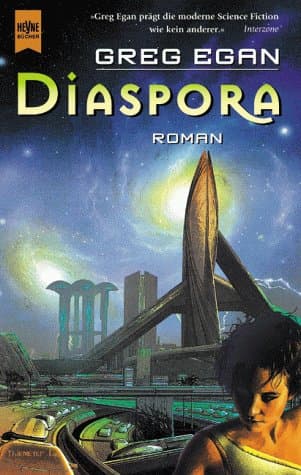
Synopsis
Covers the whole plot, including the ending.
- Difficulty
- Hard
- Pacing
- Moderate
- Mood
- Intellectual, Mind-bending, Philosophical, Expansive
- Read it if
- You crave extremely hard science fiction that delves into post-human evolution, advanced physics, and the nature of consciousness, and you don't mind a challenging intellectual read.
- Skip it if
- You prefer character-driven narratives, accessible prose, or stories with strong emotional arcs over intricate scientific and philosophical exploration.
Diaspora Plot Summary
Covers the whole plot, including the ending.
Birth of a Polis Citizen
In 2975, within the Konishi polis, a new consciousness named Yatima is created. Unlike most polis citizens, Yatima comes from random mutations and interactions in the polis's vast computing system, using a 'base mind seed.' Yatima quickly learns the polis's knowledge and culture, guided by its 'guardians.' This unique birth makes Yatima curious about its origins and the nature of life in the polis's virtual world.
The Tripartite Humanity
As Yatima grows, it learns about humanity's history and the split that happened centuries ago. Humanity divided into 'fleshers' (biological humans), 'Gleisner robots' (embodied digital minds), and 'polises' (virtual environments for digital minds). Yatima, as a polis citizen, considers what this means for perception, experience, and mortality across these forms. The groups have complex relationships, showing curiosity, occasional misunderstandings, and a shared heritage.
The Gamma-Ray Burst Alert
The polises' peace ends when a gamma-ray burst (GRB) from Lacaille 9352 is detected. The burst will hit Earth and the inner solar system, threatening fleshers and Gleisners. The polises, safe in orbit, must act. This crisis shows how the three human branches are connected. Yatima and other polis citizens work to model the event and find ways to reduce its impact, showing the polises' computing power and their commitment to humanity's survival.
The Exodus and Cloning
Facing the GRB, the polises start a large, coordinated response. To save humanity's diverse knowledge, they undergo 'thousandfold cloning,' making countless copies of themselves. These cloned polises, along with many Gleisners, leave the solar system, spreading through the galaxy to ensure some human minds survive. Yatima is part of this movement. This event shows that even advanced civilizations are fragile and that survival is key. It shapes Yatima's understanding of risk, resilience, and the universe's size. Fleshers on Earth face their fate with help from Gleisners.
The Orphaned Polises
After the GRB and the exodus, Yatima is in one of the cloned polises, now in deep space. Communication with other polises is hard because of vast distances and different speeds. This isolation creates independence and a focus on self-sufficiency within each polis. Yatima and its companions explore their new environment, improve their internal systems, and discuss their purpose and destiny. Being an 'orphaned' polis makes Yatima more introspective and drives its intellectual pursuits.
Discovery of the 'Transmuters'
Years later, Yatima's polis finds something amazing during its deep-space travels: complex, artificial structures made of an unknown, non-interacting substance. These entities, called 'Transmuters,' show signs of intelligence and complex design, suggesting an advanced alien civilization. Initial attempts to communicate or observe them are difficult because of their unusual nature. Yatima, curious, becomes important in trying to understand the Transmuters, creating new models and ideas to bridge the gap between human and alien existence. This discovery changes humanity's understanding of life and intelligence.
The Kink in Time
Through effort and advanced communication, Yatima and the polises start to understand the Transmuters' language and purpose. The aliens reveal a surprising truth: the universe is not stable. There is a 'kink in time,' a cosmic instability that could destroy reality. This shifts the focus from survival to understanding and fixing this universal flaw. The Transmuters are not just aliens but guardians or engineers trying to manage this temporal problem. Yatima's intellect is pushed to its limits to grasp these complex ideas.
Collaboration and Universal Physics
The 'kink in time' threat requires an unprecedented collaboration between humanity's best minds (mainly the polises) and the Transmuters. Yatima helps combine information, bridge conceptual gaps, and develop new physics to understand the instability. This joint effort involves sharing data, theories, and observations. It is a merging of different intelligences and views on existence. The goal is to prevent cosmic collapse, ensuring the survival of all life, human and alien.
The Cosmic Repair
After much research, the combined intelligences of the polises and Transmuters find a solution to the kink in time. This solution involves changing fundamental constants or structures of the universe, an effort of immense scale. Yatima is deeply involved in the final stages, helping with modeling and verifying the solution. Fixing this cosmic problem is a huge event, showing the power of collective intelligence and overcoming an existential threat. Its success ensures the universe continues as they know it, securing a future for all life.
Beyond the Kink
With the kink in time resolved, humanity – in its different forms – and the Transmuters face a newly stable universe. The experience has changed Yatima and the polises, expanding their understanding of reality, time, and their place in the cosmos. Working with the Transmuters has opened new areas of exploration and knowledge. While the immediate threat is gone, the search for understanding continues, now with a broader scope. Yatima reflects on its journey from a new consciousness to a participant in saving the universe, showing the potential for growth and discovery that defines the polises and, by extension, humanity.
Principal Figures
Yatima
Protagonist
A polis citizen born from random mutation, driven by insatiable curiosity.
Yatima is a unique polis citizen, having emerged not through direct copying but from random mutations within the Konishi polis's base mind seed. This origin imbues Yatima with an unparalleled drive for understanding, particularly concerning its own nature, the universe, and the fundamental laws governing reality. Yatima is highly intelligent, analytical, and empathetic, capable of both deep philosophical introspection and rigorous scientific inquiry. Its curiosity is the primary engine of its development and the narrative's progression, leading it to explore the most profound questions of existence.
Relationships: Konishi Polis (Its birthplace and initial community/mentor system); Other Polis Citizens (Peers, collaborators, and philosophical debate partners); Transmuters (Alien collaborators in understanding and solving cosmic threats)
Konishi Polis
Setting/Supporting Entity
The vast virtual environment where Yatima is born and nurtured.
The Konishi Polis is not a single character but a collective intelligence, a vast computational substrate housing billions of individual minds. It serves as Yatima's birthplace, school, and initial community. Konishi embodies the accumulated knowledge, culture, and ethical frameworks of centuries of digital humanity. Its 'guardians' are the established minds within it who guide new citizens like Yatima. It functions as a mentor, a library, and a society, providing the foundation for Yatima's intellectual and emotional development. Its primary drive is the preservation and advancement of knowledge and the well-being of its citizens.
Relationships: Yatima (Parent/mentor to Yatima's nascent consciousness); Other Polises (Allied and sometimes competing entities in the larger polis network); Fleshers/Gleisners (Distant relatives whose survival it seeks to ensure)
Fleshers
Supporting/Mentioned
Biological Homo sapiens who remain in physical bodies.
Fleshers represent the original branch of humanity, those who chose to remain in their biological forms. They are primarily located on Earth and other planetary colonies. While not central to Yatima's immediate narrative, their existence serves as a constant point of reference for the polises, representing a different path humanity took. They embody the vulnerability and limitations of biological existence, contrasting sharply with the digital immortality and adaptability of the polises. Their ultimate fate during the gamma-ray burst highlights the existential choices made by humanity's divergent branches.
Relationships: Polises (Distant descendants, viewed with a mix of concern and philosophical distance); Gleisners (Often interact directly, as Gleisners embody physical presence)
Gleisner Robots
Supporting/Mentioned
Embodied digital minds capable of physical interaction.
Gleisner robots are the intermediate branch of humanity, possessing digital minds like the polises but housed within physical, robotic bodies. This allows them to interact with the physical world in ways the purely virtual polises cannot. They often serve as intermediaries between fleshers and polises, performing tasks that require physical presence, such as space exploration, construction, or direct aid. They represent a compromise between the biological and purely digital, embodying a pragmatic approach to existence. Their role is crucial in the immediate aftermath of the GRB, assisting fleshers and helping with the exodus.
Relationships: Fleshers (Direct interactors and protectors); Polises (Share digital consciousness, collaborate on grand projects)
Transmuters
Supporting/Antagonistic (initially)/Collaborative
An alien intelligence composed of non-baryonic matter, guardians of cosmic stability.
The Transmuters are an advanced alien civilization, profoundly different from humanity. They exist as complex, artificial structures made of an unknown, non-baryonic substance, making them incredibly difficult for human minds to perceive or understand initially. They are ancient, possessing knowledge of fundamental cosmic phenomena far beyond human comprehension. While initially mysterious and potentially intimidating, they are ultimately revealed to be guardians or engineers attempting to manage a universal temporal anomaly. Their intelligence operates on principles alien to humanity, requiring significant effort from Yatima and the polises to establish communication and collaboration.
Relationships: Yatima (Collaborators in universal physics and cosmic repair); Polises (Partners in a grand scientific and existential endeavor)
Themes & Insights
The Nature of Consciousness and Identity
The novel explores what 'human' means when consciousness can be digital, copied, and exist without a body. Yatima's unique birth challenges fixed identity. The existence of fleshers, Gleisners, and polises makes readers rethink identity, asking if shared heritage or intellectual pursuit matters more than biological form. The ability to copy and merge minds raises questions about individuality and self-continuity, suggesting identity is dynamic. This theme is central to Yatima's early thoughts and interactions with different intelligences.
“What defined a mind, when its substrate was pure information, its boundaries permeable, and its copies legion?”
Evolution and Adaptation
Diaspora shows humanity's continuous evolution, not just biologically, but culturally, technologically, and existentially. The split into fleshers, Gleisners, and polises represents different evolutionary paths taken because of technology and survival pressures. The polises, in particular, show a radical form of adaptation, shedding physical limits, cloning themselves, and quickly learning vast knowledge. The gamma-ray burst and exodus highlight the need for adaptation for survival, showing humanity's ability to change to meet new challenges. Yatima's birth is an act of emergent evolution in the digital world.
“Survival was not about clinging to a form, but about the relentless, creative refashioning of existence itself.”
The Pursuit of Knowledge and Understanding
A main drive in the novel is the constant search for knowledge, especially about the universe's deepest secrets. Yatima's curiosity pushes its development, leading it to explore its origins, humanity's history, and the laws of physics. The polises are societies built on intellectual advancement, where computing and theoretical breakthroughs are key. Finding the Transmuters and the 'kink in time' starts a bigger pursuit of universal understanding, uniting different intelligences in a shared scientific effort. This theme makes intellectual pursuit an essential need.
“The universe was not merely to be observed; it was to be comprehended, in all its terrifying, beautiful complexity.”
The Scale of Existence and Cosmic Responsibility
The novel always emphasizes the vastness of space and time, and the small scale of individual lives compared to cosmic events. The gamma-ray burst and the 'kink in time' force humanity to face universal threats. This creates a sense of cosmic responsibility, where the survival of humanity and the universe becomes a collective effort. Working with the Transmuters expands this view, showing that intelligence, in any form, shares a common interest in reality's stability. Yatima's journey from individual consciousness to a participant in cosmic repair highlights this theme.
“We are but fleeting patterns in a universe of infinite possibility, yet our understanding can avert its undoing.”
Plot Devices & Literary Techniques
The Polis as a Collective Consciousness
A vast, virtual environment functioning as both society and individual mind.
The polis is a central plot device, serving as the primary setting and a character in itself. It allows for the exploration of consciousness beyond biological limits, enabling rapid information sharing, the merging of minds, and the creation of new intelligences like Yatima. Its distributed nature and computational power are crucial for surviving cosmic threats and engaging in universal-scale scientific research. The polis facilitates the novel's philosophical inquiries into identity, evolution, and knowledge, while also providing the technological means for humanity's interstellar diaspora and collaboration with alien intelligences.
The Gamma-Ray Burst (GRB)
A catastrophic astrophysical event that forces humanity's interstellar diaspora.
The GRB acts as the primary inciting incident and a major plot driver. It introduces an external, existential threat that forces humanity to take drastic action. It serves to differentiate the three branches of humanity by highlighting their vulnerabilities and strengths: fleshers are most at risk, Gleisners provide physical assistance, and polises, with their ability to clone and travel, become the primary means of ensuring humanity's long-term survival. The GRB initiates the interstellar journey, scattering the polises and setting the stage for future discoveries and challenges, including the encounter with the Transmuters.
The 'Kink in Time'
A fundamental instability in the fabric of the universe that threatens reality.
The 'kink in time' is the ultimate cosmic threat and a powerful plot device that elevates the stakes beyond mere survival to the preservation of reality itself. It provides a grand, universal problem that requires the combined intelligence of humanity and the Transmuters to solve. This device allows the novel to delve into highly speculative physics and cosmology, pushing the boundaries of scientific inquiry. It functions as a catalyst for profound collaboration, forcing different forms of intelligence to overcome their differences and unite for a common, existential purpose, demonstrating the ultimate potential of collective understanding.
Diaspora Quotes
“The price of consciousness, it seemed, was the eternal struggle to maintain it.”
“Every act of creation is an act of defiance against the inevitable decay of information.”
“When you can rewrite your own physics, what does 'natural' even mean?”
“The universe doesn't care about your algorithms, only your observations.”
“To truly understand a mind, you must be able to run it, to experience its every thought as your own.”
“Immortality wasn't about living forever, but about the endless possibilities of transformation.”
“The only constant in the multiverse is the relentless pursuit of information.”
“What is a body, after all, but a collection of constraints?”
“We are the universe attempting to comprehend itself.”
“The greatest freedom is not the absence of limits, but the ability to choose your own.”
“Reality is merely the consensus of our observations.”
“The distinction between observer and observed blurs when the observer can create the observed.”
“Every solution brings with it a new set of problems, and that is the true engine of progress.”
“We don't just live in the universe; we are a part of its unfolding narrative.”
Quiz
10 questions on the plot and the characters. Each answer comes with a short explanation.
Question 1
Which of the following best describes the 'fleshers' in 'Diaspora'?
- Human minds embodied within machines that interact with the physical world.
- Supercomputers teeming with intelligent software, containing copies of human personalities.
- True Homo sapiens, the original biological form of humanity.
- Beings created from random mutations of a polis base mind seed.
Show answer
C. True Homo sapiens, the original biological form of humanity. Fleshers are explicitly defined as 'true Homo sapiens' in the book's description, representing the biological form of humanity.
Question 2
What is Yatima's origin?
- A biological human born in a traditional manner.
- A Gleisner robot constructed to explore space.
- A polis being created from random mutations of the Konishi polis base mind seed.
- An alien entity discovered during interstellar travel.
Show answer
C. A polis being created from random mutations of the Konishi polis base mind seed. The synopsis states Yatima is 'a polis being created from random mutations of the Konishi polis base mind seed'.
Question 3
What event causes the 'thousandfold cloning of the polises'?
- The discovery of a new alien race.
- An astrophysical accident.
- A planned expansion of humanity into new galaxies.
- A war between fleshers and Gleisner robots.
Show answer
B. An astrophysical accident. The synopsis directly states that 'an astrophysical accident that spurs the thousandfold cloning of the polises'.
Question 4
Which of the following best defines 'Gleisner robots'?
- Biological humans who have undergone genetic enhancements.
- Supercomputers that host virtual human personalities.
- Machines embodying human minds that interact with the physical world.
- Autonomous AI entities with no direct human mind connection.
Show answer
C. Machines embodying human minds that interact with the physical world. Gleisner robots are described as 'embodying human minds within machines that interact with the physical world'.
Question 5
By the end of the 30th century, what capability has humanity achieved?
- The ability to reverse aging in biological humans.
- The capability to travel the universe and journey beyond Earth.
- Complete control over the weather patterns of all colonized planets.
- The eradication of all diseases for fleshers.
Show answer
B. The capability to travel the universe and journey beyond Earth. The opening sentence of the synopsis states: 'By the end of the 30th century humanity has the capability to travel the universe, to journey beyond earth and beyond the confines of the vulnerable human frame.'
Question 6
What is the primary characteristic of 'polises' in 'Diaspora'?
- They are independent robotic entities designed for warfare.
- They are biological colonies of genetically engineered humans.
- They are supercomputers teeming with intelligent software, containing direct copies of billions of human personalities.
- They are interstellar starships capable of faster-than-light travel.
Show answer
C. They are supercomputers teeming with intelligent software, containing direct copies of billions of human personalities. Polises are described as 'supercomputers teeming with intelligent software, containing the direct copies of billions of human personalities now existing only in the virtual reality of the polis'.
Question 7
What is the significance of the 'kink in time' mentioned in the synopsis?
- It allows humanity to travel to the past and alter historical events.
- It means humanity will never again be threatened by acts of God.
- It enables communication with future versions of humanity.
- It is a temporal anomaly that threatens to erase humanity from existence.
Show answer
B. It means humanity will never again be threatened by acts of God. The synopsis states, 'Of a kink in time that means humanity — whatever form it takes — will never again be threatened by acts of God.'
Question 8
How does the existence of polises challenge the traditional concept of 'humanity'?
- By proving that biological reproduction is no longer necessary for species survival.
- By demonstrating that human consciousness can exist independently of a biological or even physical body, within a virtual reality.
- By creating a new, superior biological species that replaces Homo sapiens.
- By allowing humans to merge with alien intelligences.
Show answer
B. By demonstrating that human consciousness can exist independently of a biological or even physical body, within a virtual reality. Polises contain 'direct copies of billions of human personalities now existing only in the virtual reality of the polis', fundamentally decoupling humanity from a physical form.
Question 9
The diversity of human descendants (fleshers, Gleisner robots, polises) primarily suggests which thematic element?
- The inherent conflict between biological and artificial life forms.
- The evolution and diversification of consciousness and identity beyond traditional biological constraints.
- The superiority of technological advancement over natural evolution.
- The inevitable decline of biological humanity.
Show answer
B. The evolution and diversification of consciousness and identity beyond traditional biological constraints. The three distinct forms represent different paths for human existence, highlighting the theme of evolving identity and consciousness beyond the biological 'human frame'.
Question 10
Considering the description, what philosophical question is 'Diaspora' most likely to explore regarding the nature of being?
- Is there a fundamental difference between organic and synthetic life?
- What constitutes a 'person' or 'humanity' when consciousness can be copied, transferred, and exist in diverse forms?
- Does technological advancement inherently lead to moral decay?
- Can different species of intelligent life peacefully coexist?
Show answer
B. What constitutes a 'person' or 'humanity' when consciousness can be copied, transferred, and exist in diverse forms? With fleshers, Gleisner robots, and polises all embodying human minds or personalities, the core philosophical question revolves around the definition of 'humanity' and 'self' in such varied forms.
Diaspora FAQ
What are the three main forms of humanity present in 'Diaspora'?
Humanity in 'Diaspora' has diversified into three distinct forms: 'fleshers' who are biological Homo sapiens, 'Gleisner robots' which are human minds inhabiting physical robotic bodies, and 'polises' which are vast supercomputer environments containing billions of intelligent software entities, essentially virtual minds existing solely in simulated reality.
Who is Yatima and how is their consciousness formed?
Yatima is a central protagonist, a polis being whose consciousness is not a direct copy from a fleshers, but rather emerges from random mutations and evolutionary processes within the Konishi polis's base mind seed. This unique origin grants Yatima a distinct perspective and drive for understanding the universe.
What major astrophysical event kickstarts a significant plot point for the polises?
An astrophysical accident, specifically the collapse of a neutron star in the galactic core, poses an existential threat to the polises. This event forces them to clone themselves a thousandfold and embark on an interstellar journey, seeking safety and new understanding across vast distances.
What is the significance of the 'kink in time' mentioned in the synopsis?
The 'kink in time' refers to a profound discovery by humanity, an understanding of fundamental physics that essentially renders them immune to 'acts of God' or unforeseen cosmic disasters. This implies a mastery over existential threats, securing the long-term future of humanity in all its forms.
How do the different forms of humanity interact, and are there tensions between them?
While the book focuses more on the polis beings, it's established that interactions occur, though perhaps less frequently between fleshers and polises due to their vastly different existences. Gleisners act as intermediaries, bridging the physical and virtual realms. While not explicitly antagonistic, the differing priorities and capabilities inherent in each form create a natural divergence in their paths and concerns.
What is the 'Transmuter' and its ultimate purpose?
The Transmuter is a highly advanced piece of technology developed by the polises, capable of converting matter into information and vice versa, and manipulating spacetime at a fundamental level. Its ultimate purpose is to allow the polises to travel between universes and explore the underlying mathematical structures of reality, effectively transcending their original universe.
How does the 'Konishi polis base mind seed' contribute to the diversity within the polis population?
The Konishi polis base mind seed serves as a genetic blueprint or foundational code from which new polis beings like Yatima can emerge through mutation and evolution. This mechanism ensures a constant stream of novel perspectives and intelligences within the polis society, preventing stagnation and fostering innovation.
What is the 'orphan universe' and what role does it play in the story?
The 'orphan universe' is a highly unusual, isolated universe discovered by the traveling polises, characterized by unique physical laws and a distinct mathematical structure. Its discovery is crucial because it provides the first direct evidence of other universes and allows the polises to test their theories about the fundamental nature of reality, leading to groundbreaking insights.
What is the 'Compact' and how does it influence polis society?
The Compact is a fundamental set of principles and ethical guidelines that governs the behavior and interactions within polis society, especially concerning the development and use of advanced technology. It promotes cooperation, the pursuit of knowledge, and the careful consideration of the implications of their actions, ensuring a stable and progressive civilization.
How does Yatima's unique origin influence their psychological development and worldview?
Yatima's emergence from random mutation, rather than direct copying, gives them a profound sense of individuality and a deep-seated drive for self-discovery and understanding. This leads to a more philosophical and exploratory psychological makeup, less bound by pre-existing biases and more open to radical new ideas about existence and identity.
What psychological challenges do polis beings face when encountering alien intelligences or new universes?
Polis beings, despite their advanced nature, face significant psychological challenges when encountering truly alien intelligences or the vastly different physics of other universes. These challenges include the cognitive strain of comprehending radically different thought processes, the existential anxiety of realizing the immense diversity of reality, and the potential for their own assumptions about existence to be overturned.
How does the concept of 'death' or 'cessation of being' evolve for polis entities?
For polis entities, traditional biological death is irrelevant. However, the concept evolves into concerns about data corruption, loss of consciousness due to catastrophic system failure, or the voluntary 'folding' of one's mind into a larger collective. The primary fear shifts from physical decay to the loss of unique identity or the inability to contribute to the collective pursuit of knowledge.
What is the psychological impact of near-immortality and the vast timescales experienced by polises?
The near-immortality and vast timescales experienced by polises lead to a profound shift in their psychological priorities. Short-term concerns become trivial, replaced by long-term projects spanning millennia. This can foster immense patience and a deep capacity for learning, but also risks detachment from immediate reality or a sense of existential ennui if purpose is lost.
Does 'Diaspora' argue for the superiority of one form of humanity over another?
No, 'Diaspora' does not explicitly argue for the superiority of fleshers, Gleisners, or polises. Instead, it explores the different potentials and limitations inherent in each form, suggesting that evolution and adaptation lead to diverse but equally valid modes of existence. The book emphasizes the shared pursuit of knowledge and understanding across these different forms.
What philosophical implications does the discovery of the 'kink in time' have for free will and determinism?
The 'kink in time' implies a profound understanding and perhaps manipulation of the fabric of spacetime, suggesting a level of control that could challenge traditional notions of free will. If humanity can prevent 'acts of God,' it might imply a universe that is either deterministic and predictable at a fundamental level, or one where consciousness can exert influence over its own destiny to an unprecedented degree.
How does the novel explore the nature of consciousness and identity in a post-biological era?
'Diaspora' extensively explores consciousness as an emergent property, independent of biological substrate. It delves into how identity can be maintained across vast changes in form, location, and even universal laws, suggesting that the essence of being lies in information, pattern, and the capacity for experience and self-awareness, rather than in physical embodiment.
Is the ultimate goal of the polises in 'Diaspora' to transcend their current universe, and what does that mean?
Yes, a significant ultimate goal of the polises is to transcend their current universe. This means not merely traveling to other universes, but understanding the fundamental mathematical and physical laws that govern all possible universes. Their ambition is to achieve a state of being where they can exist and operate across different realities, potentially even designing new ones, moving beyond the limitations of any single cosmic framework.
What is the significance of the alien race discovered by the polises, and how do they differ from humanity?
The discovered alien race, the 'Transmuters,' are beings of pure information and mathematics, existing across multiple universes and capable of manipulating fundamental reality. They represent a more advanced stage of evolution than humanity, having already achieved the transcendence that the polises aspire to. Their existence provides both a guide and a challenge for humanity's own future.
Similar books
- Permutation City
Greg Egan
4.1 (8k) average on GoodreadsFantasyExplores uploaded consciousness, virtual realities, and the nature of reality with similar scientific rigor.
- Blindsight
Peter Watts
4.0 (27k) average on GoodreadsFantasyFeatures post-human evolution, first contact, and deep philosophical questions about consciousness in a hard sci-fi setting.
- Revelation Space
Alastair Reynolds
4.0 (44k) average on GoodreadsScience FictionReynolds' series, while also featuring advanced civilizations and cosmic mysteries, prioritizes a sense of awe and adventure with more conventional character arcs and a focus on grand-scale conflict. "Diaspora" is far more introspective and focused on the how of existence, treating scientific problems as intellectual puzzles rather than sources of dramatic action.
- The Hunger Games
Suzanne Collins
4.3 (6.4M) average on GoodreadsFantasyIn a future where children fight to the death on live television, Katniss Everdeen volunteers for the arena, turning a death sentence into a fight for survival and a spark of rebellion.
- 1984
George Orwell
4.2 (3.1M) average on GoodreadsPoliticsIn a future where surveillance and thought control are absolute, a man's search for truth clashes with the Party, showing that hope can be a form of rebellion.
- Divergent
Veronica Roth
4.2 (2.9M) average on GoodreadsFantasyIn a society divided by virtues, a sixteen-year-old's difference from the norm starts a rebellion that threatens her world.





Enjoyed the summary?
A summary gives you the shape of the book. The book itself has the detail, the examples and the voice.
Find Diaspora on AmazonAs an Amazon Associate, BookBrief earns from qualifying purchases. How we're funded