
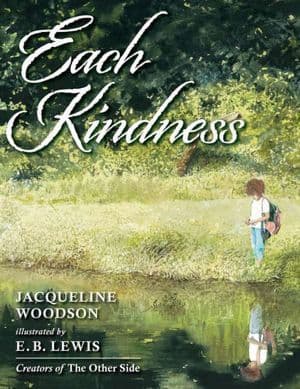
Synopsis
Covers the whole plot, including the ending.
- Difficulty
- Easy
- Pacing
- Moderate
- Mood
- Thought-provoking, Poignant, Reflective, Sad
- Read it if
- You want a poignant story about empathy, regret, and the lasting impact of kindness (or lack thereof), perfect for discussions with young children.
- Skip it if
- You prefer lighthearted stories without a strong moral lesson or themes of regret.
Each Kindness Plot Summary
Covers the whole plot, including the ending.
Maya's Arrival and Initial Rejection
On a windy day, a new girl named Maya comes to Chloe's class. Maya looks different from the other children; her clothes are old, her hair is messy, and her shoes are too big. When she smiles at Chloe, Chloe looks away, feeling uncomfortable and disapproving. During recess, Maya asks Chloe and her friends if she can play. Chloe's friend, Kendra, quickly says "No," and Chloe does not say anything, agreeing with the rejection. Maya is left to play alone, picking dandelions and blowing their seeds, which makes Chloe feel a bit bad.
Repeated Attempts and Continued Exclusion
Days turn into weeks, and Maya keeps trying to connect with Chloe and her friends. Each time, they are cold to her. At lunch, Maya offers to share her meal, which is an apple and a sandwich, but Chloe's friends make fun of her simple food, making Chloe laugh along. In class, Maya tries to answer a question, but her voice is soft, and Chloe's friend, Kendra, mocks her, causing the group to laugh. Chloe watches Maya's quiet loneliness, often seeing her playing by herself, picking up shiny things and putting them in a small box, a private world Chloe and her friends never try to enter.
Maya's Sudden Absence
One morning, Chloe comes to school and sees Maya's seat is empty. The teacher, Mrs. Albert, tells the class that Maya and her family have moved away. The news is given without much fuss, and the other children quickly move on. However, Chloe feels a strange pang of guilt or regret. She remembers all the times Maya tried to smile at her, to share with her, to play with her, and how each time, Chloe and her friends had pushed her away. Maya's leaving settles heavily on Chloe, leaving her with an uncomfortable feeling she cannot shake.
The Kindness Lesson and Chloe's Realization
A few days after Maya leaves, Mrs. Albert teaches a lesson on kindness. She fills a bowl with water and drops a small stone into it, showing how the ripples spread out. She explains that each act of kindness, no matter how small, sends out ripples that can change the world. She asks each student to think of a kind act they have shown. As the other children share their stories, Chloe is silent, unable to think of a single kind act she had shown to Maya. The idea of spreading ripples makes Chloe realize that her actions toward Maya created no ripples of kindness, only stillness and emptiness.
Regret and Missed Opportunity
The kindness lesson deeply affects Chloe. She imagines the ripples of kindness spreading, but for her, there is only a vast, still pool where Maya used to be. She remembers all the specific times she rejected Maya: turning away from Maya's smile, laughing at her simple lunch, ignoring her attempts to play. Chloe realizes she had many chances to be kind, to include Maya, to offer a friendly word, but she did not. A deep regret washes over her, understanding that she missed the chance to create positive ripples, to make Maya feel welcome, and to possibly gain a friend. The weight of her unkindness becomes a heavy burden.
The Unspoken Apology
Chloe leaves school that day feeling sad. She imagines what it would have been like if she had been kind to Maya — if she had smiled back, invited her to play, or shared her lunch. She pictures Maya's smile, now gone. The lesson about kindness, which was meant to inspire, instead shows Chloe's failure. She understands that while she can choose to be kind to others in the future, the chance to be kind to Maya is gone forever. The story ends with Chloe holding the memory of Maya and the painful lesson of kindness never given, showing the lasting effect of even small acts of unkindness and the importance of being compassionate.
Principal Figures
Chloe
Protagonist
A young girl who initially rejects a new classmate, later realizing the painful consequences of her unkindness.
Chloe is the story's main character, a school-aged girl who is part of a friend group. Initially, she is swayed by her friends' unkindness towards Maya and participates in the exclusion, though sometimes with a hint of internal discomfort. She is not overtly malicious but is passive in her unkindness, failing to stand up for Maya or offer friendship. Her character arc is defined by her profound realization and regret after Maya leaves, understanding the missed opportunities for kindness and friendship. She learns the hard lesson that some mistakes cannot be rectified.
Relationships: Maya (Victim of Chloe's unkindness and missed friendship opportunity); Kendra (Friend who influences Chloe's unkind behavior towards Maya); Mrs. Albert (Teacher who facilitates Chloe's realization about kindness)
Maya
Supporting
A new student who is repeatedly rejected and ridiculed for her appearance and quiet demeanor.
Maya is the new girl in Chloe's class, characterized by her worn clothes, messy hair, and quiet nature. Despite her outward appearance, she consistently attempts to befriend Chloe and her group, offering smiles, sharing her lunch, and trying to participate. She is resilient, often retreating to play alone with her found treasures when rejected, but her persistent attempts show a desire for connection. Her eventual departure is the catalyst for Chloe's profound realization about kindness and regret. Maya represents the vulnerable 'other' in the classroom setting.
Relationships: Chloe (Object of Maya's attempts at friendship, which are rejected); Kendra (One of Maya's primary tormentors)
Kendra
Supporting
One of Chloe's friends, who is openly and consistently unkind to Maya.
Kendra is a prominent member of Chloe's friend group and acts as the most vocal and direct antagonist towards Maya. She is quick to say "No" when Maya asks to play, mocks Maya's lunch, and makes fun of her quiet voice. Kendra's actions influence Chloe and the other friends, setting the tone for Maya's exclusion. She embodies the overt unkindness and bullying that Chloe later regrets being a part of. Kendra shows no apparent remorse or change of heart within the story's scope.
Relationships: Chloe (Friend, influencing Chloe's behavior); Maya (Target of Kendra's ridicule and exclusion)
Mrs. Albert
Supporting
The compassionate teacher who teaches a lesson on kindness that profoundly impacts Chloe.
Mrs. Albert is Chloe's classroom teacher. She is observant and thoughtful, initiating a lesson about kindness using the metaphor of a stone creating ripples in water. While she is unaware of the specific unkindness directed at Maya, her lesson is perfectly timed to trigger Chloe's introspection and regret after Maya's departure. She serves as a moral guide, providing the framework through which Chloe understands the impact of her actions and inactions. Her role is crucial in bringing Chloe's internal conflict to the surface.
Relationships: Chloe (Teacher to student, providing a pivotal lesson); Maya (Teacher to student, though unaware of Maya's specific struggles)
Themes & Insights
Kindness and Empathy
The main theme looks at the effect of kindness, or the lack of it, on people and the world. Chloe's repeated rejection of Maya shows the pain caused by unkindness and the need for empathy toward those who are different or vulnerable. The teacher's lesson about ripples of kindness shows how even small acts can have far-reaching effects, emphasizing that no kindness leaves an emptiness. Chloe's regret highlights the lasting emotional cost of not being compassionate.
“Each kindness, no matter how small, sends a ripple out into the world.”
Regret and Missed Opportunities
This theme is explored through Chloe's experience after Maya leaves. Chloe is bothered by the many chances she had to be kind to Maya but ignored. Her realization that these chances are gone forever creates a deep regret. The story shows that some moments for connection and compassion are brief, and once missed, they cannot be brought back, leaving a lasting burden on the person who did not act. Chloe's struggle with her past actions is central to the story's emotional impact.
“And I knew that I'd left a space inside myself where Maya could have been. And it was too late to fill it now.”
Social Exclusion and Bullying
The book clearly shows the quiet but harmful nature of social exclusion. Maya is pushed away not through physical harm, but through repeated rejections, mockery, and being ignored by Chloe and her friends. Her worn clothes and quiet manner make her an easy target for those trying to strengthen their own social position. The story shows how even just being part of exclusion, like Chloe was, adds to the victim's pain, illustrating the shared responsibility in creating a welcoming environment. Maya's loneliness during recess is a strong symbol of this exclusion.
“No,' Kendra said quickly. 'You can't play.”
The Ripple Effect of Actions
The teacher's lesson about dropping a stone into water, creating spreading ripples, is a main theme. It shows how every action, good or bad, has effects that go beyond the immediate moment. For Chloe, this idea brings a painful understanding that her unkindness toward Maya created no good ripples, only an absence, a stillness where friendship and connection could have been. The theme shows how human actions are connected and their ability to either build or break relationships and communities.
“And the water moved out and out and out in a circle.”
Plot Devices & Literary Techniques
Symbolism of Maya's Clothes and Treasures
Represents vulnerability, difference, and a quiet inner world.
Maya's worn clothes and too-big shoes immediately set her apart, symbolizing her socioeconomic difference and vulnerability, making her a target for exclusion. Conversely, her habit of collecting 'shiny things' in a small box symbolizes her quiet resilience, her ability to find beauty and value in small, overlooked items, and her rich inner world that Chloe and her friends never bother to explore. These details visually reinforce her 'otherness' and the missed opportunity for connection.
The Ripple Effect Metaphor
Illustrates the far-reaching impact of kindness and unkindness.
The central metaphor introduced by Mrs. Albert, where dropping a stone into water creates ripples, is a powerful plot device. It visually and conceptually explains how every action, big or small, has consequences that spread outward. For Chloe, this device acts as an epiphany, making her understand the profound absence of positive ripples from her actions towards Maya and the lasting impact of her unkindness. It's the catalyst for her deep regret and the story's moral lesson.
First-Person Narration (Chloe's Perspective)
Provides intimate access to the protagonist's internal conflict and regret.
The story is told entirely from Chloe's point of view, allowing the reader to experience her initial discomfort, her participation in Maya's exclusion, and ultimately, her overwhelming regret. This perspective is crucial for conveying the internal shift and the emotional weight of her realization. By seeing the events through Chloe's eyes, the reader gains empathy not just for Maya, but also for Chloe's journey of understanding and remorse, making the moral lesson more impactful and relatable.
Contrast between Maya's Attempts and Chloe's Rejection
Highlights the stark difference in character and the opportunities for kindness.
The narrative repeatedly sets up scenes where Maya makes an overture of friendship (smiling, asking to play, offering to share lunch) only to be met with rejection from Chloe and her friends. This stark contrast emphasizes the active choice being made to exclude Maya and underscores the many missed opportunities for kindness. It builds a pattern that culminates in Chloe's regret, making the 'what if' scenarios more poignant and the lesson about valuing chances for connection more powerful.
Each Kindness Quotes
“Each kindness makes the whole world a little better.”
“I watched the water ripple out, becoming bigger and bigger.”
“Maya smiled at me. I didn't smile back.”
“Every time Maya asked to play with us, I said no.”
“I felt the weight of that stone in my pocket.”
“That day, Maya was absent. And the next day. And the day after that.”
“Ms. Albert told us that Maya's family had moved away.”
“I thought of all the kindnesses I had thrown away.”
“The chance of a kindness with Maya was gone.”
“Like a stone dropped in water, I could feel it rippling out.”
“I watched the water still.”
“This is what kindness does, Ms. Albert said. Each little thing we do goes out, like a ripple into the world.”
“I never got to tell Maya I was sorry.”
“And I missed my chance.”
Quiz
10 questions on the plot and the characters. Each answer comes with a short explanation.
Question 1
What does Maya repeatedly ask Chloe and the other girls?
- If she can borrow their toys
- If she can play with them
- If she can sit with them at lunch
- If she can join their club
Show answer
B. If she can play with them Throughout the story, Maya repeatedly asks Chloe and her friends if she can play with them, but they always say no, leading Maya to play alone.
Question 2
What object does Chloe's teacher use in her lesson about kindness?
- A mirror
- A stone
- A book
- A flower
Show answer
B. A stone Chloe's teacher drops a stone into a bowl of water to demonstrate how each kindness ripples out and makes the world a little better, which is central to the book's message.
Question 3
Why does Chloe feel regret after her teacher's lesson?
- She realizes she failed a test
- She understands she missed a chance to be kind to Maya
- She wishes she had studied harder
- She feels guilty for breaking a school rule
Show answer
B. She understands she missed a chance to be kind to Maya The lesson makes Chloe reflect on how she treated Maya, and she regrets not showing kindness when she had the opportunity, as Maya is now gone.
Question 4
What happens to Maya after she is repeatedly rejected by Chloe and the other girls?
- She becomes friends with someone else
- She moves away and is no longer at the school
- She confronts Chloe about her behavior
- She stops trying to make friends
Show answer
B. She moves away and is no longer at the school Maya eventually leaves the school, and Chloe realizes she is gone, which adds to her regret over not being kinder.
Question 5
How does Chloe initially respond when Maya tries to befriend her?
- She ignores or turns away from Maya
- She laughs at Maya
- She tells Maya to leave her alone
- She pretends not to see Maya
Show answer
A. She ignores or turns away from Maya Chloe doesn't actively bully Maya but instead turns away or ignores her, which is a subtle form of rejection that contributes to the story's theme of missed kindness.
Question 6
What is the main theme of 'Each Kindness'?
- The importance of academic success
- How small acts of kindness can positively impact the world
- The challenges of moving to a new school
- The value of material possessions
Show answer
B. How small acts of kindness can positively impact the world The book emphasizes that even small kindnesses, like including someone in play, can create ripples of positivity, and missing these opportunities can lead to regret.
Question 7
What does Chloe realize she cannot do after Maya is gone?
- Win a competition
- Take back her unkind actions or make amends with Maya
- Change her grades
- Find a new best friend
Show answer
B. Take back her unkind actions or make amends with Maya Chloe's regret is deepened by the realization that she has lost the chance to be kind to Maya, as Maya has moved away, highlighting the permanence of missed opportunities.
Question 8
How does the book illustrate the impact of kindness?
- Through a mathematical equation
- By comparing it to a stone creating ripples in water
- With a chart showing happiness levels
- Through a story about a famous historical figure
Show answer
B. By comparing it to a stone creating ripples in water The teacher's lesson uses the metaphor of a stone dropped in water to show how each kindness spreads out like ripples, making the world better, which is a key visual and thematic element in the book.
Question 9
What might Chloe have learned about herself by the end of the story?
- That she is naturally unkind and cannot change
- That her actions have consequences and she should be more mindful of kindness in the future
- That making friends is unimportant
- That teachers always give good advice
Show answer
B. That her actions have consequences and she should be more mindful of kindness in the future Chloe's regret and reflection suggest she grows to understand the importance of kindness and the impact of her choices, implying she will act differently in the future.
Question 10
Why is the title 'Each Kindness' significant to the story?
- It refers to a specific kindness Chloe showed Maya
- It highlights that every act of kindness, no matter how small, contributes to a better world
- It is the name of a game the children play
- It describes Maya's personality trait
Show answer
B. It highlights that every act of kindness, no matter how small, contributes to a better world The title encapsulates the book's core message: each individual kindness has value and can create positive ripples, as demonstrated through Chloe's missed opportunity with Maya.
Each Kindness FAQ
What is 'Each Kindness' about?
The book follows Chloe, a girl who repeatedly rejects Maya, a new classmate who tries to befriend her. When Maya eventually leaves the school, Chloe realizes the lost opportunity for kindness after her teacher's lesson about how small acts can ripple outward.
Why should I read 'Each Kindness'?
It's a poignant picture book that delivers a powerful message about empathy, regret, and the lasting impact of missed chances for kindness. With Jacqueline Woodson's lyrical prose and E.B. Lewis's evocative watercolor illustrations, it sparks meaningful conversations about inclusion and compassion.
What is the background/setting of 'Each Kindness'?
The story unfolds in an elementary school classroom and its surroundings, with scenes like the playground where Maya is excluded. The setting emphasizes everyday school dynamics where small social choices have profound consequences.
What are the most memorable quotes?
Key quotes include the teacher's lesson: 'Each kindness makes the whole world a little better' and Chloe's reflection: 'I watched the water ripple as the sun set through the maples and wished...that I'd shown Maya the kindness she deserved.'
What writing style does the author use?
Jacqueline Woodson employs sparse, poetic prose with a reflective first-person narrative from Chloe's perspective. The language is simple yet emotionally resonant, pairing beautifully with the illustrations to convey subtle emotions and themes.
What minor details add significant meaning?
Maya's second-hand clothes and broken shoes subtly highlight her socioeconomic background, making her exclusion more poignant. The repeated imagery of water ripples in the teacher's bowl symbolizes how kindness spreads, mirroring Chloe's later regret by the pond.
What are some subtle foreshadowing moments?
Early scenes show Maya playing alone with small objects like stones and jacks, hinting at her resilience but also her eventual departure. Chloe's initial indifference when Maya arrives foreshadows her later deep regret after Maya is gone.
What unexpected character connections exist?
While Chloe and Maya never become friends, Chloe's emotional connection forms only in retrospect through shared spaces like the classroom and playground. The teacher serves as a bridge, linking the lesson on kindness to Chloe's personal realization about Maya.
What are unspoken character motivations?
Chloe likely excludes Maya due to social pressure or unconscious bias, never articulating why she turns away. Maya persists in seeking friendship despite rejection, motivated by loneliness and hope, which she never verbally expresses.
What psychological complexities do characters exhibit?
Chloe shows cognitive dissonance—initially dismissing Maya but later grappling with guilt and regret. Maya displays quiet resilience, continuing to reach out despite rejection, highlighting the emotional toll of social exclusion on a child.
What are the major emotional turning points?
The key turning points are Maya's final attempt to play being rejected, her sudden disappearance from school, and Chloe's realization during the kindness lesson. Chloe's moment by the pond, wishing she'd acted differently, is the emotional climax.
How do relationship dynamics evolve?
The dynamic shifts from Maya's active attempts at friendship and Chloe's passive rejection to a one-sided connection after Maya leaves. Chloe's regret transforms her from a bystander to someone emotionally invested, but too late to change the outcome.
Which parts remain ambiguous or open-ended?
The book never reveals why Maya left the school or what happened to her afterward, leaving her fate uncertain. It also doesn't specify if Chloe will act differently in the future, focusing instead on the lesson learned.
What are controversial scenes or decisions?
Some readers debate whether Chloe's regret is sufficient, given she never apologizes to Maya. The exclusion scenes, while realistic, may be painful for children who have experienced similar rejection, sparking discussions about bullying and empathy.
'Each Kindness' ending explained: how it ends & what it means
The book ends with Chloe by a pond, throwing a stone and watching ripples, symbolizing her realization that kindness creates lasting effects. It means that missed opportunities for compassion can lead to profound regret, urging readers to act kindly in the moment.
What is the significance of the ripple metaphor?
The ripple metaphor, demonstrated with water in a bowl by the teacher, visually represents how small acts of kindness spread outward. Chloe later replicates this by a pond, connecting the lesson to her personal regret over not showing kindness to Maya.
How does the book handle themes of regret and redemption?
It portrays regret as a powerful teacher through Chloe's poignant reflection, but offers no redemption with Maya, emphasizing that some consequences are irreversible. This encourages proactive kindness rather than relying on second chances.
About the author

Jacqueline Woodson is an American writer of books for children and adolescents. She is best known for Miracle's Boys, and her Newbery Honor-winning titles Brown Girl Dreaming, After Tupac and D Foster, Feathers, and Show Way. After serving as the Young People's Poet Laureate from 2015 to 2017, she was named the National Ambassador for Young People's Literature, by the Library of Congress, for 2018 to 2019. She was named a MacArthur Fellow in 2020.
Similar books
- Wonder
R.J. Palacio
4.4 (733k) average on GoodreadsChildren'sFocuses on empathy, acceptance, and the challenges of being different in a school setting, though for an older audience.
- Harry Potter and the Sorcerer's Stone
J.K. Rowling
4.5 (7M) average on GoodreadsFantasyRescued from a miserable life under the stairs, an orphaned boy discovers he's a wizard destined for a magical school, where he uncovers a dangerous secret tied to the dark wizard who murdered his parents.
- The Hobbit, or There and Back Again
J.R.R. Tolkien
4.3 (2.9M) average on GoodreadsFantasyA comfort-loving hobbit named Bilbo Baggins is whisked away by a mischievous wizard and a band of dwarves on an unexpected journey to reclaim stolen treasure from a fearsome dragon, discovering courage and a magical ring along the way.
- Harry Potter and the Goblet of Fire
J.K. Rowling
4.6 (2.6M) average on GoodreadsFantasyA bewildered Harry Potter, underage and thrust into a deadly Triwizard Tournament, must brave dragons, mermaids, and a resurgent dark magic to survive a year that will forever alter the wizarding world.
- Harry Potter and the Order of the Phoenix
J.K. Rowling
4.5 (2.5M) average on GoodreadsFantasyIn a year of oppressive secrets and the threat of Voldemort, Harry Potter and Dumbledore's Army secretly train for war, shown through Jim Kay and Neil Packer's dark illustrations.
- The Lightning Thief
Rick Riordan
4.3 (2M) average on GoodreadsFantasyThrust into a world of mythological monsters and divine treachery, an ordinary boy discovers he's the son of Poseidon and must embark on a perilous quest across modern America to prevent an Olympian war.






Enjoyed the summary?
A summary gives you the shape of the book. The book itself has the detail, the examples and the voice.
Find Each Kindness on AmazonAs an Amazon Associate, BookBrief earns from qualifying purchases. How we're funded