
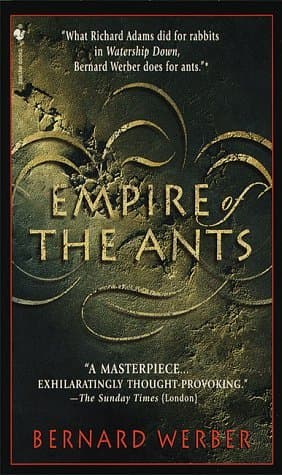
Synopsis
Covers the whole plot, including the ending.
- Difficulty
- Medium
- Pacing
- Variable
- Mood
- Intriguing, Philosophical, Expansive, Mysterious
- Read it if
- You enjoy unique perspectives, detailed world-building of non-human societies, and philosophical explorations of intelligence and interspecies communication.
- Skip it if
- You prefer human-centric narratives, are squeamish about insects, or dislike books with a slower, more descriptive pace.
Empire of the Ants Plot Summary
Covers the whole plot, including the ending.
The Inheritance and the Warning
Jonathan Wells, his wife Lucie, and their son Nicolas move into the Paris apartment at 3, rue des Sybarites, inherited from Jonathan's Uncle Edmond. The apartment is dusty and full of strange machines, showing Edmond's quiet and scientific nature. With the property, they get a strong, unclear warning: 'Never go down into the cellar.' At first, the family thinks this is another of Edmond's odd habits, but the unusual feel of the building and the warning's mystery start to make them curious, setting the stage for the strange events to come. Jonathan, a former journalist, is especially interested in his uncle's hidden life.
The First Disappearance
The Wells family's dog, Othello, a golden retriever, slips past the cellar door and disappears into the dark below. Worried about his pet, Jonathan, despite the warning, feels he must follow. With a flashlight, he goes down the steps, calling for Othello. The cellar is unexpectedly large and like a maze, filled with strange equipment and a heavy silence. As Jonathan goes deeper, the air gets thick, and a strange sense of fear comes over him. He soon gets lost and, like Othello, vanishes, leaving Lucie and Nicolas alone and confused upstairs.
Lucie and Nicolas's Search
After Jonathan is gone for a long time, Lucie gets more and more worried. She tries to call the police, but her story of a vanishing cellar is met with doubt. Desperate, she decides to investigate herself, taking Nicolas with her. They go into the cellar, calling for Jonathan. The cellar's layout seems to change, confusing them. As they explore, Nicolas, drawn by a strange sound, separates from Lucie. Lucie eventually finds him near a strange, glowing device, but before she can reach him, both she and Nicolas are swallowed by an unseen force, disappearing just as Jonathan and Othello did. The apartment at 3, rue des Sybarites is now empty.
The Bel-o-kan Colony
In a large pine stump in a park near the Wells' apartment, the well-organized and smart russet ant nation of Bel-o-kan thrives. The colony is a complex society with millions of ants, each with a specific job, communicating through chemical signals and antenna contact. They grow fungi, herd aphids for 'honeydew,' and keep up detailed tunnels. But a series of strange deaths has begun to affect the colony, especially among ants looking for food. These deaths are blamed on an invisible, odorless weapon, causing confusion and fear among the ants, threatening their survival and prompting investigation by the colony's smartest members.
103683's Awakening
Among the many ants of Bel-o-kan, a young female ant, 103683, has an unusual curiosity and intelligence, making her different from her peers. She feels that her purpose goes beyond the usual tasks of a worker. She is deeply troubled by the unexplained deaths in her colony and feels a strong need to understand why. This natural drive for knowledge and her ability to think beyond immediate needs mark her as a possible future leader. She starts to watch her surroundings more closely and questions the usual ways, setting her on a path of discovery and leadership.
The Journey to the Edge of the World
Because of the urgent mysterious deaths, 103683 decides she must investigate the source of the danger. She gets help from a skilled warrior ant, 327, known for his bravery and smart thinking. They agree to separate, believing two independent investigations might get results faster. 327 goes towards the 'edge of the world' – the dangerous and unknown area beyond the immediate colony, where the most dangerous threats are thought to be. 103683, meanwhile, focuses her investigation closer to the colony, trying to understand the 'invisible weapon' that is killing her comrades.
Perils of the Outside World
As 103683 and 327 go out, they face the harsh realities of the world outside their colony. They move through a dangerous landscape: fierce birds that grab ants from above, hungry lizards, and the constant threat of rival ant species like the fighting dwarf ants and greedy termites. They also have to deal with poisonous beetles, and the incredibly large, fast, and deadly 'monsters' known as 'cars' – giant guards of the 'edge of the world' that crush everything in their path. Each encounter sharpens their survival skills and expands their understanding of the vast, dangerous world beyond their nest.
Discovery of the Human World
103683's ongoing investigation into the mysterious deaths eventually leads her beyond the park's familiar borders. Her journey takes her through strange, man-made landscapes, ending with her finding the 'city of the giants' – the human world. She watches the huge buildings, the strange movements, and the odd behaviors of the 'fingers' (humans) that rule this place. This exposure to a completely different, very powerful civilization begins to change her understanding of the world and the possible source of the dangers facing her colony, hinting at a connection to the beings who live at 3, rue des Sybarites.
The Secret of the Cellar Revealed
Through great effort and a series of dangerous encounters, 103683's quest eventually leads her to the cellar at 3, rue des Sybarites. Here, she uncovers the strange secret: the 'invisible weapon' and the disappearances are linked to Uncle Edmond's scientific work. The cellar has advanced equipment made to study and control ant behavior, including a complex 'ant farm' that traps and watches ants, and devices that emit the radiation causing the mysterious deaths in her colony. She also finds proof of the vanished humans, showing the true extent of the interaction between the two species.
The Unthinkable Communion
Inside the cellar, 103683 meets the remaining human, a young girl named Laetitia, who is Uncle Edmond's daughter and was also trapped. Despite the huge size difference and the natural fear of the 'giants,' 103683, driven by her intelligence and the need to save her colony, tries to communicate. This 'unthinkable connection' is a key moment, as both species, through their shared problem and a desperate need to survive, begin to close the large communication gap. 103683 realizes that understanding and perhaps even working with humans might be the only way to ensure her ant nation's future.
A New Queen's Destiny
Having learned much about the human world and its dangers, 103683 returns to the Bel-o-kan colony. Her experiences have changed her; she is no longer just a smart worker but a leader with vision. She uses her new understanding to guide her colony, preparing them for future interactions with humans and changing their survival plans. Her unique journey and insights confirm her place as a natural leader, and she is set to become the new queen, bringing in a time of new understanding and smart adaptation for the Bel-o-kan nation, forever changed by its meeting with humanity.
Empire of the Ants Characters
103683
Protagonist
A curious and intelligent female ant destined to become a queen.
103683 is a young russet ant from the Bel-o-kan colony who possesses an extraordinary level of curiosity, intelligence, and independent thought, rare among her highly communal species. She is driven by an insatiable desire to understand the world beyond her immediate colony and to solve the mystery of the deaths afflicting her people. Her observational skills and ability to deduce complex patterns set her apart, allowing her to make connections that others miss. She is brave and resourceful, facing numerous dangers without faltering, always focused on the greater good of her colony.
Relationships: 327 (Warrior ant and investigative partner); Laetitia (Human girl she forms a unique, tentative connection with)
Jonathan Wells
Protagonist (initial)
A former journalist who disappears into his eccentric uncle's cellar.
Jonathan Wells is a former journalist, characterized by his curiosity and a somewhat detached intellectualism. He inherits his Uncle Edmond's apartment, along with its mysterious cellar and an ominous warning. Despite his initial skepticism, he is drawn into the enigma of the cellar when his dog disappears. He is a loving family man, evidenced by his immediate action to follow his pet, but his journalistic instinct to investigate also plays a role. His disappearance serves as the catalyst for the human side of the narrative.
Relationships: Lucie Wells (Wife); Nicolas Wells (Son); Edmond Wells (Eccentric late uncle)
Lucie Wells
Supporting
Jonathan's wife, who also vanishes trying to find her family.
Lucie Wells is Jonathan's wife and Nicolas's mother, portraying a more grounded and emotional response to the unfolding mystery. Her primary drive is the safety and well-being of her family. When Jonathan and Othello disappear, her initial reaction is fear and desperation, quickly followed by a determined, albeit ill-fated, attempt to rescue them. She represents the conventional human response to an incomprehensible threat, highlighting the danger and mystery of the cellar.
Relationships: Jonathan Wells (Husband); Nicolas Wells (Son)
Nicolas Wells
Supporting
Jonathan and Lucie's young son, who also disappears into the cellar.
Nicolas Wells is the young son of Jonathan and Lucie. Like many children, he possesses a natural curiosity and a vivid imagination. He is initially excited by the move to his uncle's strange apartment. His innocence and vulnerability make his disappearance into the cellar particularly poignant, underscoring the pervasive danger. He is often drawn by mysterious sounds or lights, indicative of a child's uninhibited exploration, which ultimately contributes to his vanishing.
Relationships: Jonathan Wells (Father); Lucie Wells (Mother)
Edmond Wells
Mentioned/Supporting
Jonathan's eccentric late uncle, a reclusive scientist whose experiments are central to the plot.
Edmond Wells is Jonathan's deceased uncle, whose presence is felt throughout the narrative despite his physical absence. He was a reclusive and brilliant, albeit ethically ambiguous, scientist obsessed with understanding ant intelligence and communication. His apartment and especially his cellar are filled with the remnants of his complex and dangerous experiments, which are the root cause of the mysterious disappearances and the threat to the ant colony. His legacy is the bridge between the human and ant worlds, and his research drives much of the plot.
Relationships: Jonathan Wells (Nephew); Laetitia (Daughter)
327
Supporting
A brave and experienced warrior ant from Bel-o-kan.
327 is a seasoned warrior ant from the Bel-o-kan colony, known for his strength, courage, and tactical prowess. He is pragmatic and loyal to his colony, willing to undertake perilous missions for its survival. He partners with 103683 in the initial investigation of the mysterious deaths, embarking on a dangerous journey to the 'edge of the world.' His experiences provide a stark contrast to 103683's intellectual quest, highlighting the physical dangers faced by ants in their daily lives.
Relationships: 103683 (Investigative partner)
Laetitia
Supporting
Edmond Wells's daughter, trapped in the cellar.
Laetitia is the daughter of Edmond Wells, who has been trapped in the cellar for an extended period due to her father's experiments and the subsequent events. She represents the human face of the cellar's mystery and the potential for interspecies communication. Her isolation and unique perspective make her an important link between the human and ant narratives. Her eventual interaction with 103683 is a pivotal moment, demonstrating the possibility of understanding across species despite immense differences.
Relationships: Edmond Wells (Father); 103683 (Forms a unique connection with)
Empire of the Ants Themes
Interspecies Communication and Understanding
The novel looks at the big challenges and possible benefits of communication between very different species. Ants, with their chemical signals and antenna contact, and humans, with their spoken language, live in separate sensory worlds. The story shows humanity's arrogance in thinking its intelligence is unique, while also showing the complex societies and individual intelligence within the ant colony. The 'unthinkable connection' between 103683 and Laetitia in the cellar is the best example of this theme, suggesting that empathy and shared survival can bridge even the deepest biological and mental differences, as seen when 103683 brings back important information about humans to her colony.
“What if the true rulers of Earth were not those who built cities of concrete, but those who moved mountains of earth?”
The Nature of Civilization and Intelligence
Werber questions human-centered views of civilization by showing the ant colony of Bel-o-kan as a very advanced, complex society with its own laws, economy, military, and even art and philosophy. The novel carefully details the ants' social structure, their farming (aphid herding, fungal growing), and their war strategies, making the reader rethink what 'civilization' means. The ants' group intelligence and their ability to adapt and create are compared with human individualism, asking which form of intelligence is truly better or more lasting. This theme is clear in the ants' smart response to the mysterious deaths, using their resources for investigation.
“They were an organism of millions of cells, each with its own task, yet all acting as one. Was this not a more perfect form of society?”
Environmental Impact and Human Arrogance
The novel quietly criticizes humanity's often destructive and unaware impact on nature. Uncle Edmond's experiments, while driven by scientific curiosity, accidentally cause disaster in the ant colony. The 'invisible weapon' of radiation and the giant 'cars' that crush ants are human creations, showing how human actions, often unplanned or unconsidered, can have terrible results for other species. The story makes us think about humanity's responsibility towards other life forms and the environments it lives in, highlighting how little humans understand about the delicate balance of nature they so easily upset, as seen in the casual destruction of ant groups looking for food by unknown forces.
“The giants lived in a world of their own making, oblivious to the smaller universes they trampled underfoot.”
Survival and Adaptation
At its heart, the book is a story of survival against huge odds. Both the Wells family and the Bel-o-kan colony face threats to their existence. The ants, especially, show great strength and ability to adapt when facing predators, rival species, and the mysterious 'weapon.' Their group problem-solving and willingness to send out explorers like 103683 and 327 show their drive to survive and change. The theme extends to the human characters trapped in the cellar, forced to adapt to their terrible situation. This constant fight for life and the new ways both species respond to challenges are central to the story's tension.
“To survive was to constantly learn, to constantly adapt, to never yield to the crushing weight of the unknown.”
Plot Devices & Literary Techniques
Dual Narrative
Alternating perspectives between humans and ants.
The novel employs a dual narrative structure, switching between the human story of the Wells family and the ant story of the Bel-o-kan colony. This device allows the reader to experience the world from two vastly different scales and perspectives. It highlights the parallel struggles, the mutual ignorance, and the eventual intersection of these two civilizations. The juxtaposition of human domestic drama with the epic struggles of the ant world creates irony and deepens the thematic exploration of intelligence and civilization, allowing for a comprehensive view of the overarching mystery.
The Mysterious Cellar
A forbidden space that acts as a portal and a scientific laboratory.
The cellar at 3, rue des Sybarites functions as a central plot device. It is initially presented as a forbidden, mysterious space, building suspense. It serves as a physical 'portal' between the human and ant worlds, where the two species' fates become intertwined. More importantly, it is revealed to be Uncle Edmond's advanced scientific laboratory, housing the experiments that cause the conflict. This device not only drives the plot by luring characters into danger but also provides the scientific explanation for the interspecies interaction and the source of the ants' plight.
Anthropomorphism (limited)
Attributing human-like thoughts and motivations to ants to aid reader understanding.
While striving for biological accuracy, the novel utilizes a limited form of anthropomorphism for the ants. It grants them complex thoughts, emotions (like curiosity, fear, determination), and motivations that are relatable to human readers. This device is crucial for allowing the audience to empathize with the ants and understand their intricate society, making them compelling protagonists rather than mere insects. It helps bridge the conceptual gap between human and ant intelligence, enabling the exploration of themes like civilization and communication from an ant's perspective without fully humanizing them in a fantastical way.
The 'Invisible Weapon'
An unseen threat to the ant colony, later revealed to be human-made radiation.
The 'invisible weapon' is a major source of conflict and mystery for the ant colony. Initially unexplained, it causes widespread deaths among foraging ants, driving 103683's quest for understanding. This device creates suspense and highlights the ants' vulnerability to forces beyond their comprehension. Its eventual revelation as human-generated radiation from Uncle Edmond's experiments serves as a powerful commentary on humanity's often unconscious and destructive impact on other species and the environment, tying the dual narratives together and revealing the true nature of the threat.
Empire of the Ants Quotes
“The greatest mystery is not that we are in this universe, but that this universe is in us.”
“Ants are not intelligent in the human sense. They are intelligent in the ant sense.”
“To really understand a creature, you must try to think like it, feel like it, even if just for a moment.”
“Fear is the greatest enemy of knowledge.”
“The true measure of a civilization is not its technology, but its ability to coexist with nature.”
“Every problem has at least three solutions: one that's obvious, one that's impossible, and one that's crazy enough to work.”
“We are all just parts of a larger whole, whether we realize it or not.”
“The future belongs to those who adapt, not those who resist change.”
“Silence is not empty. It is full of answers.”
“Sometimes, the greatest discoveries are made when you're looking for something else entirely.”
“The world is full of wonders, if only we take the time to look.”
“To conquer, one must first understand.”
“What we perceive as chaos, life perceives as opportunity.”
“The most dangerous illusion is that we are separate from the rest of life.”
Quiz
10 questions on the plot and the characters. Each answer comes with a short explanation.
Question 1
What is the primary warning given to the Wells family about the apartment at 3, rue des Sybarites?
- Never open the windows facing the park.
- Never go down into the cellar.
- Never speak to the neighbors.
- Never touch the antique furniture.
Show answer
B. Never go down into the cellar. Jonathan Wells and his family are left with only one warning from his eccentric late uncle Edmond: Never go down into the cellar.
Question 2
Which specific event initially causes Jonathan Wells to go down into the cellar?
- He hears strange noises coming from below.
- His son dares him to explore it.
- The family dog disappears down the steps.
- He is looking for a misplaced item.
Show answer
C. The family dog disappears down the steps. The family dog is the first to disappear down the basement steps, prompting Jonathan to follow.
Question 3
What is the name of the russet ant nation mentioned in the synopsis?
- Ant-lantis
- Bel-o-kan
- Formica Major
- Myrmidon
Show answer
B. Bel-o-kan The synopsis states that a young female is from the russet ant nation of Bel-o-kan.
Question 4
What is the primary goal of the young female ant in the story?
- To find a new food source for her colony.
- To discover why a strange new weapon is killing her comrades.
- To lead an attack against a rival ant colony.
- To escape the dangers of the harsh world.
Show answer
B. To discover why a strange new weapon is killing her comrades. She learns that a strange new weapon has been killing off her comrades and sets off to find out why.
Question 5
Which of the following creatures is NOT listed as a threat in the ants' world?
- Savage birds
- Warlike dwarf ants
- Aggressive squirrels
- Rapacious termites
Show answer
C. Aggressive squirrels The synopsis lists savage birds, voracious lizards, warlike dwarf ants, rapacious termites, poisonous beetles, and cars as threats, but not squirrels.
Question 6
How do ants in the story achieve 'absolute communication'?
- Through complex dance rituals.
- By locking antennae.
- Via chemical pheromone trails.
- Through high-pitched sonic vibrations.
Show answer
B. By locking antennae. The ants achieve 'absolute communication' by locking antennae, as described in the synopsis.
Question 7
What is the 'eerie secret' in the cellar at 3, rue des Sybarites directly tied to for the female ant?
- A new food source for her colony.
- The location of a rival ant queen.
- Her special destiny as the new queen of her own great empire.
- A way to communicate with other insect species.
Show answer
C. Her special destiny as the new queen of her own great empire. The end of the female's desperate quest will be the eerie secret in the cellar, a mystery she must solve to fulfill her special destiny as the new queen.
Question 8
What are 'cars' perceived as by the ants?
- Large, slow-moving obstacles.
- Sources of warmth and shelter.
- Swift, murderous, giant guardians of the edge of the world.
- Mysterious, benevolent deities.
Show answer
C. Swift, murderous, giant guardians of the edge of the world. The synopsis explicitly states that cars are the 'swift, murderous, giant guardians of the edge of the world' from the ants' perspective.
Question 9
What specific agricultural practice is mentioned that the ants engage in?
- Cultivating fungus gardens.
- Domesticating and milking greenflies.
- Harvesting seeds from various plants.
- Breeding caterpillars for silk.
Show answer
B. Domesticating and milking greenflies. The synopsis describes the ants' fascinating realm where 'greenflies are domesticated and milked like cows.'
Question 10
What is the 'unthinkable communion' the female ant must make to fulfill her destiny?
- Joining forces with the warlike dwarf ants.
- Communicating with the most barbaric creatures of all.
- Sacrificing her warrior ant companion.
- Entering a state of deep hibernation.
Show answer
B. Communicating with the most barbaric creatures of all. To fulfill her destiny, she must 'make unthinkable communion with the most barbaric creatures of all,' implying interaction with humans.
Empire of the Ants FAQ
What is the central premise of 'Empire of the Ants'?
The novel intertwines two narratives: the mysterious disappearance of the Wells family and others into the forbidden cellar of 3, rue des Sybarites, and the journey of a female russet ant from Bel-o-kan to uncover the cause of her colony's deaths, ultimately leading her to the same enigmatic cellar.
Who are the primary human characters and what happens to them?
Jonathan Wells inherits a Paris flat with a strict warning not to enter the cellar. When his dog disappears, he follows, and subsequently, his wife, son, and other rescuers vanish into its depths, becoming trapped in a bizarre and deadly environment.
Who is the main ant protagonist, and what is her initial goal?
The main ant protagonist is a young female from the russet ant nation of Bel-o-kan. She discovers a strange new weapon is killing her comrades and embarks on a quest to understand its origin and stop the deaths.
What kind of dangers do the ants face in their world?
The ants face numerous threats, including savage birds, voracious lizards, warring dwarf ants, rapacious termites, poisonous beetles, and the 'giant guardians' of the edge of the world, which are cars. Their environment is constantly perilous and requires constant vigilance.
What is the significance of the cellar at 3, rue des Sybarites?
The cellar is the nexus where the human and ant narratives converge. It holds the 'eerie secret' that is both the cause of the ant deaths and the key to the female ant's destiny, as well as the trap for the Wells family.
What is 'absolute communication' among the ants?
Absolute communication refers to the ants' ability to lock antennae and share information, memories, and emotions directly and completely. This allows for rapid knowledge transfer and highly coordinated actions, such as in warfare.
How do the ants utilize other species in their civilization?
The ants domesticate greenflies, milking them for their honeydew like cattle, and build boats out of leaves to navigate water. This demonstrates their ingenuity and sophisticated understanding of their ecosystem.
What is the 'strange new weapon' killing the ants, and how is it connected to the humans?
The 'strange new weapon' is likely a chemical or trap set by Jonathan's eccentric uncle Edmond in the cellar. Edmond's experiments or preparations in the cellar are the direct cause of the ant deaths, linking the two seemingly disparate plotlines.
What role does Jonathan's eccentric uncle Edmond play, even though he is deceased?
Uncle Edmond is the catalyst for the entire plot. His bequest of the apartment, the mysterious warning about the cellar, and his likely experiments within it are the direct cause of both the Wells family's predicament and the ant colony's crisis, even posthumously.
How does the novel explore the concept of intelligence and civilization across species?
The book presents the ant colony as a civilization 'as intelligent as our own,' with complex social structures, communication, warfare, and even agriculture (milking greenflies). It challenges anthropocentric views of intelligence by showcasing the ants' advanced capabilities.
What psychological impact does the 'unthinkable communion' have on the female ant?
The 'unthinkable communion' with humans forces the female ant to confront beings she perceives as barbaric and alien. This encounter likely broadens her understanding of the world, challenges her ant-centric worldview, and is crucial for her development as a future queen.
How does the isolation and entrapment in the cellar affect the human characters?
The isolation and entrapment in the cellar likely lead to severe psychological distress, desperation, and a breakdown of normal human behavior as they face an unknown, life-threatening environment. Their resources diminish, and their mental states deteriorate.
What lessons about survival and cooperation can be drawn from the ants' society?
The ants demonstrate exceptional lessons in survival through their adaptability, intricate cooperation, and highly organized social structure. Their ability to innovate, wage war, and maintain their colony against overwhelming odds highlights the power of collective effort.
Does the novel suggest a moral equivalence between human and ant actions?
The novel implicitly suggests a moral equivalence by portraying both species engaging in complex warfare, resource management, and social organization. It invites readers to question human superiority and consider the ethical implications of our interactions with other species.
What is the 'special destiny' of the female ant?
Her 'special destiny' is to become the new queen of her great empire. Her perilous journey and the discoveries she makes, particularly in the cellar and her communion with humans, are crucial experiences that prepare her for this leadership role.
How does the book's ending resonate with its opening themes of hidden civilizations?
The ending likely reveals the full extent of the hidden civilization within the cellar, showing its complexity and the profound, often tragic, interaction between the human and ant worlds. It reinforces the idea that there are vast, unseen worlds around us.
Is the novel a critique of human anthropocentrism?
Yes, the novel strongly critiques anthropocentrism by presenting ants as equally intelligent and complex beings. It forces readers to see the world from a non-human perspective, highlighting human ignorance and the destructive potential of our actions on other species.
How does 'Empire of the Ants' compare to 'Watership Down'?
'Empire of the Ants' is compared to 'Watership Down' for its vivid portrayal of a hidden animal civilization with complex societies, internal politics, and struggles for survival. Both novels offer deep dives into the lives of non-human protagonists, making their struggles relatable and profound.
About the author

Bernard Werber is a French author celebrated for his imaginative blend of science fiction, philosophy, and humor. His most famous work, "Empire of the Ants," explores themes of societal structures and intelligence through the lens of ant colonies. Werber's novels often combine scientific concepts with profound existential questions, making him a unique voice in contemporary fiction.
Similar books
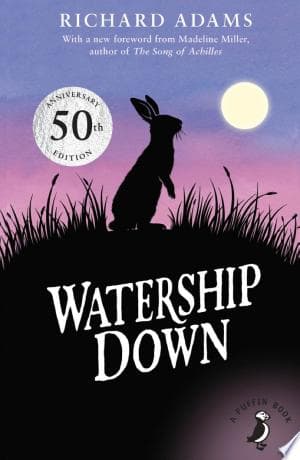
- Watership Down
Richard Adams
4.1 (434k) average on GoodreadsFantasyFeatures a detailed society of animals and their perilous journey for survival.
- The Swarm
Frank Schätzing
4.1 (16k) average on GoodreadsThrillerInvolves a global threat from a non-human intelligence, though on a larger scale.
- The War of the Worlds
H.G. Wells
3.8 (245k) average on GoodreadsFantasyWhile both novels explore alien encounters, Werber's 'Empire of the Ants' focuses on an indigenous species, challenging human assumptions about intelligence within our own world, whereas Wells depicts extraterrestrial invaders. Werber forces a more direct, internal confrontation with human exceptionalism.
- Dune
Frank Herbert
4.2 (766k) average on GoodreadsFantasyBoth 'Empire of the Ants' and 'Dune' present complex ecosystems and unique forms of life. However, Werber's work directly places human and insect civilizations on an equal, if often antagonistic, footing, exploring their potential for communication and conflict, rather than focusing on human interaction with a unique alien fauna within a grand political narrative.
- Harry Potter and the Sorcerer's Stone
J.K. Rowling
4.5 (7M) average on GoodreadsFantasyRescued from a miserable life under the stairs, an orphaned boy discovers he's a wizard destined for a magical school, where he uncovers a dangerous secret tied to the dark wizard who murdered his parents.
- The Hunger Games
Suzanne Collins
4.3 (6.4M) average on GoodreadsFantasyIn a future where children fight to the death on live television, Katniss Everdeen volunteers for the arena, turning a death sentence into a fight for survival and a spark of rebellion.




Enjoyed the summary?
A summary gives you the shape of the book. The book itself has the detail, the examples and the voice.
Find Empire of the Ants on AmazonAs an Amazon Associate, BookBrief earns from qualifying purchases. How we're funded